




Abstract
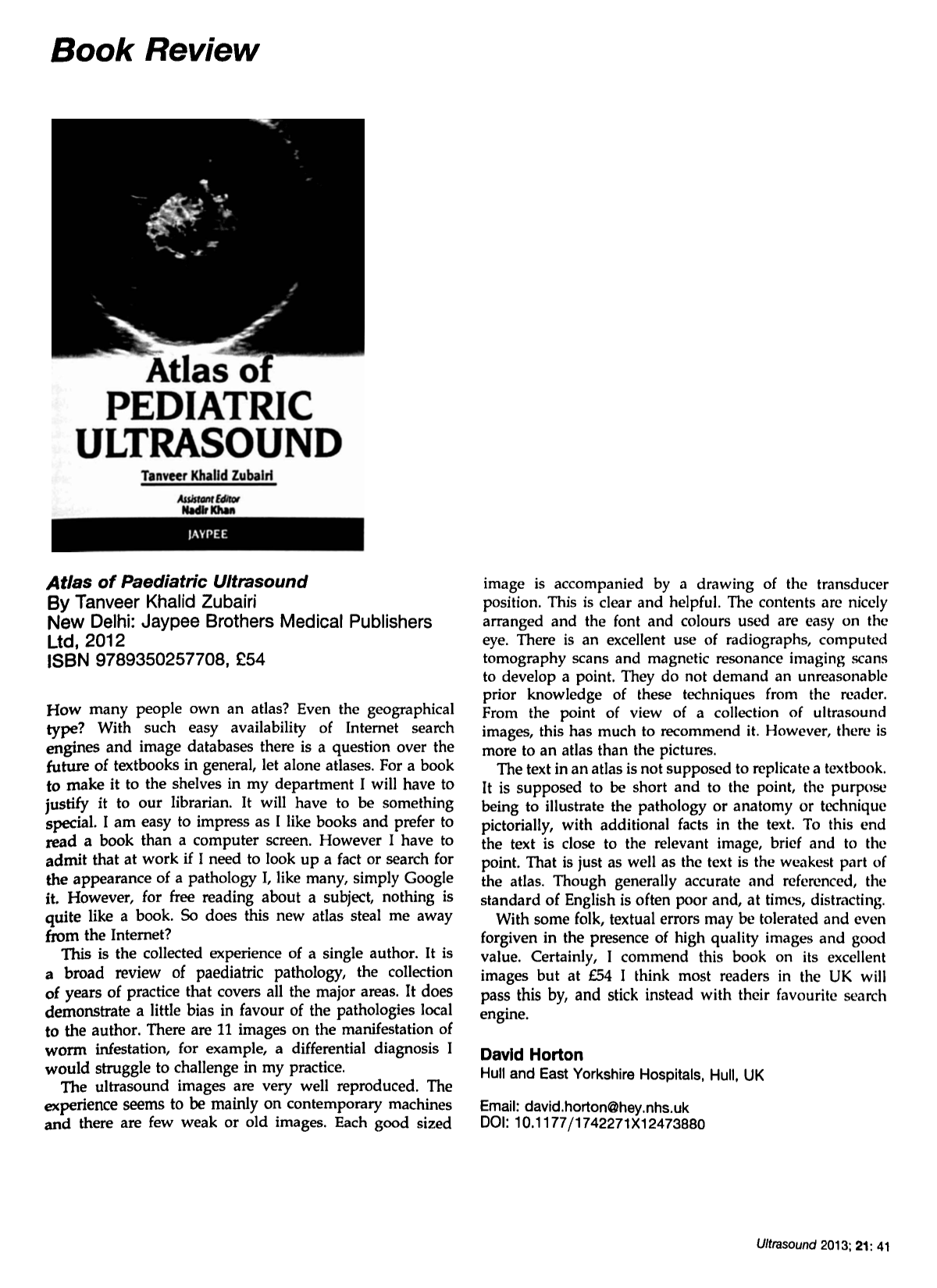
How many people own an atlas? Even the geographical type? With such easy availability of Internet search engines and image databases there is a question over the future of textbooks in general, let alone atlases. For a book to make it to the shelves in my department I will have to justify it to our librarian. It will have to be something special. I am easy to impress as I like books and prefer to read a book than a computer screen. However I have to admit that at work if I need to look up a fact or search for the appearance of a pathology I, like many, simply Google it. However, for free reading about a subject, nothing is quite like a book. So does this new atlas steal me away from the Internet?
This is the collected experience of a single author. It is a broad review of paediatric pathology, the collection of years of practice that covers all the major areas. It does demonstrate a little bias in favour of the pathologies local to the author. There are 11 images on the manifestation of worm infestation, for example, a differential diagnosis I would struggle to challenge in my practice.
The ultrasound images are very well reproduced. The experience seems to be mainly on contemporary machines and there are few weak or old images. Each good sized image is accompanied by a drawing of the transducer position. This is clear and helpful. The contents are nicely arranged and the font and colours used are easy on the eye. There is an excellent use of radiographs, computed tomography scans and magnetic resonance imaging scans to develop a point. They do not demand an unreasonable prior knowledge of these techniques from the reader. From the point of view of a collection of ultrasound images, this has much to recommend it. However, there is more to an atlas than the pictures.
The text in an atlas is not supposed to replicate a textbook. It is supposed to be short and to the point, the purpose being to illustrate the pathology or anatomy or technique pictorially, with additional facts in the text. To this end the text is close to the relevant image, brief and to the point. That is just as well as the text is the weakest part of the atlas. Though generally accurate and referenced, the standard of English is often poor and, at times, distracting.
With some folk, textual errors may be tolerated and even forgiven in the presence of high quality images and good value. Certainly, I commend this book on its excellent images but at £54 I think most readers in the UK will pass this by, and stick instead with their favourite search engine.