




Abstract
The ‘standard of care’ for chromosome testing has recently changed. For the last 30 years it has involved chromosome testing using microscope analysis. New technology using ‘DNA chips’, i.e. molecular karyotyping or microarray has now become available and is routinely offered to pregnant women undergoing invasive testing for an ultrasound detected fetal abnormality.
Women who choose to take advantage of this technology undergo extensive counselling in a multidisciplinary setting regarding the possible implications of an abnormal result. They are advised that there are some molecular changes which are known to be harmless and will not be reported. They are also counselled that some molecular changes will be reported but their clinical significance is uncertain.
This article reviews the current evidence-based role of molecular karyotyping in routine clinical practice in the setting of ultrasound detected fetal abnormality.
Molecular karyotyping
Metaphase karyotyping (profiling of chromosomes obtained during cell division) has been the gold standard for prenatal cytogenetic analysis and is able to detect whole chromosome aneuploidy (abnormal number of chromosomes) as well as deletions, duplications and other chromosomal re-arrangements that are 5–10 megabases (Mb) in size or larger. 1
Microarray or molecular karyotyping is a novel technology using ‘DNA chips’. A high resolution microarray detects changes in the chromosomes about 1000 times smaller than a conventional karyotype (10–20 kb). This is about the size of a gene. It is equivalent to having a more powerful microscope to perform the analysis.
Microarray technology can detect very small changes in the chromosome known as copy number variations or alterations (CNV). CNV are changes, deletions or duplications of DNA of more than 1000 bases. Some small CNVs are benign, some are disease causing, and yet others are of unknown significance.
There are three basic microarray platforms for detecting chromosomal anomalies: bacterial artificial chromosome (BAC) arrays, oligonucleotide arrays and single nucleotide polymorphism (SNP) arrays. Microarrays can also be classified as targeted arrays or whole genomic arrays. Targeted arrays ‘target’ known microdeletion/microduplication syndromes. Whole genomic arrays cover the entire genome at varying levels of resolution.
The microarray has its origins in the FISH (Fluorescent in situ hybridization) test. The microarray, like FISH, does not require dividing cells (it can be done in interphase of the cell cycle). The conventional banded karyotype requires cultured cells in metaphase. This improves the turnover time for the results of a microarray (1 week compared with 2 weeks for banded karyotype and has potentially more yield in a postmortem sample). As the detection of changes in the DNA content of the sample is the basis of microarray technology, balanced inversions or translocations are difficult to pick up (Table 1). 2
Advantages and disadvantages of microarray karyotyping
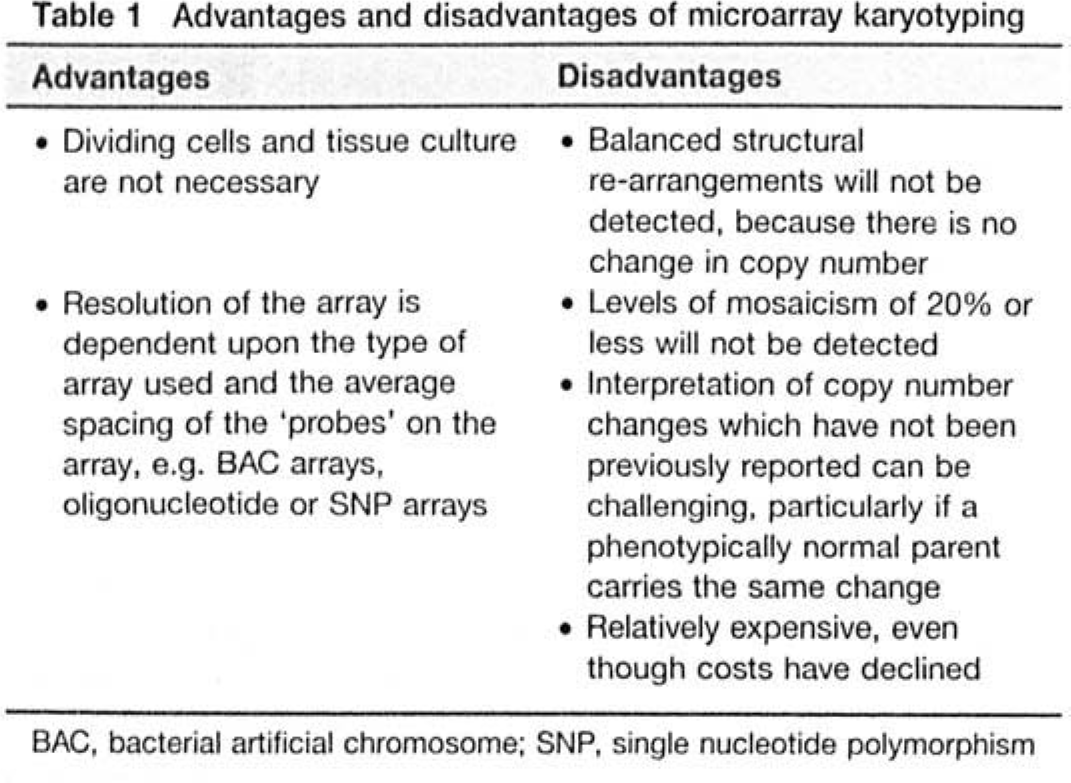
BAC, bactorial artificial chromosome; SNP. single nucleotide polymorphism
Most laboratories now use SNP arrays. SNP is the substitution of one base for another and is the most common form of DNA variation. It is seen in a population with a frequency of more than 1% but is not necessarily pathological. On average, SNPs are observed every 200–300 bases. SNPs can confer phenotypic variation in one of several ways as described in Table 2.
Causes of phenotypic variation with SNP

SNP, single nucleotide polymorphism
It can be of clinical significance if the inherited genes are entirely from a single parent (UPD: uniparental disomy) or, where the parents are themselves related, the inherited genes from each are not different, known as long continuous stretches of homozygosity (LCSH), suggestive of consanguinity or an autosomal recessive disease.3-8
Clinical applications
Microarray or molecular karyotyping is now an established part of routine postnatal diagnostic evaluation. In postnatal patients (children and adults) with a diagnosis of unexplained neuro-developmental disability, the positive diagnostic yield of microarray has been reported to be 10% higher than that of standard karyotyping. 9
Several prospective studies have demonstrated the utility of microarrays in prenatal testing for detecting such alterations. However, the detection rates of clinically significant alterations or variations in the chromosomes is different among the various published studies because of the difference in the clinical indications, probe design, resolutions and inclusion or exclusion of benign changes as a genomic imbalance.2-8, 10-25
A systematic review and meta-analysis comparing molecular and conventional karyotyping has recently been published by Hillman et al. 19 These authors found that the detection rate of chromosomal imbalances by microarray, when karyotyping is normal and chromosomal testing is performed for an abnormal ultrasound scan, varies between 2–22% in various studies, finding potentially pathological CNVs in 5–8.5% of cases.20, 22-25
The literature suggests that microarray improves the detection rate of a chromosomal abnormality in fetuses affected with an ultrasound detected anomaly. In addition, it has unquestionable value in cases where this is an inherited change which might affect subsequent pregnancies. Preimplantation genetic diagnosis, early and a tertiary level ultrasound, along with invasive testing are a few possible interventions in the future to improve pregnancy management and outcome.
The American College of Obstetricians and Gynaecologists (ACOG), Genetics Committee of the Society of Obstetricians and Gynaecologists of Canada (SOGC) and the Prenatal Diagnosis Committee of the Canadian College of Medical Geneticists (CCMG) in its recommendation, have considered it appropriate to offer microarray in ultra-sound/MRI detected fetal abnormalities.26, 27
The yield of microarray is improving, probably because the resolution of arrays used has increased with time and larger cohorts are providing a more accurate estimate.
In our department, we request FISH and Karyotype or FISH and microarray, depending on the clinical scenario and patient's choice. Abnormal results of first or second trimester aneuploidy screening prompt us to send the diagnostic sample for FISH and Karyotype. In cases, where there are abnormal ultrasound (US) findings, not suggestive of a particular aneuploidy, we advise FISH and Microarray.
FISH results usually countercheck our assumptions and in cases where there is an aneuploidy, our laboratory does not go ahead with the microarray, thus saving time and money. This has led to improved diagnosis, personalized treatment and more rapid and definitive genetic testing.
The above mentioned protocol is followed keeping in mind that there is no legal limit for the gestational age at termination in our state. In cases where the parents indicate their wish for further (invasive) testing, we offer them microarray for an ultrasound detected abnormality. Should the parents decide to continue with the pregnancy, prenatal versus postnatal testing is discussed. Unless there is a strong reason to detect chromosomal abnormality prenatally (e.g. active resuscitation at birth or palliation, decision to deliver and mode of delivery based on fetal grounds), usually a postnatal microarray testing is favoured. 9
Microarrays are a major leap in the area of prenatal genetic diagnosis but the analysis of the data and interpretation in a clinical setting still remains a challenge.28, 29
When LCSH is identified, involvement of 5–10% of the genome is suggestive of consanguinity and involvement in excess of 25% of the genome usually indicates an parental incestuous relationship. This again has a potential for uncovering high-risk ethical situations. These cases indicate genetic counselling for prediction of similar problems in future pregnancies.
CNV with uncertain clinical significance are present in approximately 1–12% of cases tested using microarray.2-10, 20-25, 30 Types of uncertain results include novel, not reported previously, reported as risk factors, e.g. for autism/intellectual disability or risk factors for adult disorders, e.g. for cancer.
When an uncertain result is detected, there are ethical considerations such as what constitutes an ‘informed choice’, how much information should be given to a woman and if withholding information is justifiable. 31
In cases where the uncertain result has not been relayed to the parents and later on a child is born with or later diagnosed with a condition or syndrome (e.g. Developmental Delay), parents could feel they have been deceived and feel they would have chosen termination had they been informed of the information prenatally.
On the contrary, possible long-term risks of disclosing uncertain results, may negatively affect the child, e.g. a healthy child being regarded as sick who does not get to enjoy a healthy childhood before the subsequent late onset of an adult condition. Like many other chronic illnesses, uncertain microarray results could be stigmatizing. There might be certain social taboos attached to these results which can in turn lead to a range of negative reactions and stereotypes about physical, mental or emotional competence.
On the other hand, if parents choose to have a termination of pregnancy which ends in severe obstetric complications denying future pregnancy, the parents will feel betrayed, and possibly unnecessarily punished. This can lead to increased medicolegal liability.
This emphasizes the importance of offering the test in the presence of strong clinical indication at this stage, pending results of larger studies and research to assess patient satisfaction and tolerance for uncertainty.
We believe the role of prenatal diagnosis is to give women informed choice. In a settling of a known ultrasound detected abnormality, usually the decision is based on the ultrasound findings and not on the results of micro-array alone.32, 33
Suggested protocol for development of local clinical practice
A multidisciplinary team, including the fetal medicine specialists, sonologists, obstetricians, paediatricians and social workers, collaborate with Genetics Services to put forward an evidence-based guideline to implement high-resolution microarray into clinical practice. The stakeholders should work together to address the development, implementation, monitoring and evaluation of the project in their setting.
Written, informed and signed consent for testing and summarizing the information is taken for all cases. Pregnant patients are consented to a high-resolution micro-array for prenatal invasive fetal sampling for ultrasound detected fetal abnormality.
They are initially offered a session of pretest genetic counselling. The nature of the fetal anomaly(ies) and the methods of sampling and analysis are outlined in this session. Pretest counselling covers areas such as potentially improved diagnostic yield, timing of results, cost, possibility of parental testing and uncertainties raised by the results.
The parents are made aware of the fact that not all findings are of well-defined clinical significance and sometimes additional testing is recommended. The parents are advised to donate a blood sample to detect if the abnormality found in fetal DNA is de novo or inherited from a healthy parent.
Post-test genetic counselling is arranged in all cases when a genetic alteration is detected.
Sample collection and handling
The nature of the collected fetal samples mostly depends on the gestational age at sampling (amniocentesis/chorionic villus sampling) or immediately before feticide (fetal blood).
Cell culture and DNA extraction
All amniotic fluid and chorionic villus samples are cultured using standard techniques and are prepared for G-band karyotyping according to the laboratory protocols. DNA is isolated directly from 5–10 mL of amniotic fluid, 1–5 mg of chorionic villus or fetal blood samples.
Interpretation of Results
A priori definitions for reporting the results are summarized in Table 3. 34
Interpretation of Results (ASCQAP) 33
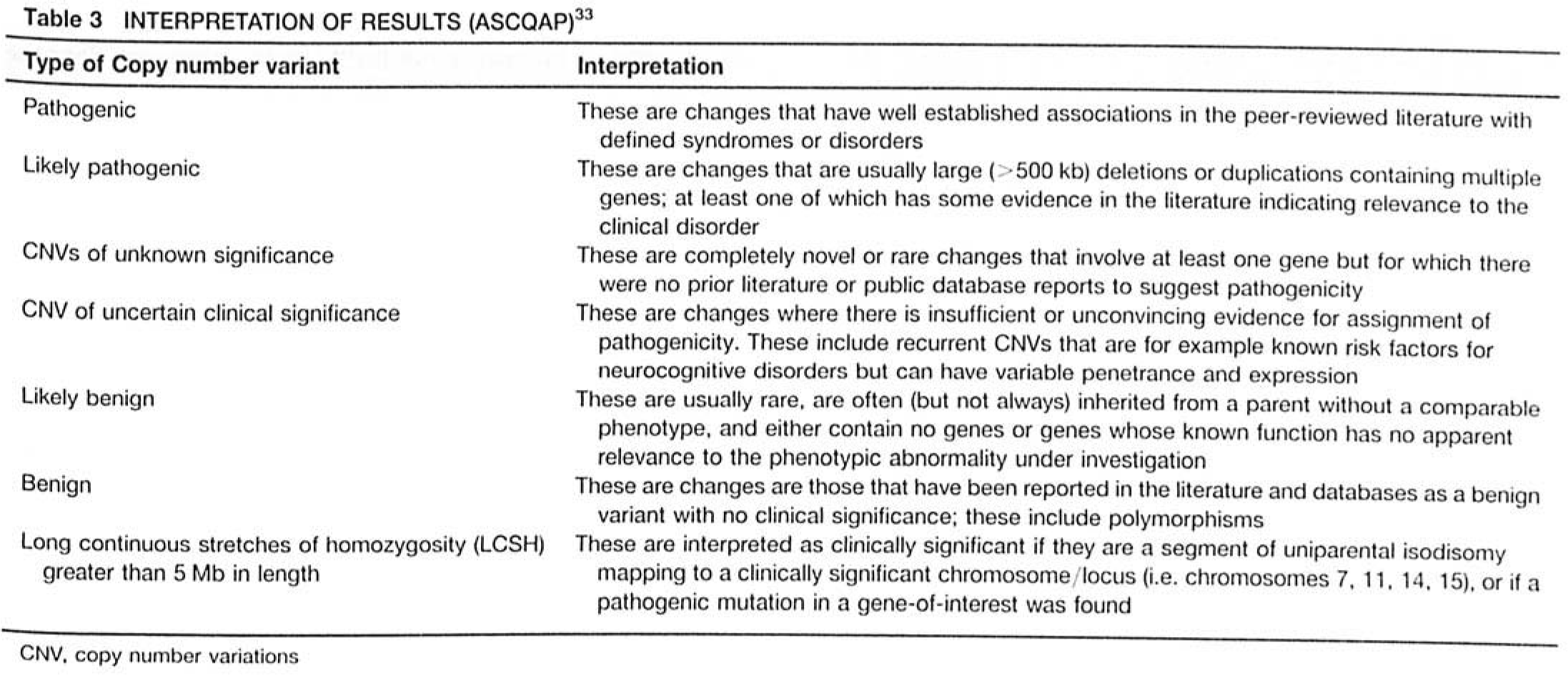
CNV, copy number variations
The possible laboratory results are:
No clinically significant CNVs;
CNVs of uncertain significance;
Pathological CNVs;
LCSH.
The CNV database used as a reference in our laboratory (VCGS) comprises the DGV (Database of genomic variants http://projects.tcag.ca/variation/), CHOP database (http://cnv.chop.edu/); DECIPHER (Database of chromosomal imbalance and phenotype in humans using ensemble resources https://decipher.sanger.ac.uk/), ISCA (The International Standards For Cytogenomic arrays Consortium https://www.iscaconsortium.org/) and internal unpublished database of VCGS (Victorian Clinical Genetics Services).
Conclusion
Review of current evidence recommends the use of micro-array in cases with prenatal ultrasound detected abnormalities, as they are associated with higher positive yield of abnormal CNVs. It is also recommended in cases with a known family history, but it is questionable at this stage in cases where the indication is advanced maternal age or parental anxiety.
Parental karyotyping is recommended to explain if the genomic imbalance is inherited. Inherited CNVs can re-assure the parents or bring on a cascade of testing on the affected parent or siblings. This might provide information that is useful for the health of the family, recurrence rate, an opportunity for early diagnostic testing in future pregnancies or PIGD (preimplantation genetic diagnosis).
Therefore, pre and post-test counselling is mandatory to ensure that families understand the information strengths and limitations of microarray analysis and make a fully informed decision. The need to offer this test in a context of a multidisciplinary setting cannot be over-emphasized.29, 32 Meanwhile, clinicians should follow robust clinical practice guidelines, strict criteria to offer the test and follow up their practice with a judicious audit.
Declarations
Footnotes
Acknowledgements
None