




Abstract
We report a case of an 8-year-old boy who underwent an ultrasound for investigation of a left upper quadrant mass and who was subsequently diagnosed with gastrointestinal stromal tumour of his stomach. Abdominal ultrasound showed a large cystic mass in the left upper abdomen which was further characterised by magnetic resonance imaging. At laparotomy, a large cystic lesion was excised from his stomach, which was confirmed at histology to be a gastrointestinal stromal tumour. We briefly discuss the presentation and imaging findings of paediatric gastrointestinal stromal tumour and how it differs from the adult form of the disease and treatments.
Introduction
Gastrointestinal stromal tumour (GIST) is a rare tumour of mesenchymal origin affecting the gastrointestinal (GI) tract. It most commonly affects adults over 40 years and cases of paediatric GIST, with patients under 18 years, account for just 1–2%. 1 They commonly are located in the stomach but can occur anywhere else in the GI tract or less commonly in the mesentery or peritoneum. 2 These tumours are derived from the cells of Cajal, the pacemaker cells of the bowel, and arise in the muscularis propria. The biology of the tumour in children differs from that in adults, with the tumours less likely to have a mutation in a growth receptor called KIT. We report a case of GIST in an 8-year-old boy, which was initially identified at transabdominal ultrasound.
Case Report
An 8-year-old boy presented to his general practitioner with a short history of fatigue after a viral illness. Examination revealed a left upper quadrant mass presumed to be an enlarged spleen. The boy was referred for an urgent transabdominal ultrasound to investigate the possible splenomegaly.
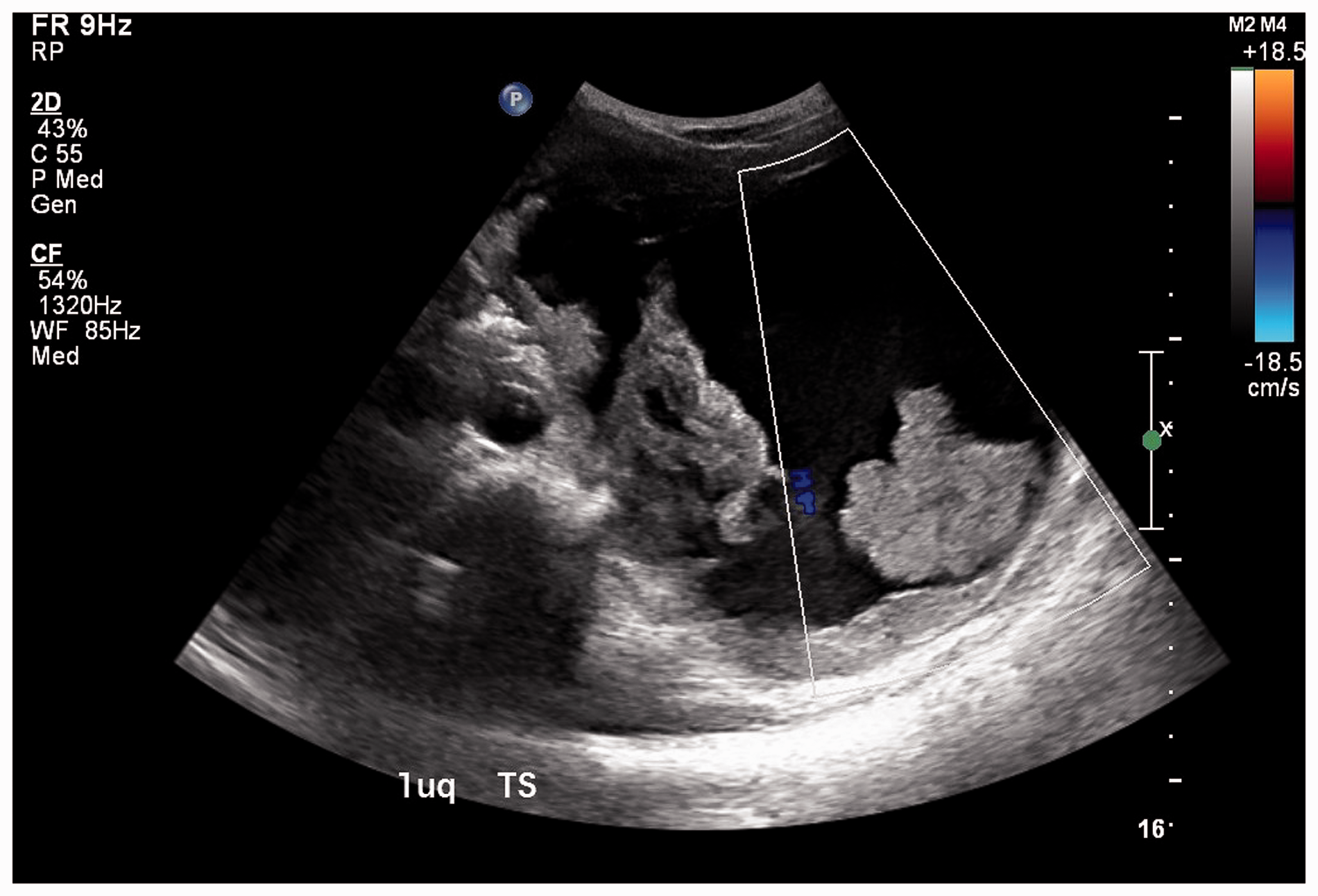
Abdominal ultrasound revealed not an enlarged spleen but a 15 cm × 12 cm complex, cystic lesion in the left upper quadrant (Figures 1 and 2). The mass was separate from the left kidney and spleen, and it contained internal solid components, which had no vascularity on Doppler ultrasound (Figure 3). The organ of origin could not be confidently identified. To further characterise the lesion, the boy went on to have magnetic resonance imaging (MRI) of his abdomen (Figures 4 and 5). This confirmed the presence of the cystic left upper quadrant mass which contained some solid areas as well as areas of haemorrhage. The mass displaced the surrounding structures such as the left kidney and left adrenal gland, which it compressed rather than invaded. There were no additional masses within the abdominal cavity and no intra-abdominal lymphadenopathy.
Ultrasound in the midline of the upper abdomen demonstrating the relationship between left upper quadrant GIST and the liver. Ultrasound showing a well-defined, large lesion displacing the normal anatomy with a central anechoic cystic region and mixed echogenicity solid components. Colour Doppler ultrasound of the GIST showing no vascularity within the solid components. Coronal T2-weighted MRI showing left upper quadrant GIST displacing the spleen inferiorly. Large areas within the tumour return high T2 signal, in keeping with cystic necrosis. Heterogeneous T2 signal within solid areas of tumour. Axial T2-weighted MRI showing relationship of the GIST with the liver.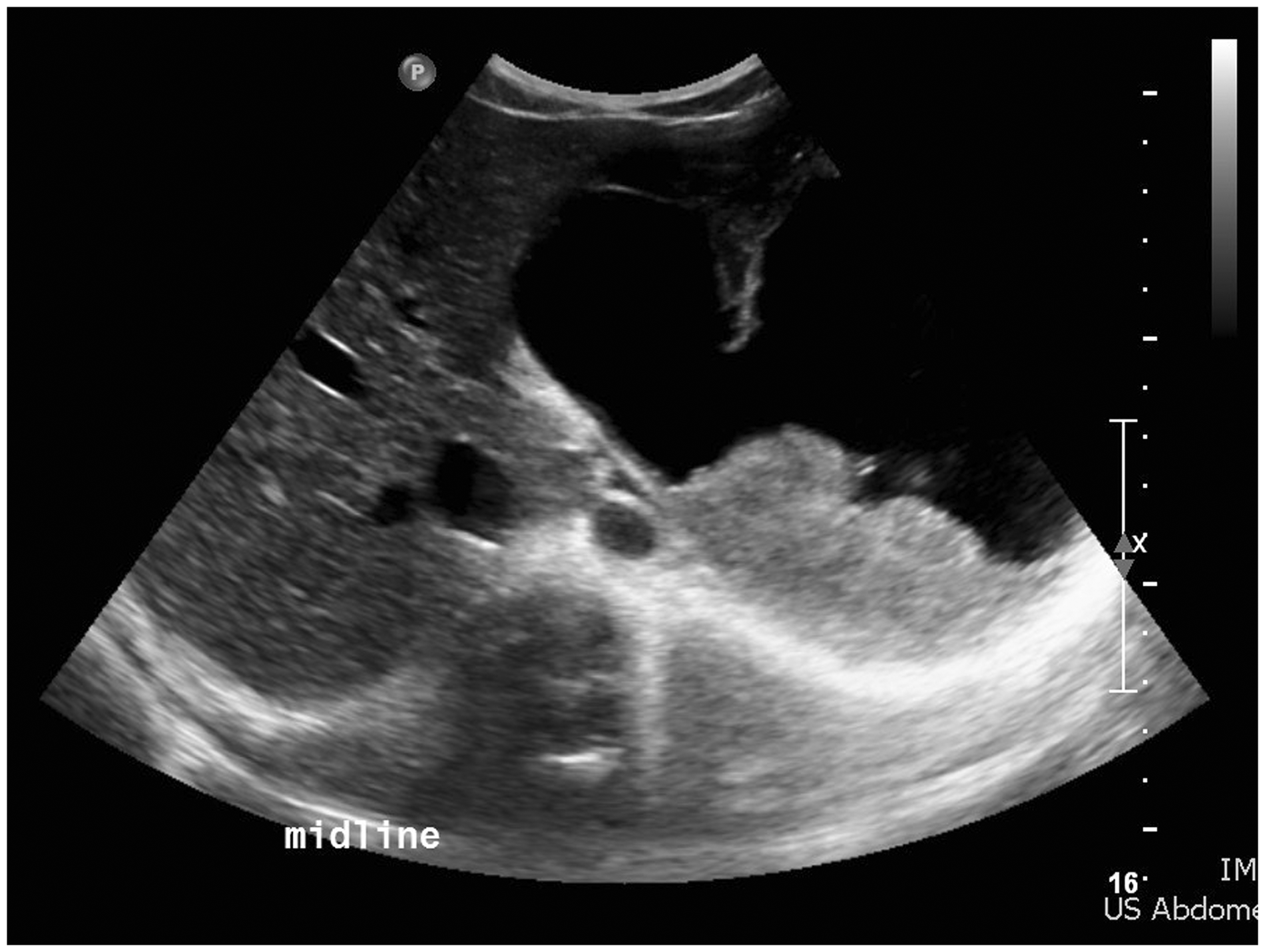



The boy was transferred to the regional tertiary referral centre for further management. On routine blood tests he was found to have a mild microcytic anaemia. A decision was made to excise the lesion and at laparotomy a large cystic lesion was dissected from the stomach. An adjacent lymph node from the lesser curve of the stomach was also sent for histology.
At histology, the tumour morphology and immunoprofile were consistent with a GI stromal tumour with a clear resection margin. Genetic testing revealed that the tumour was wild-type with no KIT mutation. The boy had an uneventful post-operative course and was discharged four days later. He underwent completion of staging imaging with computed tomography (CT) of the chest, which was normal. Further discussion with the boy’s parents revealed no significant family history and no symptoms to suggest one of the tumour syndromes associated with paediatric GIST. As the lesion had been excised completely and the lymph node showed no spread, no further initial treatment was necessary. After discussion with a paediatric oncologist with a special interest in GIST, a follow-up plan was determined. At 12 months of clinical and radiological follow-up, there was no evidence of recurrence.
Discussion
GIST is the commonest mesenchymal tumour of the GI tract. It is usually a disease of adults with the majority of cases occurring between 55 and 65 years of age. 3 Cases of paediatric GIST are much more rare; patients under 18 years of age account for just 1–2% of all cases. 1 The median age at presentation for paediatric GIST has been found to be 13 years of age and it occurs more frequently in girls with a preponderance of over 2:1. 4 Due to its rarity, an accurate incidence is difficult to determine. The UK National Registry of Childhood Tumours has shown an annual incidence of 0.02 per million children under 14 years old. 5
The majority of GISTs are of the sporadic variety although there is also an autosomal dominant familial form which occurs mainly in boys. 6 There are also a number of associations with a range of tumour syndromes, such as neurofibromatosis type 1, Carney’s triad (pulmonary chondroma, extra-adrenal paraganglioma and GIST) and Carney-Stratakis syndrome (GIST and extra-adrenal paraganglioma).
The clinical presentation of the majority of paediatric patients with GIST relates to symptoms of anaemia, secondary to chronic GI blood loss, such as pallor or fatigue. 1 Less frequently, they will present with abdominal symptoms such as anorexia, abdominal discomfort or distension, nausea or vomiting. Due to their submucosal location, they do not frequently cause bowel obstruction. A small number of cases present with a palpable mass, as was discovered in our case. Small asymptomatic GIST may be discovered incidentally on investigation of other symptoms. Paediatric GIST can affect anywhere in the GI tract, but the commonest location is in the stomach. 4 Other locations, in order of decreasing frequency, include the small bowel, colon/rectum, oesophagus, omentum and abdominal wall.
Initial investigations will be guided by the presenting symptoms and anaemia may prompt endoscopy of the GI tract prior to imaging. No abnormality may be seen as the majority of GIST are submucosal, although a bleeding point may be seen if the tumour has ulcerated into the bowel lumen. More recently, endoscopic ultrasound is playing an increasing role in diagnosis and characterisation of small, incidental GIST.
Imaging features do not vary greatly between adults and children. Ultrasound is often the initial radiological investigation in children where there is a desire to avoid radiation. At ultrasound, the tumour appearance depends on its size. The smaller the tumour, the more likely it will appear as a small homogenous solid mass. 7 As it enlarges, the tumour becomes predisposed to necrosis and haemorrhage as it outgrows its blood supply. Larger tumours appear heterogeneous with hypoechoic areas internally or may have become cystic. When the tumours become very large, it becomes difficult to discern the organ of origin on ultrasound as surrounding structures are displaced. 8
Cross-sectional imaging forms the mainstay of diagnosis and follow-up, most commonly CT. As with ultrasound, size determines the appearance of GIST on CT; smaller tumours are solid lesions of homogenous density and enhancement. As they enlarge, they become increasingly heterogeneous. If the tumour has fistulated into the bowel lumen, then an air-fluid level may be present within. CT also demonstrates multifocal lesions or metastases. MRI is a radiation-free alternative imaging modality, used particularly in children. Features of GIST on MRI are quite variable though, with signal determined by the amounts of haemorrhage and necrosis present.
The mainstay of management for GIST is surgical, with the aim being excision of the tumour with clear resection margins. Lymph node involvement is more common in paediatric GIST compared to adult cases. As such, patients may undergo lymph node sampling or dissection in addition to excision of the primary tumour. Patients will often undergo resection of any metastases at the same time. Conventional cytotoxic chemotherapy is not recommended in adult or paediatric GIST, as it has not been shown to provide any survival benefit. Tyrosine kinase inhibitors, such as Imatinib, are effective treatments in metastatic adult GIST. Due to the absence of the tyrosine kinase mutation in most paediatric GIST, these therapies are thought to be ineffective in children. There is ongoing work looking at their use in inoperable cases, and there is some early evidence that they are beneficial but the mechanism is not entirely understood.
Prediction of prognosis in adults with GIST is determined by the tumour size and location as well as the mitotic index, but this does not seem to hold true in children with the disease. Many children are cured by surgery alone despite tumour size and even if they develop recurrent disease or metastases, they may live with this for years. The most common sites for metastasis are the liver, lymph nodes and peritoneum. In children, GIST seems to run a more indolent course when compared to adults.1,9
In conclusion, this case highlights a rare but important diagnosis that may be detected at ultrasound, especially in children being investigated for anaemia.
Footnotes
Declaration of Conflicting Interests
The author(s) declared no potential conflicts of interest with respect to the research, authorship, and/or publication of this article.
Funding
The author(s) received no financial support for the research, authorship, and/or publication of this article.
Ethical approval
Written consent was obtained from the guardians of the patient to publish the images and details of the case.
Guarantor
JC
Contributorship
JC researched the literature, acquired the images and wrote the manuscript.