




Abstract
Pilomatrixomas are benign tumours of primitive hair follicles, usually presenting as painless lumps in the head and neck region in children. As they are uncommon, they are often misdiagnosed clinically. We discuss a case of a five-year-old boy presenting with a five-month history of a pre-auricular lump. The initial clinical differential diagnosis was of a dermoid or a branchial cleft cyst. However, on ultrasonography the lesion was typical of a pilomatrixoma. The imaging literature is reviewed to illustrate the sonographic appearances of pilomatrixomas.
Clinical history and examination
A five-year-old boy presented with a five-month history of a painless right pre-auricular lump. He was otherwise well. On examination, the lesion measured 25 mm ×– –>15 mm. The lump was firm and mobile, had an irregular surface and demonstrated no skin tethering or discolouration. There was no associated lymphadenopathy. The boy was referred for ultrasound examination.
Ultrasound
On ultrasonography, a well-defined, oval-shaped subcutaneous lesion was seen in the right pre-auricular region (Figure 1). It contained focal hyperechoic areas and was associated with posterior acoustic shadowing. A hypoechoic rim surrounded the lesion. Colour flow Doppler was negative.
Ultrasound image demonstrating an oval shaped, subcutaneous lesion within the right pre-auricular region. There are focal hyperechoic areas with posterior acoustic shadowing in addition to a hypoechoic rim. The colour flow Doppler is negative. Appearances are in keeping with a pilomatrixoma.
Management
Surgical excision was advised and the patient was referred to an ENT surgeon.
Discussion
Pilomatrixomas are rare, slow-growing, benign tumours which originate from primitive germ cells on their way to becoming hair matrix cells. They account for 0.001%–1% of skin lumps.1–4 The incidence is highest in the paediatric population, with a slight female preponderance.2–7 Common sites include the head, neck and the extremities. The average size of lesions is 10 mm to 15 mm. Clinical examination typically demonstrates a solitary, firm lump with an irregular surface, and no skin tethering. A red/blue discolouration of the overlying skin is also a potential clinical feature.1,3,4,6–8
Lesions are typically seen to arise from the dermis and can extend into the subcutaneous tissue. As mentioned, the proposed histogenesis is that pilomatrixoma originate from early hair matrix cells. Histologically, they contain basophilic cells and shadow cells, the transition zone between the two may be abrupt or gradual. Furthermore, dystrophic calcification is a common feature. Ossification and foreign body (giant cell) reaction can also be observed.1–3,7–9
Pilomatrixoma is an important diagnosis to be aware of, as it is often misdiagnosed clinically as a epidermal cyst, dermoid cyst or calcified lymph node.4–6,9 In studies by Kwon et al. and Pirouzmanesh et al., pre-operative clinical diagnosis was accurate in 28.9% and 38% respectively.4,5 A systematic review by Schwarz et al. concluded that the clinical diagnosis was accurate in only 43% of patients. 7
Ultrasonography is useful as a quick, non-invasive test which can differentiate between pilomatrixoma and other, more common, differential diagnoses. 7 Sonographic features reported in the literature may be classified into two main (typical) patterns, and less common (atypical) patterns. The first typical pattern consists of a well-defined subcutaneous nodule which is hypoechoic, contains internal echogenic foci (calcification) and may exhibit a peripheral hypoechoic rim, corresponding to a connective tissue capsule. The second common sonographic pattern is of a heavily calcified lesion with a larger posterior acoustic shadow. Rarer, atypical appearances with complex, pseudocystic or pseudotumoral patterns have been noted: lesions may also demonstrate varying levels of vascularisation, these are potentially more difficult to accurately diagnose at ultrasound.6,8,9 In a study by Solivetti et al., accurate diagnosis of pilomatrixoma was shown to depend on the sonographic appearance, with 100% of typical pilomatrixoma being diagnosed correctly, while only 69% of atypical pilomatrixoma were correctly diagnosed. 8
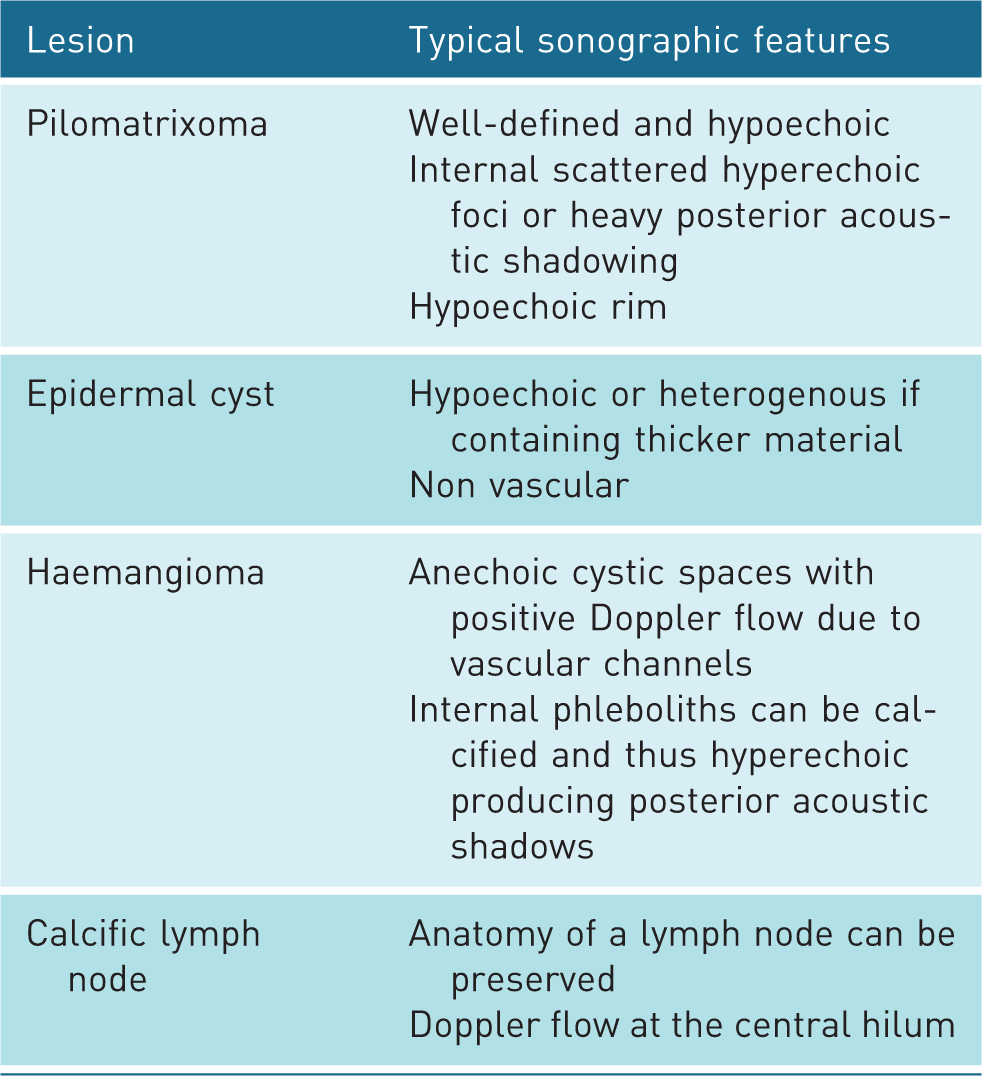
Of interest, fine needle aspiration cytology may be of limited use in the management of pilomatrixoma. Although suggested as part of the diagnostic algorithm in Schwarz et al., we feel this adds an unnecessary, invasive step in the management of pilomatrixoma in paediatric patients. 7 Surgical excision is usually definitive and diagnostic, and while occurrences of tumour recurrence have been reported, they are thought to be exceedingly rare.5,7
Conclusion
We present a case of pilomatrixoma in a child. As pilomatrixoma should be considered in the differential diagnosis of every small, slow-growing lump in the head and neck region or extremities in children, we present a review of ultrasonographic descriptions of pilomatrixomas in the current imaging literature.
Footnotes
Declaration of Conflicting Interests
The author(s) declared no potential conflicts of interest with respect to the research, authorship, and/or publication of this article.
Funding
The author(s) received no financial support for the research, authorship, and/or publication of this article.
Ethics Approval
Written consent was taken from the subject's legal guardian for the publication of this case report.
Guarantor
Mert Sirakaya.
Contributors
Mert Sirakaya and Sanjay Vydianath.
Acknowledgments
None.