




Abstract
Background
Previous studies suggest there is a need to improve the delivery of bad and challenging news in obstetric ultrasound settings. However, no research has explored the experiences of trainee sonographers when learning how to deliver challenging news. Understanding this could identify gaps in current provision and inform future training interventions.
Aims
To explore the experiences of trainee sonographers when learning how to deliver challenging news.
Methods
Semi-structured interviews were conducted with trainee sonographers (n = 7) from four training centres to explore their experiences and preferences for news delivery training.
Results
Learning how to deliver difficult news was a journey where trainees developed their confidence over time. Most learning occurred in clinical settings, but classroom teaching complemented this. Trainees appreciated the opportunity to observe clinical practice and to hear from patient representatives. However, quality of teaching varied between centres and trainees reported uncertainty regarding the specific language and behaviours they should use. They described building their own personal protocol for news delivery through the course of their training.
Discussion
An ultrasound-specific news delivery protocol which details the words and behaviours sonographers can employ could help reduce uncertainty in trainees. Trainees may also benefit from receiving structured feedback on their news delivery performance.
Background
Around 15% of pregnancies result in miscarriage or stillbirth and in 2–5% an anomaly is found which could indicate foetal disability.1–4 Ultrasound is often used to identify or confirm these complications, but the way this initial news is delivered to expectant parents varies internationally. In the UK, the sonographer conducting the scan routinely communicates difficult news during the appointment. 5 In other countries such as Australia and the US, sonographers may communicate this news or may instead refer expectant parents to their doctor to find out the results of their scan, depending on the practices of the organisation they work in. 6 Studies suggest that immediate disclosure by sonographers is preferred by expectant parents, but news delivery skills vary between practitioners; some expectant parents describe better experiences than others and poorer experiences are linked with higher parental stress levels.7–10 Healthcare professionals delivering news via ultrasound also report finding these situations stressful. Challenges in this setting include the subjective nature of ‘bad news’, the immediacy with which the news must be communicated and the difficulty of delivering news which is unclear.5,11–13
Several frameworks for delivering bad and difficult news have been proposed.14,15 The most widely used is the SPIKES, which outlines six steps for news delivery which together form the acronym: (1)
A small number of studies have explored the experiences of healthcare professionals in delivering difficult news via ultrasound scan,5,11–13 but there is a lack of research investigating experiences of news delivery training. The evidence which does exist suggests that qualified sonographers find post-qualification training beneficial, and that receiving this is linked with lower levels of one type of burnout (disengagement). 21 However, no studies have been conducted into the news delivery training experiences of trainee sonographers. In the UK, although qualified sonographers are expected to deliver difficult news as standard, there is no mandated training that trainee sonographers must receive and no required assessment that they must pass in this area. As such, it is unclear what experiences trainees have in learning how to break bad news, and whether there are variations between different training centres. Understanding how sonography trainees learn about best practice in news delivery and how they develop skills in this area could help to identify unmet training needs and inform the development and enhancement of news delivery training curriculums. In order to address this gap, the present study aimed to explore the lived experience of trainee sonographers' in learning how to deliver bad or challenging news.
Method
A qualitative study design was adopted to explore the experiences of trainee sonographers during their course. Ethical approval for this research was granted by the School of Psychology Research Ethics Committee at the University of Leeds, England (reference: 17-0153/22-May 2017).
Sample
Participants were recruited on a voluntary convenience basis. Eligibility criteria included participants that were studying a masters-level sonography or medical ultrasound training course based in the United Kingdom (UK) with accreditation from CASE. Recruitment involved directly contacting course leaders to circulate information via internal e-mail or virtual blackboards, and advertising the study via two social media platforms (Facebook and Twitter) and an online forum for UK-based students (The Student Room).
Procedure
Interview schedule.

In-depth semi-structured interviews were conducted via telephone by the authors (MH/PVK). Study information was sent in advance of the interview and verbal informed consent recorded directly prior to the interview. To ensure anonymity, pseudonyms were assigned to participants, consent and demographic data was recorded in separate digitals audio files and access was limited to members of the research team.
Analysis
Interviews were transcribed verbatim and analysed by a primary researcher (LT) using an inductive thematic analysis approach. 22 This involved reading and familiarisation with the interviews, to develop codes and themes. A subset of interviews (n = 3) was coded by a second researcher (JJ). The codes and themes were discussed to reach a consensus of opinion. The final set of themes represented the lived experiences of trainee sonographers who participated within the study.
Results
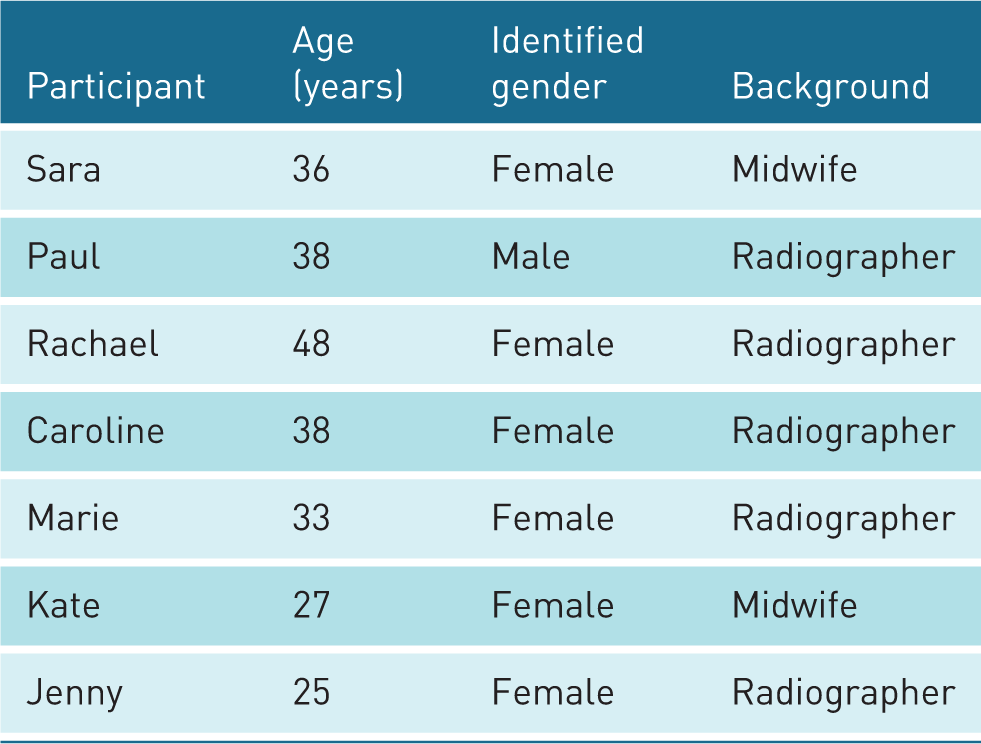
Key characteristic of study participants.
Themes and sub-themes.
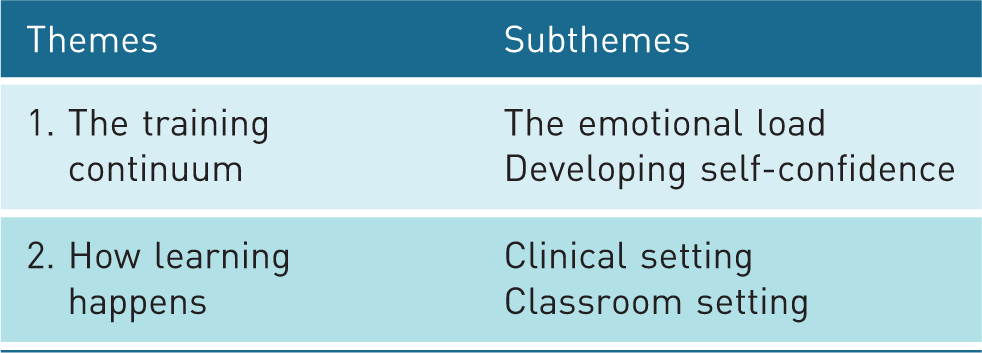
The training continuum
Trainees travelled along a journey from being the observer to the professional performing the scan. A high level of discomfort and anxiety associated with delivering difficult news appeared to be a consistent feature for the participants throughout the training course. As Kate poignantly summed: “...no amount of training will prepare you for the first time you tell someone the baby they thought they were carrying and going to give birth to, is actually not alive”.
The following subthemes, the emotional load and developing confidence, explored the psychological impact for the trainees and the way they built individual self-confidence strategies.
The emotional load
The trainees' accounts revealed the extent to which they found watching and delivering difficult news challenging. The reactions illustrated their desire not to cause any additional pain and their feelings of discomfort and awkwardness. Jenny described watching parents waiting for second opinions as ‘difficult’ and Kate commented on a specific scan that was ‘hard to watch’: The baby didn't have a heart beat and she had no idea, she, er, thought everything was okay … she hadn't brought her partner to the scan with her, because he couldn't get the time off work. So she was in a real state of shock because of that and then she had to go home and tell him the bad news herself … I know what these parents are thinking and feeling … they probably feel awful.
The trainees’ accounts also revealed the very welcomed and reassuring support received from the trained staff when presented with, as Sara described, the ‘really daunting’ prospect of delivering difficult news: “They had, I think a hand on my shoulder because obviously, I started the scan at the uterus and the uterus was empty” (Marie).
The non-verbal support provided in this scenario was significant; by placing a hand on the shoulder, the supervisor instantly recognised the issue and the conversation that was about to follow. Jenny also recognised the impact of breaking bad or challenging news on the qualified staff and how ‘stressful’ it could be. This was exemplified by trainees observing staff who were unsure what to say; Caroline commented that she had seen staff ‘struggling with their wording’.
Developing self-confidence
Over the training continuum, trainees talked about the way they built their self-confidence to deliver bad and challenging news. Some drew upon previous professional knowledge and experience; some also drew upon broader life experience. Sara said she ‘pulled’ on her previous experiences as she had ‘delivered a lot of bad news as a midwife’. Marie felt it was important to have gained life experience before starting her training so that her personal skills were ‘up to scratch’ as she was worried about having to deliver bad news: “… that's always the thing that put me off wanting to do ultrasound, was having to break bad news”.
Others preferred to develop confidence through the real-world experience of observing and having an opportunity to deliver bad news. The following extract from Paul highlighted the way he became more assured: I would really prefer to learn how to do [delivering bad news] from the clinical aspect of the training, from the people who are actually doing it so I can see them doing it and I can watch them how they cope with it and pick up on the phrases they use… I wouldn't be able to pick that up from a lecture or a book, I'd have to live it and watch it and that's the way that I've done it and that's given me loads of confidence now to be able to do it myself. … I asked her if she would like me to show her the baby…She said yes, so I showed her there's no heartbeat and explained it in a little more detail, very thoroughly, calmly and let her have enough time. We'd also got some pictures for her as well. … we go through the test questions at the beginning about bleeds … So she'd said [the patient] about having a bleed. Um, so I asked her how heavy was the bleed. So was it like, what colour was it, so kind of getting the thoughts in my head.
Thus, the reality of being newly qualified, being expected to deliver difficult news and feeling apprehensive appeared to be met with a level of acceptance that this was an inevitable part of being a sonographer.
How learning happens
This theme referred to the different ways the trainees learned how to deliver bad and challenging news. The subthemes included the clinical setting and classroom learning.
The clinical setting
The majority of learning was perceived to occur on clinical placements. Shadowing and buddying up with qualified sonographers were techniques used at the start of the training programme. There appeared to be a gradual transition so that towards the end of training, the trainees conducted the whole scanning process, including sharing results with patients. This was seen as a way to develop essential knowledge and skills in order to become an independent practitioner: So you're just literally a fly on the wall type taking it in and then later on in the training when its, the roles are swapped around and I'm the one conducting the examination and the sonographer is observing me then I've been expected to, communicate possible, er, significant findings to the patient as well. (Paul)
The need for reassurance and feedback on these occasions was vital with trainees anxious to know that they had said the right things and had shown the correct degree of empathy. What was apparent was the conflicting advice shared by qualified staff in terms of actually what to say: … we're encouraged to … introduce the idea that everything maybe isn't alright so, that maybe saying something along the lines of um, “I'm really sorry, I think you're going to have to prepare yourself for some bad news” or “I'm really sorry, I think I've found a problem. (Caroline) … one sonographer said to me that you should never say “sorry” to a patient. Um, because that makes, it might make them feel like they've done something wrong … but then most of the time when I'm with sonographers do break bad news, they, they often do say “sorry” and it kind of feels natural … (Jenny)
All participants commented on how well their qualified colleagues delivered challenging news. However, in one divergent account, Rachael described watching one sonographer insensitively deliver difficult news. She said she felt like she wanted to be ‘swallowed up’. Although she recognised the human factors that might have played a part in the qualified sonographer's behaviour, she did not feel empowered to intervene: … the sonographer … had scanned lots and lots of patients in the morning … and she wasn't expected to scan this patient. She took this lady in and [the patient] explained what had happened to her and the sonographer couldn't believe they hadn't scanned her at a different department, and more or less putting blame on this patient because she hadn't been scanned and then just said to her, “just get on the bed and we'll have a look”, and then immediately put the probe on, and there was nothing there, and then just said “there's nothing there to see, I need to do an internal'' … because I was a student … I felt out of control … (Rachael)
Classroom learning
Formal learning structure and content varied across different training providers. Some trainees received brief and self-guided learning sessions. There was no guidance for delivering news in ultrasound in particular. Marie indicated that the SPIKES protocol had been discussed in one classroom-based session and Kate described her brief academic experience as: … personally have only had three lectures … that have talked about how to deliver bad news. I wouldn't call it training to a certain extent, because, er, we were basically just told how not to do it … I don't feel like I've had that much experience really of knowing what's right or wrong [what to say] or advice really on how it's best done. (Jenny)
However, the value of listening to and talking to people that had delivered and received bad and difficult news was seen as an important aspect of the training. There were several ways this was managed, including watching YouTube video clips of parents who had gone through the experience, inviting women who had received difficult news to speak in lectures and representatives from charitable organisations. Caroline described her amazement when listening about the perspective of the patient: Well surprisingly, the lady that came in to speak to us from the Stillborn and Neonatal Deaths charity, they said that we should always use the words “died” … if you're vague and say things like “I'm very sorry, I can't find a heartbeat” … that that could be really confusing … but in practice, I see very few people doing that. … the best way to answer the question, ‘cause sometimes you break bad news and people are full of questions, and if you haven't got that knowledge, it's the right thing to say, isn't it? I think people hate role play, absolutely hate it with a vengeance. (Caroline) I have done a lot of role play in my old training, communicating with patients and break bad news, but I think it's something that should be done. (Rachael) We often have discussions … but there's no real sort of set framework or anything written down for any of this, this is all just the sonographers experiences that we're buddied with on the day. And they will impart their own experiences on us and you get different learning outcomes of each sonographer and then it's up to you to formulate your own way from that.
Discussion
The study used a qualitative approach to explore trainee sonographers’ experiences of learning how to deliver challenging news. Learning was a ‘continuum’; a journey which progressed from the start of training to qualifying. Through this journey, trainees carried an ‘emotional load’. They found news delivery situations stressful, as they empathised with the distress of the expectant parents and worried they could cause harm through their words or behaviours. They also had to develop their self-confidence in news delivery, which they did by drawing on previous experiences and practicing in clinical settings. Most of the trainees’ learning occurred in clinic and all trainees commented that they have observed good news delivery examples by their qualified colleagues. However, advice provided by qualified staff was sometimes conflicting and trainees described having little opportunity for reflection on news delivery events in clinic. Classroom learning experiences varied between training centres. Trainees appreciated talks from patient representatives and also welcomed peer discussion and support, but some trainees still felt ill-equipped to deliver challenging news towards the end of training. They understood the principles of news delivery but were uncertain in particular about the specific steps they should follow.
This is the first study to explore how trainee sonographers develop skills in delivering difficult news. A large number of studies have focused upon the experiences of expectant parents when receiving challenging news via ultrasound, which have indicated a need to improve news delivery practice.7,8,10,19,20 However, few have focused upon the experiences of the staff who deliver difficult news via ultrasound,5,11–13,21 and only one has explored sonographers' experiences of news delivery training in particular. 21 This found that sonographers felt training was effective for improving their news delivery skills and that having received news delivery training was linked with lower levels of disengagement, one form of burnout. Similar with participants in the present study, sonographers’ preferred training techniques included observing clinical practice, receiving teaching from patient representatives and group discussions. 21 Our present study extends this work by employing a qualitative approach, which allows for a much richer understanding of experience than can be provided using survey techniques. It also extends this paper by focusing on trainees rather than qualified sonographers. Our findings suggested that some elements of current training approaches are valued by trainees. However, we have also identified some gaps in provision, including a lack of specific guidance for sonography settings, receiving conflicting advice from qualified staff and a lack of feedback regarding news delivery performance.
Implications for policy and future research
Two main implications arise from these findings. First, they highlight the need for a news delivery protocol focused on ultrasound settings, which specifies the words and behaviours sonographers can use. Currently, the most widely used news delivery framework is the SPIKES. 15 However, this was developed for use by doctors in oncology settings and no studies have tested this in ultrasound settings with sonographers. 16 The SPIKES provides news delivery principles rather than specific steps sonographers can use, and as a result, each trainee in our study was tasked with developing their own personal protocol for bad news delivery through the course of training. This was challenging for trainees and left them feeling uncertain about the quality of their practice. An evidence-based, detailed and ultrasound-specific news delivery protocol could help address this uncertainty and reduce the burden of responsibility on individual sonographers.
Second, they highlight a strong need in trainees for advice and feedback from qualified staff regarding their news delivery practice. Most learning occurred on placement, but trainees commented that there was little formal opportunity for reflection or feedback on their news delivery performance. Training courses could capitalise on these experiences by introducing structured feedback opportunities for trainees; providing placement supervisors with feedback sheets that they can use to consider different aspects of trainee's news delivery practice and including this as part of their overall assessment.
Strengths and weaknesses
Our study benefited from a diverse sample which included trainees from four different training centres, across different ages with both midwifery and radiography backgrounds. However, we were unable to recruit trainees from non-White ethnic minority backgrounds and findings may not generalise to this group.
Conclusion
The study used a qualitative approach to understand the experiences of sonography trainees when learning to deliver bad and challenging news. Results suggested that training was a journey where trainees built their confidence over time. Learning occurred mainly in the clinic setting. While trainees were exposed to positive examples of news delivery by qualified staff, they also received conflicting advice and felt unsure about the specific words and behaviours they could use. Future work could address these issues by developing an ultrasound-specific framework for news delivery which carefully considers the particular phrases and behaviours sonographers can employ during these events.
Footnotes
Acknowledgments
We would like to thank our participants for the time and energy they gave to project.
Contributors
Liz Tomlin: Substantial contributions to the study design or analysis and interpretation of data. Drafting the article and revising it critically for important intellectual content. Final approval of the version to be published. Molly Parsons: Substantial contributions to the study design or analysis and interpretation of data. Final approval of the version to be published. Prashanth Vasantha Kumar: Substantial contributions to the study design or analysis and interpretation of data. Final approval of the version to be published. Jane Arezina: Substantial contributions to the study design or analysis and interpretation of data. Final approval of the version to be published. Reema Harrison: Substantial contributions to the study design or analysis and interpretation of data. Final approval of the version to be published. Judith Johnson: Substantial contributions to the study design or analysis and interpretation of data. Drafting the article and revising it critically for important intellectual content. Final approval of the version to be published.
Declaration of Conflicting Interests
The author(s) declared no potential conflicts of interest with respect to the research, authorship, and/or publication of this article.
Ethics Approval
Ethical approval for this research was granted by the School of Psychology Research Ethics Committee at the University of Leeds, Leeds, West Yorkshire, LS2 9JT (reference: 17-0153) on 22 May 2017.
Funding
The author(s) disclosed receipt of the following financial support for the research, authorship, and/or publication of this article: The research was supported by the Society and College of Radiographers (SCoR) and the NIHR CLAHRC Yorkshire and Humber ( ; Reference: NIHR IS-CLA-0113-10020). The views expressed are those of the author(s) and not necessarily those of the NHS, the NIHR, the Department of Health and Social care or the College or Radiographers.
Guarantor
Liz Tomlin.