



Abstract
Introduction:
In England, Quality Assurance is a legal requirement, regulated by the Care Quality Commission; equipment in use may exhibit only minor deterioration. There is evidence that a significant number of ultrasound transducers in use exhibit major faults and this may lead to suboptimal imaging in a large number of examinations. There is limited evidence suggesting that the uptake of Quality Assurance in the United Kingdom is low; the aim of this study was to gather more information on current Quality Assurance practice.
Methods:
A questionnaire to establish the level of Quality Assurance in place in National Health Service Hospital Trusts in the United Kingdom was sent by email to 170 National Health Service Chief Executives.
Results:
There were 60 responses to the survey from individual National Health Service organisations, only four respondents (7%) indicating that no Quality Assurance was performed in their organisation. Twenty-three percent of respondents conducted only annual Quality Assurance. Eighteen percent of respondents conducted only user Quality Assurance.
Conclusion:
In the worst case, if no non-respondents had a Quality Assurance programme, only 33% of National Health Service Trusts in the United Kingdom have a Quality Assurance programme. The true figure will be between 33% and 93%. Annual Quality Assurance alone is insufficient to detect faults in a timely manner and user Quality Assurance alone may not detect more subtle faults. It is easy and straightforward for ultrasound users to perform Quality Assurance every day, in the form of a rapid visual inspection and uniformity assessment before every use.
Keywords
Introduction
In England, Quality Assurance (QA) is a requirement of the Health and Social Care Act 2008 (Regulated Activities) Regulations 2014, which states that ‘Equipment must be suitable for purpose and properly maintained’. 1 Regulation is by the Care Quality Commission who require Health and Safety risk assessments and ‘equipment to be maintained to be sound, operationally safe and exhibiting only minor deterioration’. 2 To demonstrate this, regular inspection and testing of equipment, that is, QA, is essential. This requirement is reinforced by the specifications of national screening programmes and the guidance of professional bodies and societies. The absence of a QA programme, or ineffective QA, has been shown to have consequences for the condition of equipment in clinical use. 3
Equipment users are ideally placed to ensure timely detection of faults by performing a simple physical inspection, uniformity assessment and sensitivity check. National and international guidelines recommend daily, weekly and monthly ‘user QA’ activities.4–6
National Health Service (NHS) England statistics for diagnostic imaging show that 10,261,880 diagnostic ultrasound examinations, excluding cardiology, were carried out on NHS-funded patients in England in the financial year 2019–2020. 7 If the results of Dudley and Woolley 3 from 12 centres, where 13% of ultrasound transducers showed major faults, were representative of wider practice, then approximately 1.3 million ultrasound examinations in England in 1 year may have been carried out using equipment that was not fit for purpose. The number will be higher for the whole of the United Kingdom. We believe that where a fault with potential to seriously affect diagnosis is retrospectively detected, then all affected patients should be reviewed or recalled. There is good evidence that small transducer faults, such as two consecutive faulty elements, affect results.8,9
QA should therefore be considered a mandatory activity to ensure that equipment is safe for operators and patients and to identify significant levels of deterioration. Equipment may be unsafe if, for example, there has been probe damage or deterioration leading to holes or cracks in the lens or case; these may present an electrical hazard and will compromise cleaning, presenting a cross-contamination risk. The term ‘minor deterioration’ depends on context. Single element failure may be regarded as a minor fault in any context, while multiple element failure is significant in a primary imaging environment but may be minor for a procedure guidance device.
Many non-diagnostic ultrasound procedures are carried out, for example, needle guidance, line placement, fluid drainage, and there may be many diagnostic procedures not recorded in national statistics, for example, in emergency settings; all have the potential to be affected by faulty equipment.
There is limited evidence regarding the uptake of ultrasound QA in the United Kingdom. In the study by Dudley and Woolley, 3 3 of the 12 sites surveyed had annual QA, none of the sites had regular QA by users and there were no significant differences in fault rates between the sites with annual QA and those with no QA. This suggests that the uptake of QA may be low and that annual QA is insufficient to detect faults in a timely manner.
Further evidence includes a 2019 ‘Performance Audit of Ultrasound Imaging Systems’ by the Regulation and Quality Improvement Authority in Northern Ireland and a 2016 workforce survey by the Institute of Physics and Engineering in Medicine (IPEM).10,11 The Northern Ireland audit tested 127 of 428 ultrasound systems in use, finding that only 4% had local QA in place and that 61% of systems and 34% of probes had faults. The IPEM workforce survey achieved a 50% response rate (38 departments) and identified that 42 Clinical Scientists were supporting ultrasound services but the total time commitment of these individuals was only 13 whole time equivalents, concluding that ‘this reflects the very low proportion of time many Clinical Scientists have available to spend on ultrasound, and the low number of specialists’.
This limited evidence is indicative that QA may not be widely supported by Medical Physics Departments and that QA may not be widely implemented in the United Kingdom. The aim of this study was to gather more information on current QA practice in the United Kingdom.
Methods
A questionnaire was developed to establish the level of QA in place in NHS Hospital Trusts in the United Kingdom and was sent by email to 170 NHS Chief Executives. Telephone calls were made to organisations that had not responded by a given deadline to ask the Chief Executives’ personal assistants whether the email had been received and to pass it on to the relevant person. Table 1 shows the content of the questionnaire.
Questionnaire sent to NHS Hospital Trusts.

QA: Quality Assurance; NHS: National Health Service.
Responses to the survey were tabulated and charted to show the source of responses and the variation in QA implementation.
No ethical approval was required for this service evaluation.
Results
There were 60 responses to the survey from individual NHS organisations. Table 2 shows the staff groups of respondents. It is unknown whether respondents were providing data on behalf of their department only or on behalf of the whole organisation; two respondents stated that their responses applied to their imaging department only.
Summary of staff groups responding.

Figure 1 summarises responses to questions about the level of QA implementation, showing the number of Trusts with implemented or planned user QA, whether staff have been specifically assigned to user QA, the frequency of QA and whether acceptance testing is performed. Figure 2 shows the levels of QA implemented within Trusts, whether user only, annual only, both annual and user or no QA. Possession of an ultrasound test object (termed ‘phantom’ in the survey) was reported by 25 respondents; departments with a test object were 19 of 31 performing both user and annual QA, 5 of 14 performing annual testing only and 1 of 11 performing user testing only.

The number of organisations with user QA, staff assigned and levels of QA implemented.

The levels of QA implemented within organisations.
Figure 3 shows the frequency of user QA within the Trusts. Of the 18 respondents with no formal user QA, 2 indicated in free text that ‘As sonographers we perform visual inspection of probes and cables prior to first scan’ and ‘Our probes are regularly checked for any damage by the Modality leads’. Where annual QA was performed (45/60 Trusts), this was performed by an in-house Physics service in 23 and by an external Physics service in 22.

The frequency of user QA within the responding organisations.
Table 3 shows the maintenance arrangements for ultrasound equipment of the responding Trusts including the type of maintenance provider, the level of contract and the approximate proportion of systems on a comprehensive plus probes maintenance contract. Multi-vendor contracts are where a single service organisation, either an original equipment manufacturer (OEM) or a third party, provides maintenance to all ultrasound equipment irrespective of manufacturer.
The maintenance arrangements for ultrasound equipment of the responding Trusts (options provided in a pick list in the survey questionnaire).

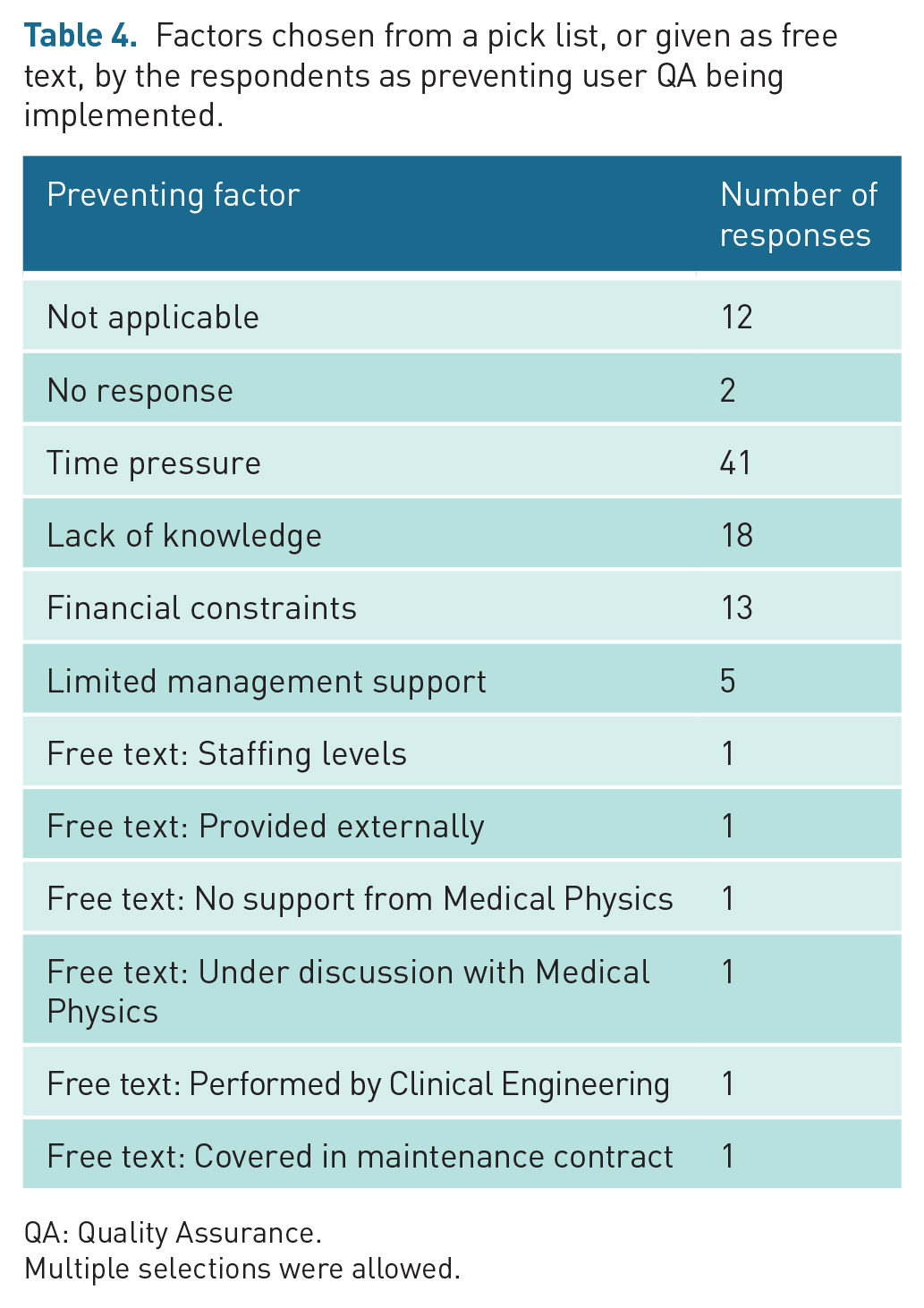
Table 4 shows the factors reported by the respondents as preventing user QA being implemented. Only 12 of the respondents chose ‘not applicable’ here, although 42 had already implemented user QA and 12 had a plan for implementation.
Factors chosen from a pick list, or given as free text, by the respondents as preventing user QA being implemented.
QA: Quality Assurance.
Multiple selections were allowed.
Discussion
Our survey included questions about the levels of QA performed, as both simple user checks and more comprehensive tests are important in attempting to demonstrate the full range of possible faults. Evidence-based guidelines recommend that QA should be performed by users at regular intervals.4–6 Hangiandreou et al. 12 and Martensson et al. 13 concluded that annual QA alone is insufficient for timely detection of faults. Hangiandreou et al. 12 and Sipila et al. 14 showed that over 90% of faults can be detected by visual inspection of the equipment and by a simple assessment of uniformity. More comprehensive annual testing using a test object should detect more subtle faults, such as changes in sensitivity not found by user tests. 15
The main limitation in this study was the survey response rate of 35%, with only four respondents (7%) indicating that no QA was performed in their organisation. Simply in statistical terms, a sample of 60 respondents provides a margin of error of approximately ±10% at a confidence level of 95%. 16 It is unlikely that the missing data from non-respondents were random, so that non-response bias is present in our results. 17 In the context of the limited evidence outlined previously, including a transducer condition survey showing only 25% of departments having a QA programme, it seems likely that there is a lower implementation of QA among non-respondents. In the worst case, if no non-respondents had a QA programme, only 33% of NHS Trusts in the United Kingdom have a QA programme. The true figure will be between 33% and 93%.
Figure 2 shows that 23% of respondents had only annual QA, performed either by in-house or external Medical Physics services; faults will not be detected in a timely manner in these centres. User QA only was reported by 18% of respondents; it is possible that more subtle faults are not detected in these centres due to the lack of a test object in all but one of these organisations.
Figure 3 shows the frequency of user checks. Daily QA and weekly or monthly QA was reported by 11 respondents; this group, comprising 26% of those performing user QA, is likely to detect some major faults on the day of occurrence and other significant faults in a reasonably timely fashion. Daily QA only was reported by two respondents; this is probably adequate to detect some major faults but it is impractical to perform a full visual inspection, uniformity assessment and sensitivity measurements on a daily basis. Weekly or monthly QA only was reported by 27 respondents. The frequency of user QA was not specified by two respondents; this may be due to a limitation of the survey in constraining responses to daily and weekly/monthly with no option for other frequencies.
Table 3 shows that all but one respondent had maintenance contracts in place, the majority (67%) with a comprehensive contract and 78% with at least 60% of contracts including some form of probe replacement cover. Probe replacement cover allows risk-assessed decisions to be made regarding the severity of faults and the need to replace a transducer independent of financial constraints.
Table 4 shows factors identified by respondents as barriers to the implementation of QA. Time pressures were identified as a factor by 41 respondents. This is unsurprising in a patient-focused environment; however, it is vital that examinations are performed with equipment that is fit for purpose. Visual examination of a transducer takes only a few seconds, as does a check of in-air uniformity. These tasks may easily be performed at the start of each clinical session with no impact on patient throughput. A more thorough physical inspection of the equipment and an in-air uniformity assessment using a predefined preset may take 15–20 minutes depending on the number of transducers, so may result in the loss of a patient appointment for each scanner on a monthly basis unless performed outside clinic hours.
Lack of knowledge was identified as a factor by 18 respondents. There are several sources of guidance showing that user QA can be straightforward and accessible for ultrasound users.5,18 Financial constraints were identified as a factor by 11 respondents. In the initial stages of setting up a QA programme, where the focus is on visual inspection and in-air uniformity assessment, there is no real financial commitment other than a small amount of staff time. It may be that some organisations see the replacement of equipment exhibiting significant faults as a financial barrier to QA, but this will ultimately be detrimental to patient care. There is a financial cost to elements of a QA programme that may be implemented later, such as the purchase of test objects and the involvement of scientific and technical support services. Limited management support was identified by five respondents; QA is an essential component of good governance and managers should be aware of the Health and Social Care Act 2008 (Regulated Activities) Regulations 2014. 1
Free text responses identified further barriers to implementation of user QA as ‘staffing levels’, which is a similar factor to time pressures and financial constraints. The responses ‘no support from Medical Physics’, ‘under discussion with Medical Physics’ and ‘covered in maintenance contract’ have limited relevance to user QA as, by definition, the latter is performed at the user level and should be more frequent than maintenance visits, which may be annual or biannual. Responses indicated that user QA in two departments was ‘provided externally’ or ‘performed by Clinical Engineering’; these may be viable options but provision of monthly checks by another department or organisation is likely to be more expensive than using departmental staff.
A minority of respondents (42%) had an ultrasound test object. Of the 45 respondents with annual QA, 24 reported having a test object. It is probable that the annual test providers have test objects not identified in the survey. Access to a test object is important in fault management. For example, the in-air sensitivity test recommended in a number of guidelines is not a direct measure of sensitivity;4–6 when out of tolerance a more rigorous measurement of sensitivity, such as low contrast penetration or grey level, is required. 15
Conclusion
There is a legal requirement for ultrasound QA in the United Kingdom and there is good evidence that equipment users should perform QA at regular intervals to detect significant faults in a timely manner. This survey has shown that user QA is not widely implemented. User QA can be straightforward and accessible for ultrasound users and guidance is available to overcome a perceived lack of knowledge. Implementing a full QA programme around the foundation of user QA has a financial cost but has benefits in assuring that patients are examined using equipment that is safe and functional.
It is easy and straightforward for ultrasound users to perform QA every day, in the form of a rapid visual inspection and uniformity assessment before every use.
Footnotes
Acknowledgements
The authors would like to thank all those responding to the survey.
Contributors
The study was conceived and designed by DJW and MAS. NJD carried out data analysis and prepared a draft manuscript, which was reviewed by, and a final version approved by, all authors.
Declaration of Conflicting Interests
The author(s) declared the following potential conflicts of interest with respect to the research, authorship and/or publication of this article: Multi-Medix Ltd provides commercial ultrasound Quality Assurance (QA) services.
Funding
The author(s) received no financial support for the research, authorship and/or publication of this article.
Ethics approval
N/A since participants were under no obligation to complete and all personal information was anonymised.
Permission from patient(s) or subject(s) obtained in writing for publishing their case report
No. No patients involved.
Permission obtained in writing from patient or any person whose photo is included for publishing their photographs and images
No. No patients involved.
Confirm that you are aware that permission from a previous publisher for reproducing any previously published material will be required should your article be accepted for publication and that you will be responsible for obtaining that permission
Yes.
Guarantor
NJD.
