




Abstract
Studies on gender and leadership to date reveal that structural, psychological, and attitudinal barriers disadvantage women in the workplace. Women who work in outdoor recreation programs also face gender stereotypes related to the perceived appropriateness of the social role they play, and level of physical ability; stereotypes which cause employees and co-workers alike to prefer male leaders. One area of outdoor recreation that requires further investigation is live-in summer camps, because of the more nurturant requirements of leaders in these spaces. This paper documents which qualities residential summer camp staff value in leaders, and hypothesizes whether women who work in the more home-like setting of live-in camps face the same attitudinal and social barriers as women in other areas of outdoor recreation. Analysis yielded a distinct gender bias in favor of men, suggesting that even when a more nurturant environment is required, people still perceive men to be the most appropriate leaders. This pervasive gender bias confirms a patriarchal understanding of leadership and the legacy of historical gender roles even in the unexamined, and more feminized, environments of live-in summer camps. It also re-confirms that, despite popular rhetoric in the West about equality and opportunity, everyone is not allowed equal opportunity to lead.
Introduction
The last decade has produced a significant amount of research on gender and leadership, particularly on the dearth of women in management. 1 Diverse studies have found that women’s absence from leadership positions is due to relational attitudes toward women (see Davidson and Burke, 2000; Eagly and Karau, 2002; Atwater et al., 2004; Ellemers et al., 2004; Berdahl and Anderson, 2005; Eagly, 2005; Allen, 2006; Arvey et al., 2006; Carli, 2006; Eagly and Diekman, 2006; Northhouse 2006); hierarchies and differences between women (see Bartunek et al., 2000; Bell and Nkomo, 2001; Hill, 2003; Campbell, 2004; Elliott and Smith, 2004; Berdahl and Moore, 2006); and the structural and psychological barriers that women both internalize and face from their colleagues (see Cockburn, 1991; Bowen et al., 2000; Correll, 2001; Bailyn, 2002; Budig, 2002; Babcock and Laschever, 2003; Biernat, 2003; Dasgupta and Asgari, 2004; Dindia and Canary, 2006; Duehr and Bono, 2006; Eagly and Carli, 2007; Corell et al., 2007; Eagly and Koenig, 2008; Bobbitt-Zeher, 2011). Most studies find that women face incredible obstacles to leadership because of the cultural association between leadership and masculinity (see, in addition to those listed above, Hearn and Parkin, 1983; Eagly and Steffen, 1986; Miranda and Yerkes, 1987; Catania et al., 1996; Chemers, 1997).
The emergent analysis of women in outdoor recreation leadership has opened up questions about women in sport, women in the outdoors, and women in high-risk or adventure challenge programs (see Johnson, 1990; Jordan, 1991; Garvey and Gass, 1999; Clemmensen, 2002; Saunders and Sharp, 2002; Sharpe, 2005; Warren, 2006; Rilling and Jordan, 2007). These studies find that attitudinal gender discrepancies toward leaders also exist in the field of outdoor recreation. For example, Deb Jordan (1991) analyzed participants’ responses to hypothetical adventure recreation leaders, and found that all participants valued male leaders more highly because of stereotypes about appropriate gender roles, women’s strength, and women’s athletic abilities. Notably, these stereotypes stand in contrast to biological studies on the actual discrepancies between women’s and men’s sizes and muscular development, which are minimal, on average (see, for example, Hubbard, 1990). Garvey and Gass’ (1999) study on hiring preferences in adventure programs found that although the hiring decisions in the groups they examined were mainly made by women, women applicants still faced attitudinal barriers their male counterparts did not. A third example, by Belinda Clemmensen (2002), found differences in participants’ perceptions of male and female challenge course instructors and, again, that participants preferred male leaders. Other studies of women and leadership in outdoor recreation explore the possible differences in leadership styles between men and women (see Henderson and Bialeschki, 1984; Carter and Colyer, 1999), or they examine leadership considering gender as one factor of many (see Bass, 1981; Bass and Stogdill, 1990; Martin et al., 2006). This paper addresses the specific area of live-in summer camps which is missing from extant work on outdoor recreation, perhaps because it falls more easily into the category of outdoor recreational leisure activity. Neither adventure nor challenge recreation have the same nurturance associations that parents and children expect from summer camps, which tend to be less risk-focused and more skill-building, and which, as live-in, quasi-domestic spaces, have inherent in them the expectation that children will be cared for, supported, and safe (Henderson et al., 2007). Thus, following on from extant feminist analyses of women in leadership, we wanted to determine whether social-role stereotypes which associate women with caregiving and hinder women in most fields would enable women leaders in summer camps.
The potential benefits of establishing if a gender bias exists in summer camp staff are two-fold. First, if a gender bias in young adults does exist, that suggests there has been little change in sex-role stereotyping, despite rhetoric about human rights and equality (see Brodie, 2008), and it is something that must be addressed. Second, if the groups exhibit no gender bias in leadership preference, this would indicate that work setting does affect what qualities staff expect of leaders. Young adults have a significant amount of choice when searching for a summer camp employer. Many factors, including general camp environment, salary, and time off, play a role in their decision. One of the likely deciding elements for employees, since salary and work time are generally similar between camps, is the anticipated atmosphere and interactions with managers and staff leaders. Given this, it is likely that previous experience with leaders will dictate the individual’s leadership preference, and elements such as style and gender will play a role in their decision.
Literature review: Gender and leadership
One of the most important contributions that feminism and gender studies have made to postmodern thought is the assertion that gender is the socially-constructed counterpart to biological sex (see, for example, Butler, 1990, 1997; Kimmel, 1994, 2008). Gender is ideology inscribed on the body. It is a performance circumscribed by social expectations (see Butler, 1990, 1997; Ridgeway, 1991, 2009). Studies in social and applied psychology confirm that the words and actions associated with masculinity and femininity help to define and prescribe gender roles. Poststructuralism, with its many connections to psychoanalytic theory, explains the linguistic and discursive constructions of gender, self, and stereotype outside the social psychology field (see, for example, Crawford, 1995; Gal, 1996; Cameron, 1998). These many discursive nodes encourage individuals to perform their prescribed gender roles, perpetuating a binary gender system (masculine/feminine) which controls and limits actions according to historical practice and social roles, institutionalized laws and policies, and individuals’ expectations of others’ gender performances (Cameron, 1998). Since the 1980s, integrative – also referred to as intersectional – feminist theory has expanded gender analysis to be more inclusive and more in step with postmodern power structures identified by Michel Foucault: that is, web-like, nodal power structures which are internalized and reproduced by individuals, as opposed to punitively hierarchical. To account for postmodern power mechanisms, integrative feminism situates the gendered body in its broader cultural context to consider class, race, sexuality, age, ability, ethnicity, etc. alongside gender. This theoretical approach is useful, because it reveals and possibly destabilizes how the dominant gender binary is classist and racist, as well as ableist, heterosexist, and ageist. In terms of our study, our groups of camp employees were for the most part white, middle-class, heterosexual, young, able-bodied, and well-educated. The gender stereotypes they iterated reflected the dominant middle-class, Western, heterosexual construction of the genders rooted in traditional patriarchal discourse, and this narrow view is both a shortfall and a call for future research. For the purposes of those unfamiliar with integrative feminism, the attitudes that the employees in our groups iterated reflected an internalized binary gender system which was defined by traditional social and familial roles of the dominant white, Western, heterosexual, middle classes (e.g. nurturing mother/breadwinning father; private femininity/public masculinity; passive femininity/active masculinity).
The same social role limits and gender role differences were noted in early work in the leadership field, which argued for distinct differences between men and women in leadership roles (see Hollander, 1961; Chapman, 1975; Brown, 1979; McElroy, 1982; Murphy et al., 1995). However, a large and more recent body of evidence critiques the idea that men and women have naturally different leadership styles (see for example, Brown, 1979; Dobbins and Platz, 1986; Wajcman, 1998; van Engen and Willemsen, 2000; Baron et al., 2007). There is no such thing as ‘female’ leadership style, argues Wajcman, for example, but suggests that gender stereotypes are still ‘deeply entrenched’ (1998: 56). Perceived difference in leadership styles, more recent studies argue, are the result of gender role expectations and performances. This is significant when a measured gender bias for male leaders is exhibited by the young adults in our focus groups. The presence of such a bias indicates that young adult staff members are strongly influenced by a masculinist understanding of leadership, even in a setting which requires more feminine-linked nurturant traits. The connection in Western discourse between femininity and nurturing is long-standing, and is cited by experts who study structural barriers women face in the workplace as one of the primary sex-role stereotypes that cast women in subordinate, caregiving, supportive roles. Indeed, calls for social changes which would encourage equity in the workplace include the necessity that nurturing ‘be redefined as normal for boys, young men and men’ (Hearn, 1999: 157).
Study area and participant profile
History of the study camp
The study camp was opened in the early 1980s 2 and has remained under the same ownership and directors since its first year of operation. The camp is a member of the Ontario Camps Association (OCA), which serves as a certifying and inspection body for camps in the province of Ontario, Canada. Although OCA membership is not mandatory, OCA provides consistent standards for camps to meet, and is often used as a reference for parents/guardians when choosing a residential summer camp (OCA, 2009). For the first 10 years of its operation, the study camp was run by a joint management team of co-directors, one man and one woman. Within this male-female co-director format, each had different responsibilities in the daily operation of camp.
During the 1990s, a full-time assistant director was employed to share some of the responsibility of the growing business. This individual has remained employed by the camp since that time. The study camp runs sessions for four months of the year using temporary seasonal camp staff. A spring session (May–June) is tailored to school trips, with short experiences provided for clients. The summer session (July–August) is a traditional residential summer camp, with clients staying between one and six weeks. Staff members for both these sessions are hired from across the province of Ontario and abroad.
Study participants attended on a voluntary basis and were age of majority staff persons employed during the 2009 working season. They had varying levels of experience with the camp, and with summer camping in general, and ranged in age from 18 to 26 years. Ten of the participants were men and 14 were women. Six of the participants were in their first year of camp employment. Nine had worked at camps for two to three seasons, including the 2009 season. Two participants had worked for summer camps for four to five years, including the 2009 camp season, and seven participants had more than five years of camp work experience, including the 2009 camp season. Many of the more experienced staff members had worked at more than one summer camp.
With the exception of one racialized male, all participants were white, and all were middle- to upper-middle class. One male participant was openly gay. Furthermore, of the focus group participants, four planned to attend high school for an additional year after the 2009 camp season, four were enrolled in accredited Ontario colleges, nine were attending Canadian universities, two had graduated from Canadian universities, one participant was a former university student who transferred to an Ontario college, and two participants were undecided about their status after the 2009 camp season. We highlight participants’ education levels, racialization, and, where open, sexuality, to mitigate any assumptions that gender stereotypes are less likely to be held by marginalized groups, or more likely to be held by less well-educated groups.
Methods
This study establishes a preliminary understanding of how residential summer camp staff interpret leadership. Although the study took place at a successful residential summer camp in Ontario, Canada, it serves as a representative sample of the larger camp staff population because camps hire from a similar pool of potential employees in North America. The data were accumulated through three focus groups based on the Berg (2004) and Krueger and Casey (2009) models, during the 2009 camp season (May–August). The focus group structure was coupled with feminist methods outlined by Montell (1999) and Wilkinson (1998), which recognize that the interviewer is also a participant and that their presence in the focus group can affect how the group interacts; that interviewers are not objective, neutral observers of the action in the group. The interviews did not aim to discover whether or not men and women have different leadership styles, claims that are difficult to track empirically (see Eagly and Johnson, 1990; Judy Wajcman, 1998), but rather to discover if young adults perceive that men and women have different styles of leadership, and if so whether they value one more highly than the other.
Focus groups were chosen over other sampling methods, such as individual interviews or group interviews, in order to achieve discourse analysis and examine personal attitudes, opinions, and dominant ideologies about gender roles and leadership (see Eagly and Steffen, 1986; Kent and Moss, 1994; Neill, 1997; Wilkinson, 1998; Dasgupta and Asgari, 2004). Discourse analysis was developed in the field of semiotics. It accounts for not just the words people use to describe events, themselves, or others, but more importantly the sociolingual context in which those words occur. In short, discourse analysis places bodies in ‘a host of pre-existing discourses’ (Newbery, 2003: 209). Thus, we considered not only the participants’ discussion phrases and terms, but also whether they used them negatively or positively. We then situated their responses in relation to the established dominant discourses which frame leadership, such as patriarchy. We hoped that, at least in more nurturant settings, a discursive shift would occur regarding women and leadership. To establish a discursive space, the moderator used open-ended questions, and participants were most often left to explore the meanings of the questions, as well as their personal and group opinions, without prompting or coaching from the moderator.
As working at residential summer camp is a significant and often 24-hour-a-day commitment, focus groups were held during staff free time. Having to sacrifice a portion of what little free time was allotted to them was presumably a limitation to finding study participants. We were also aware that mixed-gender groups could yield different results than single-gender groups. Dale Spender’s (1980) ground-breaking work on women’s and men’s speech found that in mixed gender settings, when women talk more than 30% of the time, they are perceived by other members of the group to be dominating the conversation. Men in the group unconsciously employ tactics to re-establish a 30/70 split by interrupting, speaking loudly, ignoring the offending woman, or using closed or aggressive body language. Furthermore, Spender found that men set the tone and subject for mixed-gender conversations, and also that women generally collude with and encourage both a 30/70 split in the conversation and male-driven subject-matter (p.41–49). These trends were verified in our focus groups, even though women outnumbered men in two of the three groups (5 : 3 and 6 : 2). Thus, we are aware that single-gender groups might have produced different results because women participants may have given different responses, or talked more than they did. Further, we ground our conclusions in this study within the context of other work on women in leadership and women in organizations. This particular study is a small sampling which indicates that similar findings, across many different types of workspaces, in many different countries, also apply to live-in summer camps. A broader sampling might have yielded different results, which is unlikely in light of the extant research and findings; however, expanding the samples is a space for future research.
We also recognized that the focus group moderator was a male, seasoned summer camp staffer, who had previously worked at the study camp. Our rationale for mixed groups, despite the ways that they can clearly skew gendered commentary, was that men and women do not live in separate spaces, and discourse analysis needs to reflect the pressures and social expectations people face in interactions with each other on a day-to-day basis. Therefore, an analysis of how discourse is generated about gender and leadership required a mixed-gender setting.
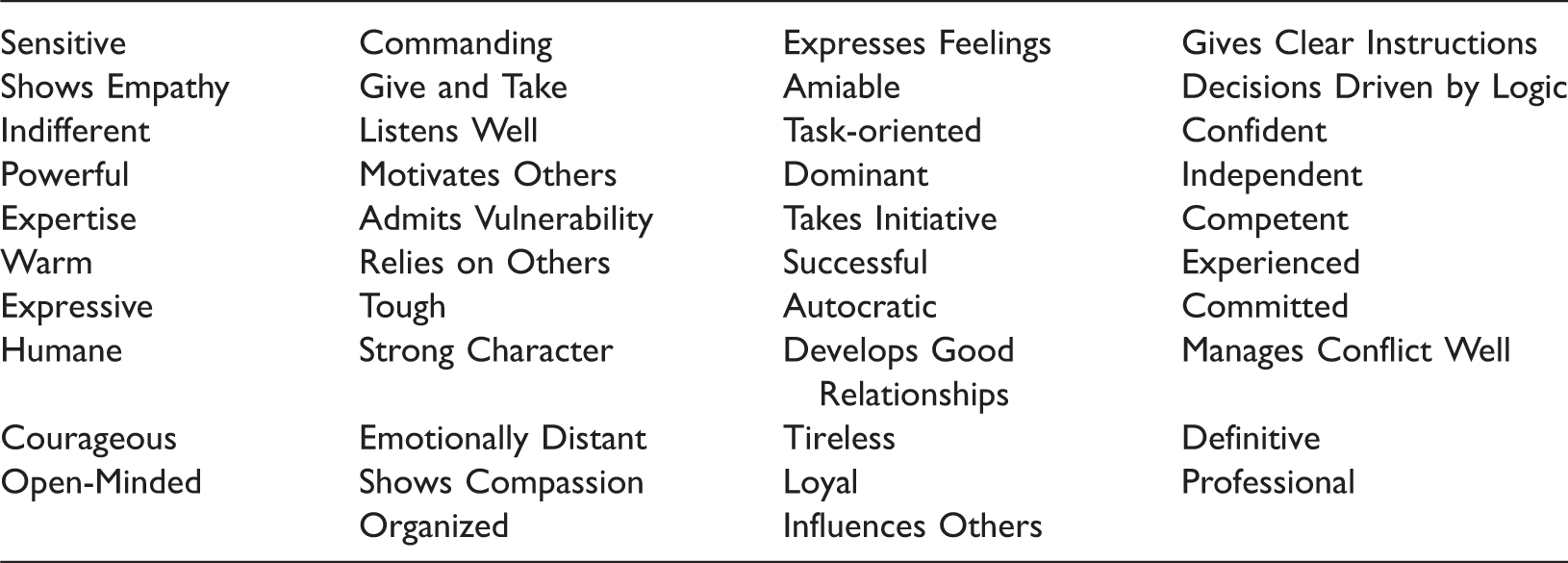
List of general leadership terminologies extracted from literature.
List of gender-linked leadership terminologies used to evaluate focus group transcriptions.
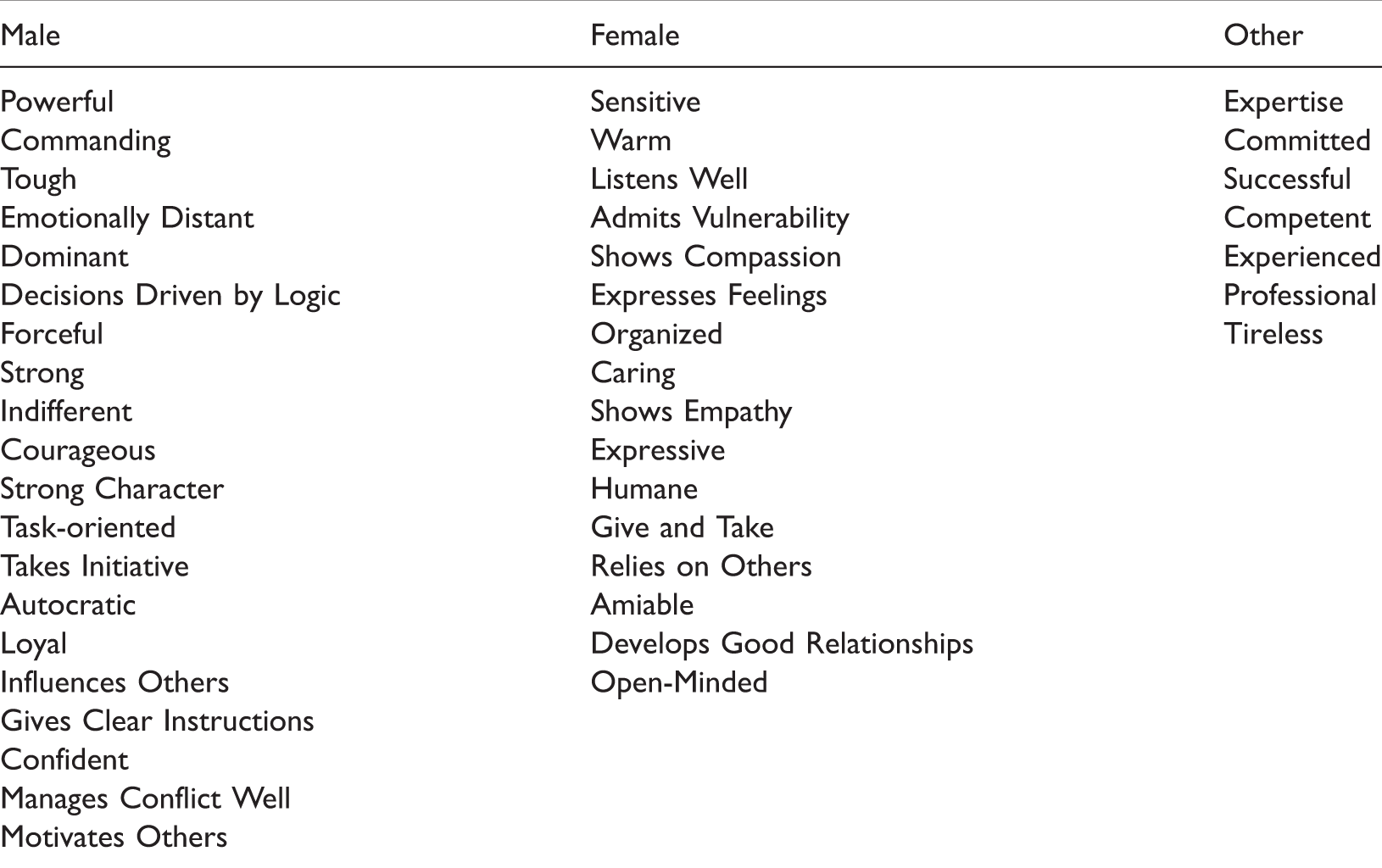
Discursive gender-trait analysis is supported by the work of social psychologists Banaji, Hardin, and Rothman (1993), who conducted a test in which participants were shown stereotypically masculine and feminine words followed by a sex-typed first name (e.g. Jane or John). Participants were then asked to identify the gender of the name by pushing one of two buttons. Participants responded quickest when the name coincided with the gender-linked trait-word they had just seen. The principle Banaji, Hardin, and Rothman posited, summarized by Eagly and Carli, is that ‘things that people have experienced as occurring together – bread and butter, women and sensitivity, men and logic – are responded to as a unit … faster responses reveal pre-existing mental associations … And these associations come automatically to mind, without people necessarily even being aware of them’ (Eagly and Carli, 2007: 86). Thus, the internalized associations participants made between gender and leadership would reveal dominant discourses about men, women, and authority.
After recording the gender-linked traits of words, we overlaid the first and second levels of analysis to see where gender-linked traits intersected with specific reference to male or female leaders; fourth, we determined whether the comments were of a positive or negative nature, and applied discourse analysis to situate the negativity or positivity of the comments within their sociolingual context. The data provided seven categories of analysis: positive male-focused references; positive female-focused references; negative male-focused references; negative female-focused references; positive gender-neutral references; negative gender-neutral references; and neutral comments which could not be connected to a gender or gender-linked trait. We focus in this paper on the positive and negative comments made in relation to both gender-specific leaders and feminine- and masculine-linked traits.
Discussion
Extant studies to date have found that people generally perceive leadership to require agentic, masculine-linked traits, not communal, feminine-linked ones, so that leadership itself is ‘ordinarily conflated with men and masculinity’ (see Eagly and Carli, 2007: 90). Furthermore, women are trapped in a double bind. They are perceived to be less capable leaders when they utilize traits linked to femininity – because leaders are expected to be agentic rather than communal – but they also are perceived to be less capable leaders when they adopt masculine traits because they step outside of their expected supportive role into a role of authority (see Douglas and Michaels, 2004; Eagly and Carli, 2007: 101–107; and Eagly and Koenig, 2008). Even women who are not overtly masculine in their leadership style can face hostile resistance to their authority; simply doing their jobs and being task-oriented can cause resentment in both male and female employees who have internalized the psychology of prejudice that women’s role should be subordinate, and women’s speech should be circumscribed, always pleasant, and indirect (Carli, 2006; Eagly and Carli, 2007: 105–106).
When the concept of gender and leadership ability was broached in each of the summer camp focus groups, the participants quickly moved to discuss their ideas about leadership. The first level of analysis, which coded the number of times participants mentioned men and women, revealed a roughly equal distribution of comments about male and female leaders as well as male- and female-linked traits. However, despite the reasonably equal distribution of gender-linked comments about men and women, it was clear when we applied the later level of discourse analysis that many of the participants valued male leaders and masculine-linked traits more highly than feminine-linked traits or female leaders. Nearly 20% of the 102 (18/102) catalogued comments made about women or feminine-linked traits were negative, compared to only 5.9% (5/84) of the comments made about men. Both male and female speakers made positive comments about male leaders and masculine-linked leadership traits: for example, one male participant said, ‘They have been strong, they have always held the authority position, you look up to them, you feel safe underneath them’; and a female asserted, ‘I think that if everyone started using motivation, or at least started doing that, I think that would make everyone work more.’ Both males and females were also shown to make positive comments about female leaders and feminine-linked traits: ‘She doesn’t ask for anything and doesn’t demand that you acknowledge her leadership, which is an excellent quality’ (male participant), and ‘They really do a good job of making you feel welcome’ (female participant), although this occurred less frequently than with masculine-linked leadership traits and almost always represented positive associations with women taking on traditionally feminized characteristics such as being welcoming, or not seeking acknowledgement for their work/labor of love.
Both men and women made negative comments about female leaders and feminine-linked traits. One woman said, ‘[she] comes across as being a bitch’; and a man said, ‘What would you think that a female would do with … a boss situation? Maybe take the girls out for margueritas?’ These common stereotypes illustrate the double-bind women face. The first comment reveals that assertive women in leadership can face hostility because of the clash between gender-role expectations and leadership expectations. The interpretive framework is affected by gender stereotypes. Wajcman (1998) found that different interpretations are placed on apparently identical modes of behavior, so that women’s loud, clear instructions are often interpreted as ‘hysterical,’ or their thoughtful decision-making as caving in. The interpretive framework that surrounds leadership is thus often more important than a person’s behavior (see also Grint, 2005 and Iszatt-White, 2011). Similarly, the young man’s comment about going for margueritas reveals an interpretive lack of confidence in women’s leadership abilities – here, women’s ‘communal’ traits are interpreted as uncommitted and unprofessional. In the groups, male leaders were not subject to the same levels of hostility and contempt.
The breakdown between positive and negative traits exhibited in our focus groups indicates that gender-related preferences exist within the population of residential camp staff because of dominant discourses about appropriate gender roles. Most participants preferred male leaders and/or masculine-linked leadership traits, despite live-in camps’ more nurturant and ‘domestic’ atmosphere. In this way, we see that the problem of gender bias in leadership is not a question of men’s discomfort with women leaders, but an ideological system which encourages all members of society, men and women, to internalize the belief that men make better leaders. The internalization of the male leadership prerogative by women was iterated when women linked masculine stereotypic traits with good leadership, and feminine stereotypic traits with poor leadership. The reasons for participants’ preference were rooted in gender-stereotypic expectations as well as the social outcomes generated by historically different roles for men and women, roles that were defined by patriarchal ideology.
Positive male-focused references/negative female-focused references
An interaction between a female and male, both aged 22, clearly illustrates how gender stereotypes affect leadership expectations: Male: I think a female leader would not be as straightforward and task-oriented, which is why [I prefer a male], but then again obviously there are exceptions to the rule which no-one is going to say that there aren’t any hard-assed female bosses … So male, because they are task-oriented. Female: I could see that because I find that females are maybe a bit more … Male: Bullshit more? Female: Are more compassionate than males.
This exchange exemplifies how gender stereotypes affect attitudes toward female leaders: they are either compassionate, caring, nurturers; or dithering, undecided airheads. It also reveals how stereotype-based biases are perpetuated. The man associates proper leaders with masculine-linked traits identified by Kushell and Newton (1986), Rodler, Kirchler, and Holzl (2002), and Adams (2007) (‘straightforward,’ ‘task-oriented’). The woman’s generally passive responses do not directly refute her peer’s assessment; they simply try to redefine it, in equally gender-stereotypic ways: she highlights women’s ‘compassion’ versus straightforwardness and task-orientation.
In some instances, the speaker cited their gender as affecting their view. Some males felt that leaders of their own gender would share desirable traits: ‘If I had to pick one or the other, I would pick a male person as a leader more times than not, just because I think that as a male, I’m pretty task-oriented and I think a lot of times the leader as a guy will be task-oriented,’ said one 22-year-old. This speaker’s words reveal that he does not consider women to be as task-oriented as men (he, ‘as a male,’ is task-oriented), and his response thus indicates how gender stereotyping works to the detriment of women leaders. A female participant noted, ‘There are a lot of qualities, though, that men are just more likely to possess than maybe, like, a female boss.’ As Eagly and Carli illustrate in their book-length study on gender and leadership, ‘[t]he psychology that underlies prejudice toward female leaders is driven by conscious and unconscious mental associations about women, men, and leaders. People associate men and women with different traits, linking men with more of the traits that connote leadership’ (2007: 83), and thereby naturalizing men in leadership roles, as this female participant does.
The naturalization of men as leaders has clear connections to patriarchal systems of power. One 18-year-old female respondent stated during her focus group, ‘I prefer a male.’ It became clear later in the discussion that her preference came from her understanding that men are inherently better leaders because they naturally possess the positive qualities associated with patriarchal leadership. She ‘found female bosses to be a little bit grouchy,’ and male leaders to ‘possess more of a fatherly kind of characteristic, and I guess the way I was brought up, that kind of makes me want to, it motivates me more.’ Her response is congruent with findings in social psychology that ‘Leadership is ordinarily conflated with men and masculinity’ (see meta-analysis in Eagly and Carli, 2007: 90), and her comment confirms the connection between traditional patriarchal power and men’s position in the work hierarchy. Although she refers to her own individual experience, her experience exists within a broader sociocultural context where positive representations of ‘fatherly’ – that is, patriarchal – characteristics often trump the constructed overly-emotional ‘grouchiness’ of women.
Not all responses were as directly prejudiced against women as those above, but most responses exhibited a gender preference for men based on trait-linked analysis or direct references to males. ‘He is athletic. He is intelligent,’ said one male participant about his ideal leader. Another participant stated of his ideal leader, ‘He would legitimately work harder than anyone else.’ Some offered personal experiences with male leaders to describe their ideal leader: ‘He was very assertive in the way that he said how the weeks would be working out,’ or ‘He is the most hands-on boss that you can get.’ Another stated: ‘leaders can lead by action, as opposed to teachers.’ These statements confirmed gender-role stereotypic expectations of agentic masculinity, as well as the association of good leadership with masculine-linked traits.
It is perhaps predictable that male respondents would speak favorably about male leaders and the leadership traits which are normally associated with men. In a post-civil-rights era, when younger generations have been raised with the rhetoric of equality, it is less intuitive, however, that men and women would continue to give responses which actively demonstrate negativity toward female leaders and feminine-linked traits. Further, in line with Deb Jordan’s study, the male participants in our groups ‘were more stereotypical in their responses than were female respondents’ (1991: 242).
Some of the men denounced female leaders entirely when they defined leadership as masculine, as in the examples above. Two reasons are posited for this action: gender-role stereotypes and the threat to a boy’s club of leadership within the camping field itself, which grow out of patriarchal assumptions about men’s role. The camping industry grew from a ‘manliness is next to godliness’ discourse, most notably articulated in the early inception of the Boy Scouts (Springhall, 1991). Even many single-gendered, female, camps had (and still have) male leaders at the business and operational controls, and camp duties are often divided along gender lines. In the sample camp, for example, the male of the management team handles business, safety, and operational tasks, while the female is in charge of health, food, and the residential orientation of staff and campers. The division of labor in camp leaders reinforces, rather than undermines, men’s public leadership role, and women’s domestic and private role. Because the ‘manliness’ ideology was integrated into the foundational strategies of camp leadership, people for whom camp has played an important role may have unconsciously internalized the idea that masculine and patriarchal qualities are the correct, or most effective, qualities for leadership, even when (or perhaps because) camps promote a home-like (gendered) environment. As Jordan (1991) argues, ‘a pro-male bias tends to be greatest when the task at hand is incongruent with gender role expectations for women’ (p.242).
Camping and outdoor recreation continue to be perceived as particularly ‘masculine’ terrains because of cultural tropes about male explorers conquering nature, and women’s more domestic social role (see Sharp, 2001; Saunders and Sharp, 2002). Participants’ responses indicate that the male-as-adventurer trope perseveres, even in the potentially more feminized – that is, domestic – setting of live-in summer camps. The historical public/private gender divide in the majority white, Western, middle-class meant that women were often denied access to the job market, or consigned to support or menial roles such as clerk or secretary (see Cockburn, 1991: 76–81; Chatman et al., 2008). This trend, based on classed and gendered dominant discourses about appropriate gender roles, means that people are now more accustomed to seeing men in leadership roles, and because ‘men have predominated in leadership roles for so long … leadership itself is perceived as a masculine domain.’ Thus, ‘men have an advantage over women merely because people ascribe mainly masculine qualities to leaders’ (Eagly and Carli, 2007: 84).
The catch-22 created by the historic material conditions which blocked women’s access to leadership means that, even now, women face prejudices and are less likely to be hired as leaders or promoted, thus reinforcing the perception that men are better suited for leadership. Furthermore, ‘The inequalities that men and women commonly experience are transformed into widely shared beliefs, not merely in men's greater status and power but also in their greater know-how and ability’ (Eagly and Carli, 2007: 88). The resulting gender hierarchy explains why both men and women often resist women in leadership, especially in the ‘play’ setting of summer camps. When women take on positions equal to or over men, they ‘call into question the whole social order’ (Bertozzi, 2008: 476). A young man in a camp situation, who is required to lead children as well as his peers, may feel that his unconsciously internalized status is being tested by women leaders. Comments which balance positive feedback about male leadership with negative feedback about female leaders could, in the focus group setting, be a way to regain face, or to reassert dominant masculinity. Indeed, ground-breaking work in masculinity studies has revealed the connection between the articulation of sexist attitudes and the appropriate performance of hegemonic masculinity (see Kimmel, 1994, 2008; Connell, 1998).
Furthermore, although some women praised women leaders who employed masculine-linked traits, there were also women who made negative comments about female leaders who exhibited masculine-linked traits like directness or assertiveness. The conflicting responses of the women participants suggest a possible cultural shift in attitudes toward women’s appropriate social role and behavior. Although women leaders remained constrained by gender role and gender-stereotypic expectations overall, they could adopt some masculine traits and still be viewed positively by some of the participants.
Negative male-focused references/positive female-focused references
In contrast, virtually no negative comments were made about male leaders and masculine-linked leadership traits, with the exception of some participants’ reference to size as an artificial advantage. For example, one male participant argued that even though men may be prioritized in hiring because they are [physically] larger than women, ‘that doesn't mean that they are a better leader at all – it just means that they have an easier time just because of genetics.’ This participant's comment supports Liz Newbery’s (2003) findings in her analysis of leadership and teaching style in outdoor recreation: that the idea men and women have different leadership abilities can be traced to associations between large ‘manly’ men and the outdoors, and has little to do with measured differences in leadership style or effectiveness.
While all participants made positive comments about male leaders, only one male declared that he preferred female leaders, ‘because I just feel that I am more overall comfortable with girls. Girls are very—women are very organized and very on top of what needs to be done.’ This 18-year-old had only worked with female leaders prior to his arrival at the study camp, possibly confirming the finding of social psychologists Dasgupta and Asgari (2004) that experience can alter social stereotypes and prejudices. Dasgupta and Asgari’s study concluded that exposure to ‘counter-stereotypic leadership roles’ changes gender stereotypes (p.654). They found that even short-term exposure to notable women’s pictures and biographies altered participants’ leadership perceptions of women in a positive way. It is, however, important to note the shift from the more diminutive ‘girls’ to the more authoritative ‘women’ that occurs in his commentary, which suggests a discursive struggle to find a place for ‘women’ alongside ‘authority.’ The first discursive impulse exhibited by this participant is to infantilize women leaders, thus safely containing them within a patriarchal discourse. However, this 18-year-old male’s experience with primarily female leaders may have altered his stereotypic expectations of leadership, and may offer a strategy for equality-building. If women participate in, and are given the opportunity to participate in, non-gender-stereotypic leadership activities, the social expectations of gender performance could shift.
Furthermore, female participants were just as likely as male participants to make positive comments about leaders of their own gender, indicating some shifts in the internalization of masculinist attitudes toward leadership. Feminine-linked traits were also expressed as desirable by some participants, suggesting that more nurturant settings do allow more opportunities for women to be seen as leaders. Most of the positive comments reflected on women’s expected relational social role. ‘I find that there is almost the perfect balance between friendship and leadership [in women leaders],’ stated one female participant; ‘Another leadership quality that I think is good is the ability to listen,’ stated another in the same focus group. Positive relational associations about women leaders were expressed in other groups as well, such as: ‘the amount of patience they have;' ‘[she] is someone that you can go to about anything’; and, ‘[she is] so easy to approach.’
Opportunities created by the positive association of feminine-linked traits with camp leadership can easily be problematized, however. Even when ‘womanly,’ communal traits are positively portrayed, they buttress women’s ‘traditional obligations such as childcare and domestic work. And these obligations do not include leadership’ (Eagly and Carli, 2007: 89). For example, while one participant stated that he had no preference between male and female leaders, he qualified that he desired a leader who shared the traits of his previous employer: ‘my boss for a long time will be like [handing out jobs] “You are doing this. You are doing this”. And, like, that is just my preference.’ Task-orientation and assertive leadership style are associated with masculine-linked traits.
Women made many positive comments about male leaders, something which conversely cannot be said for the men, and, on the whole, many of the women’s positive comments about women leaders invoked masculine-linked traits such as the ability to influence others or take initiative. Although this may bolster the argument that men continued to be preferred leaders, it also challenges earlier studies which found that women penalized female leaders for stepping outside gender performance expectations when they exhibited masculine-associated qualities (see Eagly and Carli, 2007: 101–106).
Conclusion
The gender bias expressed by the majority of participants came from an overarching patriarchal interpretive framework. It is not entirely surprising that participants expressed a gender preference: most work on leadership and gender indicates a clear bias for male leaders. Referred to as the Goldberg paradigm, this bias is named for a study conducted by Philip Goldberg in 1968, which found a clear antifemale bias, even among women. In his test, participants were asked to evaluate student essays. One group was given an essay with a male name on it; the other group was given the same essay with a female name on it. Participants consistently valued the essay with the woman’s name on it lower, unless the topic was deemed to be ‘feminine.’ While these mid-20th century results may not seem startling, the fact that applications of Goldberg’s test to job applications in 2000 resulted in the same antifemale bias should be. The study, conducted by organizational scientists Heather Davidson and Michael Burke, revealed that resumés with a male name were consistently ranked higher than the same resumé with a female name.
Gender-preference for male leaders by seasonal staff is indicative of the Goldberg paradigm and presents difficulties for women who wish to enter leadership roles in camp. In order to be appreciated as leaders, participants’ responses indicated that women should be relational, communal, patient, and kind, qualities usually associated with women’s historical caregiving role – a role that precludes them from leadership within a patriarchal discourse. Moreover, according to participants, the most successful leaders employ traits associated with masculinity. The clash between expectations of leadership and gender create a double-bind that ‘requires’ women leaders ‘to be communal and to avoid direct and assertive behaviour’ (Eagly and Carli, 2007: 103), even though doing so often causes them to be perceived as less effective in the eyes of their staff.
The tensions created between gender expectations and leadership expectations were best articulated by one female participant: I guess it just depends on what kind of experience you have had with, like, who is an authoritative figure for you, both at camp and outside of camp. It is intimidating when either a girl has the same traits as a guy would, or, I don’t know, if they would like switch up, unless, like, people just find themselves more sensitive to working with girls than if they were to work with a guy. I guess sometimes when it is a guy working for a girl, I guess they feel like they want to be the bigger person. As, if it were a girl working with a girl it is more just a general, neutral kind of relationship with one another.
Even in the working environment of live-in summer camps, where feminine-linked traits are required (nurturance, empathy, community-building, caring), participants in the focus groups showed a distinct gender bias in favor of males. This is important not only because it occurred at all in a post-civil-rights era (see Brodie, 2008), but also because discourse analysis revealed a firmly entrenched patriarchal ideology. Although participants often qualified their statements as non-discriminatory with comments such as, ‘maybe it’s just me,’ or ‘I can only say what I feel,’ prior to exalting male leaders or masculine-linked traits, nearly two-thirds of them preferred male leaders, discursively confirming that gender bias was not confined to the individual prejudices of a random few who had not heard of human rights; rather, as Cynthia Cockburn (1991) found in her seminal work on men’s resistance to gender equality in the workplace, ‘patriarchy is real and it [is] durable,’ and it is ‘systemic. That is, it is not casual but structured, not local but extensive, not transitory but stable, with a tendency to self-reproduction’ (p.6). The prevalence of these individual opinions across the groups reveals the patriarchal discourse at work, which values masculine- over feminine-linked traits and male leaders over females.
The barriers women face connect soundly to gender stereotypes and traditional, essentialist, and reductive ideas about women’s role as the ‘naturally’ more proficient nurturers, educators, and caregivers tied to the domestic sphere (see Acker, 1990: 9–11; Cockburn, 1991; Eagly et al., 1995; Cejka and Eagly, 1999; Heilman, 2001; Blair-Loy, 2003; Douglas and Michaels, 2004; Fuegen et al., 2004; England, 2005; Correll et al., 2007; Heilman and Okimoto, 2007; Eagly and Koenig, 2008). These stereotypes are not only applied by men to women, they are also internalized by women, so that many women come to believe that women are not suited to leadership roles: that is to say, leadership is ‘cultural,’ it is socially constructed and shifts as cultural norms shift, and ‘symbolic,’ because it is grounded in the symbolic meanings granted by sex-role stereotypes as opposed to actual leadership behaviors (Alvesson, 1992: 185; see also Alvesson and Billing, 2009: 49–95).
Both men and women exhibited the internalization of the great man theory (see Borgatta et al., 1954) and its late offshoots (Cawthon, 1996); theories which have played a significant role in the social development of perceptions of camp leadership. The internalization of these ideas creates, for the individuals, a discursive space where the male leader is not only normal and correct, but the female leader is both devalued and resisted. For young men in particular, the devaluation of female leaders and feminine-linked traits may also be influenced by a perceived threat to patriarchal power. The young people in this study, as the children of late baby-boomers, have grown up in a society where the idea of male superiority has been officially challenged, but clearly not defeated. If this is how young men continue to measure their own social value and self-efficacy as individuals, then their challenges to women leaders can be more easily understood. This does not, however, provide these young men with license to bias. Instead, it highlights a shortfall in the way that society engineers its young people and its future leaders.
In practical terms, when formative spaces such as childcare, school, and now summer camps are dominated by women leaders, we find it difficult to make a connection between the traditional set of beliefs revealed by participants’ statements and the lived experiences of young men and women. The presence of a strong pro-male bias does indicate, however, that the gender stereotypes produced by a historically-dominant patriarchal discourse have not shifted enough to change the overall understanding of the male-female leadership dynamic. Because the young people in our focus groups still understand leadership as masculine, it appears that uneven power relationships between men and women are being maintained over time, not modified. In a field where, as of 2008, over 56% of camp directors were female (ACA, 2007, 2009), gender bias could prove difficult for some women to overcome, even when they are hired. Individual expectations and leadership realities can become incongruent, leading to issues of harassment, abuse, and retention.
However, there were moments in the study which indicate that there is the potential to shift gender stereotypes. With exposure to women in gender incongruent roles, such as leadership, one young man had re-perceived leadership and gender to allow women to unproblematically take up masculine-linked traits. Furthermore, some young women saw women who adopted masculine-linked traits as effective leaders, rather than ‘bad’ women, which allowed women to perform leadership in ways deemed to be effective by the groups. These responses, while certainly the minority, may indicate an early shift toward true equality of opportunity.
Footnotes
Acknowledgements
The authors thank the anonymous reviewers whose time and effort helped to shape this paper, as well as focus group participants who kindly gave of their time to share their ideas.