




Abstract
This study examines the mediating influence of identification with leader on the relationship between follower perceptions of transformational leadership behavior and their work outcomes, using data obtained from migrant workers and their supervisors in a large manufacturing company located in south-eastern China. Hierarchical regression analysis revealed that transformational leadership was positively related to the affective commitment and job performance of followers, and negatively related to their turnover intentions. In contrast, no significant influence was found of transformational leadership on the innovative behavior of followers. Subsequent analysis revealed that identification with leader mediated the relationship between transformational leadership and follower attitudes, but did not mediate the relationship between transformational leadership and follower job performance. These findings highlight the importance of cultural and wider contextual influences on the processes by which leadership impacts on the work outcomes of migrant workers in the Chinese manufacturing industry. The managerial implications of these findings are discussed and suggestions for future research provided.
Keywords
Introduction
Over the past two decades the impact of transformational leadership behavior on employee attitudes and behavior has received significant attention from researchers (Avolio et al., 2004). Meta-analytic reviews of the literature have found a positive association between transformational leadership and work outcomes of interest to organizations, such as job performance and organizational commitment (Lowe et al., 1996; Judge and Piccolo, 2004). However, most of the existing research has been conducted in Western organizational settings. There has been limited examination of the mediating mechanisms which may influence the relationship between transformational leadership and follower work outcomes in Asian organizational contexts (Liu et al., 2010).
Transformational leadership has been shown to work comparatively well in Asian cultures such as China, which are collectivistic and relationship-based, given the focus of transformational leaders on developing the collective identity of followers and stressing the achievement of group goals (Jung and Avolio, 1999; Walumbwa and Lawler, 2003; Walumbwa et al., 2005). Despite this, there has been limited examination of how the follower’s identification with their leader impacts on their attitudinal and behavioral responses towards his or her leadership behavior (Liu et al., 2010).
In order to address this gap in the literature, the present study focuses on identification with leader as a mechanism by which transformational leadership translates into positive work outcomes. Identification with leader has been shown to be a mechanism by which a leader engenders commitment to their goals (Shamir et al., 1993; Kark et al., 2003; Van Knippenberg et al., 2004), and is especially important in the Chinese organizational context given high levels of interpersonal relationalism and respect for seniority (Farh et al., 1998; Hwang, 2000). Although identification with leader has been shown to be closely associated with transformational leadership (Liu et al., 2010), there has been limited empirical investigation of the extent to which it mediates the influence of transformational leadership on the work outcomes of followers, especially their in-role behavior and attitudes. This study utilizes social identity theory as a tool to examine the mediating role played by identification with leader on the relationship between transformational leadership and follower work outcomes, specifically their job performance, innovative behavior, organizational commitment and turnover intentions. Social identity theory proposes that the identity of an individual derives directly from the relationship they have with social entities such as their direct supervisor, with whom they interact on a frequent basis. It proposes that individuals change or develop their self-concept when they identify with such entities, so that their values and goals become similar to that of the entity (Pratt, 1998). By focusing on identification with leader as an intervening mechanism, we hope to provide a more nuanced understanding of the processes by which transformational leadership influences the attitudes and behavior of followers in the Chinese organizational context.
This study also makes an important contribution by highlighting the importance of industrial and organizational level factors in influencing the processes by which transformational leadership translates into positive work outcomes. Although prior studies suggest that transformational leadership may lead to positive work outcomes in modern service sector organizations operating in the main economic centers of Shanghai, Beijing and Guangdong (Walumbwa and Lawler, 2003; Walumbwa et al., 2007; Liu et al., 2010), limited work has been conducted in more traditional manufacturing organizations located outside of the major cities, which are staffed primarily by migrant workers. Investigating the impact of leadership behavior on this group of workers is extremely important, given they make up the vast majority of the total urban workforce in the labor-intensive manufacturing sector, and have relatively low job tenure and technical skills compared to other groups of workers (Jiang et al., 2009; Zhang, 2010). It is also important given the fact that the Chinese manufacturing sector has been hit by significant levels of employee turnover in recent years. In some industrial sectors, which employ large numbers of migrant workers, turnover rates have reached as high as 120% in recent years (Morris et al., 2009). Therefore, it is of vital importance to understand whether transformational leadership can be utilized as a tool to enhance their work outcomes, specifically their organizational commitment and their in-role behavior, as well as reducing their turnover intentions. To this end we use a sample of 322 supervisor–subordinate dyads from a large garment manufacturer located in the south-east of China. The findings should enable us to provide guidance to managers as to how transformational leadership may be utilized to the benefit of organizations in the garment manufacturing industries and similar industries across Asia which employ large numbers of migrant workers.
Literature review
Transformational leadership
Transformational leadership theory, developed by Burns (1978) and popularized by Bass (1985), refers to the ability of leaders to change the organizational status quo through the development of shared follower values, needs and aspirations, with the aim of generating awareness and acceptance of group goals (Bass, 1990). Transformational leaders generate a vision of the future, communicate that vision to followers and foster commitment to that vision (Avolio, 1999). In this study we adopt Bass and his associates’ conceptualization of transformational leadership into four main components: idealized influence, inspirational motivation, intellectual stimulation and individualized consideration (Bass and Avolio, 1994). Although other authors have developed alternative conceptualizations of transformational leadership (Kouzes and Posner, 1993), Bass’s four-component model was adopted as it has been the most widely used and exhibited good construct validity when tested in a host of cultural and industrial settings such as China, India, Kenya and the USA (Walumbwa and Lawler, 2003; Walumbwa et al., 2005).
Idealized influence is concerned with the leader’s ability to exert emotional influence over and gain respect from his/her followers (Bass, 1998). Leaders provide idealized influence when they act as role models through the exhibition of exemplary ethical behavior. They set goals which are not self-centered and demonstrate a willingness to pursue these goals even when personal costs result. Such behavior generates respect for, and trust in, the leader and makes followers more proud of their organization and keener to work harder to promote its goals (Bass and Avolio, 1994).
Inspirational motivation is concerned with the ability of the leader to provide followers with a sense of purpose and energy to foster the attainment of organization goals (Bass, 1985). This is done through the creation of a new vision, developing clear and plausible strategies for attaining the vision and mobilizing commitment to that vision through communicating the vision to followers in a clear and plausible way (Avolio, 1999; Walumbwa and Lawler, 2003).
Intellectual stimulation refers to the ability of leaders to get their subordinates to question their own values and beliefs, as well as those of the leader and the organization. This should encourage followers to develop creative and imaginative approaches to solving problems and performing their jobs (Bass and Avolio, 1994).
Individualized consideration is defined as the ability of the leader to provide individual support to their subordinates by acting as a coach or mentor (Bass, 1985). Such leaders show the ability to motivate and develop the self-confidence of their followers by providing special attention to their individual needs, aspirations and strengths (Bass, 1998; Avolio, 1999).
Hypotheses development
Transformational leadership and work outcomes
The influence of transformational leadership on the promotion of favorable attitudinal and behavioral responses in employees, such as organizational commitment and performance, has been extensively researched in Western countries (Lowe et al., 1996; Judge and Piccolo, 2004). However, limited work has been conducted on the effects of transformational leadership on Chinese employees. Traditionally, researchers questioned the extent to which Western theories of leadership that stress employee involvement and participation are appropriate in China given the fact that it is predominantly a collectivistic and relationship-based society (Tsui et al., 2004). However, in recent years, a small but growing number of studies have established that transformational leadership can elicit the same positive emotional and behavioral responses in Chinese employees as it does in Western employees (Walumbwa and Lawler, 2003; Walumbwa et al., 2007; Liu et al., 2010; Yang et al., 2010). Some studies even suggest that Asian employees might respond even more positively to transformational leadership than employees in the West given its focus on developing the collective identity of followers and stressing the achievement of group goals (Jung and Avolio, 1999). For example, using an experimental approach Jung and Avolio (1999) found that Asian subjects respond more positively to transformational leadership than US subjects.
Only in recent years have researchers begun to examine the impact of transformational leadership on employee behavior in China and other Asian societies. Transformational leadership should have positive effects on employee behavior for a number of reasons. First, the provision of individualized consideration should enhance the innovative behavior of employees through promoting their confidence to challenge the status quo and develop new ideas. It should also lead to the greater transfer of knowledge from the leader to their follower as to how perform better in their job. Second, intellectual stimulation on the part of leaders should also assist in encouraging followers to develop creative solutions to problems and perform better in their job through getting them to challenge accepted practices (Bass and Avolio, 1994). Finally, when leaders are charismatic and inspirational, they serve as role models to their followers, encouraging them to work hard to achieve their goals and objectives (Shamir et al., 1993). This should force them to focus on the task at hand rather than towards external issues, enhancing their job performance and creativity (Shin and Zhou, 2003).
Findings from empirical studies in Asia suggest that transformational leadership benefits organizations in terms of enhancing employee performance and creativity (Shin and Zhou, 2003; Gong et al., 2009; Liu et al., 2010; Yang et al., 2010). For example, Gong et al. (2009) demonstrated a positive relationship between transformational leadership and creativity, moderated by employee creative self-efficacy, using a sample of workers in Taiwan. Likewise, Yang et al. (2010) also found that the transformational leadership of middle managers impacted significantly on the job performance of frontline employees in three large Chinese organizations. Liu et al. (2010) demonstrated that transformational leadership facilitated the voice behavior of Chinese of managerial-level employees in two major Chinese cities, Shanghai and Guangzhou. The positive effect of transformational leadership on employee behavior in these studies may be ascribed to the fact that Asian employees, who generally display high levels of conservation, respond better to a leader who provides them with individualized consideration, as highlighted by previous work on Korean employees (Shin and Zhou, 2003). Conservation refers to respect for tradition, harmony, security and conformity. In the present organizational context, we expect similar results to previous studies which have been conducted in Asia. This leads us to the following hypotheses: H1a: Transformational leadership is positively related to the job performance of followers H1b: Transformational leadership is positively related to the innovative behavior of followers
Recent work has begun to examine the impact of transformational leadership on employee attitudes in China, including their organizational commitment and turnover intentions (Walumbwa and Lawler, 2003; Huang et al., 2006; Walumbwa et al., 2007). Organizational commitment has been defined as the relative strength of an employee’s identification and involvement with a particular organization (Steers, 1977), whereas turnover intentions refers to the extent to which an employee believes they will leave their present organization in the near future (Chen and Francesco, 2000). Transformational leadership might be expected to induce a positive emotional response of employees towards the organization for two main reasons. First, transformational leaders influence their followers to sacrifice their own self-interest for the good of the organization (Shamir et al., 1993). This should lead to greater organizational commitment and lower intention to turnover, as employees work together towards the common good of the organization. Second, transformational leaders encourage followers to think more critically and seek new ways in which to approach their work (Bass, 1985). This should increase the motivation of followers and encourage them to be more involved in their job, which should lead to higher levels of job satisfaction and organizational commitment. As regards the findings of empirical work, Walumbwa and his associates found that transformational leadership was positively related to the organizational commitment, and negatively related to the job withdrawal, of employees working in financial organizations located in Shanghai (Walumbwa and Lawler, 2003; Walumbwa et al., 2007). Huang et al. (2006) found that leadership styles that stress employee participation were strongly linked to organizational commitment for short but not long-tenure employees in two large state-owned enterprises. In line with these studies we might expect transformational leadership to positively influence the attitudes of migrant workers in the manufacturing sector, given low levels of employee commitment and high turnover compared to other industries. This leads us to the following hypotheses: H1c: Transformational leadership is positively related to the affective organizational commitment of followers H1d: Transformational leadership is negatively related to the turnover intentions of followers
Transformational leadership and identification with supervisor
Over the last decade there has been growing research on how identification with groups and individuals influences employee attitudes and behavior in the workplace (Van Knippenberg et al., 2004). Identification refers to the part of an individual’s identity that derives directly from their relationship with an entity such as a group, individual or organization. An individual’s recognition that they share similar values or goals with the entity may affect their self-concept, or they might change and develop their self-concept, so that their values and goals become similar to that of the entity (Pratt, 1998). Although a great deal of work has focused on an individual’s identification with a group or organization they belong to, recent studies have broadened the categorization of identity to encompass the personal relationships an individual has with other organizational members (Kark et al., 2003; Van Knippenberg et al., 2004; Sluss and Ashforth, 2007).
One such relationship that has been shown to influence an individual’s self-identity in the workplace is a follower’s relationship with their leader. Researchers have suggested that transformational leadership may exert a significant influence on the follower’s self-identity when their beliefs about a leader become self-referential or self-defining (Pratt, 1998). Because transformational leaders provide individualized attention, intellectual stimulation, inspirational motivation and idealized influence to followers, the follower might be motivated to adjust their self-concept to become more like that of the leader, in terms of sharing similar beliefs and values (Liu et al., 2010). In other words, a transformational leader becomes a role model who the follower personally identifies with (Shamir et al., 1993). Empirical work indicates a strong relationship between transformational leadership and the follower’s personal identification with the leader (Kark et al., 2003; Liu et al., 2010). Supervisor/subordinate relationships have been shown to be even more important to organizational effectiveness in China given the hierarchical nature of Chinese society which stresses respect for seniority (Chen et al., 2002).
Despite such developments in the literature, there has been limited empirical research examining how follower identification with leader might impact on the relationship between transformational leadership and work outcomes. In recent years researchers have attempted to address this gap in the literature by examining the mediating effects of identification with leader on employee responses to transformational leadership (Liu et al., 2010). For example, Liu et al. (2010) found that identification with leader fully mediated the relationship between transformational leadership and followers’ extra-role behavior (i.e. behavior that is not explicitly required by one’s job but has a positive influence on organizational effectiveness), as well as partially mediating their voice behavior (i.e. their willingness to speak up towards their supervisor).
Social identity theory has been used to explain why identification with leader might mediate the relationship between transformational leadership and the in-role behavior of followers, in other words their job performance (Walumbwa et al., 2008). Follower identification with leader should cause the follower to experience the leader’s interests as their own (Van Knippenberg, 2000). This should result in them exerting greater effort to work towards the goals set by the leader in an attempt to enhance their own self-concept, resulting in higher levels of job performance and creativity (Van Knippenberg et al., 2004). This leads us to the following hypotheses: H2a: Identification with leader will mediate the relationship between transformational leadership and the job performance of followers H2b: Identification with leader will mediate the relationship between transformational leadership and the innovative behavior of followers
As the supervisor is one of the main representatives of the organization, stronger identification with leader should also elicit positive attitudinal responses in the follower towards their employing organization, such as higher organizational commitment and lower turnover intentions. Identification with leader also provides followers with a frame of reference with which to interpret and adapt their behavior in the context of their organizational environment (Ashforth and Mael, 1989). This should enhance the self-esteem of the follower through providing them with a consistent view of themselves, distinct from others (Dukerich et al., 2002). In turn, enhanced self-esteem should lead to greater commitment on the part of the individual. This leads us to the following hypotheses: H2c: Identification with leader will mediate the relationship between transformational leadership and the affective organizational commitment of followers H2d: Identification with leader will mediate the relationship between transformational leadership and the turnover intentions of followers
Method
Sample and data collection
The empirical study, which was conducted in October 2010, consisted of collecting information via survey questionnaires from 322 supervisor–subordinate dyads in a large garment manufacturing firm in China. The firm was located in Hangzhou, Zhejiang Province, in the south-east of China. Conducting the survey in a single organization enabled us to mitigate the effects of differences between organizations, and allowed us to observe the impact of leadership behavior more accurately than would be the case if we had surveyed dyads from a variety of organizations.
Respondents were all employed on a full-time basis and belonged to 22 production workgroups involved in textile manufacturing. Each group consisted of 1 supervisor and between 15 and 25 subordinates. Administrative employees were not included in the sample. Each workgroup was involved in working one production line. Due to the fact that they worked sequentially on the line, each specializing in a particular task, a great deal of coordination between team members was required. The main roles of the supervisor were to monitor their work process, provide guidance to them as how best to perform their jobs and motivate them to work more efficiently.
Two sets of questionnaires were used in the study: one for subordinates and another for their immediate supervisor. As most of the scales in our questionnaire were originally in English, they were translated into English and back-translated into Chinese by two members of the research team to check their reliability prior to distribution (Brislin, 1993). Following this, the survey was piloted on a small number of supervisor–subordinate dyads from the same organization. Minor changes were made to the wording and order of some items to enhance clarity.
The questionnaires were administered separately to subordinate and supervisor groups. The subordinate questionnaire was administered in three waves over a period of three weeks to reduce the possibility of common response bias. In the first wave subordinates provided their demographics and rankings of transformational leadership behavior of their immediate supervisor. In the second wave data was collected ranking their identification with supervisor. In the third wave ratings relating to their commitment and turnover intentions were obtained. Supervisor ratings on their subordinates’ performance and innovative behavior were collected during the third week in one wave.
Before the questionnaires were distributed, one of the research team visited all of the participants personally and highlighted the purpose of the research. He guaranteed them anonymity, and informed them that their employer would only be provided with the aggregate findings of the research. Each participant was then provided with a cover letter informing them how to complete the questionnaire. The questionnaires were coded with a number that allowed the research team to match the subordinate responses to those of their supervisor. Out of a total of 1000 questionnaires distributed to subordinates and their immediate supervisors (half to each group), 644 completed questionnaires were returned (accounting for 322 supervisor–subordinate dyads). This amounted to a response rate of 64.4%. A number of questionnaires were excluded due to incomplete responses.
The 322 subordinates who fully responded to all parts of the questionnaire were supervised by 22 immediate supervisors. Of the subordinates, 56.1% were female, 30.2% were younger than 20 years and only 6.1% were educated to high school level or above. On average the subordinates had been working at the organization for slightly less than 11 months. Of the 22 supervisors, half were female, around 64% were younger than 30 years and none had a high school education. They had been working in a supervisory capacity for an average of 16 months and 10 days.
Measures
All the survey items, except for the control variables, were measured on five-point Likert scales.
Independent variable
Transformational leadership
Subordinates were asked to report the transformational leadership behavior of their direct supervisor using 30 items adapted from the Multifactor Leadership Questionnaire (MLQ) form 5X (Bass and Avolio, 1995). As our focus was on transformational leadership behavior, only those items measuring transformational leadership were included in our survey, consistent with previous research (Shin and Zhou, 2003; Avolio et al., 2004). For each item respondents were required to rate using a five-point Likert scale (1 = Not at all and 5 = Very frequently, if not always).
As our hypotheses did not distinguish between the four main components of transformational leadership (idealized influence, inspirational motivation, intellectual stimulation and individualized consideration), they were combined into one higher-order factor (Cronbach Alpha = 0.872). This is consistent with recent empirical work on transformational leadership theory (Kark et al., 2003; Shin and Zhou, 2003; Liu et al., 2010).
Mediating variable
Identification with leader
Shamir et al.'s (1998) seven-item scale was used to measure identification with leader. This scale has been used and validated in a Chinese organizational setting (Liu et al., 2010). Subordinates were required to rank the extent to which they identified with their direct supervisor on five-point Likert scales (from 1 = strongly disagree to 5 = strongly agree). Sample items included ‘she/he is a model for me to follow’ and ‘my values are similar to his/her values’. The Cronbach’s Alpha for this scale was 0.815.
Dependent variables
Affective commitment
Meyer et al.’s (1993) six-item scale was used to measure affective organizational commitment. This scale has been widely used and validated in a Chinese organizational setting (Chen and Francesco, 2003). Subordinates were required to rank their affective commitment using five-point Likert scales (from 1 = strongly disagree to 5 = strongly agree). Sample items included ‘I do not feel a strong sense of belonging to my organization’ and ‘I would be happy to spend the rest of my career with this organization’. The Cronbach’s Alpha for this scale was 0.754.
Turnover Intentions
Farh et al.’s (1998) four-item indigenous Chinese scale was used to measure turnover intentions. Subordinates were required to rank their turnover intentions using five-point Likert scales (from 1 = strongly disagree to 5 = strongly agree). Sample items included ‘I may leave this company and work for another company in the next year’ and ‘I plan to stay in this company to develop my career for a long time’. The Cronbach’s Alpha for this scale was relatively weak at 0.629, which fell below the generally accepted standards of reliability. However, it was left in the analysis as it was found to be a distinctive construct in subsequent confirmatory factor analysis of the dataset, and has been validated in previous empirical work in China (Chen and Francesco, 2000).
Job performance
Job performance was measured by three items taken from Heilman et al. (1992). Previous research has validated this scale in the Chinese setting (Lam et al., 2002). Five-point Likert scales (from 1 = strongly disagree to 5 = strongly agree) were used to measure these items. Ratings were provided by supervisors for each of their subordinates. The items were ‘this employee is very competent’, ‘this employee gets his/her work done very effectively’ and ‘this employee has performed his/her job well’. The Cronbach’s Alpha for this scale was 0.891.
Innovative behavior
Innovative behavior was measured using five items taken from Scott and Bruce (1994). This scale has been used and validated in a Chinese setting (Chen and Aryee, 2007). Five-point Likert scales (from 1 = strongly disagree to 5 = strongly agree) were used to measure these items. Ratings were provided by supervisors for each of their subordinates. Sample items included ‘this team member searches out new ideas’ and ‘this team member generates creative ideas’. The Cronbach’s Alpha for this scale was 0.925.
Control variables
A number of control variables were included in line with previous research (Chen and Francesco, 2000). Dummy variables were used to measure gender (0 = female, 1 = male) and educational level (0 = junior high school education or below, 1 = high school education or above). As the workforce was made up predominantly of young workers in their teens and twenties, a dummy variable was used to separate workers into two main age groups (those younger than 20 were coded 1 and those older than 20 were coded 0). Tenure was measured as a continuous variable as time in months since joining the firm.
Analysis and results
Two steps were used in the process of data analysis. In the first step confirmatory factor analysis (CFA) was conducted using LISREL 8.8 to test the discriminant validity of the study variables. In the second step, regression analysis was used to test the direct and mediated effects of transformational leadership on work outcomes, in line with Baron and Kenny’s (1986) recommendations.
Confirmatory factor analysis.

IFI: incremental fit index; CFI: the comparative fit index; RMSEA: root-mean-square error of approximation.
Descriptive statistics, reliability coefficients and correlations amongst study variables.
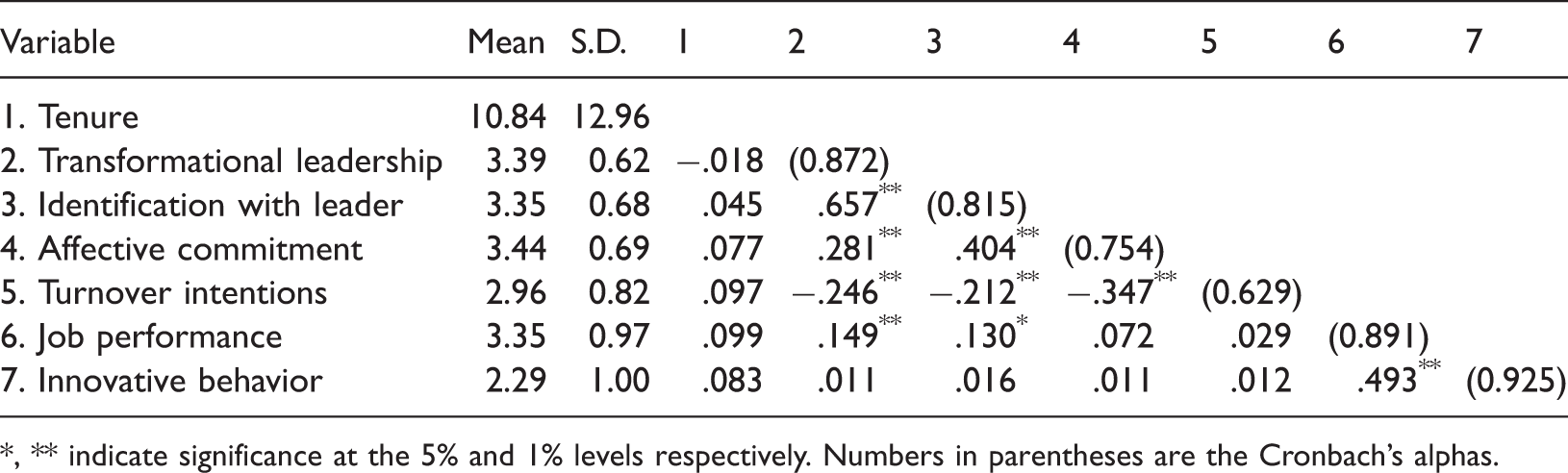
, ** indicate significance at the 5% and 1% levels respectively. Numbers in parentheses are the Cronbach’s alphas.
Regression analysis (n = 322).
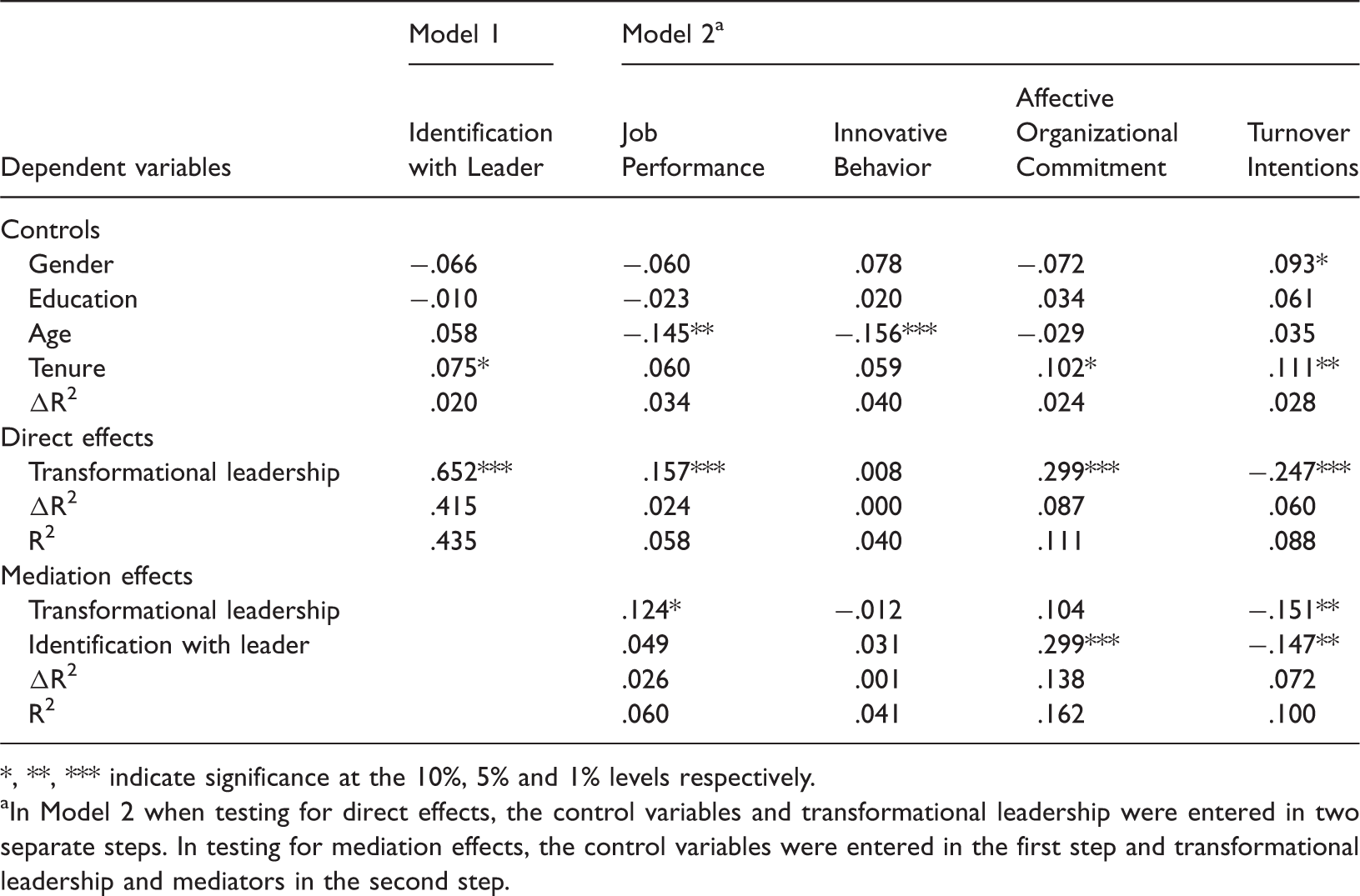
, **, *** indicate significance at the 10%, 5% and 1% levels respectively.
In Model 2 when testing for direct effects, the control variables and transformational leadership were entered in two separate steps. In testing for mediation effects, the control variables were entered in the first step and transformational leadership and mediators in the second step.
As shown in Table 3 (Model 1), transformational leadership was positively related to identification with leader when demographic variables were controlled for (β = .652 p < 0.01). Furthermore, as evident in Table 3 (Model 2) transformational leadership was positively related to the job performance of employees (β = .157 p < 0.01) and affective organizational commitment (β = .299 p < 0.01), and negatively related to their turnover intentions (β = −.247 p < 0.01), in line with hypotheses 1a, 1c and 1d. Contrary to hypothesis 1b, transformational leadership did not influence the innovative behavior of employees.
Regarding the mediated hypotheses, when identification with leader was included in the regression with transformational leadership it was still significantly related to two of the work outcomes: affective organizational commitment and turnover intentions. The previous significant relationship between transformational leadership and affective commitment was no longer significant in the presence of identification with leader, signifying that it fully mediated the relationship in line with hypothesis 2c. Partial support was also provided for hypothesis 2d, suggesting both direct and mediated effects via identification with leader, of transformational leadership on turnover intentions. No support was provided for hypotheses 2a and 2b, demonstrating no mediated effects of identification with leader on the relationship between transformational leadership and both the job performance and innovative behavior of employees.
Discussion
This study was designed to examine whether transformational leadership influences the attitudes and behavior of migrant workers from the Chinese manufacturing industry, as well as investigating whether identification with leader mediates the relationship between transformational leadership and work outcomes.
The study uncovered two main findings. First, although transformational leadership had a positive influence on employee attitudes and job performance, it had no influence on their innovative behavior. Several explanations might be provided for this finding. One explanation might be the fact that the specific organizational context in which this research was undertaken may not provide employees with the opportunity to be creative in the workplace. Indeed, recent work by Wang and Rode (2010) indicates that the relationship between transformational leadership and creativity is extremely complex, and is influenced by a whole host of individual and organizational values. They specifically found that transformational leadership only influenced creativity when the innovative climate of the organization was high and employees identified with their immediate supervisor. The demographics of the sample may have also influenced the findings. Recent work by Shin and Zhou (2003) suggests that low conservation of employees might neutralize the relationship between transformational leadership and innovative behavior. Given that our sample consists of relatively young employees, who are less traditional and more open to change (low in conservation), the presence of a non-relationship might not be so unusual. The low levels of average tenure of employees within this particular organizational and industrial context might also impact on their ability to be creative in their job, namely employees who are relatively new to the job would tend to focus on targets set to them by their supervisor rather than try to develop new ways of doing things. Previous work suggests that employees only begin to develop a capacity to generate innovative ideas once they have had some time to understand what is required in their job, and have had time to harness new knowledge for the development of creative solutions in their work (Weisberg, 1999; Gong et al., 2009). This may explain why previous laboratory studies have found a limited impact of transformational leadership on innovative behavior (Redmond et al., 1993; Jaussi and Dionne, 2003). A third possible explanation might arise from the possibility that supervisors in the textile industry have limited time to provide individualized consideration, the element of transformational leadership which has been found to be most closely linked to creativity (Moss and Ritossa, 2007). Closer examination of respondent data from this particular study demonstrated that they ranked individualized consideration of their immediate supervisor much lower than the other three elements.
Second, although identification with leader mediated the relationship between transformational leadership and employee attitudes, it was not found to influence the relationship between transformational leadership and two variables measuring employee behavior: job performance and innovative behavior. This was a surprising result given the findings of previous empirical work that indicate the positive effects of identification with leader on follower behavior in China (Liu et al., 2010). A number of factors might explain this unexpected result. One possible explanation might be that although transformational leaders should engender greater identification to leader, this may not fully translate into employee performance, as employee performance within this particular industry may result from a whole host of contextual factors which are not under direct control of the immediate supervisor. These may include factors such as employee participation in training. This resonates with Dirks and Ferrin’s (2002) assertions that attitudinal values may be decoupled from behavioral outcomes, due to a wide range of contextual factors. Indeed, previous research suggests that identification with leader may only influence employee behavior when variables measuring the organizational climate are controlled for (Siegel and Kaemmerer, 1978; Wang and Rode, 2010). As our study was conducted within a single organization it was impossible for us to do this. Another contextual factor that may explain why employee identification does not translate into employee performance results from the limited working experience of migrant employees in this particular industrial context. The average tenure of respondents in this study was less than one year, and for many it was their first job away from their hometowns. Although the receipt of encouragement and inspiration from their supervisor may quickly lead to a positive attitudinal response amongst employees, it should take much more time to influence their productive capabilities. For many employees the impact of transformational leadership on performance, and to a greater extent innovation, has not been fully realized due to their short tenure within their organization. Indeed, initial posthoc analysis suggests the relationship between identification with leader and job performance is stronger for those with longer tenure. A further explanation for our findings could arise from the fact that personal identification might lead to overdependence on the leader (Kark and Chen, 2003). This may not be effective in enhancing performance given the limited attention the supervisor can pay to each member of his/her team in this particular organizational context, resulting from the high number of subordinates per supervisor
A number of managerial implications can be derived from the findings of the present study. First, our findings indicate that transformational leadership is an increasingly important tool in the kit of managers looking to enhance employee commitment in an increasingly competitive Chinese labor market. This is beneficial given that high levels of organizational commitment have been shown to lead to lower levels of voluntary turnover (Maertz et al., 2003). Chan's (2010) profile of an apparent paradox in China's labor market with both scarcity of migrant labor and an abundance of rural labor, means that those firms that can employ effective transformational leadership mechanisms will be better positioned to retain and attract labor than those who do not or cannot utilize transformational leadership. Second, although transformational leadership was also found to be positively linked to job performance it did not influence their innovative behavior. This resonates with Wang and Rode's points about supporting mechanisms for transformational leadership being beyond the remit of frontline managers, and suggests limited opportunities are being provided to employees to develop new ways of doing things in their work. In order to enhance their competitive position firms should consider providing more opportunity for involving all members of the organization in the generation of new ideas.
Our study also raises some theoretical issues that have practical implications for organizations attempting to integrate transformational leadership in contexts where performance-related pay mechanisms are utilized. This arises because transformational leadership tends to be portrayed as a course of action by which leaders wield a hierarchical influence over the activities of others, while simultaneously asserting that their organizations possess a commonality of goals and intentions and encourage their subordinates to work towards the collective interest. However, the theoretical underpinning of strategies such as performance-related pay resides in agency theory, in which the emphasis is on appeals to individual instrumentalism (Jensen and Meckling, 1976). This apparent theoretical asymmetry may have considerable implications for the deployment of practices founded upon the collective conceptions of transformational leadership and atomistic motivations that underlie performance-based pay systems (Tourish et al., 2010). This could result in confounding messages to employees and may result in the intended effects of such organizational policies being diluted. Our proposition is that these theoretical differences have bearing on the likely success of organizational practices within this organizational context, and thus managers at a senior level should facilitate an audit to identify which of their organizational elements are congruent and which are incompatible, in order to foster better alignment of practice. Certainly, it would be appropriate to consider team or group-based performance incentives that may offer a better fit with the inherent collectivism of transformational leadership.
Limitations and suggestions for future research
Several limitations compromise the utility of our findings. The first regards the cross-sectional nature of the study, which means we are not fully able to confirm the causality between variables in our study. For example, better performing or more committed employees might rank their supervisor’s transformational leadership behavior more highly. Future research should address this by use of a longitudinal study design.
Second, only one possible mechanism which mediates the relationship between transformational leadership and its work outcomes was examined in this study. Future research may investigate other mechanisms which have been shown to mediate the effects of transformational leadership such as trust in leader (Jung and Avolio, 2000).
The fact that the present study was conducted in a single organization may also have influenced its findings. Future work should be conducted in a larger number of organizational and industrial contexts to determine whether the findings are generalizable within and outside of China. Specifically, the role played by organizational-level variables in enhancing employee responses to transformational leadership needs greater examination. In line with previous studies, the findings of the present study suggest that the innovative climate of a particular firm may combine with employee level characteristics to influence how followers respond to a transformational leader (Wang and Rode, 2010).
We might expect similar results if this study was replicated in manufacturing organizations staffed primarily by migrant workers in other Asian societies such as India and Indonesia, given that they are typically characterized by high turnover rates and low levels of job tenure as in the present study. As with China, we might expect performance-related pay to be the main driver behind employee performance, and identification with supervisor to only mediate the effects of transformational leadership onto performance outcomes when subordinates had a long-term relationship with their supervisor, given the fact that Asian cultures stress the importance of building long-term relationships (Hofstede, 2007). The low levels of employment tenure associated with migrant labor in this industrial context perhaps limits the potential for the development of interpersonal relationships between supervisors and subordinates commonly known in China as guanxi. In other words, we sense that scarcity of time in the economic context subordinates the cultural element.
The nature of labor scarcity in the textile and other labor-intensive industries in China is providing a momentum for change with regards to the management and control of labor. Recent tragedies at Foxconn and other manufacturing companies in China, resulting from the poor treatment and management of migrant labor, have provided further moral impetus for a movement towards a more humanistic approach to the management of labor resources in China (Chan, 2010). Our study considers whether transformational leadership can be utilized to elicit greater commitment and aid in the retention of workers within this industrial setting characterized by dynamic change. As more participative management styles such as transformational leadership are likely to become a consistent feature of the human relations context within the Chinese economy, research of a more longitudinal nature would be well placed to capture how transformational leadership is deployed and to capture its resultant effects in this dynamic setting. We would speculate that over time, wider organizational support for transformational leadership would become more institutionalized, and consequently the effects of organizational variables on outcomes such as innovative behavior will be lessened.
Conclusions
This study represents an important first step to understanding the influence of transformational leadership on the work outcomes of migrant workers in the Chinese manufacturing industry. In addition to this empirical contribution, a theoretical contribution is made by examining the mediating effects of identification with leader on the relationship between transformational leadership and work outcomes. Our study took place during a period of ongoing change within the textile industry and wider labor changes within China. The dynamism of this context, and therefore of our study, stands in contrast with much of the previous work in the area of transformational leadership which has been conducted in static rather than dynamic contexts.
Our findings demonstrate that Bass’s four-component model of transformational leadership, exhibits high construct validity in the Chinese context, providing further support for its generalizability to contexts outside of the West in which it was developed. As we did not seek to develop and test an indigenous measure of transformational leadership in a Chinese context, we cannot be certain as to whether or not the model might be extended to pick up additional dimensions unique to China. This could be addressed by future research. However, by focusing on identification with supervisor, a construct which has been validated by previous empirical research in China, as a mediating mechanism we examine the cultural processes by which transformational leadership influences the attitudinal and behavioral responses of followers, given that China is a culture in which deference to authority and respect for seniority is commonplace.
Our study shows that context is clearly important in terms of how leadership is exercised, given that the present study was undertaken in a turbulent and uncertain phase of Chinese economic and social development. However, we are cautious of expectations that cultural asymmetry will necessarily generate different outcomes within this field. Our study suggests that Western theories of leadership are applicable in Asia, and what is needed is to develop an understanding of the processes by which leadership influences follower attitudes and behavior. It may be that some forms of leadership develop organically within the Chinese or wider Asian context and display strong associations to Western theories of leadership, without ever having being directly or indirectly exposed to them. We appreciate that Western theories of leadership are inherently imbued with cultural origin but this does not necessarily mean that they are so particularistic that they are inappropriate in asymmetrical contexts.
In essence, we suggest that the main focus of research into Asian leadership should be on examining how the mix of cultural and wider contextual influences, such as particular socio-economic and industrial contexts, along with particular industrial work dynamics, impact on follower responses to transformational leadership. Research should also concentrate on investigating the processes by which transformational leadership influences work outcomes, not by seeking to identify forms of leadership as being associated with culturally bound identities and preferences. In the present study we do this by distinguishing between cultural influences in terms of identification with supervisor and the nature of the rather dynamic industrial context, on follower responses to the exercise of leadership. Future research could be undertaken to better understand the distinct roles of cultural and wider contextual influences on the processes by which leadership influences the work outcomes of followers.