




Abstract
This study explores whether the internalization of emotional regulation affects well-being and examines further whether authoritarian leadership can moderate the relationship between such internalization of emotional regulation and employee well-being. A total of 271 working adults who were employed by Chinese enterprises in Taiwan participated in this study. All hypotheses were tested using hierarchical regression analyses. The study showed that controlled emotional regulation through external regulation is significantly negatively associated with such indicators of well-being as mental and physical health, whereas autonomous emotional regulation through integrated regulation is significantly positively associated with such indicators of well-being as mental and physical health. The study also found that authoritarian leadership may moderate the relationship between autonomous emotional regulation through identified or integrated regulation and the well-being indicators.
Introduction
Emotional expression or withholding and health outcomes have been challenged by more complex findings (Ebbesen et al., 1975; Gross and John, 2003; Gross and Levenson, 1997; Kashdan et al., 2007; Saxena and Mehrotra, 2010; Stanton et al., 2000; Watson and Pennebaker, 1989). On the one hand, emotional expression can be a means of alleviating distress (Stanton et al., 2000). Watson and Pennebaker (1989) found that difficulty in expressing negative emotions resulted in a tendency to feel disturbed or a failure to process intensely emotional information, with concomitant mental and physical ill health, chronic pain, the dysfunctioning of the body’s immune system, and depression. On the other hand, emotional expression can intensify distress (Ebbesen et al., 1975) and have a destructive influence on relationship closeness for people with greater social anxiety (Kashdan et al., 2007). These findings reveal the necessity of considering both situational factors and other individual differences in the regulation of emotional expression.
King and Emmons (1990) proposed that ambivalence regarding withholding the expression of emotion, rather than inexpressiveness per se, is what fosters ill-being. Ambivalence over emotional expression refers to an individual’s conflict over the expression of experienced emotion (King and Emmons, 1990). Katz and Campbell (1994) and King and Emmons (1990) found that ambivalence over emotional expression to be positively associated with self-reported physical symptoms, the number of visits to health-care providers, and depression. Other studies also found that greater ambivalence about expression associated with greater general distress, anxious arousal, depressive symptoms, and pain (Barr et al., 2008; Lu et al., 2011). These findings underline the importance of the relationship between people’s motivation for suppressing negative emotions and their well-being.
Kim et al. (2002) found that controlled emotional regulation through either external or introjected regulation is significantly positively correlated with psychosomatic problems such as anxiety, somatic symptoms, depression, negative affect, and dysfunction. Using the perspectives of self-determination theory (SDT), this study will not only explore how controlled emotional regulation negatively predicts well-being, but will also examine further how autonomous emotional regulation positively predicts well-being. In addition, Wu et al. (2003) found that authoritarian leadership demonstrated by supervisors provoked anger in employees and was also correlated with the employees’ tendency to suppress their anger. The motivation for suppressing negative emotions is generally considered relatively controlled and thus low in autonomy. We further examine whether authoritarian leadership can moderate the relationship between the internalization of emotional regulation and well-being.
Internalization of emotional regulation and well-being
SDT is a well-known psychological framework for studying people’s behavior, based on the assumption that there are different types of motivation—specifically, autonomous and controlled motivation as predictors of competence, relatedness, and well-being outcomes (Deci and Ryan, 1985; Ryan and Deci, 2000). Many studies on SDT, particularly in the health domain, have focused on the characteristics of motivation and associated regulatory processes (Kim et al., 2002; Parfitt and Gledhill, 2004; Vieira et al., 2011).
SDT posits various motives for acting which can be ordered along continua either of relative autonomy or of less to greater internalization (Deci and Ryan, 1985; Ryan and Connell, 1989). At the low end is external regulation, which refers to acting only to obtain external rewards or to escape punishment or the loss of rewards. Here, people’s behavior may be perceived as being directly regulated by external controls with which they might not concur. Introjected regulation, however, is somewhat more autonomous than external regulation, which is essentially still closely anchored to external forces and is often prompted by the desire to avoid guilt or shame. Both external and introjected regulations are forms of controlled motivation and are thus less internalized.
Identified regulation is an even more autonomous form of regulation than introjected regulation. People accept this regulation as it is in line with their underlying values and thus perceived as volitional and do not feel pressured or controlled when enacting it. For example, people may willingly withhold negative emotions because they personally attach value to not disrupting a group process. Integrated regulation is the most autonomous form of regulation, accompanied by a sense of volition and choice. People integrate identification with other aspects of their self and are autonomous in their subsequent behavior. When emotional regulation has been integrated, it assimilates emotions and utilizes inner experiences flexibly in acting autonomously, rather than suppressing these emotions to comply with social norms. Both identified and integrated regulations are forms of autonomous motivation and are thus more internalized.
The influence of each of these four different types of regulation on well-being varies significantly because each involves a different extent of internalization. Deci and Ryan (2008) indicated that more autonomous regulation behavior tends to yield greater well-being. Controlled regulation behavior, in contrast, is associated with diminished well-being. Kim et al. (2002) found that controlled emotional regulation through external or introjected regulation is significantly positively correlated with psychosomatic problems. Vieira et al. (2011) also showed that controlled self-regulation was negatively associated with well-being, whereas autonomous self-regulation positively predicted well-being.
Based on the preceding review of the literature, we propose the following hypotheses: Hypothesis 1: Controlled emotional regulation through external regulation will be negatively associated with well-being, as measured by job satisfaction, mental health, and physical health. Hypothesis 2: Controlled emotional regulation through introjected regulation will be negatively associated with well-being, as measured by job satisfaction, mental health, and physical health. Hypothesis 3: Autonomous emotional regulation through identified regulation will be positively associated with well-being, as measured by job satisfaction, mental health, and physical health. Hypothesis 4: Autonomous emotional regulation through integrated regulation will be positively associated with well-being, as measured by job satisfaction, mental health, and physical health.
Authoritarian leadership, internalization of emotional regulation, and well-being
From the perspective of the internalization of emotional regulation, people suppress emotions either voluntarily or due to coercion, and these different motivations have different effects on their well-being. If the extent of the autonomy involved in emotional restraint does indeed play a key role in influencing well-being, it is therefore important to know whether intervention can effectively moderate the relationship between the degree of autonomy and well-being. In recent years, an increasing number of studies have indicated that the type of leadership a supervisor adopts is likely to either enhance or restrict the extent of autonomous motivation in his or her employees (Amorose and Horn, 2000; Gagné et al., 2003; Goodridge, 2006; Hetland et al., 2011; Shamir et al., 1993; Wang and Gagné, 2013). For example, a manager’s transformational or charismatic leadership, or support for autonomy, is positively associated with the employees’ autonomous motivation (Amorose and Horn, 2000; Gagné et al., 2003; Goodridge, 2006; Hetland et al., 2011; Shamir et al., 1993; Wang and Gagné, 2013), whereas a manager’s transactional leadership could be more closely linked to the employees’ controlled motivation, as opposed to autonomous motivation (Hetland et al., 2011). However, few studies have examined the effect of authoritarian leadership on autonomous motivation.
According to Cheng (1993, 1995) and Farh and Cheng (2000), authoritarian leadership includes four important components. These are (a) authority and control, in that authoritarian leaders are unwilling to depute, engage in only top–down communication, control information so that it is obscure, and meticulously monitor subordinates, (b) underestimation of subordinate competence, which leads authoritarian leaders to disregard their subordinates’ suggestions and contributions, (c) image building, which leads authoritarian leaders to preserve their own dignity, perform with confidence, and manipulate related messages, and (d) didactic behavior, which means that authoritarian leaders demand achievement and specific conduct and may lash out at those who do not conform to these demands (see Wu et al., 2003).
Previous studies showed that supervisors’ authoritarian behavior evoked negative emotions in subordinates, such as anger, hostility, and fear (Farh et al., 2006; Wilkinson, 1996; Wu et al., 2003). Wu et al. (2003) also found that subordinates in Chinese organizations who are treated by supervisors’ authoritarian behavior tend to suppress their negative emotions.
Historically, Chinese people have been born into an autocratic environment dominated by fatherhood and empire, and spontaneously developed a tendency toward an overvalued, over-worshipful, and over-authority-dependent psychological and behavioral pattern. Therefore, when Chinese supervisors exhibit authoritarianism based on omnipotent authority and absolute obedience, their subordinates are unlikely to be able to express emotion, even though they feel anger (Yang, 1993).
Furthermore, authoritarian supervisors show a preference for dominating every administrative operation and using a high degree of coercive and reward power when dealing with subordinates (Wu et al., 2003). They also hold a large amount of power based on knowledge by maintaining informational exclusivity and dominating access to information. The social power resulting from such authority is sufficient to raise the level of the subordinates’ obedience and to make them withhold the expressing of their feelings of anger (Cheng, 1993).
Goffman’s (1959) dramaturgical theory can also be used to analyze the emotional reactions between authoritarian leaders and their subordinates. In dramaturgical terms, an authoritarian leader is the leading character, portraying the image of being one who is in a prominent position through grandiose emotional expression. In contrast, the subordinates have supporting roles, maintaining the leading character’s dignity through obedient, dependent behavior, the display of fear and abashment, and the withholding of negative emotions. Regardless of the Chinese tendency toward authoritarianism, this dramaturgical, social-power perspective can explain why subordinates prefer to withhold feelings of negative emotions when supervisors exhibit authoritarian leadership behavior (see Wu et al., 2003).
An authoritarian relationship is based on control and exploitation, and subordinates show conformity solely to avoid punishment (Aycan, 2006). Amorose and Horn (2000) found that athletes who perceived their coaches to exhibit a more democratic coaching style and to respond to players’ performances with high levels of praise, encouragement, and information-based feedback exhibited higher intrinsic (or self-determined) motivation than athletes who perceived their coaches to be more authoritarian in their leadership style and to provide lower levels of praise, encouragement, and informational feedback.
Based on the preceding review of the literature, we assume that supervisors’ authoritarian behavior may cause subordinates to develop controlled motives when they suppress negative emotions. Thus, we propose the following hypotheses: Hypothesis 5: Authoritarian leadership moderates the relationship between controlled emotional regulation through external regulation and well-being as measured by job satisfaction, mental health, and physical health, so that when supervisors increase their authoritarian leadership behaviors the negative association between external regulation and well-being is stronger than when supervisors reduce their authoritarian leadership behaviors. Hypothesis 6: Authoritarian leadership moderates the relationship between controlled emotional regulation through introjected regulation and well-being as measured by job satisfaction, mental health, and physical health, so that when supervisors increase their authoritarian leadership behaviors the negative association between introjected regulation and well-being is stronger than when supervisors reduce their authoritarian leadership behaviors. Hypothesis 7: Authoritarian leadership moderates the relationship between autonomous emotional regulation through identified regulation and well-being as measured by job satisfaction, mental health, and physical health, so that when supervisors increase their authoritarian leadership behaviors the positive association between identified regulation and well-being is weaker than when supervisors reduce their authoritarian leadership behaviors. Hypothesis 8: Authoritarian leadership moderates the relationship between autonomous emotional regulation through integrated regulation and well-being as measured by job satisfaction, mental health, and physical health, so that when supervisors increase their authoritarian leadership behaviors the positive association between integrated regulation and well-being is weaker than when supervisors reduce their authoritarian leadership behaviors.
Method
Participants and procedures
We used convenience sampling and distributed 400 questionnaires to full-time working adults employed by Chinese enterprises in Taiwan. Prior to distributing the questionnaires, we conducted telephone surveys to request that human resource managers or specialists working at the target firms distribute our questionnaires within their companies. We also obtained the permission and support of those firms’ managers or specialists for data collection.
A sample of 271 employees, 136 females and 135 males, completed a battery of structured questionnaires which included items measuring self-regulation by withholding negative emotions (SRWNE) (Kim et al., 2002), authoritarian leadership (Cheng et al., 2000), and well-being (Lu et al., 1999). The respondents had a mean age of 35.58 years, with a standard deviation of 7.57; 47.6% were employed in hi-tech, 10.0% in finance and insurance, 8.5% in business and professional services, 14.8% in traditional manufacturing, 17.0% in government, and 2.2% in other occupations.
Measures
Internalization of emotional regulation
The respondents completed a 28-item measure of SRWNE that had originally been developed and used by Kim et al. (2002). The scale has seven Likert-type response options with anchors ranging from 1 (strongly disagree) to 7 (strongly agree). Its items were (a) for external regulation, “I think others would be upset with me if I expressed these feelings,” (b) for introjected regulation, “Expressing negative emotions would just hurt others, and a person shouldn’t do that,” (c) for identified regulation, “It is important to me personally not to be hurtful to others,” and (d) for integrated regulation, “I find it personally satisfying to be able to feel my emotions without letting them be disruptive.”
Kim et al.’s (2002) first study found the four SRWNE subscales to have adequate internal consistency at .67 < αs < .78. Their second study also found the four SRWNE subscales to have adequate internal consistency at first test at .76 < αs < .83 and at the eight-week test-retest at .76 < αs < .85, as did their third study at .68 < αs < .79.
Authoritarian leadership
We measured authoritarian leadership with a 13-item scale developed by Cheng et al. (2000). All of the items used to assess the five authoritarian behaviors: obedience (“He absolutely demanded me to obey his guidance”), centralization (“He independently determines everything in our department on his own”), obscurity (“He never discloses any information to us”), intimidation (“He looks forbidding in front of us”), and punishment (“He rakes us over the coals when we can’t accomplish a task”). Respondents indicated their level of agreement on a six-point scale ranging from 1 (strongly disagree) to 6 (strongly agree). Because we did not hypothesize the relationships between SRWNE and specific authoritarian leadership dimensions, we decided to combine the five dimensions into one authoritarian leadership scale. Higher scores indicate more authoritarian leadership. This scale proved to have good internal consistency at α = .91.
Well-being
For the assessment of subjective well-being, this study used the Chinese Occupational Stress Investigation, 2nd edition, developed by Lu et al. (1999), which includes measurements for job satisfaction, mental health, and physical health.
Job-satisfaction subscale
This subscale’s 12 items assessed the respondents’ degree of work satisfaction during the previous three months and included the two components of satisfaction with the job itself and satisfaction with the organization. We combined the two components to create the job satisfaction scores. The items were presented with six Likert-type response options ranging from 1 (strongly disagree) to 6 (strongly agree), with higher scores being indicative of greater job satisfaction. This subscale proved to have good internal consistency at α = .92.
Mental-health subscale
This subscale’s 12 items assessed how work stress influenced the respondents’ mental feelings and behavior during the previous three months. It included such items as, “Are you always worried about mistakes you made or things you did earlier?” and “Do you feel annoyed for no apparent reason on your usual workdays?” The items were presented using six Likert-type response options, ranging from 1 (strongly disagree) to 6 (strongly agree), with higher scores being indicative of better mental health. This subscale proved to have good internal consistency at α = .81.
Physical health subscale
This subscale’s six items assessed how work stress affects the frequency of the onset of every kind of individual physical symptom during the previous three months. It included such items as asking if the respondents, “feel tired or exhausted for no reason,” and “eat, drink, or smoke more than usual.” The items were presented using six Likert-type response options, ranging from 1 (Never) to 6 (Frequently), with higher scores being indicative of poorer physical health. This subscale proved to have adequate internal consistency at α = .82.
Control Variables
On the basis of a review of the literature (Lu et al., 1999), we identified two individual variables that could co-vary with the independent and dependent variables, and for which we decided we should control in our analysis. These variables were the subordinate’s gender (1 = male, 2 = female), and age, which had a mean of 35.58, with a standard deviation of 7.57.
Data analyses
In order to estimate the construct validity of the studied variables, we undertook a confirmatory factor analysis to evaluate the convergent and discriminant validities (Anderson and Gerbing, 1988) and using maximum likelihood with LISREL 8.54 (Jöreskog and Sörbom, 2003). Due to the small sample size, we sought to reduce the number of indicators per construct using item parcels. An item parcel is an aggregate-level indicator composed of the average of two or more items (Little et al., 2002). The parceling procedure of this study is based on the item-to-construct balance method which combining higher-loading items with lower-loading items to minimize the loading differences among the manifest variables (Little et al., 2002). Besides integrated regulation construct composed of two item parcels, other seven latent constructs consisted of at least three item parcels for each construct. The three estimated models were based on the covariance matrix and were evaluated according to item parcels-level data. We used multiple fit indices to assess model fit: χ2, χ2/df, root mean square error of approximation (RMSEA) and its confidence interval, comparative fit index (CFI), and incremental fit index (IFI) (Jöreskog and Sörbom, 1993). For a model to be acceptable, recommendation that χ2/df < 3 is indicative of a good fit (Hayduk, 1987), the RMSEA value has to be lower than .08 (Jöreskog and Sörbom, 1993), and the minimum acceptable value of CFI and IFI is .90 (Bentler and Bonett, 1980). A series of nested models be tested using Chi-square difference tests (Anderson and Gerbing, 1988).
Results
Descriptive statistics
Descriptive statistics and intercorrelations among study variables.
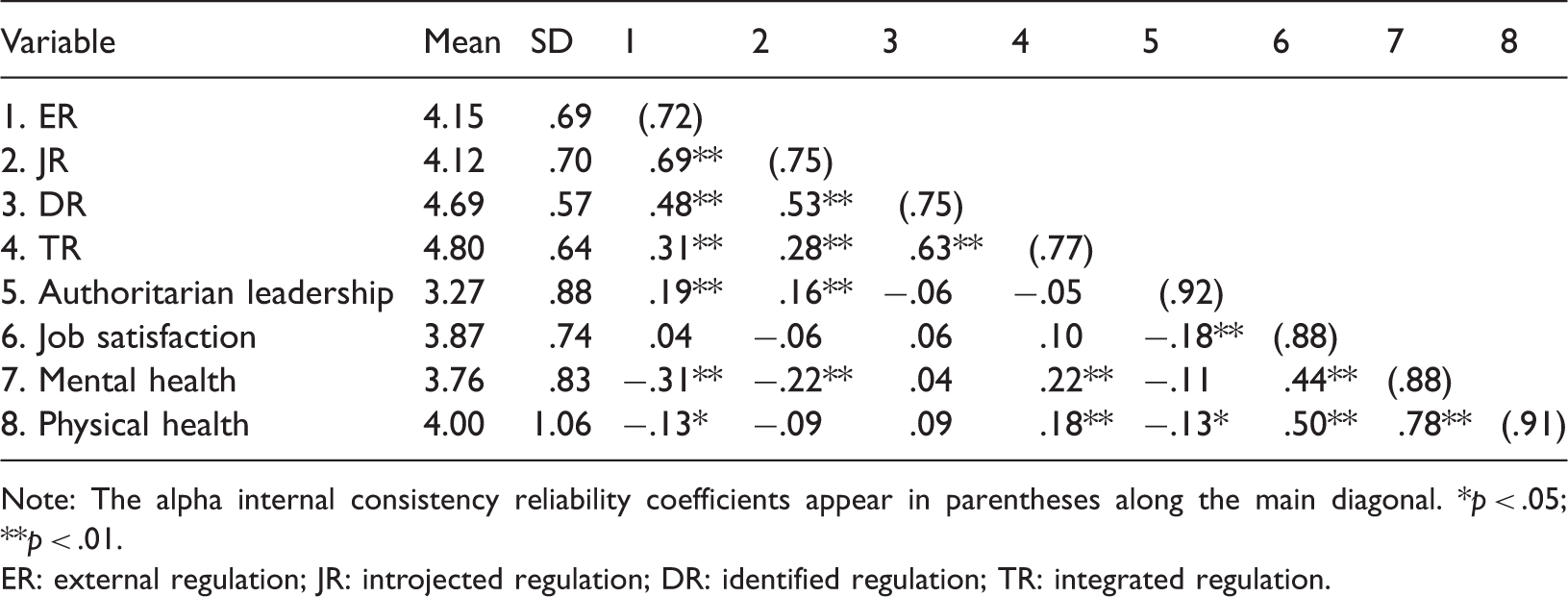
Note: The alpha internal consistency reliability coefficients appear in parentheses along the main diagonal. *p < .05; **p < .01.
ER: external regulation; JR: introjected regulation; DR: identified regulation; TR: integrated regulation.
Moreover, the results of the analysis indicate that significant correlations exist among the various types of SRWNE, authoritarian leadership, and well-being. External regulation of SRWNE was significantly correlated negatively with both mental health at p < .01 and physical health at p < .05, whereas integrated regulation of SRWNE was significantly correlated positively with both mental health at p < .01 and physical health at p < .01.
However, introjected regulation of SRWNE was also significantly correlated negatively with mental health at p < .01. Furthermore, authoritarian leadership had significant positive correlations with both external and introjected SRWNE at p < .01 and p < .01. This means that the respondents reported using more external and introjected SRWNE when they experienced more authoritarian leadership.
Authoritarian leadership also correlated negatively with well-being, with job satisfaction at p < .01 and physical health at p < .05. This means that the more subordinates perceived their supervisors to be authoritarian the less well-being they reported, specifically in regard to job satisfaction and physical health.
Confirmatory factor analysis models
LISREL results of confirmatory factor analysis models (n = 271).
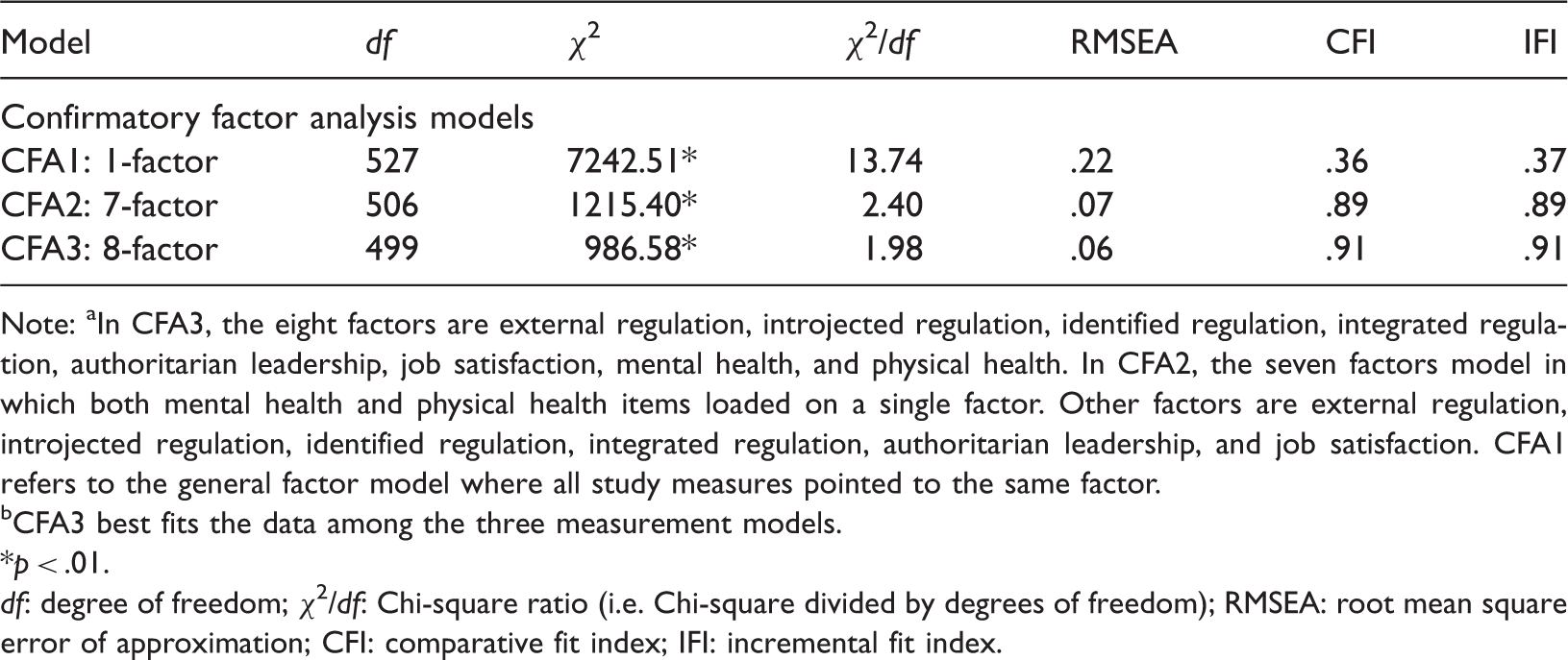
Note: aIn CFA3, the eight factors are external regulation, introjected regulation, identified regulation, integrated regulation, authoritarian leadership, job satisfaction, mental health, and physical health. In CFA2, the seven factors model in which both mental health and physical health items loaded on a single factor. Other factors are external regulation, introjected regulation, identified regulation, integrated regulation, authoritarian leadership, and job satisfaction. CFA1 refers to the general factor model where all study measures pointed to the same factor.
bCFA3 best fits the data among the three measurement models.
*p < .01.
df: degree of freedom; χ2/df: Chi-square ratio (i.e. Chi-square divided by degrees of freedom); RMSEA: root mean square error of approximation; CFI: comparative fit index; IFI: incremental fit index.
Inspection of the fit indices across models indicates that CFA3 fit the data best (χ2 (499, N = 271) =986.58, p < .01, χ2/df = 1.98, RMSEA = .06, CFI = .91, IFI = .91) and yielded a significantly better fit than did CFA1 (Δχ2 = 6,255.93, Δdf = 28, p < .001) and CFA2 (Δχ2 = 228.82, Δdf = 7, p < .001). Furthermore, the 90% confidence interval of RMSEA for CFA3 did not overlap with the confidence intervals of either of the other models (CFA1 and CFA2) (Fabrigar et al., 1999). In CFA3, all items loaded significantly on their posited underlying construct. Therefore, the results demonstrated that the measurement items were reasonably convergent on their respective constructs. Anderson and Gerbing (1988) suggested that to examine discriminant validity, one has to investigate whether the confidence interval around the estimated correlation parameter (фij) of each pair of the constructs excludes the value of one. Our investigation showed that no confidence interval of the parameter for the CFA3 contained the value of one (p < .05), thereby demonstrating adequate discriminant validity of all constructs. In sum, these results provide evidence for the convergent and discriminant validity of the proposed eight-factor model.
Power analysis
In order to determine the appropriate sample size for this study, a power analysis using G*Power 3.1.2 statistical software (Faul et al., 2007) was conducted prior to the study. Based on a power level of .95 and an alpha of .05 for multiple regression analysis with a presumed medium effect size ( f2 = .15) (Cohen, 1998), we need a minimum total sample size of 178. Overall, the current study had sufficient power well above the statistically prescribed levels.
Hierarchical linear regression
Results of regression analyses on well-being (i.e. job satisfaction, mental health, physical health).
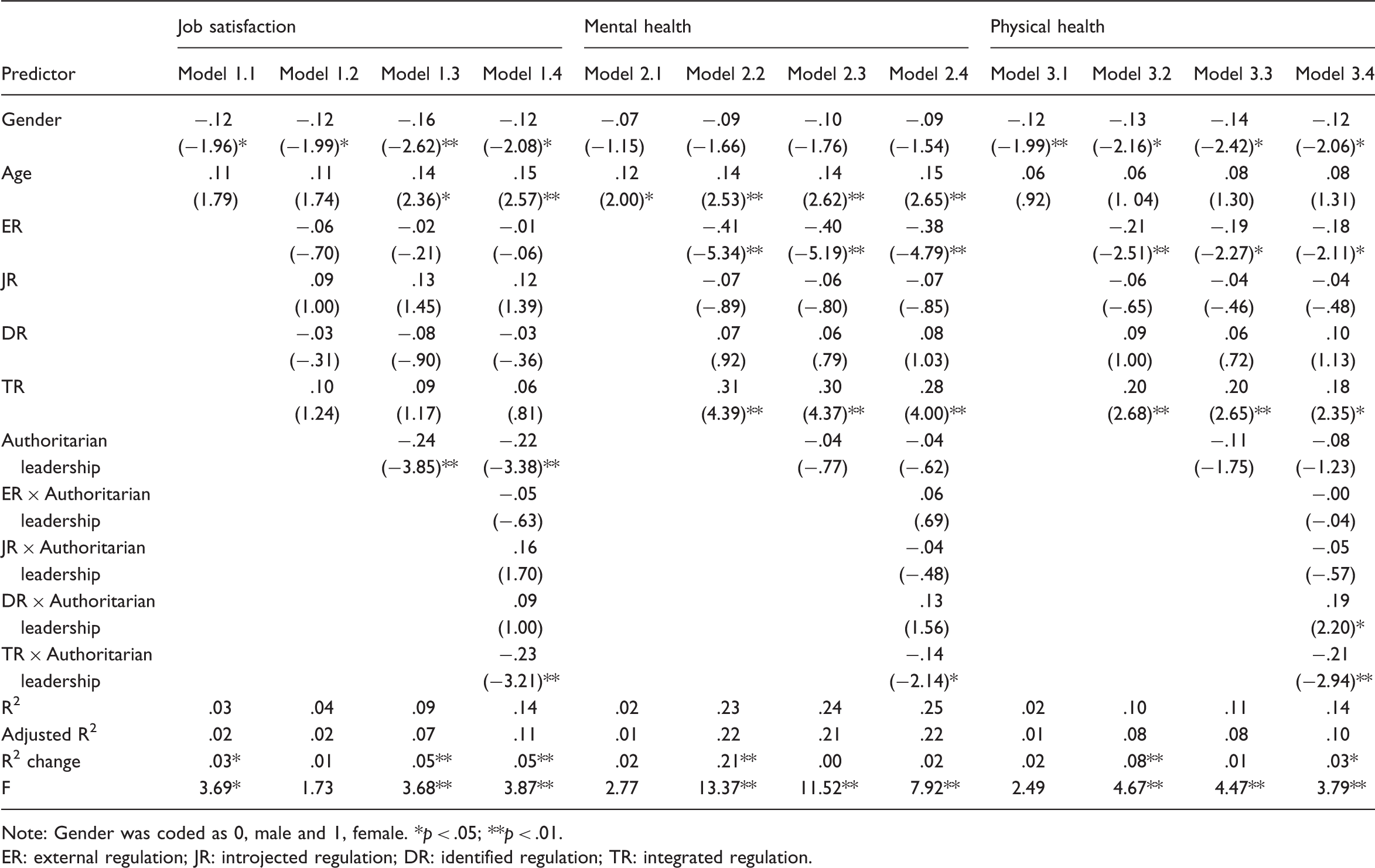
Note: Gender was coded as 0, male and 1, female. *p < .05; **p < .01.
ER: external regulation; JR: introjected regulation; DR: identified regulation; TR: integrated regulation.
Models 1.1, 2.1, and 3.1 show that the control variables accounted for only an insignificant portion of the variance in job satisfaction (3%), mental health (2%), and physical health (2%). Gender was significantly associated with job satisfaction at β = −.12 and p < .05 and physical health at β = −.12 and p < .01, whereas age was significantly associated with mental health at β = .12 and p < .05. The negative signs on the significant beta weight for gender on job satisfaction and physical health suggest that female subordinates were more dissatisfied with their jobs and less physically healthy than male ones, whereas older subordinates were mentally healthier than younger ones.
Models 1.2, 2.2, and 3.2 indicate that the four types of SRWNE accounted for an additional 1% of the variance in job satisfaction at p > .05, an additional 21% of the variance in mental health at p < .01, and an additional 8% of the variance in physical health at p < .01. Additionally, the standardized beta weight for external regulation was significantly associated negatively with mental health at β = −.41 and p < .01 and physical health at β = −.21 and p < .01, whereas the standardized beta weight for integrated regulation was significantly associated positively with mental health at β = .31 and p < .01 and physical health at β = .20 and p < .01. This means that subordinates who used external regulation were less mentally and physically healthy, whereas subordinates who used integrated regulation were more mentally and physically healthy.
These findings provide partial support for Hypotheses 1 and 4, which posited that controlled emotional regulation by external regulation would be negatively associated with well-being and that autonomous emotional regulation by integrated regulation would be positively associated with well-being
Models 1.3, 2.3, and 3.3 indicate that the authoritarian leadership accounted for an additional 5% of the variance in job satisfaction at <.01, but no additional variance or insignificant portion of the variance in mental health and physical health. In addition, the standardized beta weight for authoritarian leadership was only significant at β = −.24 and p < .01 in relation to job satisfaction. The negative sign for the significant beta weight for authoritarian leadership indicates that subordinates were less satisfied with their jobs when they encountered more authoritarian leadership.
We tested hypotheses 5, 6, 7, and 8 by examining the incremental contribution of each of external regulation, introjected regulation, identified regulation, and integrated regulation times authoritarian leadership’s cross-product in terms of job satisfaction, mental health, and physical health after controlling for the main effects of the four types of SRWNE and authoritarian leadership. To prevent multicollinearity problems, we centered the independent variables and the moderator while testing hypotheses 5, 6, 7, and 8 (Aiken and West, 1991).
Models 1.4, 2.4, and 3.4 show that the moderated interaction term accounted for an additional 5% of the variance in job satisfaction at p < .01, 2% of the variance in mental health at p > .05, and 3% of the variance in physical health at p < .05. Additionally, integrated regulation times authoritarian leadership’s interaction was significantly associated negatively with job satisfaction at β = −.23 and p < .01, mental health at β = −.14 and p < .05, and physical health at β = −.21 and p < .01. Identified regulation times authoritarian leadership’s interaction was only significantly associated with physical health at β = .19 and p < .05. We assessed the nature of this significant interaction by plotting values representing plus and minus one standard deviation from the means for authoritarian leadership.
Figures 1, 2, and 3 show the plot of integrated regulation times authoritarian leadership’s interaction with job satisfaction, physical health, and mental health, indicating that among subordinates who had experienced highly authoritarian leadership styles, the level of integrated regulation related negatively to job satisfaction (Figure 1) and physical health (Figure 2), and related positively to mental health (Figure 3). However, among subordinates who had experienced less-authoritarian leadership styles, the level of integrated regulation related positively to job satisfaction (Figure 1), physical health (Figure 2), and mental health (Figure 3).
Plot of interaction between integrated self-regulation of withholding negative emotions and the perceived authoritarian leadership of superiors on job satisfaction. Plot of interaction between integrated self-regulation of withholding negative emotions and the perceived authoritarian leadership of superiors on physical health. Plot of interaction between integrated self-regulation of withholding negative emotions and the perceived authoritarian leadership of superiors on mental health.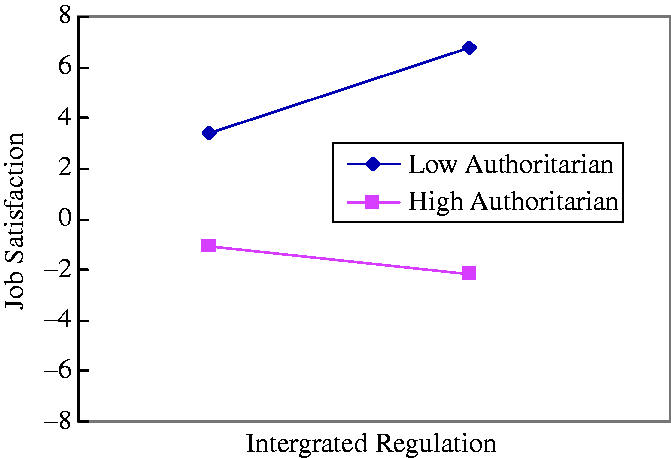
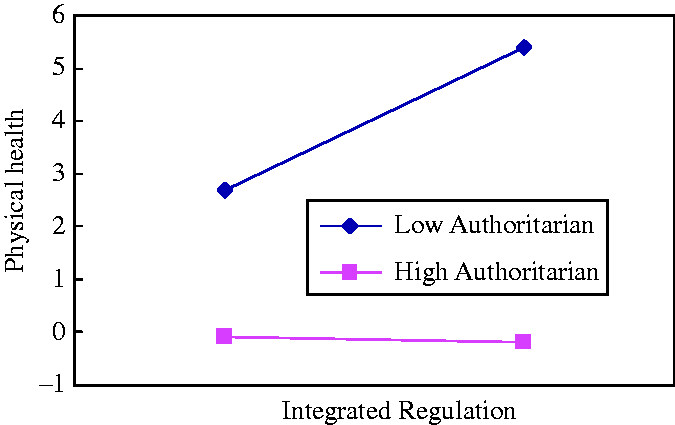
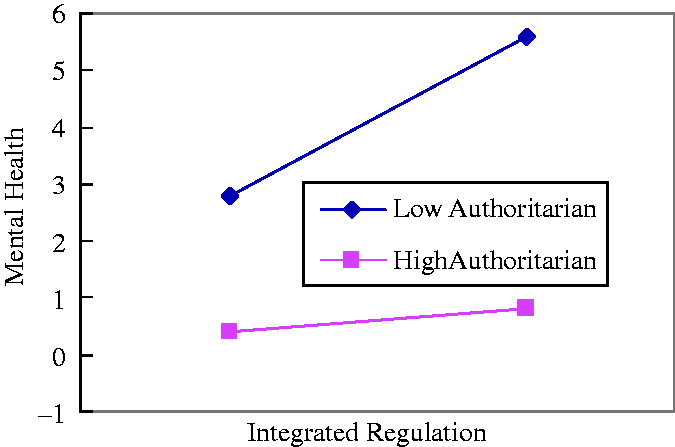
Figure 4 shows the plot of identified regulation times authoritarian leadership’s interaction with physical health, indicating that the positive relationship between the identified regulation and physical health was stronger among subordinates who had experienced a less-authoritarian leadership style than among those who had experienced a highly authoritarian leadership style. This means that we found that authoritarian leadership effectively moderates the relationship between autonomous emotional regulation and well-being.
Plot of interaction between identified self-regulation of withholding negative emotions and the perceived authoritarian leadership of superiors on physical health.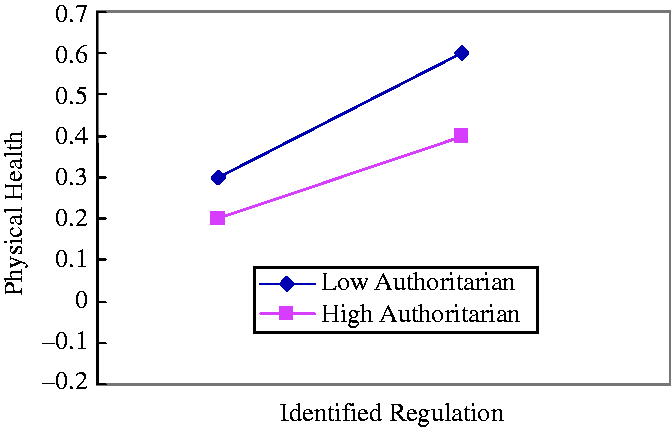
These findings therefore provide partial support for hypotheses 7 and 8, which posited that authoritarian leadership moderates the relationship between autonomous emotional regulation through identified regulation or integrated regulation and well-being. Therefore, when supervisors engage in more authoritarian leadership behaviors, the positive association between autonomous emotional regulation and well-being is weaker than when supervisors engage in less authoritarian leadership behaviors. However, as Table 3 shows, the findings do not support hypotheses 5 and 6 that authoritarian leadership moderates the relationship between controlled emotional regulation through external regulation or introjected regulation and well-being.
Discussion
The purpose of this study has been to investigate the relationships between the internalization of emotional regulation and well-being, as indicated by job satisfaction, mental health, and physical health. Its results support our hypotheses that not only is external emotional regulation significantly associated negatively with both mental and physical health, in line with Kim et al.’s (2002) findings that controlled emotional regulation is significantly correlated positively with psychosomatics, but also that integrated emotional regulation is significantly associated positively with both mental and physical health.
This means that ambivalence about not expressing emotion, rather than inexpressiveness per se, is what fosters ill-being. This assertion is not only supported by Western studies (Katz and Campbell, 1994; Kim et al., 2002; King and Emmons, 1990) but also by this study based on a Chinese sample, leading to the conclusion that the extent of the internalization of emotional regulation has universal value for both mental and physical health.
In addition, this study showed that authoritarian leadership can effectively moderate the relationship between the internalization of emotional regulation and well-being, so that the positive effect of autonomous emotional regulation on well-being is weakened when supervisors engage in more severe authoritarian behavior.
This study’s finding that authoritarian behavior by supervisors can result in their subordinates having a tendency to withhold their negative emotions is similar to Wu et al.’s (2003) finding that supervisors’ authoritarian behavior can result in their subordinates having a tendency to suppress anger. This study has further found that subordinates’ suppression of negative emotions tends to depend on external rather than autonomous forces. This means that when supervisors exercise more authoritarian leadership, their subordinates may fear that the expression of negative emotions is likely to result in punishment or to violate work ethics, leading them to prefer to suppress such emotions.
Authoritarianism is one of several unique leadership styles in Chinese enterprises (Wu et al., 2003). Leaders should focus on the effects that their leadership style is likely to have on their subordinates’ involuntary emotional regulation and ill-being when they manage them. One way in which organizations can effectively lessen the chances of authoritarian leadership occurring is by carefully selecting and training supervisors. They should seek to attract qualified supervisors who can be trained in the requisite management skills that will enable them to act in such a ways that will cause employees to see them as being not only suitably qualified but also fair. Such supervisors should be encouraged to receive further training to improve their interpersonal relationship skills (Aryee et al., 2007).
Limitations and future research directions
Our research has some limitations. One limitation is that due to the methodology of the study, with its one-time cross-sectional design and data collected from a single source, which indicates that some of the reported relationships in the proposed model may be inflated as a result of common method bias (Podsakoff et al., 2003). However, some of our findings were interaction effects, and interaction effects cannot be explained according to the viewpoint that statistical artifacts result from common method variance (Evans, 1985), and the results of the Harman’s one-factor test (Podsakoff et al., 2003) suggest that a single method-driven factor does not adequately represent our data. Moreover, our CFA results provided support for the discriminant validity of the studied variables. Taken together, we believe that the above reasons decrease the likelihood that common method variance was a major factor in our findings. We did, however, make an effort to measure these variables at multi-periods and to collect data for these variables from sources other than the respondents themselves, both of which were likely to reduce common method bias effects (Podsakoff et al. 2003).
A second limitation is that we did not control for other factors that may be related to employee well-being. Although controlling for the demographic variables of gender and age did not change our findings, we were unable to control for such contextual factors related to well-being as job insecurity, work hours, and control at work (Sparks et al., 2001). Therefore, future studies on the relationships between SRWNE, authoritarian leadership, and well-being should attempt to rule out the effects of other variables.
A third limitation is that we cannot provide a profile of those individuals who did not respond in the data collection and for whom, as a result, we only had partial data. Nonresponse bias could exist when respondents and nonrespondents differ systematically with respect to survey measures (Kessler et al., 1995). In order to reduce nonresponse bias in survey estimates, it would be better to investigate differences between the two groups for main variables or demographics in the future.
In addition, although this study supports the conclusion that authoritarian leadership could moderate the relationship between SRWNE and well-being, it was based on a Chinese sample, so we cannot generalize the moderating effect of authoritarian leadership. Comparing practices in different cultures in the future may enable the clarification of whether the moderating effect of authoritarian leadership is specifically related to Chinese culture or if it has universal application.
Future research may explore additional moderators in these relationships. For example, some studies have examined the impact of LMX on their employees’ emotional regulation (Clark and Brisette, 2000; Glasø and Einarsen, 2008). The performance of emotional regulation may be influenced by the quality of the relationship between leaders and followers (Glasø and Einarsen, 2008). The strength of LMX theory is its focus on relationship qualities, such as respect and obligation, and how these qualities determine whether the followers are members of an “ingroup” or an “outgroup” in regard to their leader (Glasø and Einarsen, 2008). If relationships are based on a high degree of respect, understanding, and trust, both employees and the employers or supervisor will be less likely to fake or suppress their emotions than would be the case if those qualities were lacking (Glasø and Einarsen, 2008). Glasø and Einarsen (2008) showed that high LMX quality was associated with less suppression and faking of emotions, for followers in particular. For this reason, creating an atmosphere of trust and confidence is very likely to be regarded as an essential prerequisite for the formation of frank and honest relationships. Clark and Brisette (2000) also found that the kinds of emotional expression during interaction depended on the quality of the relationship. In addition, previous studies have found that LMX to be positively associated with intrinsic motivation (Sherman, 2002; Tierney et al., 1999).
However, the association between such relationship qualities and the autonomous extent of emotional regulation has not yet been investigated. That is to say, future research could examine whether the high-quality relationships in LMX could lead to greater autonomy in the extent of the subordinates’ emotional regulation, and, consequently, whether they experience more well-being.
Conclusions
In line with SDT (Deci and Ryan, 1985), this study showed that the internalization of emotional regulation, rather than inexpressiveness per se, is the predominant factor in predicting people’s well-being, and that this positive relationship was somewhat weakened when authoritarian leadership is more severe. The authoritarian leadership behavior employed by supervisors to pressure or control subordinates has the potential to thwart subordinates’ feelings of autonomy, which in turn undermines subordinates’ self-determined motivation and contributes to the development of controlled motives. When subordinates feel pressured to behave in a certain way, such as suppressing negative emotions, a variety of negative consequences are expected to ensue which are detrimental to the subordinates’ well-being.