



Abstract
The aim of this study is to illustrate the rich potential of using a phenomenological lens to forefront leader–follower interactions in an intercultural and dangerous context, thus providing a more situational, relational, and integral understanding of leadership practices. An interdisciplinary approach that used a phenomenological ontology and a leadership practice epistemology was applied to re-analyze a competency framework previously identified in a larger case study of Australian military advisers during the Vietnam War. We demonstrate the rich promise of an embodied perspective through the words of the practitioner and their own (bodily) interpretations of leading. In so doing, we challenge the Cartesian mind–body dichotomy and acontextual approach that underpins most mainstream leadership studies. The (re)analysis locates two “leaderful practices” and identifies the influence of in situ context in which leader–follower relations are situated. Our results signal the explanatory potential of embodiment and the related influence of context on the processual nature of leadership.
Introduction
We are on patrol, dark night, steaming jungle. The sawgrass cuts. We step warily, listening for a sound; trip-wires, booby traps abound, meld with the earth, waiting for one more step. (Excerpted from Myth of Glory and attributed to John Kent, a Korean War veteran. Retrieved from http://www.angelfire.com/wa/warpoetry/Myth.html)
In war poetry, soldiers 1 are able to convey their acute physical wariness and sensation of being on patrol, centering attention on the physicality of leadership which is so often overlooked in the literature. A growing, but minority, trend in leadership studies has signaled the analytical value of situating leadership in its embodied context through the use of phenomenology (Cheville, 2005; Küpers, 2013; Ladkin, 2008; Ladkin and Taylor, 2010; Pullen and Vachhani, 2013; Ropo and Sauer, 2008; Sinclair, 2005). Such an approach is an extension of two current movements in leadership studies—“leadership as the management of meaning” and the “movement toward follower-centric models of leadership” (Hansen et al., 2007: 548)—and reflects growing criticism of leader competency models (Carroll et al., 2008; Raelin, 2011). This perspective argues that leadership is a dynamic process that is shaped by follower and leader perceptions and reactions to each other (Lord and Shondrick, 2011). In our paper, we build on prior research that has used an embodied perspective to explore the interaction and aesthetic knowledge produced by the practice of leadership (Hansen et al., 2007), in addition to building contextual studies of leadership (Cheville, 2005; Ladkin and Taylor, 2010). Our approach thus offers an alternative to the hegemony of leadership scholarship’s “vested interest in constructing leadership as a bold individual, agentic, and disembodied performance” (Sinclair, 2005: 390). Leadership, after all, nearly always emerges from the locale of a body. The body is simultaneously an entity in the physical world and a symbolic artifact as constructed by culture. While it has its own internal, subjective environment, the body also provides an object for others to observe and evaluate. As both individuals and groups, we rely on our physical bodies and somatic sensations to understand our circumstances and others around us (Classen, 1993, 2005; Geurts, 2002; Howes, 2003).
To demonstrate the analytical purchase of phenomenology in presenting leadership as an “embodied, situational, responsive and creative inter-practice” (Küpers, 2013: 336), we use “leadership-as-practice” (L-A-P, also known as “leaderful practice”) to examine the actions of Australian military advisers who trained and led the Republic of South Vietnam Armed Forces (RVNAF) soldiers during the Vietnam War—a context where leaders and their followers face heightened risk of bodily injury or even death. In such settings, the elemental role of the body in leadership performance is made more visible through the amplified awareness of one’s physicality–mortality and the corresponding increased import of actions and reactions of the body for both self and followers. We find it striking that few studies have explored the research potential of this topic in embodied leadership. Our paper thus aims to demonstrate that “investigating bodies and bodily responses … opens different ways of knowing leadership” (Sinclair, 2005: 404).
By explicitly acknowledging and incorporating the role of the body in our analysis of leadership, we challenge the Cartesian dual perception of the mind–body schema (Descartes, 1985) that is prominent in Western scholarship (Sinclair, 2005). This perceived duality neglects the role of the body in how leadership is manifested and transmitted to followers (Ladkin and Taylor, 2010) and the interplay of mind–body through somatic responses (Merleau-Ponty, 1962) as shaped by the environment (Goffman, 1963). A phenomenological lens offers insight into this interconnection of thought, action, environment, emotion, and resources of leadership (Gibson and Hanes, 2003) within a network of social relationships that are both individual and collective.
Phenomenology is an interpretive research methodology that provides an avenue to an in-depth understanding of the nature and meaning of real-world experience (Van Maanen, 1997) vis-à-vis the body. Within leadership studies, Merleau-Ponty’s (1962) work provides an important foundation for “approaching and interpreting bodily and embodied practices as well as the creative interplay of leading and following in situated everyday-life” (Küpers, 2013: 336). For example, phenomenological approaches have been used to conceptualize the construction of knowledge (Conklin, 2007), the decipherment of one’s “calling” (Conklin, 2012), the role of the somatic self in embodied authentic leadership (Ladkin and Taylor, 2010), and the narrative practices of strategy-making (Burgi et al., 2005; Küpers et al., 2012).However, many of these prior studies are strongly conceptual with little empirical analysis. Moreover, the felt experience of leadership as interpreted through leaders’ own words is lacking, a gap which our paper addresses.
Phenomenology and embodiment
There is strong encouragement within leadership studies to consider the role of context as “a sensitizing device that makes us more aware of the potential situational and temporal boundary conditions to our theories” (Bamberger, 2008: 840). This mounting interest in the influence of context on leadership (Bamberger, 2008) demands better purchase on the conceptual merits and potential applications of embodiment theory. Within studies of embodiment, phenomenology approaches offer a rich theoretical framework for understanding how the body is mediated and experienced within individual and collective contexts (Wilson, 1988).
Phenomenology, as founded by Edmund Husserl (1859–1938), is an epistemological philosophy that emphasizes one’s lifeworld, or “lived experience,” in the structuring of consciousness and subjectivity (Husserl, 1962). Merleau-Ponty (1962) refined this notion by introducing the idea of “embodied consciousness.” “Embodied consciousness” emerged when Merleau-Ponty (1962) argued that Husserl’s concepts of consciousness, the lifeworld, and intersubjectivity were all experienced through the body. According to Merleau-Ponty, we live the world through our body; moreover, the body is not separate from the self. When two individuals meet, they are embodied consciousness that bring their own spatiality and temporality, which can then have an impact on both individual’s bodies and consciousness. Individuals thus come to live in their bodies structured by their social position in the world (Heidegger, 1962; Schutz 1967). This social position is reciprocally conditioned by and reproduced through the embodied actions of others (Merleau-Ponty, 1962; Meskell, 1999).
A phenomenology framework privileges the sentient nature of the body in this in situ context. According to this approach, formulating identity through one’s sense of the body involves an intricate network of performance and experience which includes gestures, kinetics, proxemics, and movements, as well as using the body as a scene of display (Csordas, 1994; Jackson, 1983; Turner, 1982, 1986). How someone moves through a space, the noises they hear, the temperatures they feel, the clothes they wear, and the people they see all become constituting and important elements of analysis.
Wilson (1988) captures this practiced, sensory perspective of embodiment with the concepts of somatic precursors and relationality. Somatic precursors refer to “emotional bodily reactions,” such as the feeling of queasiness when anxious or the heady rush of elation (Ginsberg, 1984; Wilson, 1988). Relationality emphasizes the ways that the body becomes knowable through its relationship to others around it. In this action/reaction model, an individual is made aware of their embodied self as the sentient body is “culturally consumed by a world filled with forces, smells, textures, sights, sounds and tastes, all of which trigger cultural memory” (Stoller, 1994: 636).
This awareness of the body in context is not experienced on solely an individual level, but is navigated within the dynamics of a group, such as among a leader and followers. An individual always moves through the world mediating physicality, structure, meaning, and individual experience in a larger collective body (Csordas, 1990, 1994; Wilson, 1988). Embodiment is thus both an “intersection of actors and actions” and a “process of consciousness enacted, felt, and made real in the body” (Lassiter, 2002: 140). As embodiment is experienced simultaneously on an individual level and is “negotiated in a larger community-centered dialogue” (Lassiter, 2002: 140), the boundaries between the individual and collective merge and the processual, relational, and situational nature of leadership is revealed.
Embodied leadership
Some leadership scholars see embodied leadership as a possible antidote to the shortcomings and limitations of prior studies that have largely embraced a positivistic view—one that attempts to codify objective knowledge through a mainly symbolic and connectionist conceptualization (Lord and Shondrick, 2011). As Lord and Shondrick (2011) observe: “embodied, embedded views of knowledge have the distinct advantage of bringing perceptual, motor, and introspective process to bear on our understanding of leadership” (p. 217). Studies concerned with embodiment in leadership have highlighted issues of bodily presence, body language, bodywork, and embodied knowledge (Ropo and Parviainen, 2001; Ropo and Sauer, 2008; Sinclair, 2005). In this vein, Hansen et al. (2007) called for a new approach within leadership studies called “aesthetic leadership” that would reference the “sensory knowledge and felt meaning of objects and experiences” (p. 545, emphasis in original).
Two recent special issues signify growing traction of these approaches in mainstream leadership studies. The International Leadership Association published a 12-chapter volume on embodied leadership in their annual Building Leadership Bridges series. In the introduction, Melina (2013: 15) notes, “that leadership is not something ‘housed’ in an individual (a person with a body) but is a discourse that is performed by a person … in relationship with others … that both reveals and constitutes identity.” Of particular relevance to this paper’s focus on the embodied dimensions of situated interaction and context, several of the chapters examine the relational and contextual dimensions of leadership, including through gendered perspectives and body language (Hanold, 2013; Mendez and Mora, 2013; Salovaara and Ropo, 2013; Wilhoit, 2013; Winther, 2013; Yost, 2013). The publication of a Special Issue in Leadership also threw a spotlight on the growing interest in the role of the body as a vehicle for transmitting and understanding leadership. The special issue explores the “ways in which affect, materiality and leadership connect” in recognition that leadership is an “over-cognitivized phenomena” (Pullen and Vachhani, 2013: 315). For example, both Ladkin (2013) and Küpers (2013) examine the embodied perceptual process involved in leader–follower relations and its salience to the invisible, but knowable, reactions between leaders and followers. Making the case for stronger attention to material and spatial context Ropo et al. (2013) examine how spaces and places construct and perform leadership through symbolic meanings, power, and felt experiences that are captured in material places.
In a similar approach to this paper, Lord and Shondrick (2011) illustrate how incorporating multiple views of knowledge—symbolic, connectionist, and embodied—can facilitate a fuller understanding of leadership processes. The authors (2011) applied this triplex of perspectives to examples drawn from both follower-centric and leader-centric research. For example, they demonstrate that embodied views of knowledge, leadership perceptions, and memory are useful in understanding how appearance (i.e. race) (cf. Rosette et al., 2008) and gender (cf. Scott and Brown, 2006) and even voice quality (cf. DeGroot and Motowidlo, 1999) may be antecedents of leadership perceptions.
Despite the recently developed and rich body of work, what is missing is the voice of the practitioner and their own (bodily) interpretations of leading. With a similar aim as Lord and Shondrick (2011) in showing the promise of an embodied perspective on leadership studies, our study uses a phenomenological lens to explore the practice of leadership as reported in a case study of military leadership – an ontological approach that is supported by a practice epistemology.
L-A-P
To this end, the emergent “L-A-P” (Raelin, 2011) orientation provides a useful link between phenomenology and the integration of the body–mind in context. L-A-P is derived from social theory (Bourdieu, 1977/2002; de Certeau, 1984; Heidegger, 1926/1962), which allows for the exploration of the lived, or felt, experience of leadership and how they “get on” (Chia and Holt, 2006: 647). As noted earlier, the domain of leadership studies has expanded in recent years from a focus on the internal attributes associated with effective leaders (i.e. competencies) to broader inquiries that are inclusive of the contexts in which leaders and followers are dynamically embedded and interact over time (Avolio, 2007). One means through which to explore L-A-P’s emphasis on context is through Goffman’s (1963) notion of situational interaction. Goffman’s (1963) situational view of social interaction is useful in that it highlights nonverbal (embodied) and relational aspects of leader–follower interaction, while also taking into account “‘the full spatial environment’ within which two or more persons in co-presence are able to mutually monitor each other” (p. 18).
As presented here, we therefore hold that L-A-P is a useful bridge between theory and practice (Carroll et al., 2008; Raelin, 2011). Carroll et al. (2008) claim even more forcefully in their critique of the “ubiquity of competencies” in management studies that leadership risks becoming “an impoverished and largely mechanistic imperative” without a practice orientation that captures the “lived experience” so that researchers engage with real-world problems (p. 363). In his proposed epistemology, Raelin (2011) shifts the focus from content of knowledge to the processes that ultimately encourage more “knowing-in-action” or “actionable knowledge.” The L-A-P model can thus “unite the micro (‘the situated doings of individual human beings’) and the macro (‘different socially defined practices’)” (Jarzabkowski et al., 2007: 7).
The value of this epistemology in leadership studies is that it provides the theoretical and methodological strength needed to integrate context more firmly into leadership analysis. Context, the “cultural configuration of reality” (Duranti, 2010: 18), is an intersection of inter-practices (relationality), place (physical–material), and space (ideational–cultural). Ropo and colleagues (2013) designate “place” as material locales with physical qualities and “space” as the subjective, cultural experience of place, a “product of our mental powers and imagination” (p. 381). These dimensions of the lifeworld (Husserl, 1962; Merleau-Ponty, 1962) constitute the context of lived or felt experience through which the practice of leadership unfolds in embodied, relational, and situational terms.
Case study and context
In an effort to demonstrate the rich promise of an embodied perspective on leadership studies, we (re)analyzed data from a larger case study of military advisers (Fisher, 2010) conducted by the lead author that utilized a competency framework. We hold that the analysis of evaluation of military leadership is particularly suited to a phenomenological approach as noted by Hunt and Phillips (1991: 426) who stated, “We can see fighting empirically as an illustration par excellence of nonlinear thinking guided by gut feel and intuition … It requires a high tolerance for ambiguity and the ability to make sense of novel situations.” The larger case study is described in brief below.
Military leadership: The Australian Army Training Team Vietnam
The Australian Army Training Team Vietnam (AATTV) was comprised of professional soldiers who trained and led RVNAF units (inclusive mainly of the majority ethnic Vietnamese group and the indigenous tribes located in the Central Highlands who were known colloquially as the Montagnard). The advisers were exposed to intense levels of conflict, in addition to several other stressors, such as isolation, language, and cultural difficulties, and known infiltration of RVNAF units by the Viet Cong (Davies and McKay, 2005; McNeill, 1984). As a unit, they are the most highly decorated in Australian military history (Ham, 2007), and their individual military effectiveness is supported by the receipt of personal awards from both Australian and foreign militaries (Davies and McKay, 2005).
In the original case study, military advisers interpreted their experiences of leading in combat, what effective leadership ‘looked’ like, and what was the influence of leading and training Vietnamese soldiers in a life threatening environment on their own understanding of leadership. Based on the central aim of this paper to capture how the body-mind transmits leadership and the inter-practices of leader-follower relations in situ, the case study was (re)analyzed using an interdisciplinary approach as informed by phenomenology and a practice epistemology.
Types of physical and mental stressors in an extreme context.

Source: Adapted from Stress and combat performance, 2000, Aberdeen, MD: U.S. Army Center for Health Promotion and Preventive Medicine, p. 4.
Method
A central assumption that underlies phenomenology is that humans seek meaning from their experiences and from the experiences of others, a mutually constituting process that is inherently contextual. Meaning, or knowledge, is a “product” of human experience and “to understand the meanings another assigned to his or her actions require[s] that these meanings be placed within context” (Smith, 1983: 8). The use of qualitative data is thus appropriate to this analysis since this method allows for contextually rich identification, description, and explanation–generation (Crabtree and Miller, 1992), and is epistemologically emic in the way it privileges the perceptions and world views of the informants (Raelin, 2011).
The original data set used a rich combination of primary and secondary data that used three different sources in the analysis. These multiple sources of data allowed for tests of convergence and provided data for triangulation, which was necessary to ensure validity of the results (see Miles and Huberman, 1984; Yin, 2003). In qualitative case studies, triangulation is “generally considered a process of using multiple perceptions to clarify meaning, verifying the repeatability of an observation or interpretation” (Stake, 2005: 454) and a way to identify “the multiple realities within which people live.” The first source of primary data comprised of seven interviews conducted by the lead author in 2006 and 2007. The second source of data comprised of 17 interviews conducted in the 1970s by the official Australian Army historian at that time (McNeill, 1984). These interviews were located in the Australian War Memorial archives. The third data source, obtained through an online database, comprised of nine interviews that were randomly selected from the Australians-at-War film archive project, which collected the oral histories of 37 AATTV informants in 2003.
Analysis
The original analysis closely adhered to the guidelines for naturalistic inquiry (Lincoln and Guba, 1985) and constant comparison techniques (Glaser and Strauss, 1967) as each interview was systematically read and re-read. Transcripts and other data were initially coded using the software program QSR NVIVO 7, which served as a useful platform for organizing the data. Key themes that arose in the interviews and archival documentation were coded in “chunks” through the use of “thick description,” which is described by Denzin (1989: 91) as “biographical, historical, situational, relational, and interactional.” Thick description, in turn, leads to “thick interpretation” (Denzin, 1989: 91), which is designed to reveal both the conceptual and contextual structures implicit within an informant’s behavior while recognizing that multiple meanings will always be present in any situation. This approach also stayed true to the phenomenological methodology of holistically describing an experience in the informant’s own words and minimizing interpretative biases (Van Maanen, 1997).
Military leadership competencies and context.
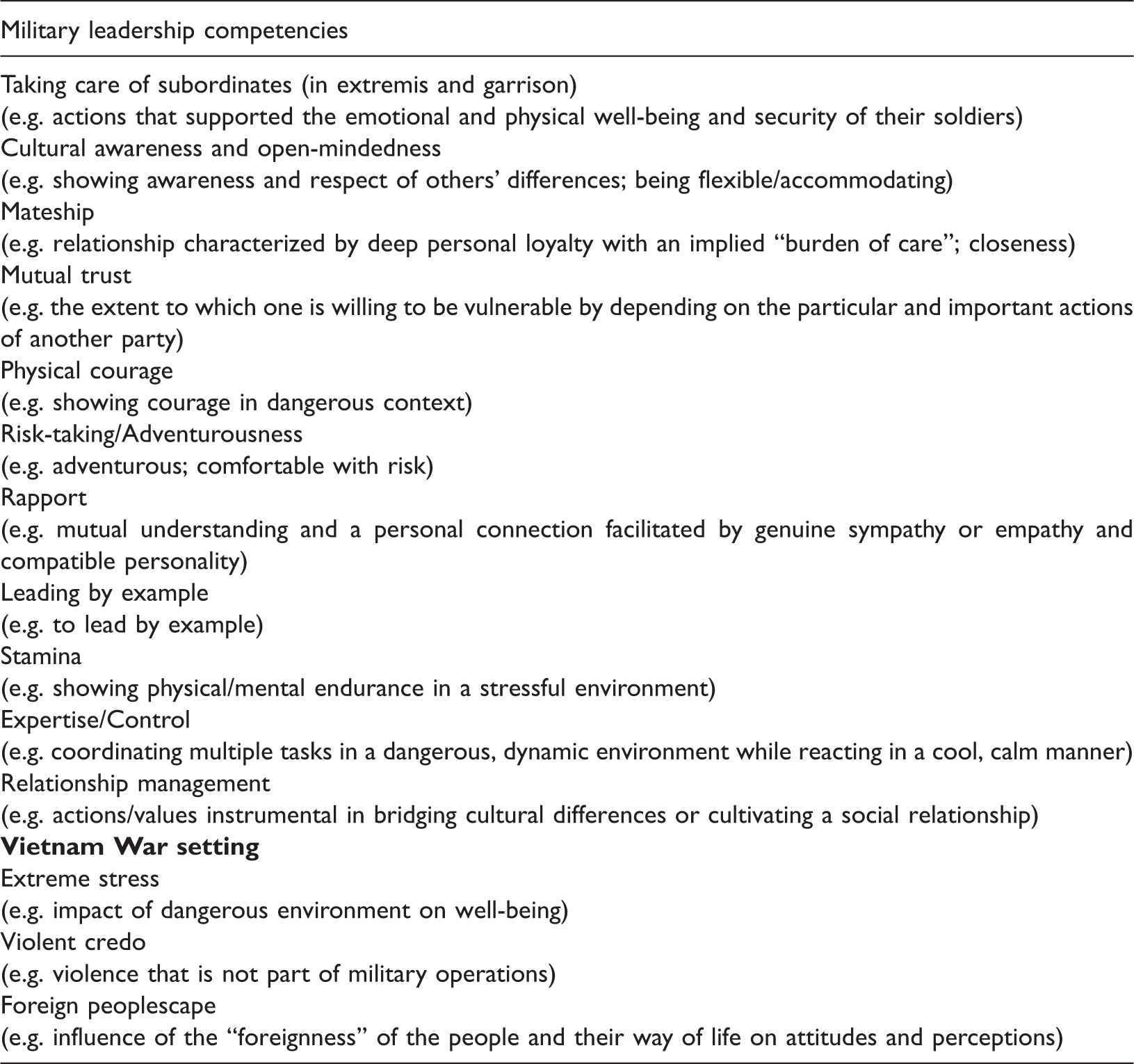
In our (re)analysis, we revisited each competency and contextual construct as embedded within the advisers’ narratives to seek out and illuminate the role of the body through reflexive, collaborative inquiry. Our approach as collaborators from two different disciplines (the lead author is a retired Navy veteran who teaches and conducts research in a business school; the second author is an anthropologist who teaches and conducts field research in an arts and sciences school) with distinct ontological and epistemological preferences further facilitated a rich, integrative analysis of the practice of leadership.
In the following discussion, the use of an interdisciplinary phenomenological framework facilitated a fine-grained analysis that shed light on the interplay of cognition and action as viewed through the body and as interpreted by the military advisers. Due to space limitations, we expound on the two leaderful inter-practices deemed most effective in advancing the paper’s aim to demonstrate how an embodied perspective “opens different ways of knowing leadership” (Sinclair, 2005: 404). We then examine how this embodied lens into the inter-practices of leaderful action simultaneously opens up and demands attention to the shaping influences of in situ context, the “full spatial environment” (Goffman, 1963: 18), inclusive of material–physical places (Ropo et al., 2013) and cultural–ideational constructs (Lefebvre, 1991; Stoller, 1994), in which leader–follower relations are situated.
Discussion
Our attention to ‘embodied consciousness’ in the analysis of the interviews illuminated the pervasiveness of descriptions which couch advisers’ experience and leadership in terms of their somatic experiences of the war in Vietnam. Bodily sensations were controlled through training and sometimes sheer will. Other times, the body was sedated and/or subdued through alcohol or sex. In the extremis of the setting, the physicality of the body comes to the fore and its influence on leadership identity formation and action is brought into sharp relief. Leadership in a foreign setting that is characterized by deep cultural and language differences demands congruence between thought and action to pass followers’ scrutiny. In a life-threatening context, a leaderful practice also demands a level of courage and genuine concern for their followers that cannot be faked. These dynamics become analytically accessible through an embodied perspective, which parses or “brackets” subjective, embodied experience into knowable encounters, actions, experiences, and emotions at both individual and collective levels. We begin by singling out the situational, relational, and aesthetic dimensions of leader–follower relations (inter-practices) before highlighting the influence of context (in situ) on embodied leadership. We further highlight the richness of a phenomenological lens by translating the competency and context framework as illustrated in Table 2 into leaderful practices in situ.
Inter-practices
In the recollections of Australian military advisers who trained RVNAF forces in the Vietnam War, leaderful action emerges in large measure as a reflection of embodied, aesthetic inter-practices between a leader and follower(s).
Leading by example
[He] gets shot in a bad place through the thigh and of course he wasn't too good. After they'd taken the position Leary sat down and as a platoon commander normally does he sights the right machine-gun, he did that, he told everyone where to go. . . And with that after he'd placed everyone in position he said to the stretcher-bearers, “Now you can take me out,” but that's the type of man he was.
The forms of leadership cultivated and expressed by Australian military members reflected a military warrior ethos in which the credibility and effectiveness of the leader was reinforced through a leadership identity that was explicitly grounded in the use, manipulation, and control of the physical body. Informal norms of military culture promoted a “warrior” image of being physically and mentally tough, as observed by an informant: “When you have, sort of, command, you can’t show weakness, you know, you have got to hold yourself together.” At this proximal level, leaders use their bodies to build trust among the people they are leading. Using the body in this relational manner as a vehicle of display was particularly important in an intercultural context such as the Vietnam War where the Australian advisers could not rely on verbal commands or other linguistic direction; instead, their leadership was embodied by what they did and how they enacted what it meant to be a warrior in that moment.
In the dynamics of a military combat setting, the embodied nature of this situated action emerges compellingly through the leader’s use of the physical body as exemplar. Leading by example is at the core of “doing” leadership and a key element in embodiment. As reported by the Australian advisers, to lead by example meant leading from the front, sharing the same physical demands and risks as the soldier, and exhibiting exemplary behavior at all times. This could mean physically leading via direct movements and actions, or providing specific task training. Through exemplar leadership in the most literal, physical sense, military leaders in combat action were able to motivate and inspire the soldiers who were fearful or inexperienced (or both). “To get them going again,” one informant described, “I had to personally lead them on down the trail despite their (and my) fear of treading on another mine. After less than an hour they were okay again and had regained some confidence.” Without such exemplary leadership, military leaders lost trust and credibility with their soldiers.
The situated interactions of these individual military leaders (micro) were mediated by socially sanctioned practices (macro) which grounded leadership in a military ethos that both demanded and celebrated physical stamina and bravery (Jarzabkowski et al., 2007: 7). Effective leadership required leaders to appear immune to the normal pain, emotion, and fear of someone who is not a soldier, as phenomenological interests in experiences of pain and suffering help to untangle (Hollan and Wellenkamp 1994; Jackson, 1999; Throop, 2010). In first measure, they needed great stamina, defined as the power of sustaining both mental and physical fatigue (Palinkas and Suedfeld, 2007). Several of the informants reported participation in operations despite being physically compromised or wounded. One soldier collapsed over a map from acute illness while attempting to coordinate artillery support during combat, while another informant, a platoon commander who had been shot in the thigh, refused to be taken out of the combat field until he had placed all of the company soldiers and weaponry in position. The physical stress of these combat leadership experiences obligated Australian leaders in Vietnam to exhibit tremendous bodily manipulation and control in order to be effective. In second measure, in a largely masculine culture such as the military (Dunivin, 1994), showing physical courage was an important part of an Australian soldier’s identity as a “man” and a “warrior” (Leadership in the Australian defence force, 2007; Meecham, 2000). This physical courage is interpreted in concrete, embodied terms: where being brave under fire is the ultimate litmus test, the distinguishing marker between the coward and the courageous is that the courageous moves and the coward freezes. Physical action is thus equivalent to being an effective leader.
These physical extremes were united and interpreted under a military ethos which integrates qualities such as honor, bravery, heroism, stoicism, absence of emotion, duty, and adventure, and which is a key symbol of masculinity in the gender and war literature (Hutchings, 2008; Sasson-Levy, 2008). A focus on embodied practice parses the complexity of this phenomenon and highlights that leadership identity is a composite of socially sanctioned roles, which individuals enact as part of a group (Wilson, 1988). Individually, this leadership identity is experienced as both “situated practices and embodied relations” (Meskell and Preucel, 2004: 121), which are part and parcel of the “cultural configuration of reality,” context (Duranti, 2010: 18). These leaderful actions were further interpreted and assessed by followers through a leader’s practice of relationship management.
Relationship management
Interviewer: [Why did you trust the Australians during combat?] Vietnamese soldier: “… during time, [you] eat with them, have coffee with them, sleep together, friendship develops. The way they look after me.
The interplay of the body–mind in exemplar leadership emphasizes how military leaders are responsible for their soldiers’ physical and emotional selves in a reciprocal relationship that is captured by the practice of relationship management, which included rapport, mutual trust, mateship, and taking care of subordinates. As central features of relationship management, mutual trust and mateship (also known as the Australian concept of two-man or “buddy relations”) underscore the emotional and psychological relationships that exist and are cultivated in the dynamic space between leader and follower. The type of personal sacrifices made by one mate for another ranged from simply assuming a mate’s extra duty if he were ill to the ultimate sacrifice of one’s own life to remain with his dying mate when in the field. As one military adviser explained, “I think it’s the fact that everybody puts their life on the line for the next fellow. It’s not a matter of bravado, it’s just that you know that your life depends on him and his life depends on you and that’s it … The fact that you do trust them with your life is that you make lifelong friends with them.” For another military adviser, the depth of this bond was so great that the relationship became one best characterized in the embodied, physical language of familial relations, “You belong to this brotherhood.”
This practice extended beyond the combat setting. The Australian military advisers were also embedded in garrison settings, highlighting that military leadership is strategic and tactical, but also intimate and domestic. It is through these daily, prolonged contexts that leaders build relationship bridges, including rapport and mutual trust. This was particularly true given the intercultural nature of the Australian-Vietnamese context, in which Australian military advisers trained Vietnamese soldiers. Through these close and informal contacts, Vietnamese soldiers were able to observe Australian soldier’s behaviors, building trust and translating knowledge in spite of language and cultural barriers.
The use of the body as a scene of leadership display featured prominently in these interactions. Men slept together, ate together, and cleaned their units together. This meant at times eating raw buffalo meat or chicken heads served with “gluggy” rice and sleeping on the ground or in hammocks (McNeill, 1984). The Australians reported bolstering cohesion in their units by engaging in a friendly manner with their soldiers through simple activities such as sharing a cup of tea or package of food, showing pictures of family members, humor, and other similar forms of interacting with their soldiers (Janowitz and Little, 1974). Conversely, this interaction allowed the Vietnamese soldiers to closely observe the Australians’ daily habits and professionalism as a soldier, which either enhanced or undermined their credibility as a leader.
The use of the body in engendering this effective inter-practice leadership is further revealed in the attitudes of reciprocity reported by leaders and their soldiers, and the metaphors they used to express them. As one leader explained, “It has to be a two-way street. I take care of the men; they men take care of me … And that’s how we survived the war.” This symbiotic relationship is expressed in bodily metaphors for rapport and connection. Another veteran observed, “I found it to be a matter of trust and rapport, if you didn't like Vietnamese they could smell it and they would not do anything for you other than be polite. Once you established a rapport, you could help influence the way they did some things, but not all” (emphasis added).
Leadership is contextualized across these interrelated domains, physically performed as an expression of body, self, and group interactions. Through a phenomenological approach, the emergence of key “leaderful” inter-practices in a highly complex setting is better understood. Simultaneously, the analysis calls for stronger attention to the influence of context on shaping a leader’s somatic responses to both self and followers as detailed in the following section.
In situ
Approaching leadership through the lens of embodiment “places” individuals “in situ”—in physical and ideational spaces which reflexively shape the leadership process. For the Australian military advisers tasked with training the RVNAF in Vietnam, the extreme context and intercultural setting in which they operated as leaders were an un(der)-known setting which unsettled their somatic bodily precursors (Wilson, 1988) and impacted their sense of relationality and (leaderly) self.
Extreme context
My interpreter out in the bush . . . he stepped on a mine, blew off his leg, and blew me over and feeling a bit of pressure I guess . . . and we went out to dinner and I’d obviously had too many beers and I started to swear. And I couldn’t stop and I have no idea and I wasn’t drunk . . . just couldn’t stop swearing and I ended up excusing myself . . . and I felt awful about it . . . I guess that’s a bit of stress.
To be clear, decisive, and forceful in his/her actions is critical as a military leader. But many informants described experiencing a mental haze because of the extraordinary physical stresses and bodily tiredness that characterizes the combat experience, such as described by the Korean War veteran at the beginning of this paper. The disruption of sensory experiences not only potentially compromises effective leadership but also sense of self. The nearness of death, loud noises, and disturbing sights, known as the “fog of war” (Marshall, 1947), requires soldiers to learn, adapt, and respond quickly to the ever-evolving dynamics of an extreme context and to do so through their physical senses.
The stability of the soldiers’ physical senses, however, may become comprised by their material surroundings and by the emotional stress brought on by the extreme context. Beyond the stressor listed in Table 1, additional stress factors associated with a combatant setting, may be grouped into the following exposure categories (Adler et al., 2003: 9) : “threats to self,” “body handling,” and “patrol experiences.” Threats to self may involve experiences such as being attacked or ambushed, seeing dead or seriously injured unit members, or having to aid in the removal of unexploded land mines. Body handling involves experiences such as seeing dead bodies or body parts, handling bodies, or smelling the stench of decomposing bodies, while patrol experiences involves having contact with traumatized civilians, having to exercise restraint while patrolling, seeing children who were victims of war, and similar activities.
Studies suggest that experienced soldiers have an emotional life span from 30 to 250 days of combat (Helmus and Glenn, 2005). Militaries traditionally mitigate these stresses of war through social and leisure activities, which offer culturally-sanctioned, familiar mechanisms for the release of bodily and mental stress. Playing cards, eating, and overuse of alcohol provide social and bodily release. For many combatants, hard drinking is part and parcel of being a good fighter, warrior, and team member (Ames et al., 2002; Bray et al., 1992). As one informant related, “Make it out and the booze was the release mechanism, and the cigarettes and the women (or so I’m told).”
For some, overuse of alcohol was part of a wider experience of bodily and cultural risk-taking behavior termed a “violent credo.” When individuals are constantly bombarded with action, fear, and mortality, frequent states of adrenaline becomes normalized; the context alters the body in a very direct physiological and emotional way. Some informants expressed feeling so numb that they needed to seek out hyper-adrenaline activities in order to feel alive. In the findings, this “recreational violence” (as opposed to operational violence in combat) consisted of deadly games performed by soldiers using loaded weapons and hand grenades. Addicted to adrenaline, the physical danger became a source of motivation in itself and was intentionally introduced by some soldiers into their context.
The practice of risk-taking/adventurousness may be better understood by considering the phenomenon of “flow” (Harari, 2008). Historical memoirs from Homeric Greece to medieval Europe report positive combat experiences that greatly resemble the phenomenon of flow (Harari, 2008). According to Nakamura and Csikszentmihalyi (2002: 90), flow is “experience [that] seamlessly unfolds from moment to moment; one is fully concentrated on the present moment; goals are immediate and clear; action and awareness merge; and reflective consciousness is lost.” It is not unusual for soldiers to enjoy the excitement and challenge of leading in such an extreme environment like war (Kolditz, 2007; Valentine, 2002), as illustrated in an anecdote by a Vietnam veteran (Hurford, cited in Donnelly, 2001: 42): “That was my first contact. The heart and head were thumping. It was an unbelievable rush of excitement – my God, it's real, it's all happened, we're actually firing bullets at each other.” This pleasurable state may be cultivated through a risk-taking orientation and helps account for its presence in the data.
Tellingly, soldiers describe this harmony of mind, body, and psyche in embodied, sensory terms: “When the doors opened at Tan Son Nhut we first got the smell of a country at war. All the smell of the tropics as well, the spices and the dog shit as well as the stink of expended ammunition. It is a great smell. If they could bottle it they could make a fortune I kid you not. Talk about pheromones. And for me that was the first time and I have never lost it.” This phenomenon may explain why some soldiers are drawn to the danger and excitement of a war zone and places risk-taking in context.
Intercultural setting
You know, you’re walking this line between they’re the civilians or are they the enemy, all the time.
Upon arriving in Vietnam, Australian military advisers were confronted with leading in an unfamiliar physical–material space which often bore little resemblance to the landscape in which they were raised or trained. Moreover, as advisers they typically worked in isolation from their parent unit and had limited to no contact with other unit members.
The discombobulating unfamiliarity of the physical setting was further compounded by the influence of the “foreignness” of the people and their way of life on attitudes and perceptions. Highlighting that the “foreign peoplescape” is not just a physical surrounding but cultural–ideational, the military advisers describe the astonishment, tensions, and ethnocentric responses that emerged over culturally different expectations regarding food practices, latrine behavior, gender relations, and death/burial treatment, among others. These incongruities were not made easier by language barriers, which necessitated the use of interpreters and which introduced an additional layer of communicative complexity in leader–follower relations. Working from within this intercultural, multi-lingual context, embodiment had to convey specific leaderly action, as leadership often had to be observed and derived through nonverbal communication. As reported by an RVNAF commander, trust was conditional and developed over time and through “testing”: “Testing means . . . if we go out on operation then we’ll see who’s going to start to run. Who’s going to be the most brave guy. Who is kind of wishy-washy.”
By challenging the dichotomy of the mind–body in our analytical approach, the role of context on shaping mental and physical responses and their interactions with one another became more apparent. This contextualized approach helped clarify when and why a leaderful practice became salient, thus extending our understanding of leadership in an intercultural, extreme context.
Conclusion, limitations, and future directions
Our study responds to the acknowledgment that despite the “growing numbers of scholars [who] are studying the role embodiment plays in leadership, few attend to the most fundamental level at which bodies are involved: that of the felt experience of being within a leadership dynamic” (Ladkin, 2013: 320). Phenomenological insights can afford sharper understandings of leadership vis-à-vis the body by making the leadership process transparent through a case study that illuminates this neglected dimension. Leadership in an extreme context like that of the Australian military advisers who trained the RVNAF brings together performance, instinct, and survival impulses which forefront the physical body as the vessel for cognition and action. Moreover, leadership in a life-threatening environment acts as a crucible that eschews “acting” or impression management: the physical and mental demands require that leaders “walk their talk” (Fisher et al., 2010; Kolditz and Brazil, 2005). A major contribution of this paper is that our novel approach suggests a more complete and fuller understanding of leadership may be achieved by considering the somatic experience and manipulation of the body within a particular context. In so doing, we demonstrate how a leader competency framework that privileges leadership as heroic may evolve into “leaderful practices” that capture the rich, complex interactions of leadership as shaped by the “spatial environment.”
Although we focus on military leadership as an exemplary case of embodied leadership, the heightened sense of bodily awareness that accompanies such a context is by no means limited to war and conflict. Extreme contexts also occur in both domestic and international organizations beyond the military, such as medical, law enforcement, fire, and crisis response organizations (Hannah et al., 2009). The insights offered by an analysis of embodied leadership in a cross-cultural, dangerous, and dynamic setting are evident across leadership contexts, for leadership often requires “movements into situations beyond the status quo,” whether symbolic or physical (Ladkin and Taylor, 2010: 23).
A noted limitation of this paper is the uniqueness of the sample, which was drawn from an exclusively male population. Masculinity is closely tied to the warrior ethos, thus it is reasonable to question whether the role of the body in combat may have a different meaning for women. Additionally, this study is situated in an intercultural context; however, most of the data analyzed herein derive from the perspectives of Australian military personnel. Integrating the embodied experience of Vietnamese military personnel and others has the potential to more fully explore the context of leadership, particularly as experienced across “cultural attitudes” (Duranti, 2010) and boundaries.
In order to further obviate the Western mind–body binary that pervades traditional leadership models, it is important to continue the development of embodied, contextual leadership by integrating the theoretical contributions of non-Western scholars, in addition to an interdisciplinary approach. Further studies on the role of the body in other leadership contexts might also be actively pursued through means such as journaling or video documentary analysis. These conceptual and analytical pursuits will contribute further to the development of leadership studies that provide another avenue to “knowing leadership.”