




Abstract
This study empirically examines the multilevel nature of thought self-leadership at work. Furthermore, this study tests the relationship between team level thought self-leadership and team effectiveness (i.e. performance and viability) through collective efficacy. A total of 103 self-management teams (453 individuals), enrolled in a five-week management competition participated in the study. The results from multilevel confirmatory factor analysis suggest that thought self-leadership is functionally equivalent across levels of analysis (i.e. individuals and teams). In addition, we found an indirect effect of team level thought self-leadership on team effectiveness criteria, through collective efficacy. These findings extend previous work on thought self-leadership and team effectiveness, and open new roads for research in self-managing work teams. Finally, this study also provides guidelines for organizations in case they wish to foster team performance and viability in their work force.
Keywords
As we go through the second decade of the 21st century, work groups have become the driving force of organizational effectiveness (Arrow et al., 2000), and self-managing teams (SMTs) are now the prevalent way to organize work (Millikin et al., 2010; Stewart et al., 2011). SMTs allow their team members a high degree of empowerment, thus encouraging individuals to lead themselves independent from external supervision, to take responsible action and to control personal behavior (Pearce and Manz, 2005). Indeed, SMTs perform a variety of management tasks like conducting meetings, setting performance goals, and defining strategy. Their members are often high skilled individuals and SMTs are associated with more positive intra-team processes (Stewart and Barrick, 2000), increased productivity (Millikin et al., 2011), and more positive evaluations of group potency (Jong et al., 2005).
Notwithstanding the fact that research on SMTs has delivered plenty of valuable information regarding what this particular way of organizing work allows to accomplish, there is less clarity regarding how individuals in SMT lead themselves. Beyond the traditional self-managerial roles of setting goals and rewards and managing group boundaries (Andressen et al., 2012; Avolio et al., 2009; Graça and Passos, 2012), highly effective SMTs could benefit from applying thought strategies that help them develop: (a) more positive appraisals of the team's ability to perform well (i.e. collective efficacy) and (b) less dysfunctional group decision making behaviors like groupthink (i.e. the group pressure to conform to the norm, thus causing dysfunctional decision making; Janis, 1983).
Team thought self-leadership, here defined as the extent to which team members collectively engage in the analysis and debate of beliefs and assumptions, internal dialogues and mental images, is held as a potentially efficient strategy to develop stronger collective efficacy believes and to overcome groupthink in SMTs (Neck and Manz, 1999). Addressing this issue is important because collective efficacy leads to positive team work outcomes (Walumbwa et al., 2010) and groupthink is associated with dramatic decreases in SMTs effectiveness (Janis, 1983; Neck and Manz, 1994). The role of thought self-leadership, at the individual level, has long been debated in the literature (Furtner et al., 2013; Hauschildt and Konradt, 2012; Marques-Quinteiro and Curral, 2012; Manz, 1986; Neck and Houghton, 2006). Indeed, there is a variety of empirical findings establishing a positive link between thought self-leadership strategies and individual self-efficacy (Neck and Manz, 1992), performance (Neck and Manz, 1992, 1996), and satisfaction at work (Houghton and Jinkerson, 2007). However, whether team level thought self-leadership strategies positively influence work group collective efficacy and effectiveness needs further clarification (Neck and Manz, 1992; Stewart et al., 2011).
In this study we extend previous literature by empirically analyzing whether thought self-leadership can be regarded as a group construct, and testing whether it predicts collective efficacy and team effectiveness (i.e. team performance, and team viability, Hackman, 1987) in SMTs (Neck and Manz, 1992, 1999; Stewart et al., 2011).
Background and hypotheses
Team level thought self-leadership
Team thought self-leadership regards a set of team cognitive self-regulatory strategies that help work groups maximize their performance capacity by fostering constructive and optimistic thought. Team thought self-leadership strategies include team self-dialogue, team self-evaluation of beliefs and assumptions, and team mental imagery (Neck and Manz, 1999).
Team self-dialogue regards the process through which team members verbalize and openly communicate about their thoughts and feelings. Team self-dialogue contributes to the development of shared awareness about reality, and facilitates team members' perception of what is going on in their fellow team members' mind. In cohesive SMTs honest debate is often reduced to the bare minimum as a way to avoid conflict that might be perceived as harmful to team cohesiveness (Beal et al., 2003). This leads to groupthink behavior and a consequent downturn in the team decision making overall performance (Janis, 1983). On the contrary, when teams actively engage in open and honest communication (i.e. self-dialogue), groupthink is replaced by teamthink and performance is expected to increase (Brown, 2003; Neck and Manz, 1994).
Team self-evaluation of beliefs and assumptions denote the reflexive processes in which teams engage when deciding about the adequacy of their current status quo. This strategy regards what teams think about any specific person (or group of persons), event or situation, and whether they decide to change the way they think. Moreover, the team's ability to evaluate and modify its beliefs and assumptions is also very important for managing unfitted (dysfunctional) beliefs that might harm group processes and outcomes. For instance, research on team decision making and adaptability has shown that teams with difficult goals and staffed with high-learning orientation members outperformed those with performance-oriented individuals (LePine et al., 2008). In this study, having a positive attitude towards learning and solving complex tasks (i.e. learning orientation) proved more beneficial for group adaptation. Differently, believing that learning is difficult and that focusing on results is better, proved detrimental to group adaptation. In SMTs, the intentional analysis of the group beliefs and assumptions helps minimizing the risk of groupthink, and ineffective decision making that is partially caused by lack of fit between reality and the team's metacognitions about reality (Brown, 2003; Neck and Manz, 1994).
Team mental imagery helps individuals and teams in work contexts maximizing their ability to share their vision concerning goals, strategy or even obstacles that need to be managed during team task planning. Team mental imagery facilitates the simulation of possible behaviors in diversified scenarios, with multiple outcomes. Instead of physical rehearsals, individuals, and teams can imagine how they will perform in future assignments, thus bolstering shared knowledge and awareness (LePine et al., 2008). In sports teams, members often visualize future plays and situations that may occur during a match (Adegbesan, 2010). As each member visualizes a play or a situation during a game, he or she may immediately share thoughts and feelings with the team, which increases team processes (e.g. communication), affective states (e.g. cohesion), and effectiveness (Travassos et al., 2011).
Imagine a particular type of SMT (e.g. top management team), that meets to analyze and discuss the company's trimester report on sales and profit. Although the company is well ranked in the stock market, in the last two weeks of the trimester it has lost some of its' market share (this could have been caused by the launch of a new product by a competing company). To achieve a successful decision outcome team members have to: (a) anticipate other team members' wills and intentions, (b) build on the current state of affairs by imagining future scenarios and corresponding consequences, (c) foster a shared positive attitude towards the situation, and (d) agree on a final strategy (Goodwin et al., 1999; Neck and Manz, 1999).
In this study we adopt a multilevel composition models framework (Chan, 1998), and mirror Neck and Manz (1999) by expecting thought self-leadership to be functionally equivalent across levels. The multilevel composition models framework sustains that constructs that aggregate through composition share the same functional relationships between phenomena, but are qualitatively different across levels. This means that although target behaviors can hold similar across individuals and teams (i.e. thought self-leadership behavioral markers such as visualizing future performance or revising the accuracy of values and believes), how such behaviors are organized (e.g. factorial structure) may differ between lower and higher levels of observation (Chan, 1998). Indeed, individual and team thought self-leadership share the same level specific cognitive self-regulatory strategies that contribute to the optimization of thought patterns at work. As a single individual can improve his or her's reflections regarding personal values and beliefs, so a team can work through discordant believes by having its members openly communicating with each other. Furthermore, as single individuals can pursue a strategy that went through intense cognitive scrutiny, teams can build several ideas that are then collectively analyzed and judged (Stewart et al., 2011; Neck and Manz, 1999).
Research on team level self-regulatory strategies allows establishing a parsimonious link between team level thought self-leadership strategies and team related constructs. As previously mentioned, while O'Reilly and Roberts (1977) found evidence for the importance of open communication in decision making effectiveness, Brown (2003) found that verbal self-guidance improves groups learning and performance. Furthermore, Millikin et al. (2010) report a positive relation between team level aggregated scores of individual level thought self-leadership strategies (i.e. self-talk, opportunity thinking/developing positive beliefs) and team productivity. Although indirectly, these findings offer empirical support to the argument that thought self-leadership is a group construct, and that there is functional equivalence across levels of observation. For this reason, we propose that: Hypothesis 1: Thought self-leadership is functionally equivalent across individuals and teams.
Team thought self-leadership, collective efficacy, and effectiveness in SMTs
Theories of team decision making suggest that team performance is often negatively influenced by groupthink, especially in highly cohesive and hierarchized work groups. Teams suffer of groupthink when team members' ideas tend to converge, which happens because individuals want to avoid conflict, or because they feel they lack the opportunity to contribute to the decision making process (Janis, 1983). Opposed to groupthink is teamthink, that is the group tendency to openly communicate and discuss new ideas until an honest consensus is reached (Goodwin et al., 1999; Neck and Houghton, 2006). Previous theoretical work on team thought self-leadership suggests that it contributes to diminish groupthink and give place to teamthink (Goodwin et al., 1999; Neck and Houghton, 2006). Through team thought self-leadership, team members become more aware of individual and shared dysfunctional beliefs that often lead to groupthink (e.g. “I don't agree with this idea but I won't mention that because she might not like it”). Team members are also expected to be more willing to communicate their thoughts and work with their colleagues in the visualization of possible consequences of multiple decision alternatives (Goodwin et al., 1999).
By virtue of team thought self-leadership, teams can develop stronger collective efficacy beliefs (Prussia and Knicki, 1996; Tasa et al., 2007). Collective efficacy is dependent on the capacity of the members of a collective to self-persuade about the ability to accomplish individual and group processes effectively (Bandura, 1997). Team collective efficacy is “a sense of collective competence shared among members when allocating, coordinating, and in targeting their resources as a successful, concerted response to specific situational demands” (Zaccaro et al., 1995: 309). Through cognitive appraisal mechanisms, such as reliance on visualizing past performance, mastery of experiences and self-talk, individuals and groups estimate their ability to successfully perform a task and acquire collective efficacy beliefs (Brown, 2003; Hackman and Kazt, 2010). Team collective efficacy is known to predict team performance in diverse contexts (Gully et al., 2002) and particularly in management teams (Sivasubramaniam et al., 2002). For instance, Jung and Sosik (2003) found that team collective efficacy mediated the relationship between initial performance feedback and subsequent group performance for groups performing decision-making tasks. Brown (2003) has also shown that collective efficacy predicted team performance and that it mediated the effect of team training on verbal self-guidance.
When SMTs engage in team thought self-leadership behaviors to regulate collective efficacy beliefs, and to reflect on the most effective decision to make, team members not only dialogue with themselves and their teammates but they also generate mental images that are shared within the team. These processes lead to an increase in the amount of information that is communally held by team members and facilitates the decision making process. Analysis of the adequacy of values and beliefs, and the search for effective knowledge structures, may also promote the fit between knowledge, participation in decision-making and team processes, thus bolstering performance by creating a clearer and stronger shared image of what to do and how to do it. Based on this rationale, we expect that: Hypothesis 2a: Team thought self-leadership positively predicts team performance, through team collective efficacy.
Furthermore, collective efficacy may also foster the extent to which team members are able and willing to continue working together over time, because team members believe more they have the necessary skill to perform well (Hackman, 1987). Research has also shown that team collective efficacy positively predicts cohesion that, although it is different from viability, contributes to team members' motivation to remain together (Paskevich et al., 1999). In addition, Cannon-Bowers et al. (1995) and Edmonds et al. (2009) found that collective efficacy positively contributes to explain team members' likeliness to expend greater effort and persist longer when performing in complex environments. Based on this rationale, we expect that: Hypothesis 2b: Team thought self-leadership positively predicts team viability, through team collective efficacy.
Method
Participants
A total of 453 individuals, in 103 teams, participated in this study. They were tasked with participating in a management competition over a five-week period. Team size ranged from 3 to 5 with an average 4.57 individuals per team. The mean age was 27.83 years (SD = 8.26 years), and the majority of the participants were men (67%).
This competition takes place every year and is highly prestige. Companies all over the country encourage their co-workers and teams to participate. Students also participate in the competition. Participating teams were ad hoc teams, specifically assembled for this competition, and were composed of professional workers employed in business companies (e.g. IT; business and consulting; industry), undergraduate and graduate students from several business schools (e.g. management; finance and account; human resources management), and teams that were formed by both students and professional workers.
Procedure and data collection
Data collection took place during the first stage of the management challenge. Each team had to run a virtual company, where each week represented a full quarter. Teams received the company's financial report from the previous year and then had to run it by making decisions concerning production, finance, marketing, logistics, and human resources. All teams competed directly with each other and they all played in the same market environment. Their aim was to achieve the highest stock price for their company. The simulation in which the game was held replicates not only the interactions that daily occur between the several departments of a company but also simulates the effects of market competition and the impact of the current economic situation. Events such as political and social crises and environmental catastrophes (e.g. floods; fires) also occur during the simulation, thus forcing teams to reconsider their course of action and the decisions they have been making.
Online questionnaires were sent to team members, prior to each week's decision. Team members were asked to report their perceptions regarding individual and team level thought self-leadership (week 1 and week 2, respectively), collective efficacy (week 4), and viability (week 5). Collecting data in different moments in time allows reducing the risk for common method biasing, and strengths the argument for a causal relation between observed variables (Mathieu and Taylor, 2006).
Measures
Individual thought self-leadership was collected on the first week of the management challenge. It was assessed with a shortened version of the revised self-leadership questionnaire by Houghton and Neck (2002), adapted to the Portuguese population by Marques-Quinteiro et al. (2012). Six items regarding thought self-leadership were considered (Cronbach's α = .83) (see Appendix 1). Participants gave their answers on a 7-point Likert scale (ranging from 1 = I totally disagree to 7 = I totally agree).
Team thought self-leadership was collected on the second week of the management challenge. Again, it was assessed with a shortened version of the revised self-leadership questionnaire by Houghton and Neck (2002), adapted to the Portuguese population by Marques-Quinteiro et al. (2012). Six items were modified (Cronbach's α = .90) following a referent-shift methodology to report to the team level of analysis (Chan, 1998). Participants gave their answers on a 7-point Likert scale (ranging from 1 = I totally disagree to 7 = I totally agree).
Team collective efficacy was collected on the fourth week of the management challenge. It was assessed using an adaptation of Jex and Bliese's (1999) collective efficacy scale. Participants rated how far they agree with the given proposition using a 7-point Likert scale (1 = I totally disagree to 7 = I totally agree). The reliability index of the scale was α = .93.
Team effectiveness criteria were collected on the fifth week of the management challenge. It was assessed using two different indicators: team performance and team viability (Hackman, 1987).
Team viability. To assess team viability, we adapted three items from Standifer et al. (2009), one item example being “this team can do well in future competitions” (Cronbach's α = .93). Participants rated how much they agreed with each sentence, rating their answers on a Likert scale of seven items (items ranging from 1 = totally disagree to 7 = totally agree).
Team performance. With regard to team performance, the computer program that runs the virtual environment in which teams compete reports the company's value on the stock market after each week's decision. In order to measure team performance, the difference between the companies' stock prices at the beginning of the competition (week 1) and the value achieved at the end (week 5) was computed. This generated a team performance index for the companies' stock price. Team performance = company stock pricetime5 − company stock pricetime1
Control variables were collected on the first week of the management challenge: team size (Curral et al., 2001), task experience (Humphrey et al., 2009), and team composition (i.e. ratio of professional workers in each team) (Knippenberg and Schippers, 2007). To control for this variable, an index determining the ratio of staff members within each team was created. This index varied between 1 (team comprising only professional workers) and 0 (team composed only of students).
Aggregation procedures
Following Bliese (2000) and Chan (1998) recommendations on deciding about the reliability of aggregated data, we tested within group agreement by considering the Rwg(j) and the ICC1 and ICC2 indexes (Bliese, 2000; James et al., 1984). The Rwg(j) for team thought self-leadership were between .42 and 1.00, with an average of .90; the Rwg(j) for team collective efficacy were between .31 and 1.00 with an average of .87; and Rwg(j) for team viability were between .57 and 1.00 with an average of .91. Regarding the results for ICC1 and ICC2, these were .13 and .38 for team thought self-leadership, .18 and .48 for team collective efficacy, and .10 and .34 for team viability. Additionally, the F test suggests that there were significant differences across teams for all the variables being measured: Team thought self-leadership (F = 1.66, p < .001); collective efficacy (F = 2.01, p < .001); and viability (F = 1.51, p < .001).
Results
Confirmatory factor analysis for competing models of individual and team level thought self-leadership.

Note. 1Model 1 is first order single factor model; Model 2 is a first order 2 correlated factor model (factor 1 is items 2, 4, and 5; factor 2 is items 1, 3, and 6); Model 3 is a first order 3 correlated factor model (factor 1 is items 1 and 3; factor is items 2 and 5; factor 3 is items 4 and 6); Model 4 is first order single factor model; Model 5 is a first order 2 correlated factor model (factor 1 is items 1, 5, and 3; factor 2 is items 2, 4, and 6); Model 6 is a first order 3 correlated factor model (factor 1 is items 1 and 3; factor is items 2 and 5; factor 3 is items 4 and 6).
After determining the best fitting model for individual and team level self-leadership we run a multilevel confirmatory factor analysis (MCFA; Byrne, 2012; Dyer et al., 2005). The MCFA allows estimating the goodness of fit of a construct's factorial structure at different levels of analysis, and informs whether there are communalities between levels (Dyer et al., 2005; Múthen, 1994). Following Dyer et al. (2005), the model fit indicators we regarded were the Chi-square index (χ2), comparative fit index (CFI), the root mean square error of approximation (RMSEA), and the within and between standardized root mean of residual (SRMR).
As expected, the model fit outcomes for the MCFA regarding individual and team thought self-leadership offered support to hypothesis 1, thus providing empirical evidence for the argument that thought self-leadership is functionally equivalent across individuals and teams (χ2 = 45.89 (df = 9, p = .00), CFI = .98, TLI = .96, RMSEA = .06, SRMR between = .09, SRMR within = .02). Additionally, we also run a multilevel reliability test to establish reliability for the within and between clusters of the multilevel model (Geldhof et al., 2014). This procedure is important because determining reliability at the within-cluster does not necessarily mean that reliability will hold the same at the between-cluster. Estimating multilevel reliability is also particularly important when it is necessary to find evidence for true score variation at different levels of analysis (Geldhof et al., 2014). The multilevel reliability was as follows: αwithin = .84; αbetween = .94.
Confirmatory factor analysis for team thought self-leadership and collective efficacy.
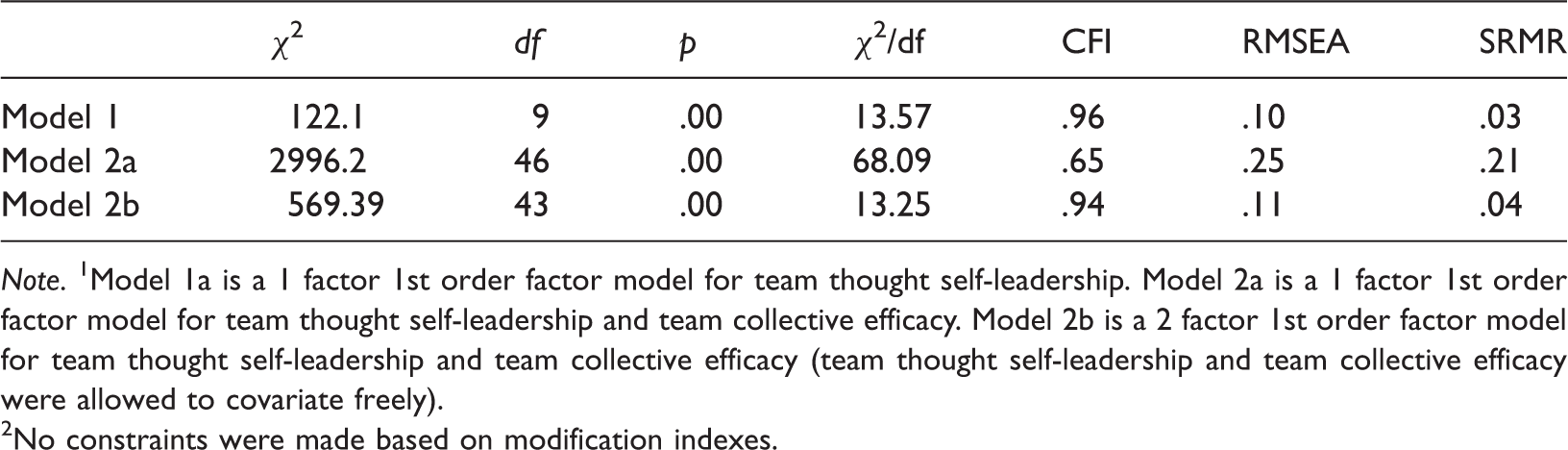
Note. 1Model 1a is a 1 factor 1st order factor model for team thought self-leadership. Model 2a is a 1 factor 1st order factor model for team thought self-leadership and team collective efficacy. Model 2b is a 2 factor 1st order factor model for team thought self-leadership and team collective efficacy (team thought self-leadership and team collective efficacy were allowed to covariate freely).
2No constraints were made based on modification indexes.
Descriptive statistics and intercorrelations.
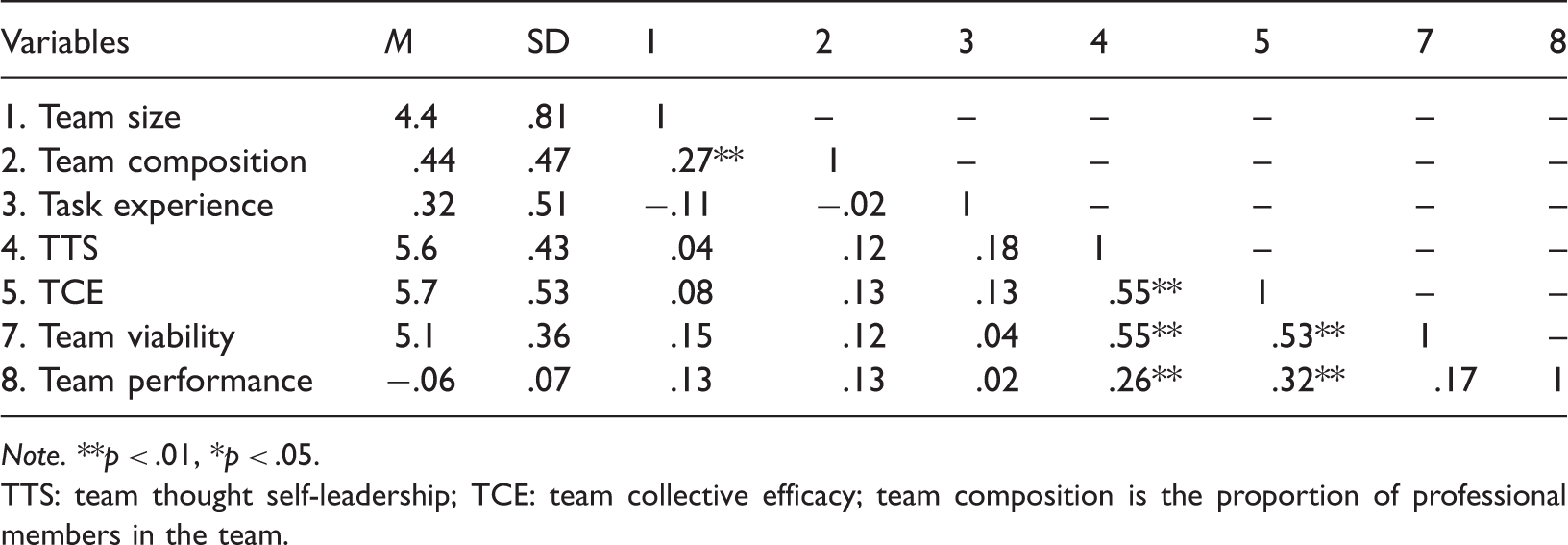
Note. **p < .01, *p < .05.
TTS: team thought self-leadership; TCE: team collective efficacy; team composition is the proportion of professional members in the team.
To directly test our proposed mediation model as depicted in Figure 1 (Hypotheses 2a and 2b), we used a regression-based path analysis with the aid of existing computational tools to test path based models and allows estimating total, direct, and single-step indirect effects of causal variables on outcome variables, through a proposed mediator variable, controlling for one of more variables (i.e. INDIRECT by Preacher and Hayes, 2008). It calculates the Sobel test (Sobel, 1986) for the total and specific indirect effect as well as percentile-based, bias-corrected, and bias-corrected and accelerated bootstrap confidence intervals for indirect effects.
The research model (ITS is individual thought self-leadership; TTS is team thought self-leadership; TCE is team collective efficacy; TP is team performance; TV is team viability).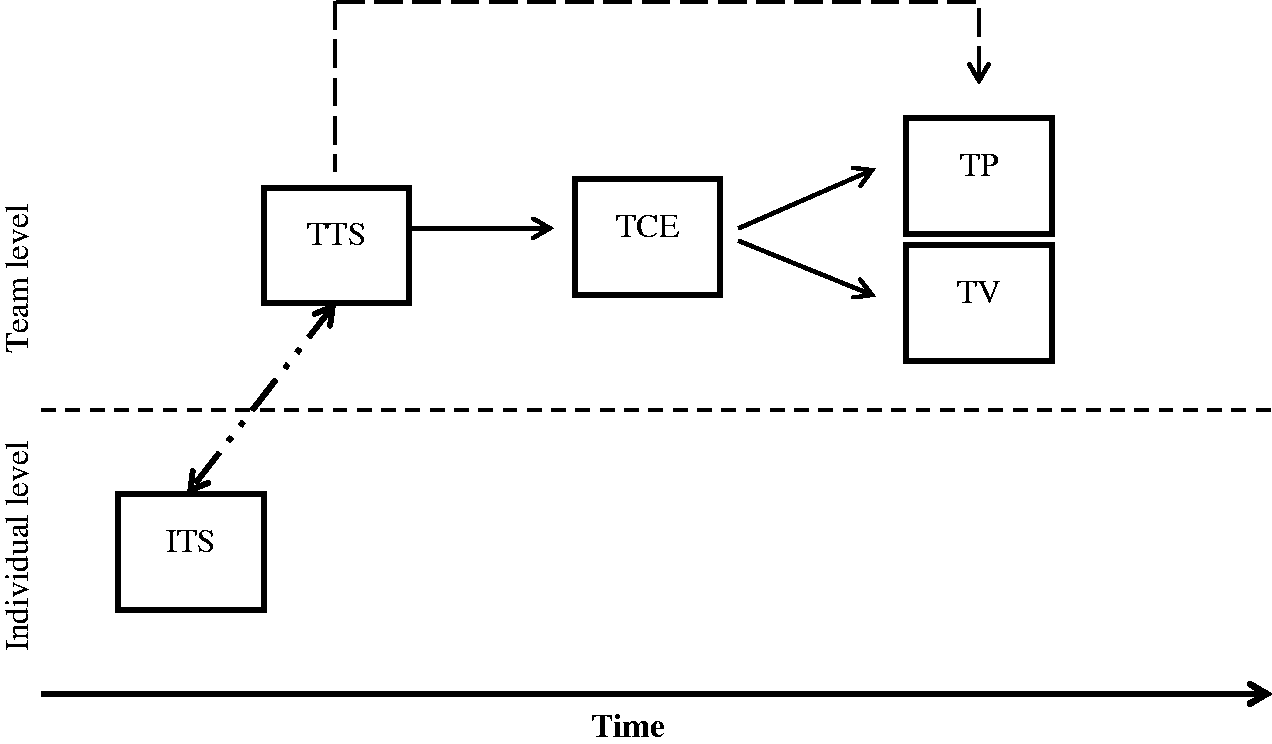
Results of mediation analysis (Hypothesis 2a).

Note. Listwise N = 103; LL: lower limit; CI: confidence interval; UP: upper limit; Bootstrap sample size = 5000. All predictor variables were mean-centered.
Results of mediation analysis (Hypothesis 2b).

Note. Listwise N = 103; LL: lower limit; CI: confidence interval; UP: upper limit; Bootstrap sample size = 5000. All predictor variables were mean-centered.
Discussion
SMTs effectiveness is very important to guarantee organizational success. Through the development of effective ways of thinking, SMTs can prevent harmful thinking patterns like groupthink and achieve desirable performance and sustainability (Neck and Manz, 1994).
This study had two main goals. First, this study aimed to test whether individual and team thought self-leadership are functionally equivalent across levels of analysis. Second, this study aimed to examine whether team thought self-leadership predicts performance and viability in work groups, through collective efficacy.
As hypothesized, team thought self-leadership can be considered as functionally equivalent to individual thought self-leadership, thus regarding the same cognitive regulatory strategies (i.e. self-evaluation of beliefs and assumptions, self-dialogue and self-imagery). In SMTs, team thought self-leadership seems to prompt the group's ability to engage in more effective thinking. This increase in SMTs quality of thinking patterns seems to positively predict team collective efficacy, as our findings suggest. Moreover, these findings are in line with previous research suggesting that how work groups think about their ability to overcome obstacles, or conclude work related tasks, is heavily influenced by their thoughts regarding their current situation (Prussia and Knicki, 1996).
The findings from this study also suggest that team thought self-leadership positively predicts team performance and team viability in SMTs. This is in line with previous theories regarding the relation between thought self-leadership strategies in SMT, and teamthink (Neck and Manz, 1994). Our findings further suggest that the relation between team thought self-leadership and team effectiveness criteria is mediated by collective efficacy. This suggests that collective thought patterns might only impact team work outcomes through team cognitive states such as collective efficacy (Bandura, 1997). Results on the relation between collective efficacy and team effectiveness outcomes are also supported by previous work showing the importance of positive beliefs regarding the group's ability to do well (Hackman, 1987; van Ginkel et al., 2009).
Alternatively, team thought self-leadership seems to be fundamental to the collective capacity for cognitive adaption, which in turn promotes increased beliefs of collective efficacy and effectiveness. By cognitive adaptation we mean a group's shared capacity to monitor and adjust its dominant thought patterns in such a way that these become fitter towards the characteristics of the task or situation at hands. Team thought self-leadership strategies help work groups shaping their thoughts regarding the task, the environment and fellow team members. When work teams such as SMT perceive that their current mind set is harming team effectiveness, they openly dialogue to develop a more adequate mind set. This is achieved by the creation of several images of the future and the anticipation of how events will unfold if the team adopts different mind sets (Neck and Manz, 1999). Our findings suggest that through team thought self-leadership, teams develop higher and more realistic collective efficacy beliefs, which have a positive impact in team effectiveness outcomes.
Theoretical and practical implications
This study contributes to team work literature in several ways. First, this study adds theoretical refinements to the concept of team thought self-leadership. Indeed, this study demonstrates that thought self-leadership is equivalent, yet qualitatively different, across levels of analysis (i.e. individual and team level). Second, this study establishes an empirical link between team thought self-leadership and team collective efficacy, thus showing the importance of group cognitive regulatory strategies in shaping shares attitudes towards group task efficacy. Finally, the results suggest that team thought self-leadership positively contributes to performance and viability in work teams.
Our results indicate that management teams would benefit from having their organizations investing in the development of thoughtful self-leading behaviors, by training their co-workers on the usage of team thought self-leadership strategies. This will help increasing team effectiveness related to decision making, which has also been shown to be positively related with team positive affect and motivational states (Costa et al., 2014).
Limitations and directions for future research
Despite its contributions, there are several limitations in this study that warrant prudence in generalizing its findings, and offer directions for future research. Firstly, our findings suggest that thought self-leadership has a different factor structure across levels of analysis (i.e. structural difference). Nevertheless, Chan (1998) multilevel theory of composition suggests that multilevel constructs can be qualitatively different across levels. This qualitative difference is signaled by the existence of dissimilarities or asymmetries in the factorial structure across levels. Furthermore, it is often the case that functionally equivalent constructs display different optimal factor structures at different levels of analysis (Chan, 1998; Costa et al., 2014; Han and Williams, 2008; Kozlowski and Klein, 2000). Secondly, team thought self-leadership dimensions (e.g. imagery; visualizing successful performance) were assessed using only two items per dimension. Although our reliability levels were satisfactory (> .70), it would have been better to use three items per dimension to secure maximum validity (Zuckerman et al., 1993). Finally, although the simulation in which participants were enrolled has highly realistic features, this study should be extended to field settings to see whether the findings are similar.
Future expansion of this particular study, and others addressing team self-leadership and team effectiveness, would benefit from the inclusion of different sources for all measured dimensions. Future research should also address the different contributions that team self-leadership and each team self-leadership strategy (i.e. behavior strategies, natural reward strategies, and thought strategies) may make to team processes and outcomes, particularly by using longitudinal research designs.
Conclusion
Self-managed work teams operating in highly demanding task environments are challenged with complex situations that require effective decision making. Our findings have shown that thoughtfulness is important to foster positive shared perceptions of team efficacy and team viability. Furthermore, our findings suggest that engaging in such thoughtful regulatory strategies as team thought self-leadership positively contributes to effective decision making in SMTs.