



Abstract
This study examined the mediating role of leader–member exchange and psychological empowerment in the relationship between ethical leadership and employee creativity. Survey data were collected from 172 doctors who were working in a large public sector hospital located in Pakistan. Results showed that as hypothesized, leader–member exchange and psychological empowerment fully mediated the effects of ethical leadership on employee creativity. Additionally, it was found that leader–member exchange influenced creativity directly as well as indirectly through the mediating mechanism of psychological empowerment. The theoretical and practical implications of this research are discussed.
Keywords
Introduction
To survive and remain competitive in the modern day business world, organizations need employees who have the skills and motivation to engage in creative behavior (Shalley and Gilson, 2004). Previous research has provided compelling evidence, which suggests that employee creativity is likely to have a profound impact on organizational innovation, effectiveness, and survival (Shalley et al., 2004). Creativity refers to the generation of novel and useful ideas relating to products, services, processes, and procedures (Amabile, 1997; Madjar et al., 2002; Zhou and Shalley, 2003). Here it is important to differentiate between creativity and innovation. While creativity refers to the production of novel and useful ideas at the individual level, innovation is the successful implementation of these ideas at the organizational level (Amabile et al., 1996; Oldham and Cummings, 1996). In other words, creativity can be considered as an important prerequisite for organizational innovation (Shalley and Gilson, 2004).
Research has shown that positive leader behaviors can play a key role in sparking employee creativity. For instance, previous studies have indicated that supportive leadership behavior (e.g. Amabile et al., 2004; Madjar et al., 2002) and effective leader–member exchange (LMX) relationships (e.g. Scot and Bruce, 1994; Tierney et al., 1999) can improve employees’ creative performance. More recently, it has been found that transformational leadership (Gong et al., 2009; Shin and Zhou, 2003) and empowering leadership (Zhang and Bartol, 2010) are also positively associated with creativity.
The present study, however, attempts to provide a new perspective on the leadership–creativity relationship by examining the influence of ethical leadership on employees’ creativity. There are major reasons (discussed later) to expect ethical leadership to have a positive impact on creative outcomes. However, despite having considerable potential to enhance creativity, no study to date has explored the effects of ethical leadership on employees’ creative performance. Thus, the central aim of this study was to build and test an integrated model that links ethical leadership to creativity.
Furthermore, in order to acquire a deeper insight into the ethical leadership–creativity relationship, this study also endeavored to identify the underlying mechanisms through which ethical leadership relates to creativity. Specifically, based on theory and research, it is proposed that LMX and psychological empowerment will be the intervening variables that link ethical leadership to employee creativity. LMX refers to the quality of exchange relationship between an employee and his or her immediate supervisor (Graen and Scandura, 1987). Psychological empowerment on the contrary is defined as a psychological state that is manifested in four cognitions: meaning, competence, self-determination, and impact (Spreitzer, 1995).
Previous studies have found that ethical leadership behaviors can contribute to the development of high quality LMX (e.g. Walumbwa et al., 2011) and strengthen employees’ sense of psychological empowerment (e.g. Zhu et al., 2004). Additionally, research has also uncovered that a high quality LMX (e.g. Tierney et al., 1999) and strong feelings of psychological empowerment (e.g. Zhang and Bartol, 2010) have the capacity to stimulate employee creativity. Thus, the two mediating variables included in this study have high potential for explaining linkages between ethical leadership and creativity. The conceptual model showing the proposed relationships is presented in Figure 1.
Hypothesized model.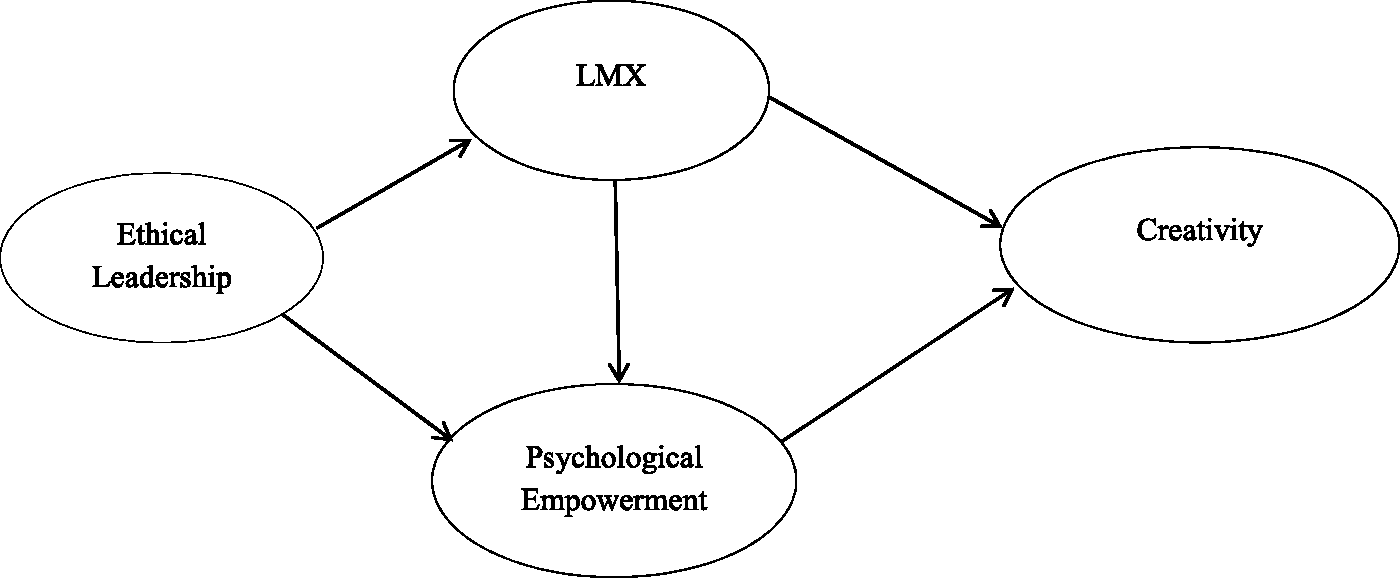
Literature review and hypotheses development
Ethical leadership
The high-profile corporate scandals in recent years have led both academics and practitioners to focus greater attention on the concept of ethical leadership (Brown and Trevino, 2006). Ethical leadership is defined as “the demonstration of normatively appropriate conduct through personal actions and interpersonal relationships, and the promotion of such conduct to followers through two-way communication, reinforcement and decision making” (Brown et al., 2005: 120). Trevino et al. (2003) identified two dimensions of ethical leadership: (1) moral person and (2) moral manager. The moral person aspect of ethical leadership refers to the personality characteristics and altruistic motivation of the leader. Ethical leaders are honest, trustworthy, and approachable. These leaders demonstrate care and concern for their followers and are perceived as fair and principled decision-makers. In addition, ethical leaders make a concerted effort to reform their followers by setting clear ethical standards, serving as ethical role models and holding followers accountable for ethical actions (Brown and Trevino, 2006; Brown et al., 2005). These behaviors depict the moral manager component of ethical leadership.
Research has demonstrated that ethical leadership can be differentiated from related forms of leadership like transformational leadership and authentic leadership (Brown and Trevino, 2006) and has the capability to deliver important follower outcomes such as greater job satisfaction and organizational commitment (Toor and Ofori, 2009), improved health and well-being (Chughtai et al., 2014), more extra-role behaviors (Mayer et al., 2009), and higher levels of performance (Piccolo et al., 2010; Walumbwa et al., 2011).
Ethical leadership and LMX
As mentioned earlier, LMX refers to the quality of exchange relationship between a supervisor and an employee (Graen and Scandura, 1987). The main premise of the LMX theory is that supervisors develop distinct relationships with each of their subordinates, ranging from low to high quality (Graen and Uhl-Bien, 1995; Liden et al., 1997). High quality LMX relationships are characterized by mutual respect, trust, and loyalty, while low quality LMX relationships are restricted to contractual-type obligations (Erdogan et al., 2006). Research evidence indicates that a high quality LMX is positively associated with important outcomes such as job satisfaction, organizational commitment, retention, and job performance (Gerstner and Day, 1997; Liden et al., 1997).
A high quality LMX relationship develops overtime through an actual exchange of valued resources between supervisors and their subordinates (Liden et al., 1997; Nahrgang et al., 2009). In other words, LMX reflects a social exchange relationship between the two parties (Walumbwa et al., 2011). The social exchange theory contends that benefits and favors directed at the subordinates by their supervisors contribute to the development of high quality exchange relationships that generate obligations for subordinates to reciprocate in equally positive ways (Blau, 1964; Settoon et al., 1996).
In the present study it is argued that ethical leadership behaviors will facilitate the development of high quality LMX. Ethical leaders are selfless, honest, and trustworthy. They treat their followers with respect and consideration, encourage them to express their opinions, and make fair and balanced decisions about issues, which are important to them (Brown et al., 2005). Such positive behaviors on part of the supervisors create obligations for the subordinates to reciprocate, which they do by expending extra effort on behalf of the supervisor or by engaging in extra-role behaviors that benefit the supervisor, thereby facilitating high-quality LMX (Settoon et al., 1996). Thus, it is hypothesized: Hypothesis 1: Ethical leadership is positively related to leader–member exchange.
Ethical leadership and psychological empowerment
Traditionally, empowerment was viewed as a set of management practices, which were geared toward sharing power and authority with employees at lower levels (Seibert et al., 2011; Spreitzer et al., 1999). However, empowerment is now increasingly conceptualized as a psychological state or a set of cognitions (Conger and Kanungo, 1988; Spreitzer, 1995; Thomas and Velthouse, 1990). Specifically, Spretizer (1995) defined psychological empowerment as intrinsic task motivation manifested in four cognitions: meaning, competence, self-determination, and impact. Meaning represents the extent to which employees perceive their jobs to be important and worthwhile. Competence refers to self-efficacy or belief in one’s ability to successfully complete a task. Self-determination indicates a sense of freedom or discretion one has to perform his or her work. Finally, impact reflects the degree to which the individual believes that he or she can influence organizational outcomes in a positive way. Spretizer (1995) argues that these four dimensions combine additively to create an overall psychological empowerment construct. That is, “the lack of any single dimension will deflate though not completely eliminate the overall degree of felt empowerment” (Spretizer, 1995: 1444).
In this study it is speculated that ethical leadership behaviors will strengthen employees’ perceptions of psychological empowerment. First, an ethical leader tends to enhance the meaningfulness of work by clarifying to the followers how their tasks and efforts contribute to the overall group and organizational goals (De Hoogh and Den Hartog, 2008). Second, Zhu et al. (2004) contend that ethical leaders’ concern for their employees’ developmental needs is likely to lead them to place employees in jobs that facilitate their growth and confidence. Such actions can boost employees’ self-efficacy and consequently enhance their feelings of competence (Zhu, 2008). Finally, ethical leaders involve their employees in the decision-making process and allow them to work autonomously on their assignments and projects (Brown and Trevino, 2006; Piccolo et al., 2010). These behaviors should enhance employees’ feelings of self-determination and impact (Seibert et al., 2011). Previous research provides supportive empirical evidence that ethical leadership can augment employees’ sense of psychological empowerment (Zhu, 2008; Zhu et al., 2004). Hence, it is proposed: Hypothesis 2: Ethical leadership is positively related to psychological empowerment.
LMX and creativity
It is anticipated that a high quality LMX will boost employees’ creative performance. Research has shown that supervisors provide numerous benefits such as opportunity to work on challenging assignments, greater autonomy and decision latitude, access to important information, and more social–political support to the high LMX employees (Liden et al., 1997). The availability of these benefits is expected to increase employees’ innovativeness and creativity (Oldham and Cummings, 1996; Shalley and Gilson, 2004). For instance, the opportunity to work on challenging assignments can enhance employees’ knowledge and skills, which in turn, may induce them to engage in creative behavior (Amabile, 1996). Likewise, greater autonomy and social support from the supervisor should inspire employees to take more risks, which subsequently can amplify their creativity (Cerne et al., 2013). Prior research has shown that a high quality LMX is likely to have a significant impact on employees’ creative performance (Atwater and Carmeli, 2009; Tierney et al., 1999; Volmer et al., 2012). Hence, the following hypothesis is formulated: Hypothesis 3: LMX is positively related to creativity.
Psychological empowerment and creativity
It is further proposed that all the four components of psychological empowerment will play a key role in promoting creativity. For instance, the job characteristics model (Hackman and Oldham, 1980) suggests that a high sense of meaning and self-determination can increase employees’ intrinsic motivation, which subsequently is expected to have a positive influence on their creativity (Amabile, 1996, 1997). Moreover, Zhang and Bartol (2010) observe that when employees feel efficacious and believe that they can shape desired outcomes through their behaviors, they are more likely to concentrate on an idea or a problem longer and more persistently. Such employees are also more willing to take risks and experiment with new ideas and as a result are likely to exhibit higher levels of creativity in their work (Amabile et al., 1996). Previous research supports the link between psychological empowerment and creativity (Seibert et al., 2011; Zhang and Bartol, 2010). Thus, it is speculated: Hypothesis 4: Psychological empowerment is positively related to creativity.
LMX and psychological empowerment
Research evidence also indicates that a high quality LMX can increase employees’ perceptions of psychological empowerment (e.g. Ayree and Chen, 2006). For instance, increased information and control available to the high LMX employees might lead them to perceive their work as personally meaningful because such resources may help them to understand how their work role fits into the larger goals and strategies of the organization (Seibert et al., 2011). In addition, high LMX employees are more likely to get opportunities to work on challenging tasks and receive developmental feedback from their supervisors, which should enhance their feelings of competence. Finally, the decisional responsibility enjoyed by high LMX subordinates can reinforce their feelings of self-determination and impact. In view of this discussion, a path from LMX to psychological empowerment was specified in the research model (see Figure 1) and it was predicted: Hypothesis 5: LMX is positively related to psychological empowerment.
Ethical leadership and creativity
Ethical leadership is expected to have a significant effect on creativity. Ethical leaders show concern for employees’ feelings and needs, give them a say in decision making, and take steps to develop their skills and expertise (Brown et al., 2005; De Hoogh and Den Hartog, 2008; Zhu et al., 2004). These behaviors can increase employees’ intrinsic motivation and raise their sense of self-efficacy and as a result may inspire them to engage in creative activities (Amabile et al., 2004; Madjar et al., 2002).
However, research evidence indicates that the relationship between leadership and creativity is complex and is unlikely to be direct or unconditional (Atwater and Carmeli, 2009; De Jong and Den Hartog, 2007; Mumford and Licuanan, 2004). For instance, De Jong and Den Hartog (2007) argue that leaders are likely to influence creative outcomes indirectly by creating a context in which creativity and innovation can flourish. Jung et al. (2007) also echo similar thoughts and contend that leadership behavior does not occur in a vacuum. On the contrary, it takes place in the context of an organization and its environment and therefore, its effects on creativity are likely to be mediated by characteristics of this organizational context.
In light of this evidence, it is proposed that the direct effect of ethical leadership on creativity will be mediated by LMX and psychological empowerment. Several studies have examined the mediating role of LMX and psychological empowerment in the ethical leadership–employee outcomes relationship. For example, Hassan et al. (2013) showed that LMX fully mediated the relationship between ethical leadership and affective commitment and partially mediated the effects of ethical leadership on leader effectiveness. Similarly, Walumbwa et al. (2011) found that LMX partially mediated the link between ethical leadership and job performance. Additionally, Zhu (2008) uncovered that the relationship between ethical leadership and followers’ moral identity was fully mediated by followers’ psychological empowerment. Thus, it is reasonable to assume that LMX and psychological empowerment will play a similar role in the ethical leadership–creativity relationship. Specifically, it is argued that ethical leadership will facilitate the development of high quality LMX (hypothesis 1) and will enhance employees’ perceptions of psychological empowerment (hypothesis 2), which, in turn, is likely to increase creativity (hypotheses 3 and 4). Hence, the following hypothesis is stated: Hypothesis 6: LMX and psychological empowerment will mediate the positive relationship between ethical leadership and creativity.
Method
Sample and procedure
The sample for this study comprised of full-time doctors who were drawn from seven departments of a large public sector hospital located in the eastern city of Pakistan. The total number of doctors working in these seven departments was 265. Data for this study were collected by administering a paper and pencil questionnaire to all the 265 doctors. The required number of questionnaires along with a cover letter assuring anonymity was handed over to the relevant administrators for distribution to the participants in each department. Participation in this study was completely voluntary. The respondents returned the completed questionnaires in sealed envelopes to the concerned people in their respective departments. The author collected these sealed envelopes personally from each department at a mutually agreed time. The entire data collection process took about 6 weeks.
Of the 265 questionnaires that were distributed, 172 useable questionnaires were received thereby yielding a response rate of 64.9%. In line with previous research, the missing data (less than 5% of the data were missing) were imputed by using the expectation maximization (EM) algorithm (Schafer and Graham, 2002; Newman, 2009). About 54% of the participants were male. The average age of the responding individuals was 30 years, while the average organizational tenure was 3.7 years. Finally, 30% of the participants held a postgraduate degree, while the remaining 70% held a bachelors level qualification.
Measures
Validated scales were used to measure the study variables. All variables in this study were assessed on a five-point Likert scale ranging from 1 = strongly disagree to 5 = strongly agree. The scales used to measure the study variables are provided in full in Appendix 1.
Employee creativity
Creativity was assessed with eight items taken from the creativity scale developed by Zhou and George (2001). These eight items have been used and validated in previous studies (e.g. Zampetakis, 2008). Example items include: “I suggest new ways to achieve goals or objectives” and “I develop adequate plans and schedules for the implementation of new ideas.” The alpha reliability for this scale was 0.94.
Ethical leadership
Ethical leadership was measured by using the 10-item ethical leadership scale developed by Brown et al. (2005). Example items include: “My supervisor makes fair and balanced decisions” and “My supervisor disciplines employees who violate ethical standards.” The coefficient alpha for this scale was 0.93.
LMX
LMX was assessed with Scandura and Graen’s (1984) LMX-7 scale. Example items include “My boss recognizes my potential” and “I have an effective working relationship with my boss.” The alpha reliability for this scale was 0.92.
Psychological empowerment
Psychological empowerment was measured with the 12-item scale developed by Spreitzer (1995). This scale measures the four subdimensions of psychological empowerment: meaning, competence, self-determination, and impact. Each dimension was assessed with three items. Example items include: “The work I do is very important to me” (meaning), “I am confident about my ability to do my job” (competence), “I have significant autonomy in determining how I do my job” (self-determination), and “I have significant influence over what happens in my department” (impact). The reliabilities for the meaning, competence, self-determination, and impact subscales were 0.86, 0.86, 0.72, and 0.90, respectively, while the value of the Cronbach alpha for the aggregated scale was 0.90.
Control variables
In line with previous research on employee creativity (e.g. Gong et al., 2009), gender, age, and education level were included as control variables in this study. Gender (1 = male; 0 = female) and education level (1 = postgraduate degree; 0 = bachelors degree) were measured by creating dummy variables, while age was self-reported in years.
Results
Descriptive statistics
Descriptive statistics, correlations, and scale reliabilities.

Correlation is significant at the 0.05 level; **Correlation is significant at the 0.01 level.
Cronbach alpha reliabilities for observed variables are in
Measurement model
The research hypotheses were tested by conducting structural equation modeling (SEM) using LISREL 8.80 (Joreskog and Sorbom, 2006). Before testing the hypothesized structural model, the measurement model was first confirmed through confirmatory factor analysis (CFA) (Anderson and Gerbing, 1988). The measurement model consisted of four latent variables: creativity, ethical leadership, LMX, and psychological empowerment. To maintain an adequate sample size to parameter ratio, three indicators each for creativity, ethical leadership, and LMX were created. Specifically, on the basis of factor analysis results, the items with the highest and lowest loadings were combined by averaging them until there were three indicators for each construct (e.g. Kim et al., 2009). Psychological empowerment on the contrary was indicated by its four subdimensions: meaning, competence, self-determination, and impact.
The fit of the measurement model was gauged by using the following fit indices: model chi-square, comparative fit index (CFI), normed fit index (NFI), nonnormed fit index, and root mean square error of approximation (RMSEA). In case of model chi-square, an insignificant chi-square value depicts a good model fit (Kline, 2005). For CFI, NFI, and NNFI, values of 0.95 and above are considered as indicating good fit (Hu and Bentler, 1999); while for RMSEA values below 0.05 signify an acceptable model fit (Kline, 2005).
The measurement model provided an excellent fit to the data: χ2 (59 df) = 57.92, p > 0.05; NFI = 0.98; NNFI = 1.0; CFI = 1.0; RMSEA = 0.00. All the indicators loaded significantly on their respective latent factors, with factor loadings ranging from 0.62 to 0.95.
Comparison of measurement models.

p < 0.01, *p > 0.05.
Composite reliability (CR) and average variance extracted (AVE)
Correlations among latent variables, CR and AVE.

Diagonal elements (in bold) are the square root of the average variance extracted (AVE). Off-diagonal elements are the correlations among latent variables.
AVE: average variance extracted; CR: composite reliability.
Furthermore, Fornell and Larcker (1981) suggest that discriminant validity is considered sufficient if the square root of the AVE from the construct is greater than the correlation shared between the construct and other constructs in the model. Table 3 shows that the square root of the AVE for each construct is greater than the levels of correlations involving that construct, thereby confirming discriminant validity.
Hypothesized model
With acceptable convergent and discriminant validities established, the proposed structural model was then tested. Results of SEM revealed that the hypothesized model (see Figure 1) exhibited a good fit to the data: χ2 (93 df) = 109.70; p > 0.05; NFI = 0.97; NNFI = 0.99; CFI = 0.99; RMSEA = 0.03. Following the recommendations of James et al. (2006), the fit of this fully mediated model was compared to the fit of a partially mediated model, which included a direct path from ethical leadership to creativity (see Table 4). This model is depicted in Figure 2. The partially mediated model provided an adequate fit to the data but was not significantly better than the hypothesized model (Δ χ2 (1) = 3.45, p > 0.05) and the direct path from ethical leadership to creativity was insignificant (β = –0.19, ns). Thus, in accordance with the rules of parsimony, the fully mediated model was accepted as the final model (James et al., 2006). Taken together, these findings indicate that LMX and psychological empowerment fully mediate the relationship between ethical leadership and creativity (Hypothesis 6).
Estimated standardized path coefficients for the partially mediated model. Comparison of the structural models. CFI: comparative fit index; NFI: normed fit index; NNFI: non-normed fit index; RMSEA: root mean square error of approximation. p > 0.05.

Figure 3 presents the path coefficients for the final model (i.e. the fully mediated model). As shown in this figure, ethical leadership was positively and significantly related to both LMX (β = 0.64, p < 0.01) and psychological empowerment (β = 0.26, p < 0.05). Therefore, Hypotheses 1 and 2 were supported. Furthermore, Figure 3 revealed that as expected, LMX (β = 0.29, p < 0.01) and psychological empowerment (β = 0.47, p < 0.01) were both positively associated with creativity. Thus, Hypotheses 3 and 4 were also corroborated. Additionally, results showed that LMX was significantly related to psychological empowerment (β = 0.44, p < 0.01). Consequently, Hypothesis 5 was also substantiated. This finding signified that LMX influenced creativity directly as well as indirectly by strengthening employees’ perceptions of psychological empowerment. Finally, it was found that none of the three control variables (i.e. gender, age, and education level) were significantly related to creativity.
Estimated standardized path coefficients for the final model. Note: For the sake of clarity, only structural relationships are shown. *p < .05, **p < .01. aThese numbers represent the standardized beta coefficients.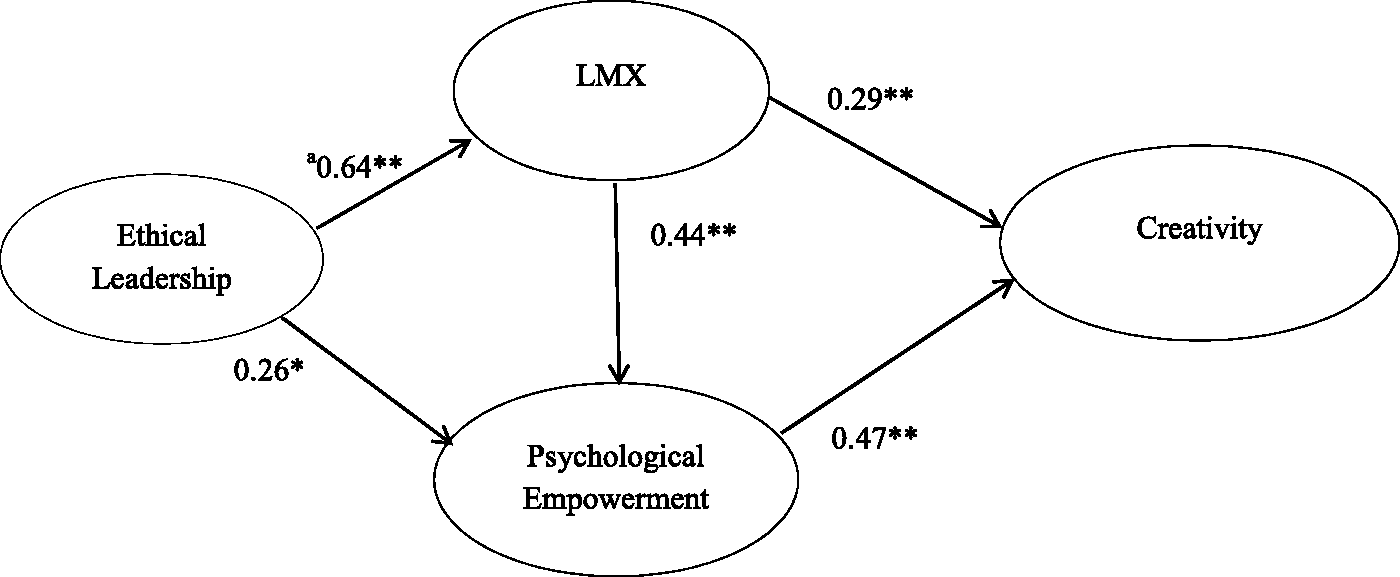
Effect decomposition for the final model (Figure 3).

p < 0.01.
NA: Not applicable.
As shown in Figure 3, ethical leadership did not have a direct effect on creativity. However, its indirect effect on creativity (β = 0.44, p < 0.01) via LMX and psychological empowerment was significant. Total effects are sum of all direct and indirect effects of one variable on another (Kline, 2005). Since, ethical leadership did not have a direct effect on creativity, its total effect on this construct was equal to its indirect effect (i.e. β = 0.44, p < 0.01).
Furthermore, results revealed that the direct effect of LMX on creativity was significant (β = 0.29, p < 0.01). In addition, it was found that the indirect effect of LMX on creativity (β = 0.21, p < 0.01) through psychological empowerment was also significant. Thus, the total effect of LMX on creativity was 0.50 (p < 0.01) [0.29 + 0.21].
Moreover, as depicted in Figure 3, psychological empowerment only had a direct effect on creativity (β = 0.47, p < 0.01). Since, there were no indirect paths linking psychological empowerment to creativity, its total effect on this variable was equal to its direct effect.
Finally, following the recommendations outlined by Preacher and Hayes (2008), the mediation hypothesis was further tested by using the bootstrapping procedure. Specifically, to assess the significance of the indirect effects, a 95% bias-corrected bootstrap confidence interval (CI) was constructed from 5000 bootstrap samples. An indirect effect is considered significant if the 95% bias-corrected CI does not include “zero.” Results showed that the 95% bias-corrected CI of the indirect effect of ethical leadership (via LMX and psychological empowerment) on creativity was: [0.28, 0.57]. Since, this CI did not include “zero,” it can be concluded that the indirect effect of ethical leadership on creativity was significant. In sum, these findings offer full support to hypothesis 6.
Test of an alternative model
In order to rule out alternative explanations for the main findings of this research, the fit of the research model (Figure 1) was compared to the fit of an alternative model in which the causal orderings from ethical leadership to the two mediating variables were reversed. Specifically, the alternative model proposed that a high quality LMX and strong perceptions of psychological empowerment will promote ethical leadership, which, in turn, will enhance creativity. The fit of these nonnested models was compared by using the Akaike’s (1987) information criterion (AIC). The model with the lower AIC is considered the better fitting model (Joreskog and Sorbom, 1993). Results revealed that the alternative model provided a satisfactory fit to the data: χ2 (91 df) = 125.94, p < 0.01; NFI = 0.96; NNFI = 0.99; CFI = 0.99; RMSEA = 0.05. However, the value of AIC for the research model (AIC = 195.70) was smaller than that for the alternative model (AIC = 215.94), which indicated that the research model was a better fitting model. These findings inspire confidence in the causal ordering of variables presented in Figure 1.
Discussion
The main purpose of this research was to investigate the effects of ethical leadership on employee creativity. Additionally, this study aimed to examine the mediating role of LMX and psychological empowerment in the ethical leadership–creativity relationship. Using a sample of 172 Pakistani doctors, the research hypotheses were tested by conducting SEM. Results revealed that as theorized, LMX and psychological empowerment fully mediated the relationship between ethical leadership and creativity. The results also showed that LMX affected creativity directly as well as indirectly through the mediating influence of psychological empowerment.
Theoretical implications
The findings of this study extend research on ethical leadership and creativity and make two distinct contributions to the literature. First, the primary contribution of this research is that it empirically establishes a connection between ethical leadership and creativity and as a result provides fresh insights into the leadership–creativity relationship. Although numerous studies have shown that positive leader behaviors can have a significant impact on employee creativity (e.g. Amabile et al., 2004; Shin and Zhou, 2003), ethical leadership has been surprisingly absent from consideration. The results of this investigation suggest that ethical leadership behaviors can also play a crucial role in igniting creativity.
Second, by establishing the mediating role of LMX and psychological empowerment in the ethical leadership–creativity relationship, this research offers useful insights into the underlying processes through which ethical leadership affects creativity. Specifically, results showed that the effect of ethical leadership on creativity was indirectly conveyed through LMX and psychological empowerment. This finding is consistent with previous research, which indicates that leaders are likely to influence individual innovation and creativity indirectly through the way in which they structure the work environment (De Jong and Den Hartog, 2007; Friedrich et al., 2010). For instance, Friedrich et al. (2010) argue that leaders can stimulate innovation and creativity by creating appropriate organizational structures and by developing an organizational culture that facilitates scanning and monitoring behaviors. Numerous empirical studies have also provided support for the notion that the effect of leader behavior on creativity is likely to be indirect (e.g. Atwater and Carmeli, 2009; Zhang and Bartol, 2010).
Additionally, this study also makes a contribution to the extant LMX literature. As noted earlier, several studies have provided evidence that a high quality LMX can stimulate creativity (e.g. Tierney et al., 1999). However, relatively less is known about the psychological mechanisms through which LMX relates to creative outcomes (Atwater and Carmeli, 2009). The findings of this research indicate that psychological empowerment could be one possible avenue through which a high quality LMX might translate into greater innovation and creativity.
Finally, another novel feature of the current study was the geographic location in which it was based. To the best of my knowledge, this is the first study, which has examined the dynamics of ethical leadership in Pakistan. Pakistan is a country, which is high on collectivism and power distance (Islam, 2004) and is facing enormous political, economic, and security issues. The results of this study suggest that the demonstration of ethical leadership behaviors can yield positive outcomes even in this unique environment. In short, this research reinforces the importance of ethical leadership as a key driver of organizational effectiveness.
Practical implications
On a practical level, this study demonstrates that fostering ethical leadership in the workplace can prove to be an effective strategy for stimulating employee creativity. So how can organizations promote ethical leadership? To achieve this goal, it is suggested that organizations should consider doing two things. First, by using appropriate selection tools such as integrity tests, structured interviews, and assessment center exercises that focus on resolving ethical issues, organizations should attempt to identify and select ethical leaders (Mayer et al., 2012). Second, the organizations can employ suitable management development programs to inspire their leaders to exhibit ethical behaviors. Specifically, these programs should focus on issues such as “communicating the importance of ethics, rewarding and supporting employees who behave ethically, and serving as ethical role models” (Mayer et al., 2009: 10).
In the preceding paragraphs it was mentioned that ethical leaders genuinely care about the well-being of their followers. However, organizations should bear in mind that care and concern demonstrated by ethical leaders may have a negative effect on their subordinates. For instance, Gabriel (2014) suggests that excessive caring can seriously constrain the autonomy of followers and as a result instill dependence and inertia. Moreover, such behavior might lead to discrimination and nepotism, which subsequently may have an adverse effect on employees’ commitment and satisfaction. Thus, ethical leaders should be advised to maintain a fair balance between care and neglect, while dealing with their subordinates (Gabriel, 2014).
As discussed earlier, ethical leadership did not have a direct effect on creativity. On the contrary, it influenced creativity indirectly through the mediating mechanism of LMX and psychological empowerment. Since, both LMX and psychological empowerment had significant unique effects on employee creativity, it is proposed that organizations should focus on creating conditions, which facilitate the development of effective LMX relationships and enhance employees’ perceptions of psychological empowerment.
Sheer (2014) argues that high quality relationships between supervisors and their subordinates can only develop if both parties make a joint and whole-hearted effort to make the relationship successful. Thus, by using appropriate employee development programs organizations need to encourage supervisors and subordinates to help each other with professional and personal problems, openly share information and ideas with one another, and give regular feedback to each other regarding issues and problems pertaining to organizational policies, tasks, rewards, and other relevant matters (Tourish and Robson, 2006). Such two-way interactions eventually may lead to the development of high quality LMX relationships (Sheer, 2014).
In order to create a psychologically empowered workforce, it is suggested that organizations should employ high-performance managerial practices (e.g. extensive use of training, open information sharing, and participative decision making), inspire their managers to use a more supportive leadership style, and provide jobs that are both meaningful and challenging (Seibert et al., 2011; Spreitzer, 1995).
Limitations and future research directions
Despite making important contributions to the literature, this research has its limitations. First, this study had a cross sectional research design, which does not allow us to make inferences about causality. The fact that the alternative model, in which the causal orderings from ethical leadership to LMX and psychological empowerment were reversed, did not fit the data as well as the research model tends to reinforce the hypothesized causal relationships shown in Figure 1. However, it is recommended that future studies should evaluate the research model developed in this study with a longitudinal research design because only longitudinal research can adequately detect cause and effect.
Second, another limitation of this study was that employee creativity was measured through self-reports. Although self-reported measures can be subject to bias (Shalley et al., 2009), they have been found to correlate (r = 0.62) with supervisory ratings of creativity (Axtell et al., 2000). Moreover, Janssen (2000) argues that employees are best suited to self-report creativity because they are the ones who are aware of the subtle things they do in their jobs that make them creative. Self-report measures of creativity therefore, have been used in several previous studies (e.g. Kim et al., 2009; Shalley et al., 2009). However, in order to minimize the potential of bias, it is recommended that future studies should assess creativity through supervisory ratings or by using appropriate objective measures (Zhou and Shalley, 2003).
Third, since all the study variables were assessed through self-reports, it is possible that the results may have been influenced by common method variance (Podsakoff et al., 2003). However, Spector (2006) argues that the common method variance problem is overstated and provides substantial evidence, which indicates that this problem does not automatically amplify correlations between self-reported variables. Moreover, the results of the CFA showed that the fit of the hypothesized four factor model was significantly better than the fit of a single factor model (see Table 2). These results indicate that common method variance was not a serious issue in this study because “if method variance is a significant problem, a simple model (e.g. a single factor model) should fit the data as well as a more complex model” (Krosgaard and Roberson, 1995: 663). Nevertheless, to alleviate problems linked to common method variance, future studies should attempt to collect data from multiple sources (Podsakoff et al., 2003).
Finally, the current study explored the role of two mediating variables, that is LMX and psychological empowerment. Although these two variables fully mediated the effects of ethical leadership on creativity, it is accepted that there might be other variables, which may also serve as mediators in this relationship. For instance, self-efficacy and psychological safety are two possible variables that can connect ethical leadership to employee creativity. Thus, in order to acquire further insights into the ethical leadership–creativity relationship, it is suggested that future studies should try to uncover other variables that have the potential to explain linkages between these two constructs.
Conclusion
This research represents one of the first attempts to link ethical leadership to employee creativity. Specifically, the present study demonstrated that ethical leadership behaviors can spark creativity by building close relationships between supervisors and their subordinates and by enhancing employees’ sense of psychological empowerment. Thus, in order to nurture innovation and creativity, it is imperative that organizations devise strategies that enable them to develop ethical leaders.