



Abstract
The primary aim of this article is to offer an indigenous perspective of relational leadership as a way-of-being and doing leadership. It is based on a longitudinal qualitative investigation of Māori leaders and practitioners in the screen industry. The findings revealed three distinct themes; embodying relational leadership, enacting relational leadership and macrocontextual influences in relational leadership. This study affirmed the ways in which culture and worldviews shaped the identity of Māori leaders, confirming that relational leadership is a process of social construction, which emerges from the dynamic interaction between ontology (ways of being) and praxis (ways of doing). This contribution charts new territory in leadership theory contributing new ways of understanding relational leadership from an indigenous Māori perspective. It highlights the importance of holistic theorisations of leadership that examine culture, identity and the macro-contextual dimensions that influence leadership.
The primary aim of this article is to offer an indigenous perspective of relational leadership as a way-of-being and doing leadership. Whilst interest in indigenous leadership research is increasing (Zhang et al., 2012), relational leadership as a field resonates with the purpose of this article, given its general objective is to enhance understanding of social processes that comprise leadership and organising, and its central focus is relational social processes by which leadership emerges and operates (Cunliffe and Eriksen, 2011; Uhl-Bien, 2006: 666). Relational ontology includes fundamental philosophical issues of social experience as intersubjective, and leadership as a way-of-being-in-relation-to-others (Cunliffe and Eriksen, 2011), which is also central to being-centred leadership (Fry and Kriger, 2009). Relational leadership is also viewed as ‘a process of social construction through which certain understandings of leadership come about and are given privileged ontology’ (Uhl-Bien, 2006: 654). Ontologically, social realities are viewed as interdependent constructions existing and known only in relation (Uhl-Bien, 2006).
As a field, relational leadership has attracted research in the integration of trust, reciprocity and leader member exchange (Brower et al., 2000), intentional forgiveness (Ferch and Mitchell, 2001) and responsible leadership in a stakeholder society (Maak and Pless, 2006) to name a few. Concomitantly, other fields of leadership research such as social network analysis, leadership networks (Hoppe and Reinelt, 2010) and shared power and integrative leadership in collaborations (Crosby and Bryson, 2010) illuminate the field.
Yet, relational leadership is still considered a fairly new term in leadership studies, and its meaning remains open to interpretation (Uhl-Bien, 2006). We argue, this offers an opportunity to contribute a cultural interpretation of relational leadership. Central lines of inquiry include; does the experience of indigenous leaders offer new ways of understanding leadership dynamics? How can studies of indigenous ways of being (ontology) and doing leadership (praxis) contribute to leadership literature? Drawing on over three decades of interdisciplinary scholarship in Māori (indigenous peoples of New Zealand) leadership, the article develops in the following way.
Relational leadership: Māori ontology and identity – includes a literature review spanning three decades of interdisciplinary scholarship on Māori leadership. A longitudinal study of Māori leaders in the screen industry. Findings: Core themes and data strands. Contribution of a conceptual framework “Dimensions of Relational Leadership; a Māori perspective” combining an indigenous leadership ontology (being) and leadership epistemology (knowing) enactment (praxis). The conclusion responds succinctly to the questions raised at the outset of this article.
Relational leadership: Māori ontology and identity
As understanding ways-of-being is central to relational leadership, this discussion investigates a Māori (first nations, indigenous peoples of New Zealand) relational leadership ontology. Here, the point is not to create a hegemonic construct of Māori or indigenous leadership, nor is it to reveal some previous unknown esoteric knowledge. Rather, it makes reference to Drath et al. (2008) who consider an integrative ontology of leadership as one in which leadership is viewed as an achievement of the whole collective (Drath et al., 2008).
Scholars argue a Māori worldview forms the basis of a Māori ontology, one that references the interrelatedness of humanity, the natural world and the spiritual world (Barlow, 1991; Durie, 1998; Henare, 2003; Henry and Pene, 2001; Royal, 2002). The following sections explain this drawing on the concepts of whakapapa (genealogical recital) and mana (authority and power) and spirituality.
Genealogical recital (whakapapa) is defined as the layering and ordering of people and events across time and space (Williams, 1975: 259) and is practiced prolifically in indigenous Māori leadership rituals. As a heuristic device, genealogical recital (whakapapa) is used to articulate relationships of self with others in terrestrial (e.g. lands, mountains, waterways), ancestral (e.g. lineage), spiritual (e.g. guardians/gods of the cosmos) and social spheres (tribes).
The concept of genealogical recital (whakapapa) is central in Māori leadership ontology. How so? Genealogical recital, as a ritual practice, is a transformative process that shifts leadership from ‘ways of being’ (embodiment) to ‘ways of doing’ (enactment) in Māori leadership.
For example, in social systems, genealogical recital is used to connect individuals and groups with waka (tribal canoe confederations), kainga (villages and communities such as sports clubs, churches and occupational settings) whanau (family and extended family), hapu (subtribes) and iwi (tribes). In recent decades, Māori organisations have proliferated and now include hundreds of corporate tribal entities, pan tribal Māori organisations, Māori entrepreneurial businesses, a diverse range of legal trusts and cooperatives, religious entities, government sponsored and non-government organisations and marae (Māori tribal/communal institutions) boards. All individual and collective entities contribute to the NZD 40 billion Māori economy (BERL, 2011). Therefore, in rituals, which may occur at all levels of practice and position such as boardrooms to communal kitchens, the practice of genealogical recital plays a central role in terms of identity and cultural affirmation. In addition, it is not uncommon for a leader of a corporate tribal entity to be found in the kitchen working with whanau (family) at any given time (Metge, 1995).
Also fundamental to genealogical recital (whakapapa) in a Māori leadership ontology is mana, which denotes social status, authority, power, influence and respect (Barlow, 1991; Durie, 1998; Henare, 2003; Marsden, 2003; Moko-Mead, 2003; Walker, 1991, 1993). Mana atua (divine sources of mana), mana tupuna (ancestral heritage), mana whenua (geographical and terrestrial sources of mana) and mana tangata (mana derived from human relationships) and mana wahine (the feminine principle) are explained further.
Relational Māori Leadership: Spiritual dimensions (mana atua)
In terms of ways of being in Māori leadership, Mana Atua is spiritual power acquired by individuals to gain skills and knowledge. An important dimension and expression of this is reflected in one’s actions, commitments and ability to fulfil social obligations (Henare, 2001). Spiritual dimensions of Māori leadership are underpinned by mana atua. Māori leaders, whether religious, warriors, native scientists, expert carvers, expert farmers or all of the above, were considered to be imbued with spiritual power. As a way of being, leadership derives influence from a cosmological community of archetypal leaders considered a spiritual wellspring. Whilst tribal variations exist, this community includes Io (a multifaceted numinous Being), Papatuanuku (earth mother) and Ranginui (sky father).
A Māori pantheon chronicles the offspring of the gods, as guardians of life and the environment and includes gods of war, peace, oceans, winds, forests and so forth. Like many pantheons, heuristic god narratives were developed with humility, humour, flair and imagination. They continue to be interpreted across time through traditional and contemporary mediums such as oral traditions, rituals, ceremonies, myths, metaphors, stories, proverbs (whakatauiki), performance, carvings (whakairo) and now in new technology-based mediums accessible in the creative industries (Durie, 1998, 2005; Henare, 2001, 2003; Marsden, 2003; Metge, 1976; Moko Mead, 1986; Royal, 2002; Salmond, 1991; Walker,; 1991 Wolfgramm and Rowles Waetford, 2015).
This view resonates with wisdom leadership, as ontological acuity is considered foundational to wisdom leadership. Wisdom is viewed as a ‘process that brings together the rational and transcendent, the prosaic and higher virtues, the short and long term, the absolute, the self and the collective’ (McKenna et al., 2009: 185). In the lived wisdom traditions of indigenous peoples (Cajete, 2000; Spiller et al., 2011), perspectives of relational well-being highlight a values-based ethic of care and a multidimensional view of wealth that opens up new ways of incorporating spiritual and environmental well-being into leadership studies (Spiller et al., 2011).
In addition, scholarship in spiritual (Fry, 2003, Fry and Kriger, 2009), ethical (Brown and Trevino, 2006) and authentic leadership also show interest in eliciting a deeper understanding of ways of being in leadership. For example, in spiritual leadership, values (honesty, integrity, trust, respect and humility), attitudes and behaviours (demonstrations of care, compassion and responsibility) are often emphasised (Fry, 2003; Fry and Kriger, 2009; Reave, 2005) whilst in terms of ethics, Brown and Trevino (2006) have considered overlaps in the fields transformational, authentic and spiritual leadership with ethical leadership.
Relational Māori leadership; terrestrial dimensions (mana whenua)
In terms of ways-of-being in Māori leadership, mana whenua refers mana that derives from special relationships with physiographic environments (tangata whenua translates to people of the lands). Special relationships developed over generations of occupation and control over unique geographical and terrestrial environments, hence the mana of the land is interrelated with those who have lived and occupied it over many generations. Over hundreds of years of living closely with and observing nature’s intelligence, guardianship of the natural world (tiakitanga) became vital in a Māori leadership ontology (Barlow, 1991; Henare, 2003). In fact, Spiller et al. argue that a relational view recognises the ontological and epistemological unification with the natural world is what unites Māori and indigenous peoples (Spiller et al., 2011), a view shared by Tewa scholar Cajete in his seminal work on native science (Cajete, 2000).
Relational Māori leadership; ancestral dimensions (mana tupuna)
In terms of ways of being in Māori leadership, Mana Tūpuna is a source of power and authority that comes from ancestors. It is held in the collective consciousness and valued as a source of ancestral efficacy (Henare, 2003; Marsden, 2003; Metge, 1976). Mana Tūpuna is expressed through whakapapa (genealogical recital) and is considered a prized form of knowledge, an essential medium by which kinship, political, economic and social ties are cemented and maintained (Barlow, 1991; Metge, 1976; Royal, 2002; Salmond, 1991; Walker, 1975). Mana tupuna often references the ancestor lines through which an individual may inherit a chiefly title that may be patrilineal, matrilineal or ambilineal. In terms of ways-of-being-in-relation-to others, consideration of primary referenced social systems is consistent with a focus on relational social processes by which leadership emerges and operates (Uhl-Bien, 2006). In Māori society, close structural parallels existed between the activities of gods and people because the line between ancestor-gods and their human descendants was finely drawn in tribal history (Salmond, 1991: 353). Hence, it is not unusual for genealogical recital of Māori to make reference back through ancestors to mountains, rivers, specific animals such as whales, and then the gods.
Relational Māori leadership: Social dimensions (mana tangata)
In terms of Māori leadership, Mana Tangata is power acquired by individuals to enhance promotion of common good. Māori social policy requires structures that enhance mana Māori as mana involves the wholeness of social relationships, well-being, integrity and continuity though time and space (Marsden, 2003). Mana also derives from the support of ones people, which requires active cooperation (mana tangata) a point that testifies to the interactive relationship between leaders and followers in Māori society (Barlow, 1991; Durie, 1998; Henare, 2003; Henry and Pene, 2001).
Relational Māori leadership; mana wahine (the feminine principle)
Mana Wahine; Māori Women Leaders (Henry & Pringle, 1996; Wolfgramm & Henry, 2015)
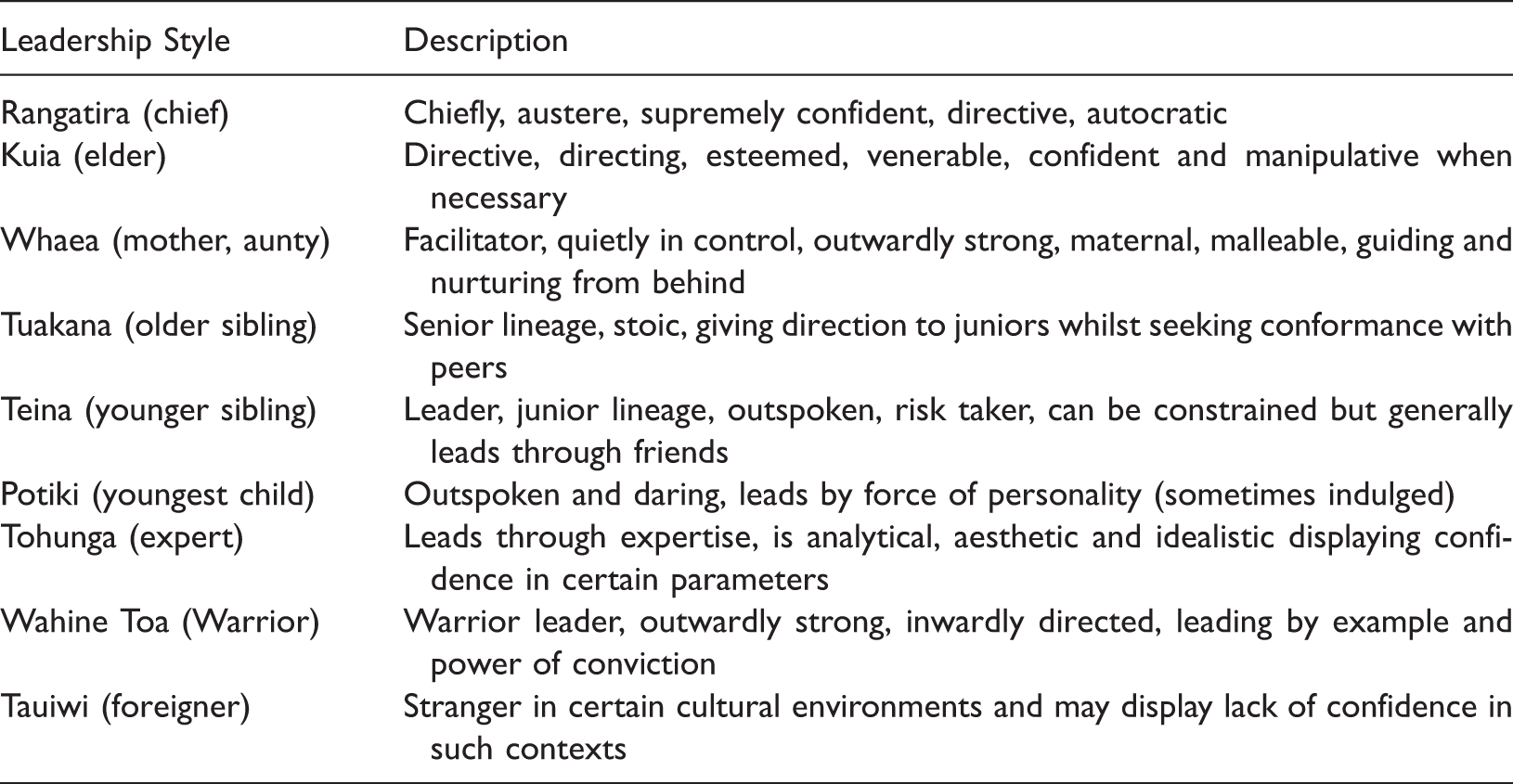
Relational Māori leadership; Māori language te reo/dimensions of language
In developing this integrative leadership ontology further, we argue relational self-identities and collective social identities (Brewer and Gardner, 1996) are inherent in Māori leadership as both the unique individual self and the broader social collective are central to Māori ways of doing leadership.
Consideration of the Māori word most associated with leader, rangatira provides insight. Ranga is the root word of raranga, which is to weave or plait, and tira can be a group, a company of travellers, or it can refer to rays or beams of light (Williams, 1975). As a noun, a rangatira is a chief, male or female (Mahuika, 1975: 42–63) who demonstrates the ability to weave diverse groups of people together.
A Māori etymology of the word rangatira is also worth considering. Ra is associated with light and is also the word for sun, ‘nga’ refers to pluralities, ‘i’ to divine energy, which underpins the word ‘tira’, and ‘a’ to the impact of light on growth. Rangatira is therefore associated with light, growth, chameleon like ways of both being and doing as a leader and with divine energy consistent with the association of mana atua with leadership.
Henare (2003) points to three other critical elements of Māori ethics relevant to leadership. Tapu that is considered the sacred and sacrosanct often denoted as an intrinsic power imbued at the moment of creation, mauri described as the life force, the intrinsic essence of a person, process or object, and hau, denoted here as reciprocity transmitted through gift giving (Henare, 2001, 2003; Henry and Pene, 2001). These concepts are made explicit in this integrative Māori leadership ontology and elucidate ways of being in relation.
In terms of understanding roles of Māori leaders in society, Winiata’s classical model of leaders in Māori society is gender neutral and fourfold with ariki (highborn chiefs), rangatira (often acknowledged tribal and pan tribal leaders,) tohunga (experts) and kaumatua (elders), still has currency (Winiata, 1967). Walker (1993) builds on this in contemporary analysis of the organic and transformative nature of Māori leadership with a particular focus on political, cultural and educational advancements, Salmond (1991) offers a gendered perspective Māori leadership, and Ballara (1998, 2003) details Māori warrior leadership and warfare.
Further on Māori leadership continues to reflect interdisciplinary approaches. For example, Waitere discusses cultural leadership with a focus on Māori leadership in education (Waitere, 2008), Hohepa and Robson examine the extent to which the dimensions of Best Evidence Synthesis Iteration resonate with traditional and contemporary conceptualisations of Māori leadership (Hohepa and Robson, 2009) whilst Holmes considers the use of humour as a means of providing a flexible indirect strategy for constructing leadership in ways that avoid conflict with traditional Māori cultural values (Holmes, 2007). Jackson (2013) engages critical discourse analysis to examine the emergent discourses of rangatiratanga within the context of Māori fisheries management, whilst Katene draws on Weberian models of leadership (bureaucratic, traditional and charismatic) and more recent leadership theories including transformational leadership to frame a discussion on Māori leadership. In doing so, Katene elucidates Māori ways of doing and being as leaders in a historical and contemporary sense (Katene, 2010).
Resonating with a critical socialist perspective, Rata asserts the emergence of a Māori ruling elite of neotribal capitalism in New Zealand and links this to an ideology of revived traditional Māori leadership (Rata, 2003), whilst Te Rito considers dramatic shifts in contemporary Māori society and its impact on evolving notions of Māori leadership, in particular, focusing on sport as an arena through which effective leadership can occur (Te Rito, 2006).
In a scoping report for the Hui Taumata, leadership in governance, Mead et al. consider the importance of augmenting Māori traditional concepts of leadership (Pumanawa) with contemporary perspectives of Māori leaders and leadership in order to keep in step with needs in changing times (Mead et al., 2006), whilst Te Momo (2011) argues six factors are significant to successful contemporary Māori leadership including aroha (compassion and love), pakanga (debates) tino rangatiratanga (sovereignty), manawahine (female leadership), tikanga kore (adapting protocols to suit the situation), pono (truth) and tika (what is deemed correct).
The challenges faced by contemporary Māori leaders and strategies employed to overcome them are advanced by Wikitera (2011) who frames her discussion by drawing on themes that resonate with Māori ocean navigation namely; travelling, navigating and negotiating. Travelling highlights the challenges for Māori living outside of tribal boundaries with limited access to the learning leadership by osmosis approach inherent in traditional Māori society. However, this is overcome by weaving new relationships and creating new cultural spaces using contemporary technologies and social media. The travelling Māori leader is seen to be able to take full advantage of globally positioned Māori resources. Navigating highlights the challenges encountered as a result of having to navigate through rigid institutional boundaries and complex political webs in both Māori in main stream institutions. In order to navigate and weave new pathways, Māori leaders require highly developed negotiating skills (Petrie, 2006). Tikanga (Māori cultural practices) is referenced as being central to leadership (Wikitera, 2011).
In generating insights from a series of leadership-focused wananga (forums), which illuminated the role Māori academic leadership Mathews (2011) engages the whakatauiki ‘He toka tumonana he akinga na nga tai’ (A standing rock in the sea, lashed by the tides Kawharu, 2008). According to Mathews (2011) in these forums, Māori cultural concepts and worldviews were frequently referenced by attendants as informing the leadership practice (Mathews, 2011).
In focusing on qualities most associated with a rangatira (leader), (Tikitu, in Best, 1898) includes concern for the prosperity of the people, intimate knowledge of the natural environment or native sciences, transmission of the language, matauranga (traditional and evolving knowledge systems) and other cultural treasures including rituals and ceremonies. The ability to mediate, manage and settle disputes, strategic leadership, courage in adversity and wisdom in genealogical recital are also valued as leadership skills (Tikitu and Te Rangikaheke in Katene, 2010). A rangatira is considered to demonstrate leadership through sustained proactive responses to outside forces perceived to threaten any of the above (Walker, 1991, 2002).
Finally, by way of comparison, we note that in research in over 500 federally recognised tribes undertaken by the Kennedy School of Government, Harvard University, Cornell and Kalt (2000) discovered, that even though tribal development strategies are heterogeneous, key leadership issues for Native Nations include actively demonstrating sovereignty, the importance of institutions given effective development is underpinned by capable institutions of governance, the significance of culture in governing structures, coherent economic tribal system and policies and procedures that reflect the values of the underlying tribal culture. The necessity of leadership is also emphasised, given nation-building requires leaders capable of introducing new knowledge and experiences, challenging assumptions, proposing change and inspiring action (Cornell and Kalt, 2000).
Investigating relational Māori leadership in a longitudinal study
‘Glamour and Grind, New Creative workers’ (2008 ongoing), is a longitudinal study that includes Māori leaders in the screen industry. Of note, Māori advancement in the screen industry gathered momentum in recent decades due to a series of landmark findings and recommendations from the Waitangi Tribunal. This tribunal is the permanent commission of inquiry charged with making recommendations to government based on claims bought by Māori in relation to actions or omission of the Crown that breach the Treaty of Waitangi. This treaty was signed in 1840 by 540 Māori chiefs and a representative of the British Crown (Orange, 2004).
In terms of the screen industry, successful claims have included the official recognition of Māori Language (WAI 11, the WAI number is allocated by the Waitangi Tribunal to differentiate different Claims and grievances), settlement of the Māori Broadcasting Claim (WAI 150) and the introduction of Māori Television Service (MTS) in 2004.
As a result, Māori now have access to multiple platforms, creative mediums and leading edge technologies considered hallmarks of the screen industry. For Māori, new knowledge created in these mediums, communicates distinct and important dynamics of the Māori world and the Māori view of the world (Royal, 2002). The role of Māori leadership and Māori leaders in building and sustaining developments in the Māori screen industry is significant and many are identified by Walker (1993).
Methodology
The research is qualitative and framed in Kaupapa Māori Research. Demand for intellectual leadership that sought liberation from hegemonic political regimes led to the emergence of radical leadership and activist movements in New Zealand in the late 1980s. Kaupapa Māori research and decolonising methodologies (Smith, 1999; Marie and Haig, 2006) emerged from this milieu to become internationally recognised as a movement synonymous with transformative leadership, conscientisation, praxis and empowerment for Māori and indigenous scholarly activists (Cunningham, 1998; Henry and Pene, 2001; Pihama et al., 2002; Smith, 1999).
A Kaupapa Māori research approach was taken as it is sensitive to the historical overt exploitation of Māori knowledge by researchers with no commitment to or interest in advancing the needs and aspirations of Māori. According to Henry and Wikaire (2013), the principles that underpin Kaupapa Māori research include;
Research for, with and by Māori Research that validates Māori language and culture Research that empowers Māori people Research that delivers positive outcomes for Māori.
Methods
Methods include participant action research (Fals-Borda and Rahman, 1991; Reason, 1994) and life history narratives. Researchers participated in local and international screen industry events. In addition, given the Māori word for research is rangahau, which implies weaving together (raranga) and reciprocating (hau), researchers initiated, convened and organised two international Māori and indigenous screen industry events (with support from multiple sponsors including Nga Pae o te Maramatanga and Te Ara Poutama) as a way of expressing gratitude to participants and as a means of reciprocating to the Māori leaders in the industry.
Primary data gathering included 25 semi-structured interviews (seven in phase 1, nine in phase 2 and the same nine revisited in Phase 3). Participants included Māori leaders in government entities and guilds that support the screen industry, directors, producers, writers, technicians and actors. As leaders, many undertake multiple roles throughout their careers in the industry.
All participants have extensive experience working in New Zealand, Māori and international film and television productions, are aged between late-20 s to early 60 s and comprised an equal number of males and females. They originate from a diverse range of tribes and there is equal representation of those born and raised in tribal communities and those raised in urban communities. Half of the sample are fluent speakers of the Māori language.
A life–history method which, according to Goodson (1995) represents stories in action within theories of context (Cole and Knowles, 2001), compliments the kaupapa Māori research approach taken.
Interviews were structured around four central questions; looking back over your life, would you tell the story of how you came to be doing work in the screen industry; looking at your work life now, what is it like; what are some of the glamour and grind factors involved in working in the screen industry; how do you see your future and the future of the industry.
All interviews were recorded and transcribed and data were analysed collaboratively over a four-year period (2008–2012). In the first layer of analysis, NVivo8 elicited 45 themes based on frequency of reference.
The life history narratives yielded a rich array of data from Māori leaders in the screen industry. Second layer analysis, considered how Māori views of the world and ways of being influenced leadership dynamics for Māori in the screen industry? How could we better identify the influences of identity, industry(meso) and macro contextual dimensions of leadership for Māori in the screen industry? and what does this research tells us about how Māori leaders navigate new frontiers to transform industry? This layer of analysis led to the current focus on developing a cultural perspective of relational leadership.
Discussion
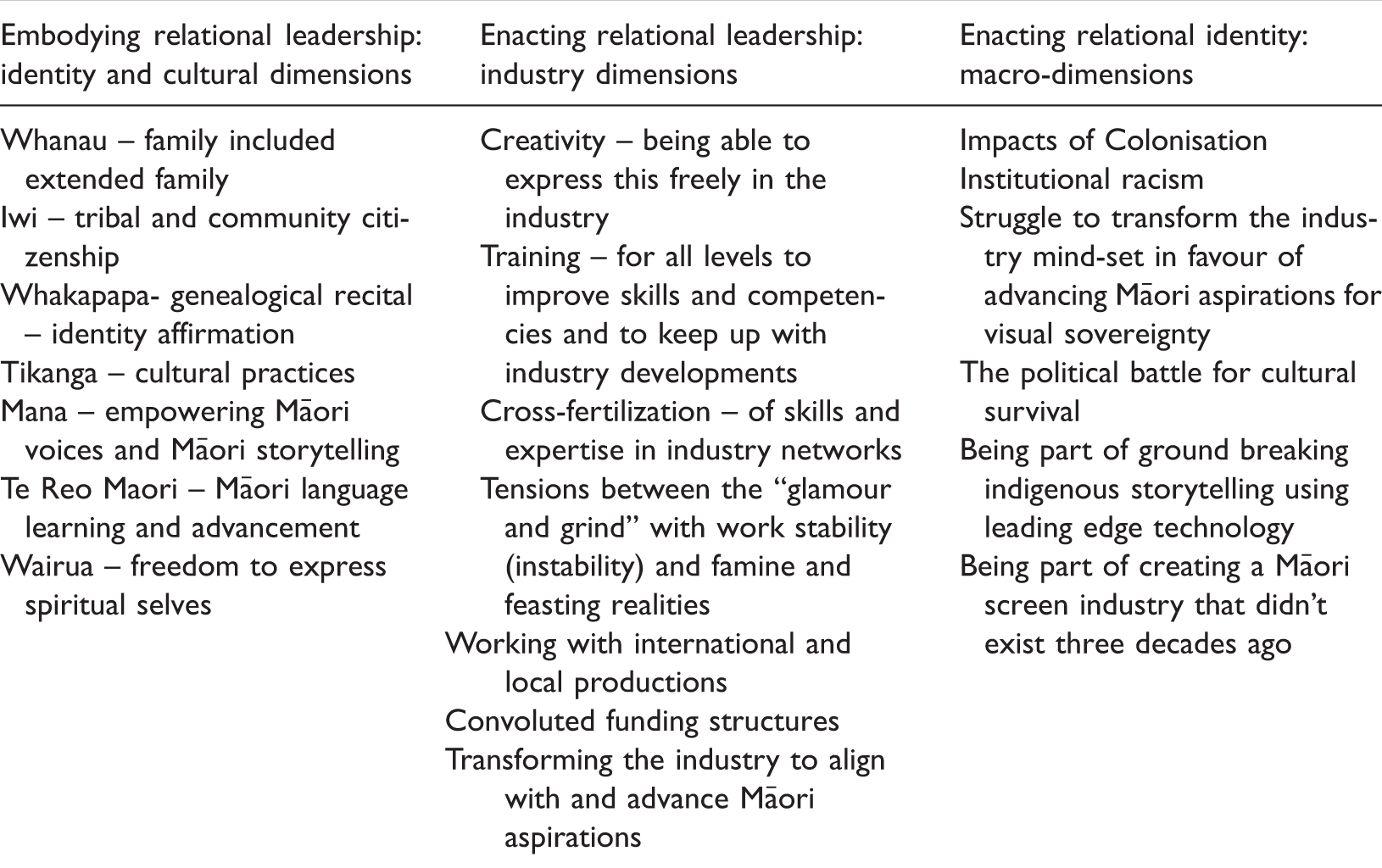
When synthesised, data revealed three distinctive themes; (1) embodying relational leadership – identity and cultural dimensions, (2) enacting relational leadership – industry dimensions and (3) macro-contextual dimensions of relational leadership.
Embodying relational leadership – Identity and cultural dimensions
At the interpersonal level, ‘the relational self is the self-concept derived from connections and role relationships with significant others’ (Brewer and Gardner, p. 84). In terms of our findings, self-concept for Māori leaders derives from relational dynamics in interaction with primary referenced social systems. For example, under the theme, Embodying relational leadership – identity and cultural dimensions, genealogical recital applied not only to ancestral connections and tribes but also to the flow and ebb of developments in the industry itself as it pertained to Māori development.
References to whanau (family and extended family), tikanga (cultural practices) and gender, also appeared important in self-concept and self-in-relation-to others. In orienting this further within the cultural realms of identity, another recurring theme was the revitalisation of Māori language and culture. As espoused by one participant, ‘Revival of Te Reo is the revival of the voice of the people, not just the words it utters; you are concerned with preserving the way a people think’. This cultural revitalisation was expressed as unique ways that Māori work together, ‘that way of sharing and tautoko (support)’. Further, the importance of sharing and telling stories that resonated culturally was acknowledged: ‘We should be taking our culture to the world and we should be taking Māori stories to the world’ and the importance of the Māori storyteller was also recognised, ‘We need to enhance our storytellers because it’s crucial to the health of our culture, to re-mythologise our stories, to give mana (authority) to what we think is important’. The telling of Māori stories by, with, and for Māori, and interpreting other stories through a Māori worldview using appropriate tikanga (rituals) was vital. Mentoring of rangatahi (youth), and managing liaisons such as gaining informed consents from all necessary iwi (tribes) and other stakeholders in any given production seen as important. Access and engagement in continuous learning of cultural practices (tikanga) and Māori language, Māori role models including the leadership and mentorship of elders, the importance of spirituality (wairua) and freedom to express themselves fully were also highlighted as important to the relational self-concept. Freedom to create their own stories and tell these stories in their own voice, in multiple mediums with humour, passion and creativity were fundamental. In addition, in terms of being Māori, narratives referenced the following which we refer to as identity frontiers in relational leadership that highlighted embodying relational leadership through identity and culture.
These factors shaped how participants viewed themselves, which impacted the degree of passion and motivation with which they approached leadership roles in the industry. It confirmed the influence of Māori culture in terms of self-concept for participants who expressed confidence, not only in terms of being Māori but also in terms of how their competencies, experience and skills delivered results for family/whanau, the industry and Māori society. These finding confirm studies of self and collective efficacy in Māori identity and transformation (Houkamau, 2007) and leadership efficacy (Hannah et al., 2008). They confirm the importance of an integrative ontology in relational leadership that includes ‘ways of being’ in leadership as an achievement of the whole collective.
Enacting relational leadership – Industry dimensions
When applied to leadership, a relational perspective changes the focus from the individual to the collective dynamic in a larger coordinated social process (Uhl-Bien, 2006: 662). In terms of the results of our study, ‘Enacting relational leadership – industry dimensions’, highlighted a number of realities encountered by these industry leaders, some of which are generic to the screen industry and others more specific to Māori. For example, the benefits of training and the need for more of it, politics of the screen industry, rigours of the glamour and grind of creative work and building careers in the industry were frequently mentioned. The intensity of divisive competition and contestability in terms of funding and general issues pertaining to convoluted funding structures were detailed. Benefits of networking in wider local and international contexts, markets and with other indigenous peoples were also acknowledged.
Participants also made specific reference to the mentorship, support and guidance of industry leaders such as the late Don Selwyn, Barry Barclay and Merata Mita. In addition, industry mentors and leaders who were not Māori, but who had aligned with Māori and supported the struggle for a stronger Māori presence in the industry were identified. Tensions between opting for a career in an established organisation such as a public broadcaster, and the feast and famine scenarios encountered by owner–managers, consultants, writers, actors and technicians, were noted.
Data analysis also highlighted industry realities of work more specific to the evolution of the Māori screen industry. For example, challenges associated with working in environments at the leading edge of the ‘melding’ of Māori-based cultural practices (tikanga) and corporate worlds were emphasised. However, the positive aspects of this were also highlighted for example, the ability to cross fertilise skills, resources and expertise, as the majority of participants had worked on Māori and international productions in a variety of roles including as directors and producers. In addition, in terms of ways of doing leadership in this industry, narratives referenced the following.
Here, findings highlight the importance of considering both the cultural and contextual forces that influence the dynamics of relational leadership.
Macro dimensions of relational leadership
Collective social identities come from identification with a group, an organisation or a social category. This implies a merging of self and group, to ascribe group defining characteristics to the self and to take the collective’s interest to heart (Uhl-Bien, 2006: 658). In terms of the results of our study, ‘Macro dimensions of relational leadership’, emphasised the contextual and structural boundaries encountered by Māori leaders in the screen industry. Here, narratives focused on issues of colonisation, struggle, racism, micro and macro aggressions of institutional racism, realities ascribed to the collective group, but encountered through individual and collective experience. However, there was also cause for optimism as one participant said, ‘Māori TV is the largest independent producer of New Zealand material now, bigger than any other channel’. Another noted that, ‘one good thing about the technology is it’s given us the opportunity to take that screen back out to the edges’, to rural and tribal communities. There was also optimism about training young Māori, ‘We need to up-skill our creative people, our creative youth’. In addition, in terms of being in the wider world, the narratives of these leaders incorporated the following:
Although small in scale, this research highlights how relational leadership from a Māori perspective derives from a combination of individual and collective aspirations. It is embodied and enacted to empower, enhance, transform and shape futures.
This offers a fresh perspective on relational leadership, which contributes to a holistic theorisation. For Māori, leadership in the screen industry has played an important role in ensuring cultural survival, continuity, voice, transmission and innovation in advancing individual and collective aspirations. The factors highlighted above, relating to cultural dimensions, industry dimensions and macro-dimensions are encapsulated in the table below.
Dimensions of relational leadership based on a Māori indigenous. Summary of Relational Leadership Factors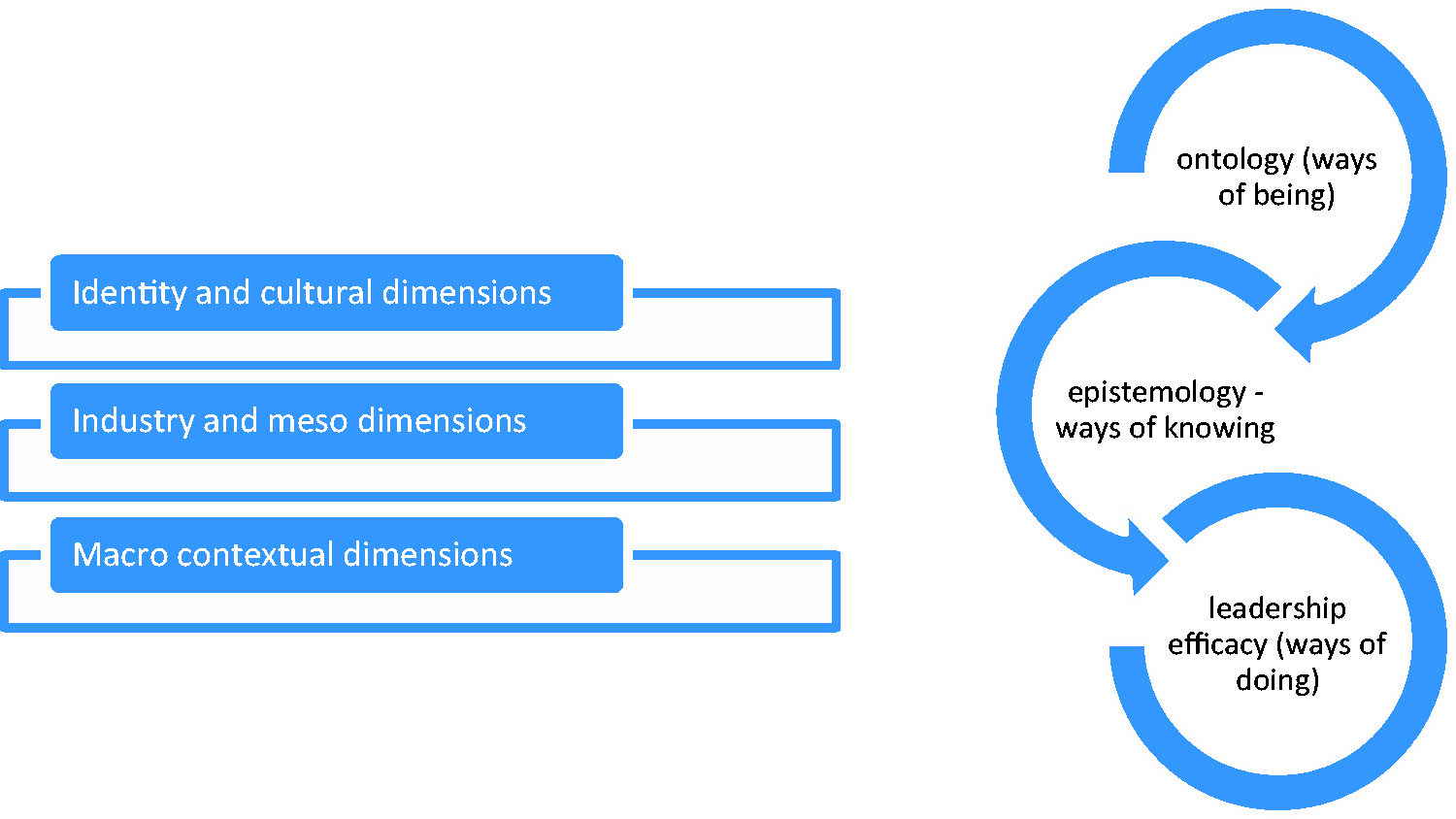
In summary, the three distinctions elicited from the study namely (a) embodying relational leadership; (b) enacting relational leadership – industry dimensions and (c) macro-contextual influences on relational leadership, have informed this cultural perspective of relational leadership.
Contribution: A relational dynamics approach to leadership; building a framework for analysis
Based the literature review and research, a framework ‘Dimensions of relational leadership’ is offered. This framework captures relational leadership as an integrative ontology that references three core themes; (a) embodying relational leadership references the importance of cultural sources of identity in a Māori leadership ontology, (b) enacting relational leadership references doing and transforming in the practice of relational leadership and (c) macro-contextual influences in relational leadership references the institutional boundaries and dimensions of relational leadership.
Conclusion
At the outset, this article asked, how does the experience of indigenous leaders offer new ways of understanding leadership dynamics? How can studies of indigenous ways of being and doing leadership contribute to leadership literature?
We answered these questions by offering a cultural perspective of relational leadership as a way-of-being-in-relation drawing from an indigenous worldview. We detailed core philosophical foundations that underpin a Māori leadership ontology including mana atua (divine, spiritual), mana tupuna (ancestral), mana whenua (geographical and terrestrial), mana tangata (social spheres) and mana wahine (feminie principle). We also highlighted the role of genealogical recital (whakapapa) as a ritual means of connecting and layering relationships across time and space, a process that resonates with both embodying relational leadership as a way of being and as enacting it as a way of doing and transforming space and place in practice.
Based on a longitudinal qualitative investigation of Māori leaders and practitioners in the screen industry, data revealed three distinct themes; embodying relational leadership, enacting relational leadership and macro-contextual influences in relational leadership.
These findings affirmed ways in which culture and worldviews shaped the identity of Māori leaders confirming that relational leadership is a process of social construction, which emerges from the dynamic interaction between ontology (ways of being) praxis (ways of doing).
In conclusion, this contribution has chartered new territory in leadership theory contributing new ways of understanding relational leadership from an indigenous Māori perspective. It highlights the importance of holistic theorisations of leadership that examine cultural, identity and macro-contextual dimensions that influence ways of being and doing leadership.
Footnotes
Acknowledgements
The authors extend their gratitude to Associate Professor Deborah Jones and Professor Judith Pringle principals of the Glamour and Grind, New creative workers project funded by the Royal Marsden Society, and the International Leadership Association Oceania 2013 conference convenors and reviewers.
Declaration of Conflicting Interests
The author(s) declared no potential conflicts of interest with respect to the research, authorship, and/or publication of this article.
Funding
The author(s) received no financial support for the research, authorship, and/or publication of this article.