



Abstract
The problems of ‘lost in translation’ are well known. Yet some terms of English managerial vocabulary, which are perfectly translatable in other languages, remain untranslated. One explanation of this phenomenon is what Linguistic anthropology call negative semantic resonances. Semantic resonances focused on the issue of which meanings can or cannot be expressed by a single word in different cultures. In this paper, based on an organisational ethnography of Latin American expatriates working for an Italo-Latin-American multinational corporation (Tubworld), we analyse the resonances of the word leader/líder and director, direttore, capo, guida, coordinador, caudillo among a group of expatriates; all Italian, Spanish or multilingual speakers who use English as a second language in their everyday interactions. The paper explains how the different uses contribute to create a meaning of what a leader should and should not be; someone who leads without leading, sometimes a manager. The authors, an Italian native speaker who learnt Spanish during childhood and use English as his everyday language and a Spanish native speaker, argue that Italian or Spanish speakers not only avoid the words duce and caudillo (the vernacular vocabulary for leader, not in use due to the political and cultural meaning) but also the word leader/líder itself, as it resonate to the other two (violent, authoritarian, autocratic, antidemocratic leadership) but furthermore because the word, a lexical loan from English, failed to encapsulate the complexity of leading multilingual organisations like Tubworld.
Introduction
It may seem contradictory for authors who are not English native speakers to write an article in English on the resonances of an English word in Italian and Spanish. However, one wonders; how much of the resonances of this word for English speakers is related to the meaning Italian and Spanish speakers give to it? What are the limitations on English-medium reflections on the resonance of the word in non-Anglophone contexts? Should an article like this also be written in Italian and Spanish? However, what is the problem of using English words in languages other than English itself, in addition to the obvious point of the domination of this language over others? If the words were gin or rugby it could be argued that they refer to English objects and practices, hence, the justification of using a local vocabulary of the natives of England or English native speakers. But what happens if Italians and Spanish have replaced their own native language words (duce/caudillo) and they use the English word leader/líder reluctantly? Indeed, what attracted to us to write this article was to notice the reluctance of using leader/líder, the need of our research participants to justify what they were talking about every time they used it and a certain sense of apology when they pronounced it. As Italian and Spanish speakers we asked ourselves: are the resonances of leader/líder not helping to make sense of our organizational world?
Our first exploration to elucidate on these questions was in the vocabulary. Duce and caudillo were never used in a traditional Anglo-Saxon managerial organizational context before Benito Mussolini (1883–1945) and Francisco Franco (1892–1975), but were applied mostly to refer to political and nation state authoritarian organizing. The meaning of leader in English is closer to ‘to travel’ or ‘showing the way’ (pioneering), with no clear connotations of authoritarianism. However, why do a significant number of English dictionaries define duce and caudillo precisely as a leader, paradoxically, the word that Italian and Spanish speakers have borrowed from English to replace these words? Take for example a current English dictionary of etymology: Leader: Old English lædere “one who leads, one first or most prominent,” “agent noun from lædan”… As a title for the head of an authoritarian state, from 1918 ( Mussolini, Benito Pronunciation: Benito Mussolini, in full Benito Amilcare Andrea Mussolini, byname Il Duce ( Caudillo: masculine noun. (military) I was reminded of a recent conversation I had with a German manager after my seminar during which I explained my dislike of the term ‘leader’ (in English, not as a borrowed word). He told me that they always speak of ‘leaders’ in German, not because they don't like managers, but because to them ‘leader’ has nothing to do with Führer, which obviously is a forbidden word. I would imagine the same goes for Duce and caudillo. In other words, they are so preoccupied with avoiding the connection with Hitler, Mussolini and Franco, that they don't have time to think that there may be a better word in English to be borrowed. On the other hand, as you say, the native English people don't have this association at all. At another seminar we came to a common jocular suggestion that leaders should actually be called ‘guides’. Obviously some semantic loans are more complicated than others. I am not sure, from one side, if I am using the word leader/líder with the same meaning with which an English native speaker uses it; from the other side, I have the impression that they resonate, when these Tubworld (name fictitious) expatriates justify why they prefer not using them, an authoritarian, monopolistic and patronizing character, always a man, a sort of duce and caudillo, precisely the words for leader in our original languages. … ;
… ;
The article is based on an organizational ethnography of Latin American expatriates working for an Italo-Latin-American multinational corporation (MNC; Tubworld). 1 We reflect on the way Tubworld expatriates explain the uses of the word ‘leader’ in their native languages (líder, Spanish; leader, Italian – the word in Italian has been imported from English with the same form) in various organizational situations and justified why they have, to them, a negative resonance. The main argument of the paper is that duce and caudillo, now excluded from vernacular vocabularies but at some point reinstated by English dictionaries in association with leader, still permeated the meaning of leader and líder in Tubworld, but occasionally other words were used instead of leader, like direttore, director, capo, jefe, guida. We claim that this was particularly evident during the organizational context of mergers, acquisitions and takeovers that affected Tubworld during the period of Gaggiotti’s fieldwork, when power and politics played a substantial role in the organizational life of the corporation.
The article unfolds as follows. First we give a very brief overview of the literature that has addressed questions of multilingualism, monolingualism and the studies of vocabulary in international organisation settings, in particular the largest literature on the subject, the organizational post-colonial approach. We continue with the presentation of the case, Tubworld, and the historical, cultural and political context of Latin American MNCs. We explain later how the word ‘leader’ was introduced and is used in Italian and Spanish; we produce also a brief lexical description of duce (I), caudillo (S), leader (I), líder (S), condurre (I), acaudillar (S), conducir (S), leadership (I), liderazgo (S), dirigente (I), dirigente (S), dirigere (I), dirigir (S), direttore (I) and director (S) and their resonances with the expatriate narratives in Tubworld. We pay particular attention to the context in which they used these words: meetings, interviews and informal chats when they discussed internationalization, takeovers, mergers and acquisitions involving Tubworld. We finish by reflecting on the consequences of the uses of líder/leader in association with other non-English words, in particular líder (S), capo (I) and guida (I), in the context of the recent expansion of Mediterranean and Latin American MNCs.
The gap in the literature to study the leader/ship phenomenon from a lexical perspective
There is an academic consensus that the specific topics of monolingualism and multilingualism and their implications for leadership are still an underexplored area of research, even after the attempts to study them at the beginning of 2000s (see among others Bordia and Bordia, 2015; Charles and Marschan-Piekkari, 2002; Fredriksson et al., 2006; Janssens et al., 2004; Welch et al., 2005). There is a claim that indeed the field of leadership studies requires an alternative research agenda focussed on language multiplicity (Schedlitzki et al., 2016) in order to include non-Anglicized notions of leadership (Guthey and Jackson, 2011). In their research for specific literature on leadership and language Schedlitzki et al. (2016) found a strong focus on exploring language as a tool for motivation and persuasion, whereas only one article was found in the Business Premier database (Zander et al., 2011) exploring language in relation to leadership and culture. In the same database, we found that only Jepson (2010) specifically addresses the relation between language, leadership and lexicality.
The lack of attention given to the multilingual dimension in research is not exclusive to leadership studies. Even in studies that focus on narrative (Czarniawska, 1997) and discursive (Fairhurst, 2007) aspects of organizing, the multilingual perspective was traditionally invisible. For Srinivas (2002) the absence of research on other vocabularies than English during the 1960s was part of a strategy of dividing West from East, silencing and disciplining the local by imposing single codes, words and concepts, ‘here and there’: ‘The existing managerial vocabulary was retained, with culturalistic explanations for existing concepts like motivation and leadership’ (p. 169). Indeed, the analyses tended to neglect the uses and coherency of vocabularies different than English in earlier colonial enterprises. Jepson (2011) and Ottenheimer (2006) noted that there have been attempts in organization studies to explore the verbal dimension of leadership, but not on the multi-lingual perspective and the multiplicities of vocabularies that constitutes its semantic domain. Similar was the case of the studies of multilingualism or monolingualism in business studies, which have been studied from the communication perspectives (see, among others, Esmann et al., 1999; Lavric and Bäck, 2009) but not from the verbal or the semantic.
The discussion on the mono-multilingual perspective of leading was also traditionally outside of the focus of leadership studies (Jepson, 2010). It seems the Narrative Turn on social research was interpreted in leadership studies more as research on ‘cultural leadership’. The interest was more on the way cultural differences were constructed, as Alvesson and Kärreman (2000) discussed; a reaction to an evident discourse–exclusive managerial Anglo-Saxon ideology. Indeed, the more cultural than, strictly speaking, lexicosemantic approach still permeates our current discussions on leadership. Schedlitzki et al. (2016) found reasons for this to be due to the dominance and unreflective use of the English language as the academic and business lingua franca within the field of leadership research, and its implications of overlooking lexical multiplicity for our understanding of sensitive leadership practices. Others have suggested this is due to the difficulty of native English speakers, including academics, to learn foreign languages (Coleman, 2009, 2011; Lamy, 2003; McPake et al., 1999) and therefore the difficulty to investigate the meaning of the leader/ship in other vocabularies.
Indeed, in response to concerns that UK-born and educated researchers lack essential foreign language skills, the British Academy produced a report in 2009 (British Academy for the Humanities and Social Sciences, 2009) which analysed the effect of the fall in modern language learning on research fields, especially in social sciences. A follow-up report (British Academy for the Humanities and Social Sciences, 2011) found that the lack of language skills limited researchers in their ability to produce research in languages other than English and therefore engage internationally in or with their research, and in their career opportunities.
At some point in our research we began to question whether perhaps other analysis on the lexical dimension of leadership were produced not in English but in Italian and Spanish. We therefore conducted a search within J-Stor (there is not a specific Italian database for scientific articles) for Italian academic journals using the keywords leadership, liderazgo and lessico. The search brought up 20 and 61 hits respectively. We went through all these 81 articles to identify those that were specifically focussed on leadership and language. We also ran other specific searches within this database, using keywords such as significato and semantica. All the searches returned 112 articles, with only two articles (Balboni, 2001; Malighetti, 1994) exploring leadership in relation to communication and culture. We also conducted a search within Dialnet Rioja, the Spanish Social Science Database with 9695 Journals and more than 5 million papers for full texts from academic journals and J-Stor using the keywords liderazgo and lingüística and liderazgo and léxico. The search brought up 38 and 12 hits respectively. We went through all these 50 articles to identify those that were specifically focussed on leadership and language. We also ran other specific searches within these databases, using keywords such as significado and semántica. All the searches returned four articles, with only three articles (Gonzales-Miranda, 2014; Mayorga et al., 2013; Vangehuchten, 2013) exploring the relation between leadership with power, the discourse of handbooks used in Spain to teach leadership and leadership as part of organization studies.
Schedlitzki et al. (2016) found that in academic practice, English became a sort of imposed lingua franca, meaning to speak and write in English is needed in order to succeed in the global academic life. This suggested to us that the lexical perspective could be more evident in post-colonial studies. 2 However, we found that for Prasad (2003) the discourse of the cultural complexity and its vocabulary dimension is an epiphenomenon of the traditional culturalistic approaches that divide people and phenomena in order to make them comparable. Post-colonialists remark that neocolonial discourse, hidden within the rhetoric of an always-complex globalization and multi-nationality, simplifies the richness and contributions of the local and imposes uniformity and simplicity on the symbolic relations of the people who work in an organisation (Peltonen, 1997, 1999), particularly in their identity representations (Leonard, 2010). Scholars have noted the lack of neutrality in the global approach, its simplicity and its one-dimensional perspective, and suggest that this perspective was inherited from the colonial organisation of the world (Prasad, 1997) into local and non-local languages, cultures, religions and ethnicities. However, they have not produced concrete analyses of how this simplification is formed at the lexical level.
We were interested also in studying the recent explorations addressing the issue of the relation between multilingualism, diversity and ethnicity. The literature suggests that differences – constructed through stereotyping rather than given in nature – play a crucial role in dividing people, impeding their adjustment and creating pseudo-cultural differences and stigmatization (see, among others, Hemmasi and Downes, 2013; Vromans et al., 2013). We found a good corpus of research on language and multilingualism that has suggested a similar idea: that indeed semantic differences are what really count, but they are often overlooked in favour of explanations that emphasize local/non-local differences, barriers and cultural distances. Some authors like Billig (1995) suggested that the construction and imagination of our identity is articulated in the choices of our everyday vocabulary. The decision to use or avoid using words depending on how they resonate, or to use them in a particular way or to depict actions in one way or another (for example, ‘to lead’ or ‘to follow’, or to manage’ or ‘to be managed’), could have consequences on our representation of these actions, on our definition of ourselves as similar or different to others and on our interactions with others (De Cillia et al., 1999).
Our conclusion was that it is not only in the field of leadership and organization studies in English, Italian and Spanish that the research agenda on language and lexical multiplicity is invisible but also in other approaches that make claim to a more diverse and local approach to leadership, like postcolonial studies and mobility and nomadic organizing and expatriation.
A case to study leadership in a multilingual context: Tubworld and Latin America
Latin America is a noteworthy region for the study of leadership from a lexical perspective. It has represented a fully integrated economy in the global market of commodities for almost 200 years. Between 1989 and 2002, it was also one of the preferred destinations for foreign investment and MNCs relocation and expansion (Gaggiotti, 2012). From the late 19th century, Latin America registered four distinct fluctuations in the workforce, all of them as a result of immigration and mobility: (1) 1870 and 1913, a period characterized by the agro-export model of development, when foreign MNCs settled, local MNCs were born and expanded, and the global workforce migrated in and out of Latin America, mostly from Mediterranean Europe; (2) 1914–1929, a period of import-substitution industrialization, with a strong presence of an international working force with Italian, Spanish, German, Lebanese, Japanese, Polish and French as their mother tongues; (3) 1990–1998, a period of privatization of national companies and (4) 2004–2008, a period of contemporary global mobility and global careerism (Chudnovsky and López, 1997). The four phases have in common the huge development of a workforce that in most cases has the capacity to use more than one language. Fowler (2002) noted that it is indeed very common, for example, that Mexicans, Argentineans and Brazilians who speak more than one language do not necessarily recognize having one mother tongue, but have a hybrid ethnicity and multiple national identities. Eighty-two percent of the expatriate managers of Tubworld are in fact Italo-Mexicans; Italo-Argentineans, Mexican-US Americans or Brazil-Portuguese and 92% of them speak two or three languages. As a Tubworld expatriate graphically explained: Interviewee 7: I do not see locals or nonlocals when managing people; I see people. How can I explain? For me it’s not important if the director (jefe) is Spanish, Mexican, Japanese or German. This is not the problem! The problem for me … I don’t see the person as a foreigner … I see the person as a person; this is why my relationship with this person is very important. How can I relate to this person from my personal point of view, not because I am his or her leader (il suo capo). What can I say? I might have an Italian leader (capo) who I like very much or an Italian leader (capo) that hates me.... This depends on the person, not on the fact that he was born in Italy.... For me it was not because I started to work for an Italian company that was acquired, right? Purchased. In fact, so many Italian companies are not Italian anymore.... They are Argentinean, German, Chinese. It is also clear that when someone buys a company he wants to impose his way of working, which may be correct or not, but it’s his.
Methodological choices
There is an academic agreement that the lexical dimension of organising practices are still an underexplored area of organizational research, in general, and leadership research, in particular. Here we need to make two considerations that have influenced our methodological choices. Primarily, we have considered here leadership as a socially constructed phenomenon, an organizing practice. Even if we are acknowledging the substantial differences between leadership and management studies and we are not implying management and leadership are synonymous, we analyzed the leadership phenomena from a semantic point of view, from its construction in the narrative of speakers, and not as a pre-defined theoretical concept. Probably due to the influence of how Italian and Spanish participants of this research justify their use or avoidance, sometimes referring to the terms leadership (liderar, condurre) and management (administrar, administrare) indistinctively, we preferred not to define leadership beforehand, to avoid stipulating a precise notion of leader and leadership from the literature instead of from the fieldwork, similar to what Marturano (Marturano et al., 2005) and others (see e.g. Astley and Zammuto, 1992; Pondy, 1978) have attempted.
Secondly, that we are only taking inspiration from linguistics; as anthropologists and management scholars we cannot claim expertise in that field. We were particularly interested in the vocabulary as a tool of constructing different realities, as Silverstein (2006) defines as an ‘entrée into understanding cultures’ (p. 481) and we found inspiration for understanding the participant’s vocabularies on Searle’s semiotic constructivism (1995), Hitchings’s cultural significance of words (2008) and Fasold’s (1984) social uses of vocabularies than in linguistic perspectives. Indeed, we used language and vocabulary in Searle’s sense, to serve ‘the intrinsic intentionality of humans’ (1995: 61), means by which humans create not only the meaning of leadership but also justify leading.
We started our work with an etymological analysis of the word ‘leader’, its incorporation into the Italian and Spanish vocabularies and its lexical relation with the words duce, caudillo, commando, liderazgo and other words of their semantic domain, scrutinizing in particular how English dictionaries define duce and caudillo as leaders. We continue with the analysis of Gaggiotti’s ethnographic fieldwork at Tubworld.
The main part of the material that we analyse here comes from the talks Gaggiotti with Tubworld expatriates, but we also draw on his own field notes. We draw on these materials to construct a series of ‘tales of the field’ (Van Maanen, 1988). Actually, these tales are closer to a film: they contain ellipses, short frames and flashbacks to Tubworld’ past.
Originally we analysed the talks according to narrative analysis (Czarniawska, 1997, 2004). Gaggiotti collected data, taking notes as recommended by Huberman and Miles (1994), in an iterative way (Kostera, 2007). Analysing the talks in chronological order also became a way of signalling his changing knowledge of the field. Gradually, he started to focus on the semantic resonances of some words, expatriate’s justifications of the avoidance of managerial vocabulary, mostly in English, and how some non-English words gave meaning to expatriates everyday leading, in particular jefe, director, capo and direttore.
From the perspective of the analysis, our interest was in exploring the relationship among resonances and the identification of actions that emerged in stories and testimonies around characters, events and places. The intention was to determine the resonances of leader/ship and how they became evident not only in the expatriates’ discourse but also in organisational discourse more generally. We were particularly interested not only in establishing how and why these resonances had consequences in expatriates’ ‘practices’ but also in determining the extent to which non-English words for leader/ship, in particular nouns and verbs, were used when telling stories. Because of length restrictions, we quote only a few examples of texts as illustrations of phenomena that characterize the whole corpus of Tubworld interviews and field notes.
The fieldwork carried out between March and August 2005 in cities hosting two factories: Bergamo (Italy) and Buenos Aires (Argentina) resulted in 52 unstructured interviews – better described as ethnographic talks (Fontana and Frey, 1994) usually with some kind of embedded questioning (Fetterman, 1989) – with expatriates and repatriated employees of various ages (35–45), gender (95% male), places of destination (most of them Europe and South America) and hierarchal levels (executive and technical management), all of whom worked for different companies of the corporation. The talks were conducted using the languages chosen by the interviewees (Italian, Spanish, English or a mix of them), recorded and fully transcribed. 3 The field notes were produced in Italian, Spanish or English, depending on the language chosen by the participants for the interaction. The fieldwork generated a total of 362 pictures, 6 hours of video recording, 14 hours of audio recording and a corpus of 35,678 words of field notes. 4 Out of the total number of talks, 46 were conducted on the company’s premises and in the physical place where the expatriate/repatriated person worked every day (the employee’s office). Gaggiotti was able to shadow 26 of the managers he interviewed, observing their work and social routines. He was invited six times to formal meetings with their teams, 14 lunches and 4 out of the office activities such as playing football or the celebration of Tubworld’ anniversary of the death of the founder, where he observed how leader/líder resonated when used in the interaction with workers, friends and even family members.
Tubworld: An ethnic group with a multilingual leadership vocabulary
Tubworld is a self-defined ‘global organisation’ that produces and trades steel pipes and offers support services for the oil and gas industry. The company, one of the multinationals within Tecpetrol, is the result of the expansion of an initial nucleus of companies and plants (sometimes a company includes more than one plant, but usually a company is composed of a single plant) producing steel pipes in three countries (Italy, Argentina and Mexico). Even though the corporate discourse does not establish a hierarchy of those who have led the processes of mergers and acquisitions in Tubworld, it is well known that it was Tubarg (Argentina), founded by the Italian engineer YTS in 1954 in the province of Buenos Aires, that took over the other two companies based in Mexico and Italy. Forty years later, the three companies started a continuous intercontinental expansion.
Towards the end of the 1990s the idea emerged of creating a global brand that would communicate the company’s commitment to clients in a unified and standardized way. The concept of Tubworld as a ‘global leader’ emerged in the corporate discourse (Catalano, 2004: 1). Multilingual brochures, pamphlets, logos and webpages were redesigned to create and promote the new brand. All the expatriates interviewed referred to this process as the Tubworldation of the company. Tubworldation in the jargon of Tubworld meant representing a conglomerate producing more than 3 million tons of seamless pipes and 850,000 tons of welded pipes, with business offices in 20 countries employing 13,000 people. All the expatriates in the study worked for one of these independent, yet related, companies.
Tubworld was defined in the organizational discourse by its multilingual organisational richness and complexity. English was Tubworld’s lingua franca, and this language mainly supported the relationship between Tubworld and its clients and providers. However, Italian was the common managerial language and substrate of managerial discourse (the organiser of the symbolic world and organisational representations) and Spanish was the language of power, represented by Tubworld Tubarg, which led the takeovers, mergers and acquisitions.
Italian, Spanish and English words for leader
It is not our intention to expand on a detailed semantic analysis of leader/ship in English and other languages such as Italian and Spanish. However, when discussing this article with our reviewers, it was suggested that indeed the word ‘leader’ is a taboo in other languages and had negative resonances even when used in English. It is well known that after the demise of Nazism the name Führerschole was replaced with ‘management school’ in every German-speaking university, even if the word Geschäftsführer is still in use (Bremen, 2016). Moreover, the word ‘leadership’, paradoxically, is lexically borrowed from the German leiten or Dutch leiden and it means originally something about travelling or pioneering. Leadership as ‘to be in first place’ is from late 14th-century. and used as a noun is first recorded c.1300. Used as to be in ‘the front or leading place’ is from 1560s (Thesaurus Online, 2016).
In Italian, ‘leader’ (written in the same way as in English) is used in colloquial speech, as capo or guida. Contemporary Italian dictionaries include the word in its English form with no connotation of a managerial or corporate role (Gabrielli, 2015).
Figure 1 shows different dictionaries’ definitions of the word ‘leader’ and alternate words that are defined or used to define ‘leader’, depending on the context. Italians do not say, for example, ‘the module leader’ but ‘the head of a course’; when a competitor is ahead in a tournament she/he is not ‘a leader’ but someone who is ‘ahead among the winners’. In Italian, it is possible to construct words using capo depending on the function of the leader, like caposquadra (head of the squad), capoclasse (head of the class) or capogruppo (head of the group). Translating these words into English as ‘leader’ produces different resonances. The ‘leader of the group’ or the ‘leader of the module’ suggests someone unique, alone and singular, with extreme power.
Leader/ship in Italian and Spanish dictionaries.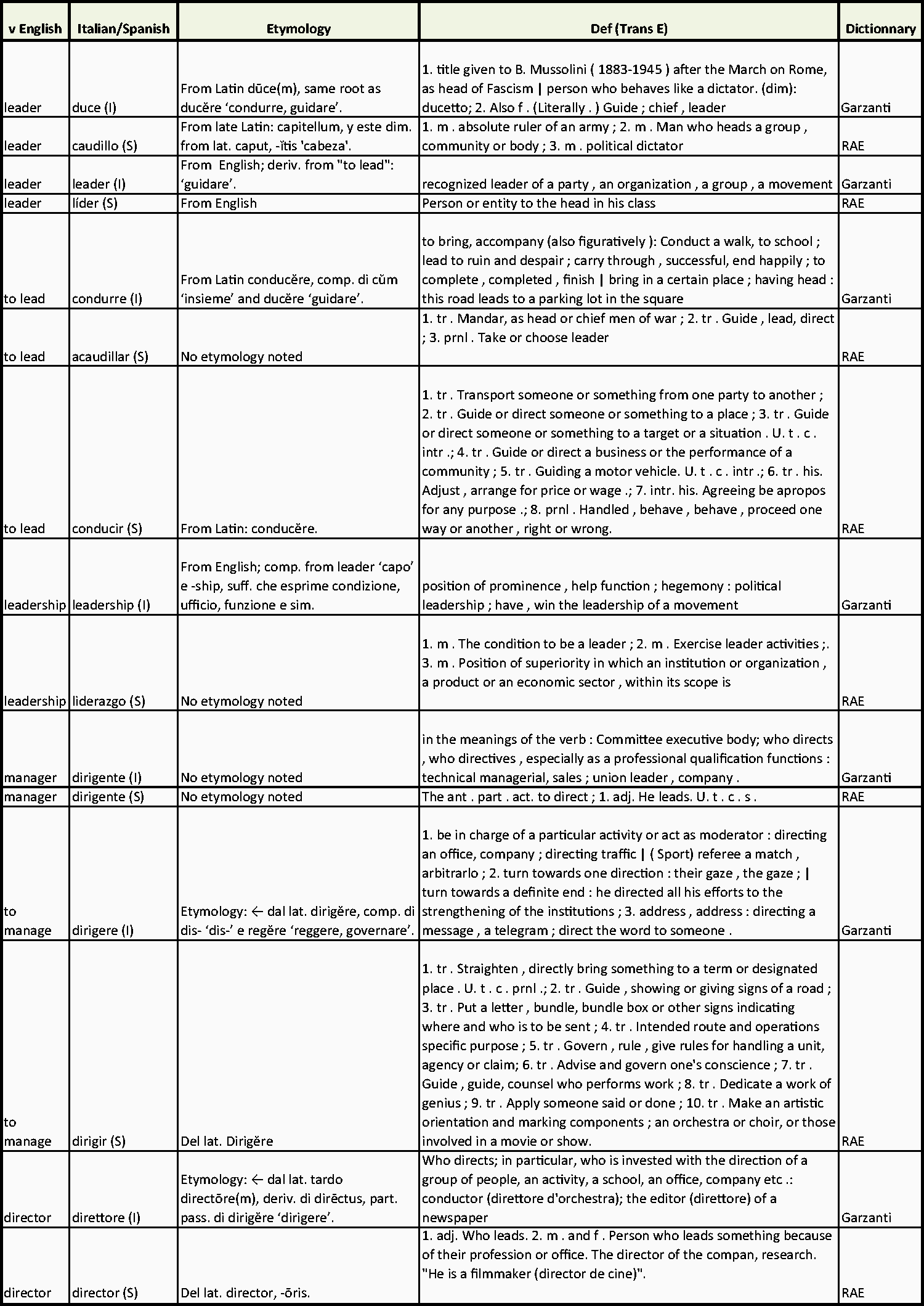
Latin American researchers have documented the first use of the word líder in Spanish in the 19th-century. Before 1929 the word used was caudillo. The Spanish form líder is documented in the Spanish vocabulary in 1929, and after a few years of being used alternately with the English form ‘leader’, was finally adopted in common use at the beginning of 1932. Godoy (2004) noted that the word originally was used in particular to refer to political leadership and, in exceptional cases, to refer to ‘leaders’ of horse races. Lázaro Carreter confirmed that líder was used first in Spanish ‘to refer to someone who manages or directs the mind and behaviour of others, in particular applied to politicians’ (Lázaro Carreter, 1997: 656). However, líder was not used to refer to general Franco, ruler and supreme dictator of Spain from 1936 to 1975. He was called by the traditional form caudillo and was the only one allowed to receive this form of address, much like Mussolini’s duce. English dictionaries and encyclopaedias however define the caudillo as a leader: Franco, Francisco. Pronunciation: Francisco Franco, in full Francisco Paulino Hermenegildo Teódulo Franco Bahamonde, byname El Caudillo (The Leader) (born December 4, 1892, El Ferrol, Spain—died November 20, 1975, Madrid) general and leader of the Nationalist forces that overthrew the Spanish democratic republic in the Spanish Civil War (1936–39); thereafter he was the head of the government of Spain until 1973 and head of state until his death in 1975 (Encyclopaedia Britannica Online, 2016b). (1892–1975), Spanish general and dictator, head of state 1939–75. Leader of the Nationalists in the Civil War, in 1937 Franco became head of the Falange Party and proclaimed himself Caudillo (‘leader’) of Spain (English Oxford Living Dictionaries Online, 2016a).
Alcoba and Freixas (2009) suggest that in official Spanish documents and in the press, liderar (to lead) is used to encompass a huge spectrum of verbs that are part of the same semantic domain, such as encabezar (to head), dirigir (to manage), capitanear (to lead a ship) or mandar (to command). All of these verbs have a derived noun in Spanish (cabeza-head, director-director, capitán–captain, comandante-commander), similar to the Italian (testa-head, capo-boss, capitano-captain, comandante-commander). Liderar is a function derived from the position of someone who is ahead of others, leading them.
Jepson (2010) has noted a similar situation for the word leader in German. ‘When consulting, for example, a German dictionary such as Collins or the Oxford Duden, it appears that there are a multitude of different translations for the English terms leader and manager. Some of these overlap and others contradict, whilst other English terms such as follower and subordinate do not have a perfect match in the German language. This multitude of possible translations and interpretations is partly due to the functional character of the German language as the all-embracing word “manager” is more specifically defined within the German language in terms of titles that describe specific positions and functions in an organisation and hierarchy, that is, manager can in German mean both managing director (Geschäftsführer) and department head (Abteilungsleiter). Further, when translating such German words, for example, Geschäftsführer or Abteilungsleiter, as ‘manager’ in English, this will not capture the entire meaning and status of the German words’ (p. 427).
The entire meaning of leader/ship in English is indeed impossible to be reproduced by any of the Italians or Spanish words used to refer to positions and functions of a leader/líder. The noun ‘lead’ in English, for example, can refer to the cord for restraining or guiding a dog or other domestic animal (English Oxford Living Dictionaries Online, 2016b). The equivalent Italian cinture per cane or Spanish correa de perro have not any lexical or semantic relation with leader/líder.
The Spanish word for ‘leader’ (líder) has, like in English, an associated noun (liderazgo/‘leadership’) that is common in organizational discourse and the economics press. There is no equivalent associated noun in Italian (commando/ ‘leadership’). However, the equivalent of ‘leading’ (liderando) is rarely used in Spanish and not used in Italian at all.
Leader/líder in Tubworld
Avoiding the use of ‘leader/líder’
At different moments of the fieldwork Gaggiotti noticed that Tubworld expatriates refer to the action of leaders not necessarily as leadership, they tried not to use the words leader/líder, leadership/liderazgo and they used the word caudillo to express the negative resonances that could emerge when using the word líder. HG: Do you think ZTL exercised good leadership in the process? Interviewee 11: Well, not really leadership I would say; I think not. He was a good facilitator; he did the job that had to be done without imposing, without being authoritarian and imposing his ideas as a leader (sin imponer sus ideas como un caudillo).... HG: But, is it possible to be a leader (I used the word líder) without being authoritarian? Interviewee 11: I don’t know; it seems very difficult to me.... How can you not make decisions and impose your ideas in the context of a takeover? I met with Interviewee 13 for coffee. He explained to me what he refers to as tubworldzation: We're not down here (in Tubworld) under a magnifying glass of a leader (he used the word caudillo) who imposes his ideology, his way of doing things. We have to take the initiative, be autonomous and show that we can take risks. If you are not able to do that, you can't develop as a manager in Tubworld. I asked whether someone should assume the leadership role (rol del líder). He replied: Sometimes; only if it’s necessary. It should not to be imposed; you need to take the initiative and take calculated risks, even if they are not fully aligned with the strategy. A leader (líder) could be like a dictator, dictating what to do, what has to be done and what can’t be done. This is not considered a professional executive manager (directivo) around here. Interviewee 6: ZXC led the takeover. HG: I thought you had also led the takeover. Interviewee 6: No. I just was part of the team with ZXC. I was in charge of directing operations. HG: That is, ZXC was the leader, the capo...? Interviewee 6: Well, he was the Managing Director (Direttore generale) and sometimes the leader (capo). In a meeting with RDG, he explained to me that the problems in the takeover in Mexico were due to Tubarg’s project leaders style (estilo de los líderes de proyecto), their arrogance, their indiscriminate use of the power they had as buyers. No leadership is needed there, he said, but what is necessary is to be sensible and work with the people, hand in hand, to explain the standards of Tubworld. He explained: Good bosses (capos), not duci were needed. I asked if the issue was because of lack of leadership training. He replied, There were very capable people, but they took a leadership role and this complicated everything. So, it was decided that other people would be in charge of the takeovers in Eastern Europe from then and they would always be mixed groups, not just people from Tubarg.
In one of his periods at Tubworld Tubital (Bergamo, Italy) Gaggiotti worked extensively with Interviewee 44 who described his experience in the takeover of Tubirom (Romania). They spoke in Italian. In Interviewee 44 words, his goal when working in Tubirom ‘wasn’t becoming a duce and getting people accustomed to following him’. This was an unusual use of duce, as the word was never used publicly in the Italian business sector. As one of the reviewers of this article suggested, even in popular business press the common word used is capo (boss). In politics, on the contrary, duce is widely used: the former Italian Prime Minister Matteo Renzi was labelled by alternative press as Il ducetto di Rignano (the little duce from Rignano – Renzi's hometown near Florence).
For Interviewee 44, however, there was no other way of leading a takeover. The idea, he said, was for them to learn Tubworld’s culture, to take initiative, to understand Tubworld’s way of working and to take calculated risks. They were used to work in the context of a public company, where they were always waiting to be told what to do, to receive orders. They did what they were asked to do, rather than what needed to be done, and his job was ‘to lead (condurre) them so they can adopt the Tubworld way of working … they needed to be convinced of that and I had the power to do it’.
Indeed, in Tubworld, liderar means to use power. However, it has to be a very sophisticated use of it, in conjunction with what the expatriates call the transmission of ideas (transmisión de ideas), in order to be efficient. There is not a single word or expression for this. The failure to transmit ideas leads to antagonism, the result of a caudillo practice, as it was explained by Interviewee 30: Interviewee 30: There are different roles, to lead (liderar) and to convey ideas. If someone can integrate the two, I think it’s easier. I think there was a lot of power involved. A takeover is a takeover. Clearly when you take over you have to assume you have a lot of power over all the company structure; power is something you need to know how to handle. The reactions you get depend on how you handle it. I would not say it was a feeling against our powerful líderes in Venezuela. But you don’t need to be a caudillo.
Leadership and management
Gaggiotti started his analysis by scrutinizing the conversations where the references to leader/leadership – líder/liderar – were addressed during his first month of fieldwork. The first impression was on the flexibility of the vocabulary the expatriates used when they express their leadership and management experiences.
Interviewee 7, a Mexican expatriate working in Bergamo (Italy) characterized a ‘leader’ as a ‘good’ manager with two skills: someone who manages without others taking note of his/her hierarchical power and someone who has technical capacity. It was possible to be part of a leadership team by being a manager. Interviewee 7: The leadership team was Ficaro, Romango and myself. HG: Ficaro led the takeover? Interviewee 7: No, Ficaro also had a way, a very good way of working with people.... He was the manager, but nobody perceived it... He was a manager with a great technical ability and because of it he was also a good leader. So I did the same and I put myself in a position of saying to people: I have a lot of experience with this. Can I help you? Interviewee 10: My trip to Canada was for a project, the development of a company that is not ours; we signed a contract with them to use and manage the steel factory and the supply chain. HG: You went as a Project Leader? Interviewee 10: Yes, but my role was not only to lead but also to build a team and direct, decide what everybody had to do. Interviewee 23: He was the director of quality of Planar. Then he moved to work for Cuttar and was the plant manager; he had to lead the whole take over. Here, he said, we must build a new culture.
Interviewee 54 was an expatriate with experience in takeovers in Brazil and Italy. He was trilingual, Spanish, Italian and Portuguese. The verbs estar a cargo/encargado (to be in charge), conducir/dirigir/condurre (to manage) and liderar (to lead) were interchangeable with one another and were used as part of a unified vocabulary when telling the story of the Tubworld takeovers, but not indistinctively. Each of these words were used to denote different actions. Estar a cargo de/was in charge of (taking over; buying) operated sometimes as a synonym for ‘to lead’ but also ‘to manage’, depending on the phase of the takeover. Interviewee 54: I was in charge of buying CSP. He (referring to the other manager) was in charge of the purchase team and, when it was finished, he said, Well, now you have bought it; now, you have to manage (manejarla) it. HG: So you led (lideraste) the takeover of CSP and TANO? Interviewee 54: No, I bought CSP but I didn’t lead (no lideré) the takeover; It happened that I led the takeover of TANO in Italy; in '94 I came to SOPA and from SOPA, I was in charge of taking over TANO in Italy. My experience in managing and buying CSP was crucial for leading the takeover of TANO. FCD was very emphatic when discussing with TFR. He said: This is a multinational corporation and you need to lead (dirigir) people from different backgrounds. If you need to speak Italian, you speak Italian. If you need to speak Spanish or English, you must speak Spanish or English.
Words and images of leadership in Tubworld
It was particularly interesting how Tubworld expatriates represent, if they infact do, the image of the leader/líder. In the intervew with Interviewee 48, Gaggiotti asked: HG: Who would be a Tubworld leader (líder) for you? Interviewee 48: I don’t know … .I think YTS. He was more than a leader to me; he was a pioneer. He created Techpetrol from scratch. It was he who invented it. Look: I have the photo he gave me when I celebrated my 30th anniversary at Tubarg.
The same picture has been used ‘officially’ by the corporation to illustrate the History and Expansion of Tecpetrol. The picture is published under the subtitle ‘Founding’ together with other pictures of workers with a footnote: ‘The founder was YTS, an innovative engineer, manager and entrepreneur, and a key force behind the development of the Italian steel industry in the 1930s.
When interviewing Interviewee 55 another image of a líder/leader was used. Il capo dei capi era il Leonardo (the leader of the leaders was Leonardo –da Vinci) he said. Indeed, Leonardo da Vinci was the inventor of the process of pipe drilling and in the main entrance of Tubworld offices the face and the name of da Vinci, together with the drawing of his design of a drill machine, is displayed (Figure 2).
Fieldwork in Tubworld (Bergamo, Italy).
Conclusions
The words for leader/líder used at Tubworld together with other words to express who is in charge, the capo, the director, etc. were used alternately (but not synonymously), as elements of a useful rhetoric that served expatriates to give a more complete picture of the complex actions of leaders and managers during takeovers: sometimes directing (dirigiendo) and sometimes managing (mandando). This was similar to what Fasold (1984) and Wardhaugh (1986) described as happening with words borrowed from another language – the practice of deciding which words to use or avoid depends on the situation or context.
In the context of the takeovers of Tubworld, there is good evidence to support the argument that ‘to lead’ resonated with the authoritarian use of power yet there was a need to demonstrate that power was not being used in an authoritarian way. The association of the words leader/líder with duce/caudillo, even if leader/líder in fact were borrowed from the English, could suggest the use of authoritarian power, hence the need to justify the use of leader/líder in conjunction with other words with the intention to minimize negative resonances. This may have to do with the context of Tubworld takeovers, in which managers (capo di azienda; director de planta/factory director) alternated in their roles: they lead the initial phases of the takeover, when power ‘needed’ to be used discretionally, followed by phases when leading represented not the uses of power but to be in a top managerial role. Conceptually, leader/ship and manage/ment are different, as they are represented, in English, by two different words, but the limits of these differences were explained by Tubworld expatriates when using Italian and Spanish.
For the expatriates of Tubworld, liderar (to lead) was always to lead ‘something’: a takeover, a group, a merger, etc., to ‘do’ something. It was not the characteristic of someone who did nothing or was ‘merely’ inspired by ideas or inspired ideas in others. At Tubworld, it was not possible to be a leader passively. Corporate leaders were more like political leaders, as the uses of the word suggest in Italian and Spanish. The leader was a factotum, a doer. This could be said to be a controversial and ethically questionable understanding of leader and leadership, but it should still be taken into account when working with Latin American leaders and managers, who are now more present in the global corporate world.
In Tubworld, English was considered an obvious (and compulsory) lingua franca, a practical and technical code necessary to do business, provide accurate information to stake and shareholders and customers and providers. However, the organisational vocabulary of Tubworld was made by words, syntagmas and phrases from three languages. Intermediate and top leaders and managers were fluent in these three languages and used words of them constantly to be clear of what they were trying to said or avoid. Part of the success in getting access from Tubworld to conduct the fieldwork was due to the Gaggiotti’s capacity of being an Italian-Spanish native speaker, with formal primary and secondary education in English.
Multilingual practices in Tubworld were not only a consequence of the multiple origins of the corporation, but also part of a way of organising that minimised misunderstandings and helped to deal with organizational sophistication and a more precise use of words. Feely and Harzing (2003) have concluded that there is a relation between damages in organizational relationships and language barriers. As we saw above, there was a concern in Tubworld expatriates of avoiding internal colonialism of duci/caudillos leading when expanding through takeovers and acquisitions. The risk of isolation, exclusion, patronization and the formation of subaltern groups described by the literature when imposing monolingual barriers during mergers and acquisitions (Piekkari et al., 2005; Vaara et al., 2005) was minimized in Tubworld by choosing not to define an official company language but three.
There were phases in Tubworld takeovers that created situations whereby the negotiation of what words should resonate were crucial: leader in the sense of duce and caudillo needed always to be avoided, even at the expense of not using the word leader itself. It was important to define not the meaning of the words but also the communication patterns within the group of Tubworld expatriates. A leader of Tubworld never had to appear to be aggressive, authoritarian, someone who could be associated to a duce or a caudillo. There are these situations when Balboni refers that ‘the language skills are crucial’ (Balboni, 2001: 460–461).
Indeed, we do things with words, and as De Cillia et al. (1999) referred, we decide what and how we do things by deciding which words to use to name our actions. To avoid negative resonances, Tubworld’s expatriates switched constantly to different words, in particular when expressing leading. If just translated into English, it seems they used leader–leadership and manager–management as if they were synonymous, but they avoided authoritarian resonances that the word leader could produce in the particular context of Tubworld expansion. Tubworld’s expatriates were aware that the use of the vocabulary of the three Tubworld’s languages help them to produce actions and express leadership polyphony, the complexity of the different conceptions of authority, power and hierarchies that needed to be professionally and sophisticatedly managed, often at specific times in Tubworld, a common practice, as Brett et al. (2006) suggests, in the increasingly polyglot world of contemporary organizing.
Footnotes
Declaration of Conflicting Interests
The author(s) declared no potential conflicts of interest with respect to the research, authorship, and/or publication of this article.
Funding
The author(s) received no financial support for the research, authorship, and/or publication of this article.