




Abstract
The author, as a UN Commander in Bosnia in the early 1990s, faced what he believed to be an ethically insoluble dilemma entangled in the Wicked Problem of Bosnia’s civil war. Bosnia’s civil war was a Wicked Problem constructed by history, the warring factions and the UN’s policy of neutrality. The moral uncertainty of leading in Bosnia’s Wicked Problem generated a tendency to construct Tame Problems enabling forthright action guided by deontological principles of moral certainty. The reality of the Wicked Problem required leaders to adopt Utilitarian judgements based on projected consequences, as in Bosnia’s grey zone the Deontological certainties did not appear valid. When a Wicked Problem morphed into a crisis or Critical Problem requiring direct action, the morally correct course had to be instinctive aligning with Virtue ethics, the ethical character of the actors. This article is an attempt at reflective learning through post hoc sense making of events portrayed in a case study, the events fractured relationships, changed lives and provided stark lessons.
Keywords
The greatest impact here does not come from the sight of the battle and its immediate aftermath but from the collateral damage to the civilian population. The sight of mutilated woman and children and the countless refugees is something that nothing can prepare you for…there are few noble acts in a civil war. (Watters et al., 1994)
Introduction
In his book ‘Leadership Without Easy Answers’ Heifetz (1994: 22) posits that leadership is adaptive work, ‘adaptive work consists of learning required to address conflicts in the values that people hold or to diminish the gap between the values people stand for and the realities they face’. This paper examines that learning, encapsulated by Heifetz (1994) as adaptive leadership, through a case study in which the author, as a UN Commander in Bosnia’s war, faced an ethical dilemma that tested his values and leadership efficacy. It was a Wicked Problem with no discernible solution. His decision on the evacuation of a village would cost lives and fracture relationships.
In their landmark paper, ‘Dilemmas in a General Theory of Planning’ Rittel and Webber (1973) introduced us to the typology of Tame (benign) and Wicked (malignant) problems. Tame Problems, they argue, are described as definable in terms of the scope of the problem, the process for solving the problem and the fact that the solution, when found, is self-evident; essentially the problem is bounded. Wicked Problems on the other hand have no such reassuringly bounded space, they are unbounded: there is no test to validate the solution to a Wicked Problem as there is no way to trace the ‘waves of consequence over an extended – virtually an unbounded – period of time’ (Rittel and Webber, 1973: 163). In their paper, Rittel and Webber (1973: 161–167) propose at least 10 distinguishing properties of a Wicked Problem clarifying the ambiguity, complexity and uncertainty of the description, causal relationships and illimitable challenges inherent in these problems. They argue that it is morally objectionable to treat a Wicked Problem as though it were Tame or to tame a Wicked Problem prematurely (Rittel and Webber, 1973: 161). The case study provides a poignant validation of this assertion and highlights the impossible choices people have to make, and live with, when confronting Wicked Problems. The realm of impossible choices is explored by Schulzke (2013: 96), in his paper ‘Ethically Insoluble Dilemmas in War’ where he argued that moral theories are usually based on the assumption that individuals can be in control of their actions. He explores the theories of ‘moral luck’ to illustrate the extent to which factors beyond the individual’s control influence their actions and the consequences of these actions.
The leadership experiences of the author in Bosnia highlight Heifitz’s (1994) idea of adaptive leadership when faced with an ethically insoluble dilemma (Schulzke, 2013) as the crucial information to understand the situation and evaluate a moral course of action was entangled in the Wicked Problem. The ‘morally objectionable’ option of attempting to tame the problem was taken temporarily until the full reality of the Wicked Problem and ensuing waves of consequence manifested themselves in a crisis or Critical Problem (Grint, 2005). Critical Problems are a crisis where the leader faces a situation requiring immediate direct action to resolve the crisis. There is little or no time for thinking, reaction must be swift and resolute. The crisis for the author was how you make a moral judgement when faced with a Wicked Problem and lead in a situation where realities challenge values and judgement is questioned.
In an examination of leadership ethics within an ethical conundrum set in Holocaust-era Hungary, Sanders (2016: 6) argues, ‘high stake existential emergencies have a tendency to render conventional ethics approaches, such as utilitarianism and deontology inoperable.’ Sanders contends that leadership, in such ‘moral grey zones’ has to engage with the specific challenges of duress ethics and the theorem of dirty hands rather than conventional ethical theories. The paper will draw on Sanders’ (2010, 2016) ethical framing of Wicked Problems and duress ethics and offer additional insights for the notion of duress ethics and examples of the communication contradictions inherent in double effect or double bind theory (Bateson, 1972; Bateson et al., 1956; Gibney, 2006). Double effect or double bind theory underpins the idea of dilemmas based on contradictory communication and resultant demands being placed on an individual leading to a response construed as incorrect: dammed if you do, doomed if you don’t.
Following a review of ethical leadership literature, Monahan (2012: 63) concludes that there are undefined grey areas within ethical leadership and while the literature reviews ‘ethical dilemmas and problems’ it is ‘cautious on offering solutions’. Jones (1991) discusses the synthesis of ethical decision models introducing the concept of Moral Intensity generally making the assumption that the agent has the autonomy to act morally. A theme Jensen (2013) examines through a series of case studies in his paper ‘Hard Moral Choices in the Military’. Wicked Problems, certainly in this case study appear to deny the leader the freedom to act morally. Brown and Trevino (2006) examine the field of research in leadership and ethics and argue that ethical leadership remains largely unexplored.
The paper, through a detailed post hoc reflective examination of the case study, will explore ethical leadership and argue that Rittel and Webber’s (1973) problem typology might offer a framework for virtuous sense making when faced with an ethical dilemma. The paper concludes by supporting and contributing to Sanders’ ideas on grey zones and duress ethics when confronting Wicked Problems. In the case study there appeared to be no appropriate ethical decision making models based on deontological principles and no appropriate teleological cost benefit analytical frameworks. The leader must be prepared to lead in the moral grey zone retaining legitimacy and when denied the autonomy to act with moral certainty make a morally ‘good enough’ decision accepting the resultant ‘dirty hands’ (Walzer, 1973).
The case study context: Bosnia and the Balkan crisis masquerading as a tame problem
Whilst a detailed history of the Balkans or the Former Republic of Yugoslavia (FRY) is beyond the scope of this paper, a brief synopsis, focused on the complexities of Bosnia, is required to provide a degree of context, a critical dimension of any case study or leadership narrative. Glenny (1999: 634–662) provides an authoritative account of the genesis of the Balkan Wars and the 1990s Bosnian Conflict, notably the initial fighting between Serbia and Croatia as they attempted to create ethnically homogenous national entities and the Serbian/Bosnian Serbian struggle for ethnic dominance at the expense of the Bosnian Croats and Muslims in Bosnia Herzegovina. Bellamy (1996: 111–123) provides a different perspective but supporting corollary to Glenny’s (1999) interpretation, while Simms (2001) provides a critical and contemplative account of, in Simms’s view, British political and policy culpability for failure on a strategic scale.
The death of Josip Broz (Tito) (1892–1980), President for Life of the Socialist Federal Republic of Yugoslavia, was the catalyst for the breakup of Yugoslavia. The resultant intra- and interstate ‘ethnic’ strife was fermented by the rise of Serbian nationalism in 1986 under the leadership of Slobodan Milosevic. In the face of Serbian aspirations under tacit Russian patronage, Slovenia and Croatia broke away from Yugoslavia, declaring independence in June 1991 and triggering the start of civil war in Yugoslavia (Glenny, 1999: 636–638). Within Bosnia in September of the same year, Bosnian Serb Radovan Karadzic’s Serbian Democratic Party (SDS) had declared four self-proclaimed Serb Autonomous Regions in Bosnia. This was the beginning of a Bosnian Serb attempt at gaining hegemony in Bosnia. A month later, in October, in a further act of consolidation, the Bosnian Serbs proclaimed the formation of a ‘Serb Republic of Bosnia-Herzegovina’. In January 1992, Karadzic announced the creation of a fully independent ‘Republic of Serbian People in Bosnia–Herzegovina’. Two months later, in March 1992, the Bosnian majority Muslim led Government held a referendum on independence; on 5 April 1992 Bosnia-Herzegovina declared independence which was recognised by the United States on 6 April and the European Community on the following day. In May 1992, Bosnia-Herzegovina was admitted to the United Nations. The independence declaration was opposed by the Bosnian Serb representatives, who had voted in an earlier referendum (November 1991) to remain within Yugoslavia. Bosnian Serbs, supported by their Serbian neighbours, opposed an independent Muslim led Bosnia and countered with armed force to partition Bosnia on ethnic or cultural lines. Paramilitary Serb forces attacked Muslim and Croat communities in Eastern Bosnia and began killing and expelling them. Serb forces from the former Yugoslav Army (JNA) meanwhile encircled the capital Sarajevo and began attacking it with artillery (see Benson, 2004; Glenny, 1999).
Bosnia was the most culturally mixed of all the republics of Yugoslavia; the 1991 population census figures disclosed: Muslims 44%, Serbs 31% and Croats 17% (Ogata, 2005: 51). By June 1992, Serb forces were controlling two-thirds of Bosnia-Herzegovina and had forced a million people from their homes (Ogata, 2005: 51)(See Figure 1. A cultural patchwork).
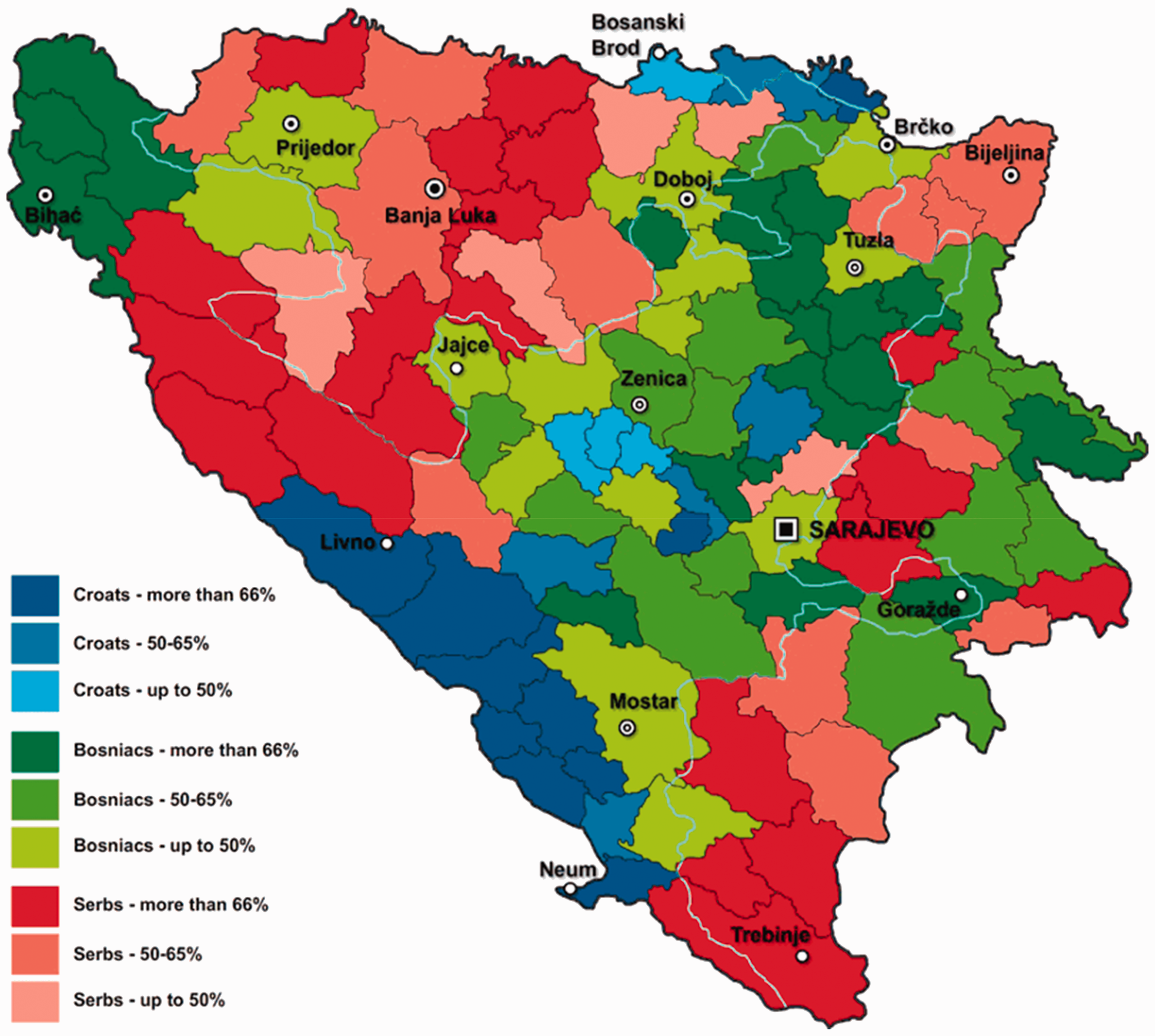
Bosnia 1991 a cultural patchwork: to understand this positioning of Bosnian Serbs, Croats and Moslems and their mutual antipathy you could start with the Christian schism in 1054, the Ottoman empire’s attack at Kosovo Polje in 1389, the collapse of the ottoman Empire after First World War, the rise of Josip Broz (Tito) in Second World War as Churchill’s favoured killer of Nazi’s and his rise to Power after Second World War. Tito created and ruled over a Yugoslavian Communist State before his death in 1980, his death was the catalyst for civil war.
The UN entered the fray in November 1991 led by the United Nations High Commissioner for Refugees (UNHCR) under the leadership of Mrs Sadako Ogata to deal with displaced populations in Croatia resulting from the Croatian/Serbian conflict. The UNHCR acted as lead UN agency in both Croatia and later Bosnia-Herzegovina, supported in both by the United Nations Protection Force (UNPROFOR). UNPROFOR (1992) was initially established in Croatia in June 1992 (UNPROFOR 1) with a headquarters in the then neutral Sarajevo. In September 1992 its size and mandate increased with the creation of UNPROFOR 2 with its headquarters in Zagreb, Croatia. UNPROFOR 2’s mission (UN.org-1, 2011) was to support the UNHCR in the distribution of humanitarian aid through the protection of convoys in Bosnia-Herzegovina and the release of detainees, if so requested, by the International Committee of the Red Cross (ICRC). The mission of UNPROFOR was not to protect the civilians caught up in Bosnia’s civil war; this became an increasing issue as the conflict took on genocidal characteristics.
The role in 1992/3 of the UNHCR in the Balkans, as perceived by its commissioner Mrs Sadako Ogata, drove the mission of UNPROFOR and is fundamental to this narrative. In November 1992, Ogata spoke to the Third Committee of the UN’s General Assembly in New York:
In former Yugoslavia, for instance, our presence in the middle of a conflict, the very objective of which is to uproot people, has confronted us with a real dilemma. How far can we persuade people to remain where they are in order to prevent displacement and ethnic cleansing? By doing so, are we not exposing their lives to danger? These are the kind of choices that daily confront our staff in the field. (
Ogata, 1992
)
In an address to the John F. Kennedy School of Government in 1996, Ogata (1996) articulated this as a moral dilemma for the UNHCR. ‘It was a moral dilemma for UNHCR and other humanitarian agencies to carry on humanitarian assistance while feeling increasingly helpless in containing “ethnic cleansing”, i.e., mass displacement of ethnic groups which was the very objective of the brutal conflict.’
How does one make sense of or explain such complexity? BRITBAT attempted to explain this complexity using the analogy of a three dimensional game of chess where each dimension or level equated to the strategic, operational or tactical (top, middle and bottom) levels of engagement. Each level was a three-sided chess board enabling nine players to engage simultaneously, moving their chess pieces in an interconnected ‘game’. A move on the strategic (top) level by a strategic player had implications for the two levels below. A move on the tactical (lower) level had implications for the operational (middle) and strategic (top) level. The challenge for the ‘players’, including the United Nations, was to monitor the three dimensions understanding the implications of the moves and understanding the strategy of the ‘game’. Some of the ‘players’ lost perspective of the ‘game’, playing their own agenda thereby derailing the strategy, if there was one. Who the players were and who at any one time was ‘playing’ the game, was part of the Wicked Problem.
The value of case study
This paper attempts an exercise in reflective learning through interpretative scholarship (Crotty, 1998) and retrospective sense making (Weick, 1995). It will draw on a real world context situating the narrative in the ethnographic tradition (Fetterman, 2009). Through the exploration of this ‘wrong wrong’ dilemma as a case study it hopes to examine the role of ethics when leading Wicked Problems: a case study in leading within the grey zone (Levi, 1986; Sanders, 2016) of extreme moral ambiguity. Yin (2009) describes case study as the examination of a real life contemporary phenomenon and cautions on the use of multiple sources of evidence. Welsh and Lyons (2001) argue that outcomes from individual case studies are not statistically generalizable but are analytically generalizable. Eisenhardt (1989) in her article ‘Building Theories from Case Study Research’ explains how case studies can be used to various ends including providing description, testing theory or generating theory. As an exercise in retrospective sense making the author attempts to make sense of the events he faced as a UN Acting Battalion Commander. The biases and heuristics of the author will undoubtedly shade the case study. Multiple sources of evidence are used to build the case study and rationalise the author’s recollection of events.
The paper will also draw on Grint’s (2005) conceptual leadership framework or heuristic, where he introduced a third problem, the Critical problem to complement Tame and Wicked and proposed approaches, or leadership styles described as, Command, Manage and Lead, specific to the problems Critical, Tame and Wicked. Grint’s (2008) heuristic will be utilised to further make sense or draw meaning and possibly lessons from the leadership challenges described in the case study. The critical examination of the case study will explore how the context of the war in Bosnia met Rittel and Webber’s (1973) criteria for a Wicked Problem, however the default leadership approach by Governments, officials and UN soldiers on the ground was to seek reassuring Tame solutions the consequences of which were crisis, failure and fractured relationships. The reality of confronting a Wicked Problem in Bosnia in 1993 and the ethical leadership challenges this presented appeared to be intractable.
Literature: Ethics, leadership and command
In contemporary moral philosophy (Alexander and Moore, 2016) Deontology (from the Greek words for duty deon and science or study logos) is a normative theory guiding what we ought to do (deontic theories), or are required, permitted or forbidden to do, a set of rules. The absolutist conception of Deontology was expressed by Kant (1780: 100) ‘Better the whole people should perish than an injustice be done’. Another perspective of this normative theory is ‘Threshold Deontology’, Moore (1997: chapter 17) pragmatically argues that deontological norms govern up to a point despite adverse consequences but when the consequences become so dire that they cross a stipulated threshold, consequentialism or utilitarianism, the ethics of consequences, takes over. Those that generally subscribe to deontological theories of morality oppose the consequentialists and pragmatism citing the Kantian (1780) tradition.
A counter ethical theory to Deontology, Utilitarianism, emerged from the 18th and 19th century philosophers and economists Jeremy Bentham and John Stuart Mill (Benthem, 1907; Mill, 1871). They argued that the right action promotes ‘happiness’ and the wrong action the reverse. The theory argues that the best action is the one that maximises utility. Bentham (1907) described Utility as the sum of all pleasures that result from an action less the suffering of anyone involved. It is a theory of consequences; the result of the action is the standard of right and wrong. When the result is the greatest happiness (utility) the action is right.
A third tradition of moral ethics is focussed not on the rules, duties or consequences but on the actor and what kind of a person the actor is or should be, described as aretaic or virtue ethics. According to Aristotle, there are no rules for leading ethically: as he suggests in his Nicomachean Ethics (Ross, 1984, book ii 2 (19)) ‘the agents must in each case consider what is appropriate to the occasion’. Aristotle’s emphasis on the ‘good, or virtue is a recurring theme in leadership literature (Bass and Steidlmeier, 1999; Burns, 1978; Greenleaf, 1977; Heifitz, 1994; Peterson et al., 2012). The ethical arguments in a more contemporary sense will draw on Williams and Smart (1973) with arguments for and against Utilitarianism, and Gewirth (1982) examining the Deontological argument that certain rights are held to be absolute and rights are infringed when the correlative duty is not carried out. Van Staveren (2007) makes the point, examining economics that Virtue Ethics are beyond Utilitarianism and Deontology as the ‘good’ has no universal standard and moral behaviour is imperfect and continuously adapting to changing social circumstances, later introduced in the paper as a moral ‘Grey Zone’ (Levi, 1986).
The paper will suggest the case study appeared to show that ethical decisions within a Tame Problem, real or socially constructed, seemed to sit within Moral Absolutist or Deontological ethics (Kant, 1964). Addressing a Tame unambiguous problem, the author as Acting Battalion Commander was able to act in a morally appropriate way out of duty and within bounded ideas of right and wrong. The moral path appeared discernible and the moral solution, like the solution itself, was deontologically self-evident. The Wicked Problem appeared to align more with a Utilitarian (Bentham, 1907; Mill, 1871) idea of the primacy of consequences with the Acting Battalion Commander struggling to discern ideas of right and wrong or what constituted the greatest ‘happiness’ or least harm (Utility, Bentham (1907), a perspective not without critics (Scheffler, 1988). Critical variables for decision-making were time pressure, an unknowable future and the inability to predict cause and effect, the constituents of Schulzke’s (2013: 96) concept of moral luck. Kamm’s (2007) principle of permissible harm, where harm is an aspect of the greater good, supported the Utilitarian position, harm to one group might be permissible for the greater safety of a larger group. The Critical Problem drew on the Acting Battalion Commander’s Virtue Ethics (Crisp and Slote, 1997) as the lack of time for rational analysis required an intuitive response to the crisis, itself enmeshed in the Wicked Problem, possibly developing the idea of duress ethics (Sanders, 2016: 5). Virtue Ethics places the focus on the individual character of the person as the locus for ethical thinking or action rather than the act itself (Deontology) or the consequences (Utilitarianism/Consequentialism). The Kantian (Kant, 1964) argument that the only absolutely good thing is good will, that is the motive of the person, may be the moral arbiter in this case study. An honest reflection on the motives behind the selected course of action and the degree to which they were manifestations of good will or virtuous character remain, for the author, inexorably entangled in the Wicked Problem of the Bosnian war (Dannatt, 2016: 220–229) and its grey zone morality. In Primo Levi’s post hoc analytically constructed ‘Grey Zone’, hauntingly portrayed in the ‘Drowned and the Saved’ (Levi, 1986) written 40 years after his survival of Auschwitz concentration camp, he cautions against binary constructions of good/evil or right/wrong and the possibility of foreseeing one’s own behaviour.
The context of the Bosnian war and its legality or the justification for the legal killing by the warring factions is explored in Bellamy (2006), McMahan (2009), Walzer (2015) and Rodin (2002). The killing of non-combatants by the warring factions in Bosnia remains a contentious issue. As to what constitutes a non-combatant and whether they can be legitimately killed in war is a Wicked Problem. The bombing of Dresden (13–15 February 1945), a target of no military significance (Daily Telegraph, 2015) with a population of 1.2 million civilians reverberates through history as an example of the legal but morally questionable killing of between 25,000 and 35,000 non-combatants. Kamm’s (2007) principle of ‘Permissible Harm’ where the harm is an aspect of the greater good illustrates the ambiguity of the decision to bomb Dresden. The permissible harm (killing of 25–35,000 civilians) was argued by the RAF to be an aspect of the greater good of breaking German will, a factor in allegedly hastening the end of the war. This grey zone logic culminated in the dropping of atomic bombs on the Japanese cities of Hiroshima and Nagasaki in 1945.
If any conclusion is to be drawn from the study of leadership literature: academic, biographical, autobiographical or historical, it may be that it is a contested subject. Stogdill (1974: 7) writing over 40 years ago noted ‘there are almost as many different definitions of leadership as there are persons who have attempted to define the concept’. Today there are more definitions and the subject continues to sit in the eye of the beholder. The scale of the discourse and its contradictions can be seen by simply typing ‘leadership’ into Google, there were 802,000,000 hits on 2 February 2017.
The essential differences between command and leadership, in a military context, and their relationship, is important to this case study. General Rupert Smith (2005: 65), describing the difference between Command and Leadership argued: ‘the difference between the two is that the leader says come on, whilst the Commander says go on’. He also opined, during a lecture at the Joint Services Command and Staff College in 2000, that ‘Commanders are not Leaders’ (author’s records). When explaining the roles of the Commander and Commanded he argues that the Commander has the more difficult task, as the commanded, who are remote from the Commander must be trusted to know the ‘way’, recognise the ‘end’ (end state) and be capable of looking after themselves. Equally, they must know that they will be supported and the ‘end’ is of value. This Command framework as described by Smith (2005) is used to further contextualise the narrative, specifically: what constitutes the ‘end’, who designates it and who quantifies its value? An alternative differentiation explored in ‘Leadership in Defence’ (DLC, 2004) examined the distinction of leadership within a military context from that of a non-military context. The military ‘leader’ (Commander) possesses legal powers to enforce their will on the ‘led’ (Commanded). The Armed Forces Act 2011 provides the legal framework for Commanders to give legal ‘orders’ that the subordinates are required to obey or suffer a range of penalties, including imprisonment and dismissal. The subordinate, on joining the Armed Services, swears an oath of loyalty, essentially agreeing to obey the legal orders of a superordinate. Thus within the military commander/leader subordinate/follower relationship there is a legally enforceable and consensual ‘contract of compliance’. The challenge for the military Commander is to convert the subordinate to follower and their position from Commander to Leader or Commander/Leader. This leveraging of their position through what French and Raven (1959) described as ‘Referent Power’ hopes to instil selfless commitment in the follower that transcends the contractual and transactional obligation (obedience) of the subordinate. This will always be a subtle and opaque relationship with the potential for misinterpretation by the Commander/Leader as to their perceived position by the Subordinate/Follower. The position of Leader may be fleeting or illusionary as the position of Commander is a legal constant. The Armed Forces encapsulate this idea in what they describe as the ‘Moral Component of Fighting Power’ (JDP 0-01 2014: 32–36).
Decision making: The wrong wrong dilemma
In a lecture entitled ‘Leadership in the Age of Dilemmas’, Rajan (2002) discussed Badaracco’s (1997) book in which managers face business problems, causing them to confront difficult, deeply personal questions. In deciding how to act these managers reveal their inner values, test their commitment to those values, and ultimately shape their characters; their dilemma is to choose between right and right. The Bosnian case study presents an altogether different dilemma when commanders/leaders must choose between wrong and wrong; however, in deciding how to act there are parallels with Badaracco’s (1997) managers in terms of testing deeply held values and the shaping of character. This attempt at sense making of Bosnian events or as Hogan (2007: 7) described it, ‘to make meaning’, was to reconcile or examine a decision made by the author as an Acting Battalion Commander within a Wicked Problem and in the grip of a ‘Wrong, Wrong’ dilemma. Rickards and Clark (2006: 18) describe the essence of a dilemma as a situation in which there is no satisfactory choice (course of action) that suggests itself based on the evidence available. The author, as the Acting Battalion Commander, described this as a ‘wrong wrong’ dilemma as the available or disenable courses of action appeared to be ethically wrong and the author could not escape the responsibility of the decision. The theoretical basis for the idea of the ‘Wrong Wrong’ dilemma sits within Double Bind Theory (Bateson, 1972: 206–212; Bateson et al., 1956). Essentially the victim, in this case the Acting Battalion Commander, find themselves in a communication matrix in which messages contradict each other, the contradiction remains with the victim and the ‘victim’ cannot escape the field of interaction.
In attempting this critical enquiry there may be wider, if not specific, lessons for leadership in complex environments or complex adaptive systems of interactions (Hazy, 2008). This is characterised within a Wicked Problem in this narrative and might be a fruitful area of study for students of leadership and those that would grapple with volatile uncertainty and moral ambiguity in the usually Wicked Problem of leading peacekeeping or broader international intervention (Jenson, 2013; Schulzke, 2013). In Bosnia leading within uncertainty and ambiguity in a volatile environment appeared to create a need for certainty on the part of the leader and the led, the commander and the commanded no matter how fleeting or illusionary. Leaders attempted to tame the Wicked Problem to provide the delusion of moral certainty and measurable progress. The challenge for the Acting Battalion Commander was to instil confidence in the subordinates whilst attempting to attain their followership and avoid becoming overwhelmed and diminished by the wickedness of the Bosnian problem described below.
The case study detail: The Bosnian war as a Wicked Problem
It was into the progressing and complex civil war between and within the former Yugoslav states that the UK Government committed an Army Battalion Group based on a Warrior 2 equipped armoured infantry Battalion (known within the UNPROFOR as BRITBAT) to support UNHCR operations in September 1992. BRITBAT 1 was deployed in Bosnia, as part of UNPROFOR 2, and ready for their mission on 18 November (Stewart, 1993: 19–105). The author joined BRITBAT 1 in early February 1993 as second-in-command (Stewart, 1993: 255).
While acting as the Battalion Commander of BRITBAT 1, having ‘stepped up’ from second in command, in the early hours of 18 April 1993 the author faced a dilemma as described by Ogata above, while supporting the UNHCR’s operations in central Bosnia. This ‘wrong, wrong’ dilemma was on the face of it ethical, it also generated an ethical leadership quandary.
The problem was that while the situation, in its broadest sense, was not of the Acting Battalion Commander’s making, the courses of action facing him would result in terrible things happening to many people: so on the face of it, it was a question of which outcome (wave of repercussions, Rittel and Webber, 1973: 163) would be worse. In Nagel’s (1972) argument it was a case of evaluating alternative pathways or measures to be taken between total outcomes based on the Utilitarian or Deontological (Absolutist) perspective. The Utilitarian perspective, the rightness or wrongness of action is based on the resulting consequences (greatest good (happiness) for the greatest number (Bentham, 1907; Mill, 1871). The Deontological or Moral Absolutist perspective argues the rightness or wrongness is based on the actions themselves, thus some actions are wrong no matter what consequences flow from them (Kant, 1964; Nagel, 1972). The dilemma for the Acting Battalion Commander was not knowing where the potential courses of action would lead, other than terrible things would happen to the civilians caught up in the fighting and that taking the wrong course might precipitate greater terror (Schlimmbesserung 3 ). There was not the choice of taking no action as events were already in hand that meant no action was in itself an action with potentially dreadful consequences. The rules (Mandate and Rules of Engagement) essentially required UNPROFOR to remain neutral, that is to take no sides in the conflict and to not facilitate or enable ethnic cleansing, that is move uninjured civilians. Paradoxically, possibly one of the greatest contemporary contributions to the Moral Absolutist (Deontological) tradition is the four Geneva Conventions (Geneva Conventions, 1949), as the United Nations Protection Force, BRITBAT 1’s mandate did not include the policing of these rules of war.
Change of command: Fighting in and around Vitez, a critical problem
The Battalion Second in Command (Bryan) contacts the Commanding Officer (Bob), by phone in the small hours of 16 April 1993: ‘Bob, is that you’? ‘Yes I am here Bryan’. (Bryan) ‘Do you know what’s going on? The whole place has erupted, it’s gone crazy. We are stuck in the middle of a major battle. You’re miles away, on the wrong side of the lines’…. The phone line went dead.
These few words recalled by the Commanding Officer of BRITBAT 1 (Stewart, 2009: 1) initiated a period when the Second in Command (described here as ‘the Acting Battalion Commander’) assumed Command. The Commanding Officer remained out of contact until he could re-join the Battalion a few days later.
At 5.30 a.m. on 16 April 1993, the HVO (Bosnian Croat military) launched a widespread and systematic surprise attack on the Bosnian Muslim villages in the Lasva Valley, Central Bosnia, including the town of Vitez (ICTY, 1995). As the fighting erupted around BRITBAT’s base outside Vitez the initial assessment was the Bosnian Serbs had broken through the Bosnian Croat and Moslem lines and were advancing to capture more territory; the situation was confusing as shot and shell landed in and around the BRITBAT base, the intent of the Serbs towards the UN was unknown. The author quickly deployed a range of armoured reconnaissance assets to establish the situation, which was, in typical British understatement, confusing. Reconnaissance forces discovered the reality of the situation and the initial crisis (Critical Problem) of a suspected Serb assault receded. The day was spent visiting the local Croat (HVO) and Muslim (BiH) military Commanders to establish their intentions and attempted to initiate, through bilateral negotiation, a series of ceasefires. There was little appetite for rational discourse, the warring factions and their commanders were engaged in fighting and duplicitous exploitation of BRITBAT to their perceived tactical advantage. They lied as to their true intentions and lied again, a contradictory communication matrix (Bateson, 1972): the wicked nature of the Bosnian War became all too apparent in literal as well as figurative terms.
In the late afternoon of 18 April a fuel tanker containing approximately 500 kilograms of explosives detonated near the mosque in Stari Vitez or Vitez old town (Mahala), destroying the offices of the Bosnian (Muslim) War Presidency, killing at least 6 people and injuring 50 others (ICTY, 2000: 662–664). On hearing the explosion from the Battalion’s Headquarters outside the town of Vitez, a Company Commander, commanding 14 Warrior armoured fighting vehicles and approximately 100 soldiers, was dispatched to discover the source and target for such an uncharacteristically large explosion. Having been principally ‘spectators’ or observers in another person’s war we now had an apparently straight forward, if very dangerous, Tame task within the UNPROFOR mandate: to effect the rescue (protection) of civilians injured by the explosion and trapped in the cellars of a number of collapsed blocks of flats in Vitez. Supported by Royal Engineers, the Company Group, having broken through the Bosnian Croat military Cordon around the Moslem half of Vitez, began the rescue. Due to the nature of the damage to buildings and resulting lack of shelter from the fighting the decision was made to evacuate the uninjured Bosnian Muslim elderly men, women and children together with the injured from the town, and transport them to an adjacent Muslim town at that point not engaged in the fighting. The lack of shelter for the civilian population and their imminent danger from direct (machine gun) and indirect (artillery and mortar) fire created a Critical Problem. The Company Commander and Acting Battalion Commander quickly exercised their judgement in the crisis and began the evacuation. While this decision was in contravention of the UNHCR’s policy on ‘assisting ethnic cleansing’, the humanitarian imperative or Moral Absolutism appeared starkly clear to both of them: if we left them in the village they would be killed. Due to poor communications with the higher UN Command permission could not be sought for the evacuation, the Acting Battalion Commander would seek retrospective permission or ‘forgiveness’ when Communications were re-established. There was a palpable sense that BRITBAT 1 was at last doing something to make a direct humanitarian difference (Mooney, 1995).
At about 2 o’clock in the morning, as the rescue and evacuation were progressing, the phone rang in the Operations Room in Battalion Headquarters at the school in Vitez. This was unusual as the phones had been erratic to non-existent since the fighting had begun. It was the Commander of the (Muslim) Armija BiH (ABiH) 3rd Corps in Central Bosnia, a man the Acting Battalion Commander had met a number of times and whose military judgement was generally respected, although like his Bosnian Croat and Serb protagonists in the civil war, he was a master of Balkan duplicitousness. He explained how his main force, which deployed from central Bosnia a few days ago, was extracting from engagements with the Serb Army in Eastern Bosnia in order to respond to the surprise and in his view unprovoked HVO (Bosnian Croat) attack on the Muslim villages in Central Bosnia. Up until 16 April, the HVO and ABiH (Bosnian Muslims) had been largely allies in central Bosnia defending against a series of Bosnian Serb/Serb offensives. It was within the security of this alliance that the ABiH forces had felt safe to leave their villages and march East. The ABiH Commander explained how he intended to disengage from the Serbs in Srebrenica (Eastern Bosnia) and redeploy his force to counter-attack the HVO in Central Bosnia. He required his village militia garrisons to hold out for about 48 hours, the time he believed it would take him to redeploy to central Bosnia. He then asked why BRITBAT was evacuating the Muslim civilians from Stari Vitez.
Having explained the situation and the humanitarian imperative, as the Acting Battalion Commander saw it, the ABiH Commander insisted the evacuation be stopped immediately, something that initially appeared ridiculous and counterintuitive. He explained that his garrison forces numbering no more than a couple of battalions in the Muslim villages in Central Bosnia, currently besieged by numerically superior HVO forces, were only likely to stand and fight if they were defending their families. Thus if the families were evacuated from Stari Vitez the ABiH garrison would be unlikely to stand and fight. He argued that Stari Vitez was critical to his area defence and in the event of Stari Vitez falling to the HVO, the other villages would quickly collapse resulting in the ethnic cleansing, and possible genocide of the Muslim population of Central Bosnia. The phone line then went dead. To the Acting Battalion Commander there appeared to be two courses of action: stop the evacuation of the Muslim civilians from Stari Vitez and condemn them to further certain harm or evacuate them and, if the ABiH Commander’s judgement was correct, possibly initiate a domino-like effect across the Muslim villages of Central Bosnia. The second course of action ran the risk of potentially greater Muslim civilian casualties, which BRITBAT was in no position to prevent (see Figure 2. The situation on day 3 of the fighting).
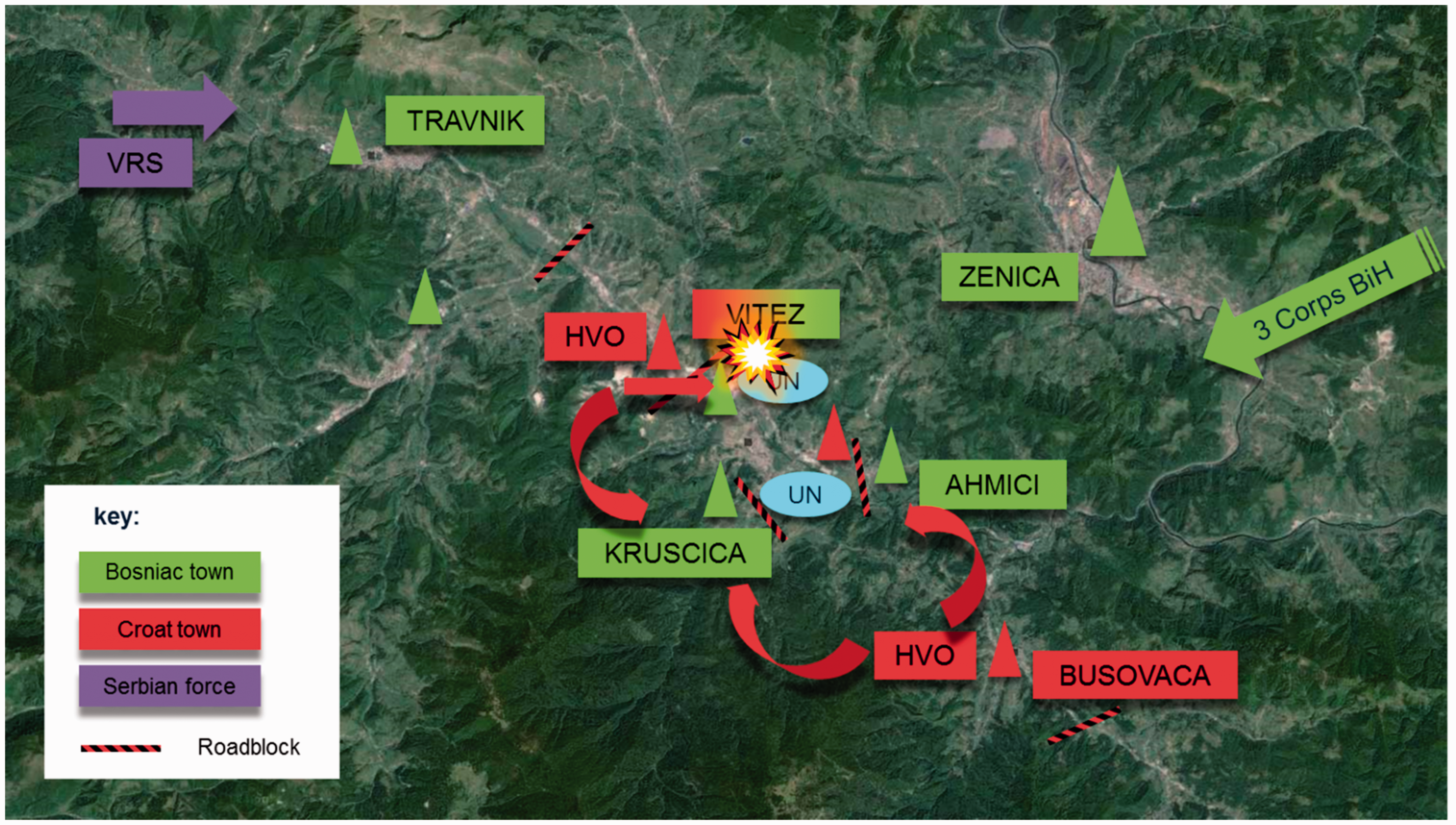
The situation on day three of the fighting (18 April), the Bosnian Croats attack the Bosnian Moslem villages having isolated them using road blocks. Following the explosion of the lorry bomb against the Bosnian Moslems in Stari Vitez their main force (3rd Corps) returns from Eastern Bosnia to counter-attack the Bosnian Croat forces (author’s notes).
Both potential courses of action were fraught with uncertainties. Time was a critical factor: if a decision was delayed the course of action already in hand, the evacuation, would create an outcome which would not be deliberate but the result of indecisiveness. Actions such as evacuate all the Muslim villages or defend directly or indirectly the civilians in Stari Vitez, while attractive morally, were unsound as they were impractical from a capacity point of view and violated the UN’s mandated principle of neutrality. BRITBAT did not have the authority to undertake such missions within its UN mandate; in effect ethnically cleanse Central Bosnia of Muslims, doing, in this case, the Bosnian Croats’ job for them. Neither did UNPROFOR’s mandate permit BRITBAT to change the balance of power in favour of any faction. Thus defending the villagers or villages, directly or indirectly, which was in effect to take sides, was out of the question, even if the combat power had been available. As an example of this policy of rigid neutrality UNPROFOR were required, at considerable risk, to relay any mines lifted to ensure tactical favour was not given directly or indirectly to a particular warring faction.
Insecure radios and generally very poor radio communication negated detailed discussion with the deployed Company Commander, or the superior UN headquarters. In the small hours of 18 April 1993, following little sleep for all concerned during the preceding 36 hours, the critical variables appeared to be: was the Muslim Commander telling the truth, would the ABiH soldiers defending Stari Vitez lose heart and the will to fight if BRITBAT evacuated their families? Would the HVO attack the other villages if they captured Vitez? Would the other Muslim villages capitulate? Would the ABiH Corps Commander achieve his complex military undertaking and arrive back in central Bosnia to counter-attack the HVO and save his embattled communities within a realistic time frame for them to hold out?
Both the options the Acting Battalion Commander was able to formulate within the UN’s mandate appeared, in the circumstances, to be morally questionable. Option one: continue the evacuation, and save the lives of the Bosnian civilians in Stari Vitez (Deontologically sound) but possibly initiate the destruction of the remaining Bosnian Muslim villages in central Bosnia (Unsound from a Utilitarian perspective). Option two: stop the evacuation and withdraw BRITBAT forces from the town, certainly condemning the Bosnian civilians of Stari Vitez to further death and injury with the certainty of continued further destruction in the remaining Bosnian Muslim villages (Deontologically unsound). However option two, in the judgement of the ABiH Commander, could possibly strengthen the will to fight of the Moslem defenders and potentially prevent the collapse of Moslem resistance thus avoiding greater Moslem civilian casualties (potentially sound from a Utilitarian perspective): but could he be trusted? That is why the Acting Battalion Commander describes it as a ‘Wrong Wrong Dilemma’. The aphorism that ‘leadership is lonely’ or the loneliness of command struck home in the small hours in a quiet and subdued Battalion Group Operations Room.
Discussion
Studying Rittel and Webber’s (1973) paper in 2002 lifted one veil on the author’s Bosnian dilemma in that as a Wicked Problem, the situation had no solution and thus unsuccessful attempts at rational solution finding had been while nugatory not failure: ‘the one-best answer is possible with ‘Tame’ problems, but not with ‘Wicked’ ones’ (Rittel and Webber, 1973: 169).
Upon further reflection and discussion, Rittel and Webber’s (1973) problem typology, while a useful framework, did not quite work in its totality as a framework for post hoc rationalisation. In their delineation of the ten constructs of a Wicked Problem Rittel and Webber (1973: 161–167) do not consider time as a specific variable. In Vitez time was a critical variable; in effect a ticking Wicked Problem. In Rittel and Webber’s (1973) vernacular whilst recognising the Balkan war was a Wicked Problem, the situation in Vitez appeared to be, or was, when initially analysed a seductively Tame Problem. BRITBAT could solve a problem and in the process appear to do some humanitarian good and get a deontological warm glow. Discussing this ‘Wrong Wrong’ dilemma with Keith Grint in 2003 helped the author make further sense of events and, while providing no answers, aided reflection and the sense making process. Grint (2005) encapsulated part of this discussion and provided an insightful conceptual framework or heuristic. Grint synthesised Etzioni’s (1961) typology of compliance with the idea of Tame, Wicked and Critical Problems linking the typology of a problem with an approach or leadership style. Grint (2005: 1473) provides a useful synopsis of the problem typology which helps this narrative. A ‘Tame’ Problem may be complicated but is resolvable through unilinear acts because there is a point where the problem is resolved and it is likely to have occurred before. In other words, there is only a limited degree of uncertainty and thus it is associated with Management, a managerial style (procedural). A ‘Wicked’ Problem is complex, rather than just complicated, it is often intractable, there is no unilinear solution, moreover, there is no ‘stopping’ point, it is novel, any apparent ‘solution’ often generates other ‘problems’, and there is no ‘right’ or ‘wrong’ answer, the association with uncertainty requires a leadership style (questioning/consultative). A Critical Problem, for example, a ‘crisis’, is presented as self-evident in nature, as encapsulating very little time for decision-making and action, and it is often associated with authoritarianism – Command.
People really wanted to go. They were desperate to go. They were literally screaming for their lives and begging us. As the Commander on the ground I felt it was my duty, as anybody would have done if they’d seen what was going on, to get them out and get them to a place of safety.
The Acting Battalion Commander, having earlier temporally masked the Wicked Problem by agreeing to and supporting the evacuation (Tame Problem), was rudely returned to the Wicked Problem of the multiple complexities of Bosnia’s war with the intersession of the phone call from Bosnian Moslem Corps Commander. Thus, the Company level of Command/Leadership was focused on the Tame Problem and the Battalion level was grappling with the Wicked Problem. The impact of time for the Acting Battalion Commander’s decision to evacuate or stop the evacuation was also engendering a crisis or Critical Problem of which the Company Commander was unaware. Compounding the Acting Battalion Commander’s problems was a serious radio communications issue. The radios to the UN Command (High Frequency) did not work at certain times due to the ionosphere interfering with the signal. The Battalion Command radios (to the Company Commander) were insecure, precluding discussion that would inform and potentially advantage a waring faction. Thus, the Acting Battalion Commander could not communicate with his UN Headquarters to seek guidance and could not discuss the changing tactical situation between the Bosnian Moslem and Croat forces with the Company Commander in Vitez.
In this situation there appear to be correlations between the Tame Problem being one of Moral Absolutism or Deontology, the failure to save the noncombatants in Vitez would have been wrong no matter what consequences flow. The Wicked Problem being one of Utilitarian judgment, the potential impact of the rights and wrongs of the chosen action; the dilemma being the decision that maximizes good over evil (Utility) or the greater good (happiness). To the Acting Battalion Commander, the Tame Problem’s Moral Absolutism, transparently apparent to the Company Commander, was blurred by the Utilitarian conundrum of the greater good or lesser evil, and his inability to fathom it as the future was indeterminate. This was at the heart of the Acting Battalion Commander’s Critical Problem as a decision was required. Another element of the Acting Battalion Commander’s Critical Problem and central to the concept of his dilemma was what Nagel (1972: 126) describes as ‘absolutist intuition’ that is seeking to do the right thing that is the ‘only barrier before the abyss of utilitarian apologetics for large scale murder’, the spectre of Dresden.
The wider or strategic circumstances that contributed to the Acting Battalion Commander’s Critical Problem serve as an example of the dangers of Tame solutions to Wicked Problems, or taming the Wicked Problem. At that time in Bosnia, on the strategic stage or top board in Bosnia’s three-dimensional game of chess, David Owen and Cyrus Vance had proposed the so called ‘Vance-Owen Peace Plan’, a loose confederation of 10 ethnic provinces or cantons (Owen, 2012). Whilst on one level logical and possibly laudable, the plan appeared to compound the wickedness of our Wicked Problem in central Bosnia as it ignored the realities (Simms, 2001). The ‘peace plan’ by advocating ethnically homogenous Cantons, to prevent the state fracturing, inadvertently fermented ethnic cleansing especially in the proposed 10th Canton situated around Vitez. It was the intent of the Bosnian Croats to rule Canton 10 with an unquestioned democratic majority that provoked their campaign in April 1993 to rid (ethnically cleanse) Vitez and its environs of Muslims. The deployment of the main Moslem forces (3rd Corps) from the proposed Canton 10 to counter a Serb advance in Eastern Bosnia was their opportunity. The Vance-Owen peace plan was a strategic ‘clumsy solution’ (Grint, 2008) to Bosnia’s Wicked Problem, or more probably an attempt to Tame it, and on 18 June 1993 Lord Owen declared the plan ‘dead’. The Bosnian Croat/Muslim conflict in Bosnia would not abate until 23 Feb 1994 (The Washington Agreement). The waves of consequence of this intervention still run their course in a divided nation and enduring ‘frozen conflict’.
In the early hours of 19 April 1993 the Acting Battalion Commander made his decision, he decided to stop the evacuation of the civilians from the besieged village. The Company Commander on receiving his instruction initially argued to continue the evacuation. The Acting Battalion Commander then rephrased the instruction as a Direct Order and warned the Company Commander, a colleague and friend, of the consequences to his career if he disobeyed. ‘If you were here you would not give that order’, implored the Company Commander, he then reluctantly obeyed the order. The inability of the Acting Battalion Commander to explain the changes in the situation over the insecure radio and the Company Commander’s initial refusal to accept the instruction changed the situation from a Tame Problem (stop the evacuation) to a Critical Problem. The Acting Battalion Commander acted as a Commander and gave an order leaving no ambiguity in the mind of the Company Commander of the consequences of disobedience. In these circumstances the Company Commander had no autonomy, an essential component of moral judgement (Schulzke, 2013: 97), thus the morality of the judgement rested with the Acting Battalion Commander. On return to the Headquarters the Company Commander was briefed on the changed situation and the reasons for the change of orders. He struggled to accept the reasoning having just left women and children to die. The Acting Battalion Commander pondered the circumstances and actions that had led to him threatening to end the career of his friend and ‘Best Man’ at his wedding. Denied autonomy and faced with a legal order the Company Commander followed the rules of military discipline (the contract of compliance) and in his own words ‘very reluctantly obeyed the order’.
The Bosnian Moslem forces arrived in central Bosnia after two days and began counter-attacking the Bosnian Croat forces. The problem was now to stop the Bosnian Moslem forces destroying and killing Bosnian Croat villages driven by a sense of betrayal and a revenge psychosis. After a few days a tenuous ceasefire was hammered out led by the returned Commanding Officer and the EU Ambassador to Bosnia. BRITBAT would police the ceasefire and its infringements for the remainder of the deployment discovering further atrocities from the April 1993 fighting including the Moslem Village of Ahmici (BBC, 2000).
Later in the spring of 1993 the author (reverted to Second in Command) was in discussion with Senator Joseph R. Biden Jr, then the Chairman of the United States Senate Foreign Relations Committee during his fact-finding mission to the Balkans and in particular Bosnia (Stankovic, 2000: 143). Senator Biden explained: ‘Bosnia is like a forest fire, you don’t go in to a forest fire, what you do is encircle it with fire breaks to prevent it spreading and let it burn out, then you go in and damp it down’. The author asked how one stood in the firebreak and listened to the screams of the women and children burning in the fire, he said, ‘Son, you have been here too long’ (author’s record). Senator Biden certainly understood the Wicked Problem and avoided postulating Tame solutions. For the author this encounter encapsulated the Utilitarian versus Ethical Absolutist argument. The answer to the ‘wrong wrong’ dilemma, evacuate or not evacuate, is wrapped around the rightness or wrongness of the consequences of the decision versus the rightness or the wrongness of the actions themselves (Nagel, 1972). The Ethical Absolutist does not consider the consequences of the action, listening to the screams of the women and children left to the fires. The question was would not evacuating the village have incurred fewer screams? It was impossible to know until the waves of consequences had run their course (Rittel and Webber, 1973), a defining factor of a Wicked Problem.
Leading in Wicked Problems
Can you train for or be prepared for leading in moral ambiguity? Aristotle argued in Nicomachean Ethics (Ross, 1984, book i 4 [3]) that to gain value from the study (‘listen intelligently to lectures’) of ‘what is noble and just’ you must be ‘brought up in good habits’. Today we might call ‘what is noble and just’ our moral compass, how this is set and calibrated is no different to Aristotle’s interpretation: we must be brought up in good habits. Unlike Utilitarianism and Deontology, Virtue Ethics focuses on the character and habits of the actors. Contemporary study of what is noble and good in ethical leadership is explored by Northouse (2007: 341–370). Ladkin (2010: 172–175) also provides a succinct explanation of Aristotle’s teaching on ‘virtue’ and the positioning of virtue as a point of balance between opposing characteristics. Aristotle argued (Ross, 1984, book ii 4 [18-19]) that virtue could only be learnt through engagement with a virtuous community. To answer the question, can you train or be prepared for leading in moral ambiguity, would appear to rest within the idea of Virtue Ethics and the developing of what Aristotle called Phronesis or Practical wisdom, ‘a reasoned and true state of capacity to act with regard to human goods’ (Ross, 1984, book vi 5 [ 98]). This might be construed as honing a moral absolutist intuition or moral compass. As ethical theory provides no absolute answers, thus morality is not fixed, the study of ethics equips the leader with the frameworks for argument and the potential to justify decisions and dirty hands.
Contemporary leadership literature’s emphasis on moral leadership may have begun with Burns (1978: 20) when he states that transforming leadership raises leaders and followers to ‘higher levels of motivation and Morality’. However, the literature, for example Jones (1991) synthesising ethical decision-making models, assumes there is a moral or ethical position to be adopted and the leader transitions from moral judgement to moral behaviour. When the leader’s choice sits within the ethical opacity of a Wicked Problem there is little published research. It is an area of potential research resonate with current Wicked Problem examples such as Ukraine, Libya, Iraq and Syria. The reconciliation of Deontological and Utilitarian ethical approaches to these Wicked Problems and what counts as virtuous conduct is a contemporary dilemma for democratic decision makers in arenas as diverse as social care, climate change and UN intervention in wars.
Peace keeping and wider intervention operations would appear to increasingly operate in the ‘grey zone’, this strange morality or amorality was captured by Primo Levi (1988: 22–51). Levi examines through his experience of survival in Auschwitz the issues that emerged in what he argues is a human and social condition that seeks a state of conflict rather than harmony. He describes a state of opposites and the ambiguity associated with the concepts of we/they, vanquished/victor and good guy/bad guy. For Levi (1988: 22–51) the ‘Grey Zone’ allows and then thrives on ambiguity and compromise, engendering submission and collaboration perpetrating evil. In the Bosnian ‘Grey Zone’, like Levi’s Auschwitz, there was a suspension of morality in a state of conflict that enabled wickedness and evil: there were no good guys and bad guys just aggressors and victims dependent on which of the warring factions could exploit their opportunity. One Hundred and six civilians killed in Vitez, Ahmici and their environs in the April 1993 fighting were buried by BRITBAT in a mass grave outside Vitez. As the war progressed the ability of the UN to retain its position as a virtuous community would become increasingly tested until the strategic failure in Srebrenica in July 1995 when the Serbs murdered over 7000 Muslim men and boys and ethnically cleansed (deported) 23,000 women and children. Srebrenica was a so-called UN Safe Area ‘protected’ by a UNPROFOR light Infantry Battalion. The international community rightly lost faith in the UN and UNPROFOR in Bosnia as a result of the Srebrenica massacre: the threshold whilst never stipulated had been passed (Moore, 1997: Ch. 17). The discredited UN Force was replaced by NATO, who bombed the Serbs to the negotiation table. Paradoxically during the Bosnian war (1992-1995) 8,132 Civilians were killed in Sarajevo’s ‘Grey Zone’ (ICTY, 2003) and at no time did it appear that the threshold for UN or wider world community intervention was reached, it took the single incident of Srebrenica to act as the tipping point. The total killed in Bosnia’s civil war was 89,881 (ICTY, 2010). The Wicked Problem of Bosnia overwhelmed the United Nations; however, it was not an excuse to do nothing, as Edmond Burk (1729–1797) opined, ‘the only thing necessary for the triumph of evil is for good men to do nothing’. That remains the stark lesson for the United Nations and those grappling with Wicked Problems, good women and men must do something. Declaring UN safe areas in Bosnia without the courage and will to make them safe was doing nothing (New York Times, 1999).
Conclusion
A leadership lesson from this case study may be the requirement to be prepared for Wicked Problems and ethical ambiguity or a Grey Zone (Levi, 1986; Sanders, 2016). Rittel and Webber (1973) when describing Wicked Problems argue that the taught problem-solving processes beloved of systems thinkers and the military- understand the problem/mission; gather and analyse information; synchronise information; await the creative leap and work out the solution- do not work. To understand the scope of the problem and the options for managing it, the leader needs to establish an arena or space for critical argument and constructive dissent, what Grint (2005) calls ‘lead’. The design of performance metrics to analyse progress or assess options is, as Rittel and Webber (1973) argue, a Wicked Problem. What does this critical argument space look like and how does the leader behave in it are part of the Wicked Problem. The author would argue, in the light of his defining leadership experience, that the preparation of the space is a requirement to build, reinforce, and reinforce again mutual trust between commander and commanded, leader and led. It is only through mutual trust that the leader can share uncertainties and vulnerabilities and subordinates can transform into Leaders and Collaborators (Followers) to cope with the vagaries, inconsistencies, insecurities and ethical complexities of Wicked and inevitable Critical Problems. It is only in this safe and trusted space that imagination and creativity can democratically flourish to grapple with the Wicked Problem and moral uncertainties enabling followers to become constructive dissenters rather than destructive consenters. A lesson for the then-Acting Battalion Commander was that he had not developed this critical space or understood the need for it; he had assumed that existing relationships would suffice and the ‘creative leap’ as in the past would solve the problem. He was not prepared for the moral ambiguity and the uncertainty this would engender in himself and those he commanded or led. There did not appear to be an ethical way to lead in the Wicked Problem that confronted him in Bosnia. The ‘wrong wrong’ dilemma did not have a discernible ethical solution, both courses of action could be argued ethically: the Deontological course would have been to evacuate and save the lives of the civilians, Kant (1964) saw duties as absolute and prohibited using people as a means to an end. The Utilitarian/Consequentialist course appeared to be to stop the evacuation thus potentially avoid greater harm to a greater number of civilians. In the Bosnian Grey Zone, the potential greater casualties appeared a less acceptable option than the fewer certain casualties, possibly an illustration of duress ethics (Sanders, 2016) and seeking splattered rather than dirty hands. Neither course of action was correct, there was no correct solution: it was a Wicked problem.
The wider lesson for the peacekeeper or interventionists might be that the elegant ‘road map’ to peace would appear at best elusive or at worst illusionary and belong to the seductive domain of the Tame Problem where differences are reconcilable and solutions morality discernible and self-evident. Developing leaders or appointing those capable of tackling Wicked Problems, in whatever context, would seem to favour the pragmatic approach of the ‘Bricoleur’ (Grint, 2008) and concepts embodying models such as Emergent Strategy (Mintzberg et al., 1999) where leaders are comfortable arguing emergent patterns in a stream of action rather than designing road maps. The ‘road map’ remains the perfectionist embodiment of a traditionalist leadership model and a credible solution for Tame Problems. The temptation, as illustrated in the Case Study, was to avoid confronting the Wicked Problem socially constructed by the context of Bosnia and tame it or to seek a Tame Problem that had a clean hands solution and quantifiable ethical metrics for success.
The challenge for the leader in the Wicked Problem’s critical argument space or when leading the Wicked Problem is to collaboratively discern an acceptable ‘End’ (end state). Possibly and more realistically, it is to pragmatically identify its direction, have the confidence to seek out the ‘Way’ whilst harmonising the paradoxical performance measures (tracking judgement and actions) and remaining aware there will never be sufficient ‘Means’. Sharing the fact that the ‘Way’ is not known or the ‘End’ may be indistinct with the wider followership or wider actors and stakeholders presents a particular conundrum that is an inherent part of the Wicked Problem. Those who can cope with the knowledge that the leader does not know the way or has no certainty as to the end and has no road map may be leaders themselves and can assist the leader or join a cadre of leaders (Kakabadse, 2000) in the critical argument space. Those who need reassurance of the leader’s omnipotence are destined to remain followers; those who would exploit the situation to personal advantage must be carefully managed. The leader must seek out the leaders within the followership and wider stakeholder community and join them in the critical argument space to build enduring trust while seeking the ‘Way’ and divining the ‘End’ from the paradox of performance measures so they recognise it (Smith, 2005: 65) as better or worse, satisfying or good enough (Rittel and Webber, 1973: 163).
In 2005, an American commander in Iraq was explaining to a reporter that he did not know the ‘Way’ and that in order to discover it ‘we are learning from current events’. The media’s reaction to his expressed uncertainty was to write: ‘… doesn’t own a how-to manual titled Building a Police Force in the Midst of an Insurgency. He’s winging it’. 4 This highlights the risk of sharing uncertainty with those who would exploit it, a conundrum for all leaders in the Wicked Problem space.
The author continues to reflect on that time, the sleep test (Badaracco, 1997) is passed, mostly, presumably based on Kant’s assertion that the only absolutely good thing is good will, or the absence of personal agenda. The experience informed future decisions made by the author as an adaptive commander/leader in other Wicked Problem spaces. In those spaces, he hoped for better moral luck and to avoid dirty hands (Nagel, 1979; Sanders, 2016; Schulzke, 2013; Williams, 1981) however, dirty hands and Wicked Problems retained their correlation.
Footnotes
Declaration of Conflicting Interests
The author(s) declared no potential conflicts of interest with respect to the research, authorship, and/or publication of this article.
Funding
The author(s) received no financial support for the research, authorship, and/or publication of this article.
Notes
Author's biography
He lectures widely, for example: Warwick University, Oxford University, Lancaster University, Duchy College (Plymouth University) and a range of public and private sector leadership Programmes, he also acts as an advisor and expert panelist. He has chaired a number of NATO Advanced Research Workshops and in 2016/2017 delivered strategic leadership programs in Sudan, South Africa, Namibia, Botswana, Malaysia, Myanmar, Ukraine, Chile, Paraguay, UAE, Kuwait and Saudi Arabia. He has also lectured in Indonesia, Nigeria, Ethiopia, Iraq and Estonia.
His research interests include: cross cultural leadership, leadership and management of change, strategic leadership, contemporary innovations in leadership development, toxic leadership, leadership as a relationship and the constructs that underpin that relationship, leadership research methodologies and the use of Personal Construct Theory. His current research is examining the impact of high operational tempo on personal leadership constructs.
Prior to joining Cranfield Bryan had a successful career in the British Army. Having commanded 1st Battalion the Cheshire Regiment he was director of Military Studies (Colonel Training) at The Royal Military Academy Sandhurst, a member of the Directing Staff at the Joint Services Command and Staff College (Advanced Command and Staff Course), Founding director of the Ministry of Defence Strategic Leadership Programme and Vice President of the Army Officer Selection Board. In direct leadership roles, culminating in a one star (Brigadier’s) appointment on General Petraeus’s staff in Iraq, Bryan has commanded on active service in a number of theatres, including N. Ireland, Rhodesia, Belize, Bosnia, Iraq and Kosovo. His leadership has been formally recognised on three occasions in the UK’s Operational Honours and Awards List and in  he was awarded the Legion of Merit (Officer) by The United States.