




Abstract
Over time, the relevance of heroic leadership to contemporary corporate environments has been questioned, with media coverage arguing there is a need for alternate, post-heroic forms of leadership. Using a multimodal media analysis, we show how two leading Australian business magazines frame leadership in response to this debate, identifying three distinct frames of leadership. The first frame emphasizes masculinized heroic leadership as normative which reinforces gendered assumptions through differential framing of men and women’s leadership. We then argue media (re)frames post-heroic leadership as a variation of heroic leadership through two further frames; by subsuming feminized attributes into the repertoire of heroic leadership as ‘softer masculinities’ and through the construction of a masculinized post-heroic hero, both applied exclusively to men’s leadership. This (re)framing of heroic leadership has significant implications for perceptions of credible contemporary business leadership.
Keywords
Introduction
Media plays a central role in the social construction of leadership (Liu et al., 2017). Social and cultural understandings of how leadership is performed are shaped through discursive elements and visual representations that constitute the media frame, which in turn, is influenced by the prevailing social, political and cultural context (Chen and Meindl, 1991; Liu et al., 2017). Traditionally, leadership has been constructed and understood through historical narratives, story-telling and portraiture of past successful individual leaders, who have predominantly been male (Guthey and Jackson, 2005; Spector, 2016). Thus, despite being presented as gender neutral, normative definitions of leadership reflect and emphasize attributes, characteristics and behaviours culturally associated with men and masculine gender norms (Crevani et al., 2007; Ingersoll et al., 2017). These normative assumptions about leadership centre around ‘great men’ who inspired and had ‘power over’ their followers, producing a masculinized notion of ‘heroic’ leadership (Grint, 2010; Meindl et al., 1985). Heroic leadership has been the dominant discourse of leadership in organizations, academia and media (Chen and Meindl, 1991; Schweiger et al., 2020).
Over time, the relevance of heroic leadership to contemporary corporate environments has been questioned. Volatile political, economic and social contexts and changing community expectations have called for new leadership behaviours. For example, a stream of studies explicate how stereotypically masculinized characteristics such as narcissism, over-confidence and hubris underpin corporate failings, diplomatic disasters and a loss of public trust in leadership (Claxton et al., 2015; Thanem, 2013; Williams et al., 2020)
This paper adopts a media framing lens to explore the extent to which a shift towards post-heroic leadership is evidenced in the framing of leadership in contemporary business media. Specifically, we analyse how leadership is constructed in two leading Australian business media magazines which are pivotal in establishing and shaping the leadership agenda in the Australian corporate business sector. As has occurred in many countries globally, Australia has recently undergone significant political, social and economic events that have drawn attention to leadership, including dramatic changes to political leadership and high-profile investigations (Royal Commissions) into misconduct in banking and in aged care (Commonwealth of Australia, 2019; Rimmer and Cosoleto, 2018). Australia thus provides an ideal context for exploring how Australian business media are responding to and engaging with the global critique of heroic leadership in media framing. The aim of this article is to investigate how two popular contemporary business media artefacts The Deal and Boss magazines frame leadership.
We begin by explaining our approach to understanding leadership as a social construction and critically reviewing the gendered conceptualizations of heroic and post-heroic leadership in the extant literature. We then introduce our empirical research context and present the findings from our multimodal media analysis of front covers and editors’ letters in two leading Australian business media artefacts. Our analysis showcases the prevalence of three dominant frames of leadership in Australian business media, that is, Validating Heroic Leadership, Softer Heroic Leadership and Post-Heroic ‘Heroes’. Finally, we elaborate the implications of our findings and recommendations for future research.
Theoretical framing
Social construction of leadership
This paper subscribes to a social constructionist orientation, where reality is understood and constructed through social processes such as societal discourses, interactions and structures, as well as human cultural activity such as language, portraiture or texts in media artefacts (Cunliffe, 2011; Mavin et al., 2016). Critical theorists posit that leadership is a social process based on gendered assumptions, emerging through the enactment and (re)production of a range of interactive characteristics, attributes and behaviours, which are culturally ascribed to masculinities and/or femininities (Fletcher, 2004; Ford, 2010; Harding et al., 2011). The performativity of leadership encompasses corporeal and embodied practices as well as other socio-materialities and cultural activities such as media portrayals, discourse, visual imagery, photographs and performing arts (Ford et al., 2017; Liu and Baker, 2016; Pullen and Vachhani, 2020).
Media artefacts have played a long-standing role in the social construction of leadership. For example, Griffey and Jackson (2010) highlight how commissioned portraits historically functioned to represent enduring and idyllic meanings about leadership. Modern day parallels of visual constructions of leadership include corporate images portraying idealized and visionary leadership (Chen and Meindl, 1991) or photographic portraits of CEOs that depict authenticity, authority, and heroism in corporate leadership (Guthey and Jackson, 2005). Mccabe and Knights (2016) showcase how masculine discourse and terminology is used in corporate videos to construct effective leadership as militaristic, whereas Liu and Baker (2016) explore how media representation is used as a linguistic device to romanticize white heroic leadership as ethical and moral. Similarly, Spector (2016) and Alvehus (2019) emphasize that language and text produce narratives that privilege and retrospectively romanticize particular experiences of leadership to frame leadership through hegemonic masculinities.
Drawing on these prior studies, we view business media artefacts as a cultural milieu where leadership is constructed through the intersubjective and intertextual meaning-making of the visual and discursive elements such as the discourse, narrative, text, subtext, language, semantics, imagery, symbolism, signage, aesthetics, colours and contextual cues (Collinge and Gibney, 2010; Cunliffe, 2011; Shortt and Warren, 2019).
Gendered leadership: heroic and post-heroic leadership
This study is positioned within the critical leadership studies literature, which recognizes the social construction of leadership is based on gendered assumptions, that are governed by socio-cultural norms and expectations (Butler, 1990; Cunliffe and Eriksen, 2011; Ford, 2010). Fletcher (2004) suggests that gendered assumptions underlying heroic leadership are deeply rooted in stereotypically masculinized images and behaviours socially ascribed to men, such as authority, confidence and competition whereas post-heroic leadership is associated with feminized images, stereotypes and assumptions, behaviours and characteristics culturally ascribed to women such as empathy, nurturing and collaboration (Fletcher and Kaufer, 2003; Ford and Harding, 2018; Stead, 2014).
These gendered assumptions can be attributed to early conceptualizations of leadership that emerged from studies based on behaviours, characteristics and personality traits of individual successful leaders in military, political or corporate arenas, who have predominantly been male (Crevani et al., 2007; Drysdale et al., 2014; Ingersoll et al., 2017). Considered as ‘great men’, ‘heroes’ or ‘saviours’ for leading with confidence, inspiring followers, being rational or willing to make tough calls in times of crises, these characteristics, attributes and behaviours have been culturally associated with men and emphasized as an organic extension of masculine gender norms and collectively referred to as ‘masculinities’ (Drysdale et al., 2014; Pearce and Manz, 2005; Spector, 2016). The enactment and reproduction of masculinities in leadership is understood to be a performance of ‘heroic leadership’ (Fletcher, 2004). Historically, heroic leadership is therefore a gendered and masculinities-informed conceptualization of leadership (Crevani et al., 2007).
Newer models of leadership signal a shift away from individualized achievement towards collaborative and shared practices (Fletcher, 2004). Presented as an alternative, ‘post-heroic leadership’ emphasizes distributed power and collective achievement (Fletcher and Kaufer, 2003; Ford et al., 2017). Critical leadership scholars argue that post-heroic leadership is not individualistic or performed by a singular ‘hero’ or saviour, instead it is performed through collective agency, dialogue and relationality (Cunliffe and Eriksen, 2011; Fletcher, 2004). Post-heroic leadership emerged from studies analysing communication and interaction between leaders and followers, interviews, and comparative cases where power dynamics were identified as shared, and leadership was characterized by empathy, inclusivity and collaboration (Crevani et al., 2007; Harding et al., 2011). These studies present post-heroic leadership as aligned with performing characteristics culturally ascribed to women and behaviours socially associated with feminine gender norms, collectively referred to as ‘femininities’. In this paper these are also referred to as ‘feminized attributes’.
The gendered assumptions underlying the logic of leadership is explained in a seminal paper by Fletcher (2004) who illustrates how gender norms and stereotypes socially ascribed to masculinities and femininities are so deeply embedded in conceptualizations of leadership that they are often conflated. She further explains that these traits, characteristics and behaviours do not necessarily reflect the behaviour of individual men and women practising leadership, yet the association of heroic leadership is deeply entrenched in masculinized images and stereotypes and behaviours and characteristics socially ascribed to men. Similarly, post-heroic leadership is associated with behaviours and characteristics culturally ascribed to women and feminized images and stereotypes. These definitions are often interpreted and presented in literature as dualisms or binary categorizations of leadership (Arnulf et al., 2012; Drysdale et al., 2014; Fulop, 2012; Ryömä, 2020).
Whilst post-heroic leadership is positioned as the antithesis of heroic leadership, in practice there is much overlap between the two conceptualizations of individual (heroic) and collaborative or shared (post-heroic) leadership, with leaders demonstrating both individualistic and shared characteristics (Crevani et al., 2007; Hamrin et al., 2016; Harding, 2014). For example, in certain situations leaders perform both heroic and post-heroic leadership or hybrid forms of leadership that draw on both sets of attributes (Arnulf et al., 2012). While these studies suggest a fluidity in the performance of heroic and post-heroic leadership depending on the situational context, they also inadvertently present heroic and post-heroic leadership as gender neutral binaries. Collinson et al. (2018) argue such categorizations are oversimplified perspectives and there is a need to explore the fluidity, interplay and performativity of gendered characteristics and behaviours underpinning heroic and post-heroic leadership.
Gender norms: performativity, embodiment and materiality of leadership
In critical leadership studies, gender is recognized to be fluid, pluralistic and multidimensional and can be embodied in multiple or varying forms through corporeal, embodied and material elements (Butler, 1990; Harding et al., 2017). For example, women wearing dresses, visible makeup, and accessories for embodiment of femininities, or men asserting masculinities through physical embodiment such as, growing a beard, wearing dark formal suits or accessories such as a tie, watch or belt (Bathurst and Cain, 2013; Ropo et al., 2013). In addition to embodied performativity, femininities and masculinities also materialize through language, symbolism and discourse, can be adjusted to situational contexts, and can be performed concurrently with gender norms (Ford et al., 2017; Tyler and Cohen, 2010). For example, a woman leader can conform to feminine gender norms by exhibiting glamour or emphasizing a family role such as wife or mother, whilst simultaneously mirroring masculinized leadership practices such as confidence and competitiveness (Elliott and Stead, 2018; Gardiner, 2018; Stead and Elliott, 2018). Similarly, men can exhibit masculinities through attire such as a dark suit to convey power or emphasize a social role as father or protector and still project feminized leadership behaviours to indicate inclusiveness, empathy and adaptability (Küpers, 2013; Ladkin, 2013; Van De Mieroop, 2019). This literature demonstrates the importance of considering both the gendered expectations underpinning conceptualizations of leadership whilst also paying attention to how leadership is performed and by whom.
Performativity, in addition to embodied manifestation of gendered norms, suggests masculinities and femininities are materialized through physicality, spatiality and interaction. Harding et al. (2017) explore this notion of materiality by including tables, chairs, stationery, name plates or spatial and physical domains as symbolic objects that have implications for the performativity and meaning-making of leadership. For example, normative gendered assumptions underpinning heroic leadership are reinforced through symbolic objects such as a large desk, or a shiny name plate for the CEO which assert masculinized characteristics of dominance, authority and power (Mccabe and Knights, 2016). A female secretary outside an office similarly establishes hierarchy and subservience and has the dual effect of reinforcing stereotypical gendered cultural norms ascribed to men and women in an organizational space (Ford et al., 2017; Swail and Marlow, 2018).
Although leadership as an embodied and gendered phenomenon has been explored in the extant literature (Harding et al., 2017; Liu, 2017; Stead, 2014), there is less discussion on media representations of the fluidity in embodied gender norms and performing leadership.
Media framing
Media framing explores how visual and discursive elements combine to create affect, elicit an emotional response in the audience and ultimately construct meaning (Butler, 2010). Media artefacts are powerful tools in framing and socially constructing leadership (Mavin et al., 2010), with extant studies on media artefacts employing a gender lens to explore portrayals of leadership and cultural representations of leaders (Elliott and Stead, 2018; Liu, 2017; Mavin et al., 2016, 2018; Stead and Elliott, 2018). For example, and relevant to the focus of this paper, studies using frame analysis highlight how media represents individual male leaders at the centre of positive press coverage (Iszatt-White et al., 2018; Liu et al., 2017). Leadership is portrayed as a masculine and natural space for men, where women are framed as the ‘other’ (Harmer et al., 2017) and often subjected to stereotyping, resistance and negativity (Baxter, 2018; Elliott and Stead, 2018). The emergence of post-heroic leadership, premised on practices culturally ascribed as feminized attributes, challenges normative masculinized gender-linked assumptions of leadership and is argued to create space for greater diversity in leadership (Crevani et al., 2007; Fletcher, 2004). We similarly adopt a media framing lens to explore the extent to which a shift towards post-heroic leadership forms is evidenced in Australian business media.
Research context: Australian business media
This study positions Australian business media as a cultural frame in which leadership is constructed and framed for the Australian public (Collinge and Gibney, 2010). Studying media as a place where leadership is constructed is particularly relevant as the contextual, political and cultural flavours that influence the dominant meaning can become apparent (Mabey and Freeman, 2010). Australian leadership is arguably shaped through an egalitarian notion of ‘mateship’, where both men and women are expected to be ‘one of the boys’ (Ashkanasy, 2008; Ashkanasy and Roberts, 2000). Gender analysis of Australian media however presents a complex picture in which framing of leaders emphasizes masculinities-informed hegemonic leadership (Liu, 2017; Mclean and Maalsen, 2017) where women are subjected to misogyny and resistance when attempting to perform heroic leadership (Coatney, 2018; Pini, 2005).
Recently, devastating natural disasters, changes in political leadership, and inquiries into corporate misconduct have been the focus of media attention (Commonwealth of Australia, 2019; Rimmer and Cosoleto, 2018), and fuelled a growing critique of individualized heroic models of leadership in organizations. These events signalled a loss of public confidence in heroic leadership and contributed to calls in the media for new and alternative approaches to leadership. Although post-heroic leadership offers new perspectives to meet evolving expectations and, to a degree, even aligns with the egalitarian notion of ‘mateship’, media representation of post-heroic leadership remains relatively underexplored in an Australian business context. Given the turn to post-heroic leadership in global contemporary leadership debates (Collinson et al., 2018; Ospina et al., 2020; Ryömä, 2020), there is a need to explore the extent to which Australian business media discourse and representations are responding to and engaging with these emerging post-heroic conceptualizations of leadership. In this paper, we explore how Australian business media responds to debates on newer forms of leadership by asking: How is leadership framed in contemporary Australian business media? and How do gender norms inform media framing of leadership?
Research methods
This paper is underpinned by a social constructionist orientation, where reality is understood as ‘social facts’ that are interpreted through societal discourses, structures and interactions (Cunliffe, 2011) and human cultural activity such as language and texts or media artefacts (Mavin et al., 2016). The social reality of leadership framed in Australian media artefacts is interpreted through a multimodal media analysis of Australian business magazines. Media analysis methodologies, although uncommon, have been used effectively in management and organization studies to explore leadership (Bachmann et al., 2018; Elliott and Stead, 2018; Liu, 2017). This study views media artefacts as a place where leadership is constructed through “discursive realities” (Cunliffe, 2011:663; Collinge and Gibney, 2010) and explores how Australian business media frames leadership through discourse (text, language) and semiotics (visual imagery, signs) in media artefacts.
Data collection
Summary of data sample.
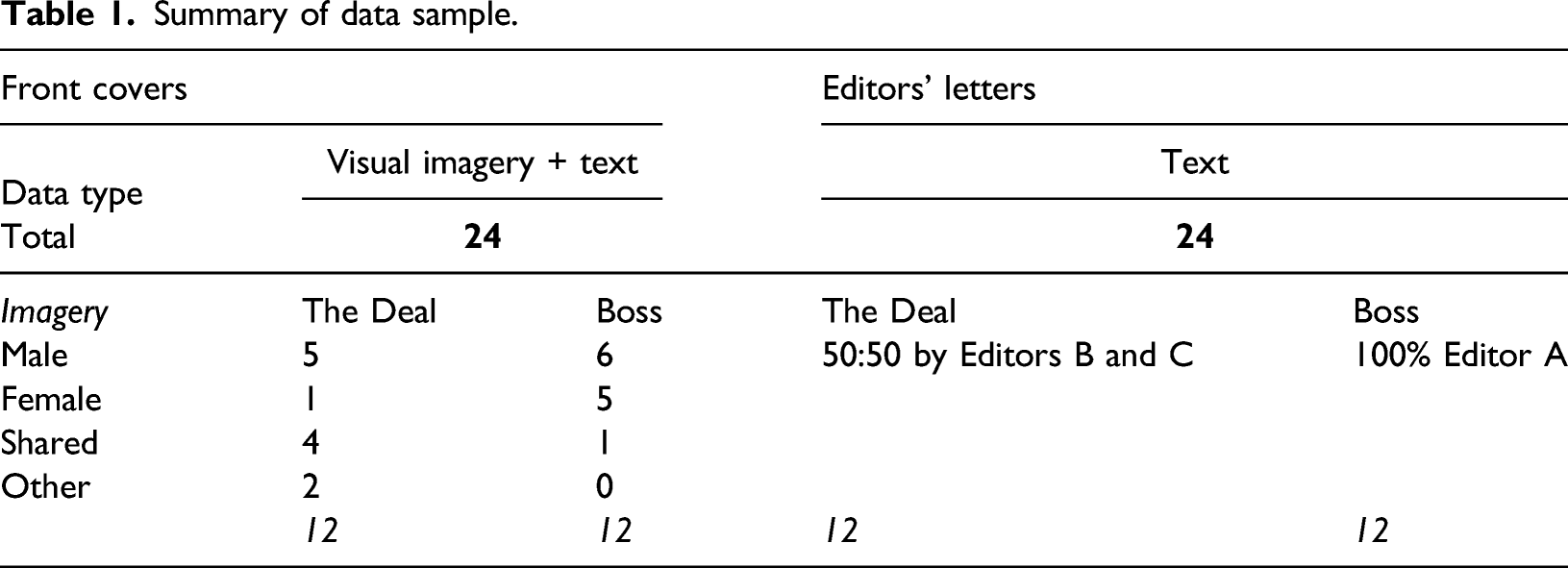
Media analysis
The theoretical framework laid out in the previous sections serves as a foundation to the analysis undertaken to understand how media constructs leadership as heroic and/or post-heroic through a multimodal analysis of media artefacts. Multimodal approaches unveil a range of intersubjective social structures and processes that create and represent meaning about leadership, through a combination of language, subtext and visual imagery along with the use of space and materiality of symbolic structures, body, clothing and contextual references emphasizing and enabling particular and dominant meanings (Alvehus, 2019; Cunliffe, 2011; Guthey and Jackson, 2005). The interpretation and construction of meaning from multimodal analyses may sometimes vary according to the cultural flavour and social norms of the audience (Liu, 2017).
The multimodal media analysis informing this study integrated semiotic analysis and critical discourse analysis methods (Fairclough, 1995; Kress and Van Leeuwen, 2002; Norris, 2019). The analysis was undertaken in sequential stages to interpret how the multimodal visual and discursive components of multiple media data sources came together to construct leadership frames. In Stage 1, the magazine front covers were analysed through a semiotic framework and in Stage 2 a critical discourse analysis of the editors’ letters was completed. Stage 3, the culminating focus of this paper, revealed the dominant Frames through which leadership was constructed in the Australian business media. This stage involved collectively synthesizing the intertextual and intersubjective emergent meaning about leadership from visual and discursive elements of both data sources analysed in stages 1 and 2. This approach provided a deep understanding of how leadership was constructed in media through the multidimensional elements in each media frame. The benefit of conducting a sequentially staged multimodal media analysis was to ensure that the individual parts of the media artefacts were analysed and interpreted with reference to the whole (Heidegger, 1996), or in other words, the interrelated interpretation between the artefact and the context (Smith and Amrine, 1996). The three-staged multimodal media analysis employed in this study is detailed below.
Stage 1: magazine covers
Magazine covers, through visual imagery and headlines are a powerful messaging tool that enable audiences to construct a story and social meaning governed by context, socio-cultural norms and normative schemes (Elliott and Stead, 2018; Liu, 2017; Shortt and Warren, 2019). The first stage of analysis employed semiotic analysis to consider how leadership is framed through the visual and discursive elements in the imagery and accompanying text on the magazine front covers. This method involved considering the constitutive elements or ‘semiotic modes’ (Kress, 2004) of the media frame which include the text, visual imagery and layout and how they come together and interact to create a particular meaning. The media frame is constituted of multiple semiotic modes that can have distinct individual meanings, which can change, complement or negate meaning emerging from other individual semiotic modes (Kress and Van Leeuwen, 2005). In order to understand the represented meaning, the semiotic modes need to be viewed together in symbiotic layers to translate how the modes convey a message or social meaning with regard to genres, constructs or objects (Kress, 2010). For example, Liu’s (2017: 271) study of Australian media representation of banking CEOs during the Global Financial Crisis evidences this approach, illustrating how NAB CEO, John Stewart was constructed as an ethical leader through visual imagery and complementary textual descriptions. She identifies how media drew on dynamic imagery exposing and concealing Stewart’s body and physical appearance in combination with a masculinist script portraying him as competitive, paternalistic and working class.
We adopt a similar approach in this stage of analysis. In order to interpret the meaning being communicated through the magazine cover the individual elements such as the text (literal meaning, intended meaning, inferred meaning, words), semiotic imagery (visual image, gestures, expression, physical and corporeal elements, attire, colour) and layout (background, colour scheme, font, size of imagery and text, arrangement, proximal distancing) were interpreted first, individually in situ, and then in relation to the other constitutive elements in the frame to understand the holistic or overarching meaning about leadership and the extent to which gender norms informed the emergent meaning (Butler, 2009; Fletcher, 2004).
Stage 2: editors’ letters
The editors’ letters represented the “primary discourse” as they expressed the editor’s position and claims about the content (Fairclough, 1995:55) and served as an introduction to the magazine supplement, outlining the context and key themes included in the issue. The second stage analysed the dominant meaning emerging from the argumentation, text and themes in the editors’ letters using critical discourse analysis. As Paltridge (2006) argues, a critical discourse analysis goes beyond a descriptive analysis of the text and requires a deeper exploration of what is being represented about socio-cultural practices through the discourse. For example, Liu’s (2017:268) study of Australian media and ethical leadership evidences this approach, interpreting a Courier-Mail article stating “Stewart has made it crystal clear he intends to reshape the bank: strategically, structurally, operationally and culturally” as a ‘conquest’ narrative, and an article in The Age “I wanted to work for Frank, I wanted Frank up there” as suggesting a ‘humility’ narrative, demonstrating the reproduction of gendered discourses of leadership.
In Stage 2 of our study, the discursive elements of the text were analysed using Mullet’s (2018) structured process of reading the content and identifying broad categories from the text which included context, focus, argumentation, tone and lexical choice. Each editor letter was categorized into Context, which included references to specific incidents, industry or societal changes, Focus, which encompassed specific or explicit claims made in the text, Argumentation, included the inferred or intended meaning emerging from the text, Tone, included an analysis of the intended sentiment, and Lexical choice pertained to the choice of words and references made. The discursive elements in each category were analysed first, in situ, and then relationally to determine the intended and inferred meaning about leadership and the extent to which gender norms were invoked to convey the meaning.
Stage 3: frame analysis
Finally, in the third stage, a complete framing analysis was undertaken to determine the dominant framing through the intersubjectivity and intertextuality of the visual and discursive elements of the multiple media sources analysed. The media artefacts from stage 1 and stage 2 conveyed how leadership is represented in Australian business magazines and the extent to which gendered norms are invoked in media framing to convey a particular meaning about leadership. For example, through a combination of constitutive elements including discourse, narrative, text, subtext, language, semantics, imagery, symbolism, signage, aesthetics, colours and contextual cues, the key attributes and characterizations emphasized in the framing became apparent. This aligns with Elliott and Stead’s (2018) approach to media framing analysis where they compared and contrasted the meaning emerging from visual imagery and argumentation in the text to identify dominant construction of leadership. Similarly, in stage 3 of our analysis, the themes and discourse patterns from the earlier stages were collectively synthesized and interpreted to illustrate the dominant meanings in the framing of leadership. Stage 3 also served as ‘within method triangulation’ (Holloway and Wheeler, 2009:309) where distinct methods of analysis were applied to interpret the data and the outcomes compared to ensure credibility in the findings. Through this multimodal analysis of the magazine covers and editors’ letters, we identified, and present three distinct frames of leadership. Together, these frames provide a textured picture of how Australian business media constructs leadership and conveys particular meaning about leadership and gender norms.
Findings
Explained in detail in the following sections, the frames indicate the configurations of leadership conveyed through the magazine supplements. The first frame, titled Validating Heroic Leadership, dominated the magazine supplements and portrayed leadership through hegemonic masculinities, idealizing and romanticizing heroic ideals of leadership. The framing conveyed heroic leadership as an organic extension of gender roles culturally associated with men, where women’s leadership was accepted, provided they simultaneously conformed to and reaffirmed feminine gender role expectations when performing leadership. The second frame titled, Softer Heroic Leadership, presented a new construction of leadership which recognized that hegemonic masculinities were not always appropriate in response to changing societal contexts. In this frame, alternative leadership configurations were constructed by continuing to draw on masculinist norms and subsuming a range of feminized attributes into a ‘softer’ modified form of heroic leadership. The third frame, titled Post-heroic ‘Heroes’, constructed a new frame by celebrating individual leaders (exclusively men) as heroes because they embraced collaborative and post-heroic moulds of leadership. Across these frames, we identified gender norms as heavily entangled in how media constructed leadership, resulting in multiple configurations of heroic leadership, reflecting hegemonic and dominant masculinities and also incorporating femininities. This resulted in differential positioning of men and women’s leadership across the three frames of leadership.
Frame 1 – validating heroic leadership
In the first frame, Australian media romanticized a heroic version of leadership by highlighting past achievements and instances where individuals had triumphed over challenges (Meindl et al., 1985). Three heroic variations appeared in media framing: champions (glamorizing individual achievements); heroes (achievements whilst also triumphing over a challenge); and bosses (complete authority and dominant power). Hegemonic masculinities informed media framing to construct leadership as a masculine domain.
Magazine covers showed leadership framed as heroes and champions, for example, through headlines like “The Quiet Achiever” (Sep18_Boss_cover) or “No Holds Barred” (Mar18_Boss_cover). As explained in Figure 1, the first headline, in combination with other semiotic modes in the frame, portray success, accomplishment and embodied masculinities. The headline “No Holds Barred” conveyed combat and risk-taking, attributes culturally associated with men (Elliott and Stead, 2018; Mccabe and Knights, 2016). The phrase, itself a reference to terminology used in contact fighting sports such as wrestling, constructs a dominating, overpowering champion image (Paechter, 2018). Magazine covers framed leadership through references to bosses, discursively emphasizing individual authority and power, and separating leaders from followers by accentuating hierarchies (Grint, 2010). For example, through the headline “Aldi’s boss Tom Daunt on the way we shop” (Sep18_Deal_cover) or “Rio Tinto’s JS Jacques” uncompromising new regime” (Mar18_Boss_cover) portray unquestionable, absolute and authoritative power. As Harding et al. (2011) argue, heroic leadership is seen when framed as standing out from the crowd and being watched by followers. Frame 1 – validating heroic leadership.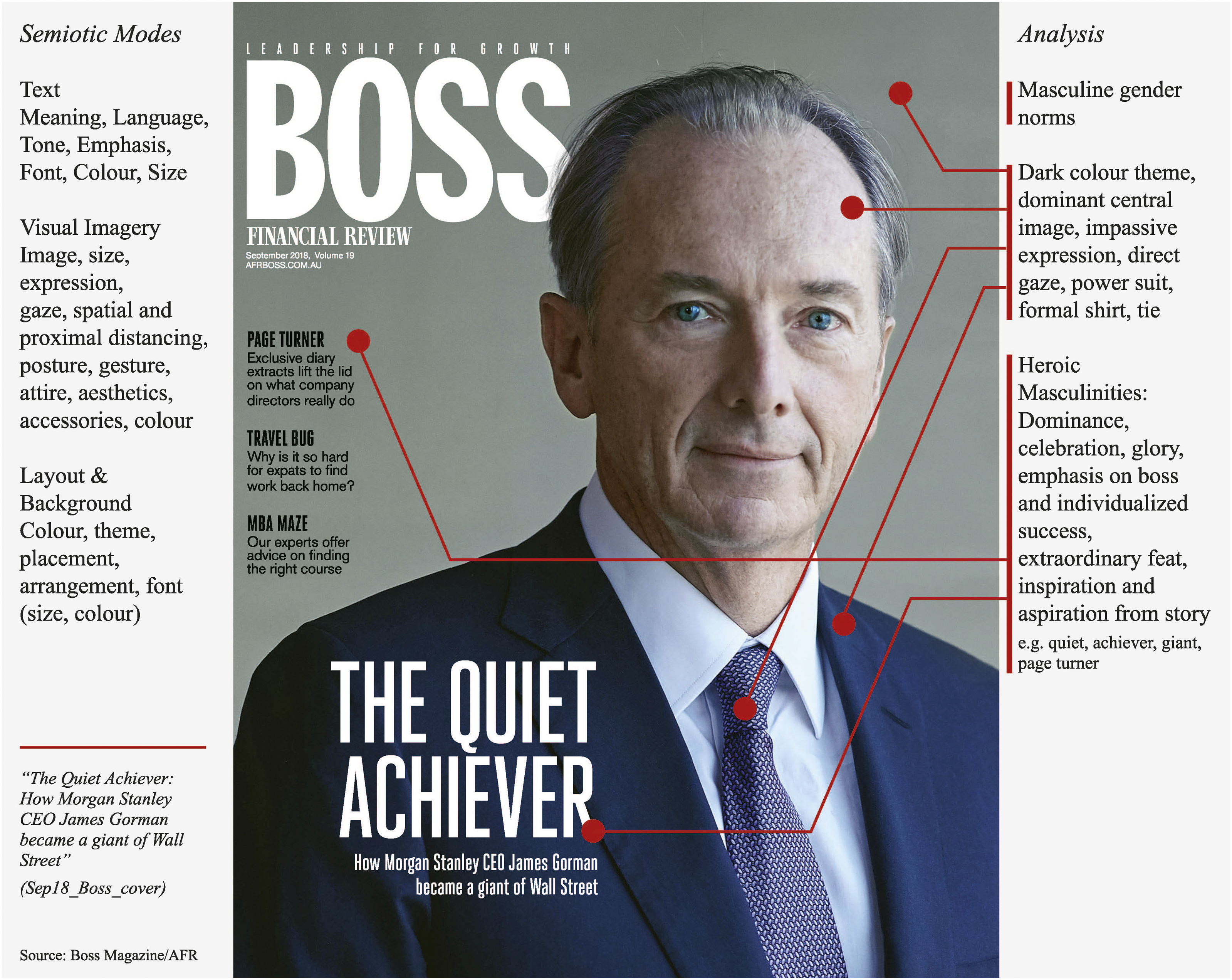
Kyriakidou (2011) posits that hegemonic masculinities pervade management practices and organizational discourse. These have also made their way into media discourse about leadership and were evident in Australian media framing that validated and promoted heroic configurations of leadership. For example, editorial discourse focussed on skills, abilities and personal attributes of leaders that further reinforced the heroic perspective towards leadership, inspiring and leading followers through masculinized attributes such as confidence and competitiveness (Mccabe and Knights, 2016). As one editor describes “good deal-makers are good leaders – people who take a country or an individual to where you want them to be” (Oct18_Deal_p.5). Similarly, the following quote illustrates how masculine gender norms informed the framing of leadership:
“Rob Scott has taken the helm as chief executive at Wesfarmer in the middle of a retail maelstrom” (Feb 18_Boss_p.4)
By framing the leader as a captain of industry who has taken charge in a turbulent time, leadership was constructed as a male domain, and the masculinized and heroic characteristics associated with leadership were reinforced through the choice of language, words and tone of argument in the framing. Such characteristics in leadership are congruent with roles associated with men (Rosette and Tost, 2010) and entangle masculine gender norms with leadership. Other examples of masculinist gender norms invoked to construct leadership include references such as “Fighting them in the Aisles” (Sep18_Deal_cover), “Line of Fire”, “Taming the Beast” (Oct18_Deal_cover) associating leadership with aggression, conflict, and power. Corporeal elements in visual imagery were also important, such as wearing dark suits to indicate power (Mccabe and Knights, 2016) or impassive facial expressions to convey embodied objectivity and rationality (Ladkin, 2013).
The Boss magazine cover for Sept 2018 (see Figure 1) demonstrates how the semiotic modes of the cover and editorial collectively construct one form of heroic leadership through the framing of James Gorman, Chief Executive of Morgan Stanley investment bank.
In this example, the main coverline portrays individualistic achievement and the accompanying subheadline presents an inference to hegemonic masculinities and heroic leadership through words and text such as “giant” to emphasize domination and intimidation. This is further complemented by the composition of the media frame, with an up-close upper body shot of the subject looking directly at the camera, engaging the audience and ‘dominating’ the frame (Kress, 2010; Mccabe and Knights, 2016). The discourse in the corresponding editorial focussed on Gorman’s leadership in the banking industry context, representing him as an inspirational hero for leading the organization towards success:
“And so it is with James Gorman, the chief executive of one of the biggest investment banks on Wall Street, Morgan Stanley. I take my hat off to Gorman for taking the gamble in steering Morgan Stanley away from pure investment banking to an institution that derives half of it’s business from wealth management. It was a big call and he clearly understands what it takes to make a wealth business work. Unlike some others.” (Sept18_Boss_p.4)
The argumentation in the editorial reinforces masculinized assumptions underlying heroic leadership, by portraying Gorman as a dominant figure in this space and distinguishing him as an inspirational leader (“unlike others”), who exhibits bold and complex behaviours (“for taking the gamble….it was a big call”). The tone and lexical choice constructs the heroic image by telling the readers his leadership should be admired (“I take my hat off”), and suggesting future leaders can follow in his footsteps by following his example “if you are a newbie are great reminders of what it takes to keep forging ahead” (Sept18_Boss_p.4). The editor’s narrative constructed leadership as a masculine domain by drawing on masculine terminology and reinforcing normative masculinized gender expectations.
Whilst heroic leadership was emphasized through individual success, glory, authority and achievement (Crevani et al., 2007; Fletcher, 2004), the reinforcement of gender norms and conformity with cultural expectations in the construction of leadership differed when women’s leadership was the subject of the frame. Women’s leadership was framed as able to ‘mirror masculinities’ such as competitiveness “Winning leadership” (Nov17_Boss_cover); risk-taking and confidence “Christine Holgate is ready to usher the organisation into a new era” (Oct18_Boss_cover); power and univocal authority “Why Anna Bligh wants you on your mobile” (Mar18_Deal_cover) and glorified achievement “Tech whiz Maile Carnegie reinvents ANZ” (Mar18_Deal_cover).
In this frame, across the media artefacts analysed, portrayals of women as credible heroic leaders also emphasized material and corporeal elements such as appearance, feminine dressing, high heels and shiny jewellery. For example, as illustrated (see Figure 2) through the Nov 2018 issue of Boss (Nov18_Boss_cover), the language (“Iron Woman”, “challenging”) and dark suit comply with performing masculinized behaviours whilst at the same time the socially ascribed gender role and feminine gender norms are emphasized through materiality and physical embodiment such as glamorous accessories, make up, posture (head tilt and demure stance, leg forward) and attire (bejewelled belt and animal print high-heels) (Elliott and Stead, 2018; Fotaki and Harding, 2016). Frame 1 – mirror masculinities (ability) and gender norms (conformity).
Across the editors’ narratives the entanglement of gender norms with leadership was also emphasized. Editor narratives highlighted how women’s leadership has to overcome cultural expectations and double standards, consistently having to navigate and uphold gender norms through attire, accessories, make up, appearance and social behaviours in the leadership space. The editors distinguished women’s leadership as different to the norm by referring to special issues, editions or features on women in leadership. The argumentation, lexical choice and tone across the editor letters reinforced how social roles and feminine gender norms disassociated women from traditional conceptualizations of heroic leadership. For example, the editorial in Nov17_Deal addressed the lack of women in leadership roles, building an argument that women are in an unfamiliar masculine space:
“After all, it’s hard to imagine yourself in an organization where everyone seems to be wearing suits” (Nov17_Deal_p.5)
The phrasing establishes leadership as a space dominated by men (established as dominant by using the term “everyone”) where women do not belong organically (“imagine yourself in”). By drawing attention to masculine norms (“wearing suits”), the expectation to mirror masculinity is reinforced (Pullen and Vachhani, 2020). Further on, the editor emphasizes how feminine gender norms and cultural expectations problematize women’s leadership. The lexical choice and tone suggests that women pursue work and leadership at the expense of family, “the stress on families from juggling jobs and children seems to be greater than ever”. As Carli and Eagly (2016) argue, women’s leadership faces varied and circuitous challenges. This is seen in our data in not only the emphasis on gendered expectations of appearance, but also the editorial recognition of a pattern of appointing women to leadership when the “risk of failure was high” (Sep18_Boss_p.4) and editorial identification of the critique women’s leadership attracted and the need to defend it:
“This man is highly successful and a standout in this field. He said he was “bored” by and “sick of” the focus on gender diversity. Unfortunately, it is necessary to keep up the scrutiny.” (Nov17_Boss_p.7)
The media framing positions women as accepted and recognized as visitors in the heroic leadership domain, subject to how effectively they mirrored masculinized attributes such as determination or ambition (Elliott and Stead, 2018; Pullen and Vachhani, 2020) whilst simultaneously conforming to feminine gender norms. This is consistent with extant literature which notes the differential treatment of women’s leadership (Elliott and Stead, 2018; Liu, 2017), and is clearly acknowledged in the following editorial quote:
“A woman’s presence – her clothes – her style, her voice if not her physical features – are still factored into judgements in the corporate world. Male CEOs are not allowed to front the AGM in shorts, but women get special treatment when it comes to the optics. It’s getting easier but the demands for women to frock up or down at work are still there.” (Nov18_Deal_p.5)
Across this frame, masculinist terminology and gender norms such as sporting, hunting, military action and fighting were drawn on to construct leadership as a heroic masculine domain. Such framing drew on hegemonic masculinities to validate heroism as an organic extension of cultural roles associated with men, and distinguished women as outsiders who were recognized as credible and accepted in a narrow and limited frame of leadership.
Frame 2 – softer heroic leadership
This frame specifically appeared in the construction of leadership during times of change in the business landscape and societal expectations or in response to adverse events or crises (for example, loss of public confidence in the financial industry). The framing presented a configuration of heroic leadership, in such a way that feminized attributes were subsumed, or incorporated into the repertoire of heroic leadership. We conceptualize this as ‘softer masculinities’. This ‘softer masculinities’ framing of heroic leadership was only evident where men were the subjects in the frame. This had the dual effect of validating traditional and masculinized logic underlying heroic leadership, whilst simultaneously arguing heroic leadership was not always appropriate and needed to change. This was evident in particular, when contextual factors such as a loss of trust in institutions, changing market and social dynamics and technology driven disruption, were addressed in the media frame. Through this framing Australian business media suggest new ways in which masculinities in heroic leadership could be modified (rather than rejected or replaced) in response to changing contexts.
The concurrent questioning and reinforcement of heroic leadership appeared in magazine cover headlines which raised doubts on whether the quintessential heroic leaders could be saviours when faced with adversity for example, “Can Andrew Thorburn manage NAB’s burning platforms?” (Jul18_Boss_cover), or questioned if they could recreate former glory such as “Can Rob Scott find another Bunnings?” (Feb18_Boss_cover) or transform an organization “Can Julian Segal reinvent Caltex?” (Apr18_Deal_cover). Although the text posed a question about the individual leader’s ability to achieve these outcomes, heroic leadership was simultaneously emphasized through the expectation that leaders should achieve such extraordinary feats that continued to position them as superior or exalted (Grint, 2010).
Questioning the effectiveness of heroic leadership in media emerged in response to specific incidents and changing contextual situations such as a loss of public confidence in institutions such as banks. For example, in this data both magazine supplements emphasized the ‘breaking of trust’ (see for example Deal Mar18, May18 and Boss Dec17, Apr18,) by past leaders highlighting the weakness or cracks in the heroic mould of leadership using headlines such as “Who can you trust?” (Jun18_Deal_cover). Similarly, the editors’ letters referred to the “bad behaviour” (Mar18_Deal), “distrust and backlash… and unlawful behaviour” (May18_Deal), ‘bad corporate culture and systemic exploitation’ (Dec17_Boss_p.4), “existential threats and management failings” (Apr18_Boss_p.4) of current leadership (in the financial sector). Editors’ letters further highlighted a palpable need for alternative approaches to leadership that involved inclusion and transparency with customers, illustrated in the excerpts below:
“some financial services leaders are unable to manage the vast organisations beneath them. We must see a real change as a result” (May2018_Boss_p.4).
“Now is the time to help consumers navigate their way through the negative stories and make sound decisions about how to get the advice they need.” (Jun18_Deal_p.3)
These examples suggest a shift towards leadership that embraces positive, facilitative guidance (“help”) and empowerment of customers (“navigate their way… and make sound decisions”). Although supportive and inclusive language are associated with post-heroic leadership (Fairhurst and Uhl-Bien, 2012), it is important to note that media framing here did not present them as the enactment of post-heroic leadership (Crevani et al., 2007; Ford, 2005). Instead, the framing alluded to expanding heroic leadership to take on these feminized attributes as alternate masculine behaviours or softer masculinities in leadership.
To provide one clear example, the semiotic modes on the Boss magazine cover for Feb 2018 (see Figure 3) convey how heroic leadership could be expanded to perform ‘softer’ masculinities in response to changing contexts. The elements of the media frame (Feb18_Boss_cover) portray Rob Scott from hardware store Bunnings, as heroic whilst simultaneously incorporating vulnerability, emotion and struggle into the frame. Frame 2 – incorporating softer masculinities.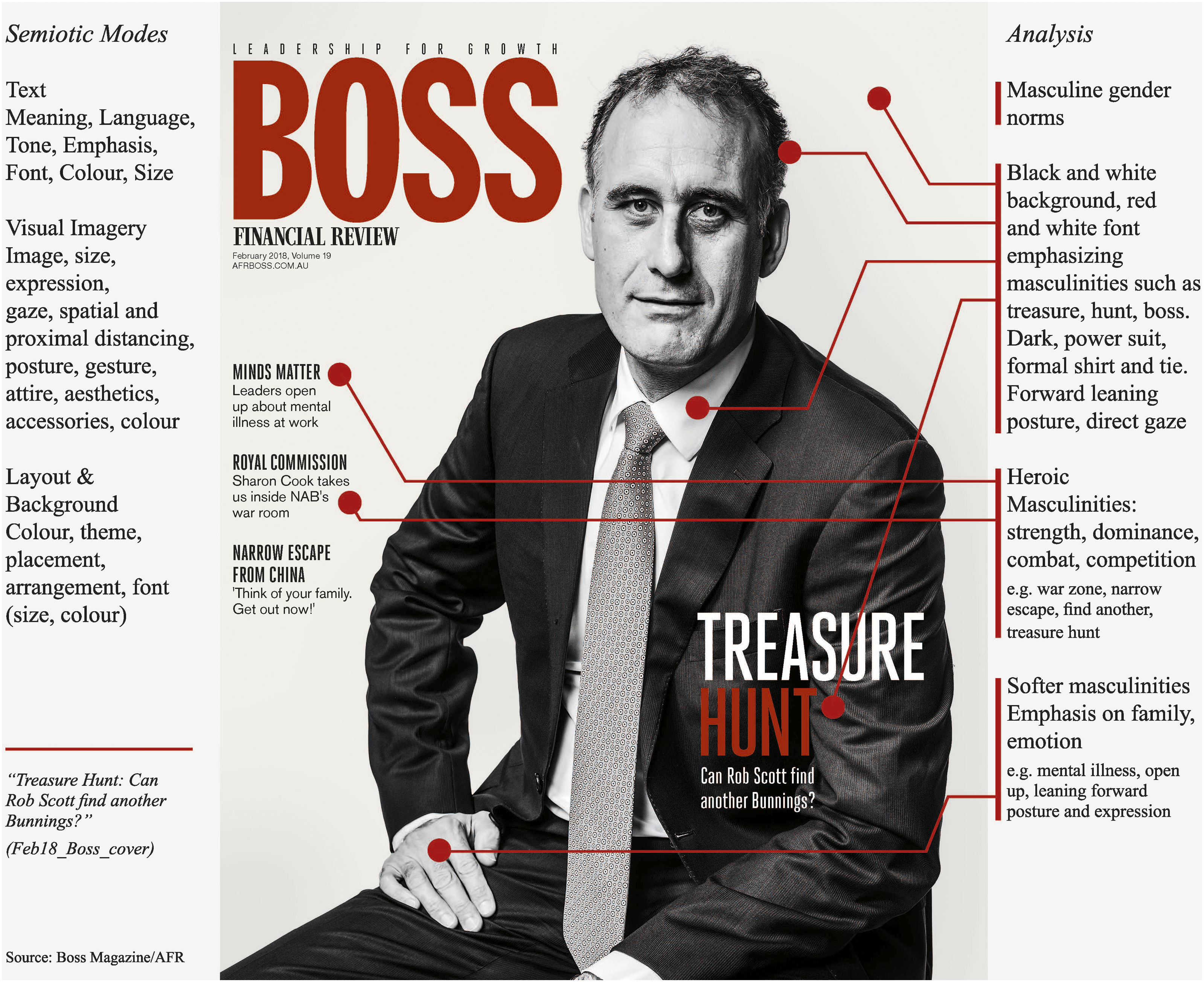
In this example, the visual and discursive elements represent heroic leadership through a dominance of masculinist references like “war”, “treasure” including an added red font colour emphasis on “hunt” and “Boss”. These references reinforce stereotypically masculine images and associate leadership with masculinized attributes such as power, aggression, combat and danger (Paechter, 2018). However, there is also evidence of feminized attributes and gendered expectations ascribed to women, such as empathy and compassion. This is seen in references to content on “mental illness”, showing stress and worry and emphasizing a caretaker or protector social role through the phrase “think of your family”. On balance, the feminized attributes in this framing do not suggest the emergence of a post-heroic configuration of leadership. Instead, femininities are subsumed into a shifting frame of heroic leadership. Embodied conformity with masculine gender norms are prevalent through corporeal and material elements in the visual imagery such as the formal power suit and tie, but the shift towards a softer configuration is subtly suggested through the rumpled suit, tired expression and a hunched, forward leaning more relaxed posture. The accompanying editorial emphasized the need to incorporate sensitivity and empathy into traditional leadership:
“mental health conditions are not a limiting factor for professional success…There are very few senior leader role models for those with mental health conditions. It’s the negative perceptions, not the conditions, which are the issue….Mercer’s group helped us find five of the six senior leaders who were happy to talk about their experience. Their stories will resonate with many. And many leaders now understand that their workplaces must support good mental health for all.” (Feb18_Boss_p.4)
The editorial statement illustrates how changing societal contexts requires an expansion of leadership to include attributes such as displaying emotion and vulnerability (“talk about their experience”) to remain effective. The editor’s letter in Jun18_Deal, further signals to the shifting expectations from heroic leadership. “We hope to get good advisers to aspire to greatness, always with an eye towards putting the client’s best interest first” (p. 5). This illustration from the editor’s letter highlights the context of the discredited banking industry and loss of public confidence and, argues for leaders to enhance their repertoire of leadership practices and behaviours with characteristics such as empathy and compassion. These characteristics are culturally associated with femininities (Fletcher, 2004). The lexical choice and tone of the phrasing, however, reinforces the individualistic heroic leadership rhetoric (“aspire to greatness”), tempered with an additional focus on others’ needs and interests. The shift towards enacting softer characteristics in heroic leadership appeared in other examples where the framing depicted a display of emotions, gestures and facial expressions (e.g. Jul18_Boss_cover) not usually associated with heroic leadership (Ford, 2010; Grint, 2010), such as smiling (e.g. Jun18_Deal_cover), or which indicated stress and worry (e.g. Feb18_Boss_cover and Apr18_Deal_cover).
Whilst this frame reconstructed an expanded configuration of heroic leadership when men were the subject of the framing, women’s leadership was excluded from this framing. As outlined in Frame 1, media constructed women’s leadership as credible and heroic in particular configurations, where they were able to mirror masculinities whilst simultaneously conforming to and emphasizing feminine gender norms. However, when depicted in relation to crises or changing contexts, the framing questioned the credibility of women’s leadership when they deviated from the accepted configuration of heroic leadership. For example, in the Boss magazine cover for May 2018 (see Figure 4), a woman leader’s alternative approach was framed as her inability to enact masculinities in heroic leadership successfully, rather than framed as the emergence of alternative configurations of leadership. Frame 2 – mirror masculinities (inability) and gender norms (non-conformity).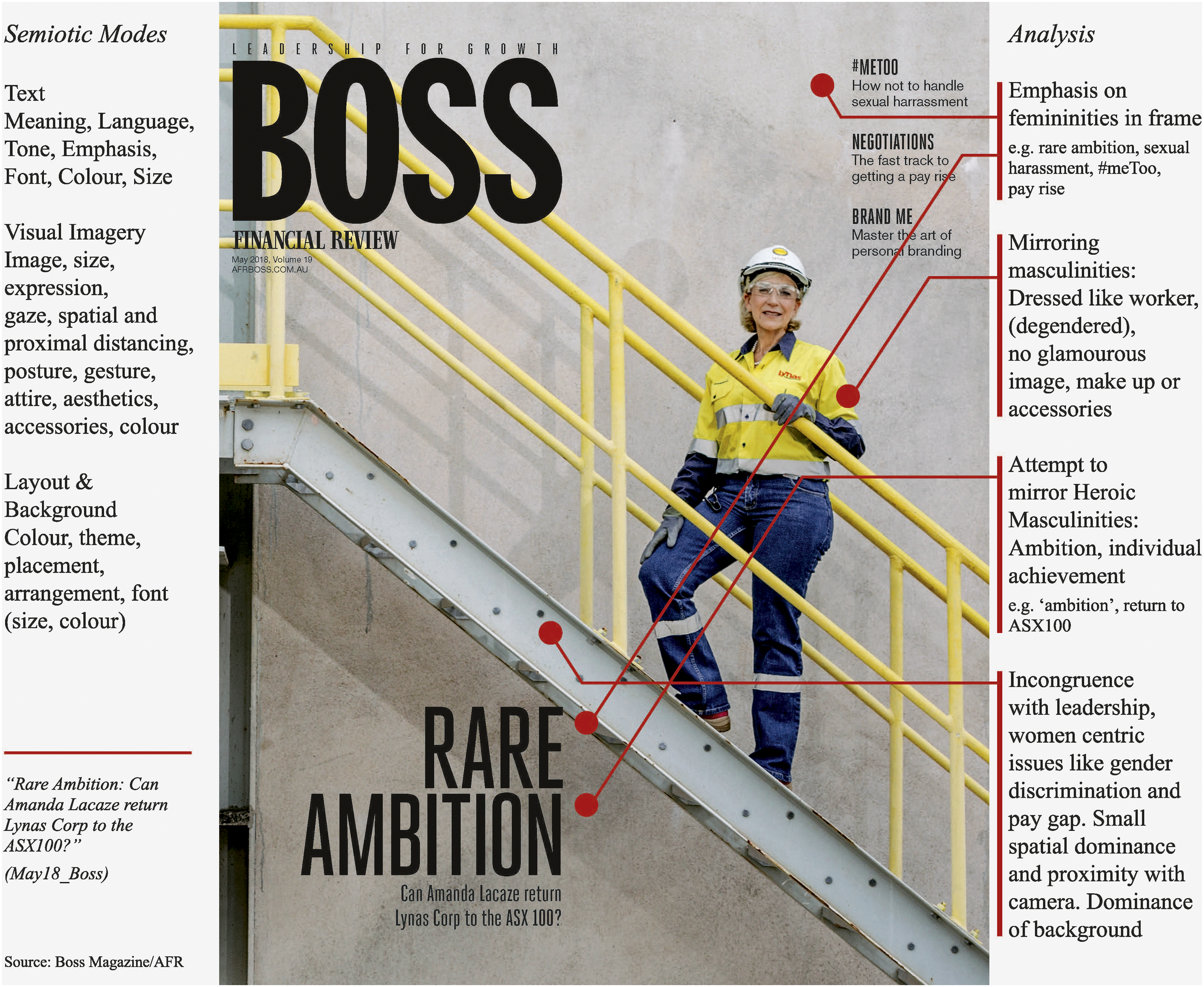
In this example, the headline ‘Rare Ambition’ is supplemented by questioning whether the female leader can “return” the company to a former position of success. “Ambition” and leading the organization to success and glory is reflective of enacting masculinities (Fletcher, 2004). However, the phrasing in this frame positions the female leader’s ability to achieve the intended outcome as unusual or “rare”, a deviation from the behaviours expected from women’s leadership (Elliott and Stead, 2018). The framing highlights a departure from the accepted conformity with feminine gender norms, for example, dressing like a worker rather than in the usual business suit, glamorous make up and glossy appearance (Elliott and Stead, 2018; Fotaki and Harding, 2016). Textual references to content such as “#meToo and sexual harassment” and “Negotiations for getting a pay rise” draw attention to women centric issues (gender discrimination and pay gap) and the constant struggle faced by women in masculine domains (Carli and Eagly, 2016; Paechter, 2018), thus problematizing women’s leadership.
This differential framing by gender is further strengthened through the corresponding editorial for this cover, where mining CEO Amanda Lacaze is referred to as “the only blonde in the village” (May2018_Boss_p.4), referencing a woman’s leadership and feminine gender norms in the context of a masculine domain, that is, a mining sector. The framing through lexical choice and tone of argumentation emphasizes appearance and infers inability by alluding to the gendered ‘dumb blonde stereotype’ (Baxter, 2018; Paechter, 2018), whilst simultaneously suggesting her feminine presence in the domain is rare or unique (“only blonde in”) (Eagly and Karau, 2002). The efficacy of women’s leadership is undermined when gendered norms which are not associated with leadership are over emphasized (Elliott and Stead, 2018; Liu, 2017; Mavin et al., 2018). In times of uncertainty as the context, media framing reverted to questioning the credibility of women’s leadership. This is evidenced in the editorial description of CEO of the Australian Banking Association, Anna Bligh’s leadership during a time of crisis for the banking and financial sector, “as the threat of a banking royal commission looms, her skills as a communicator, advocate and persuader will be put to the test” (Nov17_Boss_p.4). The lexical choice and tone in phrasing (put to test) questions her ability to perform the required task, rather than suggesting a need to modify leadership practices. Framing of women’s leadership lacked the positive inclusion of attributes associated with femininities to produce a ‘softer masculinities’ form of heroic leadership.
The frame of Softer Heroic Leadership constructed a new, softer configuration, where in response to changing social contexts, a new range of practices culturally associated with femininities, were incorporated into heroic leadership. This framing was, however, only applied to men’s leadership. By invoking and emphasizing masculinist descriptors and masculine gender norms, modes which incorporated feminized attributes were subsumed into heroic leadership as ‘softer masculinities’. Framing of women’s leadership as effective and credible remained limited to a specific configuration of heroic leadership premised on mirroring masculinized attributes but conforming to feminine gender norms.
Frame 3 – post-heroic ‘heroes’
The third frame showcased a construction of a new ‘hero’ in media framing where performing new, inclusive and post-heroic leadership was glorified and celebrated. In this frame, the media complexified the performance of femininities in leadership by attributing them to a new ‘post-heroic hero’. This frame exclusively showcased men’s leadership and included instances where male leaders expressly enacted stereotypically feminized behaviours and characteristics such as support, humility and inclusivity (Fletcher, 2004) or where younger, millennial leaders disrupted hierarchies through collaboration and adaptability (Pearce and Manz, 2005). This framing operated to reframe the performativity of post-heroic leadership as a new dimension of masculine heroism. Distinct from Frame 2, which constructed an expanded configuration of heroic leadership by subsuming feminized attributes as ‘softer masculinities’, in this frame, the feminized logic underpinning post-heroic leadership was expressly recognized and acknowledged. However, by drawing on heroic descriptors and masculinized terminology, the performance of post-heroic leadership was reframed as heroism, performed by and attributed to post-heroic ‘heroes’.
Post-heroic configurations of leadership were expressly part of the framing in a small number of magazine covers and editorials. On magazine covers, the textual meaning of the headlines in the media frame combined with materiality such as informal attire and posture presented within the visual imagery suggested the enactment of post-heroic leadership by reproducing feminized attributes as adaptability, inclusivity, sharing of power and flexibility (Fletcher, 2004; Fletcher and Kaufer, 2003). The Boss magazine cover for Dec 2017 (see Figure 5) demonstrates how the semiotic modes of the cover and editorial directly emphasize the performance of post-heroic leadership. Frame 3 – performing post-heroic leadership.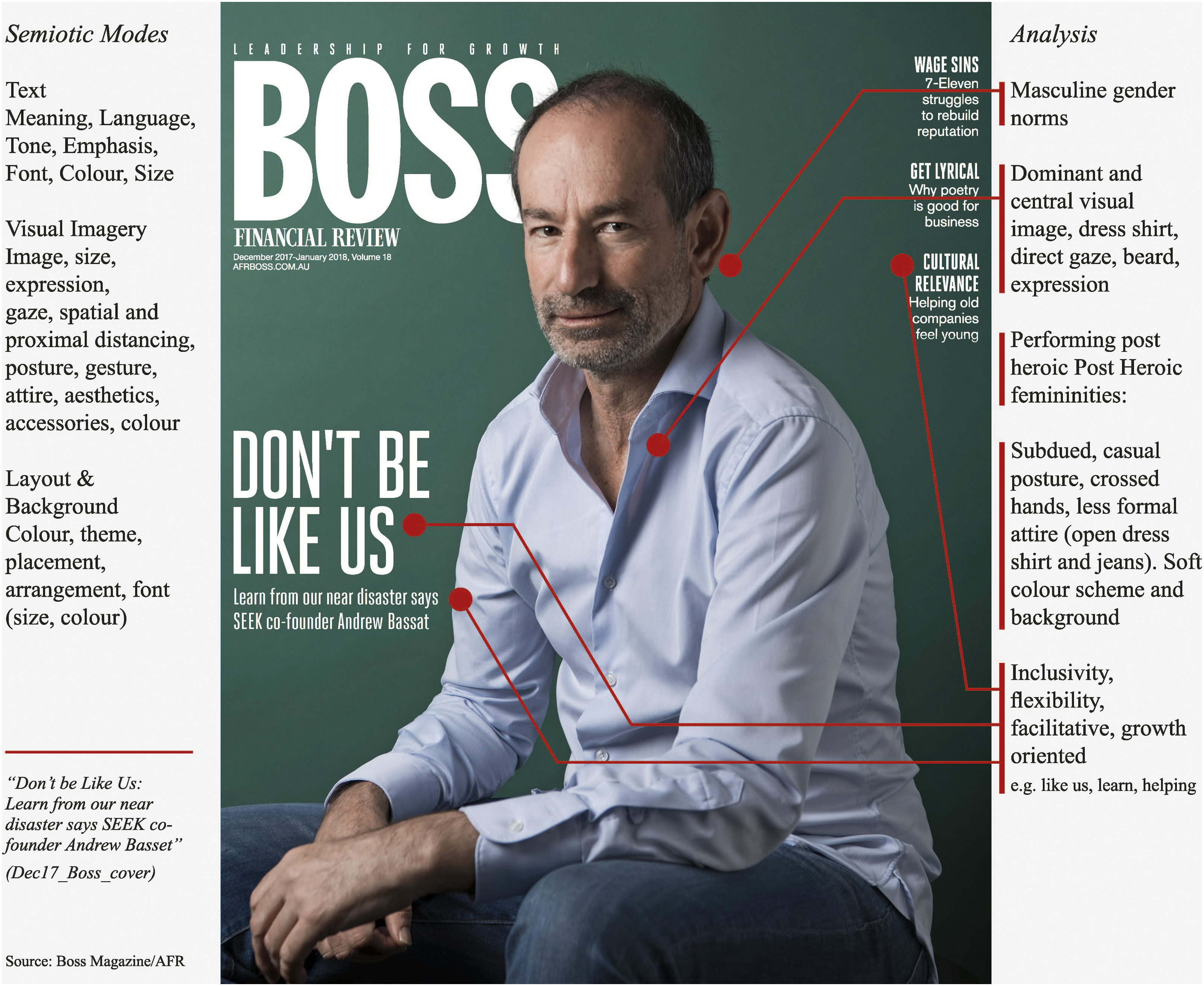
In this example the framing uses the words ‘Don’t be like us’ (Dec17_Boss_cover) in combination with embodied femininities such as submission, passivity and warmth (Ford, 2010; Harding et al., 2017), and through a subdued and non-threatening physical pose and warm facial expression (Ladkin, 2013; Ropo et al., 2013). The framing reflects post-heroic ideals, through the textual references to being cautionary, and inclusive (the use of the word “us”), and the headline suggests a lesson to be learned through dialogue from a helpful and supportive CEO, and mutual learning through leadership (“helping”) (Fletcher, 2004). As Crevani et al. (2007) explain, post-heroic leadership is relational and consists of co-created or collective learning, emphasized in this cover through text that infers agency and capacity to act (“learn”). The corresponding editorial specifically emphasizes the context of leadership as new and emerging from past failure, drawing attention to a shift away from traditional behaviours and thinking, “SEEK co-founder Andrew Bassat displays some of this new leadership thinking.” (Dec17_Boss_p.4). The alternative configurations of (“new”) leadership are highlighted in the argumentation by emphasizing the enactment of feminized attributes such as sharing of power, dialogue and self-abnegation (Rippin, 2007) “he candidly reveals that SEEK almost failed”, and demonstrating a facilitative, nurturing and growth-oriented approach (Fletcher, 2004) “Bassat’s lessons for the soon-to-be-disrupted should be heeded” (Dec17_Boss_p.4). Post-heroic leadership clearly emerges in the frame and is also positioned as positive by suggesting the “lessons” should be regarded and held in high esteem (“should be heeded”). The tone and lexical choice in the editor’s narrative portray the leader as an inspirational survivor.
In each instance where media framing portrayed alternative and collaborative leadership as a departure from traditional heroic leadership, the framing also relied on masculine descriptors and heroic characterizations such as fighters and disruptors. For example, the editor’s narrative in Dec17_Boss below, frames inclusive leadership as necessary in the contemporary business world, and simultaneously creates a heroic and brave persona (“courage”) for the leader who questions traditional heroic approaches:
“How much courage did it take for Alex Abrahams, founder of dental group Pacific Smiles to ask the panel of young leaders at our AFR BOSS Leadership summit: “I’m an Anglo-Celtic male. I’ll disclose I am 59. What do myself and my cohort do to be part of this business diversity world, or should I just check out?” (Dec17_Boss_p.4)
The editorial (below) further references how a panel discussing contemporary leadership also subscribed to the hero narrative, celebrating and lauding the enactment of post-heroic leadership as a means to becoming “great” and a “champion”:
“They agreed the times require a new style of leadership, not new leaders. Said Cope: “Practice inclusive leadership be conscious of your unconscious biases, practising inclusive leadership allows you to become a great advocate and champion of change.” (Dec17_Boss_p.4)
Similarly, the framing of leadership performed by younger, male, ‘millennial’ leaders in transformational business contexts such as technology driven, digital, innovative industries was consistently and exclusively depicted as a deviation from heroic norms by way of a deliberately more inclusive, shared approach to leadership and a rejection of hierarchical approaches. The editorial in the Mar18_Deal issue provides an example of how new leadership (“a new generation”) is framed as a rejection (“no patience”) of existing bureaucratic and authoritarian approaches:
“a new generation demonstrates that it has ‘no patience for cumbersome processes and poor service’” (Mar18_Deal_p.3)
Media framing of leadership performed by ‘millennial’ leaders, relied on masculine terminology in the text to frame the performance of post-heroic leadership as heroic. In this frame, the performance of feminized attributes such as a facilitative or growth-oriented mindset (Rippin, 2007) was framed as a new celebrated form of heroism, performed by emerging ‘heroes’, such as young, entrepreneurial ‘millennial’ leaders who defy tradition and lead (Eagly and Karau, 2002). Media framing of Afterpay founder and entrepreneur Nick Molnar (Figure 6), provides an illustrative example. Frame 3 – post-Heroic leadership (millennial leaders).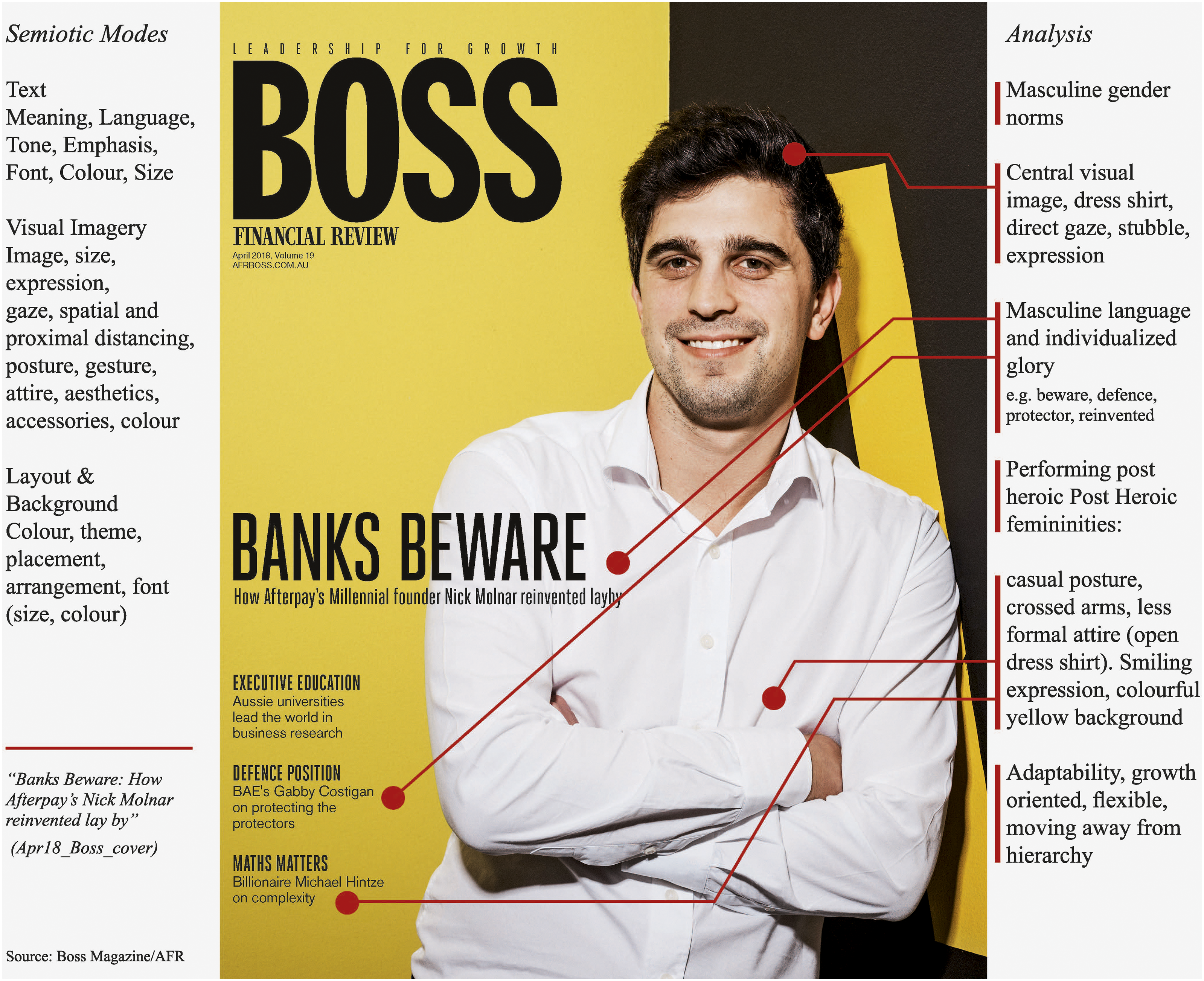
In this portrayal, post-heroic leadership emerges in the smiling, casual, informal stance of the subject in the frame, representing an enactment of warmth, emotion and expressiveness. The lack of formal dress/traditional power suit, a smiling, relaxed subject, and the use of yellow and black to frame the image, constructs an alternate, less traditional configuration of leadership (Küpers, 2013) reinforced by the sub-headline “how…Nick Molnar reinvented”. The statement highlights how the subject’s leadership represents a different approach that could be learned from, yet also focuses on individualized achievement (Pearce and Manz, 2005; Rippin, 2007). Viewed together the dominant modes emphasize feminized attributes to produce a construction of post-heroic leadership. Yet masculine and heroic characterizations are still evident in the frame, through corporeal elements such as the subject’s unshaven look, direct gaze suggesting control, the cautionary and combative coverline “Banks Beware”, and the focus on individual achievement. The accompanying editorial (below) reinforces Molnar as a post-heroic leader with heroic ambition and masculine characteristics to be feared:
“Nick Molnar neatly fits the stereotype of the young digital entrepreneur who is disrupting the establishment, with his platform rolling out across bricks and mortar stores as well as online. Nor does Molnar’s ambition end in Australia. …Financial services editor James Eyres unpacks the man and business that bankers are becoming wary of.” (Apr18_Boss_p.4)
These examples illustrate how Australian business media frame the performance of post-heroic leadership as heroic, and provide empirical evidence to support Ford’s (2005) contention that despite the call for post-heroic leadership in organizations, the hero archetype is still embedded in discourse. Ford (2005) argued that leadership theories require ‘heroes’ to make sense of leadership and so the performance of post-heroic leadership is best achieved when performed by a post-heroic ‘hero’, noting that organization (and media) rhetoric does not include heroines.
Our analysis of Australian business media uncovered differential framing of women’s post-heroic leadership. In contrast to men’s leadership, media framing did not champion or celebrate women’s performance of post-heroic leadership as a heroic endeavour. To illustrate, the excerpt below uses language that first acknowledges alternative leadership but then denigrates the intellectual acumen of the female leader and devalues associated post-heroic characteristics: “One of the things I love about Elizabeth Gaines, the chief executive of mining group Fortescue, is the fact that she doesn’t need to be the smartest person in the room. It takes a considerable self-confidence and refreshing lack of ego to admit that'’(Nov18_Boss_p.6)
This was in stark contrast to media framing of post-heroic leadership as “great”(Apr18_Boss_p.4) and “courageous” (Dec17_Boss_p.4) when men were in the frame.
The frame of Post-Heroic ‘Heroes’ uncovers a limited but emergent acknowledgement of post-heroic leadership in media framing. This finding illustrates how the enactment of femininities such as inclusivity, power sharing and collaboration in (men’s) leadership was represented through a heroic lens. A continued deference to masculinist gender norms and heroic characterizations clouded how media framed the performance of alternative configurations of leadership as great, brave, or dynamic, and reframes the performance of post-heroic leadership as a new form of masculine heroism. Media framing of the post-heroic hero was applied exclusively to men’s leadership and restricted women’s leadership to the performance of specific masculine configurations of heroic leadership to be perceived as effective or credible.
Discussion
In this paper, we explored how contemporary leadership is framed in Australian business media and how gender norms inform media framing of leadership, unveiling a hyper complexity within Australian business media’s framing of leadership. Our findings show a hegemonic masculine discourse continues to dominate media framing in Australian business magazines despite newer forms of leadership being framed as a necessary response to the loss of confidence in business leadership (Commonwealth of Australia, 2019; Rimmer and Cosoleto, 2018). Whilst two new frames (Softer Heroic Leadership and Post-heroic ‘Heroes’) of leadership emerged, we argue these are premised upon multiple (re)framings of heroic leadership, reifying and reproducing heroic leadership and underlying gender norms which effectively reproduce the status quo, despite calls for change. This paper contributes ‘softer masculinities’ to conceptualize a new form of heroic leadership which subsumes attributes culturally associated with femininities, and secondly argues ‘post heroic heroes’ are centred in media attempts to frame post-heroic leadership. Although often presented as gender neutral (Hoobler et al., 2018), heroic leadership is recognized as a masculinities-informed conceptualization of leadership. By identifying the gendered media framing, we contribute a textured understanding of how media framing of the embodiment and performativity of leadership draws on gendered assumptions of attributes culturally associated with masculinities and femininities and embodied gender norms. This occurs in three distinct frames: firstly, to reinforce gendered associations of masculinities with heroic leadership; secondly, to expand the repertoire of heroic leadership to incorporate attributes previously associated with femininities; and thirdly, to reframe performing alternative forms of leadership through a masculinized heroic lens.
The Validating Heroic Leadership frame resonates with the extant critical leadership studies literature which argues masculinities are deeply embedded in leadership discourse such that performing heroic leadership continues to be viewed and presented as an organic extension of the cultural role of men (Mccabe and Knights, 2016; Spector, 2016). In fact, we demonstrate that masculine gender norms were so entangled with performing leadership that they were treated interchangeably in media framing of heroic leadership. Our study illustrates how men’s heroic leadership was romanticized through multiple hero personas and masculine avatars of champions, bosses, and heroes, complemented through a reification of masculine gender norms materialized in visual and discursive elements of the media frame (Bathurst and Cain, 2013; Harding et al., 2017). Our exploration of how media constructs leadership, therefore, contributes a deeper understanding of the nuances in materiality of masculinities which vary in dimension when intersecting with gender norms (Collinson, 2018; Ford et al., 2017). As illustrated in our multimodal analysis, multiple configurations of heroic leadership emerged where authority, power, ambition, competition and other masculinized characteristics were glorified in media framing and attributed to men’s leadership through reinforcement of varying gender norms to produce heroic archetypes. Through this finding we highlight how media actively reproduce a gendered power relationship by constructing leadership in line with the stereotypical masculinized ‘great men’ and ‘hero’ narrative (Fletcher, 2004; Spector, 2016).
Despite this reification of heroism, a more contingent understanding emerged for women’s leadership through the Validating Heroic Leadership frame, which constructed women as capable and credible heroic leaders when they were able to mirror masculinities such as authority, power, ambition and risk-taking, provided they simultaneously conformed to, and emphasized, femininities associated with gender norms. These insights advance Elliot and Stead’s (2018) argumentation that the credibility of women’s leadership is often dependent on using femininity as gender capital. This framing operated to further reinforce gendered assumptions underpinning heroic leadership. Media framing emphasizes a limited configuration of women’s heroic leadership premised on their ability to employ embodied and corporeal practices to produce culturally appropriate (and stereotypical) images (Gardiner, 2018; Pullen and Vachhani, 2020), which we argue constrains opportunities of how women can perform leadership.
The second and third frames contribute a deeper understanding of how leadership is (re)framed as variations of heroic leadership through the entanglement, complexification and reinforcement of feminized and masculinized attributes in the framing of post-heroic leadership. We identified how, when framing men’s leadership, the media responds to calls for new forms of leadership by offering new configurations which subsume attributes culturally associated with femininities, such as being flexible, inclusive and empathetic (Fletcher, 2004), conceptualized in this paper as ‘softer masculinities’ into a reformed and softer heroic leadership. In this space, media construction of women performing new or alternative configurations of leadership, continued to be framed as ineffective, lacking credibility and legitimacy (Carli and Eagly, 2016; Hoobler et al., 2018). Differential framing had the dual effect of validating traditional expectations and normalizing gendered power relations by expanding the range of characteristics and behaviours in men’s leadership by including ‘softer masculinities’ as a response to societal changes during times of challenge whilst limiting a positive framing of women’s leadership to times of stability, yet emphasizing it as a fallible configuration. This framing positions men’s leadership as capable of flexing and responding to contemporary challenges, whilst negating the possibility of interpreting women’s leadership as equally capable. Whilst the Softer Heroic Leadership frame identified the incorporation of femininities into an extended form of heroic leadership, the third frame of Post-heroic ‘Heroes’ demonstrated how media reframed the performance of post-heroic leadership as a new form of heroism. Media framing acknowledged the need for more relational approaches to leadership emphasizing inclusivity and a growth mindset as necessary responses to current challenges yet relied on descriptors associated with heroic leadership to praise when this was performed. As Ford (2005) argues the hero archetype remains the dominant lens through which leadership is understood. Our findings show this leads to framing ‘post-heroic heroes’ as the required ‘new form’ of leadership, which is applied exclusively to men’s leadership. In the one example of women’s leadership in the Post-heroic ‘Heroes’ frame, the attributes associated with post-heroic leadership which were celebrated in men’s leadership, were not acknowledged or framed as heroic, but were in fact devalued. We contend that through these shifting frames, media reasserts the gendered assumptions underpinning the logic of leadership, reifying power and legitimacy through heroic variations of leadership performed by men.
We further demonstrate that media reinforcement of a masculinist framing of leadership is also in contrast to Australian expectations of egalitarian leadership, constructing Australian business leadership as a masculine domain (Ashkanasy, 2008). This suggests the gendered logic underpinning conceptualizations of leadership holds true despite a macro level shift in rhetoric away from heroic individualism to post-heroic ideals (Fletcher, 2004).
Our study therefore, contributes a richer understanding of how hegemonic masculinities continue to pervade media framing of leadership. Connell (2005: 237) argued, albeit sceptically, that societal changes will lead to a de-gendering or transformation of hegemonic masculinities. Our study demonstrates how during times of crises, challenge and change hegemonic masculinities are being reformed in media framing of business leadership; however rather than a de-gendering we suggest masculinities are being reformulated through subsuming femininities and legitimized through a romanticized heroic rhetoric. Australian business media recognizes the need for post-heroic configurations as required of contemporary leaders yet incorporates them into the repertoire of heroic leadership performed through men’s leadership and reframes performing post-heroic leadership as a form of masculine heroism. The fallback on masculinist discourse and heroism to frame the performance of post-heroic leadership, can therefore be seen as a reformulation and reification of masculinities which therefore remain dominant in responses to changing societal contexts (Connell and Messerschmidt, 2005; Messerschmidt, 2019).
Lastly, the exclusion of women’s leadership from the expansion and (re)framing of heroic leadership suggests that whilst Australian business media has moved past subjecting women’s leadership primarily to misogyny and resistance (Coatney, 2018; Pini, 2005) they struggle to disassociate stereotypical images linked to gender norms and cultural expectations of women, in framing leadership. We further argue that through multiple configurations and framings of heroic leadership, that media constructs only men as able to perform both masculinized and feminized attributes, despite the theoretical assertion that post-heroic leadership can be performed by both men and women (Alvesson and Spicer, 2012:277; Fletcher, 2004). Media framing, rather than creating space for women’s leadership to enact post-heroic configurations of leadership, reinforces an exclusionary masculinist heroic stereotype. In recognizing how media constructs leadership as a masculine domain, we question whether the performance of feminized attributes associated with post-heroic leadership by women are misconstrued and dismissed as attempts to conform to feminine gender norms. We therefore argue that the reformulation of masculinities in new frames of heroic leadership, reify gender norms and stereotypes for men and women.
Conclusions
This paper provides a richer understanding of the gendered assumptions underpinning the conceptualization of heroic and post-heroic configurations of leadership. We offer insights into how media framing contributes to the reinforcement and reproduction of gender norms and operates to privilege the performance of masculinities and femininities in men’s leadership, which has a differential impact on how women’s leadership is perceived as credible and legitimate.
The findings of this study have implications for women and other individuals aspiring to leadership roles who do not fit the traditional heroic leadership mould. Post-heroic leadership was assumed to potentially create an advantage for those who seek to perform alternative forms of leadership by incorporating feminized attributes and providing opportunities for people at all levels to advance into leadership (Cunliffe and Eriksen, 2011; Fletcher, 2004). This study has demonstrated that heroic leadership ideals continue to dominate and how in media framing, post-heroic leadership is recognized only in men’s leadership, potentially perpetuating a labyrinthian journey into leadership for women and other people who refute or do not fit dominant norms (Carli and Eagly, 2016). While media framing continues to default to or reconfigure heroic leadership as a masculinized domain, opportunities for alternative forms of leadership and indeed, alternative leaders, to be recognized and accepted, may be limited. Our study focussed on exploring how gender norms inform media framing of leadership. There is a need to address how other dimensions such as ethnicity, race, gender fluidity and sexual orientation impact media framing of leadership to determine if similar patterns emerge. As key influencers of public understanding of corporate leadership, current media framing is likely to confuse or even marginalize individuals aspiring to become leaders who may struggle to identify with the hero archetype, as they navigate their way through the media’s complex gendering of leadership.
The insights from this paper may also benefit organizations seeking to implement contemporary approaches to leadership. Hegemonic masculinities exist within management practices and organizational discourse (Kyriakidou, 2011), therefore organizations should give careful consideration to how they frame leadership for employees through discursive realities such as policies and documents, training programmes, communication and websites. Our study demonstrates how the visual imagery, text, language and symbolism included in documents and artefacts sets expectations for how leadership should be performed in the organization. Collectively, this study offers rich insights into the complexities of how leadership is understood, perceived and framed.
Footnotes
Declaration of conflicting interests
The author(s) declared no potential conflicts of interest with respect to the research, authorship, and/or publication of this article.
Funding
The author(s) received no financial support for the research, authorship, and/or publication of this article.
