




Abstract
Hope as a feature in both authentic and spiritual leadership theory has become a diminished moral concept, departing from its philosophical and theological roots, and distorted by excessive positivity, success, instrumentalization, cultural bias, and ideology. Following Ciulla’s (2014) assertion that biography can do much to inform leadership theory, this paper contributes a richer understanding of hope through the though case of Václav Havel and the Charter 77 human rights movement in Czechoslovakia using French existentialist Gabriel Marcel’s ethics of hope. Five elements of Marcel’s philosophy demonstrate hope’s transforming vulnerability amidst technological control, relationship with despair, active presence, creative fidelity, and transcending power in love. Examining Czechoslovakia’s human rights movement through the lens of Marcellian ethics provides insight into the role of absurdity and truth-telling as a precursor to hope, taking responsibility for failure, overcoming fear through the “solidarity of the shaken,” creative fidelity through living in truth and using humor, and love manifesting as sacrifice and openness to seeing one’s contribution to the moral contamination of society under totalitarianism.
Keywords
Despair and cynicism are two widespread responses to the vexing issues of authoritarianism, surveillance capitalism, and fractured societies. The appeal of populist politicians propagating deterministic narratives and existential threats, some contend, are paving a path to an age of unfreedom (Snyder, 2018). This is a time where leadership theory could benefit from the historical lessons of people who endured with hope amidst unfreedom, drawing on ethical traditions largely overlooked in leadership studies.
The totalitarian communist era behind the Iron Curtain in Czechoslovakia in the 1970s and 1980s is a worthwhile study of leadership and hope in a repressive society. Not far removed from over 3 years in prison for dissident activities, banned Czech playwright Václav Havel offered an exposition on hope in highly adverse circumstances: Hope is not prognostication. It is an orientation of the spirit, an orientation of the heart, it transcends the world that is immediately experienced, and is anchored somewhere beyond its horizons… Hope, in this deep and powerful sense, is not the same as joy that things are going well, or willingness to invest in enterprises that are obviously headed for early success, but, rather an ability to work for something because it is good, not just because it stands a chance to succeed. The more unpropitious the situation in which we demonstrate hope, the deeper that hope is. Hope is definitely not the same thing as optimism. It is not the conviction that something will turn out well, but the certainty that something makes sense, regardless of how it turns out. (Havel, 1986/1990).
In these words, Havel offered the insight that hope is not a goal-directed optimism infused with positivity; it is an inner dimension directed toward the good. In Czech, the phrase in the last line, “makes sense,” is more accurately translated as “is meaningful.” Contrary to English, the verb ‘to hope’ does not come from the same root as the noun in Czech (Svobodová, 2020). Havel was using hope as a verb, not “having a belief” or “expectation” as the noun implies. As Svobodová (2020) suggests, “We cannot ‘have’ hope in the sense of an object; we can only live in hope as in an environment” (pg. 180). Hope here is not cast as wish fulfillment; it is tied to one’s very humanity, it is embodied relationally, and it compels a sense of responsibility.
This notion of hope animated the human rights movement known as Charter 77 in Czechoslovakia in the 1970s and 1980s. Havel, as an iconic founder of the movement, was shaped in his understanding by existentialist philosophy, phenomenology, Plato’s “care of the soul,” and Christian theology (e.g. Palouš, 2016; Putna, 2011). Eschewing heroism, Havel practiced hope in a diverse community, found genuine hope through his confrontation with failure, and orchestrated hope through “the power of the powerless” culminating in the Velvet Revolution of 1989, which led to the fall of communism in Czechoslovakia after 40 years. Many studies of social movements focus primarily on structural aspects, but the balance is shifting toward their “agentic, resourceful, and hopeful” dimensions (Ganz and McKenna, 2019. p. 187).
The central claim here is that hope has been trivialized in modern leadership theory into something quite different than what Havel suggested. In much the same way as authenticity, the concept of hope in positive theories of leadership, such as spiritual leadership theory and authentic leadership theory, has little to do with the rich use of the concept in philosophy and more to do with instrumentalism (Alvesson and Einola, 2019; Case et al., 2012). We can begin to recover some of the richness of hope by using French existentialist philosopher, Gabriel Marcel’s “ethics of hope” to analyze the relationship between hope and leadership ethics in the case of Charter 77. Looking back to the embodiment of hope in Havel’s leadership in the context of the Charter 77 community using biography, archival research, and personal interviews, can powerfully illuminate the leadership challenges facing humanity today as well as deepen leadership theories derived from positive psychology.
The concept of hope in authentic and spiritual leadership
Positive psychology is predominant in recent leadership theory and there are a growing number of critical scholars that question its usage and assumptions. Building on work in this field, authors of Authentic Leadership (e.g. Luthans and Avolio, 2003) and Spiritual Leadership Theory (e.g. Fry, 2003) define hope similarly. For example, Fry (2003) defined hope, a central component of his theory of spiritual leadership, as “a desire with expectation of fulfillment”(713). Spiritual leaders, according to Fry (2003), combine hope with faith and possess clarity about where they are going, how to get there, and are willing to endure hardships in order to achieve their goals. In authentic leadership, hope is part of “psychological capital” alongside confidence, optimism and resilience (Luthans and Avolio, 2003). Yet these formulations, focused on positivity, clarity, individuality and success, leave us with a greatly diminished understanding of the relational dynamics and richness of hope in leadership studies. Perhaps this is partly due to the fact that much of these theoretical formulations have been situated in the organizational context, particularly business, appropriated to the language of management. The criticisms of these theories, attributes of this narrow understanding of hope, focus on an overemphasis on positivity, close ties with success, instrumentalization, cultural bias, and ideology.
Alvesson and Einola (2019) warn of excessive positivity in theories of ethical, spiritual, servant, and transformational leadership which overplay idealized role models and “upbeat ideologies”(383). The assumption tends to be that hope is always an ethically positive contributor to leadership activity. There is no recognition that positive concepts like hope can be abused and how leaders and followers might counteract this destructive behavior (Ford and Harding, 2011). If hope is only about “a desire with expectation of fulfillment,” then we are left without an ethical dimension that moves us beyond its instrumental use. Alternative to the tendency toward excessive positivity there are many examples of hope emerging through deeply troubling experiences, a “dark night of the soul” where leaders face “their own innermost fears, doubts and uncertainties” (Olivier, 2009; 254).
Positivity goes hand in hand with the tendency to tie hope too closely to success and clarity of goals. Hope in authentic leadership and spiritual leadership is based in positive motivations, willpower and goal planning (e.g. Luthans and Avolio, 2003). This is derived mostly from C.R. Synder’s hope theory (e.g. Snyder, 2000). In hope theory, hopefulness is a life-sustaining human strength comprised of three distinct but related components: (1) pathways thinking that builds strategies and links events, combined with (2) agency thinking that sustains motivation to generate a valued outcome, and during a significant event these two components interact and result in (3) actions directed by clear and valuable goals (Snyder et al., 2002). While this theory recognizes the negative and positive cognitive and affective dimensions of hope, it dichotomizes these experiences. For instance, Snyder (2002) states that “A high-hope person should have enduring positive emotions, with a sense of affective zest about the pursuit of goals,” while a low-hope person “should have negative emotions, with a sense of affective lethargy about the pursuit of goals”(pg. 252). Scholars in the field of positive psychology have recognized the lack of attention to the veracity of negative states being conducive to flourishing as a general criticism of the field (e.g. Ryff, 2022; Van Zyl et al., 2023). Further, even though scholars like Snyder (2000) and others recognize the work of Victor Frankl and others on the deeper processes of meaning-making through reflective struggle, the theory itself does little to incorporate this basis for hope that undergirds agency and pathways. Hope theory seems to rest on the assumption that hope is a type of goal-directed calculation of success, privileging those whose self-determination through action is possible. In the concentration camp, Frankl (1946/2006) suggested existential meaning was the anchor of hope, rather than goals, when all freedoms have been taken away. Hope stems not only from the how and what, but from the why of existence.
Hope is presented within the context of spiritual leadership as a tool for organizational success, suitable for measurement and achievement of the bottom line. Case et al. (2012) and Case and Gosling (2010) argue that spiritual leadership “introduces what we take to be impoverished definitions of spirituality and proceeds to operationalize them in empiricist terms” in order to measure spiritual leadership as a performative practice (18). This kind of instrumentality diminishes the human person to functions and outcomes. Case et al. (2012) conclude that this way of viewing spirituality trivializes the human need for relationship and vulnerability of human nature in favor of a narrative of limitless possibility and self-reliance.
Another criticism is that positive psychology and, by extension, leadership theories that incorporate hope, contain a cultural bias and lack of attention to context. Often positive psychology is positioned as universally relevant but is rooted in the idea that the pursuit of happiness is a strongly individualistic process neglecting the cultural, historical and societal grounding of traits, states, and behaviors (Marecek and Christopher, 2018). There is a need for normative leadership constructs to consider context more critically. For example, rather than assuming positive follower responses to spiritual leadership there is a need to consider the situational complexities and socially constructed needs in the leadership process (Alvesson and Einola, 2019; Liu et al., 2017). Various cultures have different ways of engaging with phenomena central to leadership. For instance, more interdependent, or collectivist, societies tend to integrate positive and negative experiences and emotions more readily than individualistic cultures (Miyamoto and Ryff, 2011).
Finally, critical leadership scholars have observed that attempts to reach the soul of workers reinforce an ideological thread (e.g. Case and Gosling, 2010). These scholars argue that spiritual leadership theories are missing rigorous philosophical analyses of ethical issues distinctive to leaders and leadership. Indeed, hope runs the risk of falling into the tendency of transformational leadership, to promote a cult-like attitude toward change which can shut down dissent (Tourish and Pinnington, 2002). While spiritual leadership theorists purport a non-leader-centric model, a grounded philosophical approach that places interdependence and context at its core can take leadership theory much further.
Leadership ethics and hope
Leadership ethics often functions as a critical theory challenging the assumptions of the field (Ciulla, 2009a). It focuses on more than just leaders and followers doing the right thing in pursuit of some meaningful change. Ciulla (2009a) has defined four dimensions for exploring leadership ethics: (1) the ethics of the leader in terms of internal awareness and intentions (2) the ethics of relationship between leaders and followers, (3) the ethical challenges of the process of leadership, and (4) the ethics of the actions, or inaction, of a leader. Examining these complexities in a deeper way suggests that our understanding of good leadership be informed by ethical traditions that could be used to draw these dimensions together. Whereas much of leadership ethics draws from virtue ethics, consequentialism, and deontological ethics; the intersubjective, experiential, and relational focus of ontological ethics and existentialist thought holds promise for leadership studies. Bradley-Cole (2021), similarly, saw phenomenology as an ontological approach that situates authentic leadership within the relational nature of being and meaning-making through care.
French existentialist Gabriel Marcel’s ethics of hope provides a robust conceptual lens to examine leadership ethics within the Charter 77 human rights movement. According to Marcel scholar Jill Hernandez (2011), Marcel’s ethics of hope offers an “alternative to isolation, dread and anguish of most existentialists, while creating a space for individuals working for change within intersubjective relationships”(3). This intersubjective ethical approach bears a likeness to other relational ethical theories discussed in leadership ethics. Hernandez (2011) likens Marcel’s ethics of hope to a feminist ethics of care, which has been the subject of some attention in leadership ethics (e.g. Ciulla, 2009b; Johansson and Edwards, 2021). It offers an alternative to consequentialist and deontological approaches to leadership ethics.
Gabriel Marcel’s ethics of hope
Building on Christian theism and existential philosophy, Gabriel Marcel’s “ethics of hope” was ontologically grounded in interpersonal relationships with others and in transcending pain and anguish. As opposed to deontology, which is focused on duty and universal moral principles, ontology is focused on one’s concrete experience with being, identity, and character. Marcel’s (1933/1956) understanding of Being is contained in what he called “the ontological mystery,” a place of relational wonder where people cannot be reduced to mere function or an instrumental role. Modern technological society tends to reduce human relationships to a “problem”—what we can analyze, objectively understand, and utilize—but a mystery “is a problem which encroaches on its own data.” (Marcel, 1933/1956, pg 19). In other words, one can try to understand a relationship, but they are also intimately involved with it, one can only understand it superficially in an objective sense. The problematical objectifies, but mystery entails presence to others—putting ourselves at their disposal. This intersubjective realm of presence to another person is where Marcel locates the transcendent, and thus the spiritual (Mester, 1963). Marcel placed hope at the relational center of the ontological mystery, and this was the starting point for his ethics of hope.
Marcel defined hope as “carry[ing] within oneself the intimate assurance that, despite what appearances may be, the intolerable situation that is currently mine cannot be definitive; there must exist a way of escape”(Marcel, 1989. p. 54). Hope is not mere wishing or calculating, it is a reflective way of living, a facing of the harsh realities, and way to transcend one’s situation. Hernandez (2011) explained that true hope does not give one an advantage toward happiness, but it does give an advantage toward being moral as it relies on one’s responsibility to the dignity and humanity of others and reflects concrete experience rather than wish fulfillment. Hope relies on the creation of possibilities rather than the estimation of possibilities. To understand this better and apply it to leadership within Charter 77, five elements of Marcel’s ethics of hope will be described. These elements are not meant to be comprehensive, but rather draw out some key points of analysis for leadership ethics.
The first element of Marcelian ethics is hope as the “arm of the disarmed”. With hope, one relinquishes power and control over one’s situation and instead asserts meaning beyond any technique (Svobodová, 2020). Hope is the opposite of a weapon, or arm, which coerces and dominates. One of the examples that Marcel used was nonviolent resistance, those who are physically disarmed but morally engaged, freely facing and exposing injustice through their bodies. He was concerned also with technological abstraction which distances people from their own and others concrete vulnerabilities. People are reduced to technicians who can achieve mastery, standardization, and efficiency but become estranged from themselves and others in the process (Gendreau, 2003). In contrast to technological abstraction, hope is achieved through intimate experience, dialogue and care amidst systems and devices that diminish personhood and leave no room for the spiritual.
Second, hope embraces the reality of meaninglessness and despair. Hope is not wishful thinking or optimism, it requires that we be present to our own and others’ suffering, disappointment and adversity. Hernandez (2011) writes, “Hope is not the guarantee that life will be better. Life is full of difficulty, pain and grief. Hope does not protect us from living through these encounters but aids the hopeful in living through them. The way out for a person can be to create possibility and meaning in these events through hope”(68-9). For Marcel, hope and despair are coexistent. Hope does not consist in the ‘power of positive thinking,’ it converses with darkness and pain. This suggests a unity between hope and courage as existential virtues. Hope and despair’s coexistence is similar to what Preskill and Brookfield (2009) called “critical hope” which recognizes the absence of hope while understanding that the fight for justice is complex. The opposite of hope, Marcel asserted, is dejection which comes through isolation, pride, and disconnection with others. A dejected person is a person lives as if they do not need others.
The third element of an ethics of hope is active presence to concrete experience as a basis for trust and reciprocity. Presence is arrived at through what Marcel calls “recollection” (e.g. Marcel, 1933/1956). Marcel tied recollection to acceptance of one’s station in life, a detachment from experience based on experience. He wrote, “no apprehension of ontological mystery in whatever degree is possible except to a being who is capable of recollecting himself… who is at the mercy of his life and without a hold on it.”(Marcel, 1933/1956. p. 23). Marcel invoked the Biblical phrase “you are not your own” to suggest that humans belong to a relational mystery that is outside of themselves, that is to God. Someone who is present to others through recollection is a person who is at the disposal of others and sees oneself no longer as an autonomy but as a self for others sake. Being an active presence to others is being a person capable of attending to others with his or her whole self, giving oneself in the act of listening (Marcel, 1933/1956). This person is both vulnerable with, and vulnerable to, others.
Fourth, hope is practiced in creative fidelity. In using this term Marcel uses a more expressive term for faith, which is part of the triad at the heart of the theological virtues of faith, hope, and love at the core of spiritual leadership theory (Fry, 2003). Rather than faith simply adding certainty to hope, here it is the creative force of hope. Mester (1963) explained, “Hope is essentially an appeal to a creative power. The subject of hope is the subject in need of others. The object of hope becomes the very communion itself with others.”(pg. 134). Out of this communion comes a mysterious impulse to create, to respond out of “the active recognition of something permanent, not formally, but ontologically” (Marcel, 1933/1956. p. 35). Creative fidelity consists in human dignity and compassion, in the freedom of the will, and just actions. It provides a means of transcending fear. Yet fear is not the correlative of hope; hope is a rejection of fatalism and a faithful move toward the good (Marcel, 1949). Yet unlike other Christian existentialist philosophers like Søren Kierkegaard, Marcel did not think of hope in eschatological terms, his notion of hope was profoundly ‘this-worldly’ (Bernier, 2015; Ejike et al., 2021).
The final element of Marcel’s ethics is hope embedded in love as the ultimate mark of intersubjectivity. To love someone means willing for another “thou shall not die,” it has its basis in unconditional compassion (Marcel, 1989). This is the transcendent connection between people that propels the persistent nature of hope against the odds. Since hope is a “radical refusal to reckon possibilities,” it emanates out of this unconditional love (Marcel, 1949. p. 167). Love is defined by availability, a characteristic that supersedes egoism and advantage, and is not predicated on reciprocity nor insistent on its rights or claims on others (Ejike et al., 2021). Hope consists then in a generosity towards others based on one’s availability and openness to God through being. Thus, the ethics of hope requires humility as the posture of living in the ontological mystery, it does not pretend to be all-knowing and self-sufficient. Ejike et al. (2021) explain, “to hope truly is to be open, available, selfless, patient, courageous, positive, and persevere in the face of present sufferings” coming to an acceptance of them as part of the human condition (pg. 11). Hope derives its power from love.
These five elements of Marcel’s ethics of hope provide a philosophical lens for deepening the understanding of hope in good leadership. It fundamentally challenges ‘leader-centric’ ideas of hope that overemphasize heroism. Hope here is rooted in the mystery of being rather than goal-setting; it is grounded in meaningful relationships and intersubjectivity. It especially connects the first two of Ciulla’s (2009a) four dimensions—the internal world of the leader and the relationship between leaders and followers in the ontological mystery. This has implications for the third and fourth dimensions--the ethical challenges of the process of leadership and the actions of leaders and followers as hope is realized as a concrete reality involving creative fidelity and love. Leaders and followers who live in hope in pursuit of the good are disarmed amidst mechanisms of control, they diagnose and act against modern “technics” which depersonalize, dehumanize and desacralize. Hope’s embrace of despair counters the excessive positivity, instrumentalization and ideology criticized in spiritual and authentic leadership (e.g. Alvesson and Einola, 2019). An ethics of hope suggests that leaders and followers working for change attend to the loss and hopelessness of their situation as way to bring about creative and meaningful possibilities.
Methods
To apply Marcel’s ethics of hope, we turn to the case of leadership in the human rights movement under totalitarian Czechoslovakia in the 1970s and 1980s. This methodology builds on the suggestion that biography can do more to inform leadership theory than the other way around (Ciulla, 2014). At least in Central Europe, Václav Havel is one of those iconic leaders on the level of Mandela, where myth and hero-making are not uncommon. Enabling a fuller view of the ethics of hope in leadership, the approach here is to provide a historical analysis of leaders and followers in the movement via historiography. To gain a more in-depth understanding, the author conducted several interviews of close associates of Havel, Charter 77 signers, and members of the Committee for the Defense of the Unjustly Prosecuted (founded in 1978 by Havel and others). These interviews were valuable because they filled in gaps between biographical and archival materials, as they provided a more intimate and relational perspective on Havel and Charter 77.
The five elements of Marcel’s ethics of hope serve as a conceptual lens to view the relationship between leaders and followers in the Czechoslovakian human rights movement under totalitarian communism in the 1970s and 1980s. There is evidence that at least one very influential person in the movement, the Czech phenomenological philosopher Jan Patočka’s ideas and actions bore strong resemblance to Marcellian ethics and the two men were even in contact in the late 1960s (Svobodova, 2020; author interview with Daniel Kroupa August 29, 2023). Finally, findings from the historical case study under the rubric of the ethics of hope will be used to suggest a fuller elaboration of hope in authentic and especially, spiritual leadership.
Context: Havel, Charter 77 and human rights in Czechoslovakia
Václav Havel was born to a wealthy family of real estate investors just a couple years before the Munich Agreement and the subsequent invasion of Hitler’s forces into Czechoslovakia. Over the next 50 years, he would see Nazis and then Soviets rule what had once been a thriving democracy in Central Europe. Historical and contemporary contexts as a core component of the “leadership system” (e.g. Kellerman, 2012) will be described here before using each of the elements of the ethics of hope in which to draw implications and lessons.
The political context of the struggle for human rights in Czechoslovakia was shaped most profoundly by the communist coup of 1948. The Soviet Union, which liberated most of the country after the war, used their popularity to help orchestrate a consolidation of power after the Party received the highest popular vote of any party just 2 years before. For Havel, the coup was not only political, but it was also personal. His family fortunes were confiscated, and properties seized and nationalized, and he as cut off from formal education because his family represented the bourgeoise. He later credited this reversal of fortune as a spiritual advantage, the ability to see the reality of the world “from below,” which helped him “to escape the “eventual illusions and mystifications” under the regime’s ideology (Havel, 1992. p. 4). The era of Stalinist terror, purges, and propagandist “show trials” of the 1950s led to a political loosening of grip and eventual economic crisis in the 1960s.
The early 1960s, as Havel made his way into a career in the theatre, marked a period of self-paralysis within the communist party, stifling bureaucracy, and decline in foreign exports and crumbling of state-controlled economic infrastructure (Keene, 2001). These were the conditions Havel portrayed in his absurdist plays starting in 1964 with the Garden Party, where the main character loses his identity in the bureaucracy and ideological language of his society. Havel also joined the Czechoslovak Writer’s Union and became an advocate for political prisoners exposing these writer’s use of ideological language (Keene, 2001; Havel, 1965). This period of crisis set the stage for a leader named Alexander Dubček, who initiated from within the communist party a series of liberal reforms he called “socialism with a human face”, which culminated in the Prague Spring. The Prague Spring not only opened Czechoslovakian society to Western ideals, culture, and social movements; but open calls for government accountability such as Ludvík Vaculík’s “Two Thousand Words” manifesto. Vaculík would become a very close associate of Havel, instrumental a decade later in founding Charter 77.
Socially, the greater freedoms associated with the Prague Spring, meant a period of jubilation and self-expression encouraged by exposure to cultural phenomena like the hippie movement. Meanwhile, Moscow was very much unhappy with the reforms in Czechoslovakia and with approximately 200,000 Warsaw Pact troops and 2000 tanks invaded the country in August 1968 (Stoneman, 2015). The Soviet Union framed the invasion as “brotherly help” from imperialist forces. Students took to the streets in protest and the reform leaders like Dubček were humiliated. One college student, Jan Palach, lit himself aflame on Wenceslas Square as a protest, his funeral a dramatic expression of the country’s grief and despair. Havel addressed fellow citizens by radio, “I see Jan Palach’s death as a warning against our own moral suicide” (Sedláčková, 2014).
This began a period of dismantling reforms and reestablishing a tight hold on all aspects of life that came to be known as “normalization.” The normalization regime rested on the purge of social and economic institutions, strict control over the spread of ideas, and the reinstatement of centralized control over the economy (Wheaton and Kavan, 1992). Half a million people were purged from the Party, millions lost their jobs, and screening commissions “founded on ritual humiliation” were imposed (Bolton, 2012, p. 63). The new authority in the Communist Party, Gustáv Husák, expressed the ideology of normalization as “the quiet life” and “calm” to ensure citizen compliance and silence on political issues (Bren, 2010, p. 69). Havel was now a banned playwright and retreated to private life until 1975 when he wrote an open letter to “Dr Husák” holding him responsible for the deadening of society. He wrote, “True enough the country is calm. Calm as a morgue or a grave, would you not say?”(Havel, 1992, p. 72). Copies of this and subsequent writing he sent both underground through “samizdat 1 ” and to the foreign press.
The turning point that galvanized the movement for human rights was the arrest of a rock band called the Plastic People of the Universe in 1976. What seemed like just another trial of misfits, Havel and others recognized as a significant moment. They knew that behind the façade of due process was “an impassioned debate about the meaning of human existence”—whether one could express themselves freely at all, or whether one should simply surrender to one’s place in the world (Havel, 1976, p. 105). The trial brought many groups together in defense of the band: Christian ministers, former communists, artists, and philosophers, including a banned phenomenologist named Jan Patočka. It was the spark that lit the fuse.
The case of Charter 77: a human rights movement is born
Among the most cited characteristics attributed to Václav Havel was the ability to draw a diverse group of people together and incite them to work productively toward a common purpose (author interview with Malý, 2021; Kroupa et al., 2019). Malý called the Charter “a good school of democracy for me” because of the diversity and common purpose of the initiative (author interview with Václav Malý, 2021). This was particularly poignant following the trial of the Plastic People of the Universe when a scheme was devised to leverage the human rights agreements that were part of the Helsinki Accords of 1975, reluctantly signed by the Czechoslovak government to ward off foreign criticism. The result, Charter 77, was a document with signatures, a pluralistic community consisting of four groups: 1) former communists, (2) liberals claiming various ways of the Masaryk [democratic founder of Czechoslovakia] tradition, (3) Catholic and Evangelical Christians, and (4) the underground environment of rock bands and cultural and literary critics (Putna, 2011). Even though the Charter petitioned that the government be held accountable for human rights, Jonathan Bolton (2012) argued that, “Charter 77 had more to do with a sense of activity, an assertion of autonomy, a taking control of one’s fate, than with any articulated allegiance to human rights”(p. 27). The Charter document was intended to be sent to President Gustav Husak, federal offices, citizens through samizdat, and foreign press. As the fuse had been lit, the philosopher Jan Patočka was reported to have said, “Make no mistake. This time, its gonna explode!” (Bolton, 2012, p. 172, ft. 49).
That explosion took the form of a full-scale attack including interrogations, propaganda, ritual loyalty, and imprisonment. Václav Havel, Ludvík Vaculík, author of Two Thousand Words, and actor Pavel Landovský were caught in a high-speed police car chase on January 6, 1977 as they were delivering the Charter to federal offices. The regime gathered over 7000 signatures for a document denouncing Charter 77 (with names published in newspapers), published approximately 57 articles in the span of 2 months against the Charter, interrogated an estimated 230 signatories, and conducted 50 house searches (Ruml, 1987). Havel was interrogated several times and taken into custody, imprisoned for half the year. To combat the fact that the Charter was initiated and signed by artists and actors, the propaganda campaign included a televised gathering of culturally influential artists coerced to show their loyalty to the regime. The actual contents of the Charter were kept out of the hands of denouncers. Charter members like Havel, Vaculik, and Patočka were slandered in newspapers with headlines like, “losers and self-proclaimers” which in Czech means something closer to self-righteous filth of the earth (Karlik and Pokorná, 2002). This thorough-going campaign against Charter 77 was meant to isolate, denounce, and demoralize those who would challenge the regime.
Yet in the midst of the onslaught, philosopher Jan Patočka became a clear moral voice for the Charter while Havel was imprisoned. Havel and Patočka met in the 1960s when Patočka gave lectures on phenomenology at the theatre where Havel performed his plays. Patočka lived through the turbulence of two world wars and developed the concept of the “the solidarity of the shaken” which he described as a deep understanding of one’s present circumstances and of “slavery and freedom with respect to life” amidst the force of technology and “built up in persecution and uncertainty” (Patočka, 1973/1996, p. 135). In early 1977, he wrote a series of underground essays explaining the moral significance of the Charter to followers. He stated that this epoch for human rights “involves a revolution in people’s consciences, in their behavior towards themselves and their neighbors, since motives for their actions no longer lie exclusively in the domain of advantage and fear but instead of respect for what is higher in human beings, and take into consideration duty, the common weal, in this sense, the burden of misunderstanding and certain risk.” (cited in Kriseova, 1994. p. 129). He was interrogated by the police 3 days after writing this. During the interrogation he told the police that he wrote to give ‘deeper moral meaning’ to the Charter (Bolton, 2012. p. 155). To Patočka the “solidarity of the shaken” had concrete application in the Charter.
The strategy that began to emerge in this time of fear was to engage foreign contacts as well. This was the most dangerous part of the strategy, but one that shows Jan Patočka’s courage the most. He secretly met on March 1st with Dutch Foreign Minister Max van der Stoel and foreign journalists to discuss the movement. The meeting was reported to the government and was considered an “unparalleled interference” (Bolton, 2012). The secret police came to his apartment the same day and the next. Though he was suffering from health problems, he was interrogated for 48 h and hospitalized. From the hospital he wrote “What can Charter 77 Hope to Accomplish?” in which he argued, Some have speculated that the Charter will succeed only in bringing about a situation worse than presently exists, and that it will force the government to silence even those not previously counted among its critics. In response I can only say this: yielding to power has never freed anyone from oppression…No, we free ourselves only by constantly reminding the regime of the injustices that we suffer…Let us nurture once again the feeling that there are values worth suffering for—values that make life worth living. Incidentally, these are also the values that give meaning to art and culture.” (Patočka, 1977 in Riese, 1979, pp. 199-201).
A few days later, Patočka died at age 70. He became the martyr of the movement. Just after his death, philosopher Ladislav Heydanek wrote, “We do not feel sorrow and disappointment, but it is suddenly as if we were holding a torch that had been passed onto us” (Bolton, 2012. p. 160). Patočka’s legacy was so powerful that the regime sent a helicopter to fly low over his funeral ceremony and had people revving motorcyles closeby to drown out the priest’s words (Kriseová, 1994). But the moral torch had already been passed. His death struck something deep in Charter supporters and his words were repeated up through the Velvet Revolution in 1989: “yielding to power has never freed anyone from oppression” and “there are values worth suffering for.”
One of the ways that the torch was passed to Havel was Patočka’s conversation with Havel in the hallway of the secret police headquarters in early 1977. Havel recounted this important meeting, where Patočka became less of a deity to him and more human; he was amazed that he could be treated as an equal in philosophical dialogue. Havel (1977) reflected, “Every moment they [the interrogators] might have come for one of us, but the professor did not mind: at his impromptu seminar on the history of the idea of human immortality and the weighted words of human responsibility [he spoke] as carefully as if we had unlimited time ahead of us”(2). This was the last conversation the two ever had. As much as the words they exchanged, Havel was struck by Patočka’s equanimity during a time of such anxiety and duress. Patočka taught Havel to explore questions that go to the heart of human identity and responsibility, which would factor large into Havel’s emergence from undoubtedly the darkest period of his life.
During this time in prison in 1977 Havel became severely depressed, in bad physical shape, and became addicted to anxiety medication (Barton, 2020; Žantovský, 2016 in Dušek, 2016). He was cut off from news about the Charter and the outside world. His situation became desperate. Under these harsh conditions he made a plea to the prosecutor general. According to Zantovský (2014), “On 6 April, in a moment of weakness, he addressed to his prosecutor a petition for release, in which he admitted that his ‘well-intentioned initiative’ might have been deliberately distorted by foreign media, and pledged, in exchange for his release, ‘to refrain from public political activities’”(p. 186). The prosecutors had convinced Havel that leading Charter members had given it up. Havel’s petition was used immediately as propaganda in the media, who reported that Havel had renounced Charter 77. In exchange for his plea, Havel was released on May 20. When Pavel Landovský (actor and Charter 77 signer) picked him up from prison Havel immediately realized his friends had not given up on the Charter (Kriseová, 2014, p. 135). In fact, during this period the Charter had grown stronger. Even though fellow Charter members understood, Havel felt that he had betrayed the cause. Havel’s failure was even heavier after discovering that Patočka was in touch with the same prosecutor general and never gave in (Palouš, 2016 in Dušek, 2016). This haunted Havel for a long time; he saw that in his dejection he lost hope. Yet, as his close associate Michael Zantovský (2022 interview with author) concluded, “the crisis in 1977 was what made him the Havel as we knew him.”
Havel initially dealt with his failure by seeking vindication through actions that deliberately violated his prison concessions and reignited his conscience and artistic solidarity. He hosted an underground music festival at his country house, he co-founded the Committee for the Defense of the Unjustly Prosecuted as an offshoot of the Charter, he wrote a play called Protest, he met with Polish dissidents in the mountains, and he wrote his seminal essay “Power of the Powerless,” all within 18 months. These actions got him arrested, put on trial, and sentenced to 4 years in prison. Just prior to this, Havel was under such close police surveillance that he hid his essay Power of the Powerless in the trunk of a tree outside his country house (Barton, 2020). He dedicated this essay to Jan Patočka and one can see Patočka’s influence in it. For example, early in the essay Havel describes the “post-totalitarian system” as one that plays on existential uncertainties with a hypnotic charm, all one needs to do is accept it and everything becomes clear, but “the price is abdication of one’s own reason, conscience and responsibility”(p. 130). The essay was not only an acute diagnosis of life under post-totalitarianism, but a call to action, a call to “live in truth” which resonated throughout the Soviet Bloc. A Polish factory worker recalled in 1979, “Reading [Havel’s essay] gave us the theoretical underpinnings for our activity. It maintained our spirits; we did not give up, and a year later—in August 1980—it became clear that the party apparatus and the factory management were afraid of us. We mattered. And the rank and file saw us as leaders of the movement.” (Havel, 1992 p. 125). Havel’s writings helped small communities of “dissidents” to frame their actions and build their strategy within small actions of freedom and hope.
Yet it wasn’t just Havel’s extreme adversity alone that was transformative. It was how Havel processed the meaning of his failure that made the difference. During his second prison term he wrote weekly letters to his wife, Olga, which were highly censored. In the absence of any instructions, plans, or reflections that could be confiscated or blacked out, his Letters to Olga became philosophical treatises on the meaning of his life. In them, he revisited his failure of 1977 reflecting that he let his moral guard down and that his attempts to erase his inner suffering with actions leading back to prison did not work. Finally, he had come to the realization that acceptance of responsibility fully in one’s Being was a way through his pain: It is not hard to stand behind one’s successes. But to accept responsibility for one’s failures, to accept them unreservedly as failures that are truly one’s own, that cannot be shifted somewhere else or onto something else, and actively to accept…the price that has to be paid for it: that is devilishly hard! But only then does the road lead—as my experience, I hope, has persuaded me—to a renewal of sovereignty over my own affairs, to a radically new insight into the mysterious gravity of my existence as an uncertain enterprise, and to its transcendental meaning. And only this kind of inner understanding can ultimately lead to what might be called “peace of mind” to that highest delight, to genuine meaningfulness, to that endless “joy of Being” …and become what the Christians call grace (Havel, 1989, 351-2 letter 138).
Havel’s acceptance and its transcendental meaning was conveyed in relationship with others. Letters to Olga were not just letters to his wife; Havel through Olga was writing to his brother Ivan and an underground group of Jan Patočka’s former students called Kampademie 2 . This group wrote through Olga letters to Havel about their philosophical discussions (Kroupa, 2023 interview with author). When Havel was released from prison, it was the small community of Christian philosophers and theologians in Kampademie that embraced a broken Havel in 1983 (Putna, 2011). He had already been part of their conversation. In 1989, Kampademie was the most well represented group in the Civic Forum, the organization formed to lead the Velvet Revolution (Kroupa, 2010).
Havel’s emergence from prison marked a period of myth-making around Havel as the undisputed leader of the dissident movement (Zantovský, 2014). Yet along with its diversity, Charter 77 had its share of internal conflict and disagreement. In 1977 Charter signer Ladislav Hejdánek wrote a samizdat series called “Letters to a Friend” dissuading a fictional, young and eager sympathizer to not sign the Charter and to encourage respect for those who in conscience did not sign (Bolton, 2012). Even Havel’s close associate Ludvik Vaculik wrote in samizdat expressing caution about “heroes” who go to prison used as an example for others (Vaculik and Havel, 1979). Havel argued in reply that while he agreed that people should not be set apart from others as “heroes”, if people only calculated the risks involved in dissent against the regime, there would be no solidarity with unjustly prosecuted people left (42). In addition, Havel only reluctantly accepted the label “dissident” which the Western press had given him. He wrote in Power of the Powerless that the term was damaging because it separated protestors apart from others, that they were not primarily rejecting anything, and that they were expressing what ails society as a whole (Havel, 1978). There was clearly pressure from the outside to idealize the role of dissident.
Havel’s struggle to be a consistent leader or even a moral exemplar were reflected in the characters of 1980s plays like Temptation and Largo Desolato. Those close to Havel have noted that despite his inconsistencies, helplessness and moral struggle, Havel retained a kind of moral authority that amplified his ability to convene and facilitate diverse groups with common purpose (e.g. Author interviews with Daniel Kroupa, 2023 and Michael Žantovský, 2021). As Žantovský (2021 interview with author) observed about Havel, “His leadership style was a bit of a mystery to everyone because he did not conspicuously lead, he always pretended he followed, and he was a very good listener, he insisted on people being involved in the discussions and the decision-making.” His ability to convene a diverse group would prove critical in the events of 1989, where the seeds of living in truth, freedom and solidarity in the Charter would yield a harvest of leaders and followers in the Civic Forum. They would achieve the unthinkable, the fall of 40 years of communism and a new, democratic government with Vaclav Havel as its President.
Discussion: ethics of hope in the Czechoslovak human rights movement
Conceptual framework and case study analysis.
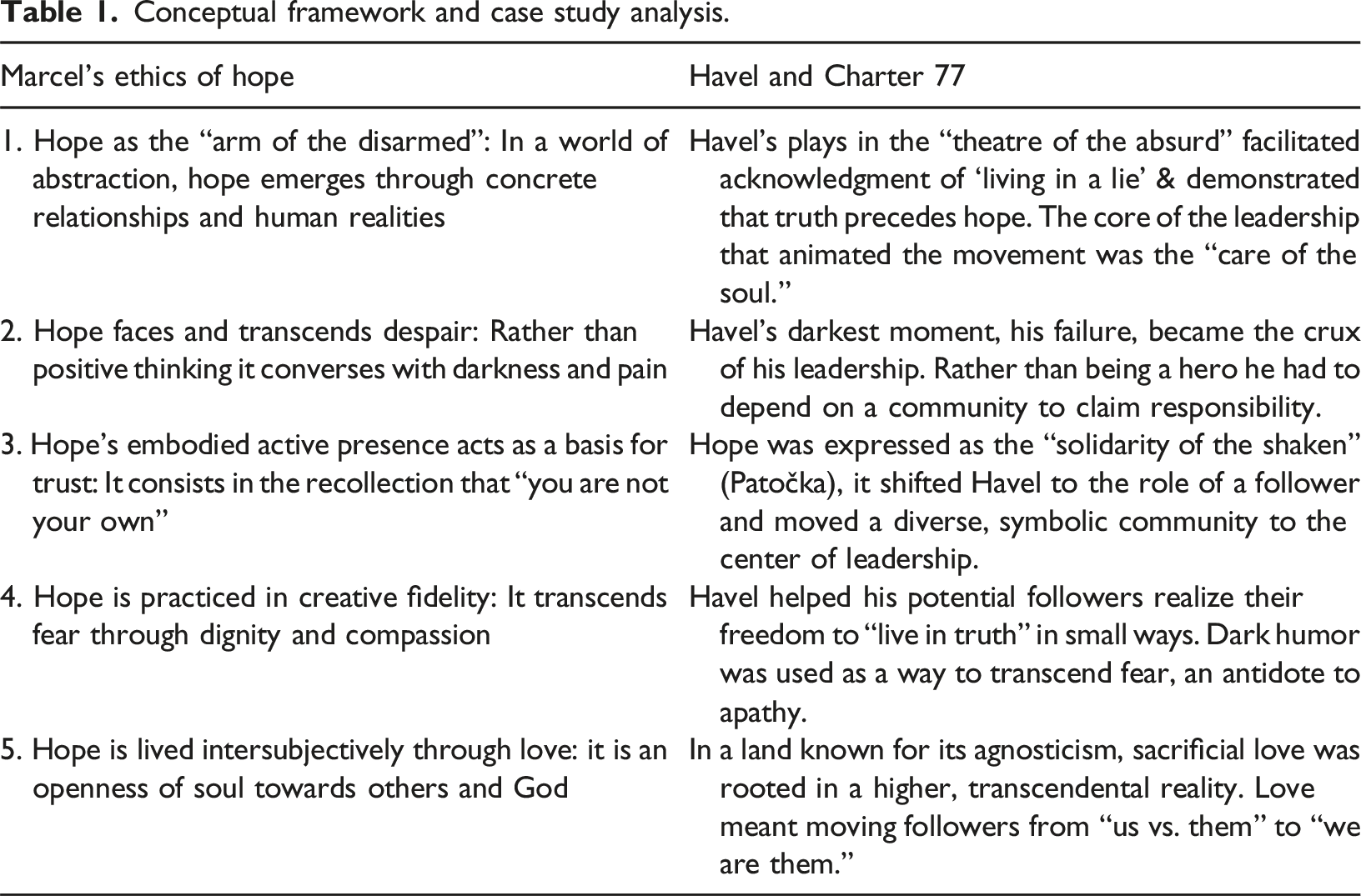
Marcel’s notion of the “arm of the disarmed” as opposed to the abstractions, estrangement and standardization of the modern technological world is reflected in Havel’s absurdist plays and his truth-telling about the regime. Following the absurdist theatre tradition of Samuel Beckett and Eugene Ionesco (1960)s theatre became for him “a spiritual and intellectual focus, a place for social self-awareness...an area of freedom, and instrument of human liberation.” (Havel, 1986/1990, p. 54). This lens of absurdity that formed Havel worked by paradox: The plays are not—and this is important—nihilistic. They are merely a warning. In a very shocking way they throw us into the question of meaning by manifesting its absence. Absurd theatre does not offer us consolation or hope. It merely reminds us of how we are living: without hope. (Havel, 1986/1990, p. 54)
In as much as his plays were dramatizing the communist regime’s stifling of the human person, Havel’s emphasis was to bring his audience face to face with their own lives. This plunging into darkness rests on the assumption that people have a basic moral sense and that if confronted reflectively with it’s absence, hope and meaning would rise up. Havel in Power of the Powerless similarly wanted his readers to consider the ways in which they were “living in a lie,” which the regime was expecting. Marcel (1984) argued that hope has a kind of prophetic quality to it, in the sense that hope’s precondition is truth-telling. Similarly, theologian Walter Bruggemann (2011) argued, “In a dramatic way, truth precedes hope. Thus they are related, but in a sequence. It is of course possible to stay too long in such truthfulness, forever critiquing and warning and analyzing. But of course there is at least as much danger, if not more, of rushing too soon to hope, before truth breaks the denial. Hope practiced in denial is no hope at all.”(p. 20). The implication is that leaders and followers are responsible for truth-telling in their concrete circumstances, even when it looks ugly, before engaging and acting in hope.
It is worth noting that Havel saw his artistry on stage not only as displaying the absurd realities of life under communism, but modern humanity in a state of crisis—the loss of identity and experience of the absolute (Havel, 1986/1990. p. 53). The villain in the plays was often not a person, it was the systemic environment that the characters found themselves in, which they also created and perpetuated. Havel’s Audience captured a banned writer working at a brewery pitifully asked by his boss to inform on himself to the secret police as a favor. Like Havel’s letter to Husak, the characters live in a world governed by fear, where conscience and integrity were forgotten and opportunism and playing the game to one’s advantage were the norm. This was often portrayed in the ambiguity of language and threat. The reductionist tendency to serve the machine mirrors Marcel’s view of modern “technics” and the dehumanization and desacralization of the modern world, where people become estranged from themselves in the spirit of abstraction. Incumbent upon the leader-follower relationship is the “care of the soul,” as Patočka taught, which takes seriously meaning in the specific context of one’s concrete actions.
Havel’s confrontation with his own failure of responsibility can be seen within the second feature of Marcel’s ethics of hope, the idea that hope is not hope unless it is surround by a halo of possible despair. Hope is not a form of escapism; it does not guarantee that life will be better. The way to transcend pain is to create meaning or possibility within one’s plight. Havel was holding himself to his failure, but importantly, did so in relationship with others. This failure was not a “problem” (in the Marcellian sense) to Havel, one that could be brushed aside or taken away, rather it was an “insight into the mysterious gravity of my existence as an uncertain enterprise” (Havel, 1982/1989. p. 351). Somehow failure is a part of our Being, as Havel reflected from prison, it cannot be shifted somewhere else or onto someone else. His recollection shows the deep influence of Patočka and his last conversations with him in between interrogations, in his existential responsibility for his action made in despair. As Zantovský (2021 interview with author) contended, this darkness made Havel who he was to the movement, it fueled his activity and he processed it without excuse or equivocation. Followers ought to pay attention to how leaders process their own failure or mistakes, and whether they hold themselves to a higher standard as research in leadership ethics suggests (e.g. Price, 2000).
Active presence to others’ concrete experience as a basis of trust, the third element of the ethics of hope, we can see in Jan Patočka’s notion of the solidarity of the shaken. He contends that this solidarity is built up in persecution and uncertainty when people are shaken from their “everydayness” to a deepened responsibility (Patočka, 1975, 135). His leadership in the Charter had a profound impact on Havel. Perhaps his greatest moral contribution to followers of Charter 77 was helping people understand the moral significance and meaningful sacrifice in a revolution in their relationship with their neighbors. He wrote that “yielding to power has never freed anyone from oppression,” suggesting that a calculous of making the situation better should not be a primary consideration (Patočka, 1977 in Riese 1979, 199). Only in Czechoslovakia at the time, as much as people did not believe in the slogans and rituals of the regime, they followed them out of fear and thus did not want to be dragged into the consequences of “living in truth.” Hope was embodied in Patočka’s influential moment of presence with Havel in between interrogations, being at his disposal with equanimity. Havel was a leader and follower in need of others. Groups like Kampademie, who embraced him at his weakest point, aided his growth.
Yet the active presence of the Charter “community” was highly limited as it was nearly impossible to gather as a group without secret police intervention. Rather, active presence was contained in the symbolic makeup of the Charter. As Charter signer and philosopher Daniel Kroupa (2019) reflected, “For me the most amazing thing was that the Charter 77 community was comprised, on the one hand of people like Catholic priest Josef Zvěřina or Professor Růžena Vacková, who had spent the 1950s in communist prisons, and on the other hand by people like Oldřich Hromádko, who had been an StB [secret police] officer and in the 1950s had been responsible for guarding those political prisoners”(35). Even though its members fought against becoming a political organization, the creation and sustaining of this diverse body was itself a force of hope for its potential to unify differing interests and backgrounds. It is a powerful example of the role of pluralism with common purpose as a mark of hopeful living—becoming to each other what they wanted their society to become.
The fourth element of Marcellian ethics, creative fidelity, brings out the commitment to live in truth as an expression of freedom. Havel recognized in Power of the Powerless that “living in truth” could take a variety of creative forms. There was a difference between speaking the truth versus living in truth as the latter emphasizes being. One did not have to be a “dissident”; he cited examples like writers who write without regard to censorship and teachers who privately teach young people things that are kept from them in state schools (Havel, 1978/1992). Leading with creative fidelity meant giving people options for meaningful action, that upon reflection they could do something. The fidelity was to free expression without regard to impact, an appeal to a transcendent and creative power. Havel’s friend, Catholic philosopher Václav Benda, even conceptualized the idea of a “parallel polis” in which he cited separate information networks, underground universities, trade unions, foreign contacts and a parallel economy. Hope involves a spiritual renewal, as Hernandez (2011) said, it can instruct us to “fix past wrongs.” This was precisely where many of Havel’s characters in his plays failed, such as in Protest, when Stanek refused to sign a petition for the unjust arrest of his daughter’s lover. Perhaps this was also emblematic of Havel’s grappling with his own hypocrisy and fragility after he emerged from prison.
Perhaps the Czechoslovak contribution to Marcellian hope in creative fidelity was in its use of humor. In 1986 Havel reflected that “foreigners are sometimes amazed at the suffering that we are willing to undergo here, and at the same time, they are amazed at the things we are still able to laugh at. It’s difficult to explain, but without the laughter we would simply be unable to do the serious things” (Havel, 1986/1992. p. 112). Humor, especially dark and absurd humor, contained an antidote to bitterness and apathy; it implied in it a hope that darkness is only temporary, that good can and will prevail. One of Havel’s close collaborators on the Defense for the Unjustly Prosecuted, underground priest Václav Malý, commented, “the seriousness of the times is known by how many jokes are made or lost. So I think that’s a good benchmark to kind of track the situation or the mood of society” (author interview with Malý, 2021). Humor created a sense of belonging and was a way of transcendence in difficult times. Humor’s role in leadership is quite underexplored, and its ethics and role could be the subject of further research.
The final element of Marcel’s ethics, hope expressed as intersubjective love was exemplified in sacrifice as the mark of self-transcendence and responsibility of leaders and followers. Hope’s “deepest roots” Havel (1986/1990) suggested, “are in the transcendental, just as the roots of human responsibility are…The most convinced materialist and atheist may have more of this genuine, transcendentally rooted inner hope than 10 metaphysicians together.”(183). To Havel hope was accessible beyond the labels of religion and spirituality because hope was a verb. Patočka taught that there were “values worth suffering for” which was connected to his concept “sacrifice for nothing” (Patočka, 1973). As opposed to sacrifice for something (as in war or athletic competition), sacrifice for nothing rejected the economy of exchange which is motivated by rewards or gains (Koci, 2017). Patočka knew that sacrifice and suffering for the common good were also part of Marxist-Leninist philosophies, which emphasized sacrifice for something. The “nothing” in sacrifice for nothing is “no-thing,” meaning that sacrifice is not for “things” but for a higher spiritual engagement, which we cannot possess as a thing. Both Patočka and Marcel agreed that hope was a movement of the open soul, a receptiveness to life and others, but it is not something that we take possession of (Svobodová, 2020). If leaders and followers view sacrifice relationally, and thus spiritually transcend adversity through love, they safeguard the way in which they achieve purpose.
Havel used this sense of responsibility to guide followers into the uncomfortable confrontation with their own collusion in the totalitarian system. Love meant shifting from “us versus them” to “we are them.” During the Velvet Revolution, Havel’s refrain was “Truth and love will prevail over lies and hatred,” but he knew that after the revolution citizens had to face their role in the totalitarian system. This recognition demanded a great deal of humility. His first address to the nation in 1990 after communism fell included helping his hearers understand that they played a part in creating a “morally contaminated society” (Havel, 1997). One had to recognize the spiritual violence of the totalitarian system within which its technologies trivialized love as a human existential need. Havel noted in his 1990 address, looking back on totalitarian control, “We learned not to believe in anything, to ignore each other, to care only for ourselves. Concepts such as love, friendship, compassion, humility, and forgiveness lost their depth and dimensions” (Havel, 1990/1992. p. 391). To move his society forward, hope meant a sober reckoning with the past.
Conclusion
Gabriel Marcel’s ethics of hope through the experience of Václav Havel and Charter 77 offer a deeper grounding for spiritual leadership theory as it demonstrates living in hope as a moral basis for responsibility, meaning making, belonging, creativity, and love that assert one’s humanity beyond calculations of success. The Czechoslovak case is largely overlooked in the West, but one that offers more of an interdependent cultural lens and national identity than typical Western individualistic and achievement-orientation toward leadership (Holy, 1996). Beyond the mythology of Václav Havel as a hero figure, his inner struggle through failure, responsibility and commitment to Being was core to his understanding of hope. Conflict, the debates within the Charter over “living in truth” and Jan Patočka’s role as moral framer of the Charter in Havel’s absence opened paths for Havel to depend on a close community of supporters. In many ways Havel did not fit the prototype of a leader (as Zantovský said “he pretended he followed”), but he did become a moral and spiritual authority through his deep-seated responsibility, propensity to expose absurd realities, ability to articulate an ethical basis for action, and skill in convening diverse networks of people to make progress on a common cause.
Marcel’s ethics of hope suggests deeper ontological roots than what spiritual leadership theory (e.g. Fry, 2003) articulates. Fry’s (2003) hope as a “desire with expectation of fulfillment” oversimplifies the concept in its rich philosophical and theological roots and does not leave room for contexts where there is no expectation of fulfillment and yet hope persists. This was the case of those who with Havel set out to assert their agency and act in freedom regardless of whether human rights were recognized by the regime (Bolton, 2012). Even when success against the regime began to materialize and goals and pathways became critical in 1989, Havel insisted that tightly linking dissident leadership with calculations of success was the surest way styme the movement (Paul Wilson introduction in Havel, 1986/1990). There are times for agency, pathways and goals as hope theory suggests, but beneath these the human person lies in its fullness and complexity and mystery. Hope as an expression of human relationship, a deep sense of solidarity across differences and a creative process that surfaces and transcends meaninglessness, despair and dejection adds a richness to spirituality beyond mere inwardness. Spiritual leadership theory can, therefore, give a greater account of the human person in the technological and instrumentalist context which tends to diminish one’s humanity.
A leadership ethics of hope through Charter 77 provides an expression of freedom, courage, and sacrifice asserting that “some things are worth suffering for.” Hope as the ”arm of the disarmed” liberated people through absurdity on display, it showed itself as Havel grappled with his failure of responsibility, it resided in laughter as a form of transcendence, it defined the solidarity and view of suffering found in the Charter 77 “community,” hope resonated in the active call to “live in truth” and create a new expression of life under a repressive regime, and it eventually emerged as love in the shape of humbly recognizing one’s collusion with the moral contamination of society and allowing truth and love to prevail. In Havel’s case, perhaps what qualifies one to be a moral (and hopeful) leader is not only one’s credibility, but one’s sustained critical reflection on one’s failure and commitment to artful solidarity which deepen one’s responsibility to others.
The totalitarian past is not so far from political realities around the world today. As Timothy Snyder (2018) argued in his introduction to Power of the Powerless, “The continuity between communism and our world is normalization: mendacity without metaphysics, communicated by technology”(pg. 7). Havel (1984/1992) himself warned that totalitarian systems are closer to Western rationalism that anyone would like to admit, they are by-products of a general crisis of Western civilization. Lessons from the Czechoslovak experience are highly relevant today as humanity faces the challenges of populist authoritarianism, artificial intelligence, global conflicts, surveillance capitalism, and climate change. Those who lead and follow in this moment will do well to remember Havel, Patočka and Charter 77’s example of hope in truth-telling, dignity, and bridging communities that function as “islands of freedom” and responsibility.
Footnotes
Declaration of conflicting interests
The author(s) declared no potential conflicts of interest with respect to the research, authorship, and/or publication of this article.
Funding
The author(s) received no financial support for the research, authorship, and/or publication of this article.
