




Abstract
This article focuses on plurilingual processes in two European-based news agencies: Agence France-Presse (AFP) and Agence télégraphique suisse (ATS). Fieldwork (observation and semi-structured interviews) was conducted in Switzerland at the regional office of AFP in Geneva and at the head office of ATS in Bern. The aim of this study is to evaluate the potential consequences of a highly plurilingual production process on the one hand, and of the ostensible invisibility of multilingualism/translation on the other hand. Some of the interviewed journalists acknowledge the risks that may be posed by interlingual and intercultural transfer (translation), given the working norms of news agencies (rapidity, accuracy of information, and adaptation to the audience). However, the institutional denial of these possible biases may prevent news agencies from reducing them.
Keywords
1 Introduction
Translation Studies have recently highlighted the crucial role and place of ‘interlingual transfer’ 1 in news agencies: ‘ … news agencies can be viewed as vast translation agencies, structurally designed to achieve fast and reliable translations of large amounts of information’ (Bielsa and Bassnett, 2009: 56). International and national news agencies actually ‘translate’ on a daily basis as shown in different studies (Bielsa, 2010; Bielsa and Bassnett, 2009; Davier, 2012; García Suárez, 2005) conducted at several news agencies (Agence France-Presse, Reuters, Inter Press Service, EFE and Agence télégraphique suisse). Moreover, as news agencies are business-to-business (B2B) information services, (1) their news items are broadly distributed in traditional media (newspapers, television, radio) and on websites, and, thus (2) the words they choose in the process of interlingual transfer do have a palpable impact on the circulation of information nationwide and/or worldwide (Bielsa and Bassnett, 2009: 67). In other words, news agencies play a central role in the diffusion of translated text.
In this article, I am using the terms ‘plurilingual’ and ‘plurilingualism’ as defined by the Council of Europe (2013) as the opposite of ‘monolingualism’. In this sense, ‘plurilingualism’ refers to an individual or a group of individuals using more than one language. It is not to be confused with ‘multilingualism’, which describes a space where different languages coexist, but where individuals can be monolingual. In other words, multilingualism describes a space and plurilingualism, a practice, so plurilingual or monolingual individuals can live in a multilingual country such as Switzerland. This distinction is not made in introductory references to sociolinguistics such as Wardhaugh (2002: 94–99) or Saville-Troike (1989: 54–70), who only distinguish diglossia (‘a situation in which two or more languages [or varieties of the same language] in a speech community are allocated to different social functions and contexts’ (Saville-Troike, 1989: 54)) and multilingualism (where two or more languages are ‘used for a full range of functions in each part of the country’ (Saville-Troike, 1989: 55)). In Saville-Troika’s terms, Belgium would be defined as a multilingual country without diglossia.
This study thus focuses on plurilingual processes in two European-based news agencies: Agence France-Presse (AFP) and Agence télégraphique suisse (ATS). Fieldwork was carried out in Switzerland at the regional office of AFP in Geneva and at the head office of ATS in Bern. One week of direct (non-participant) observation (Arborio and Fournier, 2008; Beaud and Weber, 2010; Bréchon, 2011; Miles and Huberman, 2007; Quivy and van Campenhoudt, 2006) was arranged on each site, and interviews were conducted with journalists (six at AFP, 17 at ATS) 2 and with chief editors (two at AFP, two at ATS).The corpus of interviews comprises 1132 minutes (or nearly 19 hours) of records and nearly 200,000 words of transcriptions. Therefore, it is impossible to give here several quotes to illustrate each broached theme. I have tried to select the most expressive quotations and, whenever relevant, to give a rough idea of their representativeness within the framework of a qualitative analysis (Bréchon, 2011; Lejeune, 2010). 3
Studies in news translation can be categorized into four different groups: books or articles written in a didactic perspective for students of languages or translation (e.g., Chartier, 2000; Laruelle, 1989; Lavault-Olléon and Sauron, 2009; Li, 2006); papers oriented towards translation problems or strategies from a rather linguistic perspective (e.g., Cortés Zaborras, 2005; Cortés Zaborras and Turci Domingo, 2005; Gallego Hernández, 2010; Puurtinen, 2007); studies mainly reflecting on the definition of translation (e.g., Bielsa and Bassnett, 2009; Conway, 2011; Gambier, 2010; Orengo, 2005; Schäffner and Bassnett, 2010; Tsai, 2010; van Doorslaer, 2010a, 2010b); and ethnographic approaches (e.g., Bielsa, 2010; Bielsa and Bassnett, 2009; Conway, 2008, 2011; García Suárez, 2005; Tsai, 2010; Vidal, 2005). As a case study, this article draws its inspiration from the latter, particularly Bielsa and Bassnett, whose research was focused on translation in news agencies and who have emphasized the multilingualism of AFP and IPS (and Reuters) as well as what they call the double ‘invisibility’ of translation (2009: 72–73). However, they have not specifically addressed the risks incurred by the paradoxical combination of both.
The aim of this study is, therefore, to evaluate the consequences of a highly plurilingual production process on the one hand, and of the invisibility of multilingualism on the other hand. I shall refrain from drawing conclusions regarding the actual consequences of these conditions of production, but I would rather point at possible implications of the invisibility of interlingual transfer as perceived by journalists in the context of news agencies. What is the perceived vs. observed place of ‘translation’? How seriously do journalists take the risk of mistranslations? How are these risks taken into account in quality control? Are cultural biases taken into account? Is there a possibility that items from the same agency that were published in different languages might not be equivalent? While the next section of this study shows the multilingualism which is inherent in press agencies, the following section highlights the invisibility of interlingual processes, and section 4 outlines the risks that this paradox might entail.
2 Highly multilingual contexts
The aim of this section is to show the various facets of multilingualism in the two press agencies under study. It will try to answer questions such as: what do the multilingual workspaces and practices look like? Why are press agencies intrinsically multilingual? Why do they resort to interlingual transfer more than other types of media? Why is translation used instead of bilingual (or plurilingual) news production?
2.1 Multilingual production
First of all, most press agencies have multilingual
4
readerships. In the case of a global agency like AFP, news dispatches are currently being published in six languages (French, English, Spanish, Portuguese, German and Arabic) in order to reach as large an audience as possible, although not all news items exist equivalently in all six languages. The biggest markets of AFP are, self-evidently, French-speaking countries around the world, and first- or second-language speakers of English, mostly in Eastern Europe and in Asian countries (AFP bureau chief). The editor-in-chief of the AFP bureau in Geneva added that more and more European media subscribed to the English service provided by AFP because of the decreasing influence of French even in countries where Latin languages are spoken. The AFP bureau chief said:
For example there are newspapers in Italy or in Spain which prefer to receive our English news service rather than our French service because there are more and more people, journalists belonging to younger generations, whose understanding of English is better.
5
The markets in the other languages shall not be discussed here, firstly, because AFP’s two main languages are French and English in terms of circulation 6 and, secondly, because this article focuses on the work done in the Swiss regional bureau of AFP, which produces news in English and French.
ATS is clearly a national agency (Boyd-Barrett, 1998; Boyd-Barrett and Palmer, 1981; Boyd-Barrett and Rantanen, 1998; Rantanen, 1998): its clients are all Swiss-based (including international agencies on Swiss territory) and it buys the wires of world agencies to cover international news from a Swiss perspective. Although it does not operate on a global scale, its organization is comparable to AFP’s in terms of plurilingualism and multilingualism. According to its guidelines, it offers its clients a ‘complete and independent news service’(ATS, 2013) in the country’s official languages (German, French and Italian). 7 The Italian service ‘only’ translates news from the other services (editor-in-chief of ATS’s French wire). ‘Equivalent’ 8 production is made possible thanks to a financial equalization and because the Swiss Confederation, as one of the biggest clients of ATS, supports the news services in the three official languages equally (ATS editor-in-chief). In Spring 2012, ATS also launched an English service, 9 employing four journalists to try to win new markets in the Swiss tourism industry (ATS editor-in-chief). This study shall only focus on the German and French news services because they play the same role in the selection of news, that is, the one is not always a translation of the other.
2.2 Plurilingualism in the newsroom
To provide their clients with multilingual news, the press agencies in this study of course need teams of plurilingual editors. Journalists working for AFP and ATS master at least two languages, but write exclusively in their mother tongue. AFP has changed this policy over the years: ‘Hmm … the time when French journalists used to play around with the English language is over!’ 10 (AFP bureau chief). At ATS as well, I could observe that all journalists at the French and German news desks were native speakers of their working language. Both at AFP and at ATS, the plurilingual teams share an open space office, where editors with different mother tongues and cultures work together (Figures 1 and 2).
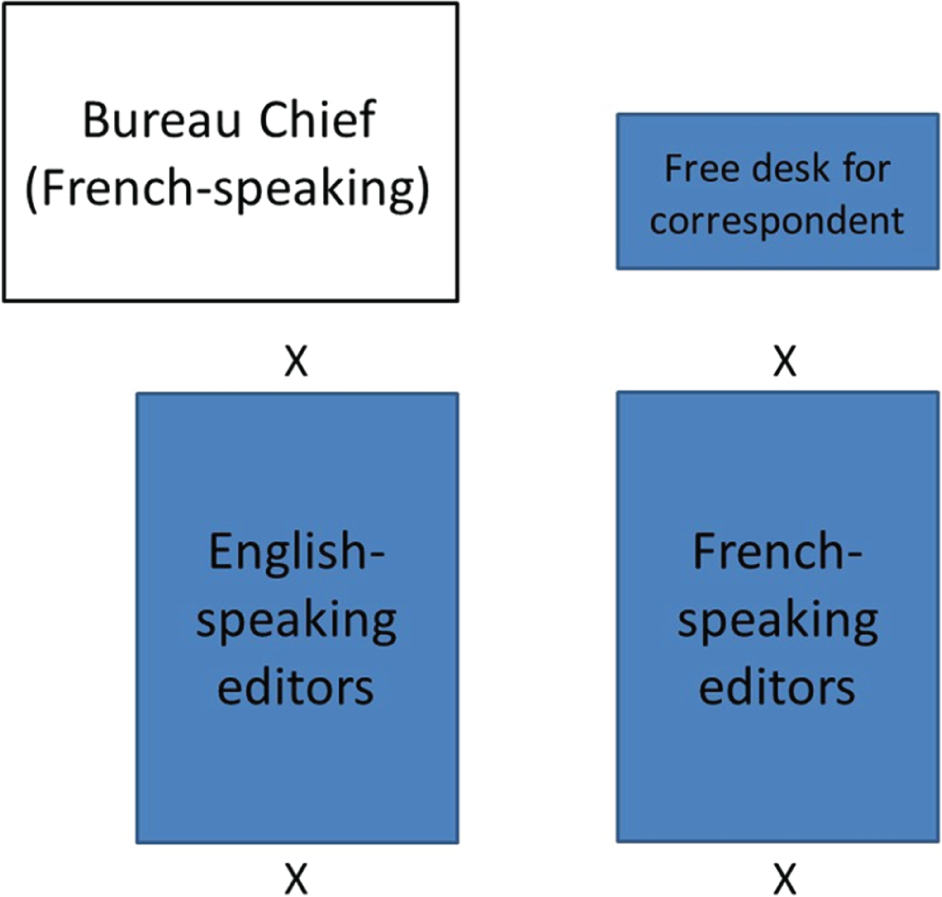
Multilingual work space at AFP’s Swiss bureau in Geneva [The empty box represents a separate room. The Xs stand for a given reporter’s workplace.]

Multilingual work space at ATS’
According to several interviewees, this open-space arrangement is a cultural melting pot that even helps fight possible prejudices and broadens the world-view of reporters (ATS senior editor). Although the most common language is French in both agencies, editorial meetings at ATS 11 are held in German and French. Every journalist introduces the topics he is going to treat during the day in his native language, and nothing is interpreted, which is sometimes difficult for the editor in charge of the meeting, especially when it comes to abbreviations and jargon in the other language (ATS senior editor).
Since journalists have to be plurilingual, or bilingual at least, their language skills are tested when they apply for work at an agency (see also Bielsa and Bassnett, 2009: 58). Two successive directors of the Geneva office of AFP explained that candidates have to translate a news item (or, rather, ‘edit’ it in AFP’s terms) into their native language (two successive AFP bureau chiefs). Tests administered at ATS seem to be less systematic, especially for holders of a press pass. The editor-in-chief of ATS’s French service said that the linguistic abilities of professional journalists are not checked because journalists usually tend to underestimate their language level (ATS editor-in-chief of French service) and because they prefer to hire a good reporter even if his language skills need improvement (Ibid.). When selecting trainees (ATS trains many journalists for a period of two years), the wire service tests their general knowledge of current affairs, gives them an article to write based on ready material, and makes them translate two news items into their mother tongue (ATS editor-in-chief of French service). However, the oral comprehension of AFP and ATS editors is hardly ever checked, which is surprising since they have to attend press conferences on intricate topics in their foreign language(s).
The multilingualism and plurilingualism of the teams of reporters are one of the most important resources, should a linguistic problem arise. Either the author of the original dispatch is in the office when the question arises or another editor with the same mother tongue can help a colleague to understand and/or with interlingual transfer. When asked about their linguistic resources, many interviewees (16 out of 27, but not all of them were asked this question) answered that they consulted online 12 or paper dictionaries first, and then turned to colleagues if they had not found a solution. These plurilingual situations involve ‘autotranslation’ processes, that is, ‘translating what one has just said in one language into another’ (Harris and Sherwood, 1978; Toury, 1995: 244). Autotranslation is often used in the case of quotes: ‘Because it’s really … it’s too dangerous. Yes, the risk of mistranslation is very serious […]’ 13 (AFP journalist). Nevertheless, using colleagues’ knowledge as a resource seems to come with experience, as was stated by several journalists who confessed they were afraid to ask for help when they started their work at the agency: ‘At the very beginning here I used the dictionary, I confess, a bit … because you’re afraid, you know, because you’re afraid to show that you don’t master German as much as …’ 14 (ATS trainee). In his ethnographic study, Flynn also shows that literary translators do not only rely on ‘bookish’ resources when they face problems (2005: 197), but have also developed networks of ‘native’ friends or experts they can resort to when they need help (2005: 83). Indeed, dictionaries cannot provide much information about context, dialectical variations or intertextual references. Calling on outside expertise seems to be a manifestation of professional experience.
2.3 Multilingual sources
Multilingualism may be more evident in oral communication situations, but multilingualism is also present in the sources of information journalists deal with. During my fieldwork at AFP and ATS, I could observe that a news agency item is actually a patchwork of many different sources, many of which were originally in a different language (Figure 3).
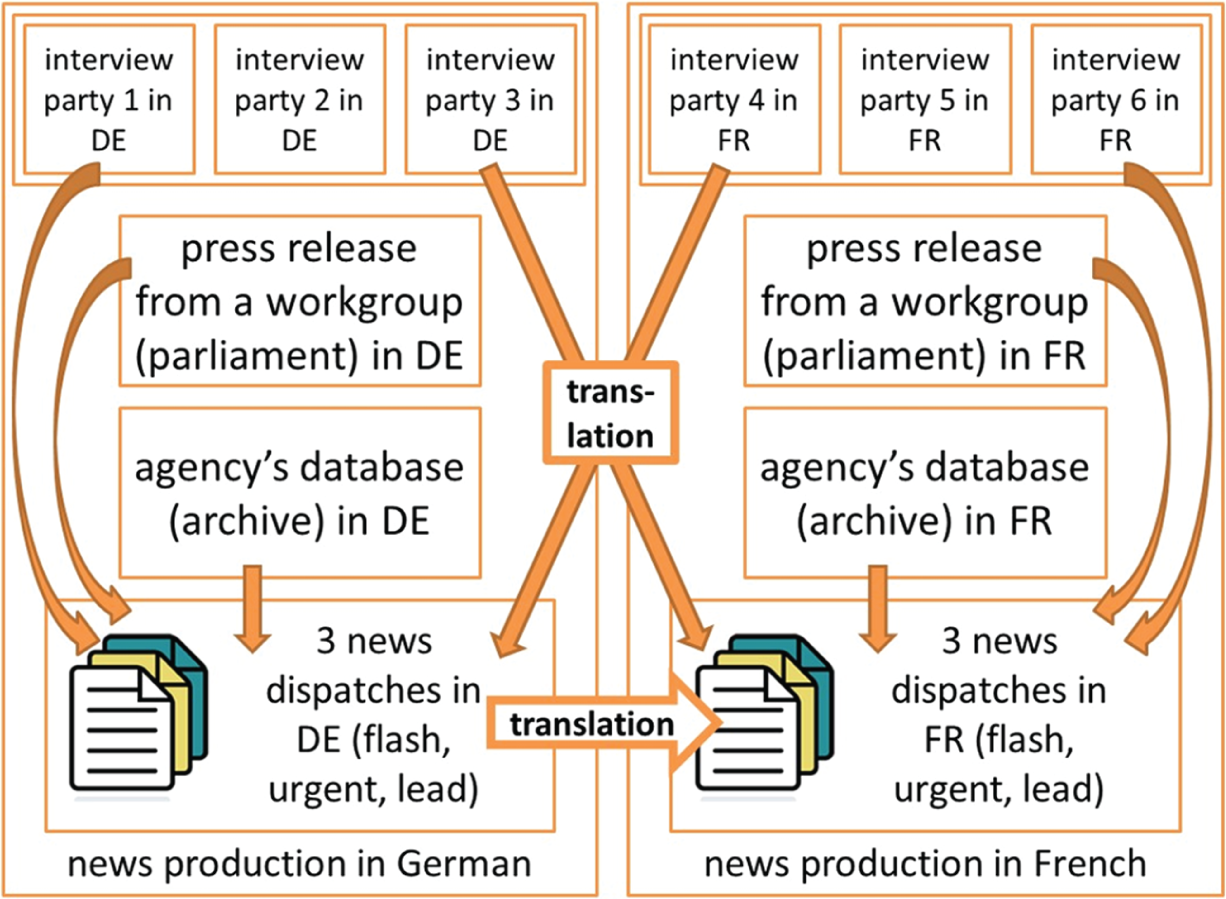
Example of plurilingual production [DE stands for German, FR for French.]
These sources can be written or oral discourse coming from press conferences, press releases, 15 (phone) interviews, etc. Most press conferences are held without consecutive or simultaneous interpreting, but it does happen that documents are dispensed in several languages (e.g., in French if a UN briefing is given in English, or if a company announces its results in German). Quotations are written down by the reporters in the original language and then translated into the language of the news dispatch. Whenever possible, phone interviews are carried out by reporters who speak the same language as the interviewed personality. As a consequence, many quotations have to be translated into the other language of the wire agency. Press releases from plurilingual institutions such as international organizations or Swiss federal departments (or even Swiss associations and companies) are supposed to arrive in at least two official languages, but (1) one editor complained that that was far from always being the case, and (2) another one said that the translation provided often arrived too late and could not be waited for.
Translation or interlingual transfer is the most efficient solution news agencies have found to cope with this ubiquitous multilingualism. Why, then, would it not be possible to publish independent news in two (or more) different languages without resorting to interlingual transfer? The first reason put forward by researchers as well as by reporters seems to be economic rationalization: ‘The integration of translation in the production of news maximizes the efficiency of news organizations that have had, since their inception, to deal with linguistic diversity and to communicate information across linguistic borders’ (Bielsa and Bassnett, 2009: 58). The French-speaking editor-in-chief of ATS agreed on this point. According to him, it is much more expensive to run two independent editing desks that are actually working on the same topics and leading the same interviews. Moreover, sources may become irritated if reporters from the same media call them for quotes in different languages (ATS editor-in-chief of French wire). Thus, interlingual transfer is a way of rationalizing the work of inquiry and of occupying only one reporter (in the field or making phone calls), while another journalist investigates another topic.
The boundaries of interlingual transfer actually seem to be set by the importance of the topic under investigation. As Bielsa and Bassnett put it: ‘First, translation must never delay the circulation of important information, especially in certain cases when it is possible to prepare news reports in advance’ (2009: 70). In the case of crucial subjects that have to be published without any delay, ‘parallel production’ 16 is preferred. For 10 out of 26 editors interviewed at both APF and ATS (but not all of the interviewees were asked this question), this criterion was clear, as the following quote illustrates: ‘Well, actually, when it comes to important, or actually very important events, both [news dispatches] are written parallelly in English and French, so there is nothing to translate. But for small news we’re supposed to have a translation’ 17 (AFP editor). For instance, when the results of the Swiss vote about the so-called ‘minarets ban’ were officially announced in November 2009, there was no time for translation at AFP or at ATS. ‘Parallel production’ was the rule because the vote against minarets was dominating the headlines in both wire services. Thus, interlingual transfer seems to be restricted to situations that are deemed to be of lesser importance either because the publication of a piece of news can wait a little or because a smaller audience is targeted (like the Italian-speaking community in Switzerland). This result does not correlate with the observations of Bielsa and Bassnett, who state that they noticed more cases of literal translation in these situations (2009: 91), but it was confirmed in both fields.
As the press agencies under study produce news for multilingual clients, they are vast multilingual employers. The plurilingualism of their employees are already a concern even during employment procedures, although oral comprehension of foreign languages is not checked over. As multilingual work environments, news agencies offer their editors space for cultural exchange and to expand their horizons. On a professional level, plurilingualism is an incomparable resource in solving comprehension problems, especially given the great number of multilingual sources the reporters have to incorporate into their texts. Therefore, interlingual transfer is a way of facilitating the production of information in several languages on the basis of primary sources in different languages. These conclusions apply to both sites under study; perhaps because AFP Switzerland is a small local bureau composed of five journalists, I am aware that the results of fieldwork at the headquarters of AFP might differ from these. Considering the importance of plurilingualism and of interlingual processes, what place are they given in the agency and among the public?
3 Invisibility
As this paper draws in part on Translation Studies, it would be bold not to mention the concept of ‘invisibility’ developed by Venuti (1995) and cited by Bielsa and Bassnett (2009). It must be specified that Venuti’s representation of invisibility stems from the context of literary translation. Venuti links fluency (or idiomatic translation) with the invisibility of translation and with the subservience of translators. Authors such as Pym (1996) and Flynn (2005) criticize what they consider to be an illogical relation, among other reasons, because invisibility is taken as an ‘ontological state’ (Flynn, 2005: 99). Following the example of Flynn, I decided to confront the question of invisibility with data from the field. In this respect, a new distinction might be needed between: (1) a picture of invisibility projected on a profession from outside; (2) invisibility endured as an ancillary status by the journalist/translator himself; and (3) the textual invisibility of translation processes. Moreover, can a difference be observed between the international (AFP) and the national agency (ATS) under study? Bielsa and Bassnett highlight a dominant model, in which interlingual transfer is fully incorporated in journalism, and an alternative model, in which professional translators also work for the newswire (2009: 79 ff.).
3.1 A negative conception of translation
No fieldwork was done outside the newswires on the perception of agency journalists. However, I could observe that the reporters experienced their translation tasks as an auxiliary activity that was imposed on them. This was apparent from their discourse, despite the fact that I did not even ask this question as such. First of all, many an interviewee tried to distance himself from the word ‘translation’. For instance, AFP journalists speak about ‘editing’, instead of ‘translating’(see also Bielsa and Bassnett, 2009; Gambier, 2010) because they want to underline a difference in the nature of the task (this theme was coded as such 95 times in the corpus): ‘But our job is not to translate, our job is to tell stories, or rather to inform people’
18
(AFP junior editor). At ATS, the word ‘translation’ is not taboo, but is understood as being limited to situations of ‘literal’ (Newmark, 1981; Pym, 2008; Toury, 1995) interlingual transfer (there are 75 coded occurrences of this argument in the corpus). Then, translation is considered an unpleasant task as ‘conventional metaphorical expressions in everyday language’ (Heywood and Semino, 2007: 25; Lakoff and Johnson, 1980) show it in our interviews. When I asked the editors what difficulties they encountered while translating, they answered by resorting to metaphors from the ‘source domain’ (Heywood and Semino, 2007) of suffering, as can be read in the following excerpt (emphases mine):
[…] it’s more constraining because there’s always the burden of translation, you see. […] Actually, instead of being able to write in our own language, a language we perfectly master, we must make the effort of translation.
19
(ATS journalist)
This metaphorical analogy between translation and a burden seems to be the basic metaphor for most interviewees. 20
Reporters justify their critical stance towards translation by explaining that translation is inadequate in journalistic settings. For an AFP editor, official translations coming from international organizations are ‘just too slow for us’. The editor-in-chief of ATS said that they were not looking for translators because translations were inappropriate in the wire service, ‘because translation has to be done … it’s slightly different from a usual translation. Rapidity is at stake, it’s journalistic work …’ 21 (ATS editor-in-chief). As mentioned before, reporters may reject translation because they have a restricted conception of it, as is visible in the following quotation: ‘And for us, the closest [to the original] is not necessarily the best’ 22 (ATS editor-in-chief). As translation is associated with submission to the author’s enquiry and style, agency journalists try to set themselves free: ‘… well, when you know the topic, when you know the stakes, you can be a bit freer in the translation than just sticking word for word to what was done’ 23 (ATS senior editor). Since translation is seen as a synonym of servility, freedom is thought to be attained by writing directly in one’s mother tongue (ATS senior editor).
3.2 Lack of systematic translation methods
How does interlingual transfer acquire visibility in the training of beginners? Actually, the honest answer to this question would be that it does not. A reading of the AFP and ATS style guides (AFP, 2004; ATS, 2008) confirms the following remark by Bielsa and Bassnett (2009: 70): ‘Agency manuals do not include full sections on the translation of news, and only a few remarks specifically dealing with translation’. Besides, there exist no specific courses for trainees and newcomers. When I asked some section editors about the advice they give to the trainees they are in charge of, I was struck by the fact that their pedagogy relied on the ‘learning by doing’ principle (this theme was coded 74 times): ‘… we really learn on the job, it’s “learning by doing”, and actually we don’t think about our practice a lot’ 24 (ATS senior editor). The recommendations given about translation are very general (‘read the text completely before translating’ or ‘don’t stay too close to the original’), and the young trainees are supposed to find adequate linguistic resources by themselves on the internet (ATS trainee and ATS senior editor).
This lack of methodological conceptualization on the institutional level causes uncertainty among the reporters (even among senior editors), who doubt their own professional habits: ‘It depends … well, I think … I don’t really know what the official policy is, what’s normal, or what only my opinion is [Q: It doesn’t matter!] …’ 25 (ATS trainee). After a deeper analysis of the data, it became clear that there was no training for translation because translation was considered to be a simple task and because translation was the actual training for wire editors (‘learning by copying’ (ATS trainee)). Translation is perceived as an easy means of access to the structure and the style of news items.
One of the working hypotheses in the beginning of the project was the inherent link between translation and bilingual revision, which derived from Translation Studies. My questions built on this intellectual prejudice. As a consequence, the interviewees did not dare to admit that they did not reread their translation in parallel with the original text. They answered that they ‘did not always do it’ (ATS reporter) or that they ‘did not do it often’ (ATS senior reporter), in a tone of embarrassment. But I was able to observe that this was not the case; according to Bielsa and Bassnett: ‘A second revision compares the translated text to the original in order to verify numbers, dates, quantities and similar data, as well as to check that quotes have been translated faithfully and accurately’ (2009: 88). Nonetheless, every news item is proofread by its author and by the desk. At AFP’s regional bureau, the dispatch is proofread once more inside the office, sometimes by a journalist or another speaker of the same mother tongue, for instance by the first author of an ‘edited’ (translated) item. However, I never saw a journalist undertaking a parallel revision using the original text and target text. Of course, it can be argued that there are very few translations involving a source text and a target text as such. I can propose two hypotheses to explain this. First, the written comprehension of the ‘translator/editor’ is never questioned: it is assumed that all potential interpretation problems have been cleared before the production of the dispatch. Second, no difference of nature is made between a translated news item and a non-translated one: ‘But, actually, it’s the normal writing process for … it’s the same for all stories’ 26 (ATS senior editor). The ‘edited’ text is then read ‘as a piece of target-language text, checking it for stylistic acceptability’ (Toury, 1995: 191).
3.3 Textual invisibility
Indeed, according to Bielsa and Bassnett, ‘translation has been integrated with other processes involved in the production of news’ (2009: 70). Therefore, translation is not observable in the form of source/target text equivalences because of a multi-source translation situation, as several scholars state it (Bielsa and Bassnett, 2009; Tsai, 2010; van Doorslaer, 2009, 2010a).This phenomenon can be illustrated by the experiment that a French company developing computer-assisted translation software conducted at AFP: the company wanted to align source texts and their translation so as to create a translation memory, but the project failed. The impossibility of alignment provides additional evidence that all traditional traces of translation are erased. This is also why I gave up the idea of composing a parallel corpus of news dispatches: all potential source texts are made invisible in the resulting text in the target language. Theoretically, tracing the time of publication and the abbreviated names of the authors could provide indications of the original, but it is a very time-consuming process and does not give unambiguous proof that the text found was indeed the source of the translation. Even if the editor-in-chief of ATS assumes that interlingual transfer is transparent for the agency’s clients because they receive the abbreviations with a list of corresponding authors, it is probably not for the final user, who receives the news item without any of this information.
Agency editors both at AFP and at ATS perceive translation as ‘invisible’ in Venuti’s (1995) and Simeoni’s (1998) sense: for them, translation implies dependence on the original author, so they try to free themselves from it. As a consequence, translation has become an invisible activity in wire services: it is not addressed in the training of young editors, it lacks institutional reflection, and it is not taken into account in the revision process. Moreover, it is almost impossible to find marks of translation in the final product. In this perspective, no substantial difference could be noted in the way translation is perceived (or not perceived) in a national (ATS) and an international agency (AFP). The ‘dominant model’ defined by Bielsa and Bassnett (2009: 79 ff.) seems to apply to both situations. What consequences can ensue from such an untheorized, unconceptualized and untaught practice?
4 Potential risks
According to the interviewed editors, the combination of a highly multilingual environment and of the perceived and textual invisibility of translation may incur some risks. Do they think there might be translation problems? What circumstances could cause potential problems? In this respect, what role can culture or culturally constructed preconceptions play in interlingual transfer?
4.1 Possible translation problems
First, some interviewed reporters mentioned different kinds of problems that could arise from interlingual transfer: distortions, comments, assimilation of external content, and abstraction. Distortion can be induced by miscomprehension of a phrase in another language or through an over-hasty transfer. An AFP journalist cited an example of over-interpretation: in the context of the Haiti earthquake in 2010, the word ‘damaged’ was wrongly translated into the French word ‘détruit’ (‘destroyed’). According to him, this inaccurate translation gave a more dramatic image of the situation. A former trainee from ATS said that he just about avoided a misinterpretation in a speech that might have caused a diplomatic incident. The trainee was sent to an economic press conference in German where he mistook the phrase ‘im Provisorium’ (provisional solution) for the word ‘Improvisorium’ (which he thought to mean ‘improvisation’, although it does not exist in German). Fortunately, he asked a colleague before handing in the story.
The chief editor of the French service also told us about a translation problem that happened in the title of a news article and which was reported by the source quoted in the article. The translation apparently crossed the fuzzy border between ‘fact’ and ‘comment’. According to the interviewee, this type of mistake is more likely to occur in the title, which has to fulfil requirements that are sometimes hard to combine: it has to be short, precise, attractive and neutral (ATS editor-in-chief of French wire). Another serious mistake may lead sources to complain: the undue appropriation of a quotation, in other words, the integration of reported speech in the text that is supposed to be authored by the news agency. This is likely to happen from German into French if a journalist does not recognize a verb mood with a special function, Konjunktiv I. Konjunktiv I shows that the sentence is in reported speech even if it does not bear any of the usual signs like quotation marks or introductory verbs. According to a French-speaking ATS reporter, this is a trap young journalists can easily stumble into and that can result in ‘big mistakes’.
Another senior editor of ATS sees translation posing a general risk for the transmission of news. He thinks that translation necessarily distorts the message: ‘Translations shouldn’t be multiplied because there’s a loss, you know. Well, and if the Italian-speaking editors translate once more, there’s not much left of the original message anymore’ 27 (ATS senior editor). As we can see, some journalists do not really trust translation. A colleague of this senior editor commented that translation can produce double abstraction: agency reporters very rarely go into the field, so if a news item is translated, it can be doubly far away from what actually happened. He gave me the speculative example of a fire breaking out in the south of the country and covered by the regional bureau of Zurich: the first version of the news item would be written by German journalists from their office, then it would be translated by French editors who had not been on location either. According to him, the latter text would be even further away from the event since it was created on the basis of text that was written on the basis of phone interviews. In other words, this editor points out, the risk in agency journalism may be doubly more abstract because of translation.
The interviewees believe that the risk of mistranslations has to be related directly to the linguistic knowledge of each ‘translator/editor’: ‘The only problem with that is, of course, it depends on linguistic skills, the degree of competence, linguistically, that you have’ (AFP junior editor). But even more important than that is self-awareness of one’s skills ‘and also the degree of caution that the individual person might exercise, how they know that they have a doubt or that their competence might have its limits’ (AFP junior editor). According to this reporter, it is more important to know when to look up an unknown word and when to ask colleagues than to be quick to get off the mark with a possibly inexact solution. This is where a problem seems to arise. Other interviews with trainees and editors speaking about their early years in the agency actually show that beginners tend to hide their doubts out of shame and fear that the senior editors would discover their weaknesses (ATS trainee). However, senior editors who are responsible for trainees think that they will ask questions if a problem arises. An examination of practices in the field proves that they do not always do so. As a matter of fact, some journalists actually noticed translation errors in the texts they authored (ATS correspondent in Belgium). Indeed, how could translation problems be avoided if bilingual revision rarely occurs (see section 3)?
4.2 The influence of cultural preconceptions
Although editors try to separate translation from intercultural transfer, the issue of culture kept coming back in the interviews. ‘Realia’, that is, references to ‘culture-bound notions and phenomena, such as religious or educational concepts, taboos, values, institutions, etc.’ (Leppihalme, 2010: 129), present the first cultural problem. Reporters have to transfer their stories to their target audience, which is supposed to understand them without looking anything up: ‘Well, we put the exact word, but first, we want people to understand what we’re talking about, and they wouldn’t understand if we put ‘Conseil fédéral’ [in French]’ 28 (AFP junior editor). Therefore, their transfer strategies often comprise the use of a generic term, sometimes along with a calque (in the previous example, that would be ‘the Federal Council, the Swiss government’), or a cultural adaptation (that could be ‘the Swiss Cabinet’). Given the format requirements of a news dispatch, these explanations or adaptations have to be very short, which can slightly distort the exact cultural phenomenon. According to an interviewee, this professional habit might lead to caricatures of reality: ‘Linguistically, it’s so easy to say: “They’re the bad ones”, when you decide to forget about nuances’ (ATS senior editor).
Cultural transfer also takes place through paragraphs containing background information designed to help the audience contextualize the news story. Nevertheless, the number of these paragraphs is strictly limited by the format of agency news. As one journalist put it, press agencies are not supposed to give ‘civilization courses’, but enough context, nevertheless, for the reader to understand what is at stake (ATS senior editor). Some editors acknowledged that the background information comprised in these paragraphs strongly influences understanding of a media occurrence. As a case in point, during the vote against minarets in Switzerland, an AFP reporter complained that the news was biased by the selection of information: ‘But I said: “But there are 200 mosques in Switzerland. It’s not written anywhere!” [Q: Hmm, hmm.] When you read the papers you had the impression that it was awful, that Muslims were just about to be kicked out …’. 29 According to this editor, the described occurrence was co-shaped by the choice of information, which was oriented by the French cultural background of the author.
Realia and background are more subject to changes during interlingual and intercultural transfer. However, news agencies also regionalize or ‘localize’ (Orengo, 2005; Pym, 2004 ) their copy. Localization involves different kinds of deep modifications. Usually news items about a foreign country or another region are shortened if they are aimed at an audience they don’t affect directly. For instance, AFP news about France is summed up in its English version; ATS news about the German-speaking part of Switzerland is abridged in French. One journalist advanced this argument: ‘If we don’t do it the customer will do it afterwards’ 30 (ATS senior editor). In fact, if a story is considered too long by a media client, it might be shortened or even deleted. And the first information mentioned often has to be adapted for another audience. For instance, a dispatch about a Swiss topic may start with a case in Geneva in the French version and with an illustration in Basel in the German version (ATS senior editor). It is also frequent that quotations are not translated, but replaced by a quotation from a source speaking the same language as the journalist. One ATS reporter explained that this change had no linguistic rationale, but they imagined the audience would rather read a quote by an expert coming from the same region. However, if there was a contradiction between the opinions of personalities from one region to the other, this contradiction would have to be highlighted and the corresponding quotes translated (ATS editor-in-chief of French wire).
5 Conclusion
As was demonstrated in section 2, languages are everywhere in press agencies (in the work space, in the documents the reporters receive in their mailbox, in the press conferences they attend, etc.), even though the journalists do not carry out many ‘translations’ in the classical sense of the term.
31
Translation, or interlingual transfer, is thus a way of rationalizing the production of news for multilingual audiences. Section 3 makes the following quote evident:
Moreover, it could be argued that news translation is doubly invisible, not just because of the need to adopt a domesticating strategy that values fluency and hides its very intervention, but also because of the fact that translation has been successfully integrated within journalism. (Bielsa and Bassnett, 2009: 72–73)
In other words, translation is perceived as an invisible activity if ‘invisible’ is taken in Venuti’s (1995) and Simeoni’s (1998) sense, that is, as subordinate activity journalists try to free themselves from. This attitude also leads to textual invisibility: there are very few visible signs of translation for the end user of the news dispatch in the media and, due to localization processes, it is hardly feasible to track segments of source texts. Bielsa and Bassnett also notice the invisibility of interlingual transfer in newsrooms, but (1) they did not broach the lack of in-house training; and (2) they did not question the concept as it is introduced by Venuti (1995) and Simeoni (1998). Consequently, they do not put much emphasis on the conception of ‘literal translation’ (Chesterman, 2011; Halverson, 2003), which is widely shared among agency journalists, although this very conception seems to create risks. Literal translation may be adopted by wire editors because it can be used to diminish the cognitive effort involved in interlingual transfer and to minimize risk-taking (Chesterman, 2011: 30; Englund Dimitrova, 2005: 232 ). Since all translations are considered to be literal translation and, therefore, appear dissatisfying and unrewarding, journalists may be tempted to avoid this practice entirely.
In fact, section 4 emphasized the possible risks entailed by interlingual transfer in the context of press agencies, which has not been dealt with so far in news translation to my knowledge. Serious errors might occur because of misunderstanding a source segment. If an error is not discovered, in the absence of a bilingual revision (which was not observed by Bielsa and Bassnett, 2009), it might also be spread over various media and go around the country (for ATS) or the world (for AFP) in the blink of an eye. However, the aim of this study was not to spot actual translation problems in a corpus, but rather to hint at risks perceived by AFP and ATS editors. In fact, the results of this fieldwork could be completed by a corpus-based project so as to try and identify possible mistakes. To be interesting, such a study should be carried out on a large corpus since a few examples of translation problems would not be very significant. This paper showed that mistakes may arise because of the shame young journalists may feel in acknowledging their problems in understanding a text and because of the lack of adequate revision procedures needed to address this specific problem. The consequences of this paradox were not addressed by Bielsa and Bassnett (2009).
Finally, one has to be aware that intercultural transfer also causes possible distortions, in particular because there is not enough space to spell out the developments of a story or the subtleties of a foreign phenomenon. Cultural approximations may then be spread through numerous media across cultural borders as newswires provide media with raw material. To conclude, multilingualism and interlingual processes at work in wire services pose potential risks, especially since interlingual transfer is not theorized at the institutional level (projected invisibility of translation). Audiences may not be aware of the potential biases inherent in interlingual/intercultural processes because of the textual quasi-invisibility of multilingualism in the end product, which is sold as ‘objective’ news, as was shown by Tuchman (1972) in a broader context. The practice of translation (or interlingual and intercultural transfer (Davier, 2012)) in news agencies is an additional element that plays a part in shattering the illusion of objectivity (Tuchman, 1972; Lakoff and Johnson, 1980; Volosinov, 1986) in news writing. In this respect, applying the theoretical framework of Translation Studies to the analysis of agency news is a unique way of attracting attention to these risks in the field of Journalism and Communication Studies.
Footnotes
Funding
This work was partly supported by the Swiss National Science Foundation [Grant No. PBGEP1_142551].