




Abstract
How are marginalized peoples and places framed in their dominant national media? Framing theory applied through a comparative narrative analysis of 313 news articles, 291 photos and 1051 telenovela scenes allowed Brazilian media representations of a marginalized people, favelados, and marginalized, contested spaces, favelas, to be juxtapositioned. ‘Organizing principles’ communicated through media reports and stories of these marginalized groups operated to shape a certain social reality within the nation-state of Brazil. The salient latent frames Abandoned favelas and favelados and Favela life is ideal father-led life percolated from news and novela reports, respectively. That the timing of news reports and photos with telenovela production were concurrent, yet the manifest media framing of these people and places proved so radically different, makes this study interesting. More importantly, while the telenovela initially appeared as the more progressive storyteller, latent framing across media platforms harmonized hegemonically, retrogressing Brazilian storytelling to its paternalistic past.
Keywords
Favela is life, favela is love. Favela is freedom, friendship and feijoada. Favela is people persevering. It is laughter and tears, life and death – only a hair’s-breadth apart. It is a place where the unexpected is expected and spontaneity is the norm. It is not all pain, poverty, and passivity. It is people living their lives amid a civil war. People who would prefer to work and to study. People trying to be recognized as people by other people For whom they are invisible and inconsequential.
In the hit Brazilian telenovela or mini-series, Duas Caras (Two Faces/d) (2007–2008), TV Globo, the world’s second largest television network (Tolipan, 2012), centralized its story and heroes within Portelinha, a fictional favela, or slum. TV Globo’s telenovela focus on the favela was a landmark step. Because they are ‘often figured … as Brazil’s worst nightmare’ (Sheriff, 2001: 17) and have occupied contested spaces in Brazilian society over time; favelas have typically been taboo subjects within Brazilian media. They have been associated with poor Black Brazil (Sheriff, 2001); often consisted of decrepit shelter with poor water, sewerage and trash conditions; are often located on hillsides; and have been known for crime, violence and drugs. Their residents, favelados, are often stereotyped not only as being poor and often Black, but also as being dirty and illiterate, as well as unskilled immigrants from Brazil’s northeastern states (Sheriff, 2001). In other words, marginalization in Brazil seems tied to race, class and geography, as in living in favelas or city peripheries (Perlman, 2010).
Over time, Brazilian television in general and TV Globo in particular have been critiqued not only for their exclusion of minorities, but also their limited portrayal of minorities like Blacks, who appeared only in subservient roles (Araújo, 2000; Telles, 2006). Perhaps in response to critique, and in a strategic effort to capture audience members fleeing to competitors, TV Globo introduced into its repertoire more Black actors, favelas and favelados through Duas Caras. Some scholars have argued that Duas Caras constructs racism as an individual phenomenon limited to the sphere of romantic relations, rather than addressing it as a broader social and historically situated malaise that affects Afro-Brazilians’ socio-economic mobilization. 1
The telenovela tendency of weaving important social and political statements in a romantic storyline to hold audience attention is not new (Straubhaar, 1989). But, interesting and traceable evolutions have occurred in Brazilian society following Duas Caras’ positive portrayal of fictional favela Portelinha and its inhabitants. This includes additional TV Globo telenovelas addressing formerly taboo subjects and themes, including favelas, like Salve Jorge (Hail George) (2012–2013), and race, such as Avenida Brasil (Brazil Avenue) (2012), Cheias de Charme (Full of Charm) (2012) and Lado a Lado or (Side by Side) (2012–2013). In addition, and perhaps in a more important demonstration of societal change, more Brazilians self-reported themselves as Afro-Brazilian in the 2010 census, shifting the documented Brazilian populace to a definite Afro-Brazilian majority for the first time in Brazilian history. Also, since Brazil’s bid to host the 2014 World Cup and 2016 Olympics, favelas have begun to receive somewhat positive news coverage, if one considers crime reduction methods and real-estate marketability positive (see Darlington, 2011; Willis, 2013).
These circumstances raise an important and interesting question: How does print news media and telenovela framing of a marginalized place, such as a favela, and a marginalized people, like favelados, compare? This study investigates marginality – a type of social exclusion beyond poverty and income destitution (Ronsini, 2009) – within the context of Brazil’s rising print-industry news media and a top-ranked telenovela, media from different producers with inherent systemic differences, to cut through news story normalization and routinization that can occur through press practices (Cantrell and Bachmann, 2008; Rosas-Moreno and Bachmann, 2012; Shoemaker and Reese, 1996). Both media production practices and audience composition (dis)similarities differentiate national print media from television. ‘Organizing principles’ (Reese, 2003) detected through a comparative narrative analysis of 313 news articles, 291 photos and 1051 telenovela scenes of this marginalized type of place and people have operated to help shape a certain social reality within Brazil. News stories and photos included in the analysis are concurrent with the telenovela’s pre-production and production stages, with sampled artefacts appearing 9 months prior to the telenovela’s premiere almost through to its finale. Ultimately, news and novela representations of favelas and favelados contrast manifestly to show how much more progressive the telenovela is as a media storyteller than print news media. However, latently, the dominant national media echo hegemonic messages tied to Brazil’s paternalistic past.
Brazilian marginalization and media
Discourse about race in Brazil, whether among people in person or in the media, has been strongly characterized by the idea that Brazil is a racial democracy, or a nation where all races are equal. Starting in the 1930s with Gilberto Freyre’s (1987) introduction of the term, Brazilians have seen themselves as a mixed-race nation, which, unlike the United States, never had formal racial discrimination or segregation. Over time, the dominant discourse in Brazil has tended to be that Brazil does not have any problem with racial discrimination, that most Black Brazilians are poor because of class immobility and class discrimination rather than racial discrimination. In other words, people are poor, but the poor who are Black just happen to be Black. In her analysis of Duas Caras, Joyce (2012) lays great stress on this ‘myth of racial democracy’, that, over time, the myth has made it difficult to have an open discussion of racial issues, including the concentration of Black people in favelas. One reason why Duas Caras was such a remarkable media event was its open treatment of racism, of Black–White interaction and of the generalized racism, combined with class discrimination, applied to favelas.
A telenovela is a Cinder(f)ella-like, rags-to-riches-type prime-time serial, a 6-days-per-week, 1-hour programme with a pronounced beginning, plot development throughout its 6- to 8-month duration, and a definitive end (Rosas-Moreno, 2010). Unlike other media, telenovelas evolve according to sophisticated audience research techniques to satisfy general audience preferences, attitudes and opinions (Hamburger, 1999; Mattelart and Mattelart, 1990). Brazilian audiences, regardless of age, gender, education level and socio-economic status, continue to turn to national cultural staples like telenovelas for news and information by which to make daily decisions. However, the huge audiences for telenovelas primarily lie outside the traditional middle class.
Instituto Brasileiro de Opinião Pública e Estatística (IBOPE; Brazilian Institute of Public Opinion and Statistics) data since the 1970s have consistently indicated that while a very broad swath of viewers watch telenovelas (Sinclair and Straubhaar, 2013; Straubhaar, 1991), particularly the main 8/9 p.m. telenovela on Globo, that viewership is heaviest among the lower middle class, working class and working poor, whose other leisure options are more limited, and for whom high-quality television like prime-time telenovelas have represented a very welcome form of leisure and information. Two of TV Globo’s main rival networks, TV Record and Sistema Brasileiro de Televisão (SBT), had both targeted working-class and lower middle–class audiences with increasing success since the 1990s (Borelli and Priolli, 2000), which meant targeting Black audiences and favelas with more screen time and more favourable coverage. So, in a strategic effort, TV Globo has had to revise its target audience away somewhat from the traditional middle class to reach this new group of consumers (Sinclair and Straubhaar, 2013).
Although marked by segmentation and stratification, media pluralism in Brazil is steadily increasing. Many media, particularly radio and television stations, as well as local newspapers, are owned by politicians (Herz and Midia, 2014), but the major national media are usually less partisan. The recent growth of a huge new lower middle class of an estimated 40 million people has brought many more people into increased literacy, with increased access to the Internet and its resources. Much of the growth of this new middle class results from improved government programmes in the last 15 years under the Lula and Dilma administrations, which have specifically targeted the poor with both transfer payments and incentives to keep children in school (Pezzini, 2012). This new lower middle class has also grown as a result of the strong Brazilian economy of the last 15 years.
One key aspect of the telenovela examined here is that it represents an explicit attempt by TV Globo to reach that new lower middle class, who are more often Black or mixed race, many of whom still live (in increasingly nice houses) in favelas, while the print media still target the traditional middle class, many of whom are discomfited by the rapid growth of the new lower middle class (Redação, 2011).
Print media have tended to address the existing middle class that has had the affluence and literacy required to read them. Because of a growing middle class and increasing literacy rates in Brazil, print news continues to be the main medium of choice for societal elites, including telenovela writers and producers, and is rising in popularity in Brazil. Newspaper and newsmagazine reporters and editors tend to come from Brazilian bourgeoisie and above, and they write to people like themselves (De Melo, 2009; Matos, 2008; Rosas-Moreno, 2011). So, many journalists essentially conceive of their audience as members of the traditional middle class, which has often been afraid of Black people, especially those living in favelas, who they often consider to be marginal (Duarte, 2013). This may help explain the negative representations we find of both Black Brazilians and favelas in the press we sampled. Again, news and novela representations of favelas and favelados contrast manifestly to show how much more progressive the telenovela is as a media storyteller than print news media. However, latently, the dominant national media echo hegemonic messages tied to Brazil’s paternalistic past.
Theoretical approach: Framing theory and intertextuality
The constructionist school of thought within framing research devotes explicit attention to meaning construction and how frames can contribute to defining a situation (Gamson and Modigliani, 1989; Van Gorp and Van der Goot, 2012; Van Gorp and Vercruysse, 2012). Simply put, frames are tools used at least by mass communicators to tell stories to certain ends. Frames are formed and transferred through selection and salience (Entman, 1993). They are powerful organizing principles that indicate the ‘We all know what we’re talking about here’ (Lewis and Reese, 2009), so that story hearers can participate in a type of shared experience. That shared experience necessitates reliance upon group catchphrases, metaphors, sound bites, graphics, visuals plus allusions to history, culture and/or literature for interaction and meaning exchange (Fahmy, 2010; Gamson, 1992; Nisbet, 2010; Van Gorp and Van der Goot, 2012). Many of these are found in media frames (Scheufele, 1999), or frames that are contained or shared in journalistic stories across different media, such as print and television. ‘By extending the idea of frames beyond the single story, more complicated layers of latent meaning can be tapped’ (Gamson, 1989: 159).
Put perhaps another way, frames are communicated within a shared cultural space, which means sources and receivers typically tap into the same sources for meaning making. Pan and Kosicki (1993) suggest that each news story has a theme that functions as its central organizing idea, and these themes provide readers with cues that prompt them to understand and interpret a news story in a specific manner. Themes, then, can provide a measure of the presence of frames (Kuypers, 2006; Levin, 2005), with the cues within themes – be they key words, metaphors, concepts or symbols (Kuypers, 2002) – being likened to framing devices (Pan and Kosicki, 1993).
While manifest frames can emerge through analysis of themes, frames should not be confused with themes or topics, but understood as ways of approaching, understanding, even evaluating various topics (Connolly-Ahern and Broadway, 2008). Considering frames empowers researchers to look at the deeper structures of news messages to decipher shared messages and meanings. While the included information (or manifest content) is critical to consider, information that is not explicitly articulated (latent content) can also be telling (Gamson, 1989). These latent media frames ‘work by connecting the mental dots for the public’ (Nisbet, 2010: 47), helping to bring about understanding of particular issues or topics between the media and the public (Entman, 1993; Reese, 2003; Van Gorp and Van der Goot, 2012). In this sense, news and novela frames are intertextual (Geraghty, 2007; La Pastina, 2004).
In this application, intertextuality is the ‘interpenetration of journalistic discourses in the telenovela and the telenovela as a reference to news and political discourse’ (La Pastina, 2004: 304). Framing theory allows for understanding of manifest as well as latent news and telenovela content, to uncover the organizing principles that powerful institutions such as news and telenovela producers craft. Manifest content refers to messages that are more explicitly stated, and latent content is deeper, perhaps even unintended, messages. Associations between issues and a broader, cultural phenomenon suggest perspectives from which reality can be perceived (Van Gorp and Vercruysse, 2012).
When considering news and telenovela text, visual information can serve as additional, important details considered (sub)consciously as audiences evaluate messages (Coleman and Banning, 2006: 314) and, hence, should continue to be one of the ongoing topics in news framing research (Fahmy and Kim, 2008). This is largely due to the communicable power of non-verbal behaviour – gestures, expressions, even posture – that is transmitted in non-verbal dimensions, such as level of activity, arm positioning, eye movement and hand motions (Coleman and Banning, 2006). While only slices of reality (Fahmy, 2004), news photograph studies demonstrate the importance of considering visual information in framing studies of text. News photographs can also indicate what is excluded or not shown (Fahmy and Kim, 2008). Likewise, what is not captured in text, or what is either missing or excluded from news copy or simply unsaid, must also be considered (Rosas-Moreno and Bachmann, 2012).
Framing, then, allows a consideration of what is shown, not shown, said, unsaid, and what is inferred or understood. It enables frames emerging from a manifest and implicit approach to print national news and Duas Caras to be compared and contrasted to note similarities and differences between news and telenovela messaging. Overlap between news and telenovela frames shows the intricate, deliberate, ‘real time’ conversation that occurs at least between the telenovela writer and concurrent news events. Framing, then, uniquely links media producers, content and audiences across time and space (Rosas-Moreno and Bachmann, 2012), influencing development of a national identity. Framing theory, then, is fitting to address this study’s main query: how does the way favelas and favelados are framed in news media compare with how they are framed in a top-ranked telenovela?
The method
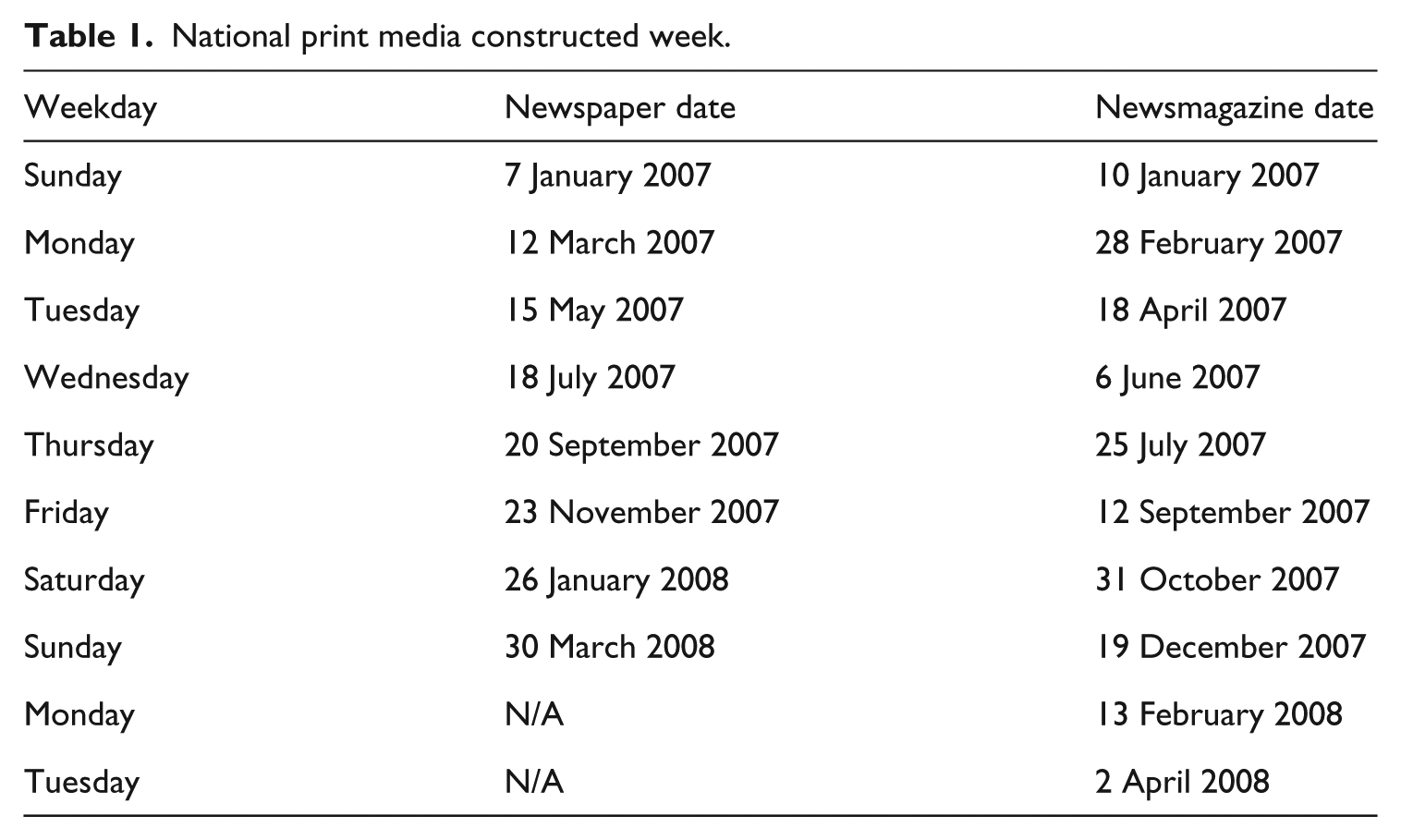
The historically leading national daily, O Jornal do Brasil, published by Editora JB out of Rio de Janeiro, Brazil’s cultural capital; the world’s fourth largest weekly newsmagazine, Veja (Look), published by Editora Abril from São Paulo, Brazil’s industrial capital; and Veja’s lifestyle-oriented insert, Veja-Rio, for Rio, but with a national distribution, are the three news media sampled. Research has shown constructed week samples to be more efficient than other forms of sampling for newspaper studies, with 2–5 weeks of information being optimum (Hester and Dougall, 2007; Riffe et al., 1993). In brief, secondary systematic sampling of newspaper and newsmagazine stories and photos over an approximate 16-month time period, ranging from 7 January 2007 to 2 April 2008, generated 313 (218 O Jornal and 95 Veja/Veja-Rio) articles and 291 photos for analysis. The research time period includes 9 months of news leading up to the premiere of Duas Caras and concludes about 1 month prior to its finale. A news story was defined as an article – a hard news cover story, a letter to the editor or a profiled special interview, as in Veja’s case – from the byline to its last printed word. A photo was defined as a news photograph appearing in conjunction with a news story’s text. Table 1 summarizes this information:
National print media constructed week.
A composite week is similar to a constructed week, yet it serves broadcast medium study purposes rather than print media. As in the case of constructed week sampling, research demonstrates that a sample of two to five composite weeks of broadcast materials is sufficient for a broadcast television programme under study, like Duas Caras (Kunkel et al., 1999; Stern and Mastro, 2004). Given the importance of the initial episode or telenovela premiere, which lays out initial characters, themes and frames, the start date for the composite week was Monday, 1 October 2007. Creating the telenovela sample resulted in five 6-days-per-week composite weeks, or a total of 30 episodes, ending on Saturday, 24 May 2008. The all-important telenovela finale, which was broadcast outside the sample parameters 1 week later on 31 May 2008, was added to the sample, resulting in 31 of a possible 209 episodes, or 1051 total scenes. A scene was defined as an exchange of dialogue between or among telenovela actors on a given topic until a break in the flow of the scene occurred.
With data pooled, Brazilian print national news stories and photos, along with telenovela scenes, have been comparatively narratively analysed to understand news theme framing and intertextuality of favela and favelado representations among the media. Comparative narrative analysis allows for inductive, theoretical, crystallized (Richardson, 1994: 522) interpretation of various media components, including verbal and non-verbal representations or symbols, or texts and visuals (Berger, 1997, 2005). The process is reciprocal and dynamic, rather than linear, with news themes in each medium triggering consideration, then evaluation of possible news themes in other media to surface salient latent news frames. In other words, this exploratory qualitative analysis, in the Rojecki (2005) and Esser and D’Angelo (2006) traditions, went farther than a mere topical assessment; in addition to considering what themes rose from the stories, photos and telenovela scenes, the authors made connections to larger ideologies to give voice to some frames embedded within the media.
Findings
From the study materials, two salient latent frames speaking to the treatment of Brazilian favelas and favelados in (news) media arose. With regard to news reports, the salient latent news frame of Abandoned favelas and favelados emerged. This news frame echoed current understandings and conceptions, even stereotypes, of generalized favela life. However, the salient latent telenovela frame that surfaces in Duas Caras, that of Favela life is ideal father-led life, represented a more normalized, progressive portrayal of Brazilian life. Here, ‘normalized’ would be a more equal media representation of Brazilians, where minorities are more represented and in more leading roles, to satisfy critiques like those of Araújo and Telles. Favelados were shown to be diverse, seeking education, happy and co-existing in a desirable state of peace and security. The two frames, when considered manifestly, are striking opposites, indicating sharp contrasts between news and novela portrayals of a certain Brazilian way of life. However, latently, they converge, pointing to a hegemonic Brazilian paternalistic cultural, political and social tradition.
Salient latent news frame: Abandoned favelas and favelados
The salient latent news frame, Abandoned favelas and favelados, emerged when considering the manifest and latent content within sampled newspaper and newsmagazine reports along with their corresponding photos. In particular, news reports and photos manifestly highlighted concerns with shelter, security, transportation, health and education. With particular regard to the latent news framing of favelas and favelados, news photos reinforced general attitudes regarding this marginalized place and people, since the absence of information can be as telling as its presence. Furthermore, these discounted groups call through news media on government for assistance, tapping into traditional paternalistic Brazilian government ideology.
With regard to shelter, manifest news media content indicated uneasiness with electricity and housing. At the time of this study, about 12 million Brazilians lived without electricity, despite governmental promises and programmes like Luz Para Todos (Lights for All) that guaranteed basic electricity services in the poorest of rural communities by 2008 (see Veja, 6 June 2007: 70). Housing coverage revealed tensions among privileged homeowner groups not boycotting an increase in an already large real-estate tax (the Imposto Predial e Territorial Urbano, or IPTU), despite depreciating land value, but threatening voting against current legislators’ renewed office terms (see Jornal’s 26 January 2008 front-page article). Meanwhile, Rio’s governor, Sérgio Cabral, was quoted as saying that favelas are marginalizing factories (‘fábricas de marginais’ from Veja, 31 October 2007). The news story’s reporter points out that Governor Cabral failed to separate the people from the poverty; it is not that favelados are inherently bad; it is the miserable conditions in which they tend to live that are bad. Those conditions include lack of reproductive counsel or assistance and can encourage crime and violence, including drug and gang warfare.
As sampled news articles manifestly highlighted, paramilitaries and drug gangs within favelas run their own law systems not necessarily parallel with existing order. Jornal, in its 15 May 2007 cover story, spotlighted how drug dealers use the online social networking site, Orkut, to exhibit their arms, including machine guns, pistols, grenades, even hand-held weapons that can shoot down helicopters. However, Veja reports that the well-trained Batalhão de Operações Policiais Especiais (BOPE) is equipped to help; the Brazilian military police Elite Squad, which is trained to fight drug traffickers and gang leaders as well as perform other combat operations, enters favelas to fight drug lords and protect innocent favelados (see Brisolla, 2007).
One of the largest issues the press notes in regards to crime and violence is drug related. The seriousness of the drug problem was underscored by the press’ deliberation on various angles of the topic. Stories surround the people involved in the drug exchanges, drug operatives still being able to supervise and run their organizations from prison, and the various processes in place to annihilate perpetrators and the problem. In addition, the press told the calmer, albeit more dramatic, personalized and impact-oriented, story. For example, Veja-Rio’s 19 December 2007 cover article revealed the pain of middle class parents whose children get into drugs. That another article listed signs to look for in children/teenagers to know if they are involved in drugs suggests the problem is growing within various Rio communities.
In addition to security concerns from crime, violence and drugs was the explicit request for protection from deaths associated with public transportation. Vehicle safety, as Jornal’s 20 September 2007 issue noted, and railroads/commuter tracks or lack thereof, according to several 18 July 2007 Jornal reports, were major concerns. Death from drugs and drug-related concerns was a health issue just as air safety also proved critical.
Education surfaced manifestly with regard to the framing of favelas and favelados. Veja-Rio’s 28 February 2007 issue centered on how Rio’s youth are taking advantage of buildings newly renovated for the explicit purpose of providing more educational opportunities for Brazilians. The corresponding photos showed young men and women sitting at desks with pen and paper ready to study and learn (cover); other young adults sitting in a computer lab as if receiving instruction (14–15); (fe)male students of various ages with backpacks staying after class (16–17) and on their way to class (18, 20). These newsmagazine insert pictures implied that getting your education is the thing to do; everyone – male, female, various ethnicities among a certain young demographic – is doing it. While these pictures seemed more ethnically diverse than those found in the newspaper, few, if any, Afro-Brazilian students appeared, and most of the students shown were more fair or White than not.
Removing text from the newspaper and newsmagazine sample, a Brazil different from what was reported on was shown; colourless stories became colourful as text and photo messages clashed, allowing interesting latent interpretations of news media framing of favelas and favelados. In particular, photos of groups seemed largely to show people of colour in bad situations, in working conditions and as crime committers. For example, the lead photo on the cover of the Jornal of 7 January 2007 was a boat of non-White men and women in knee-deep water. The caption below the photo stated, ‘In Campos, the river South Paraiba overflowed and residents were rescued by boats’. While it is possible that White Brazilians were also involved in the flood conditions, at least the selection of the photo of non-White men and women isolated them as the only ones suffering. This plays into the misconception that non-White Brazilians are poor and need assistance. Similarly, Jornal’s 18 July 2007 photo accompanying the cover story on Rio’s Santos Dumont Airport fire was of non-White workers waiting kerbside to clean up – as the logos on the backs of their uniforms indicated. Furthermore, Brazilians working to unearth and collect guerrillas’ corpses were not White (Quadros, 2007: A2-A3). The message seemed to be that non-White Brazilians are the working force or backbone of the nation, even that they are the ones who do the dirty jobs.
In Veja’s 10 January 2007 special on crime, prison convicts were photographed. The dramatic hands and feet reaching from overfilled jail cells were not White (see the same issue: 48–49). Militia operatives fighting crime in the favelas were not White (see the same issue: 53). In a sea of seated, bare-backed, backs-to-the-camera shot of FEBEM 2 prison inmates, only one man’s skin was lighter than all the others, but it is questionable whether he was White (see the same issue: 80–81). Not even the statistics associated with the crimes mention race. While photos of non-White Brazilians in good situations also peppered the newspaper and newsmagazine, the news was saturated with additional examples of visual references to Black or Brown (‘Moreno’) people in negative situations. This further perpetuates the scenario that the poor are dark and even dirty, substantiating their marginalization.
The underlying tone of the news stories and photos of these discounted groups was a call through news media on the government for assistance. Pleas sounding from news reports and photos of requirements for shelter and protection from crime, violence, drugs, safe transportation and security underscored a certain dependency on the powers that be, like children on parents, to provide basic necessities. This taps into traditional Brazilian government ideology, which has tended to be paternalistic, as will be addressed more in the next section.
Salient latent telenovela frame: Favela life is ideal father-led life
In sharp contrast to the salient latent news frame, Abandoned favelas and favelados, the salient latent news frame, Favela life is ideal father-led life, rose in the telenovela. Known in Duas Caras as ‘a model favela’ (Barreto, speaking to Evilásio, Thursday, 25 October 2007, Episode 22, Block 2) where (fe)male visitors ‘can feel at ease; where they’re at is one of the safest places of the city [of Rio de Janeiro]’ (Gioconda’s testimonial given Saturday, 24 May 2008, Episode 204, Block 4), Portelinha represents a best-case scenario, an ideal ‘band of brothers’ (Monday, 1 October 2007, Episode 1, Block 1). Manifestly, Duas Caras’ presentation of the model favela Portelinha was surprisingly on par inversely with news reports regarding shelter, security, transportation, health and education, presenting a normalized, even idealized, community. The latent framing of Portelinha founder and leader Juvenal Antena as a ‘father who’s willing to make whatever sacrifice’ (Monday, 1 October 2007, Episode 1, Block 2) embodies Brazil’s traditionally paternalistic and patrimonial government.
Telenovela favela Portelinha residents enjoyed shelter. Portelinha’s formation for and by displaced workers appeared authentic because of historical precedent, since many favelas formed through land disputes or seizures, enabling belief in a Portelinha-type reality. Yet, atypical of favela conditions, Portelinha’s houses were nice by any living standard, with solid walls, floors, washing machines and televisions, even indoor plumbing, from what could be assessed. When a fire broke out and destroyed a large part of the favela, refuge was provided in the Samba School until housing could be rebuilt; Juvenal promised his people that no one would stay out on the street (see Saturday, 16 February 2008, Episode 120, Block 2). Workers were seen happily rebuilding houses, like when one White female tour guide took her tours of foreigners to show off Portelinha (see Saturday, 16 February 2008, Episode 120, Block 4).
Telenovela ‘ideal’ favela Portelinha residents benefitted from security; members enjoyed peace, had access to plentiful supplies of money and food, and took pleasure in camaraderie. Not only did novela characters talk about their desires for peace and how those brought them to Portelinha (see Wednesday, 5 December 2007, Episode 57, Block 1), but panoramic shots of the favela often showed ‘Aqui se vive in Paz [Here, you live in peace]’ banners (see e.g. Saturday, 10 November 2007, Episode 36, Block 2). Portelinha people were told in a few instances that they could borrow funds from Juvenal, that he would ‘be your bank’ (see, for instance, Tuesday, 27 November 2007, Episode 50, Block 5). In addition to Portelinha’s spotlighted restaurant, Castle of Saint George, which constantly received fantastic reviews from Rio magazines in the telenovela (see e.g. Wednesday, 30 April 2008, Episode 183, Block 2), food was abundant. Many street vendors sold snacks, and one slender character who constantly ate lots of appetizing-looking foods was teased that she would become a whale (see Friday, 28 March 2008, Episode 155, Block 4). Finally, camaraderie among residents included lots of parties and dances (see e.g. Monday, 14 April 2008, Episode 169, Block 2), communal viewing of the Oscar-winning documentary Battle of Portelinha (see Wednesday, 23 January 2008, Episode 99, Block 3), neighbours socializing (see, for instance, Thursday, 25 October 2007, Episode 22, Block 4), and familial disputes becoming community entertainment (see, for instance, one family’s argument drawing an impressive crowd on Saturday, 10 November 2007, Episode 36, Block 2).
Telenovela ‘ideal’ favela Portelinha residents also benefitted from safe, shared transportation and health. For small fees, residents rode mini-van taxis from central points to wherever it was that they needed or wanted to go (see Saturday, 10 November 2007, Episode 36, Block 4). They travelled without incident or report of incident. In addition, telenovela ‘ideal’ favela Portelinha residents tended to be healthy and to thrive. While one male character’s mental illness ultimately led to his expulsion from his family and Portelinha and later his death, evidencing the safe environment of the ideal favela, another female character’s triumph in overcoming drug addiction was traced.
Education in the ‘ideal’ family of Portelinha received abundant attention. Many Portelinha favelados attended the neighbouring Universidade Pessoa de Morães through the scholarship opportunities its White female president specifically created to help its poor neighbours empower themselves to achieve a higher socio-economic status (see Tuesday, 9 October 2007, Episode 8, Block 4). In Duas Caras, students from Portelinha performed so well that Célia Mara, co-head of the university, suggested to the president that they host a celebration to honour the students’ excellent achievement (Friday, 31 May 2008, Episode 209, Block 4).
While the manifest framing of the favela and favelados sharply contrasts that of the news, the latent framing embodies Brazil’s traditionally paternalistic and patrimonial government. This is particularly evident through the portrayal of Portelinha founder and leader, Juvenal Antena, a ‘father who’s willing to make whatever sacrifice’ (Monday, 1 October 2007, Episode 1, Block 2). Regarding governmental paternity, Brazil’s history of patron–client relationships stems from its turbulent history of democratic periods following colonial-time imperial Portuguese rule and sandwiching (military) dictatorships. ‘In a sense, this is similar to a “good ol’ boys” system; people in positions of power invite their friends to join them’ (Bourdieu, 1986: 241–258). With respect to patrimony, patrimonialist societies – one example being the Roman Catholic Church – can be any form of political domination or authority based on personal and bureaucratic power exerted by a royal or leading household. Paternally and patrimonially, Juvenal was a father to his community: he created and maintained discipline and exercised astonishing wisdom.
It is in the opening episode of the telenovela that Juvenal transitions from the leader of security who opposes squatter groups to the ‘father’ of the group that became favela Portelinha. He struggled legally and ethically with what he should do. Legally, he received direct orders from his employer and his employer’s lawyers to expel the group of contracted poor workingmen from the land they migrated from the North to work and occupy. But, ethically, and with the influence of his conscience plus persuasions from his boyhood-friend, Misael, the right thing to do was to let the migrants stay. In a symbolic gesture, Juvenal removed his black security-labelled jacket, asked his security team to do the same and join him, then invited the migrant men to trust in him, promising them work and a place to live. His commitment to the migrant workers who first formed favela Portelinha plus the other members of Portelinha earned him the title ‘the father of the favela’ (Friday, 21 December 2007, Episode 71, Block 3).
Juvenal created strict law and order with no wiggle room within the first 24 hours of the favela’s formation. The first night everyone was in the favela territory, a fight broke out. When Juvenal arrived on the scene, he created communal law, then decreed, ‘Keep the order. Those who don’t are expelled! … It’s important for everyone to know, in our camp now and in our community in the future, I won’t allow any messing around. Law and order will preside’ (Monday, 1 October 2007, Episode 1, Block 3).
In addition to maintaining law and order, Juvenal sat in judgement in his ‘throne room’. On a regular basis, community members with any questions and/or grievances entered the throne room to speak with Juvenal on a first come, first served basis.
Repeatedly, Juvenal demonstrated that he was ‘in the know’ regarding all aspects of his people. He knew their issues, who the residents were and how they were connected, and how to solve their problems. He did so quickly, easily and surprisingly successfully, such that one character, who benefitted from his wisdom and who would later become the co-director of the neighbouring university, admitted she had never seen anything like him (Monday, 19 November 2007, Episode 43, Block 1). Certainly, Juvenal exercised a type of divine intuition and counsel.
Discussion and conclusion
If combined, Brazil’s 12 million people living in favelas would form Brazil’s fifth largest state, one generating R$38.6 billion annually in commercial activity, which is roughly the equivalent of Bolivia’s gross domestic product (GDP) (Carta Capital, 2013). According to the Instituto Brasileiro de Geografia e Estatística (IBGE) 2010 census, Rio has Brazil’s largest favela population, with about 22 per cent of Rio’s 6 million residents living in more than 500 favelas (Hurrell, 2011). In other words, if all the people living just in Rio’s favelas were combined, they would form Brazil’s ninth largest city (Carta Capital, 2013). What happens when those who are traditionally marginalized in society, but are, in actuality, a huge component of that society, enter a national spotlight?
Framing theory applied through a comparative narrative analysis of 313 news articles, 291 photos and 1051 telenovela scenes allowed Brazilian media representations of a marginalized people, favelados, and marginalized, contested spaces, favelas, to be juxtapositioned. That the timing of news reports and photos with telenovela production were concurrent, yet the manifest media framing of these people and places proved so radically different, makes this study interesting. Even more importantly, the latent framing across media platforms harmonized. ‘Organizing principles’ communicated through intertextual media reports and stories of these marginalized groups operate to shape a certain social reality within the nation-state of Brazil.
Research has demonstrated how powerful imagery can be, debunking what text might say (Coleman and Banning, 2006; Graber, 1990). It substantiates that news reports and their photos could clash. That they did in this study played into a larger, dominant ideology, perpetuating the notion that favelas and favelados are marginalized places and people. While news reports suggested that it is not the people, but the places, that are to blame, it was the telenovela that suggested an alternate reality or possibility for each. In other words, favelas and favelados appeared less marginalized and more normalized in Duas Caras. Table 2 helps summarize findings to this point with regard to manifest media framing of favelas.
Contrasting manifest media framing of news and novela favelas.
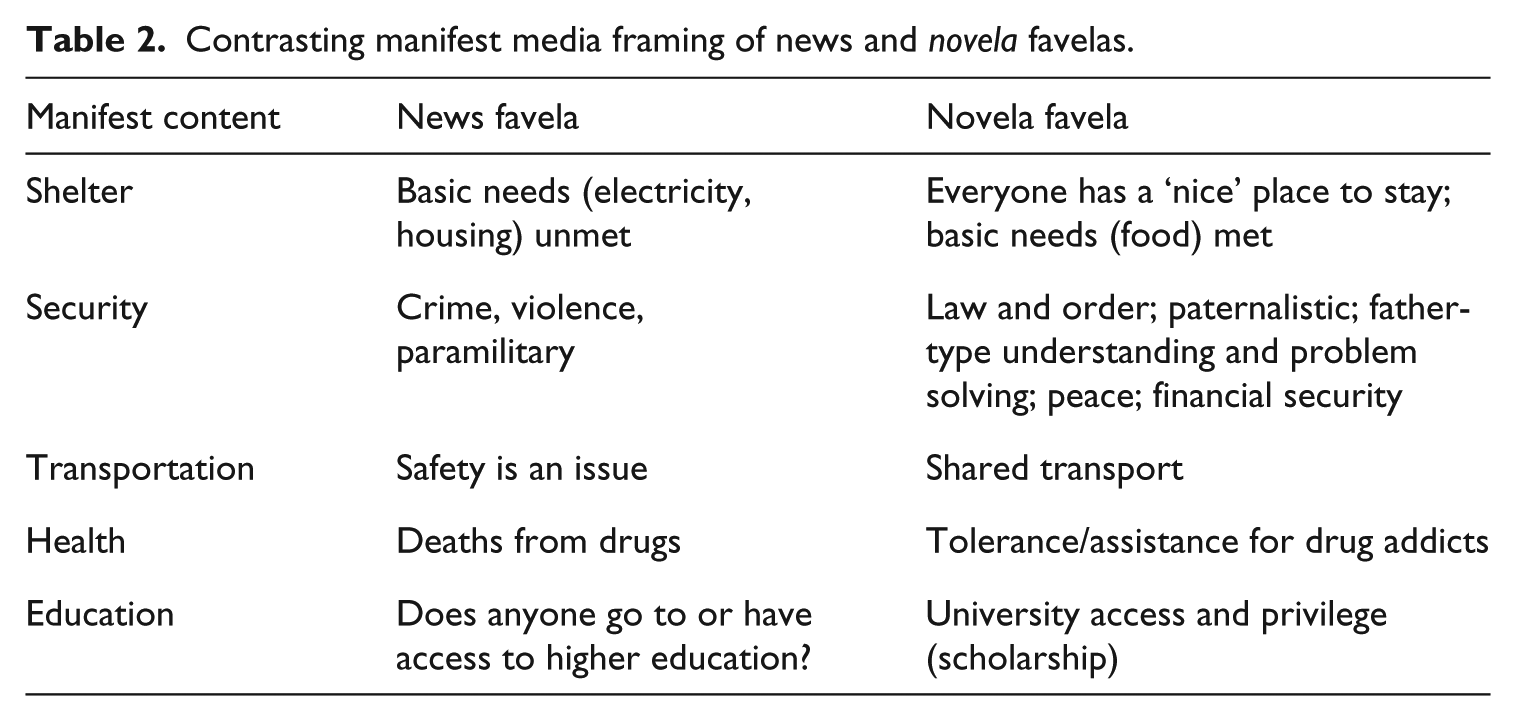
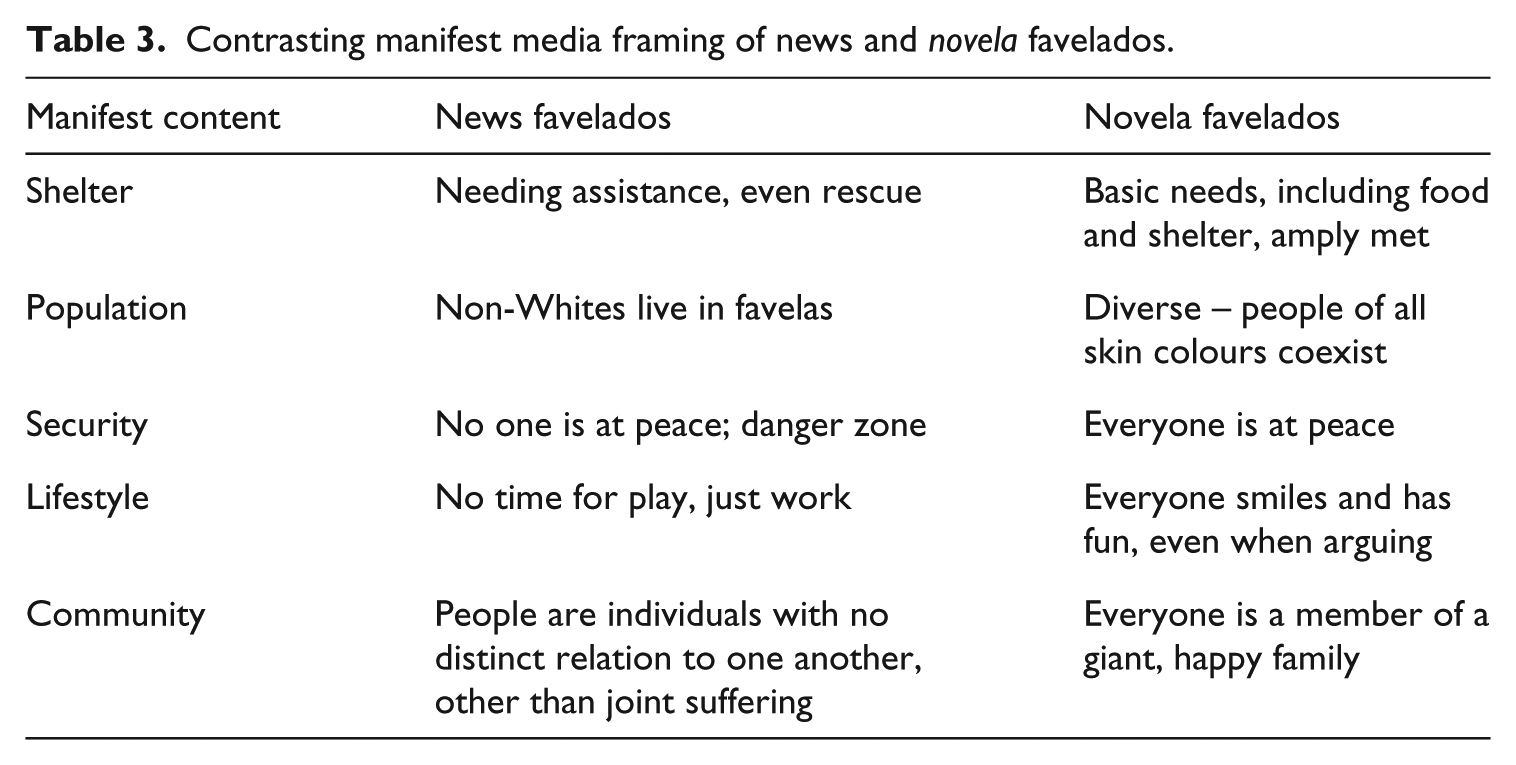
Table 3 helps summarize findings to this point with regard to manifest media framing of favelados.
Contrasting manifest media framing of news and novela favelados.
Although the manifest content showed dialogically opposed news and novela favela and favelado framing, the latent framing synchronizes, tapping into hegemonic cultural, political and historical Brazilian ways of life. In both the news and the novela, the latent message of paternal government zips present-day Brazil with its past. It is (un)consciously familiar to Brazilians, or the way things have been, over time.
News reports, be they stories and/or photos, appear to remain limited in their ability to show what could be. Research over time has demonstrated the tendency of news narratives to frame people of colour as criminals or victims, with Blacks being underrepresented as victims of violence (Dixon, 2007; Dixon and Linz, 2000a; Entman and Gross, 2008) and news consistently over-representing Black criminality (Dixon, 2007; Dixon and Linz, 2000a, 2000b; Entman and Rojecki, 2000). This has led to a sense at least among Brazil’s White populations that the Black populations are the source of much of the vice, decay and criminality in Brazilian society (Garcia-Navarro, 2014). Particularly through imagery, news associates Blacks with the undeserving poor (see, for instance, Gilens, 2004). ‘Aside from crime, perhaps the most frequent and disproportionate association made with persons of color in the news media is poverty’ (Entman and Gross, 2008: 101). Stated another way, according to Tereza Campello, Brazil’s minister for social development and combating hunger, ‘Poverty in Brazil has a face, and that face is black’ (Winter, 2014). This is particularly problematic in newspapers from large cities, like Rio – Jornal’s home – or São Paulo – Veja’s home, which are likely to publish stories about Blacks that ‘… almost without regard to topic, are bound to emphasize the negative’ (Gandy et al., 1997: 178).
Perhaps inherent to the nature of news to focus on negativity, news producers could exercise greater flexibility not only in the types of stories told, but also who tells the stories, since one does not ‘… see Black people writing for newspapers …’ (Rabouin, 2014). Furthermore, this should be expanded to the ways in which stories are shown. That they are not indicates they are stalemating in their representation of societal viewpoints and remaining more susceptible to traditional definitions and understandings, particularly of a marginalized people and place.
The novela, with its more positive manifest framing both of favelas and favelados, could be considered the more progressive media storyteller for at least two reasons. First, it presented a normalized or even ideal reality that should be advanced towards. It is arguable that fiction allows for many of reality’s constraints to be disbanded or relaxed, allowing telenovelas to show a more ‘good life’ portrayal of marginalized peoples and places than news media. This kind of assessment, however, negates the role telenovelas have played within at least Brazilian society over time. Telenovelas have been known for engaging in entertainment–education, which, generally, is entertainment programming with a prosocial message. It is a strategic method developed by Miguel Sabido that attempts to implement a media message to influence social norms and behaviours one way or another (Joyce, 2010; Rosas-Moreno, 2014; Singhal and Rogers, 2004). Not only have studies connected societal evolutions such as decreasing family sizes and various forms of civic engagement directly with telenovelas, but they have also shown that telenovelas continue to serve as alternative news sources. As telenovelas, then, continue their traditional role of informing, educating and defining what it means to be Brazilian within an evolving, partly free ranked press system (Freedom House, 2014), this aim does not seem overly ambitious. Again, as noted earlier, consider the telenovelas and the previously taboo subjects that have begun appearing since Duas Caras, like Salve Jorge and Lado a Lado, as well as the official-since-2010-census Afro-Brazilian majority. Brazil’s former minister for racial equality, Elio Ferreira de Araujo, attributed the officially self-declared Afro-Brazilian majority to growing pride among his country’s Black and indigenous communities (Phillips, 2011). Also, as noted earlier, favelas have begun to receive somewhat positive news coverage, particularly with regard to favelas becoming ever more attractive for various reasons, including their scenic views from their hillside terrain (see Willis, 2013). Changes are occurring in fictional and factual settings, although more prominently in fictional.
TV Globo’s hit 8 p.m. telenovela Duas Caras might also be considered more progressive because of its application of racial democracy, which was discussed earlier. This 1930s notion that all races are equal continues to be contested among critical scholars who consider it a myth (Chaka, 2005; Sheriff, 2001; Stam, 1997). Yet, racial democracy remains a critical component of Brazilian national identity (De Sousa and Nascimento, 2008) and way of life (Htun, 2005). The novela highlighted the election of an Afro-Brazilian to municipal power within the normalized favela at the time that Barack Obama was claiming international acclaim as the United States’ first elected Afro-American president. The novela’s election could mean that all Brazilian races are gaining equal opportunity.
Although the telenovela can be considered the more progressive storyteller, it can also be considered the more harmful, since its news-mirroring latent framing is so enticingly presented. Who would not want to live in a safe haven, where food and money seem easily accessible, all seem generally welcomed, and a strong father figure ensures that all’s well that ends well? Or, who would want to change that existence? Consider Juvenal Antena’s portrayal in the novela. On one hand, he is a kind patriarch or father who can lend money, provide shelter and security. On the other, he is above the rules or norms of society, being able to deftly avoid death. The power of his charisma, as communicated through the actor portraying him, warranted the telenovela writer calling him ‘a god’ (TV Globo, 2008). It seems, then, when considering both news and novela manifest and latent framings of the marginalized that both storytellers are harmful in that they caricature favela life in one extreme way or another. 3
Telenovelas such as Duas Caras evidence manifestly that they are progressive. Through this cultural forum, telenovela authors and producers are able to incorporate (inter)national current events with social, political and cultural issues and play out possible scenarios. They can be a testing ground for reality. However, although Duas Caras hints that White male leadership is shifting and that favelas could be normalized if not idealized, novela framings of people and places latently synchronize with news framings of the same.
In essence, ‘organizing principles’ communicated through national dominant media reports, photos and other visual and intertextual representations of these marginalized people and place operated to shape a certain social reality within the nation-state of Brazil. Framing theory has been critical to making sense of the manifest and latent framing of the news and novela representations, uncovering dialogically opposed manifest messages that are actually latently linked. More studies with regard to at least the news media framing of marginalized groups must occur to better understand its potential effects at least within South America’s leading power and the world’s seventh largest economy (EUBrasil, 2014).
Footnotes
Acknowledgements
Another version of this work appears as a chapter in a book from Lexington.
Funding
This research received no specific grant from any funding agency in the public, commercial or not-for-profit sectors.