




Abstract
This article looks at the representation of Darfur in Kenya from 2003 to 2008. Using Pierre Bourdieu’s field theory and Rodney Benson’s habitus affinity and habitus disaffinity, this article highlights the pitfalls of using ‘African media’ as an analytical category when studying media representations of atrocities by Africa’s press. The evidence presented here suggests the need for an approach that is nuanced when analysing representation of issues of political or social import, especially considering, in the case of Kenyan news organizations, the willingness to lift news reports from Western organizations. By lifting such a large number of stories from wire agencies, the Kenyan media field privileges narratives employed by these organizations. This parsing out of articles is necessary if scholars are to confidently understand how the press in Africa represents Africa to local/national audiences.
Introduction
Writing about coverage of the Ethiopian famine in Africa, David Styan (1999) stated that a majority of African countries got ‘their images of other African countries from a handful of western-based news agencies’ (p. 289). Additionally, he stated, African journalists were rarely, if ever, employed by foreign news agencies due to a bias towards in-house trained staff familiar with the organizational structures of Western agencies. While conducting interviews with African journalists between the summer of 2012 and 2015, the question of how Africa’s press represents African phenomena kept on arising. Journalists voiced continued frustration about who narrates African stories to African audiences. A Kenyan journalist summed it up thus: What is our responsibility? That [relying on foreign news organizations] is actually the failing of the media in this continent […] Where is your credibility going to be? Ten years from now, 20 years from now, somebody reading what New York Times published in the Standard or the Nation [two of Kenya’s leading dailies] or Mail and Guardian [South Africa’s leading online newspaper], what perceptions will they have about the media in the continent? […] We have failed as a continent. (Journalist interview, Kenya, 2012)
Interviews with journalists highlighted a level of ambivalence between wanting to tell African stories and relying on non-African media organizations to tell these stories. Work by Wahutu (2017) shows that among rank-and-file journalists, this reliance on wire services was at times viewed as epitomizing a ‘colonial mentality’ within African newsrooms. Journalists suggested that there is still a belief by some editors that Western news narratives are better and ‘more accurate’ than those by local journalists. The sentiment on accuracy is not unique to journalists, and Kalyango’s (2011) work in Uganda finds that most Ugandans relied more on CNNI for African news than they did on local news.
Styan’s findings and journalists’ frustrations raise an interesting conundrum in the study of knowledge production by news organizations on the continent, especially because news organizations create and shape knowledge of the world outside ourselves (Gans, 1979). Following Styan’s logic, Africans’ understanding of an atrocity on the continent is likely to mimic that of a Western audience. Despite this, the literature on media representations of atrocities in Africa has been largely silent on how African media organizations represent atrocities. The few that have analysed the African press (see Alozie, 2005, 2007; Mody, 2010; Ray, 2009; Savelsberg and Siguru, 2017; Wahutu, 2017) have approached their analysis at the more macro (media organizations) than micro (journalist by-lines) levels. Taking cues from sociology of knowledge, this article departs from this trajectory by proposing a different approach to studying representations of atrocities by the media, an approach that seeks to move beyond an undifferentiated understanding of the press in Africa and is more dynamic than those hitherto espoused. To do this, it argues that using the term ‘African media’ as an analytical category is problematic. ‘African media’ assumes that media organizations in African countries get their coverage of events in other African countries primarily from in-house journalists in their employ or other African news organizations. This article argues and shows that there is a need for media scholars to use by-line accreditation when making any argument about how African media represents events within the continent. While this may not always be a fool-proof analytical approach, the findings of this article show that it provides for a more nuanced understanding of African representation of atrocity in Africa than is currently the case.
This project situates itself within previous work on the representation of Darfur in the African press (see Alozie, 2005, 2007; Mody, 2010; Ray, 2009) and builds on some of the findings in these works on African representations of atrocities in Africa. However, as already mentioned, these works have largely focused on what was published rather than who is credited as filing the particular stories being analysed. Perhaps as a consequence of focusing on what was said about Darfur, Mody (2010) and Ray (2009) argue that there is a convergence of narratives between the African and Western press in their representations of Darfur. Taking arguments by Mody (2010) and Ray (2009) into account, the question, thus, becomes whether or not this convergence is due to journalists in African countries having internalized already present frames and narratives about Darfur, thus the convergence, or if this is an effect of the rise in the use of lifting rights by news organizations.
Domesticating foreign realities for a local audience
Moeller (1999) suggests that ambiguity, and indeterminacy, of social reality abroad is domesticated in an attempt to avoid cognitive dissonance for the audience, a process Park (1940) referred to as creating conceptual order. Domestication takes place through framing an atrocity in a manner aligned with the cultural and historical systems of knowledge and meaning of the target audience (Chin-Chuan et al., 2002; Cohen, 2001; Mamdani, 2007; Merton, 1968). This domestication process relies on employing frames that make ‘nonrecognizable happenings’ into perceptible events (Tuchman, 1978: 192), using what Mannheim (1936) calls a specific ‘style of thought to particular situations’ (p. 3). 1 Hawk (1992) and Seaton (1999) echo this by suggesting that even though journalism may bend language to suit its needs, it still depends on language and frames that will help the audience recognize and make sense of events, what Berger and Luckmann (1966) refer to relying on common sense explanations.
Domestication is partly influenced by the fact that news reports need to enable the audience to make cultural connections between its world and that of the other being represented (Cohen, 2001: 19). Already present and salient frames and narrative genres that highlight good and bad guys or the audiences’ moral obligation to do something or to care are often relied upon to make this connection (Entman, 2004; Moeller, 1999). In the age of online readership, this connection is created through the use (and insertion by some editors) of words and phrases readers are already searching for on Google or likely to do so (see Bunce, 2015: 19). In the effort to domesticate foreign news on atrocity, coverage may misrepresent, and misunderstand, the nature of an unfolding atrocity (Atkinson, 1999; Chin-Chuan et al., 2002; Moeller, 1999).
Studying newspapers
News, whether print, broadcast or online, is the primary medium through which we get to learn about events that happen in other parts of the world. The study of the media, specifically newspapers, as a source of knowledge is not a new scholarship endeavour and can be traced to seminal works by Benedict Anderson (1983) and Habermas (1989) and in Weber’s 1910 speech at the inaugural German Sociological Society meeting (Weber, 1976). Jürgen Habermas posited that 18th-century newspapers provided a space within society where citizens could converse as equals. However, as the 18th century drew to a close, he notes, this space became commercialized and consequently ‘refeudalized’ by capitalism and the capitalistic class. As such, newspapers moved from being a space accessible by everyone in society into one whose access was controlled by those with resources and a profit motive. Contemporary scholars such as Schudson (2011) have echoed Tocqueville’s view of the role of the news and newspapers more generally by positing that printers in colonial America sought to unite citizens by primarily printing foreign news which eschewed local politics and afforded the local readers no grounds to grumble about local politics. Foreign news, therefore, worked to and continues to other the foreign by creating a dichotomous view of the world.
Sociology of knowledge alerts us to the fact that due to their social context and taken-for-granted knowledge, journalists are bound to have a perspectival view and understanding of the reality they construct and give meaning to (Gans, 1979). Schudson (2011) highlights this point by stating that the very act of communicating to the audience, journalism’s primary function, is a ‘social coordination of individuals and groups through shared symbols and meanings’ (emphasis not in original; p. 11). Moreover, journalists not only produce the news but also, simultaneously, engage in constructing and giving meaning to reality (Gans, 1979). Rosen (1999) informs us that some journalists define their roles as a craft that builds the world for the audience while also, concurrently, describing this world to the audience. The influence of journalists in creating and shaping knowledge about the world is also seen in Stephen Ostertag’s (2010) article, where 63 per cent of his respondents ‘were solidly confident in their knowledge and understanding’ of issues ‘going on in the world’ (p. 835). In Kenya, Mbeke et al. (2010) found that approximately 80.6 per cent of Kenyans fully trust the media.
Concomitantly, it is also true that audiences do not always ‘decode’ media messages in a monolithic fashion. Just as journalists’ social context is important in news production, so too is the audience’s social context in their ‘decoding’ of news articles (Hall, 1980). To avoid what Mannheim (1936) refers to as ‘talking over each other’ when framing the news, journalists will ‘encode’ narratives in a manner that invites their preferred ‘decoding’. Media influence is, thus, not a path-deterministic process but, rather, path-dependent. Information gleaned from a news story is not predetermined by journalists who produce the news. Rather, journalists inscribe preferred decoding pathways through ‘words and images highly salient’ within society’s knowledge structure (Entman, 2004: 6). Newspapers should therefore be understood as repositories of knowledge, representing (by and large) society’s understanding of contemporary events. Accordingly, it is important to highlight the important role played by journalists in the creation and maintenance of this reservoir in their use of language and frames that are familiar and easily recognized by their audience. 2
Yet, despite the role played by social context in influencing journalists’ perspectives, it is also important to highlight that journalists do also internalize the ‘rules’ of their journalistic habitus. This habitus is more likely to reflect the ethos and social context of the news organization that employs them. Emirbayer and Johnson (2008) state that professional habitus will at times override one’s social context. As a result, how local journalists working for the wire services frame a story is likely to be influenced and derived from organizational expectations in addition to, rather than solely from, personal experiences and cultural schemas that exist independently in their psyches (Martin, 2003; Merton, 1968). As such, a local journalist working for an international organization (such as Reuters) is likely to frame a story according to Reuters’ ethos on news coverage as highlighted in A Handbook of Reuters Journalism (Reuters, n.d.). Conversely, an international journalist living in Nairobi and working for a news organization from Kenya would frame his or her story according to the ethos of the local news organization. It is this understanding and approach to newspapers and journalists that anchors this article’s use of by-line accreditation to parse out news articles.
Theoretical underpinning
This article takes a field approach to its analysis of news coverage of the atrocities in Darfur (Bourdieu, 1999). It takes as a fact that the Kenyan media field is part of what Rodney Benson (1999) refers to as a ‘world media system’, within which one may find a convergence and divergence in narratives and practices (p. 484). Within the media field, journalists jostle for positions of influence and cultural capital, which is captured in the number and page placement of articles credited to particular journalists. Recently, Benson (2013) has also added to our understanding of field analysis by proposing the twin ideas of habitus affinities and disaffinities. He (2013) states that habitus affinities will ‘lead to more (and positive) news coverage of some groups whereas habitus dissafinities could contribute to less (and less positive) news coverage of other groups’, (p. 27). One may therefore assume that when reportage of atrocities in Africa occurs, the journalists occupying positions of influence in the field will be those with habitus affinities (African journalists) and not those with habitus disaffinities, that is, Western journalists.
Methodology and case studies
Using Kenya as a case study and Benson’s (2013) habitus affinity and habitus disaffinity, this article analyses who produced news about the atrocities in Darfur between 1 January 2004 and 31 December 2005. It does this through a content analysis of news reports published in the Kenyan press between these 2 years, focusing especially on the by-line accreditation of each story. The content analysis centres on articles on Darfur published between 2004 and 2005 by two of the leading media organizations in Kenya: the Nation Media Group (NMG), which publishes The Daily Nation and The East African (a regional weekly), and the Standard Group (SG), which publishes the East African Standard. At the inception of Kenya’s independence, The Daily Nation (hereafter The Nation) and the East African Standard (hereafter, The Standard) were the only two privately owned newspapers in the country (Ogola, 2011). This content analysis is coupled with interview data with Kenyan and South African journalists conducted between 2012 and 2015.
The Nation, founded in 1959 by Michael Curtis and Charles Hayes and bought by the Aga Khan in 1960, supported Kenya’s independence (Ainslie, 1966). 3 However, Ogola suggests that this was more for self-preservation than a wish to agitate for Kenya’s self-rule (2011). Ogola suggests that the Aga Khan sought to ensure that his business interests would be protected by not only the incoming regime but also the sizeable Ismaili community in Kenya (2011). Its parent company, The Nation Group (now the NMG), brought ‘a new tabloid format and exciting layouts for the first time to East Africa’. Its printing technique, web offset, was new not just in Africa but also in the world, which made its newspapers technically comparable to newspapers in the Global North (Ainslie, 1966: 105). 4 The Nation’s format liberally used images with its news and its layout ‘brought for the first time in East Africa the concept of the newspaper as entertainer’ (Ainslie, 1966: 105).
The Standard, on the other hand, vociferously sought to expand British military presence and justify violence against the liberation movement leaders and indigenous populations. This was after the paper’s founder, Alibhai Mulla Jivanjee, sold it to European owners, who were ‘more white settler-friendly’ (Kadhi and Rutten, 2001: 243). The Standard became a voice for the ‘white settler community and was fiercely against internal self-rule’ (Ogola, 2011: 81). Ainslie (1966) alerts us to the fact that ‘ [The Standard] expressed all the White hysteria, all the angry settler demands for more and more repressive action by the Colonial office that made this period the ugliestin Kenya’s history’ (p. 100). The Standard had ‘largely ignored the “winds of change” sweeping over Kenya and the British empires in the 1950s’ (Bourgault, 1995: 163). After independence, however, The Standard began to support the government. President Kenyatta, initially refered to as an evil genius, now became the man ‘to thank for a peaceful transition to independence’ in the columns of The Standard (Ainslie, 1966: 103). This support was, just like The Nation’s, predicated upon its pursuit to curry favour with the new government (Bourgault, 1995: 81).
These two newspapers have a rich history in Kenya and can arguably be viewed as good barometers of Kenyans’ engagement with events beyond Kenya’s borders. The choice of 2004 as the first year to be analysed is grounded on the fact that 2004 represents the period when there was an intense international glare on Sudan and Sudanese politics. It is also the year that Darfur got into the international arena proper with the then United Nations (UN) Secretary General Kofi Annan speaking on the violence before the UN General Assembly. Despite the attack on the el-Fashir airbase in 2003, there was no coverage of Darfur in 2003 in either Kenya that this project could find. This was not unique to Kenya since work by Savelsberg (2015) finds that there was initially little to no coverage of Darfur in the Global North in 2003. The year 2004 was also the time that the United States designated the atrocities in Darfur genocide, with a host of American officials visiting the region and several peace meetings taking place across the continent. The year 2005 was when the UN instituted a commission of enquiry that would deliver its report to Kofi Annan, with the Security Council recommending that the International Criminal Court (ICC) probe the crimes committed in Darfur.
The choice of Kenya as a case study is informed by the fact that it has historically had a more robust media field than its neighbours in the region. It is important to note, as well, that Kenya’s media field invites mixed opinions from those who view it as deeply compromised (see Nyamnjoh, 2005) to those who point to its vibrancy and call it the ‘most respected, thriving, sophisticated and innovative in Africa’ (BBC, 2008). However, despite these opinions, the fact that Kenya has been seen as a comparative oasis of peace in the Great Lakes Region makes it the most suitable neighbouring country to analyse.
Findings
As shown in Table 1, of the 197 published newspaper articles on Darfur between 2004 and 2005, a bulk of the coverage, 119 news articles, was provided by the wire services. Only 24.87 per cent (49 articles) of the news coverage was credited to Kenyan journalists. This figure includes 12 op-eds written by individuals from Kenya. In addition, 9.5 per cent (n = 19) of articles were attributed to journalists and individuals from the Global North and eight articles have no by-line attribution. Only one article was lifted from the Sudan News Service and two were from the former UN news organization, Integrated Regional Information Networks (IRIN). Those articles by multiple authors are coded according to where the first author was located. Thus, if the first author is Kenyan and the second authorship was credited to Reuters, the article was coded as being written by a Kenyan journalist and vice versa. Coding the articles based solely on the first author eliminates the risk of an article being coded multiple times. 5
By-line accreditation in Darfur coverage, 2004–2005.
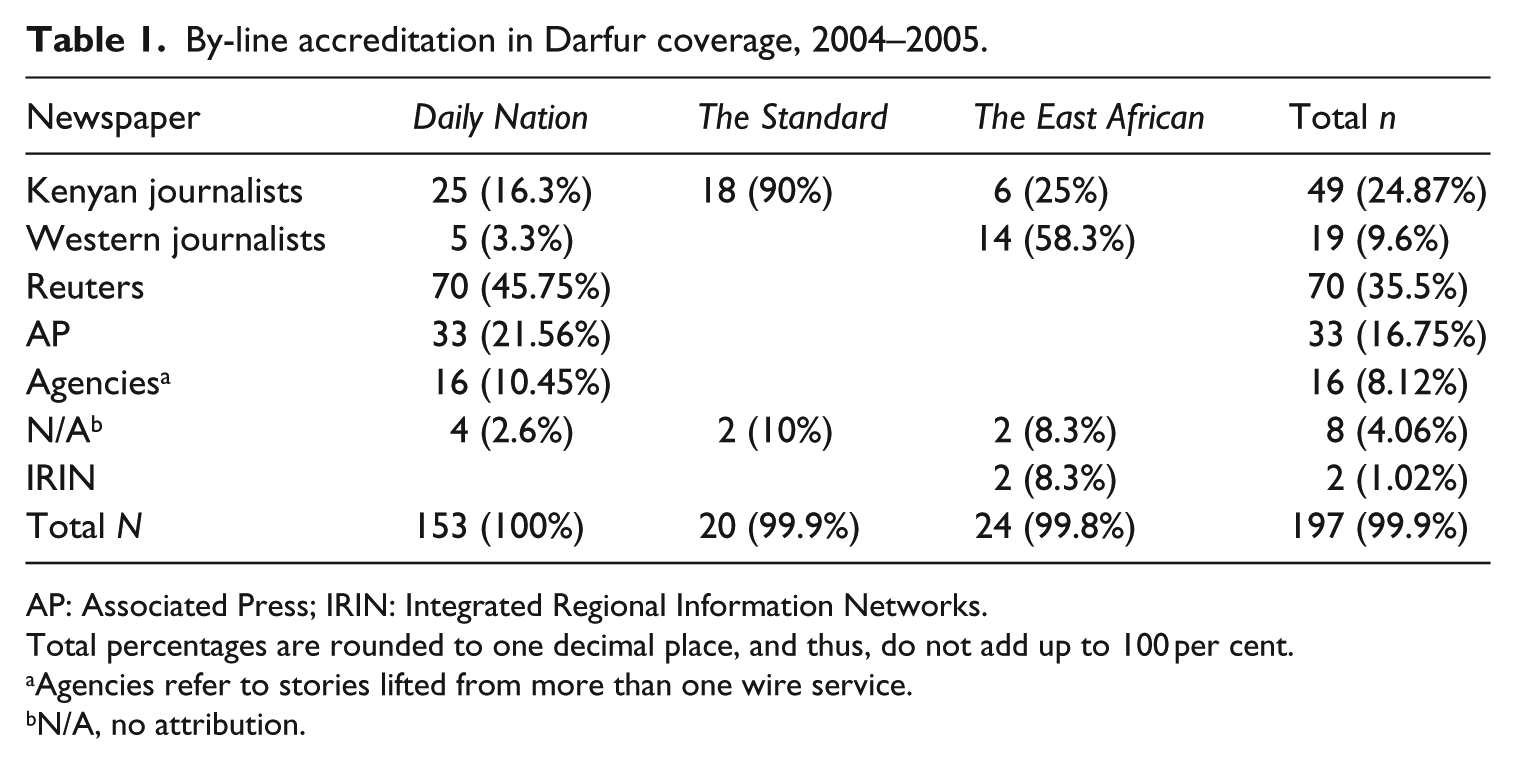
AP: Associated Press; IRIN: Integrated Regional Information Networks.
Total percentages are rounded to one decimal place, and thus, do not add up to 100 per cent.
Agencies refer to stories lifted from more than one wire service.
N/A, no attribution.
Table 1 points to The Daily Nation being the most active in its coverage of Darfur, with a total of 153 stories, followed by 24 stories by its sister publication, the East African, and 20 by The Standard. The disparity in coverage can be attributed to the resources at the disposal of NMG as compared to SG. In 2011, NMG was ranked the ‘biggest media firm in Africa outside South Africa, with a market value of $324 million and a 52.54 per cent dollar return’ (Maweu, 2014: 28). In the same year, The Daily Nation boasted a total weekly readership of 5.5 million readers compared to 3.3 million for The Standard (Nyabuga and Booker, 2013). The Daily Nation had a total of five news articles by foreign journalists: one by Somini Sengupta, then with The New York Times, two by Kevin Kelley from the United States and two by Meera Selva, currently at The Guardian. The Standard did not have any article credited to a particular foreign author during the duration studied here.
‘Knowing’ about Darfur
Recalling scholarship on knowledge production by the media (see Fine, 2001; Park, 1940; Schudson, 2011), it is worth noting that wire services, and those who staff them, have a perspective that is representative of their social context. As socialized members of society, journalists’ knowledge is representative of and anchored upon their societal influences (see Benson, 2013; Gans, 1979). Work by Gruley and Duvall (2012) and Tsatsou and Armstrong (2014) echoes this scholarship by pointing to how Western understandings of the Global South, and ethnocentric approaches to covering foreign atrocities, negatively affect how atrocities such as Darfur are covered by media fields in the United Kingdom and the United States.
From Table 1, it would be correct to surmise that The Standard presented its readers with understanding that was better informed by, and attuned to, Kenya’s social context and realities than The Daily Nation did. However, considering its total number of news reports compared to those by The Daily Nation (and the latter’s readership numbers), it is evident that for the average Kenyan newspaper reader, their understanding of Darfur was largely influenced by The Daily Nation. This results in a paradoxical situation in which journalists with habitus dissaffinities appear to occupy the positions of influence within the field, as epitomised by the sheer number of articles about Darfur lifted from wire services. Wire agencies play a key role in the knowledge production process, which makes them appear (to the ordinary news consumer) a more credible source of knowledge than those with habitus affinities. One effect of this is a transposition onto the audience a monolithic understanding of the role of local actors in the conflict. This framing of local actors to the conflict is likely to take on an even more hegemonic quality in Kenya where, as Mbeke et al. (2010: 55–56) show, a large number of people fully trust the media.
Editors explained the ubiquity of wire services as being largely a result of stretched/limited resources. Although data on comparative costs are currently not available for use here, it is instructive that NMG have two in-house journalists whose beat was Sudan and South Sudan. Yet, as highlighted by Table 1, NMG had the largest share of its articles on Darfur lifted from wire agencies. Nonetheless, an NMG editor put it to me that in the Darfur instance, we almost exclusively rely on the wire agencies because our network of correspondents […] we are not in every country […] So when it comes to the coverage of that war we largely depend on the wire agencies […] they will have the resources and have the advantage of their agencies operating in this area for a long time. (Editor interview, 2012)
Rank-and-file journalists who have worked on Darfur stories viewed prevalence of wire services stories differently. They were frustrated by the fact that their organization had lifted stories from wire services, some of which were filed in Nairobi, or decided to include a story lifted from a British newspaper when it had a journalist visiting and reporting from Darfur (see Agencies, 2005; Associated Press, 2005; Selva, 2004a, 2004b). This despite the stories lifted being less detailed and far less contextualized than those filed by their own journalist in Darfur. A journalist, whose knowledge about the region is regarded as unparalleled by his colleagues, complained that when you are talking about issues next door, we are better placed than them. But you see this thing has something to do with colonisation, it […] it […] which is also creeping into […] you see it everywhere, you see it in restaurants, you sit here and a mzungu (white person) comes and they rush to him. You see it everywhere. Some editor in his mind thinks that a [westerner’s] story would be better than yours. (Journalist interview, 2015)
This privileging of narratives by wire agencies is not unique to the Kenyan media field. In South Africa, news on Darfur was primarily from wire agencies as well. South African journalists explained this as being a consequence of not only limited resources but also audience interests: the other is interest […] at the end of the day we are at the mercy of our readers. So we don’t ignore the issue (Darfur) altogether, that would be irresponsible, but we don’t necessarily want to spend exorbitant money on something which we know our readers are not that interested in. (Editor I interview, South Africa, 2012)
The point raised about audience interest is one that was ever present in interviews with South African journalists. There was a sense that the audience in South Africa (and, by extension, South African society) was insular in nature and was, thus, less likely to be interested in Darfur unless it had specifically something to do with the nation’s well-being, which is reflected in what the newspapers actually covered. Consider the following two interviews with South African journalists both of whom were editors on the Africa desk of their respective organizations: [O]ne thing you must understand about South African media is that it’s incredibly insular and incredibly parochial, so therefore you won’t find us ever leading a newspaper, or a radio bulletin or anything like that with a story relating to Sudan unless it’s something like Thabo Mbeki was shot in Sudan. (Editor I interview, South Africa, 2012) there is just […] there is just no […] seriousness about covering the continent you know it is just yeah […] South Africa is insular […] it is beyond insular and perhaps that is the kind of hegemonic power that you know Africans feel disdain about. (Editor II interview, South Africa, 2012)
In this sense, the use of wire services provides South African news organizations with a way to keep an eye on the goings-on across the continent without expending too many resources. This partly explains the findings in Mody’s (2010) work on South African representation of Darfur, which finds a convergence in narratives on Darfur.
This is not to imply that there are no local journalists employed by these organizations – there very well might be. Reuters, for example, has Kenyan journalists working for it in its Nairobi offices. However, local journalists are often in the minority and have internalized the ‘rules of the game’ as to the editorial stances and preferences of editors and sub-editors; these two groups of people are often (if not always) Western. For example, in Reuters’ Nairobi office, Bunce (2010: 521) found that all managerial positions were filled by Western nationals, with just five Kenyan journalists, one South African television producer and one Ugandan correspondent. Wire agencies, in this regard, resemble what Boyd-Barrett (2001) calls models of colonial outposts where expatriate command, control and narratives are privileged.
Voices from Darfur
How the audience ‘knows’ about Darfur is also influenced by whom news organizations give a voice to. The choice of sources is a subjective process that implicitly anoints which voices should be seen as credible and worth paying attention to (see Gans, 1979; Hallin, 1989; Hilsum, 2007; Sigal, 1973). Both Kothari (2010) and Schudson (2011) highlight the important role played by sources in framing a story. Kothari’s (2010) work, especially, investigates how sources quoted by New York Times journalists affected the framing of Darfur.
Two articles in 2004 crystallize the benefits of not only paying attention to by-line accreditation but also being cognizant of the role sources play in shaping Kenyan audiences’ understanding of Darfur. Both were written from refugee camps in Darfur and were published by The Nation 2 months apart. The first, by Somini Sengupta (2004), was lifted from the International Herald Tribune and the other was by an in-house Kenyan journalist, Peter Kimani (2004). Both stories refer to the conflict as one pitting the ‘Arab-led’ government and its proxy (the Janjaweed) against ‘black Africans’ in Darfur (see Wahutu (2018) on the use of this binary by media fields in Africa. Both frame the atrocity as an ethnic conflict and a humanitarian crisis, which is in keeping with how media fields in Rwanda, South Africa and Egypt generally framed the atrocities (Wahutu, 2018). This is where the similarities end.
Kimani (2004) talks about the effects of the conflict on neighbouring countries such as Uganda, while also highlighting the number of refugees being hosted by Kenya and Chad. He mentions the inadequacy of African Union (AU) troop numbers, which has led to heightened insecurity within the two internally displaced person (IDP) camps, Otash and Kalma, that he visited. To provide a mental image of the suffering and violence, Kimani uses direct quotes from several Darfuris within the two camps. Consider these two extracts from Kimani’s reporting: Farid Phillip, a Christian of Arab ancestry, does not consider religion the biggest obstacle to lasting peace in Sudan […] ‘There are many struggles here, cultural and religious, but there is also the economic question’. When I ask his views on the persecution of his people [the Fur], he explodes to reveal his true feelings – untempered [sic] anger – that’s as shocking as it is revealing […] ‘I have given my children Western names like Fernando and Nancy and my relatives have been wondering why. I hate the religion imposed on me, and I decided my children will not go through it again’.
This last extract is taken from a longer one in which Kimani interviews his translator, Adam, a Fur Muslim, who says that he has been treated ‘contemptuously in government offices and cannot secure a job’ (Kimani, 2004: 13). Thus, in not only tone but substance as well, Kimani provides his reader with what Benson (2013) refers to as a multiperspectival narrative on Darfur by including Darfuri voices, voices of Kenyan scholars and Sudanese government officials.
Sengupta’s (2004) article takes a different approach to covering life in an IDP camp. She profiles two Darfuri women in Oure Cassoni camp. The reader, however, never hears the women’s voices, rather Sengupta makes the women’s experiences legible for her audience by choosing to narrate their experience for them. Consider the following extracts from her reporting: Hawa Hassan Ahmed, 29, arrived here at the Oure Cassoni camp after her mountain hideout in Northern Darfur was attacked by the Janjaweed […] she escaped alone on a donkey sent up to the hills by her cousin. Khadija Ahmed, under the acacia tree outside Oure Cassoni, survived [an] attack in Amborou […] and only left after her livelihood – her 75 cows – were rounded up and taken by soldiers.
The reader hears only two voices, that of Sengupta narrating the stories of Hawa Hassan and Khadija Ahmed and that of a Western United Nations High Commissioner for Refugees (UNHCR) official quoted by Sengupta. Sengupta’s approach to covering life at the Oure Cassoni camp epitomizes Hannerz’s (2012: 142) argument that in the coverage of Africa, victims are rarely, if ever, given a voice to narrate their own experiences and often ‘remain mostly silent’ (for a different variant of the same argument, see Mathers (2012).
Concluding discussion
African news organizations are lagging behind in the production knowledge about events unfolding in the rest of the continent. Instead, they habitually reproduce knowledge produced by wires agencies, challenging Benson’s (2013) proposition on the role and influence of habitus affinities and disaffinities. There is a continual placing of voices from the metropole at the status of the universal standard, which, in turn, places into hierarchies’ differences in expression into spatial (Northern Muslims vs. Southern Christians) or temporal (civilized centre vs. primitive periphery) categories (Boatcă and Costa, 2010). This is the case even when there was a general drop in overall coverage which was more pronounced in coverage by African journalists than in coverage by wire services. 6 The end result is a creation of what Becker (1967) has referred to as a hierarchy of credibility. Within this hierarchy, Kenyan journalists are closer to the bottom.
The prevalence of articles by wire agencies in Kenya also places voices from the metropole at the status of the universal standard, the effects of which Boatcă and Costa (2010) have eloquently discussed. Not accounting for this dominance is what leads to scholarship on Africa’s press arguing that there is a convergence in narratives on atrocity between the media field in Africa and media fields in the Global North. I suggest that what is happening is less a convergence of narrative about Darfur, but rather a pushing to the periphery of African narratives about Darfur by African media fields. This demonstrates the importance of more gradation than has hitherto been the norm in the study of representations by media organizations in African countries. Furthermore, this article has shown that knowledge on Darfur is primarily produced by one organization. It is clear that Reuters occupies a position of influence that is much higher than African news organizations and plays a hegemonic role in producing knowledge about Africa to the detriment of African voices.
This article highlights the pitfalls of using ‘African media’ as an analytical category when studying representations of events like atrocities by Africa’s press. The evidence presented here suggests the need for an approach that is nuanced when analysing representations of issues of political or social import. More specifically, Kenyan news organizations (Table 1) seem to be more than willing to use news reports from Western organizations in their coverage of atrocities. By lifting such a large number of stories from wire agencies, the Kenyan media field privileges narratives employed by these organizations. These findings show why scholars of African representations of Africa[ns] need to reassess what counts as an African representation and what is merely a reproduction of Western news representations of Africa. This parsing out of articles is necessary if scholars are to confidently understand how the press in Africa represents Africa to local/national audiences.
Footnotes
Funding
The author(s) received financial support for the data collection for this article from the Bernard and Fern Badzin Fellowship in Holocasut and Genocide Studies through the Center for Holocaust and Genocide Studies at the University of Minnesota-Twin Cities.