




Abstract
Based on a critical reading of the International Panel on Social Progress (IPSP) report on media and communication, this article presents various issues central to media democracy in Latin America. The response to the IPSP report examines four key elements: (1) access to media and digital platforms, (2) the potential impact of Internet Service Providers (ISPs) on freedom of expression, (3) Net neutrality as an essential component of digital platforms and 4) issues of concentration, diversity and pluralism in media and digital platforms.
The International Panel on Social Progress (IPSP) chapter on ‘Media and Communications’ is comprehensive, ambitious and fascinating; it is an indispensable contribution to those of us who deal with these topics from a democratizing perspective. I appreciate the opportunity to share some supplementary ideas and reflections about the Latin American experience.
A recent, still unpublished report made by OBSERVACOM (‘Concentration in the Digital Ecosystem and Its Impact on Freedom of Expression’) reveals the role that major Internet corporations play in the free flow of information and communication, and the true access to content available on the Internet. It also identifies the increasing number of problems derived from concentration in the new digital economy (both at the level of infrastructure and Internet Service Providers (ISPs) and at that of intermediaries or platforms). I would like to share some of the main findings and conclusions of the report.
Access: A central issue
A major point of the IPSP report is the inclusion of access as the main topic of the public agenda. Allow me to make some comments in this regard:
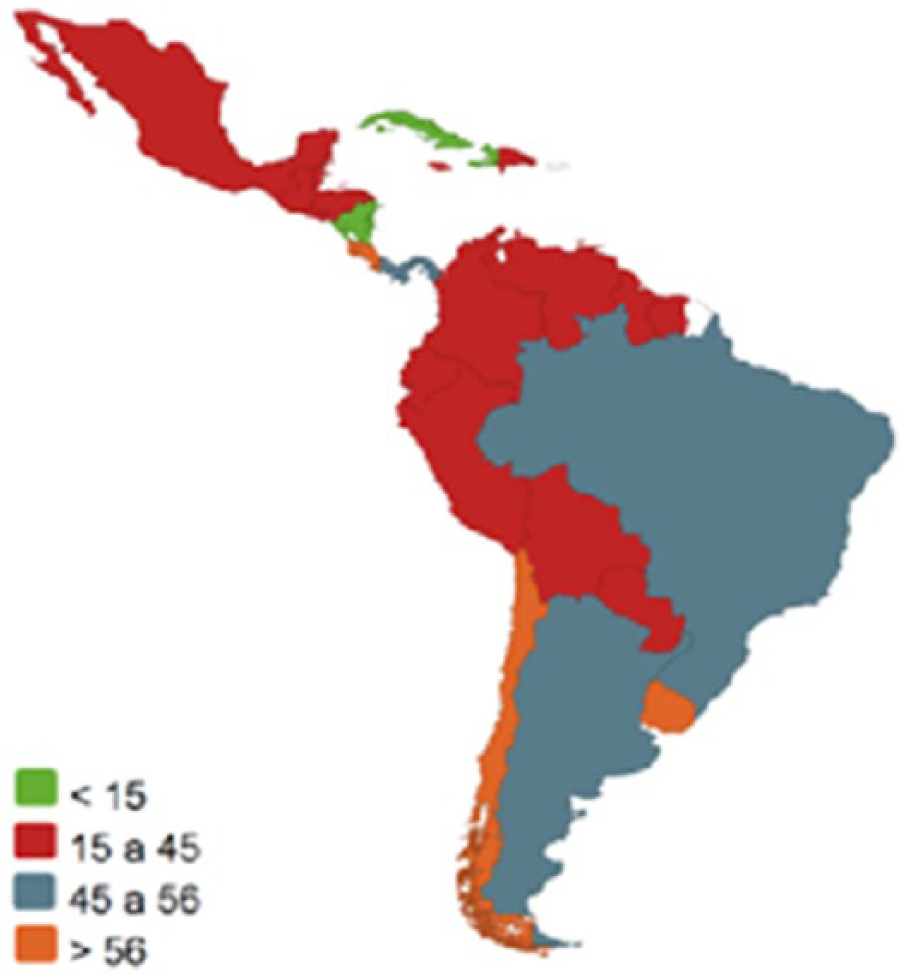
(a) The IPSP report stresses the need to address the concept of ‘access’ not as just ‘connectivity’; it rather proposes a critical approach to the international agenda. We all share the need for a more holistic approach that incorporates the notions of use and appropriation of information and communications technologies (ICTs) by citizens so that they become, in fact, tools for social progress. (b) However, the traditional concept of access to the Internet is still valid in Latin America due to the broad digital gap (e.g., between Latin American countries and the members of the Organization for Economic Cooperation and Development (OECD), between and within Latin American countries) generated by social, economic or geographical factors. Universal access to the Internet is a debt in our region since, in most of our countries, connectivity is far from reaching 50 per cent of the population, as shown in the following charts that illustrate the state of Broadband in Latin America and the Caribbean in 2016, according to the report of the Economic Commission for Latin America and the Caribbean (ECLAC).
Households connected to the Internet, 2015.
(Percentage of total number of households)
Source: ORBA (Regional Observatory of Broadband) of ECLAC based on data provided by UTI, World Telecommunications Indicators Database, 2016. Numbers indicate regional average of households connected to the Internet. Chile and Mexico are not included in OCDE numbers.
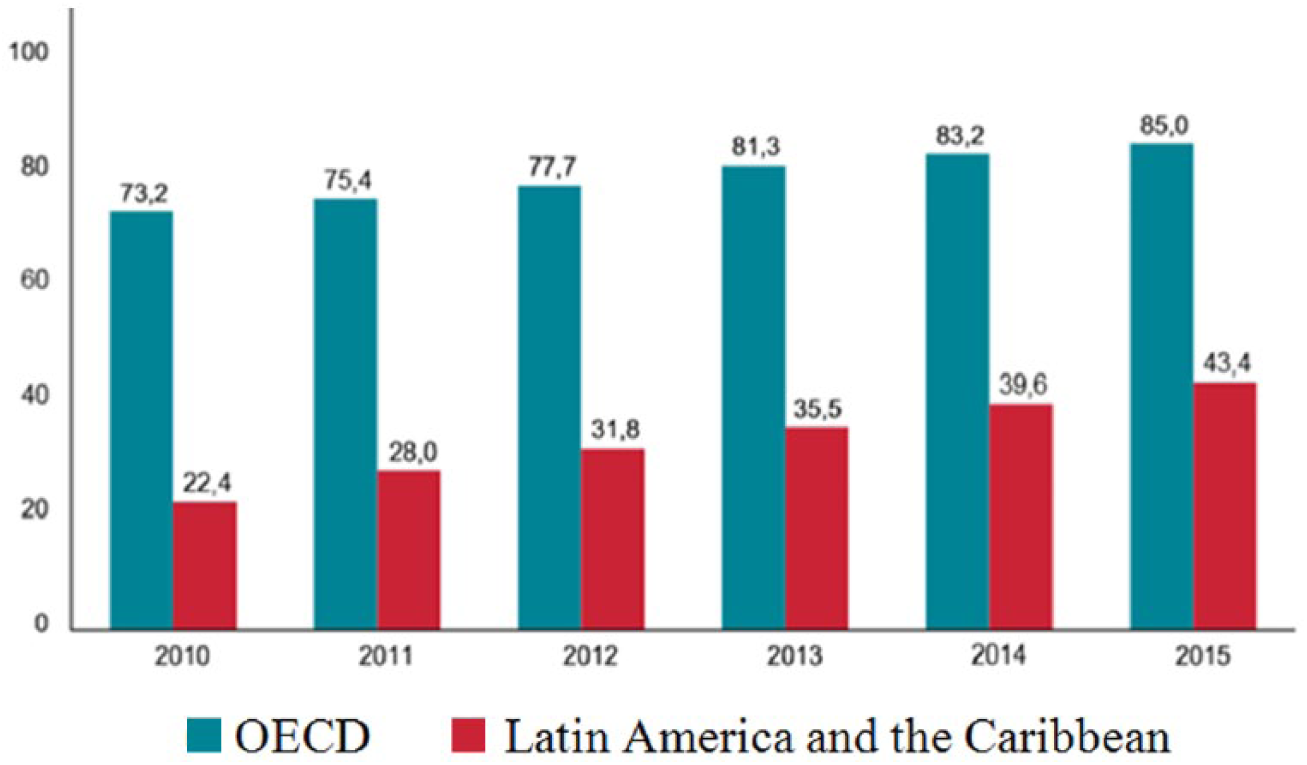
Internet users, 2015.
(Percentage of the whole population)
Source: ORBA (Regional Observatory of Broadband) of ECLAC based on data provided by UTI, World Telecommunications Indicators Database, 2016. Chile and Mexico are not included in OECD numbers.

Percentage of households with Internet access.
(Percentage of total number of households)
Source: ORBA (Regional Observatory of Broadband) of ECLAC based on data provided by UTI, World Telecommunications Indicators Database, 2016.
(c) This debt to the poorest and most vulnerable majorities reminds us that this digital gap affects freedom of expression, as reiterated by the Rapporteurs for Freedom of Expression of the Inter-American Commission on Human Rights (IACHR) and the UN. In Standards for a Free, Open and Inclusive Internet, the American Rapporteur states that ‘Today, Internet access is a sine qua non condition for the true exercise of human rights which include the right to freedom of expression and opinion, association and meeting, education, health and culture’; the American Rapporteur also says that ‘the lack of Internet access increases vulnerability and inequality, and perpetuates social exclusion’. Frank La Rue, former Rapporteur for Freedom of Opinion and Expression of the UN, said in his 2016 report that Internet access is a right, for ‘having no access to the Internet, which facilitates economic development and the exercise of various human rights, means that marginalized groups and developing countries remain burdened with a disadvantageous situation that perpetuates inequality between and within countries’.
(d) The question of access to sources of information and communication in our region transcends the Internet and also requires maintaining policies that guarantee universal access to traditional media such as over-the-air television. Without leaving aside the rapid growth of Internet services and platforms, an agenda on media and communications that fosters social progress should not ignore the important role that traditional media still play in most Latin American and Caribbean countries.
(e) If we go back to the idea of Internet access of those who have connectivity, we should highlight the role of gatekeepers and the enormous power that telecommunications corporations or ISPs may have on the free flow of information and a free and open Internet. One of the threats to open access to online content is the possibility of these companies’ biased treatment of the content distributed through their networks. The prospect of Net neutrality aims at avoiding the infrastructure operators use their power to control the speed and traffic conditions of service and content suppliers on the Net. This power would allow them to market ‘fast lanes’, and/or give priority to companies belonging to their own economic group, or to hinder services of their own competitors or their allies’ competitors. Thus, the issue of Net neutrality is a principle that civil society should defend (even though it is also defended by Internet giants, albeit for commercial reasons). Threats to freedom of expression through the fragmentation of Internet access conditions in the region also include practices that offer free access to particular services (e.g. ‘zero-rating’) and connectivity (e.g. ‘free basics’); these create a sort of ‘walled gardens’. In fact, the zero-rating practice is the most important case of neutrality violation in Latin America. The existence of a market concentrated in a few telecommunications corporations – a situation sometimes exacerbated by the fact that they are natural or de facto monopolies – aggravates the threat to open access to the Internet.
(f) In line with the critical perspective proposed in the report regarding Internet access, OBSERVACOM has carried out several research studies on issues related to the applicability of the principle of diversity and pluralism of ideas and information in the new digital environment; the research points out the key role of Internet platforms for access to unlimited online content, an issue that I will address next.
The impact of Internet corporations on freedom of expression
The volume of information available on the Internet is so impressive – over 1.2 billion websites and more than one zettabyte (1 billion terabytes) of data trafficking each year – that it is impossible, in human times and with human abilities, to exercise the right to seek information or to communicate with others without using applications and services that facilitate this process. Without intermediaries, it would be impossible for us to enjoy this huge potential.
Companies that provide Internet platforms and applications play an important role in the access to free and open Internet, in their position as intermediaries between users and available content. But this new and key role – paradoxically – turns them into a potential threat to freedom of expression, a risk aggravated by the growing concentration of their power.
These intermediaries are not only a technical support and ‘pass-through roads’, they often also affect the content that passes through them. They can monitor all of the content produced by third parties and have a hand in such content by establishing an order and prioritizing access to it; in this way, they can determine which content and sources of information users can see and which not. They can also block, delete or take content out of Internet indexing (even discourse protected by the right to freedom of expression), as well as user accounts or profiles. These actions are often performed as a result of external pressure exerted by government authorities or other private actors, but they can also be the result of their own decisions.
Algorithms are responsible for making fundamental decisions about the content we have access to; they either facilitate or hinder access to Internet content. Algorithm architecture and the use of artificial intelligence for the selection of content that people can see based on their preferences, with the purpose of making them feel ‘satisfied’ and ‘comfortable’, might be a well-intentioned and successful business strategy to attract customers, but is not necessarily compatible with diversity and pluralism, two fundamental requirements for a proper democratic society.
Decisions concerning this content-based access and the removal of content that is considered ‘inappropriate’ or ‘offensive’ – by corporations and their ‘moderators’ – lack transparency and due process. The most important corporations in the communications sector do not inform the public about how much content they remove by their own choice. All these practices place intermediaries away from international standards on legitimate restrictions to freedom of expression, including the Manila Principles on Intermediary Liability (https://www.manilaprinciples.org/).
The growing impact of intermediaries as a gateway to information content available on the Internet has also changed the flow of resources within the digital economy, a fact that seems to affect indirectly diversity and pluralism, for it has a negative impact on the financial resources available to producers of traditional news content, especially those committed to investigative journalism and hard-news journalistic tasks that have high fixed costs.
This situation generates several risks for freedom of expression – with supporting evidence collected and provided in the OBSERVACOM report – which can be summarized as follows:
Direct impact on freedom of expression Removing, blocking or taking out of web indexing certain content as a result of pressure exerted by governments or private actors Making opaque decisions about removing, blocking or taking out of web indexing certain content Prioritizing certain news content, ideas and opinions Prioritizing content and cultural diversity Fragmenting public debate and making certain voices go silent (bubble effect) Direct impact on freedom of expression on the Internet: impact on the sustainability and diversity of content producers Transfer of newspaper advertising revenue to intermediaries Transfer of national resources to centralized global economies
Platform neutrality should also be a basic Internet principle
In Latin America, the standards on freedom of expression embrace the principle of Net neutrality as an essential condition for freedom of expression on the Internet. The objective is, as mentioned before, to prevent ‘users’ freedom of access and right to use, send, receive, or deliver any content, application or legal service through the Internet from being conditioned, directed or restricted through blocking, filtering, or interference.
The same principle should apply to other intermediaries – not only to ISPs and telecommunications corporations – in order to assure diversity, pluralism, and free and open Internet access. This is important because many of these platforms – and the algorithms they use– are increasingly responsible for making fundamental decisions about the content that people have access to.
Potential or effective intervention in Internet content places a great responsibility on intermediaries; if there is no democratic regulation, such responsibility may turn into an unprecedented private regulation. This situation is aggravated by democratic states’ failure to regulate phenomena that are beyond their administrative control.
The concept of ‘neutrality’ should also apply to corporations that own Internet platforms, for this new actor of the digital ecosystem can also harm freedom of expression by conditioning, directing or restricting content through blocking, filtering or interference if they fail to be neutral about any information or opinion diffused through their platforms and applications.
The fact that this ability to be a gatekeeper lies in the control of a physical or virtual layer of access should not erode the principle of Net neutrality, a key issue in the agenda of freedom of expression on the Internet. In fact, evidence of ISPs’ systematic and extended violation of freedom of expression for political or ideological reasons was not necessary to identify a serious problem regarding this fundamental right, and to reach the conclusion that it is a fundamental principle that should be regulated by national laws.
Concentration, diversity and pluralism on the Internet
The issues of diversity and pluralism should be included in the main agenda of civil society groups fighting for human rights and social progress in the new digital environment for the reasons already explained, and also because we are facing a new scenario of increasing power concentration in a few transnational corporations.
The existence of traditional media monopolies and oligopolies in Latin America is a fact supported by numerous academic research studies, and registered by international organizations such as UNESCO. Meanwhile, when asked about power concentration on the Internet, many believe the question has not been asked properly. The advent of the Internet meant eliminating obstacles to produce, disseminate and find a wide range of information and opinions, and it was assumed that this would render the issue of concentration anachronistic and inadequate.
However, according to the data and evidence provided by OBSERVACOM research, we can also find processes of concentration and dominance in the new digital ecosystem. They can be found both at the level of Internet service providers or ISPs (telecommunications corporations) and at the level of over-the-top (OTT) service providers or intermediaries (Internet companies), in key areas related to the freedom of expression and the right to information.
This accumulation of power is not only the result of the success in providing goods and services to users, but also of the very traits of a ‘network economy’: the global scale of the business at hand, the capacity to obtain capital for investment, the possibility to merge with or acquire competing or complementary companies, among other reasons. The dispute over the radio spectrum and the Internet of things (IoT), and in particular the capacity to monetize big data, seem to indicate that current concentration processes are getting stronger.
Beyond economic competition, concern about power concentration at the level of intermediaries or OTT service providers is certainly valid since many of the corporations with significant market power and a dominant position in the Internet are the owners of platforms whereby information and other relevant content flow freely; such is the case of social networks, browsers, communication applications and video-exchange platforms. In this scenario of power concentration, the potential risks regarding access, diversity and pluralism of ideas and information mentioned above are even bigger.
Even worse, evidence shows a trend towards higher concentration in a few transnational corporations as a result of the dynamics of the present Internet business model. Reasons for this tendency include success in the provision of goods and services, the global scale of the business, access to capital for investment and business mergers or acquisitions, among others.
Traditional anti-trust laws are not enough to confront these challenges, particularly from a human rights approach that requires analysing the issue of concentration not only from the economic point of view, but also as an enormous power that has an impact on our democracies and runs contrary to the principles of access, diversity and pluralism.
Footnotes
Funding
The author(s) received no financial support for the research, authorship and/or publication of this article.
Notes
OBSERVACOM is the Spanish acronym for Observatory of Regulation, Media and Convergence, an initiative of Fundación Libertis. OBSERVACOM is a Latin American think-tank that was created to address issues related to regulations and public policies of the audio-visual media within a convergent environment from the perspective of rights and freedom of expression. OBSERVACOM has monitored regulatory processes in the region and worked on issues related to media concentration, access for community media organizations, the transition to digital television, management of the radio spectrum and digital dividends. More recently, it has begun to monitor and analyse the regulation of the Internet, over-the-top (OTT) audio-visual services and, in general, the technological convergence processes that have created a new digital economy, addressing these issues in relation to the principles of access, diversity and pluralism.
OBSERVACOM differs from other experiences in Latin America given its regional scope and the fact that it addresses the intersection of issues related to telecommunications infrastructure and the content disseminated and distributed via such infrastructure, with respect to the protection of freedom of expression, universal access and the promotion of diversity and pluralism. It has developed ongoing information, research and training initiatives and organizes workshops and conferences to facilitate analysis, dialogue, the exchange of experiences and the identification of improved regulatory practices that are compatible with international standards.
Though it is a young organization, established in 2015, the knowledge and experience of OBSERVACOM have turned it into a regional platform that provides information, analysis and proposals, with increased capacity for dialogue with the different actors (social, academic, business and state) involved in these issues. In addition, it has developed a considerable capacity for collaboration and joint work with a large network of experts, universities, social organizations, activists and regulatory bodies in the region. OBSERVACOM has opened up opportunities for dialogue and undertakes joint activities with regional networks and international bodies that protect freedom of expression.