



Abstract
In the context of a perceived crisis of globalization, this article outlines key features of the globalization paradigm that bore influence in media and communication studies, observing two recurring and related weaknesses: underestimation of the continuing significance of nation-states, and overestimation of the extent to which cultures and identities had become ‘post-national’ and cosmopolitan. The rise of populism could lead to a post-global era, but it is more likely that it marks a reassertion of national policy and political priorities into the operations of global corporations and multilateral institutions. This raises the question of whether global communication studies need to be more concerned with national policy questions rather than with ‘the global’ as an entity in its own right.
Keywords
Introduction: Tough times for the ‘Davos Man’
The period since 2016 has been a hard one for advocates of globalization. That year was marked by two events that most did not predict, and which have been highly disruptive in their global effects. The first was the so-called Brexit referendum in the United Kingdom (UK), where a narrow majority chose to leave the European Union (EU), thus reversing over 40 years of elite consensus about the benefits of EU membership. The second was the election of Republican candidate Donald Trump as the 45th President of the United States, over the far more experienced Democratic Party candidate Hillary Clinton. These electoral trends have been seen as part of a wider populist upsurge occurring in liberal democracies in Europe, Asia and Latin America, as part of a backlash against the perceived economic, social and cultural consequences of accelerated globalization (Eatwell and Goodwin, 2018; Goodhart, 2017; Mudde and Kaltwasser, 2017). In particular, they have been linked to a crisis of global elites, or what has derisorily been referred to as the ‘Davos Man’ (Tett, 2017), after the annual World Economic Forum (WEF) event hosted in Davos, Switzerland, which brings together business and government leaders as well as various academics, civil society leaders, celebrities, journalists and others to address common global challenges.
The sense of a retreat from globalization has been picked upon among many of its erstwhile advocates. The leading global business publication The Economist editorialized in 2017 that the current era could see ‘globalization in retreat for the first time since 1945’, as the ‘new nationalists’ argued with increasing success that ‘globalization has benefited the elites and penalized the ordinary workers and that governments should put America/Britain/France first’ (The Economist, 2017). In the Harvard Business Review, it was noted that ‘public sentiment about globalization has taken a sharp turn . . . [and] even among business leaders, doubts about the benefits of global interconnectedness surfaced during the 2008 financial meltdown and haven’t fully receded’ (Ignatius, 2017: 10). Even the WEF has been forced to acknowledge popular discontent with globalization. In a background paper for the 2019 Davos Forum, WEF chair and founder Klaus Schwab (2018) observed that [o]wing to the slow and uneven recovery in the decade since the global financial crisis, a substantial part of society has become disaffected and embittered, not only with politics and politicians, but also with globalization and the entire economic system it underpins. In an era of widespread insecurity and frustration, populism has become increasingly attractive as an alternative to the status quo.
In this article, I will discuss the emergence of the globalization paradigm in the social sciences, and its impact on media and communication scholarship, before exploring some of its conceptual limitations. I will then discuss proposals for reform of global institutions and agreements, which have been proposed under the banner of neo-globalization, sometimes also referred to as progressive globalization or globalization from below. I will observe a tension between those proposals for transformation of the global order away from what is referred to as neoliberal globalization that focus upon global civil society organizations as a countervailing force, and those that focus on reform within the framework of a system of nation-states. The article will then conclude with a discussion of the prospects of the current period being one of post-globalization, marked by a decline in various indicators of global interconnectedness, whether as a result of the reconfiguring of the world into relatively discrete and competing political–economic blocs (a new age of empires), or the rise of competing populisms within nation-states, and an increasingly protectionist global system.
I conclude that the extent of global interconnectedness is now advanced to a point where a retreat to competing national populisms is highly unlikely. At the same time, the current perceived crisis of globalization, and the rise of populist movements, marks a return of the significance of domestic political forces to the shaping of globalization, as well as a reminder of the continuing centrality of nation-states in the context of globalization.
Requiem for the globalization paradigm?
The globalization paradigm has been highly influential in communication studies, and the social sciences generally, over the past 30 years. It emerged with particular strength in the 1990s at the intersection of diverse forces including: the dissolution of the Soviet Union and the end of the Cold War; an accelerated period of growth of international trade, investment and the global movement of people; the rise of the Internet and global digital communication networks; and an increase in the number of international laws, treaties and agreements. The growing number of transnational institutions, laws and agreements gave legal and institutional form to what Manuel Castells (1996), termed as the ‘global network society’, and were designed both to accelerate global commerce and communication and to create collective action frameworks to tackle perceived global problems including environmental degradation, climate change, terrorism and human rights. To the extent that they gave rise to international civil society movements and international governmental and non-governmental organizations (NGOs), they were a key element in transforming the sovereignty of nation-states, so that effective political power was increasingly ‘shared and bartered by diverse forces and agencies at national, regional and international levels’ (Held et al., 1999: 80).
The globalization paradigm has been notoriously difficult to define. Sparks (2007) noted that ‘there is no single theory of globalization that commands common assent’, (p. 126) while Ritzer (2007) observed that ‘everything in globalization studies seems to be up-for-grabs’ (p. 4) and Held et al. (1999) pointed out that ‘no single coherent theory of globalization exists’ (p. 436). Arguments around globalization have typically been tied up with other conceptual claims, including the globalization of modernity (Giddens, 1990), the rise of a network society (Castells, 1996, 2009) and critiques of ‘methodological nationalism’ (Beck, 2000, 2005) At its core, however, are propositions that globalization ‘refers both to the compression of the world and the intensification of consciousness of the world as a whole’ (Robertson, 1992: 8), involves ‘the intensification of worldwide social relations which link distant localities’ (Giddens, 1990: 64) and ‘refers to the expansion and intensification of social relations and consciousness across world-time and world-space’ (Steger, 2009b: 15).
There has been considerable empirical evidence to support various claims made around globalization, particularly in the economic sphere. The World Bank’s measure of world trade as a percentage of global gross domestic product (GDP) shows a more or less continuous increase from 30 per cent in 1973 to 41 per cent in 1992, to 60 per cent in 2008 (Figure 1). While there has been considerable volatility in the period since 2008, the share of world trade as a percentage of global GDP had risen to 71 per cent in 2018.
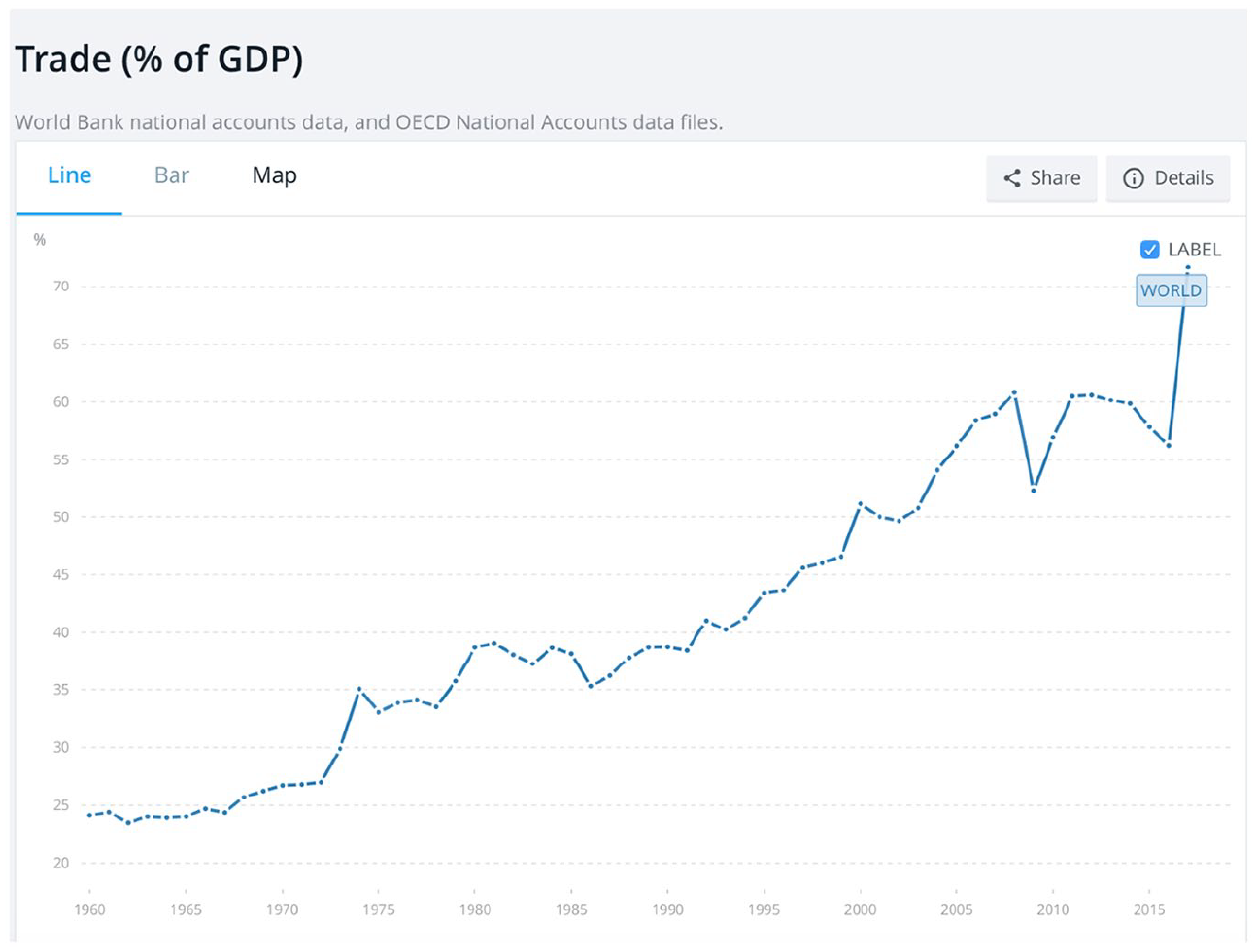
World trade as a percentage of global GDP, 1960–2018.
Similarly, in the period since 1990, the total assets of foreign affiliates (i.e. the assets of overseas branches of multinational companies) grew by 1793 per cent between 1990 and 2015, and foreign direct investment (FDI) grew by 1278 per cent from 1990 to 2015, while global GDP grew by 337.5 per cent over the same period (Figure 2).
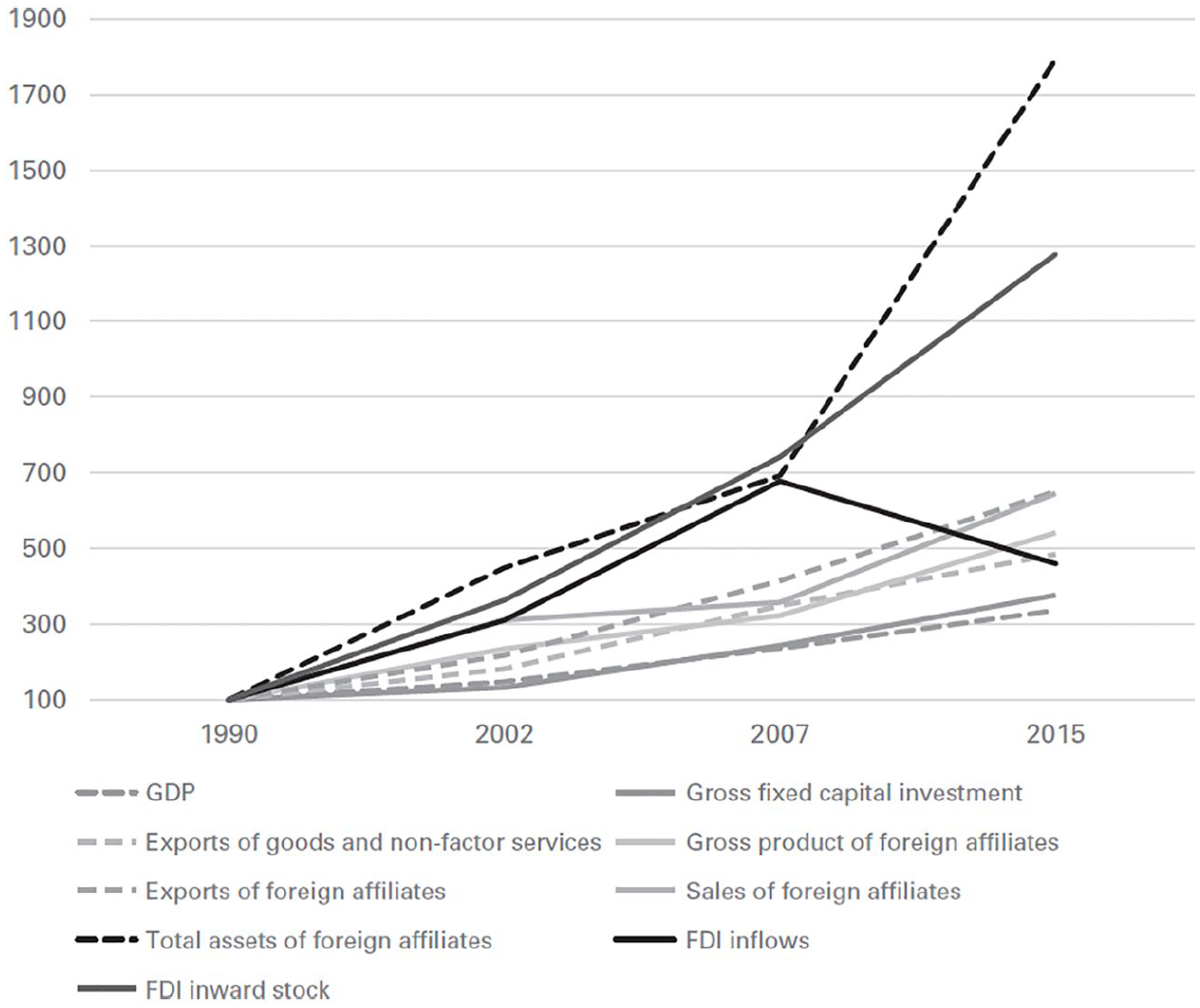
Indicators of foreign investment, assets and sales growth, 1990–2015.
This seemingly relentless march towards greater global economic integration was both aligned with, and facilitated by, the global Internet. The estimated number of Internet users around the world went from 360 million in 2000 (5.6% of the world’s population) to 2.4 billion (36.3% of the world’s population) by 2012, and 4.1 billion (53% of the world’s population) by 2018, with the fastest rates of growth being in the developing world (Flew, 2014a; We Are Social, 2018). Taking a longer-term perspective in terms of global civil society, it is estimated that there were over 38,000 active international non-governmental organizations (INGOs) in 2018, compared to less than 200 in 1900 (Union of International Associations (UIA), 2019).
But the argument for globalization was never simply an empirical one. From a critical perspective, Wolfgang Streeck (2017) argued that globalization as a discourse gave birth to a new pensée unique, a TINA (There Is No Alternative) logic of political economy for which adaptation to the ‘demands’ of ‘international markets’ is both good for everybody and the only possible policy anyway. (p. 23)
Anthony Giddens (2002) observed in his 2002 BBC Reith Lectures that ‘Globalization is . . . a shift in our very life circumstances. It is the way we now live’ (p 19), while Ulrich Beck (2000) argued that ‘globality is an unavoidable condition of human intercourse at the close of the twentieth century’ (p. 15). The former UK Prime Minister Tony Blair told the 2005 Labour Party conference in Brighton that debating globalization was as pointless as debating ‘whether autumn should follow summer . . . the character of this changing world is indifferent to tradition’ (quoted in Goodhart, 2017: 7).
Globalization theorists gave considerable attention to communication and culture, and their focus upon communication and culture as drivers of globalization in their own right, rather than as an epiphenomenon of economic globalization, differentiated their work from both world-systems theory and theories of media and cultural imperialism. Giddens (2002) observed that ‘globalization is . . . influenced above all by developments in systems of communication’ (p. 37). Castells (1996) proposed that the Internet and digital networks were at the forefront of informational capitalism, where ‘the core processes of knowledge generation, economic productivity, political/military power and media communication are already deeply transformed by the informational paradigm, and are connected to the global networks of wealth, power, and symbols working under such a logic’ (p. 21).
The globalization of communication was not seen as an extension of cultural imperialism for reasons related to both production and consumption. On the production side, it is argued that alternative production centres challenge the dominance of ‘Global Hollywood’, as new media capitals and media cities are developed that orient production towards international markets, but on the basis of connectivity to particular geo-linguistic regions rather than to the world as a whole (Curtin, 2009; Straubhaar, 2007). Insofar as global media giants gained a foothold in national media cultures, they often did so through glocalization, or revising their global branding and content strategies to better align with national cultures and expectations (Robertson and White, 2007), rather than imposing a singular Western template onto diverse regions and cultures.
With regard to consumption and cultural identity, the risk of globalization being synonymous with cultural imperialism and an increasingly homogeneous global culture was seen as negated by the role played by global media and communication flows in promoting ‘the growth of alternative frames of collective identity’ (Scholte, 2005: 232), particularly cosmopolitan and non-territorial identities not tied to nation-states and national cultures. John Tomlinson (2003) argued that ‘globalization, far from destroying it, has been perhaps the most significant force in creating and proliferating cultural identity’ (p. 269). Large-scale movements of people, and the increasingly multicultural nature of many nations, have promoted cultural hybridity, or the mixing of cultures, races, languages and identities, which in turn de-nationalizes cultural identity, as argued by Jan Nederveen Pieterse (2015): Globalization or the trend of growing worldwide interconnectedness has been accompanied by several clashing notions of cultural difference. The awareness of the world ‘becoming smaller’ and cultural difference receding coincides with a growing sensitivity to cultural difference . . . Yet it is interesting to note how the notion of cultural difference itself has changed form. It used to take the form of national differences, as in familiar discussions of national character or identity. Now different forms of difference have come to the foreground, such as gender and identity politics, ethnic and religious movements, minority rights, and indigenous peoples. (pp. 41–42)
For authors such as Ulrich Beck (2000, 2005), David Held (1997, 2016), Jurgen Habermas (2002) and Manuel Castells (2008), such developments pointed in the direction of increasingly cosmopolitan and ‘post-national’ cultural and social identities as a necessary precondition for the transformation of political culture towards forms of global civil society, global governance and cosmopolitan democracy that could transcend nationalism and the nation-state.
In retrospect, the most obvious weaknesses of the globalization paradigm lay in its conception of the nation-state as a declining institution. The various arguments that the nation-state had been ‘diminished’ (Cable, 1995), ‘hollowed out’ (Strange, 1995), was experiencing ‘declining sovereignty’ (Hardt and Negri, 2000) and becoming ‘just a node (however important) of a particular network’ (Castells, 2009: 19) misunderstood the relationship both between nation-states and international institutions, and between nation-states and economic globalizations. With regard to international governance, Hirst et al. (2009) made the point that the nation-state did not emerge in a historical vacuum: the sovereignty of states emerged in the context of a system of states – sometimes referred to as the Westphalian system, after the 1648 Treaty of Westphalia, signed at the end of the Thirty Years’ War in Europe – and territorial sovereignty has always been contingent upon its recognition by other nation-states. The proliferation of international agreements in the 20th and 21st centuries, and of multilateral institutions responsible for managing such agreements, enables an architecture of international governance to emerge, but the capacity of such institutions to act effectively and to have legitimacy in doing so remains contingent upon the participation and support of the nation-states that are signatories to such agreements. Hirst et al. (2009) referred to this as the process of ‘suturing’, or the stitching together of diverse institutions and agreements into a common framework, arguing that ‘the nation-state is central to this process of “suturing”: the policies and practices of states in distributing power upwards to the international level and downwards to subnational agencies are the ties that will hold the system of governance together’ (p. 316).
Implicit in the ‘declining state’ thesis is an underlying assumption about the nation-state and the national economy being broadly coterminous, and that globalization weakened the capacity of an activist state to regulate capital, on the basis of capital becoming increasingly internationally mobile and corporations becoming increasingly transnational. The sociologist Daniel Bell (1987) referred to this as ‘the nation-state . . . becoming too small for the big problems of life, and too big for the small problems of life’ (p. 14). However, the nation-state has not been shrinking in size. Across 13 OECD (Organization for Economic Cooperation and Development) nations in the period between 1980 and 2009, the average share of government spending as a percentage of GDP rose from 43.3 per cent in 1980 to 47.7 per cent in 2009, with only three of the countries surveyed – Sweden, Belgium and Great Britain – seeing the share fall over that period, and in all cases the share was about 50 per cent of GDP prior to 1980 (Flew, 2014b).
There is also an element of the ‘fallacy of linearity’ in the assumption that nation-states are associated with predominantly national economies, meaning that economic globalization inevitably means that capital now operates beyond the national scale. The question of whether corporations retain or transcend their national base as they become multinational has occurred since the debate between Robin Murray and Bill Warren in New Left Review in the early 1970s (see Flew, 2018b: 156–157), and economic geographers have come down firmly on the side of arguing that most multinational corporations are best thought of as national corporations with international operations rather than as truly global corporations (Dicken, 2007). Weiss (1997, 2010) has critiqued the notion of the ‘powerless state’ in the face of globalization, arguing that it ignores the question of differential state capacities to respond proactively to such challenges and the manner in which some nation-states have actively promoted globalization in order to strengthen the capacities of ‘their’ national corporations and other institutions in international markets. Following Mann’s (1997) observation that ‘though the capitalist economy is now significantly global, its globalism is ‘impure’, a combination of both the transnational and the inter-national’ (p. 489), Weiss makes the point that globalization has enabling as well as constraining dimensions for nation-states. For example, China’s accession to the World Trade Organization (WTO) in 2001 did not cede China’s sovereignty to the WTO, but rather promoted internal restructuring of the Chinese economy to promote greater export competitiveness, as well as locate China within the decision-making frameworks of multilateral governance.
Just as claims about the decline of the nation-state in an age of globalization are overstated, so too have been claims about the decline of national cultures and identities. Authors such as Appadurai (1990, 1996), Scholte (2005) and Tomlinson, (2003, 2007) are right to point to a connection between the spread of global media and cultural forms and the growth of non-territorial forms of cultural identity. This refers to attachments and affiliations based on age, class, disability, gender, race, sexual orientation or other aspects of ascribed behaviour or a common sense of belonging. The global Internet also provides new ways in which awareness of such identities can be developed and shaped, as well as new networks of affiliation, solidarity and struggle. The difficulty is that this is presented as being paralleled by a decline of territorial identities, where a relationship to culture is defined in terms of a relationship – current or prior – to a defined territory or place. As with nation-states and globalization, the evidence is considerably more complex.
Globalization theorists draw attention to the challenges that are presented by increasingly multicultural societies for unitary notions of national culture and identity, and the need to pluralize such conceptions in order to enable greater inclusion. Governments have been required to respond to the growing pluralization of ‘ways of life’ within nations by demonstrating active support for a plurality of cultures within cultural institutions, including those of the media (Bennett, 1998). But there is a need to not overstate the degree to which populations have left the boundaries of nation-states, or that mass migration is historically unprecedented. Castles and Miller (2003) have pointed out that, in proportional terms, mass voluntary migration in the period from 1815 to 1914 was greater than that in the period from 1945 to 2000. United Nations (UN) data reveal that 213 million people were migrants in 2010, meaning that international migrants are about 3 per cent of the world’s population (Berg and Besharov, 2016). This is not a figure that has varied greatly over recent years, staying within a 2–3 per cent band since the 1960s. It is therefore clear that the vast majority of the world’s population remains in the countries in which they were born. Moreover, about one-third of total migration is South–North migration, which has been the predominant focus of theories of cultural hybridity, and over half of the world’s migrants are in 10 countries. These include OECD countries such as the United States, Germany, UK, France, Canada and Spain, but also countries such as the Russian Federation, India, Saudi Arabia and Ukraine (Berg and Besharov, 2016: 58). In the latter cases, and in many other countries where migrants constitute a large percentage of the national population, such as Singapore or the Gulf States, there is little preparedness on the part of governments to redefine national identity in order to accommodate migrants as full cultural citizens, rather than as highly contingent guest workers.
The conceptual problem with the cultural hybridity paradigm is that it presents the question of cultural identity in the contemporary age – sometimes referred to as ‘postmodern identities’ (Bauman, 1996) – as essentially an open one for all peoples. This is what Mathews (2000) has referred to as the ‘cultural supermarket’ conception of identity, where the global market offers us an infinite array of possibilities to shape and form cultural identities. An obvious question here is how available are these multiple identities of the ‘cultural supermarket’ to people around the globe. Mathews (2000) makes the obvious point that ‘while some people in our globalizing world have the freedom to choose, many more do not’ (p. 179). There is also, again, a curious absence of the state’s role in the construction of identities, even though nation-states continue to invest heavily in the institutions, ceremonies, rituals, and so on, through which cultural identities are conferred. Indeed, with the growing investment in cultural diplomacy and the use of media to project ‘soft power’ internationally, there is growing investment in projecting national cultural identities internationally as well as within territories.
A proliferation of identities in the context of cultural globalization can therefore be consistent with the institutionalization of forms of identity through the cultural practices of nation-states, entailing fixity as well as openness, and nation-states can respond in a variety of ways to such challenges to ‘traditional’ conceptions of national culture and identity. Mann (1997) makes the point that while global communication networks strengthen the capacity of social movement identities to be constructed on a transnational basis, the forms of social regulation that are demanded by such movements are overwhelmingly enacted on a national basis: the extension of such rights across nation-states typically works on the basis of an emulation effect (e.g. legalization of same-sex marriages in one country strengthens the case for change in another), rather than the imposition of international laws onto nation-states.
Neo-globalization
It is important to note at this point that globalization has always been accompanied by a multilayered critique, and that the nature of globalization and preferred frameworks of world order and international governance are highly contested. From the successful campaign against the Multilateral Agreement on Investment in 1997 and the 1999 protests against the first WTO Ministerial Conference in Seattle (the ‘Battle of Seattle’) through to a range of subsequent protests at meetings of multilateral entities and forums such as Group of Eight (G8) and Group of Twenty (G20) summits, meetings of the WEF, the International Monetary Fund (IMF) and others, there have long been vigorous protests and organized movements that have challenged the institutions, ideologies and discourses associated with the dominant models of globalization (Brecher, 2012; Dawkins, 2003; Graeber, 2002; Hardt, 2002; Kahn and Kellner, 2007; Kingsnorth, 2003; Steger, 2009a, 2009b).
Such movements have been opposed to what they have variously termed ‘neoliberal globalization’, ‘corporate globalization’ and ‘globalization from above’, as promoting economic exploitation in the ‘Global South’, worsening economic and social inequalities, being undemocratic and entrenching elite dominance on a global scale, undermining local cultures and economies, and worsening environmental degradation (see, e.g. Dawkins, 2003; Kiely, 2005: 166–176). Elements of their critique have been shared by those who have been close to the leading multilateral institutions, such as the former chief economist of the World Bank, Joseph Stiglitz, who wrote in 2002 about Globalization and Its Discontents (Stiglitz, 2002). The alternative approaches proposed have variously been referred to as ‘anti-corporate globalization’ (Kingsnorth, 2003; Starr, 2000), ‘justice globalism’ (Steger, 2009a), ‘globalization from below’ (Brecher et al., 2000; Falk, 2004), ‘alter-globalization’ (Pleyers, 2010), global democracy (Dawkins, 2003; Smith, 2008) and anti-capitalism (Sklair, 2002; Tormey, 2004). Among the many fora in which such alternatives have been debated, perhaps the most significant has been the World Social Forum (WSF), which first convened in 2001 in Porto Alegre, Brazil, as a ‘counter-summit’ (Kahn and Kellner, 2007: 664) to the WEF, adopting the slogan ‘Another World is Possible’ (Hardt, 2002; Munck, 2007; Smith, 2008).
An important distinction needs to be made between critics of globalization who argue from a populist, nationalist or protectionist standpoint, and those who adopt the standpoint of what Held and McGrew (2007: 171) termed ‘critical globalism’. Graeber (2002) argued that activists protesting globalization in its current forms were in fact more internationalist than the defenders of multilateral institutions, as activists have been trying to draw attention to the fact that the neoliberal vision of ‘globalization’ is pretty much limited to the movement of capital and commodities, and actually increases barriers against the free flow of people, information and ideas. (pp. 64–65)
Kiely (2005) observed that activist movements had differentiated themselves from right-wing anti-globalization by ‘a more explicit commitment to global solidarity rather than national protectionism . . . [and] the growth of campaigns in solidarity with oppressed minorities and asylum seekers, and therefore against immigration controls’ (pp. 178–179). The group associated with what we term as neo-globalization is thus associated with projects for ‘the reform and transformation of actually existing globalization’, which ‘build upon the reform of existing infrastructures of global governance and civil society [and] seek the democratic regulation of globalization in order to address its more malignant structural and distributional consequences’ (Held and McGrew, 2007: 170–171).
One important manifestation of neo-globalization has been around the rise of global civil society. The term ‘civil society’ does not have a universally agreed meaning, but generally refers to ‘that substratum of civil arrangements and institutions upon which any stable democratic polity rests’, and to ‘a social sphere, differentiated from the state, the private world of the family, and the operation of the market’ (Holton, 2005: 133). Mary Kaldor (2003) has observed that global civil society can be defined in a relatively limited sense, such as a commitment to the rule of law – most notably humanitarian and human rights law – at a global level, backed up by international treaties and institutions, or recognition of NGOs as a third sector alongside states and corporations. It can also take a more expansive and activist form as promoting ‘globalization from below’ and a global public sphere through which transnational advocacy networks and social movements become more interconnected through participation in, and at times resistance to, institutions and networks of global governance. Critical to this capacity is the formation of what Manuel Castells (2008) termed a global public sphere, where these actors can ‘harness the power of the world’s public opinion through global media and Internet networks . . . [for] broadening political participation on a global scale, by inducing a fruitful, synergistic connection between the government-based international institutions and the global civil society’ (p. 90). Global civil society is therefore about ‘“civilizing” or democratizing globalization, about the process through with groups, movements and individuals can demand a global rule of law, global justice and global empowerment’ (Kaldor, 2003: 12).
Holton (2005) has observed that the duality between highly expansive and normative conceptions of civil society, and its more specific association with NGOs, produces a conceptual slippage in claims about its wider significance. At its most expansive, it is associated with definitions of ‘globalization from below’ that incorporate ‘all those aspects of global developments below and beyond the state and international political institutions’ (Kaldor, 2003: 9), or what John Keane (2003) referred to as ‘a vast, dynamic biosphere [that] comprises a bewildering variety of interacting habitats and species: INGOs, voluntary groups, businesses, civic initiatives, social movements, protest organizations, whole nations, ethnic and linguistic borders, pyramids and networks’ ( p. 18). At the more pragmatic institutional level, it is typically taken to refer to NGOs, and particularly INGOs. Held (2004) identifies the ‘leading actors of global civil society’ as ‘non-governmental organizations and transnational advocacy networks . . . playing a role in various domains of global governance’ (p. 88), and McGrew (2002) observes that ‘global governance . . . constitutes the key arena within which the interests of both states and the agencies of civil society are articulated and reconciled in the process of global policy formation’ (p. 279).
The conceptual slippage matters at two levels. It is not apparent, for instance, that global mobility equates with the adoption of cosmopolitan identities, or with the disappearance of nationalism. Many migrant communities adopt transnational identities, identifying with both their homeland and their country of settlement, which is not a territorially bound national identity in the traditional sense, but is also not a cosmopolitan form of identity. Insofar as it refers to support for emancipatory values such as democratization and the guarantee of human rights, as deduced from World Values Surveys conducted since the late 1990s (Welzel, 2013), the case can be made that these emancipatory goals are primarily projected upon the nation-states within which those surveyed are a part of. Indeed, cosmopolitanism has in recent times been associated with elitism, and disregard for one’s fellow citizens. The danger noted by Castells (1996) that ‘elites are cosmopolitan; people are local. The space of power is projected throughout the world, while people’s life and experience is rooted in places, in their culture’ (p. 415) has been echoed in more recent times in anti-globalization rhetoric about unaccountable cosmopolitan elites. One example, from a politician not necessarily regarded as a populist, is former UK Prime Minister Theresa May’s statement to the 2016 Conservative Party Conference that ‘if you believe you’re a citizen of the world, you’re a citizen of nowhere. You don’t understand what the very word “citizenship” means’ (May, 2016).
An important critique of the dichotomy between ‘globalization from above’ and ‘globalization from below’ has been made by Peña and Davies (2014) in their revisionist account of the evolution of the WSF. They question the extent to which it functioned primarily as a forum for anti-capitalist social movements on a global scale, and noted the extent to which its development was tied up with the shift of the Brazilian Workers’ Party (PT) from an oppositional social movement-based grouping to becoming a party of government in 2003. Many of the tensions they identify in the WSF, such as the relationship between an NGO-based grouping that reaches out to Western-based foundations and ‘progressive’ elements of business, and a social movement-based grouping demanding more radical alternatives to global capitalism, are rooted in the coalition-building politics of the PT over this period and the complexities of the Brazilian state. Their analysis seeks to challenge what they refer to as ‘a liberal stereotype that frames “the South” as the home of plural grassroots movements, independent civil society and counter-hegemonic political projects – a characterisation all too common in existing work on global civil society’ (Peña and Davies, 2014: 275).
There is little doubt that many of the causes that have been associated with global civil society movements, such as the rights of migrants and the undocumented, human rights, the need for action on climate change, and addressing global poverty and inequality remain very important. Global civil society movements, NGOs and transnational social movements have played a critical role in forcing such issues onto the agenda of the global polity. Moreover, they have maintained a critique of the prevailing liberal approaches to globalization, and the international institutions and forms of global governance that have either facilitated or failed to adequately address global problems, that continue to have moral and ethical force. What is in dispute, however, is the claim that this has seen a movement of the global system in the direction of what Robert Gilpin (2001) termed as the new medievalism, where [t]he concept of national sovereignty . . . is breaking down because of both internal and external developments; states are fragmenting into sub-states as a result of ethnic and regional conflicts and, at the same time, are being eclipsed by rising non-state and super-state actors such as multinational firms, international organizations, and especially, nongovernmental organizations. (pp. 390–391)
Reform of the global system along the lines envisaged by neo-globalization cannot rest simply upon institutions of global governance or a vaguely defined global civil society.
1
Rather, as Dani Rodrik (2014) has concluded, The nation state lives, and even if not entirely well, remains essentially the only game in town. The quest for global governance is a fool’s errand, both because national governments are unlikely to cede significant control to transnational institutions and because harmonizing rules would not benefit societies with diverse needs and preferences. (p. 154)
Post-globalization?
It has become commonplace to observe the rise of populism in the 2010s as part of a backlash against the policies of the past 30 years in Western liberal democracies, and the perceived bipartisanship of the established political parties, and political and economic elites generally (including media elites), around economic liberalism and globalization. Populism is variously presented, both by its friends and its enemies, as the new wave of electoral politics in liberal democracies (Bannon, 2018), the harbinger of a new ‘illiberal international’ (Lloyd, 2018), nothing more than a convenient cloak for bigotry and ill-informed resentment against economic and social progress (Kenny, 2018), and as providing the signposts for a revival of the left as the centrist politics of the ‘Third Way’ fall into disrepute (Rubin, 2018). A notoriously difficult term to define, the general tenor of populist politics that ‘the people’ are being neglected by unaccountable elites, and that dramatic action is required to turn around this iniquitous state of affairs, is reinforced by the perception that globalization has been associated with rising economic inequalities, social dislocation, and accelerated cultural and demographic change that has seen a significant proportion of the population ‘left behind’ and, in Arlie Hochschild’s (2016) words, ‘strangers in their own land’. While the global elites gathered at the WEF in Davos warned about the dangers of populism, their very presence in Davos provided populists with a powerful symbol of what is presented as a ‘globalist’ conspiracy against the ‘common people’. Steve Bannon (2018), the former Trump campaign manager and now a self-proclaimed thought leader of the new national populism, refers to ‘people on both the “left” and the “right” feel[ing] that they have been the punchline of a long-running joke by the Party of Davos’.
Populist leaders have come to power in many countries in the world, although there may be as many populisms as there are leaders. Leaders as diverse as Vladimir Putin in Russia, Recep Tayyip Erdoğan in Turkey, Rodrigo Duterte in the Philippines, Jair Bolsonaro in Brazil and Viktor Orbán in Hungary have been variously identified as populists, even when they differ on substantive policy questions. In Europe, new political parties that have been identified as populist now attract about 25 per cent of votes in elections in European states, compared to about 5–7 per cent in the 1990s (Lewis et al., 2018), pointing to their capacity to draw support away from the long-established parties of the centre-right and centre-left. In their 31-nation study of the rise of such parties, Inglehart and Norris (2016) attributed this rise to a mix of economic factors, such as stagnant real wages and the perceived economic insecurity of the ‘left behinds’, and cultural factors, such as a backlash against multiculturalism, cosmopolitanism and cultural pluralism. Eatwell and Goodwin (2018) observe that populism is characteristically linked to nationalism, and they attribute the rise of national populism to what they term as the ‘Four Ds’:
Distrust of political elites, anger at corruption and perceived exclusion from the institutions of liberal democracy;
Deprivation in the face of rising economic inequalities, stagnant real wages, job insecurity and declining social provisions;
Destruction – real or perceived – of national cultures and traditions, value systems and authority structures, and historically embedded ‘ways of life’;
Dealignment of citizens as voters from the major political parties, and from the class and other societal cleavages associated with those parties.
Goodwin (2018) summarizes the appeal of national populism, and the leaders and political parties within which it has become associated, in these terms: Each national populist party has its own local particularities but there are common themes. In the aggregate, national populists oppose or reject liberal globalisation, mass immigration and the consensus politics of recent times. They promise instead to give voice to those who feel that they have been neglected, if not held in contempt, by increasingly distant elites.
Following Mudde and Kaltwasser (2017), we can differentiate right-populism and left-populism on the basis of the latter being largely based around a distinction between ‘the elites’ and ‘the people’, but with ‘the people’ understood in a pluralistic sense, whereas right-populism typically triangulates between elites, the people and ‘others’ (such as ethnic, racial, religious or sexual minorities), who are counter-posed to a ‘national people’ with its own defining history, culture and identity.
Nationalism is a common thread of contemporary populism, and global elites are frequently characterized as its other. But nationalist sentiments are by no means unique to populists, and it remains the case that the number of nation-states in the world continues to grow, and many significant political struggles today are around national identity and the rights to a territorially defined nation-state: the cases of Palestine, the Catalan independence movement in Spain and the movement for an independent Scotland are three such cases that come readily to mind. Stuart Hall’s (1993) observation that nationalism ‘is not only not a spent force; it isn’t necessarily a reactionary or progressive force, politically’ (p. 355, author’s emphasis) comes to mind when thinking about contemporary national populism. Advocates of left-populism, such as Chantal Mouffe (2018), argue that the left needs to accept that democratic struggle is necessarily founded at the level of the nation-state, at least in the first instance: The hegemonic struggle to recover democracy needs to start at the level of the nation state that, despite having lost many of its prerogatives, is still one of the crucial spaces for the exercise of democracy and popular sovereignty. It is at the national level that the question of radicalising democracy must first be posed. This is where a collective will to resist the post-democratic effects of neoliberal globalization should be constructed. (p. 71)
There are two potential scenarios whereby the rise of national populism is associated not only with what The Economist (2019) has termed ‘slowbalisation’, or the continuation of global integration but at a slower rate than in the 1990s and 2000s, but to a reversal of the globalization trajectory and the onset of a ‘post-global’ era. One is the proposition that the major global powers may break up into a series or territorially or linguistically based ‘empires’. Updating Samuel Huntington’s ‘Clash of Civilizations’ thesis (Huntington, 1993), this proposition is that the end of globalist ideologies is the portent of a new era of competing civilization-states, pursuing realist foreign policies and mercantilist economic policies. In the English-speaking world, it is influential among those proposing an ‘Anglosphere’ of the English-speaking nations (CANZUK) in the wake of the UK’s withdrawal from the EU or the revival of the British Commonwealth under an ‘Empire 2.0’ agreement (Bell, 2017). Comparable observations can be found with the likes of Steve Bannon, as well as the Russian philosopher and political advisor Aleksandr Dugin, who has spoken of a ‘Eurasia Union’ centred around Russia, as a geostrategic counterpoint to perceived US-led liberalism.
In their broader ambitions, such scenarios are almost certainly implausible. The extent of global economic interdependence, and the interconnectedness through digital media technologies, make the prospect of economic autarky almost inconceivable. It is also notable that some see such alliances being forged around free trade and others around protectionism. But insofar as such ideas have influence – and there are pockets of influence in the Trump administration in the United States, among the pro-Brexit wing of the UK Conservative Party, in Vladimir Putin’s inner circle in Russia – there are two areas where they could have an impact on globalization trends. The first is in trade with China, and the prospect of a trade war leading to a ‘New Cold War’ between the United States and its allies with China. The second is within the EU, with the consolidation of a grouping of populist and nationalist parties, as has been flagged by leaders such as the Italian Prime Minster Mario Salvini. Such a scenario would most likely impact upon the freedom of journalists, whose capacity to resist those leaders who refer to them as ‘enemies of the people’ and purveyors of ‘fake news’ hinges in part upon the commitment to liberal–democratic values such as freedom of speech and freedom of the press in Western democracies.
A second scenario that is more plausible is that we are entering into an era of competing populisms in the political sphere. Authors such as Mouffe (2018) have observed that a left-populist economic programme is potentially quite popular with voters, who have come to see tax cuts to corporations and high-income earners, privatization of public assets and international trade agreements that lead to relocation of jobs offshore as inimical to their interests. The discussion of populism has tended to focus on the emergence of new parties, but it can be readily associated with shifts within the established political parties, as seen with the rise of Trump in the US Republican Party, the significant support for Bernie Sanders in the 2016 and 2020 US Democratic Party primaries, and the leadership of long-time left campaigner Jeremy Corbyn of the UK Labour Party from 2015 to the party’s landslide electoral defeat in 2019. Underpinning the prospect of centre-left parties shifting to the left is discontent with the status quo among their membership base, the role that the Internet and social media can play as campaigning and fundraising tools, and the fragmentation of news media, meaning that the ‘gatekeeper’ function of mass media outlets is not as significant as it once was in endorsing political consensus and the perceived views of the ‘median voter’ (Thompson, 2018). Centre-left parties also need to be concerned about being electorally outflanked on their left, as happened with the displacement by SYRIZA (Coalition of the Radical Left) of the social-democratic Panhellenic Socialist Organization (PASOK) in Greece, and the rise of the Greens and the commensurate decline in votes for the Social Democrats in the Netherlands and Germany.
As with neo-globalization campaigners in civil society movements, left-populists are not necessarily opposed to globalization. They support many of the developments associated with global interconnectedness, such as the capacity of the Internet to enable communication and interaction beyond national boundaries, and societies that are increasingly diverse and multicultural. But they have long viewed international trade and investment agreements as anti-democratic, and adversely affecting working people and those on lower incomes. 2 It is highly likely that future multilateral trade and investment agreements will be subject to closer scrutiny by domestic political entities than has hitherto been the case since the 1990s. Beyond the specifics of global trade and investment, national governments could slow globalization trends in other ways. The growing pressure to apply new forms of regulation to digital technology giants, in the wake of many public hearings and inquiries pointing to their failure to exercise their power over digital communication platforms in a socially responsible manner, is likely to act as a catalyst to new forms of nation-state regulation (Flew, 2018a).
Conclusion
It has been argued in this article that the influence of the globalization paradigm in global communication studies, and in the social sciences generally, is in decline. This is partly because it has consistently underestimated the continuing significance of nation-states and their institutions, particularly in managing and brokering the various forms of political, economic and cultural interconnectedness associated with global interdependence. It has also overestimated the degree to which national cultures and territorially derived forms of identity have continued to have resonance, even as there is greater scope for non-territorial forms of identity to be adopted and to enable political, social and cultural change through the formation of transnational networks and movements. Some of the weaknesses of the globalization paradigm become apparent in arguments for new forms of globalization (neo-globalization), particularly around the notion that global civil society has emerged as a third force alongside nation-states and transnational corporations, which can transform global governance in a more cosmopolitan direction.
There has also been consideration of how significant the rise of various national populisms has been, and may be in the future, in reversing the overall trajectory of globalization: this has been referred to as post-globalization. The extent of economic interdependence and global interconnectedness makes a large-scale return to protectionism and economic autarky unlikely, and the prospect of new ‘civilization states’ or a ‘new age of empires’ emerging appears limited. A more likely scenario is that the reassertion of domestic political demands into international arrangements will see greater scrutiny of the institutional forms that have enabled globalization, such as international trade and investment agreements, and that there will be a greater preparedness on the part of nation-states to regulate global companies, particularly in the fields of digital media and communication.
A final point concerns the future of global media and communication studies. Prior to the 1990s, this field was conceived as international communication and dominated by modernization theorists who advocated for the role of communication technologies in economic development, and critics who argued from a political economy perspective that such initiatives constituted new forms of media and cultural imperialism. The proposition that it was specifically concerned with studying ‘the global’ took root in the 1990s, with the rise of the globalization paradigm. If it is the case that we remain within a global system of states, and have not entered a post-Westphalian world – noting that the rise of populism is in part a reaction to global elites and their perceived disconnectedness from nation-states – then national policy concerns are going to become more prominent in the field. Whether this in turn sees a shift away from analysing global phenomena, and a turn towards comparative international studies, will be a trend to watch for in the coming years.
Footnotes
Funding
The author(s) received no financial support for the research, authorship, and/or publication of this article.
