



Abstract
This study analyses Disney’s operations in the Indian film market through its subsidiary, UTV Motion Pictures, during earlier decades. Scholarship in the critical political economy has ignored how transnational media corporations make inroads into profitable markets. The present study addresses this critical gap by examining Disney’s expansion strategies in the Indian culture market. The analysis reveals that Disney has increased its influence in the Indian entertainment sphere by following the capitalistic logic of profit maximisation at the expense of local production, distribution and consumption of entertainment products. The study discusses the future research agenda for critical political economy theory.
India has become a lucrative market for major transnational media conglomerates due to the globalisation of her entertainment industries. The Indian government initiated economic policies that increased commercialisation, privatisation and deregulation of the media in the 1990s (Chakravartty and Sarikakis, 2006). These actions facilitated foreign direct investment (FDI), joint ventures and co-productions between Indian media and various transnational media corporations (Rasul, 2012; Thomas, 2010). The new policies, especially when the government gave industry status to Bollywood 1 in 1998, helped the entertainment industry take a quantum leap with the help of FDI and investments from the Industrial Development Bank of India (IDBI; Govil, 2013; McPhail, 2010). In addition, the flow of foreign capital and a ‘phenomenally successful extension of marketing’ globalised the cultural influence of Bollywood in different parts of the world (Gopal and Moorti, 2008; Kavoori and Joseph, 2011; Schiller, 1996: 115). The global reach of Bollywood attracted commercial sector investment in the Indian entertainment industry through co-productions and joint ventures, and transnational media – owned cooperatively by multinational media firms such as Disney – engaged in joint ventures with Bollywood to enhance their revenues and capture one of the biggest entertainment markets in the world (Artz, 2015; Thussu, 2007). In this paper, I will detail how Disney made inroads into the large Indian culture market, and how subsidiaries such as UTV Motion Pictures paved the way for the cultural conquest of the local entertainment industries and labour.
When the Indian government introduced market-oriented liberal economic policies in the 1990s, transnational media corporations found an opportunity to expand their commercial interests in India, which were facilitated by the ‘logic of national capitalist expansion that reached global dimensions’ (Artz, 2015: 12). Davis and Yeh (2008) also argue that it was a question of survival and simply unavoidable for the global entertainment industries to ignore Asian entertainment markets due to their size and revenue generating capacity. For example, Bollywood surpassed Hollywood in terms of growth rates in the mid to late 2000s (Overdorf, 2007). Additionally, mergers, interlocking directorships, concentration of ownership leading to reduced competition and homogenisation of the media sphere across the globe were dominant trends in the 21st century entertainment markets, which helped fewer than 10 US-based transnational media firms to collaborate with three to four dozen global conglomerates to control large global markets such as Bollywood in a globalised cultural economy (Flew, 2007; Herman and McChesney, 2001; Thomas, 2010).
As Indian films became ‘integrated into capitalistic expansion’ (Desai, 2004: 66), Western media conglomerates were ‘keen to draw upon the Bollywood aesthetic for their own ends’ (Athique, 2012: 123), for Western audiences tended to appreciate Bollywood-inspired makeovers. Further, transnational corporations were interested in the Indian entertainment market due to the availability of cheap labour that lowered production costs and increased financial returns due to the size of the market (Thomas, 2010; Thussu, 2007). At the same time, production and distribution of entertainment products became easier with the assistance of local partners and subsidiaries. For example, Disney, through its partner, Yash Raj Films and subsidiaries, UTV Motion Pictures and Disney India, emerged as a major transnational conglomerate interested in investing and capturing the Indian market. Disney applied multiple macro-structural policies that ensured its marketing success in India. Historically, Disney skilfully used nostalgic themes to generate and sustain audience loyalty. For example, Disney’s resurgence of classics such as The Jungle Book and Beauty and the Beast was a huge commercial success. Conventionally, Disney used popular characters and soundtracks invoking nostalgic feelings with amplified production abilities through cutting-edge technology that resulted in the production of a superior quality sequel of an original film. In this way, Disney effectively targeted audiences by employing a multichannel marketing strategy that focused on tactically producing entertainment products for different groups of audiences in large international markets such as India.
During the last decade, Disney’s subsidiary, UTV Motion Pictures, established itself as a dominant player in the areas of production, marketing, distribution, licensing, merchandising and syndication of films in India and worldwide. With a modest beginning in 2004, UTV Motion Pictures increased its size over the years (Athique, 2012) and co-produced mega hits such as Chennai Express (2013), Yeh Jawaani Hai Deewani (2013) and PK (2014), which were among the highest grossing Bollywood films, earning US$63 million, US$47 million and US$120 million, respectively (Gehlawat, 2015). In 2016, however, news reports revealed that the Hollywood major was planning a reduction in its staff by 15 per cent and the Disney International chairman, Andy Bird, reportedly stated that ‘a re-balancing and re-calibration is needed to reflect local market realities’ (Bhushan, 2017: 1). 2 Notwithstanding notable failures such as Saawariya (2007) and Mohenjo Daro (2016), another UTV Bollywood co-production, Dangal (2016), grossed over US$70.3 million (Rs4.8 billion) locally and emerged as the highest-grossing Hindi language films of all time (Bhushan, 2017).
The involvement of international media firms such as Disney and their subsidiaries in Bollywood’s entertainment operations have changed the Indian entertainment industry landscape and raised significant academic questions regarding capitalistic expansionism and the ‘hegemonisation’ of entertainment culture (Ahmed, 2015). To explore the implications of the spread of cultural hegemony through transnational capital flows in Bollywood, this article critically analyses the history and political economy of Disney’s operations in the Indian film market through UTV Motion Pictures, a former subsidiary of the Walt Disney Company. Combining critical political economy and cultural hegemony as a theoretical and methodological lens, I examine the growth and expansion of Disney’s UTV Motion Pictures in the Indian entertainment market, which contributed to the consolidation and control of a handful media conglomerates over the global flow of entertainment products in India. The current study addresses a critical gap in the political economy literature by advancing an understanding of how transnational media corporations make inroads into profitable markets and establish a cultural hegemony at the expense of local media industries and labour.
Theoretical positioning: Critical political economy and cultural hegemony of global media
Chiumbu and Radebe (2020: 1) have stated that ‘the critical political economy of the media approach allows an understanding of the ideologies and power structures that influence media operations, ownership, and funding’. In recent decades, researchers have argued that although the critical political economy of the media is a dominant paradigm to deconstruct issues associated with the ownership structures and transnational operations of media giants, the theory needs adjustments, decolonisation and realignment with similar concepts such as cultural hegemony to understand the media operations of transnational media corporations in the Global South (McQuail, 2005). The two concepts are identical as cultural hegemony is defined as a situation in which ‘participants in a social relationship consent to the policies and leadership of a dominant group’ (Artz, 2015: 9), while the critical political economy of communication explores questions related to media operations, ownership and funding dealing with the production, distribution and consumption of cultural products (Chiumbu and Radebe, 2020; McChesney, 2008). Flew (2007: 73) argues that the cultural hegemony of transnational media corporations and ‘the radical critique of global media associated with critical political economy experienced a resurgence of interest in recent years’. Through powerful production and distribution networks, global media perpetuate ideologies that help the elite maintain the consent of audiences, which consume conformist messages produced by cultural industries (Artz, 2015; Bagdikian, 2004; Gramsci, 1995; Hesmondhalgh, 2007; McChesney, 2008). The media depend on market forces for their operations, and it is no surprise if they advance the interests of those who supply them money in the form of advertising dollars and subsidies (Altschull, 1995). The reliance of media on the business elite for the production and distribution of cultural products results in the commodification of culture that leads to consolidation, conglomeration and concentration of ownership and cultivates an artificial consensus regarding policies and ideologies favouring the elite, such as consumerism, the equating of democracy and capitalism and audience autonomy (Mosco, 2009).
Cultural hegemony also solidifies the control of a few transnational media corporations over information and entertainment flow and promotes superficial and limited entertainment genres (Hall, 1986). For example, Thussu (2005) argues that out of the 10 channels provided by Star TV, owned by News Corp. in India, nine focus on entertainment-oriented programmes. The proliferation of channels and genres does not lead to content and programme diversity, but, rather, a cultural hybrid is promoted under the influence of cultural hegemony that results in cultural homogeneity favouring capitalistic ideologies of consumerism at the expense of local values, the working class and diverse populations (Artz, 2015). Through cultural hegemony, the profit-oriented commercial operations of transnational media corporations often conflict with the social and cultural needs of the working classes and local communities, which subsequently lead to a number of social problems. These powerful media conglomerates tend to maximise audiences and increase revenues by producing entertainment products in localised formats, as such programmes are relatively cost-effective to produce and create and promote consumerism – rather than collectivism to solve social and economic problems such as poverty, homelessness and hunger – which is the ultimate goal of global capitalist ideology (Algan, 2003; Artz, 2003; McChesney, 2008; Thussu, 2007). Thus, cultural hegemony operates at the production and distribution levels of cultural commodity creation, which paves the way for the cultural, economic and political dominance of the capitalistic philosophy.
According to Mosco (2009: 2), political economy is ‘the study of social relations, particularly the power relations that mutually constitute the production, distribution and consumption of resources, including communication resources’. Likewise, critical political economy critically evaluates the hegemonic practices encouraged by global transnational media firms and focuses on the connections between ‘political, coercive, economic, and symbolic power structures entwined with the mass media; historical approaches defining the history of economic order; the varying nature of the relationships between commercial mass media and the state machinery; and an emphasis on praxis’ (Rasul, 2012: 564; Mosco, 2009).
Critical analysis of political, economic and ideological orientation of the entertainment industries is heuristically significant as cultural products ‘manufactured’ by these capitalist-friendly firms are affecting the consumption patterns of billions of cinephiles all over the world by promoting a hybrid culture characterised by mergers of traditional and modern forms of cultural expression, combining past with present and local with transnational through, for example, technological innovations and other spaces (Artz, 2015; Zhao and Chakravartty, 2007).
The critical approaches of political economy and cultural hegemony are instructive to understand the operations of Bollywood as a global entertainment industry and a collaborator with other transnational entertainment corporations such as Disney. In this vein, I explicate the nature of the relationship between Disney’s global operations and an entertainment-obsessed South Asian market comprising of more than one billion viewers. These approaches will help us explore questions related to the globalisation of the entertainment industries, the logic and justification of capitalism, the consolidation of ownership, cultural homogeneity and the global media monopoly. Combining these approaches to analyse global operations of media behemoths in the Global South might also lead to the theory-building and advancing knowledge in this largely under-represented area in the critical political economy literature.
Global Bollywood and Disney
With more than one billion active viewers worldwide, Bollywood, which connotes Hindi-language Indian cinema in this study, began to attract the attention of international investors in the mid-1990s due to the Indian government’s liberal economic policies (Chakrabarti, 2014; Nijhawan, 2009). Bollywood is one of the largest and most popular film industries, which has successfully cultivated an ‘imagined sense of Indianness’ among India diasporic communities all over the world drawing ‘from [the] socio-political environment of India which is reinforced by Bollywood and bought into by its viewers’ (Chatterjee and Vasek, 2020: 222). Although transnational corporations and Indian financial institutions were once reluctant to invest in Bollywood movies due to the risky nature of investments in the entertainment industry, as audiences’ reception of films and revenues could not be efficiently predicted, the size of the Indian entertainment market and presence of Indian diasporic communities in various corners of the world encouraged transnational media corporations to enter into co-production agreements and joint ventures with the Indian culture industry (Rasul, 2018; Wasko, 2004). After Bollywood was officially declared an industry, which allowed commercial banks to lend money to filmmakers, capitalist logic dominated filmmaking in India and encouraged horizontal integration, which was not the case prior to the 1990s when Bollywood was largely art-driven and dependent on local investment for the production and distribution of movies. In addition, Bollywood was influenced by the globalisation wave and established distribution offices in other countries, which not only focused on promoting Bollywood films in the international market, but also helped negotiate deals with transnational capitalist firms in order to increase production budgets and market films in other countries (Bettig and Hall, 2012; Rasul, 2012).
Global Bollywood earns revenues through its entertainment products entrenched in dance and music, which have promoted a ‘Bollyculture’ in different corners of the world (FICCI, 2004; Gokulsing and Dissanayake, 2009; Kavoori and Punathambekar, 2008). Kavoori and Joseph (2011) argue that the globalisation of Bollyculture has connected Indian diasporic communities through traditional South Asian narratives promoted by Bollywood films. According to estimates, approximately 11 million people watch Bollywood movies every day, and the industry produces more than 1000 movies per year, not only in the Hindi language, but also in major regional languages (Thussu, 2013b). Bollywood has earned a distinctive place in the international popular culture that has encouraged global cultural industries, such as Viacom DreamWorks, NBC Universal, Warner Brothers, Sony and Disney, to engage in joint ventures with the Indian entertainment industry, allowing them to make inroads into the large Indian market (Rasul, 2018).
Bollywood and its global partners also benefitted from the advent and popularity of over-the-top streaming services (OTT) such as Netflix, Amazon Prime, Hotstar, YouTube and Hulu, which have changed the way transnational entertainment industries reach different international markets. Netflix, for example, is available in over 190 markets around the world including India, but ‘Hollywood movies typically account for over two thirds of the titles offered’, while Hindi-language entertainment constitutes a small fraction of the entertainment programmes (Lobato, 2018: 247). In the last few years, there were around 40 providers of OTT media services in India, which distribute popular entertainment programmes through the Internet. In 2018, the OTT market was estimated to reach US$303 million and was expected to grow steadily because of the COVID crisis, the size of the South Asian market, and the mounting popularity of Hindi-language programmes.
In recent decades, the Indian entertainment market and streaming services have also introduced small budget films which have been met with unprecedented box-office success (Laghate, 2016). For example, Kiran Rao’s Dhobi Ghat (2010) won itself accolades and heralded the beginning of an exciting decade for small budget films. The commercial success of Tigmanshu Dhulia’s Shagird (2011), Anand L. Rai’s Tanu Weds Manu (2011), Sudhir Mishra’s Yeh Saali Zindagi (2011) and Aparna Joshi’s Utt Pataang (2011) attracted the attention of major Bollywood players, and exhibitors turned their attention to small-budget films due to theme diversity, creativity and positive reviews. However, media giants largely ignored small-budget filmmaking ventures and collaborated with their established local partners (Artz, 2015).
With increasing collaboration trends among global media conglomerates, several Western entertainment industries invested heavily in Asian film industries such as Bollywood through co-production deals carried out by their local partners and subsidiaries, which was a hallmark of 21st-century capitalism (Schiller, 2000). To establish a stronghold in Asian markets, transnational corporations prefer to produce localised content that can be sold easily in local markets due to its embeddedness in the local entertainment culture (Artz, 2015). At the same time, Bollywood actively seeks partners in the Western world for investments interested in one of the largest entertainment markets worldwide. Indian media firms also support transnational corporations to protect their capitalistic interests by capturing the huge Indian market. Reliance Big Pictures, for example, struck a deal with DreamWorks valued at US$1.2 billion that created a new joint production company (Dobuzinskis, 2008). Likewise, the Walt Disney Company, which opened its subsidiary in India in 2004 and began to increase its reach into multiple media industries, acquired controlling stakes in UTV in 2011 after significantly expanding its footprint and investing in a number of successful co-production ventures. Thus, Disney’s interest in an expanding Indian entertainment market demonstrates that ‘the production and distribution of global media entertainment conforms to transnational capitalist social relations of production’ (Artz, 2015: 79). Global expansion has been a hallmark of the business strategy of transnational media conglomerates, and, according to McChesney (2008: 398), Disney restructured its global operations in 1999 to ‘expand and strengthen its ‘global presence’. Disney’s enthusiasm is understandable; experts project that the major Hollywood studios, which earned around one-half of their income outside the United States, will see that portion rise in the coming generations’. As a globally expanding culture industry, Bollywood found a natural ally in Disney (Gokulsing and Dissanayake, 2009).
In the Indian context, Disney is particularly important because it has been successful in controlling stakes in one of the biggest production and distribution firms in Bollywood, UTV Motion Pictures, at an opportune moment when Bollywood was actively courting global investors (Thussu, 2007). As the world’s second-largest entertainment conglomerate with revenues of US$40 billion, Disney collaborated with local Bollywood bigwigs, endeavoured to make inroads into the Indian market using its multiple entertainment production specialties and synergistic business practices, and launched a computer animated film project with Yash Raj films in 2008, called Roadside Romeo (Artz, 2015; Chopra, 2009). Due to its multipronged business strategies, Disney was successful in weaving the irresistible appeal of Hindi films with consumerism, and exemplified ‘the drive for transnational production and distribution that spurs the drive for transformation of capitalism’ (Artz, 2015: 111). Having 13 joint ventures in various European countries, Disney, however, proceeded cautiously in the Indian entertainment market (Chalaby, 2009) and partnered with Yash Raj films, which is one of the most prominent and largest distribution and production firms in India. As stated earlier, Disney’s subsidiary, UTV Motion Pictures, which is the film unit of UTV Software Communications, has emerged as a powerful player in the Indian entertainment market. After a decade-long engagement in Bollywood, Disney is among the few transnational corporations that has successfully established its cultural hegemony in the largest entertainment market in the world. It is, therefore, significant to critically investigate Disney’s interest in consolidating its economic interests and controlling ‘large chunks of popular cultural production’ (Wasko, 2013: 225) in the huge Indian entertainment market at a time when the supportive Indian state has relaxed government regulations after the grant of industry status to Bollywood.
A passage to India through UTV Motion Pictures: Discussion and analysis
The current study adds to existing knowledge by critically examining the role of Disney and its subsidiaries in managing and regulating media flows, media power and media control in India (Flew, 2007; Thussu, 2007) through the lens of political economy of communication which remained under-researched in the academic literature. The study also focuses on the adaptation of transnational business models of production and distribution, which have been tailored to the Indian cultural context through overseas companies such as UTV. These models have changed the ‘balance of power in the film world’ and transformed relationships between exhibitors, distributors and producers (Athique, 2012), which has not been paid adequate attention in academic literature. As stated earlier, our study is different from previous explorations of Disney’s operations in different parts of the world due to its focus on critically examining the role of Disney and its subsidiaries in the Indian film market. Previous studies dealt with the expansion of Disney’s operations in India and the globalisation of Bollywood without critically examining the political and economic interests of the Hollywood major in the region.
Production strategies
Scholars in the tradition of critical political economy argue that transnational conglomerates, through their subsidiaries (such as UTV Motion Pictures, in this case), seek to promote their power, politics and ideology (Artz, 2015; Flew, 2007; McChesney, 2008; McChesney and Schiller, 2003), and Disney also ‘engages in processes of commodification and exploitation that recognise profit as the sole determining factor in all corporate decision making’ (Giroux and Pollock, 2010: 6). For example, Disney’s subsidiary UTV has been engaged in horizontal and vertical integration processes by financing and distributing films in India since 2005 and has established its dominance over local and small-scale independent film distributors (Lorenzen and Taeube, 2007). Disney’s successful alliances with local Indian partners such as UTV has strengthened its position in the huge Indian market where production in local languages was always key to success and also complemented its fast-growing Disney-branded businesses. In 2006, Disney’s local ally procured Hungama TV, India’s foremost children’s TV network and acquired an equity interest in UTV Software Communications Limited, which Disney increased in 2008, enabling both companies to augment each other’s commercial prowess and effectively dominate the Indian market through its marketing strategies, joint ventures, interlocking directorships and expertise (McChesney, 2008).
Initially, Disney was reluctant to produce high-cost, star-studded Bollywood films and followed a cautious business strategy because of several cultural complications such as language, market structure and resistance from regional film industries opposed to the dominance of Bollywood and its international partners (Thomas, 2010), which would make production a risky business; however, as noted, it began buying stakes in UTV in 2006. As Bollywood’s business grossed more than US$2 billion in 2006, Disney invested about $230 million to enhance its stake to 32.1 per cent, which granted it a 15 per cent stake (worth US$30 million) in UTV’s broadcasting unit; Disney again increased its stake to 50.44 per cent in 2012 to gain control of UTV (Bhushan, 2012). In addition, UTV established a vibrant film studio in India, which offered services in production, distribution, creative development and marketing of entertainment products across India and globally (Overdorf, 2007). As one of the leading firms in the entertainment business in India, UTV played a significant role in introducing Bollywood’s products to a global audience, which, according to Kavoori and Joseph (2011), has spread Bollyculture by producing some of the most widely recognised films in recent years.
Overdorf (2007) argues that Disney’s UTV established partnership with various Indian television channels such as Zee TV, Star India and Sun TV and struck co-production deals with Fox Searchlight and Sony Pictures. Likewise, UTV was involved in co-producing video games with Sony and Nintendo, and co-owned a television channel with Smriti Irani, the then minister for human resource development (now renamed the Ministry of Education) in the Indian government in 2015, and the UMP television channel in Mauritius (Artz, 2015). UTV seems to have successfully worked on a transnational formula, which relies on going public on the stock exchange, creating local audiences, producing localised entertainment formats, international product branding and advertising dollars flowing from both national and international advertisers. In the domain of marketing, UTV has emerged as a leader in the Indian market by increasing spending on marketing to 25 per cent of a film’s production cost, which matches the dominant marketing expenditure on Hollywood products (Athique, 2012; Overdorf, 2007). By relying on its own distribution network, UTV has established offices in some 20 countries that have a sizable population of the Indian diaspora (Kavoori and Punathambekar, 2008). Besides India, UTV has production and distribution agreements with entertainment industries in other Asian countries such as Singapore, Malaysia and Thailand (UTV, 2013).
Distribution strategies
UTV’s traditional cultural products, characterised by melodramatic narratives to appeal to the emotions of the audience, are deeply rooted in Indian dance and music culture and promote consumerism that supplements revenue enhancement strategies. Disney’s powerful subsidiary describes its business policy as: UTV’s Motion Pictures business spans the integrated model of creative development, production, marketing, distribution, merchandising, and syndication worldwide. UTV’s portfolio includes Hindi Movies, Regional Movies, Animation Films, international productions and coproductions. . .[UTV believes that] well segmented channels targeting likeminded people will score over others by creating an engaged consumer; thus, offering us as well as advertisers’ myriad possibilities to deliver content to a defined audience. (Artz, 2015: 113; UTV, 2013)
Considering UTV’s expansion and Disney’s global infrastructure, this explains how transnationalism and profit logic stand at the heart of transnational media corporations’ operations. As global entertainment culture is being Asianised (Pieterse, 2006), transnational corporations such as UTV are promoting cultural hybrids, which homogenise content at the expense of diversity. UTV and other transnational conglomerates such as Sony and Viacom tend to engage in the production of Bollywood movies that appeal to an international audience, which leads to the standardisation of narratives. For example, UTV co-produced and distributed movies such as Jodhaa Akbar (2008, featuring Hrithik Roshan and Aishwarya Rai Bachchan) and Dilwale (2015, featuring Shah Rukh Khan and Kajol) that revolved around homogenised, feel-good love stories with happy endings and a great deal of emotional drama, with a capacity to attract audiences worldwide and maximise profits. Panday (2011) argues that melodramatic narratives based on love stories invariably capture the attention of Bollywood fans and guarantee commercial success due to the cultural underpinnings of South Asian societies, which are highly demonstrative and family-oriented. Likewise, international media conglomerates are interested in promoting consumerist ideologies to the right kind of middle-class consumers, who like entertaining narratives that take them away from their stressful daily lives and transport them to another world by selling dreams in productions that facilitate escapist tendencies (Kaur and Sinha, 2005; Nijhawan, 2009). On the other hand, class struggle is ignored because it is not ‘sexy’ and ‘sellable’ to upper- and middle-class audiences scattered in different parts of the world (Athique, 2012).
Capitalistic logic and cultural hegemony
Subsidiaries such as UTV pave the way for cultural hegemony through which consensus on consumerist ideology is manufactured and perpetuated (Bagdikian, 2004; McChesney, 2008). Since these companies also work for advertisers, their entertainment products promote a set of branded values which stimulate profit maximisation through increased consumption. Due to the sharing of capital and resources, transnational conglomerates increase labour productivity by using sophisticated technology so that fewer workers are needed to produce entertainment products, which results in unemployment (Artz, 2015). Likewise, in adverse economic conditions, these firms can pull out their investments, which would lead to a greater chaos for the workers associated with the production and distribution of entertainment products. For example, if one examines the growth trajectory of UTV’s operations in India, one finds that the transnational media firm expanded its business as Bollywood flexed its economic muscle with the support of the Indian government. It adopted an economic model that protected its investments by producing small-budget films and gradually engaging in larger projects that were financially viable and guaranteed financial gains (Athique, 2012). Thus, Disney’s entertainment operations in India through UTV closely follow the logic of transnational capitalism, cultivating consumerist values through capital-intensive production and distribution of films and other entertainment products through synergistic strategies and ancillary markets (Artz, 2015; Bagdikian, 2004; McChesney, 2008). The processes involved in producing films have changed in Bollywood in recent decades due to the international flow of investment by transnational actors such as Disney, and a sizable amount is spent on the promotion and marketing of the films, which was not fashionable before 1998, when Bollywood was not granted the status of an industry by the Indian government (Rasul, 2016). The next section analyses UTV’s production and distribution strategies that helped Disney make inroads into the Indian entertainment market through localisation of content and format and helped Disney emerge as a major player in the Indian cultural sphere.
From Disney with love: Analysis of the UTV’s operations in Bollywood
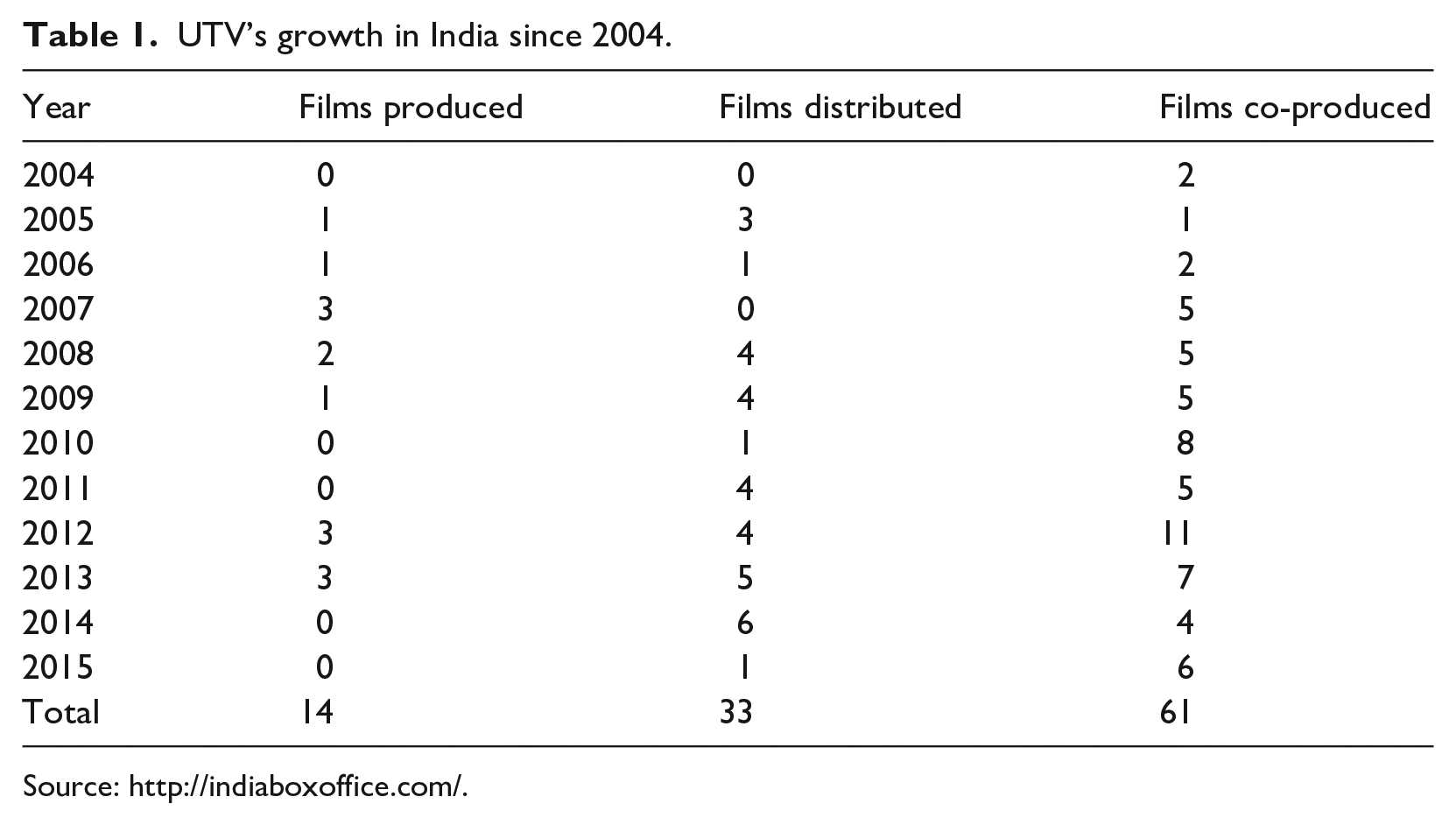
As Disney is known for its synergistic practices, which also serve as ‘the quintessential example of synergy in the entertainment industry’ (Wasko, 2001: 71), Bollywood offered opportunities after the Indian government adopted liberal economic policies and recognised the significance of movie-making as an industry. Production houses in Bollywood were keen to court international partners due to foreign investments and pooling of resources with transnational entertainment companies. The Indian government’s policies also helped Bollywood and transnational media corporations such as Disney to enter into contractual arrangements, as the Indian Ministry of Finance laid down rules to finance films in 2000, while, in 2007, the government also reduced the entertainment tax on Bollywood revenues generated though film exhibitions from national and overseas markets (Desai, 2013). With increased deregulation of the market, transnational media corporations and their local partners in India were encouraged to engage in joint ventures, foreign direct investments, horizontal integration and co-productions. For example, Table 1 demonstrates UTV’s increasing interest in Bollywood’s production, distribution and co-production ventures since 2004.
UTV’s growth in India since 2004.
Source: http://indiaboxoffice.com/.
Starting with a couple of co-productions (Lakshya and Swades) in 2004, UTV produced, distributed or co-produced 18 films in 2012 and 15 films in 2013 (Table 1). Likewise, UTV co-produced PK (2014) and Chennai Express (2013) with Vinod Chopra Films and Red Chillies Entertainment, and these movies made history by generating record revenues worldwide. PK (2014) is the top-grossing movie of all time (US$100 million), while Chennai Express (2013) is the third highest grossing movie of all time (US$67 million), a record that was only paralleled by Dhoom 3 (2013), which generated US$86 million (Entertainment Times, n.d.). Interestingly, Dhoom 3 was produced by another local partner of Disney, Yash Raj Films, with whom Disney entered into computer animated film deals in 2008 (Thomas, 2010). Thus, UTV’s cautious economic strategy of ‘starting small and thinking big’ worked, and it emerged as one of the biggest beneficiaries of Bollywood’s money-making machine. As stated earlier, UTV, which is a part of Disney’s transnational operations, is engaged in horizontal integration and is partnering with a diverse array of TV, video games and other entertainment formats including a partnership with Richard Branson’s Virgin Comics, which is based on Indian mythological superheroes (Overdorf, 2007). Likewise, UTV has collaborated with NBC Universal, Time Warner and Viacom to develop, produce and distribute internet content and TV broadcasting in addition to its growing film business to generate and increase revenues from diverse yet homogenous entertainment genres and formats based on music, dance and happy endings that are localised to maximise audiences and, in return, attract advertising dollars largely determined by the size of viewership (Athique, 2012; Overdorf, 2007; Thomas, 2010).
Critical theorists argue that so-called genre and content diversity facilitate cultural hegemony (Artz, 2015; Flew, 2007, 2013). Accordingly, UTV’s interest in media variety should not be mistaken for production of content for different communities in a multicultural society such as India. Artz (2015: 11) states that ‘hybrid forms provide diversity in local content for uniform global themes apropos of global capitalism. Standardised and formulaic presentations of hybrid content promote hegemonic narratives in line with the dominant global ideologies of consumerism and market dominance. Desai (2013) argues that Bollywood narratives are created for local consumers, Indian diasporic communities and the global audience. Hybrid narratives were used by UTV and other filmmakers to increase revenues by positively influencing the box-office appeal of Bollywood products in an age of transnational capitalism (Schaefer and Karan, 2010). For example, if we look at UTV-managed films in 2014, from PK to Khoobsurat and from 2 States to Kick, each revolves around certain universally acceptable themes such as modern civic culture, technological development and cultural globalisation.
Marketing strategies
To ensure marketability and commercial gains, producers and directors ensure that their films are melodramatic in nature with a marketable character and a focus on music and dance, all characteristics that are most likely to attract new and traditional audiences around the globe. Such trends pave a way for cultural hybrids by promoting a consumer-oriented philosophy, which runs contrary to the messages in Bollywood films produced until the 1980s, which were known for their radical narratives and activism (Ahmed, 2015; Martineau, 2013). For example, movies featuring Amitabh Bachchan, the legendary superstar of the 1970s and 1980s, and the art movies of the 1980s highlighted class struggle and oppression of the working classes by the ‘cruel capitalists’ (Schaefer and Karan, 2013).
However, current cinematic trends, dominated by transnational producers and distributors such as UTV, indicate that hedonic entertainment ‘marked by individualism, immediate gratification, and unfettered acquisitiveness’ (Artz, 2015: 11) rules Bollyworld, which promotes consumerism and a cultural hegemony that perpetuates values favouring the global expansion of capitalism (Thomas, 2010). Movies such as Dilwale, PK and Yeh Jawaani Hai Deewani could be considered as glaring examples of hedonism packed in Bollywood narratives that attract audiences. These movies are sensationalistic in nature with narratives focusing on pervasive social problems, usually related to marriage issues between two lovers belonging to different social classes, religions, castes and sometimes countries. Like Bollywood’s 1970 productions, modern audiences can relate to these Bollywood narratives, as they face many similar problems in their everyday social interactions, which leads to the development of affective dispositions towards lead actors such as Shah Rukh Khan and Akshay Kumar, and audiences flock to the theatres. Bollywood still focuses on the radical narratives of the 1970s and 1980s, such as gender equality (Dangal, 2016), political corruption (Rajneeti, 2010, and Dirty Politics, 2015) and dowry (Badrinath ki Dulhania, 2017), but the ‘new radical’ is what appeals to the audience and is, therefore, good for the marketing operations of the entertainment industry. Roy (2020), on the other hand, framed individualistic gratifying responses differently to the upbeat commercial products of Bollywood.
Further, local partners and subsidiaries such as Yash Raj Films and UTV assisted Disney in developing localised content by focusing on younger populations (14 years or less) in India, an audience greater in size than the entire population in the United States (Desai, 2013; Marr, 2007; Thussu, 2013a). Considering the importance of a predominantly younger, middle-class, consumer-oriented target population, Disney and other transnational media corporations preferred to cut deals with viable local partners for the sustainability of their business ventures (Dasgupta, 2014). Prior to the deregulation and liberalisation of the entertainment market in India, the film business was controlled by several small-scale companies owned largely by families traditionally involved in the film business (Prasad, 1998; Thussu, 2013a). For example, a business report on the status of the entertainment media claimed that there were around 400 smaller companies engaged in film production in India; however, around three dozen of these companies were registered on the stock exchange as corporate entities in the first decade of the 21st century (Desai, 2013). Although finding accurate data about the film business in Bollywood is extremely difficult due to the undocumented nature of filmmaking in India (Guback, 1969; Wasko, 2004), current trends clearly indicate that the cultural industry is experiencing a concentration of ownership in India (Thomas, 2010).
Involvement of local and international big business in the Indian cultural sphere due to the size of the market and the emergence of a relatively prosperous middle class (Nijhawan, 2009) is redefining Indian cinema by standardising its content and modernising production practices through the use of advanced technology, and a few viable production houses are controlling the film business due to their economic prowess and connections with international partners, which can directly invest in the production of entertainment products. The growth curve of UTV’s business ventures clearly manifests that capital flowing from Disney into the Indian culture industry contributes to the control of Bollywood by a handful of transnational, trans-industrial corporations. Dasgupta (2014) cautions that uncontrolled business involvement of transnational media moguls in Bollywood through subsidiaries such as UTV would lead to the control of a business elite over Indian entertainment culture, and an international model of concentrated ownership would emerge that may not serve the cultural needs of an ethnically and culturally diverse India.
Athique (2012) argued that transnational capital flow was welcomed in Bollywood, as it attracted local big business and allowed Bollywood to use sophisticated technology in filmmaking, which enhanced the receptivity and entertainment appeal of cultural products. Companies such as UTV brought investments and resources controlled by transnational conglomerates and paved the way for an increased collaboration between transnational and national media, as ‘transnationally, about 10 companies dominate, but hundreds provide essential complementary support’ to them (Artz, 2015: 10). Wasko (2001), while challenging Disney myths, also argued that Disney’s control over production and distribution was presented as something harmless, and beneficial for the development of local culture industries. Thus, control over production and distribution is tolerated without realising the long-term implications of transnational control and dominance (Bagdikian, 2004).
Corporate control over production and distribution can be harmful for national cultures (Artz, 2015; Flew, 2007; Wasko, 2001). For example, if we examine the film distribution patterns in India, we find that distributors are not interested in smaller films as the reception of such films may not help them earn revenues to cover even the theatre rentals, as the profit of distributors is determined by net gross minus theatre rentals (Desai, 2013). Therefore, smaller films produced by local companies may find it hard to attract the attention of exhibitors due to the potential risk of losing money, which discourages local producers and distributors and allows for the increased involvement of companies such as UTV, which are supported by transnational media giants. UTV, for example, distributed mega hits such as Yeh Jawaani Hai Deewani and Kick in 2013 and 2014, which were produced by Bollywood major players Dharma Productions and Nadiadwala Grandson Entertainment, but they had to depend on UTV’s resources to internationally distribute these movies (Ahmed, 2015). Likewise, UTV has been involved in the distribution of 32 films since 2004, and an overwhelming majority of these films was produced by a few powerful production houses such as Aamir Khan Productions, Walt Disney Pictures, Dharma Productions and Nadiadwala Grandson Entertainment, to name just a few. This collaborative pattern between UTV and Bollywood majors creates barriers to entry for smaller or potential new competitors, a pattern that leads to concentration (Dasgupta, 2014).
As Wasko (2001, 2004) would argue, it would be naïve to assume that the control and hegemony of a transnational mogul would not adversely affect Bollywood as a national industry. Rasul (2012) argue that one of the reasons behind the increasing interest of the Hollywood majors in India is the availability of a cheap but skilled labour force. According to Marr (2007), the cost of filming one episode of Disney’s local show, Dhoom Machaao Dhoom, is approximately US$10,000, which is a fraction of the cost of production for an episode of a US TV show. Likewise, an average movie produced by Disney’s UTV costs between US$4 million and US$10 million, which is miniscule compared to the cost of production and marketing of films in Hollywood. 3 Consequently, this affects the local labour market, as foreign investment offers better job opportunities to local professionals, but unskilled labour is rendered jobless due to the use of the latest technologies, which means fewer people are employed. This is problematic in India where unemployment rates are soaring despite economic growth in the entertainment sector (Panday, 2011). Transnational capitalism is interested in maintaining a tolerable level of unemployment, which ensures a smooth supply of cheap labour in the market. Thus, it can be argued that UTV’s expansion in the Indian market affects the local labour force; however, due to the absence of reliable data, it is difficult to assess the adverse impact on the Indian labour market associated with the production and distribution of films. This phenomenon has implications for critical political economy scholars to calibrate and readjust the theory with other useful concepts such as cultural hegemony to investigate expansion strategies of major media corporations in the Global South.
Concluding the analysis of UTV’s operations in India, I argue that transnational media corporations are hegemonising the Indian cultural sphere by localising global cultural hybrids. Commenting on Disney UTV’s operations, a marketing executive stated that Disney’s strategy to produce and distribute local films is in accordance with the company’s eastward expansion policy and its ambition of becoming a major player in Bollywood as Disney already controls the UTV, Spotboy, Disney, Marvel and Lucasfilm brands, which expands and enhances Disney’s influence (Frater, 2013). However, India is riding the globalisation wave, and following liberal economic policies supporting expansion of transnational media corporations into the Indian cultural sphere, little attention is being paid to the consolidation and concentration of ownership, control over production and distribution of cultural products, the flourishing of cultural hybrids and the promotion of a cultural homogeneity through dominance of entertainment formats promoting consumerism in the country.
Conclusion
Although India is one of the largest and ‘hottest’ entertainment markets in the world (Marr, 2007), Disney proceeded cautiously by slowly acquiring stakes in UTV. As Bollywood’s profits and popularity increased at international level, Disney bought UTV for a reported US$454 million, making Disney a significant player in the Indian cultural sphere. The Indian government and big business benefit from these developments as foreign investments flow into the country and the economy experiences a boom; however, global class relations and increasing economic influence of transnationals on the production of cultural products have been neglected by the Indian government and the bigwigs controlling the Bollywood business. Bollywood was certainly not ‘striking back’ against the influence and flow of transnational media corporations (Rantanen, 2002), as Bollywood’s share in the global earnings was a modest 2 per cent (Desai, 2013). Instead, the increased involvement of companies such as UTV has led to a greater homogenisation of content and reduced competition in the market (Flew, 2007), which, according to Artz (2015), resulted in cultural homogenisation.
As I argued earlier, ownership of the means of production and distribution is concentrated in a few hands in Bollywood, which raises questions regarding social relations under the overarching hegemony and control of a culture manufactured by transnational media corporations such as Disney’s UTV. Bollywood used to be a radical and vibrant voice promoting awareness about class struggle and social inequality, but after being recognised as an industry at the dawn of the 21st century, its dependence on national and international capitalistic structures made the culture industry change its tone and focus more on melodramatic homogenous content ensuring receptivity of the global audience. Due to the capital and technology-intensive production strategies of UTV and its allies, fewer workers are needed, which would have far-reaching implications for local labour. Indian big business does benefit from transnational investments, but it remains to be seen if the working classes in the media industry emerge as a beneficiary of the increasing synergy between Bollywood and transnational media corporations. However, if history is any indication, concentration of ownership negatively affects class relations as a result of increased collaboration between structures of cultural power and control.
Footnotes
Funding
The author received no financial support for the research, authorship, and/or publication of this article.
