




Abstract
My focus is evidence. I understand this concept to be the marshalling of facts (data, etc.) in support of some position. This might be a district attorney presenting evidence to a jury that O. J. is guilty, or a literary critic arguing that Hamlet suffered from an Oedipus complex. But what is the logical connection between the relevant facts and the position they are being used to defend? How are we to distinguish successful cases of the marshalling of evidence – good arguments – from unsuccessful cases – weak arguments? I defend what I take to be a very commonsensical and pedagogically useful theory of [good] evidence. I argue that this view,
Keywords
I.
(yeah, yeah, yeah, yeah, yeah, yeah) (yeah, yeah, yeah, yeah, yeah, yeah) When you left me all alone at the record hop Told me you were goin’ out for a soda pop You were gone for quite a while, half an hour or more You came back and man oh man this is what I saw Lipstick on your collar told a tale on you Lipstick on your collar said you were untrue Bet your bottom dollar you and I are through Cuz lipstick on your collar told a tale on you, yeah You said it belonged to me, made me stop and think Then I noticed yours was red, mine was baby pink Who walked in but Mary Jane, lipstick all a mess Were you smoochin’ my best friend, guess the answer’s yes Lipstick on your collar told a tale on you Lipstick on your collar said you were untrue Bet your bottom dollar you and I are through Cuz lipstick on your collar told a tale on you, boy Told a tale on you, man Told a tale on you, yeah
My focus is evidence. I understand this concept to be the marshalling of facts (data, etc.) in support of some position. This might be a district attorney presenting evidence to a jury that O. J. is guilty, or a literary critic arguing that Hamlet suffered from an Oedipus complex. But what is the logical connection between the relevant facts and the position they are being used to defend? How are we to distinguish successful cases of the marshalling of evidence – good arguments – from unsuccessful cases – weak arguments? Connie’s bit of teenage angst provides an attractive entry to these issues. What was Connie’s evidence that her boyfriend was smooching her best friend, Mary Jane? She actually has quite a bit of relevant data. First, of course, is that he had lipstick on his collar. When confronted he told her that the lipstick was hers. She then noticed that the stain on his collar was red, but her lipstick was baby pink. He had left her alone at the record hop for half an hour or more. And, finally when Mary Jane appeared, her lipstick was all a mess. We can schematize this evidence as follows.
e1. He left Connie all alone at the record hop. e2. He was gone for half an hour or more. e3. There was a lipstick stain on his collar. e4. When confronted he claimed that the stain came from Connie’s lipstick. e5. The stain was red. e6. Connie’s lipstick was baby pink. e7. Mary Jane’s lipstick was all a mess. ====================================================== t0. He had been smooching Mary Jane during the half hour absence.
Does all of this provide evidence for her hypothesis about the origin of the lipstick stain? And for the normative assessment that he was untrue? And for the prediction that he and Connie are through? Is this evidence,
I defend what I take to be a very commonsensical and pedagogically useful theory of [good] evidence. I argue that this view,
In making this inference one infers, from the fact that a certain hypothesis would explain the evidence, to the truth of that hypothesis. In general, there will be several hypotheses which might explain the evidence, so one must be able to reject all such alternative hypotheses before one is warranted in making the inference. Thus one infers, from the premise that a given hypothesis would provide a “better” explanation for the evidence than would any other hypothesis, to the conclusion that the given hypothesis is true.
1
The hypothesis that he had been smooching Mary Jane beautifully explains his absence, Mary Jane’s cosmetic disaster, and most directly the red lipstick stain on his collar. But, as Harman observes, other hypotheses might also explain the evidence. Here are just a couple.
He went out for a soda pop, just as he said. When asked about the lipstick stain he responded that it came from Connie, since she was the only one he had been smooching. The laundry detergent his mother uses left a residue on his collar that chemically changed the baby pink lipstick to a bright red color. Mary Jane had been smooching a new guy she met at the record hop, and this messed up her lipstick. We can label this rival explanation t1.
Or the circumstances might be more sinister. He left Connie all alone because he was feeling ill, but thought it more decorous to say he wanted a soda pop. Mary Jane has been harboring a grudge against Connie since the last student council meeting. She found him in the lobby, distracted him, and wiped lipstick on his collar. After he left to return to Connie, Mary Jane smudged her lipstick with the back of her hand. When he returned and was asked about the stain, he told Connie it was hers because she was the only one he had been smooching. Let’s label this one t2.
Inference to the best explanation not only provides a structure for an evidential case, it also announces a test for the quality of the evidence in an argument. Connie’s theory must not only explain what she knows, it must explain it
There is, of course, a problem about how one is to judge that one hypothesis is sufficiently better than another hypothesis. Presumably such a judgment will be based on considerations such as which hypothesis is simpler, which is more plausible, which explains more, which is less ad hoc, and so forth.
2
Harman recognizes that this formula is vague and too abstract to constitute much of a practical algorithm for determining the best explanation in concrete cases. Much of the professional literature agrees and indeed this has become the major source of reticence to the adoption of inference to the best explanation. I agree that there remains serious work to do here, but at the same time, I also believe Harman’s quick and dirty list of explanatory virtues captures much of what we admire in Connie’s reasoning. Our rival explanations are much more complicated, and only manage to explain all of the data by introducing ad hoc additions like detergent residue, high school grudges, and revenge. I think her account is simple, coherent, elegant, and clearly the most plausible. Her evidence counts as pretty strong because the smooching hypothesis is the best explanation of the evidence.
Sadly, not all appeals to evidence are as successful. The Literary Digest conducted a poll in 1936 and famously declared that Alf Landon would win the presidential election. Their sample was huge, 2.4 million, but their results were laughable. Inference to the best explanation allows us to easily see what went wrong.
e1. Respondents overwhelmingly preferred Alf Landon. ==================================================== t0. Voters as a whole overwhelmingly preferred Alf Landon.
t0 nicely explains why the poll turned out as it did, but IBE reminds us that we must consider other accounts as well. The problem, of course, was bias in their sample. They polled their own readers, and selected from lists of registered automobile owners and phone users. Well it was 1936 and the depths of the Great Depression. Who could afford a magazine subscription, or to own a car, or even a phone? Not that many. The Literary Digest had inadvertently polled the preferences of wealthier potential voters, and not surprisingly they indicated a predilection for the Republican candidate. This rival explanation is superior to t0, and had it been carefully considered at the time, it would have been recognized as stronger even before the embarrassing results on election day. The Literary Digest’s evidence was poor because there is a clearly better explanation of the evidence; their hypothesis failed to be the best explanation.
II
Here are the missing links of the very simple chain: 1. You had chalk between your left finger and thumb when you returned from the club last night. 2. You put chalk there when you play billiards, to steady the cue. 3. You never play billiards except with Thurston. 4. You told me, four weeks ago, that Thurston had an option on some South African property which would expire in a month, and which he desired you to share with him. 5. Your check book is locked in my drawer, and you have not asked for the key. 6. You do not propose to invest your money in this manner.
3
The beginning of “The Adventure of the Dancing Men” begins with a little case study in Sherlock Holmes’ “deductive” method. Holmes’ method, of course, is not deductive in the formal logician’s sense, but inductive, or better, abductive. It is inference to the best explanation. Holmes possesses a fair amount of data.
e1. Watson had chalk between his left finger and thumb. e2. He uses the chalk when he plays billiards. e3. He only plays billiards with Thurston. e4. He told Holmes four weeks ago that Thurston had an option on some South African property which would expire in a month. e5. Watson’s check book is locked in Holmes’ drawer. e6. Watson has not asked for the key.
Holmes explains all of this with the hypothesis that Watson has decided against the investment. Holmes goes on to explicate his reasoning with the metaphor of a chain.
You see, my dear Watson … it is not really difficult to construct a series of inferences, each dependent on its predecessor and each simple in itself. If, after doing so, one simply knocks out all the central inferences and presents one’s audience with the starting-point and the conclusion, one may produce a startling, though possibly a meretricious, effect. Now, it was not really difficult, by an inspection of the groove between your left forefinger and thumb, to feel sure that you did not propose to invest your small capital in the gold fields.
4
Although I think it is clear that Holmes exaggerates when he claims that the inferences follow in sequential lockstep, the insight that explanatory reasoning often proceeds in steps, is important. Here is how I would schematize Holmes’ inference.
e1. Watson had chalk between his left finger and thumb. e2. He uses the chalk when he plays billiards. e3. He only plays billiards with Thurston. ====================================================== t’0. Watson played billiards with Thurston last night. e4. He told Holmes four weeks ago that Thurston had an option on some South African property which would expire in a month. e5. Watson’s check book is locked in Holmes’ drawer. e6. Watson has not asked for the key. ====================================================== t”0. Watson has decided against the investment.
Each of these inferences are to (alleged) best explanations. t’0 explains the chalk on his hand and is consistent with Holmes’ background knowledge of Watson’s preferences in playing partners. t”0 explains the lack of a request for the key, and is consistent with Holmes’ knowledge of what Watson told him four weeks ago, and the location of the check book. As always in an explanatory inference, rival explanations are possible. Other things might explain the chalk.
t’1. Watson played billiards with someone else last night. t’2. Watson was purchasing a new cue, and applied the chalk to test its feel. t’3. Something else entirely was responsible for the chalk on Watson’s hand.
Although it is unlikely to be taken seriously by juries and the like, including a generic rival like t’3 is often a good idea. Similarly many other things could explain the absence of a request for the key.
t”1. Watson keeps a secret stash of money, and made the investment with Thurston from this source of cash. t”2. Thurston’s option has been extended an additional two months, and Watson is still considering the investment. t”3. Something else entirely is the reason Watson did not ask for the key.
We know from Watson’s narrative that Holmes was indeed correct in his diagnosis. But even without this additional bit of data, inference to the best explanation allows us to see why Holmes had pretty good evidence for each of his hypotheses, since both t’0 and t”0 better explain what we know than any of the rivals we have reflected on. It is, of course, true, that oversight or lack of imagination may have precluded consideration of better rivals. And it is also true that even if Holmes’ evidence is very strong, one of the rival explanations actually captures what was actually going on. Such is the nature of evidence – it indicates truth, but does not guarantee it.
III
“It’s a terrible business,” said the stationmaster. “They are shot, both Mr. Hilton Cubitt and his wife. She shot him and then herself – so the servants say. He’s dead and her life is despaired of.
5
But “The Adventure of the Dancing Men” is not really about chalk and South African investments; it’s ultimately about murder and a couple of other mysteries that lead to the murder and its solution. Consider, first, the mystery that gives the story its name. Holmes shows Watson a piece of paper with the following pencil markings. 6
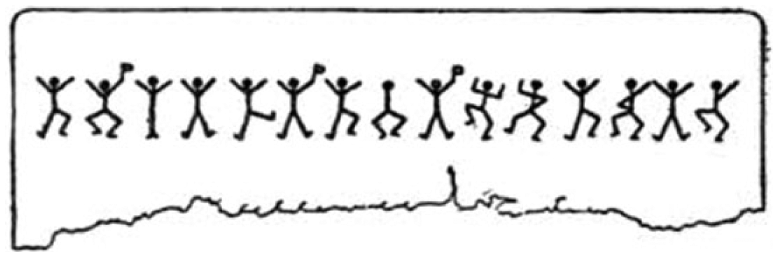
This is our first piece of evidence.
e1. The dancing men document.
Watson immediately offers an account. “Why, Holmes, it is a child’s drawing.” Holmes thinks otherwise. The dancing men drawings “have a meaning,” but they might be “arbitrary” (think “one if by land, and two, if by sea”) or they might be “systematic” (a cipher). Holmes bets on the latter. His client, Mr. Cubitt, has provided more data.
e2. Mr. Cubitt’s wife, Elsie, received a letter from America that very much upset her. e3. Other dancing men inscriptions, both on paper and chalk applied to buildings, have turned up at Riding Thorpe Manor. e4. Holmes has knowledge of the relative frequency of letters in the English language. ====================================================== t’0. The dancing men figures stand for letters. And the messages are in English.
Holmes breaks the code. He is now able to translate the different messages that turned up.
This leads to the second mystery, why is Elsie so reticent to tell her husband about her past, why is she so upset and frightened by the dancing men messages, and why did she stop her husband from confronting the stranger they caught in the act of scrawling one of the messages? Holmes is in a position to answer many of these questions simply by decoding the messages he has. In addition Holmes explains Elsie’s reticence and fear in terms of some connection to criminal activities in her past, and he knows that the correspondent is named Abe Slaney. A cable to a colleague in the United States confirms that Slaney is “[t]he most dangerous crook in Chicago.” Slaney is imploring Elsie to return to him, and finally threatening her. Holmes and Watson have plenty of evidence that necessitates hurrying to the Norfolk countryside.
e5. The contents of the messages. e6. Slaney is the most dangerous crook in Chicago. e7. Slaney’s threat to Elsie. ================================================ t”0. Elsie, and perhaps Mr. Cubitt’s, lives are in danger.
Sadly, they are too late. Immediately upon their arrival at the train station they learn of the tragedy. The stationmaster has, of course, not simply introduced crucial new evidence, but also offered an explanation. But we, dear readers, must wonder about rival explanations. Holmes proceeds to the murder scene, interviews two servants, and examines the room where the bodies have been found.
e8. Cubitt is shot dead and Elsie is gravely wounded with a gunshot to the head. e9. A revolver is found still containing four bullets. e10. The servants report several things.
Both were awakened by the sound of a loud gunshot.
A short while later they heard a second shot.
The victims were downstairs in the study.
A strong smell of gun smoke in the study.
The study window was shut and fastened.
The house was locked from the inside, and no one could have left.
They were both conscious of the smell of powder from the time they awakened upstairs.
There are still several pages to go in “The Adventures of the Dancing Men,” but Holmes has basically solved the case now. His reasoning is classic IBE. How and why did Mr. Cubitt and Elsie come to be shot? Why were the servants conscious of the smell of powder while upstairs? And what about the mysterious Slaney?
Holmes is particularly fascinated by the powder aroma upstairs – “I commend that fact very carefully to your attention.” 7 Holmes’ provisional hypothesis is that the window must have been open and the draft carried the smell. Careful examination of the study produces one last crucial bit of evidence.
e11. A third bullet is discovered in the window-sash.
A third bullet! Someone else is involved! They examine outside the window and discover important new data.
e12. Trampled flowers, large masculine footprints, and a spent cartridge.
But why only the sound of two gunshots? The first one was extremely loud. Might it “have been two shots fired almost at the same instant?” 8 Holmes concludes “it was undoubtedly so.” 9
Holmes proceeds to entrap Slaney, and he confirms that he was one of the authors of the dancing men messages, and that he and Mr. Cubitt exchanged gunshots through the window. The story never tells us precisely what happened to Elsie, but we know, just as Holmes knew.
t0. Slaney sought to win Elsie back and was refused. He came to the manor and exchanged almost simultaneous gunshots with Cubitt. Elsie closed the window and, either heartbroken at the death of her husband, overcome with guilt and a feeling of partial responsibility, or misguidedly seeking to preserve her husband’s good name, shot herself in the head.
Even at this stage other explanations are possible. Perhaps one of the servants is lying and had a murder-inducing grudge against Elsie. Perhaps the gun accidently discharged when Cubitt was shot and it dropped from his hand. But, we as readers and fantasy detectives are satisfied that we now know what happened. We, just like Sherlock Holmes, have inferred the best explanation of the known facts.
IV
At first glance, the evidence that O. J. Simpson was guilty of the murder of his ex-wife was overwhelming. Shortly after the time that the murder took place, he caught a plane to Chicago carrying a bag that disappeared, perhaps because it contained the murder weapon and bloody clothes. Police who came to Simpson’s house found drops of blood in his car that matched his own blood and that of Ron Goldman. In Simpson’s back yard, police found a bloody glove that was of a pair with one that was found at the scene of the crime, and they found a bloody sock in his bedroom. Simpson had a cut on his hand that might have been caused by a struggle with the victims who tried to defend themselves. Moreover, there was a plausible motive for the murder, in that Simpson had been physically abusive to his wife while they were married, and was reported to be jealous of other men who saw Nicole after the divorce.
10
Paul Thagard is one of the earlier defenders of inference to the best explanation. His account of the evidence in the O. J. Simpson case nicely summarizes the details of a long criminal trial. To feel confident that the evidence is really overwhelming, we must compare the prosecution’s diagnosis that O. J. had murdered Nicole to rival explanations. Again, from Thagard: The first task of the defense lawyers was to generate an alternative explanation of who killed Nicole Simpson and Ron Goldman. Based on Nicole’s known history of cocaine use, they hypothesized that she was killed by drug dealers … In order to explain the circumstantial evidence linking O. J. to the crime scene, including the bloody car, glove and sock, the defense contended that the items had been planted by Los Angeles Police Department officers determined to frame Simpson for the crime.
11
If all the jury had to do was to determine the best explanation of the facts introduced at trial, I think the case would have been an easy one. Introducing mysterious drug dealers and a racist plot on the part of the police would, indeed, explain all the evidence the jurors heard, but even the most skeptical juror would have had to admit that this rival account is complicated and pretty ad hoc. But the jurors were not simply asked to determine which theory best explained the evidence; they were asked whether the evidence proved Simpson’s guilt beyond a reasonable doubt.
Larry Laudan issues a stark indictment of reasonable doubt: At the core of criminal justice jurisprudence in our time lurks a fundamental conceptual confusion. Stated succinctly, the notion of guilt “beyond a reasonable doubt” – the only accepted, explicit yardstick for reaching a just verdict in a criminal trial – is obscure, incoherent, and muddled.
12
This could be expanded to include the lawyer’s understanding of preponderance of evidence, and clear and convincing evidence, as well. At a more general level, it could even be construed as covering our basic understanding of evidence across the board. Anyone familiar with theoretical discussions of evidence in the philosophy of science or contemporary analytic epistemology has to concede the charges of muddledness and obscurity. But incoherence is another matter altogether. For one thing, if our understanding of evidence in any particular context is truly incoherent, then no amount of analytic reflection and clarification can salvage the concept. The best that could be hoped for would be to find some new concept to substitute for the irreparably damaged one.
I believe it is premature for such radical conceptual abandonment. I have already stated that we possess a workable notion of (good) evidence that includes its use in legal, scientific, academic, and practical contexts. Why, then, are methodological discussions so muddled and obscure? I suggest this is exactly what we should expect when academics, practicing scientists, and judges attempt to construct precise models or rules for exercising a basic, likely quasi-perceptual, skill. I resort to an analogy. Major league hitters are remarkably skilled at hitting 95 mile an hour fastballs. Asking great hitters how this is done will usually result in highly idiosyncratic, and largely inaccurate, narratives. That doesn’t mean that good hitting coaches are impossible to find. No coach will be able to teach a non-skilled player how to be a good hitter. But good coaches can help very skilled hitters perform better, and save the day when the hitter is in the throes of a slump. I believe we are all very skilled at appreciating and evaluating evidence, but I also think we can all use a little good coaching now and then. Once we have waded through the idiosyncratic attempts of philosophers, academic lawyers, and well-intentioned judges, to define evidence, or “proof” beyond a reasonable doubt, we will find a useful, perfectly coherent, concept of good evidence. And one that invites expansion to include standards like preponderance of evidence, clear and convincing evidence, and reasonable doubt.
Our discussion of inference to the best explanation has so far emphasized our skill at ordinal ranking of explanatory candidates. The whole IBE test depends on determining the best explanation, which implies judgments about what is in second place, third place, etc. But our ability to distinguish between weak evidence, barely adequate evidence, really strong evidence, and proof beyond a reasonable doubt, introduces notions of not just ordinality, but cardinality as well. We need some method of determining not just what the best explanation is, but how superior it is compared to the alternatives.
Truly cardinal systems of measurement are additive. A location being twenty miles away is twice as far as a location that is only ten miles away. But, is a 4.0 grade point average (GPA) twice as good as a 2.0 grade point average? The academy, of course treats GPAs as though they were additive. An A in a three credit class “cancels out” a C in another three credit class for a GPA of 3.0. But this is very artificial. As anyone who has ever graded college level essays can attest, there simply isn’t an answer to whether an A paper is twice as good as a C paper. Sometimes it is a hundred times better. Sometimes, at least in my experience, it isn’t even as good as the C paper, but the former one gets the A, and the latter the C, for quasi-technical reasons in the assignment.
It would be convenient, indeed, to have some truly cardinal scale to apply to explanatory superiority. Oh, how useful it would be to say that t3 is twice as good as t1, but only half as good as t0. Some have tried to smuggle this clean cardinality into inference to the best explanation through the language of probability. I am skeptical that statistical thinking played much of a role in, not just Connie’s thinking, but that of Sherlock Holmes and the Simpson jurors, as well. We simply have no non-artificial way of determining prior probabilities to describe the Simpson evidence. And jurors, generally, only in the most metaphorical way, know the odds of an eyewitness account, or a certain finger print, implicating the defendant.
But even if we lack a complete model of exactly how it is done we certainly do make judgments of explanatory superiority that are more than simply ordinal. Wines are often not just better, but much better, than other wines. Same for academic papers, ice skating performances, and works of fine art. We naturally enough want some sort of scale to measure these differences, but I fear that the honest appraisal is that such scales only exist as artificial, and for that reason highly misleading, approximations for judgments that are inherently non-additive. All of this implies that there is still plenty of work to do unpacking our skills at judging explanatory superiority, and at making quasi-quantitative judgments of relative degrees of superiority. But the clear need to better understand these skills in no way challenges their existence. Juries (and detectives, etc.) base their verdicts on judgments about the best explanations of the evidence. They also largely succeed in applying cardinal standards like preponderance of evidence in civil cases, and proof beyond a reasonable doubt in criminal cases. Do they occasionally err? Yes of course they do. But does this mean that they are not skilled at these tasks? No way. Great hitters strike out on 95 mile an hour fastballs all the time.
V
I have in mind a sign that is affixed in this unpunctuated form to the door of the Johns Hopkins University Club:
I have had occasion to ask several classes what that sign means, and I have received a variety of answers, the least interesting of which is, “Only those who are secretly and not publicly members of this club may enter it.” Other answers fall within a predictable narrow range: “Only the genitalia of members may enter” (this seems redundant), or “You may bring in your own genitalia,” or (and this is the most popular reading, perhaps because of its Disney-like anthropomorphism) “Only genitalia may enter.” In every class, however, some Dr. Johnson-like positivist rises to say, “But you’re just playing games; everybody knows that the sign really means, ‘Only those persons who belong to this club may enter it.”’ He is of course right.
13
You’re driving on the interstate, come up quickly on a car ahead, change lanes and pass. As you pass, the driver’s left hand comes up along the side of his head. Did he just give you an obscene hand gesture? Or was he simply scratching his ear? Holmes had to make sense of the dancing men inscriptions. Just as we must explain the lipstick on his collar, the bodies at Riding Thorpe Manor, and the evidence at O. J.’s trial, we often find ourselves in communicative contexts where we must explain potential hand gestures, dancing men documents, to say nothing of literary and legal texts. It should come as no surprise that I believe inference to the best explanation will be helpful in these latter situations.
Interpreting the sign involves making an inference about what it means. We have a collection of data that is in need of explanation.
e1. The “text” is on a sign. e2. The sign is on a door. e3. The door is to the Johns Hopkins University Club. e4. The “text” reads, “PRIVATE MEMBERS ONLY.”
Such a characterization of the data implies that we have already done a certain amount of interpretation. We have explained the shapes “PRIVATE MEMBERS ONLY” as an attempt at linguistic communication; they did not accidentally appear when the building was being painted, nor are they modern art. Our explanatory question focuses on what these words are intended to communicate. We have a number of explanatory hypotheses: t0. Only those persons who belong to this club may enter it. t1. Only those who are secretly and not publicly members of this club may enter it. t2. Only the genitalia of members may enter. t3. You may bring in your own genitalia. t4. Only genitalia may enter. t5. The sign was intentionally designed with the double meaning by witty intellectuals.
As Fish’s no-nonsense student insists, the best explanation of the words on the door is perfectly obvious. Clearly t0 is the simplest, most complete, least ad hoc, and most plausible account. Linguistic communication and interpretation is an inherently explanatory process. From casual conversations and fun signs on doors, to the interpretation of literary, constitutional, and biblical texts, the role of the reader (or listener) is always the same. There are printed shapes and noises that need to be explained. Given the first order explanation that they are attempts at linguistic communication, the question now becomes what hypothesis best accounts for the meaning in the present context?
The explanations we have alluded to so far share a common feature. The dancing men texts were secret communication between Slaney and Elsie. The gesture might well have expressed the driver’s displeasure at your driving. The sign was saying who (or what) could or could not come in through the door. The following picture is so natural that we hardly think about it, and that indeed is the magic of linguistic (or symbolic) communication. Authors desire to communicate. They use a medium – spoken or written words, dancing men, hand gestures, or motion pictures – as their means for communicating. In the ideal case, when we are unsure of what they were communicating we simply ask them – what did you mean? If that proves impossible, as in all of the cases above, we must infer what they meant. Hirsch puts it well: It is the task of the historian of culture to explain why there has been in the last four decades a heavy and largely victorious assault on the sensible belief that a text means what its author meant.
14
We all have typed, or texted, “huh?” or just “???” when we were unsure what the person on the other end was trying to say. Here is a beautifully simple model of communication.
e1. There is a text. e2. The text has an author. ================================================== t0. The text means what its author intended it to mean.
Sadly, simple models are often too simple models. Authorial intent models of literary and legal interpretation are fraught with well-known problems. 15 But insights, even if they are mischaracterized insights, or too simple insights, are insights nonetheless. Explaining a text will always require, at least in part, explaining how and why the author constructed that text.
VI
The most important hypotheses that have been put forward are sub-varieties of three main points of view. The first of these sees the difficulty in the performance of the task in Hamlet’s temperament, which is not suited to effective action of any kind; the second sees it in the nature of the task, which is such as to be almost impossible of performance by any one; and the third in some special feature in the nature of the task which renders it peculiarly difficult or repugnant to Hamlet.
16
Besides its fame, or perhaps infamy, Ernest Jones’ essay offering the Oedipus-complex as an interpretation of “the cause of Hamlet’s hesitancy in seeking to obtain revenge for the murder of his father” would merit some discussion simply because of its title – “The Oedipus-Complex as an Explanation of Hamlet’s Mystery: A Study in Motive.” 17 Jones’ interpretation explicitly appeals to the notion of explanation at two distinct levels. One, of course, is Hamlet’s inaction. Why all the dithering? Jones argues that Hamlet is suffering from an Oedipus-complex, and offers as evidence in support of this hypothesis several bits of textual data. IBE would structure this argument in the following way.
e1. What we know from the text about Hamlet’s behavior – his inaction, his peculiar relationship with Gertrude, his misogynistic treatment of Ophelia, etc. ====================================================== t0. Hamlet was suffering from an Oedipus-complex.
The psychoanalytic diagnosis explains all of this puzzling behavior. The obvious critical problem for this interpretation is the embarrassing fact that Shakespeare wrote Hamlet almost three hundred years before Freud identified the Oedipus-complex. Jones wisely anticipates the problem and offers an explanation of Shakespeare’s mental state in writing the play.
We have finally to return to the subject with which we started, namely poetic creation, and in this connection to enquire into the relation of Hamlet’s conflict to the inner workings of Shakspere’s [sic] mind. It is here maintained that this conflict is an echo of a similar one in Shakspere himself,
2
as to a greater or less extent it is in all men. It is, therefore, as much beside the point to enquire into Shakspere’s conscious intention, moral or otherwise, in the play as it is in the case of most works of genius. The play is the form in which his feeling finds its spontaneous expression, without any inquiry being possible on his part as to the essential nature or source of that feeling.
18
So, we now are presented with an explanation, not just of the story in the play, but of its author as well. Again, Jones offers evidence. He points out that the Hamlet story was widely known in Shakespeare’s time, that the famous Kyd version was on the contemporary scene, and that “Shakspere in 1585 christened his own son Hamnet, a frequent variation of the name.” 19 The key, however, for Jones is Shakespeare’s own father.
Highly suggestive, therefore, of the subjective origin of the psychical conflict in the play is the fact that it was in September, 1601, that Shakspere’s father died, an event which might well have had the same awakening effect on old “repressed” memories that the death of Hamlet’s father had with Hamlet; his mother lived till some seven years later. There are many indications that the disposition of Shakspere’s father was of that masterful and authoritative kind so apt to provoke rebellion, particularly in a first-born son.
20
Thus, we get a linked argument reminiscent of the reasoning from the chalk on Watson’s hand to the decision not to invest.
e1. What we know from the text about Hamlet’s behavior – his inaction, his peculiar relationship with Gertrude, his misogynistic treatment of Ophelia, etc. ====================================================== t’0. Hamlet was suffering from an Oedipus-complex. e2. Shakespeare’s familiarity with the Hamlet legend and Kyd’s version of the play. e3. Shakespeare’s son’s name. e4. Shakespeare’s father’s temperament. e5. Shakespeare’s father’s death in 1601. ====================================================== t”0 Shakespeare, himself, suffered from an Oedipus-complex, and unconsciously transferred character traits from himself to Hamlet.
The million dollar questions are, of course, whether t’0 and t”0 are the
It is interesting in this connection to consider a more contemporary psychological account of Hamlet. A. B. Shaw has recently argued that Hamlet suffered from depressive illness, and that this diagnosis explains his failure to exact revenge. 21
Hamlet is a creature of Shakespeare’s imagination … He is not an actual patient. Therefore clinical diagnosis must be tentative, but there is good evidence in the play for depressive illness. Depressive illness is characterized by low mood, anhedonia, negative beliefs, and reduced energy. Hamlet actually calls himself melancholic and the very first speech he makes in the play is devoted to a public statement of his melancholy.
22
Shaw now proceeds to show how the text clearly shows Hamlet manifesting these clinical indicators.
e1. Hamlet exhibits anhedonia – e.g., “He speaks at length to Rosencrantz and Guildenstern, saying he has lost all mirth and that man does not delight him.” e2. Hamlet expresses negative beliefs – e.g., “He calls Denmark a prison. His comments to Ophelia on women are bitter.” e3. Hamlet “alludes to sleep disturbance ‘were it not that I had bad dreams’.” e4. Hamlet “has experienced events likely to precipitate depression: his father’s sudden death, his mother’s hasty marriage, and his disappointment in the succession.” ====================================================== t0. Hamlet suffered from depressive illness.
Shaw argues further that it is no embarrassment whatsoever that depressive illness only entered the clinical paradigm centuries after the play was written. We certainly grant that people suffered from this devastating condition long before psychology and medicine catalogued, and began to treat, it. Shakespeare was an excellent student of the human condition. Just as a perceptive author can recognize overly ambitious characters, jealous lovers, and power mad leaders, Shakespeare can recognize a person exhibiting the clinical behavior brought on by depressive illness – what his contemporaries would have called melancholy. Further, he can locate his depressive lead character in a play with perhaps larger and different artistic motives. Whether or not Shaw’s interpretation is the
VII
[T]he death penalty remains fraught with arbitrariness, discrimination, caprice, and mistake. … Rather than continue to coddle the Court’s delusion that the desired level of fairness has been achieved and the need for regulation eviscerated, I feel morally and intellectually obligated simply to concede that the death penalty experiment has failed.
23
The concept of evidence is rarely used to describe the structure of an appellate opinion, but it is clear that Justice Blackmun is presenting an argument, both for why the Court should have granted certiorari in the case at hand, and defending his intention to find in all further death penalty cases that the punishment as now administered is unconstitutional. Taking Justice Blackmun as the lead, I hope to show how the argument can be expanded as a linked inference once again reminiscent of the chalk on Watson’s hand to his decision not to invest.
The first sort of evidence that Blackmun needs is the constitutional language, itself.
e1. From the Fifth and Fourteenth Amendments: “[No person shall be] e2. From the Eighth Amendment: “
e3. From the Fourteenth Amendment: “[No State shall] deny to any person within its jurisdiction the
This language, as it stands, is problematic to Justice Blackmun’s case against the death penalty for two reasons. The first, of course, is that the language of due process, equal protection, and cruel and unusual punishment is abstract, vague, and inherently controversial. How those words came to be in the Constitution, an inherently explanatory question, is the subject of deep historical and jurisprudential debate. The interpretive question of what they mean is even more controversial. The second problem, though, is more immediate. The language of the Fifth and Fourteenth Amendments strongly suggests that persons may be deprived of life by the state without violating their constitutional rights.
To address this second problem Blackmun should appeal to a useful interpretive distinction first introduced by Ronald Dworkin. 24 Dworkin notes that the venerable methodology of authorial or original intent is ambiguous. Consider the following: you have been newly elected to the Faculty Personnel Committee. This is a huge tribute for someone so junior in their career, but also a huge responsibility. Your vote will help to determine who is promoted, granted tenure, and in some sad cases, fired. You do me the great honor of scheduling a meeting with me and asking my advice about how these personnel decisions should be made. I ask you to give me the weekend to collect my thoughts, and we can discuss it at the beginning of the week. Bright and early next Monday you show up at my office door, and it’s time for me to put up or shut up. Suppose my advice goes as follows.
Personnel decisions should always be made in the best interest of the university and its students. Since we are primarily a teaching institution, being a first-rate classroom instructor is an absolute precondition for tenure or promotion. We also value scholarship, so being engaged in active and productive research is also required.
Here’s the problem. My little speech is a text, and I am its author. According to authorial intent models the words mean what I am trying to communicate. We both know that Professor Green is up for tenure. Being indiscrete and more than a tad unprofessional, I have let my colleagues know that I think Green should not be granted tenure. I believe he enjoys a great reputation as a teacher because he is showy, and an easy grader. I don’t believe the students learn much in his classes at all. I also think his research is a joke. He’s published several articles, that’s true, but mainly in clubby journals edited by like-minded colleagues. So, since you ask my advice about tenure, and you know my thoughts about the concrete case of Green, if you respect my advice, you should vote against Professor Green. Right? Well, maybe not. My text didn’t talk about Green at all. It appealed to abstract notions like “best interest of the university and its students,” “being a first-rate classroom instructor,” and “being engaged in active and productive research.” You’ve looked at Green’s record. You think the teaching evaluations are very impressive, and he really has more publications than I do. You think it’s definitely in the best interest of the institution to tenure one of its brightest young stars. Dworkin argues that words can have both an
e4. The authors of the Fifth, Eighth, and Fourteenth Amendments concretely intended that capital punishment did not violate the Constitution. e5. The authors of the Fifth, Eighth, and Fourteenth Amendments abstractly intended that the entire criminal justice system, including capital punishment, adhere to the theoretical standards of avoiding cruel and unusual punishments, and be administered with due process of law, and equal protection of the law.
Blackmun now appeals to recent constitutional precedent. The case of Furman v. Georgia was unusual in many respects. It initiated the one and only time in our nation’s history when the death penalty was determined to be unconstitutional. It was an exceedingly close, 5 to 4, ruling, with the five Justice majority so at odds about why capital punishment was
These death sentences are cruel and unusual in the same way that being struck by lightning is cruel and unusual. … [T]he Eighth and Fourteenth Amendments cannot tolerate the infliction of a sentence of death under legal systems that permit this unique penalty to be so wantonly and so freakishly imposed.
26
The Gregg v. Georgia 27 case did three things, two of which were to the dismay of death penalty abolitionists. Perhaps most significantly, it ruled that capital punishment was not, per se, cruel and unusual punishment under the Eighth Amendment. It also ruled that new sentencing procedures initiated after Furman had successfully eliminated the problem of arbitrary and capricious administration of the death penalty in Georgia. But, and this is crucial to Blackmun’s argument, it reinforced the basic finding of Furman that arbitrary and capricious administration of capital punishment constitutes a fatal constitutional flaw.
Lots of other death penalty precedent is relevant as well, and indeed Blackmun highlights some of it in his Callins v. Collins manifesto. 28 For our present purposes though, the original constitutional texts, Furman and Gregg provide evidence for his central interpretive claim.
e1. From the Fifth and Fourteenth Amendments: “[No person shall be] e2. From the Eighth Amendment: “[C]ruel and unusual punishment [shall not be] inflicted.” e3. From the Fourteenth Amendment: “[No State shall] deny to any person within its jurisdiction the e4. The authors of the Fifth, Eighth, and Fourteenth Amendments concretely intended that capital punishment did not violate the Constitution. e5. The authors of the Fifth, Eighth, and Fourteenth Amendments abstractly intended that the entire criminal justice system, including capital punishment, adhere to the abstract standards of avoiding cruel and unusual punishments, and be administered with due process of law, and equal protection of the law. e6. Furman v. Georgia 408 U.S. 238 (1972). e7. Gregg v. Georgia 428 U.S. 153 (1976). ====================================================== t’0. “[T]he death penalty must be imposed fairly, and with reasonable consistency, or not at all.”
29
For a rival explanation at this stage of the argument, one need look no further than Justice Scalia’s terse concurrence in Callins v. Collins. 30
The final part of Blackmun’s argument applies extralegal empirical facts. He will employ an argumentative strategy that I have called “the argument from contingent reality.” 31 He will concede the per se constitutionality of capital punishment, but will then counter that contingent facts about its current application render it unconstitutional. Blackmun concentrates on the first of four relevant facts, but all four together make an even more persuasive case. The first, of course, will hearken back to Furman. He will document that an examination of current death penalty convictions shows that they remain arbitrary and capricious.
e8. Current (post-Gregg) death penalty convictions show the same pattern of arbitrariness and caprice that the Court was concerned with in Furman.
He might then remind the Court that there is a wealth of evidence that the above-mentioned pattern in the sentencing is worse than simply capricious, but is actually discriminatory, both in terms of race 32 and socio-economic class. 33
e9. Clear statistical data demonstrating that the race of both the defendant and the victim is a relevant factor in who receives a death sentence. e10. Clear statistical data demonstrating that the socio-economic class of the defendant plays a causally relevant factor in who receives a death sentence.
Finally, he should point out that research demonstrates a troubling number of cases where there have been near misses of convicting and executing an innocent defendant, 34 and may go so far as to claim that innocent defendants have been executed. 35
e11. Demonstrably innocent defendants have been convicted of homicides that potentially carried the death penalty. e12. Innocent defendants have probably been executed.
Blackmun offers a damning explanation of all this doctrinal and empirical evidence.
t”0. [T]he inevitability of factual, legal, and moral error gives us a system that we know must wrongly kill some defendants, a system that fails to deliver the fair, consistent, and reliable sentences of death required by the Constitution.
36
Is his account the
VIII
IBE faces two key challenges. First, how exactly is IBE to be understood and made precise? There are various conceptions of the nature of explanation, but assuming some of these are suitable for IBE this still leaves the question as to how one explanation should be compared against another so that the best explanation can be identified. Second, what is the connection between explanation and truth? Is there any reason for thinking that the best explanation is likely to be true? Or to put it another way, does IBE track truth? Of course, no approach should be expected to lead to the truth in every instance, but if IBE is to be accepted as a rational mode of inference, there must be some reason for thinking that it provides a good strategy for determining the truth.
38
I have already confessed to much unfinished business for those of us who defend inference to the best explanation, both in specific applications like literary and constitutional interpretation, civil and criminal evidence, and the like, as well as the more general areas of metaphysics and epistemology. In many respects showing that our appeals to evidence fit the structure of inference to the best explanation is the easiest of the challenges. The author will present examples of reasoning from evidence (isn’t all reasoning “from evidence”?) in various contexts and illustrate how well they fit the schema. This, of course, is the project I have begun in the present article. But IBE will fail to win overall methodological support until these other problems and puzzles are candidly addressed. We have seen, for example, that explicating the legal standard of proof beyond a reasonable doubt remains very much a work in progress.
So without any presumption of solving them in the present context, let me close by simply stating what I believe are the two biggest metaphysical and epistemological problems IBE faces. Harman in his canonical statement of inference to the best explanation acknowledged that “there is, of course, a problem about how one is to judge that one hypothesis is sufficiently better than another hypothesis.” David H. Glass reiterates this problem in this section’s epigraph, but goes further and queries – “does IBE track truth?” Consider an analogous question – does visual perception track the truth? Philosophers from Plato, to Descartes, to contemporary sociologists of knowledge have struggled with this one. But most beginning students, and most of our best natural scientists, have no trouble with it whatsoever. Of course vision tracks the truth! And even though there remains much work to do in cognitive science, we also know why and how vision tracks the truth. Vision is clearly an adaptive trait. Natural selection has provided countless species a way of tracking the environment external to the organism. Is vision different for different species? Of course. Is human vision perfect? Of course not. But seeing what’s going on around you is a basic perceptual skill that almost all humans possess. The story about explaining things, I suspect, will ultimately be very similar.
Virtually everyone who has survived past infancy has a more or less well developed set of perceptual skills. These skills may be generally described as the ability to tell what’s going on (sometimes) simply by seeing it … This is the ability to tell what’s going on – or what’s gone on – even when we are not confronting it directly. We can often tell what has happened from the traces it leaves. We can tell there was a frost by the damaged trees; we know it rained because the mountains are green; we can tell John had some trouble on the way home from the store by the rumpled fender and the broken headlight. We reconstruct the event from its telltale consequences. It is this diagnostic skill we exploit in the most basic sort of inductive arguments; it is the foundation of our ability to evaluate evidence.
39
To say that we are skilled explainers is not to say that there is some kind of cognitive or conceptual magic bullet that bestows “objectivity” on our judgments of explanatory success or failure. Indeed, objectivity is in an important sense impossible. It is, after all, individual subjects who present evidence, assess its quality, and make judgments about what the best explanation really is. Evidence evaluation is by its very nature subjective, but what we aspire to is
If our ability to successfully explain things, that is to say rank one possible explanation as superior to another, is a basic perceptual skill given to us through natural selection, the external world and the way things are out there must have played a huge role in the development of this skill. If we were not largely successful in “tracking truth” when we explain things it’s hard to see how this behavior would survive, indeed thrive, in our species. This bit of adaptionist reasoning rings true for our hunter-gatherer ancestors. It also nicely fits Connie’s diagnosis of the lipstick stain, and the thinking of the jurors in the Simpson trial. 41
But does IBE track the truth of what transpired at Riding Thorpe Manor, or why Hamlet procrastinates, or even whether capital punishment
Though truth is correspondence with the facts it cannot be recognized by its correspondence. We cannot rely on the facts to guide proofs of scientific theories since the facts are irretrievably at the outer end of the correspondence relation. … So any indicators of truth must be internal. … The process of justifying, then, is a process of comparing aspects of the system, and the accomplishment of justification is the demonstration of coherence among the aspects.
42
But we believe the external world is there, and we believe it contributes to the truth or falsity of many of the claims we make and theories we defend. This is the venerable correspondence theory of truth, but more sophisticated and modest by conceding that there is no “God’s eye” from which to immaculately and directly determine correspondence.
But it’s only by analogy and metaphor that we believe there’s a world where Elsie tried to kill herself, or Hamlet failed to act. We believe there’s a constitutional text, and an historical record of previous Supreme Court rulings. We also believe there’s a world (again described in our conceptual scheme) where race, class, and human error influence who lives and dies. But is it this world that determines the truth or falsity of Justice Blackmun’s claim about the Constitution? Literary and constitutional truths appear to rely more on the coherence theory of truth.
It is tempting to adopt an overall coherence theory of truth, since it would elegantly unite all of my examples above. I demure, however, because I continue to believe that this does not do justice to our intuitions about Connie and the lipstick, or what happened in the Simpson case. But, perhaps it’s not so surprising after all that we see two very different sorts of truth at work in different compartments of our intellectual lives. The basic explanatory skill that underlies naïve metaphysical realism and the correspondence theory of truth must have developed much earlier in evolutionary history. Our human and pre-human ancestors merely needed to explain the world as it “really” was well enough to survive and reproduce. As we progressed as a species and began to produce complicated texts, and indeed whole cultural practices within which these texts were embedded, these closely related explanatory skills had much more abstract and intellectual applications to these very texts and cultural practices. In these latter contexts, inference to the best explanation does not discover truth as much as it creates truth. Appeals to evidence in the complicated worlds of teenage romance, detective fiction, criminal law, literary interpretation, and constitutional law all nicely fit the structure and evaluative methodology of inference to the best explanation. But only the diagnoses of lipstick stains, murder victims and bloody gloves can be held to the standards of correspondence and metaphysical realism. Literary and constitutional texts can be explained, and can be better or worse explained, but the truth or falsity of these interpretations is firmly in the realm of the coherence theory.
Footnotes
1.
G. Harman, “The Inference to the Best Explanation,” The Philosophical Review 74(1) (1965), 89.
2.
Harman, “Inference.”
3.

4.
Doyle, “Dancing.”
5.
Doyle, “Dancing.”
6.
Doyle, “Dancing.”
7.
Doyle, “Dancing.”
8.
Doyle, “Dancing.”
9.
Doyle, “Dancing.”
10.
Paul Thagard, Hot Thought (Cambridge, MA: MIT Press, 2006), p. 136.
11.
Thagard, Hot Thought, pp. 138–9.
12.
L. Laudan, “Is Reasonable Doubt Reasonable?,” Legal Theory, 9 (2003), 295.
13.
Stanley Fish, Is There a Text in this Class? (Cambridge, MA: Harvard University Press, 1980), pp. 274–5.
14.
E. D. Hirsch, Jr., Validity in Interpretation (New Haven, CT: Yale University Press, 1967), p. 108.
15.
The classical discussions of the problems with authorial intent in literary interpretation is W. Wimsatt and M. Beardsley, “The Intentional Fallacy,” Sewanee Review 54 (1946), 468–88. Revised and republished in William Wimsatt and Monroe Beardsley, The Verbal Icon: Studies in the Meaning of Poetry (Lexington, KY: University Press of Kentucky, 1954), pp. 3–18, and in legal interpretation, P. Brest, “The Misconceived Quest for Original Understanding,” Boston University Law Review 60 (1980).
16.
E. Jones, “The Oedipus-Complex as an Explanation of Hamlet’s Mystery: A Study in Motive,” The American Journal of Psychology 21 (1910), 75.
17.
Jones, “Oedipus-Complex,” 74.
18.
Jones, “Oedipus-Complex,” 102–3.
19.
Jones, “Oedipus-Complex,” 103.
20.
Jones, “Oedipus-Complex.”
21.
A. B. Shaw, “Depressive Illness Delayed Hamlet’s Revenge,” Medical Humanities 28 (2002), 92–6.
22.
Shaw, “Depressive,” 92.
23.
Callins v. Collins, 510 U.S. 1141 (1994). Justice Blackmun, dissenting.
24.
Ronald Dworkin, A Matter of Principle (Cambridge, MA: Harvard University Press, 1985), pp. 48–55.
25.
Ibid.
26.
Furman v. Georgia, 408 U.S. 238 (1972).
27.
Gregg v. Georgia, 428 U.S. 153 (1976).
28.
Callins v. Collins.
29.
Callins v. Collins.
30.
Callins v. Collins. Justice Scalia concurring.
31.
J. Johnson and C. Johnson, “Poverty and the Death Penalty,” Journal of Economic Issues 35 (2001), 1–7.
32.
See, for example, David C. Baldus, Charles Pulaski, and George Woodworth, “Comparative Review of Death Sentences: An Empirical Study of the Georgia Experience, ”Journal of Criminal Law and Criminology (1983); and “Death Penalty Sentencing: Research Indicates Pattern of Racial Disparities,” GAO/GGD-90-57, 26 February 1990, reprinted in Hugo Adam Bedau, The Death Penalty in America (New York: Oxford University Press, 1997), pp. 268–74.
33.
See, for example Johnson and Johnson, “Poverty,” and S. Bright, “Counsel for the Poor: The Death Sentence Not for the Worst Crime but for the Worst Lawyer,” Yale Law Journal 103 (1994).
34.
See, Michael Radelet, Hugo Adam Bedau, and Constance Putnam, In Spite of Innocence (Boston, MA: Northeastern University Press, 1992).
35.
See, John C. Tucker, May God Have Mercy (New York: W.W. Norton & Co., 1997).
36.
Callins v. Collins.
37.
Callins v. Collins.
38.
David Glass, “Inference to the Best Explanation: Does It Track Truth?” Synthese 185 (2012), 412.
39.
Larry Wright, Better Reasoning (New York: Holt, Rinehart & Winston, 1982), p. 51.
40.
I argued this in the context of natural theology in J. Johnson, “From Friendly Atheism To Friendly Natural Theology: The Case for Modesty In Religious Epistemology,” Minerva – An Internet Journal of Philosophy 7 (2003).
41.
I am assuming that most of the jurors would have said that the evidence pointed to O. J.’s guilt, but that the state had failed to prove this beyond a reasonable doubt.
42.
Peter Kosso, Reading the Book of Nature (Cambridge: Cambridge University Press, 1992), p. 136.