



Abstract
International legal theorists posit historical moments when conceptions of justice are “constituted by, and constitutive of, the transition” (Teitel). This article uses the framework of transitional justice to understand the cultural work of political allegory in the spring of 1660 on the eve of the English Restoration. Insights from transitional justice (1.) help explain how Anglican royalists convinced wary Presbyterians to assent to a restoration of the monarchy; (2.) permit a new reading of Milton’s allegory of Sin and Death in Paradise Lost; and (3.) facilitate a more critical history of the framework of transitional justice itself.
Keywords
The notion of “transitional justice” … comprises the full range of processes and mechanisms associated with a society’s attempts to come to terms with a legacy of large-scale past abuses in order to ensure accountability, serve justice, and achieve reconciliation. These may include both judicial and non-judicial mechanisms, with differing levels of international involvement (or none at all) and individual prosecutions, reparations, truth-seeking, institutional reform, vetting and dismissals, or a combination thereof. —United Nations Security Council Report of the Secretary General, “The Rule of Law and Transitional Justice in Conflict and Post-Conflict Societies,” August 23, 2004
1
[W]hat will then be the revenges and offences and rememberd and returnd, not only by the chief person, but by all his adherents; accounts and reparations that will be requir’d, suites, inditements, inquiries, discoveries, complaints, informations, who knows against whom or how many, though perhaps neuters, if not to utmost infliction, yet to imprisonment, fines, banishment, or molestation; if not these, yet disfavor, discountnance, disregard and contempt on all but the known royalist or whom he favors, will be plenteous: nor let the new royaliz’d presbyterians perswade themselves that thir old doings, though now recanted, will be forgotten; what ever conditions be contriv’d or trusted on … Let them but now read the diabolical forerunning libells, the faces, the gestures that now appeer foremost and briskest in all public places; as the harbingers of those that are in expectation to raign over us; let them but hear the insolencies, the menaces, the insultings of our newly animated common enemies crept lately out of thir holes, thir hell, I might say, by the language of thir infernal pamphlets … —John Milton, The Readie and Easy Way (2nd Edition), April 1660
2
On April 2, 1660, two days before Charles II set out the terms to which he would assent for the restoration of the Stuarts in his Declaration of Breda, bookseller George Thomason recorded his receipt of an anonymous royalist broadside whose full title, occasionally abbreviated (for reasons of economy and academic gentility) as The Life and Death of Mris. Rump, was The Life and Death of Mris. Rump. And the Fatal end of her Base-born brat of destruction, with her own first hatching And bringing forth from the Devils Arse a Peake, it being the only place from whence this illegitimate Bastard or Monster had its Nativity (See Figure 1).
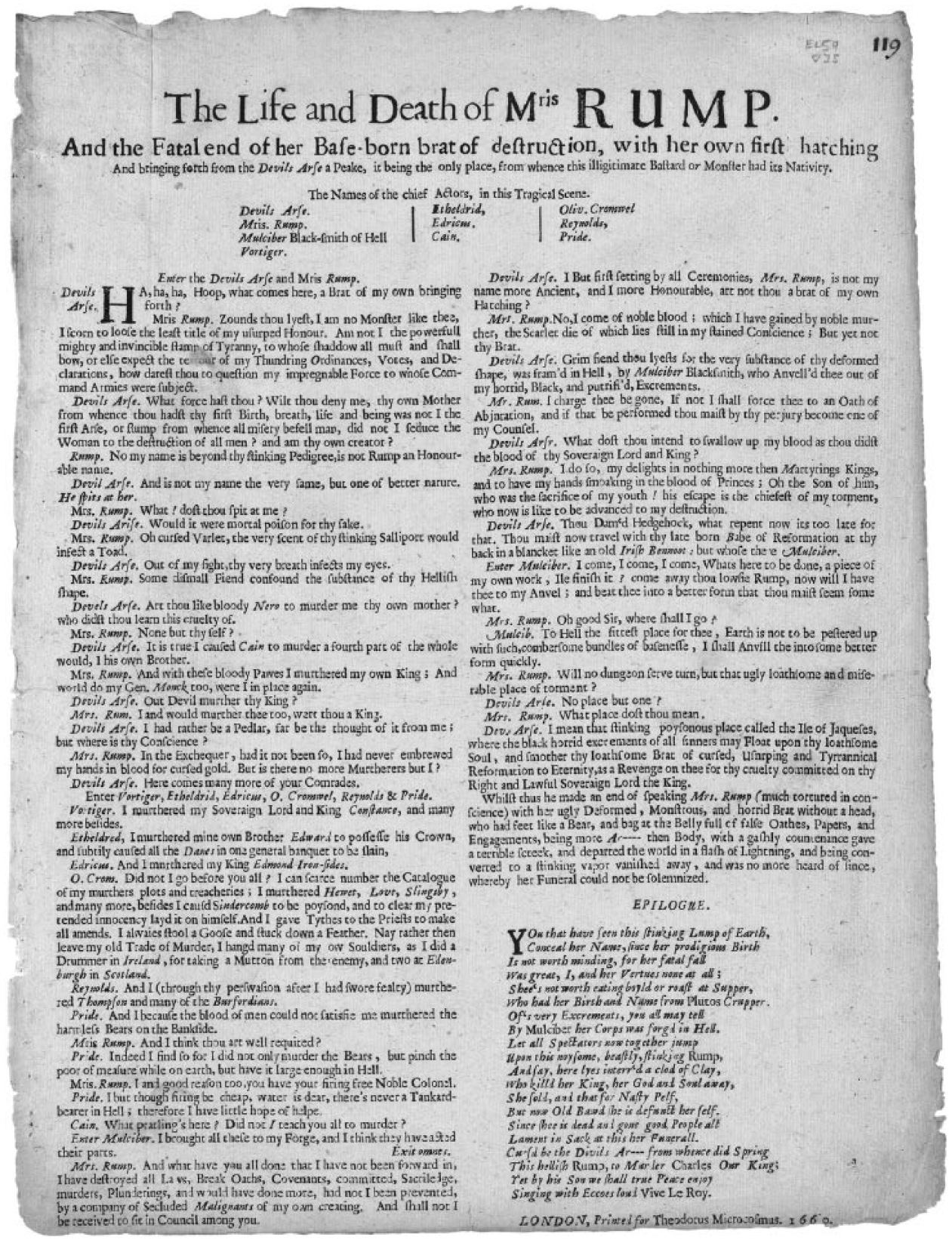
The Life and Death of Mris Rump, and the fatal end of her base-born brat of destruction, etc. Folger 236958 (flat). Used by permission of the Folger Shakespeare Library under a Creative Commons Attribution-ShareAlike 4.0 International License.
Unsurprisingly, it is a crude, vituperative dialogue. Its main characters are Mistress Rump, the Devil’s Arse, and Mulciber, “the black-smith of hell.” Oliver Cromwell, Cain, Ethelred, and Thomas Pride all make cameo appearances. The death of Mistress Rump, to which the title alludes, involves her “being converted to a stinking vapor” and “vanish[ing] away,” never to be heard from again, “with her ugly Deformed, Monstrous, and horrid Brat without a head.” 3 In the context of the readmission of royalists and Presbyterians to the House of Commons in February, the death of Mistress Rump requires little exegesis. The monstrous, headless child, symbolic of a republican form, is equally direct. 4 Yet, as feminist scholars including Lois Potter, Sharon Achinstein, Diane Purkiss, Katherine Romack, and Shannon Miller have shown, such broadsides deserve scholarly attention for the ways they mobilize misogynist anxieties about female agency against republican and Parliamentarian enemies. 5 And, as historian Ann Hughes has emphasized, such broadsides could even “deliver subtly distinct messages within a broad framework of unnatural inversion.” 6 This article argues that appreciating the consequential political work these and similar publications did on the eve of the Restoration requires an even fuller context – one that reaches back to royalist publications of the 1640s and forward into the perpetuation of Milton’s Paradise Lost through the literary canon. My focus is on The Life and Death of Mris. Rump along with some little-studied companion pieces published at the Restoration and in the context of their slightly better-known progenitors, a set of pamphlets published in 1648 under the name of the royalist newsbook Mercurius Melancholicus and dubbed by their modern editor The Mistress Parliament Political Dialogues. 7 Vicious, gross, and disturbing, both sets of allegories present themselves as vehicles of popular politics of the meanest and most acrimonious kind.
That may or may not be true of the Mistress Parliament allegories. But of the later Mistress Rump allegories, it is not. This article argues that the spring of 1660, as England considered the possible restoration of the Stuart monarchy, might profitably be understood as a moment of political transition when conceptions of justice were “alternately constituted by, and constitutive of, the transition” from one political regime to another. 8 As such, the Mistress Rump allegories are usefully understood as part of “the full range of processes and mechanisms associated with a society’s attempts to come to terms with a legacy of large-scale past abuses,” processes and mechanisms increasingly known by the shorthand “transitional justice.” As a 2004 report from the UN Secretary-General puts it, transitional justice must embrace “all groups in society, including elites, ex-combatants and (non-criminal) elements of former regimes, all of whom must be reassured that they will be protected from unlawful or unfair retribution and offered a real chance at reintegration into their society.” 9 Beneath the veneer of their invective, I argue, the Mistress Rump allegories make a magnanimous gesture ultimately critical for brokering the fragile trust between royalists and Presbyterians that was necessary for the readmission of the Stuarts. Having set forth the argument that allegories such as these – even with their seemingly implacable malice – were capable of performing the most delicate of political overtures, I will then turn, for evidence that scholars can benefit by attending to the way such allegories sought to sooth Presbyterian fears of royalist reprisals, to John Milton’s oppositional allegory of Sin and Death in Paradise Lost, which takes aim at the tenuous, emerging coalition. 10 In using allegory to disrupt transitional justice’s fundamentally comic drive toward reconciliation over and above political contestation, Milton can be seen as an early critic of transitional justice who anticipates some significant 21st-century critiques. 11
Although one historian has been “left with the distinct impression that in … the spring and summer of 1660 moderate Episcopalians and moderate Presbyterians came closer to a rapprochement than at any time since their divergence in the middle decade of the reign of Elizabeth,” the textual means by which Anglican Royalists courted Presbyterians’ allegiance have rarely been explored. 12 This article begins with the question of what role popular allegories played in repairing the ruins, as Milton once put it in another context. 13 From the readmission of the Presbyterian members of the Long Parliament on February 21 through the sitting of the Convention Parliament on April 25, Presbyterians effectively held the political fate of the nation in their hands. Some of the Presbyterian laity were eager to recall Charles II, but the clergy – people like Richard Baxter and Edmund Calamy – worried about Charles’ restoring episcopacy and the Anglican liturgy, and so balked at a Restoration, insisting that if Charles were to be recalled, it would have to be on harsh terms that protected presbytery. 14 Perhaps even more significantly, Presbyterians who had fought with Parliament in the civil wars also required assurance that they would not fall victim to Stuart retaliation. It has long been known that royalists sent emissaries to assure nervous Presbyterian clergymen that the king would assent to the ecclesiological wishes of the Parliament during this tense period; that Edward Hyde, Earl of Clarendon, orchestrated from Brussels a campaign to mute intemperate Anglican ministers’ criticism of Presbyterians, lest Presbyterians’ fears that an Anglican ascendancy would be overtly hostile to presbytery be confirmed; 15 and that royalist presses during this period poured forth declarations that royalists did not seek revenge on those who had taken up arms against Charles I in the 1640s. But the role of the Mistress Rump allegories in this campaign has never fully been recognized.
Derek Hirst has identified “the need for a more complicated story” about the period immediately preceding the Restoration, noting that there remains much about the return of the Stuarts that remains unknown. 16 Legal scholars’ framework of transitional justice helps us see the Restoration in a productive new light. A methodological challenge many scholars have faced has been to link the lively world of popular print culture with the period’s mutable landscapes of political affect – the less tangible but no less important topologies of fear, hope, love, and trust that, in aggregate, helped to secure some kinds of political relations and debilitate others. Transitional justice is a useful framework for the Restoration of 1660 precisely because it takes seriously the subjective aspirations and grievances of participants without losing sight of the judicial and non-judicial mechanisms called upon to make a polity whole.
By comparing the Mistress Rump allegories of the spring of 1660 with the Mistress Parliament allegories of 1648, we can see more clearly how extensive the royalist conciliatory gestures were. 17 Anonymous, the Mistress Rump allegories subtly suggested royalists’ interests without subjecting any individual to charges of hypocrisy or duplicity; popular and cheap, they assured themselves a wide audience in the process of “constructing an image of Royalism as popular, and the popular as Royalist.” 18 With attention to print history, we find that royalist attempts to woo Presbyterians took on an interesting popular dimension that complemented their campaign for the allegiance of the elite. As the sociologist Richard Sennett has written, “Political cooperation has to be humanly fine-tuned, through rituals of mutual respect,” often relying on face-saving gestures on the part of the powerful that amount to ritual “exercises in applying minimum force.” 19 In 1660, ascendant royalists conducted such maneuvers in the public sphere by quietly shifting their verbal abuse away from potential new allies.
Before looking in more detail at particular works, however, it is worth pausing to discuss the cultural milieu in which they circulated. Joad Raymond rightly observes that the Mistress Parliament play-pamphlets exemplified an “unstable composite genre, mixing elements of drama, reportage, satire, and prose polemic.” 20 The mode of allegory did most of the heavy lifting. Anthropomorphized abstractions like Mrs. London, Mrs. Sedition, and Mrs. Privilege people the pamphlets’ outrageous, bodily-function ridden world. Their “main purpose,” as Raymond puts it, “was fruit throwing.” 21 The play-pamphlets did so, in part, by trafficking in popular views of childbirth, a trope well suited for allegory. Mistress Rump’s “Base-born … illegitimate Bastard or Monster” is a telling indicator of the cultural meanings of progeny: its satirical language of illegitimacy and monstrosity, while heaping obvious scorn on Mistress Rump and her child (itself a parody of Puritans’ “babe of reformation”), also reflects deeper popular attitudes toward conception and monstrous births, which most people in the period considered wholly possible. In his valuable study of anecdotes of monstrous births circulating in the 1640s and used for polemical purposes in the ongoing Revolution, social historian David Cressy relates how purported monstrous births signaled to observers the “monstrous, vicious, or irreligious activities” of their parents. “Women especially,” he writes, “were believed to be responsible for the issue of their wombs.” 22 But “[m]ore than simply an abomination of tissue, monstrosity pointed to social pathology and religious failing, a disturbance of the natural order.” 23 Stories of monstrous births, as Julie Crawford has demonstrated, expressed fears of radical, un-policed Protestantism: monsters were seen as punishment for “conscientious resistance to patriarchical and clerical control.” 24 Thus, such attitudes about monstrous births were not merely an aftereffect of a providentialist outlook, but also served as a way of thinking and talking about history, transition, and justice: the beauty (or monstrosity) of the “issue” was an index of its parents’ virtue, its form a revelation of the past’s rights and wrongs. Bastardy and monstrosity were therefore closely linked: a monstrous child told a historical narrative of its parents’ depravity and demonstrated that however much parents (women especially) might try, sin could never be fully cloaked from public view. “I am … deformed,” one new-born pamphlet-monster announced baldly, “for the sins of my parents.” 25 Deformed bodies, that is, narrated putative truths about what happened previously behind closed doors: they told stories about historical injustice.
In the 1660 debates over the political settlement, allegorical progeny are regularly pressed into service as deliverers of political-historical meaning in just this way. But there was of course precedent. Anonymous pamphleteers discussed Cromwellian constitutional turbulence in procreative terms in 1656. A Cromwellian figure in the politically cagey allegory A Perfect Nocturnall relates to his wife “Policy” of “our Son Parlia that thou and I and all our Friends had taken so much pains to bring up and order in al things to help us carry on the work.”
26
What makes the work especially cagey is its mediation between past and future, as evidenced by its central biblical allusion, which ambivalently exculpates and criticizes Cromwell’s rising power. Policy’s words to the Cromwellian figure (Hiel) provide a useful look at the popular link between one’s virtue and one’s progeny: [A]lthough I had many Husbands and many Children … yet I have not had such beautiful Children by any one I have had by Thee, for about the middle of thy years, and to these late dayes thy seed was not corrupted, so what the Fruit of our Bodies were fair and lovely. But now in the latter days, thy seed is corrupted, so that lying together contrary to former engagements makes our Issue incapable of long life.
27
In an obvious reference to Cromwell’s dissolution of the Rump, Hiel confesses that their “beautiful” son Parlia “grew so undutiful and unservicible to me in my great undertakings that I was forced to kill him with my own two hands.” 28 Hiel appears only once in the Bible, in 1 Kings 16:34, where he fulfills Joshua’s prophesy that the person who tries to rebuild Jericho shall lay its foundation at the cost of his first born child. 29 In linking Cromwell with Hiel, the allegory thus absolves Cromwell of personal responsibility for disbanding Parliament even as it characterizes his action as a transgression against God’s will. Its disapproval is tempered by a providential recognition that God’s prophesies must be fulfilled. Casting Cromwell as Hiel, however, indicates the author’s wish to constrain Cromwell from future similar actions. No longer bound by the terms of Joshua’s prophesy, the Cromwellian Hiel’s threat to kill his next child, who he had been “forced and necessitated” to name Parlia like his murdered son, comes across as abjectly filicidal. 30 Policy’s comment that Hiel’s “seed is corrupted,” meanwhile, suggests that this second Parlia (whether meant to signify the Nominated Assembly or the Protectorate Parliament) is “incapable of long life”—whatever actions Cromwell might take.
Typical of similar characters, Parlia is both a historical narrative and a prophecy. Allegorical progeny like Parlia translate the inheritance of the past, whose secrets are revealed in the children born in the present, into politically-charged predictions of success or failure. By 1659 such gambits had become commonplace and could be accomplished in remarkably few words. England’s Safety in the Laws Supremacy calls monarchy “an offspring of Force.” 31 A satire of Harrington’s Oceana of the same year speaks of the “Senate that is now Hatching,” tainting it with the implication of irregular birth. 32 And The Humble Petition and Advice, the constitution allowing Oliver Cromwell to choose his successor, was for republicans in Richard Cromwell’s Parliament denying its legitimacy a “monster” conceived, scandalously, by Cromwell forcing his “will” upon a body that was “no Parliament, but a Faction.” 33 (The royalist broadside England’s Murthering Monsters (1659) in turn denounced the “bastard Good Old Cause,” which “fickle faction hath so…deform’d.”) 34 Short locutions like these were enmeshed in the web of cultural meanings surrounding births, children, and political transitions, a web whose invocation had the capacity to talk moralistically about virtue and vice, and, significantly, about past, present and future. Allegorical offspring, that is, functioned to relate the present to its purported history and – proleptically – to narrate its future.
I. The Mistress Rump Allegories and the Presbyterians
That allegorical figures could do such forceful political work economically – in a way, that is, that asked relatively little of readers’ time, money, or exegetical skills – was one of royalist satirists’ key discoveries of the civil wars. The Life and Death of Mris. Rump formed part of a trio of similar works published in the royalist resurgence of March and April 1660 that included Mris. Rump Brought to Bed of a MONSTER, with her terrible pangs, bitter Teming, hard Labour, and lamentable Travel from Portsmouth to Westminster, and the great misery she hath endured by this ugly, deformed, ill-shapen, base begotten Babe, or Monster of Reformation, with the great care of Nurse Haslerigg and Mris London the Midwife and the play-pamphlet The Tragedie of the Life and Death of Mris. Rump (with a similar extended title). 35 These publications incorporated new developments such as the stalwart republican Arthur Hesilrige’s 1659 muster at Portsmouth (“Nurse Haslerigg”), but they mostly revived dialogues illegally published under the name of the popular newsbook Mercurius Melancholicus in another period of royalist optimism, this one briefer and ultimately disappointing, from the spring of 1648. 36 The bulk of the text from the Restoration pieces Mris. Rump brought to Bed of a Monster and The Famous Tragedie of the Life and death of Mris. Rump was lifted from Mistres Parliament Brought to Bed of a Monstrous Childe of Reformation, which Thomason dated April 29, 1648. Perhaps the output of an inveterate duo of popular royalist printing, the journalist John Crouch and his relative, printer Edward Crouch, the 1660 texts recycled a great many aspects of the 1648 text even as “the characters were revised to fit a new political context.” 37 The plot, in which an ailing Mistress Parliament (now “Rump”) vomits up disgusting acts and then gives birth to a deformed child with the assistance of complicit nurses like Mrs. London and Mrs. Sedition, is identical. Given how few alterations were made, the works printed and sold in 1660 have appeared to some as a way for royalists in the book industry who had been starved by Interregnum press controls to squeeze some additional profit from copy leftover from the civil wars. 38 But resurrecting the Mistress Parliament allegories actually aimed toward the comic reconciliation of transitional justice. Changes that helped Presbyterians save face facilitated the critical rapprochement between royalists and Presbyterians in the spring of 1660, a reconciliation whose primary if indirect result was nothing less than the Restoration of Charles II.
Superficially, a benefit of reviving the allegories was to emphasize how little the constitutional maneuvers of the Interregnum had done to settle the nation. Anything that could be said of Parliament in 1648, they suggested, could be said of the Rump in 1660. Eleven years of Rump rule was no better than seven of civil war. Such at least was an argument underlying one of the changes that was made, whose subtlety is representative of other similar changes. In Mistress Parliament Brought to Bed of a Monstrous Childe, the protagonist vomits “Blood, innocent blood, that hath lain in clods congealed at my stomack this 7 years.” 39 Instead of adding the Interregnum years to those of the civil war, however, the 1660 version Mris. Rump Brought to Bed substitutes them: “7” becomes “11,” and Rump rule is therefore equated with the horrors of civil war violence. Paradoxically, the illusion that nothing had changed could be accomplished nicely with the flexible genre of the allegorical play-pamphlet, whose dates and characters could be easily substituted.
Worth emphasizing, however, is what such a change communicated to Presbyterians. Politically, it helped to relocate the sinful cause of the monstrous birth in 1649 – and no earlier. Ignoring the 1640s constituted a major act of restitution for a Presbyterian coalition that had every reason to still feel aggrieved and incriminated by the royalist attacks in the 1648 allegories. Some Presbyterians probably had copies of the 1648 allegories on their shelves. George Thomason, the Presbyterian parliamentarian-turned-royalist, certainly did. But Presbyterians hardly needed to compare pamphlets to recall that they had been targets of royalists’ bitterest invectives. In Mistris Parliament Presented in her Bed, Mercurius Melancholicus introduces a character named “Mrs. Schisme,” who announces, “The Kingdomes mine … My name’s Tom. Prebyter.” She battles with “Mrs. Sedition,” a figure of Independency, for claim to the state. Readers soon learn, however, that the two characters have “one Progenitor, the Devill,” with presbytery coming from “the House of Incendiaries in the Church, which is a very ancient Family” and Independency hailing from the House of “incendiaries in the State, which preceeds in antiquity.” 40 Mrs. Schisme declares, “Never did any State Incendiary bring the Designes of any Tyrant to such perfection in an age, as I have done Mrs. Parliaments in lesse then seven years, under the vizard of Religion.” 41 Mistress Parliament Brought to Bed of a Monstrous Childe of Reformation levels an attack against Presbyterians’ “sweet Babe of Reformation, that hath cost England so much money, blood and sweat.” 42 The 1648 dialogues contained strident criticisms of Presbyterians’ goals for church government, and merciless ascriptions of guilt. For royalists’ plans for a Restoration to work, they had to distinguish clearly between the 1640s and the 1650s.
A letter from the royalist conspirator John Mordaunt sent to Charles II in Brussels and written the day of the readmission of the Presbyterians, articulated both the problem the royalists faced and a potential solution that might be enacted by delicate royalists. Royalists were in Sennett’s terms “too weak to dominate or just survive alone.” 43 Ostentatiously forgetting Presbyterian “guilt,” as Mordaunt observed, promised a viable path forward for both groups. Mordaunt advised Charles, “There will yet remaine some thing, wherein your humble servants, and loyall subjects may worthily employ them selves[:] The satisfying those who perhaps have now some power, with some guilt, to persuade them to leave the former, and that your Maty will forget the other.” 44 The effort to “satisfy” the guilty yet powerful Presbyterians included a retelling of history through the revision of the Mistress Parliament allegories that was, at the same time, a gesture of solidarity and a promise of safety. As of the February 21 readmission of the excluded Presbyterians from the Long Parliament, Presbyterians were now to be courted rather than denounced. Originally, there was hope that the Long Parliament would invite Charles II back. Many, however, including Monck wanted dissolution and elections for a new, “free” Parliament. Since the voting qualifications agreed upon excluded “all who were in the War against the Parliament since 1641, or their Sons, unless they have since manifested their good Affection,” royalists’ best hope, aside from ignoring the voting qualifications (which they also did), was to encourage Presbyterians to be their proxies. 45 An important part of this was mitigating Presbyterians’ rational fear that a return of the Stuarts would lead to their being punished for having supported Parliament in the 1640s. Many Presbyterians were in fact willing “to distinguish[…] between the crimes they tooke up at first, and of what they hold now of that perswasion,” but we must not overlook how critical it was that royalists publicly assented to the same distinction. 46
Making Mistress Rump the protagonist was a meaningful step. Scholars sometimes assume that “Rump” was used to describe Parliament throughout the 1650s, but as Mark Jenner has shown, “it was only in 1659 that the term entered common parlance.” 47 The notion of a “Rump” parliament had of course became ideologically available as soon as Thomas Pride prevented members from entering Parliament in 1649, but “Mistress Rump” emerged above all as an artifact of Royalist post-Protectorate coalitional needs. Instead of pinning the sin that fated a monstrous birth on the civil wars, as the 1648 dialogues did, the Restoration productions ignored the civil wars and located the sin at Pride’s Purge, when the Presbyterians made uneasy by radicals’ calls for the execution of Charles were excluded. Events of the 1640s barely found mention; the Presbyterian Mrs. Schism disappeared. The Secluded members are acknowledged as a brake on the Rump’s excesses and, in an appeal to Presbyterian Covenanters, Mistress Rump confesses she “break[s] Covenants.” 48 Aside from “Mistress Parliament,” the most prominent features of the 1648 title pages had been “Childe of Reformation” and, satirically, “Childe of Deformation,” both of which appeared in large typeface. The Restoration editions now shifted the typographical emphasis to “Monster,” which in Mris. Rump Brought to Bed of a Monster is the only word of the title besides “Rump” to be entirely capitalized. “Monster” lacked the explicitly religious valance of “Childe of Reformation” – thus muting the attack on the Presbyterian “incendiaries in the Church” and amplifying the attack on the “incendiaries of the State,” Independents and Republicans.
Textual maneuvers like this were an appeal for trust from the Presbyterians, who needed to know that they faced no danger with a Restoration of Charles II. They could be seen as signals that royalists would willfully disregard the 1640s and limit their vengeance to the regicides and Rumpers. The allegories were built upon the conceit that sins committed on the way to power were inescapable and would always be manifested in attempts at reform, which were doomed to monstrosity. But which sins exactly fated the monstrous birth, as we have seen, could be altered with considerable ease.
The new allegories complemented – but did not duplicate – explicit declarations pouring from the presses of England’s royalists in March and April. The declarations promised that royalists did “not cherish any violent Thoughts, or inclinations to revenge against those who have been any way Instrumental in” their “past Sufferings,” which, one declared, had in any case “proceed[ed] from the hand of God.” 49 The royalist absolutions were far from categorical, however. The allegories and declarations that redrew royalist lines to include Presbyterians continued to exclude Independents and republicans, 33 of whom would indeed forfeit their lives to the royalist “appetite for retribution” with another 46 individuals suffering non-fatal penalties. 50 The Royalists’ promises not to seek revenge against the 1640s Parliamentarians was made necessary, the declarations suggested, by the malicious imputations otherwise by “enemies of the Publick Peace” and “enemies of the Nations peace,” code for the putatively fanatical Independents – Rumpers. 51 The Mistress Rump play-pamphlets communicated something that the declarations could not, however: they signaled that even the fiercest of the popular press’s attack-dogs were willing to perform the volte-face.
It would be helpful though if the Mistress Rump dialogues did not look transparently like a volte-face, at least to anyone but the Presbyterians, it being preferable to suggest that royalists never had any ill will toward the Presbyterians in the first place. Ratcheting up the attack on republicans and Independents where the denunciations of Presbyterians had previously rung out served this purpose nicely. In The Tragedie of the Life and Death of Mris. Rump, republicans and Independent Army officers are the midwives to a child whose deformity has always already been determined. The dialogue has Mistress Rump dying in pain and the child she is delivering at risk. It then introduces “Gossip Nevil” – Harringtonian republican Henry Neville, a frequent target of royalist satire – who arrogantly announces, “I shall play the Oceano Dr. so well that my Eutopian Physick will bring the Brat to perfection, Tis nothing comes now but a Harp & Cross, it smells so strong of a Commonwealth it can never miscarry.” 52 The allegory derides the republican Neville’s unwarranted optimism that a permanent settlement scheme may be devised – not least because he and his sympathizers fail to recognize that the problem lies not with the child, but with the conceivers, whose past sins are written indelibly on the progeny. The gender politics of the allegory refuse Neville the power he seemed to be claiming to set things right. Midwives could do no such thing. Only virtuous mothers had such power, and their efficacy was bounded within the circumstances of conception. A formidable patriarchal political theory undergirds such language, yet insofar as conventional patriarchy must somehow become conventional, popular allegories were a major way in which this process transpired. 53
Tactically, they could also offer furtive olive branches in order to form coalitions that would ultimately determine the political fate of the nation.
II. “Accounts and Reparations”: Allegory and the Agora in Paradise Lost
The potential impact of the royalist Mistress Rump was not lost on the republican poet and polemicist John Milton. 54 Diane Purkiss and Shannon Miller have recently shown that Milton’s allegory of Sin and Death in book II of Paradise Lost “makes sense,” as Purkiss puts it “only in the context of the republication of some key Royalist texts which link the Parliaments of the republic with the mother giving birth to monsters.” 55 For Miller, the royalist allegories themselves appropriated the gendered tropes of prophetic inspiration, with Milton’s own allegory then seeking to reclaim a “feminized prophetic voice” from royalist appropriation. 56
That Milton had the 1660 allegories in mind when he composed his own in Paradise Lost is suggested not only by the shared allegorical mode but also by a shared mise-en-scene and a number of specific echoes. In Milton’s allegory, Satan meets Sin and Death at the gates of Hell on his way to tempt Adam and Eve in Eden. Though Satan does not remember, Sin narrates how she was born out of Satan’s head and subsequently impregnated by him, thereby conceiving Death, a “shadow” who wore the “likeness of a kingly crown” (2.669, 673). 57 Upon his birth, “the monster” Death, for his part, “overtook his mother all dismay’d/And in embraces forcible and foul/Ingend’ring with [her], of that rape begot” the barking “Hell Hounds.” Nigel Smith has rightly read these events as Milton’s criticism of the Parliament-as-female-sexual partner trope, noting that for Milton “to think of a parliament as female (not male) is to think of oneself as a god, above the people.” 58 The Mistress Rump allegories help complete the picture in several key respects, helping to connect Milton’s allegory to comments about the royalists and Presbyterians in the second edition of the Readie and Easy and Way and also, as we shall see, a certain ambivalence that attaches to Milton’s Sin.
Alluding to the royalist celebrations of February 11, 1660, the prologue to The Famous Tragedie Of … Mris. Rump observes: ’Tis strange a Rump that’s roasted, boyld’d and broyl’d. Should after death bring forth a monstrous Child. Got by some Pettyfogging Knight o’the post Who in her Womb did leave his horrid Ghost, To vex the honest people of this Nation By her Base Brat pretending Reformation.
59
The “horrid Ghost” is of course a “horrid Ghost” precisely because he was “Got by some Pettyfogging Knight,” a Cromwellian trickster, and not, by implication, by the King. For Milton, conversely, the kingly seed is the cause of monstrosity, not its remedy. When Milton’s answer to Mistress Rump, Sin, falls prey to Satan’s tyrannous, incestuous desire, the “horrid Ghost” that results is Death, a monstrous hybrid who inherits features of both parents.
But Sin’s intertextual relationship with popular representations of the Rump Parliament helps explain some seeming oddities about her institutional role in the poem. Sin’s institutional job, literally divinely ordained, is to prevent the spread of monarchical tyranny by keeping hell’s gates closed. As Sin explains, “into my hand was giv’n, with charge to keep/These Gates for ever shut” (2.775–6). “From the summer of 1659 forward,” Milton had seen the Rump Parliament “as his best bet for maximal religious freedom.” 60 While it is true that Sin ultimately – sinfully – permits Satan’s progress, she is not the whore of Babylon that the Rump is in the royalist allegories. 61 Rather, Milton reverses the moral valance to make both Satan, Sin’s father, and Death, her son, gruesomely rape her. Further ambivalence can seen in Sin’s birth from the devil’s head – not exactly ordinary but, in its allusion to the birth of Athena, a considerable improvement upon “the Devil’s Arse,” Mistress Rump’s “Mother from whence [she] had [her] first Birth” in The Life and Death. 62 It is salutary to observe that the binary decision Sin faces – to open the gates or to keep them closed – accords well with Milton’s republican commitments. Though the decision Sin makes is ultimately flawed, the decision she faces is the one Milton consistently argues is a natural right of the people. 63
Following through on the logic of Milton’s allusions, we can say that Satan’s eventual journey to the new world hinges on Parliament playing the role of Mistress Parliament set for it by the royalist allegorists. Milton invests Sin with the agency to write her own narrative, but the narrative she adopts is that of daughterhood, a stance that ultimately enables Satan’s march. The “Dear Daughter” address that Milton includes was already a noticeable marker of the royalist allegories, typically directed toward Mistress Parliament or Mistress Rump. 64 Milton deploys the convention to interesting effect in Paradise Lost. It is Satan who addresses his “Dear Daughter” Sin in the poem and the genealogical address – a recognizable allusion to royalist allegories’ addresses to a feminized Parliament – has profound implications for the coming narrative (2.817). A potentially tense confrontation between Sin and Satan, then, becomes the occasion for Milton to deftly satirize the authority of genealogical claims when Sin abandons God’s “charge” to corral tyranny in favor of Satan’s patriachical appeal. Satan wins passage into Chaos on his Virgilian journey toward the new world by exploiting Sin’s narrative. “Thou art my Father,” Sin ultimately reasons, “whom should I obey/But thee, whom follow?” (2.864–6). Nevertheless, Milton’s narrative voice emphasizes the mere opportunism at the heart of Satan’s appeal to genealogy: “Dear Daughter,” Satan begins, “since thou claim’st me for thy Sire” (2.817; italics mine). If in The Readie and Easie Way, monarchy entails the “endless tugging between right of subject and royal prerogative,” the encounter in Paradise Lost by which Satan gains passage is even worse. 65 Here the politics of allegorical progeny are the condition of possibility for Satanic manipulation: very little tugging takes place at all. As Sin abdicates her godly civic duty, submitting instead to Satan’s hereditary claim, she illustrates one path for monarchical ideology.
Considering Sin’s roots in contemporaneous allegorical representations of Parliament – and more specifically representations of the pared-down House of Commons – suggests that Milton’s Death should probably not be taken as a simple figure for kingship despite his “likeness of a kingly crown.” While scholars including Norbrook and Quint have taken such a view, Purkiss may err in the opposite direction when she concludes that “direct political interpretation or equation of the figures with topical institutions or persons is inappropriate.” 66
With the character of Sin deriving partly from the royalist figures of Mistress Rump, it remains significant that Milton calls Death “the other shape” (666). The 1657 Humble Petition and Advice in which Cromwell was offered the Crown and was granted the right to choose his successor also created a companion body to the House of Commons, the “Other House.” Republicans complained it varied little from the House of Lords that they had abolished eight years earlier largely on the grounds of its hereditary titles smacking of monarchy. Sin’s comment that “long I sat not” before giving birth to this “odious offspring” could in fact refer to the Humble Petition (2.777, 280). Just as Death in Paradise Lost is a “Phantasm” and a “shadow,” in Milton’s A Defense, lords “appointed by the king … [are] his companions, his domestics, as it were, his shadows” (2.742). 67 The implicit argument of the allegory is that whether it is called a House of Lords or an “other House,” this “other shape” is the monstrous child that comes from the scandal of a representative parliament defiled by monarchy. The “likeness of a kingly crown,” in other words, is the mark of Death’s patrilineal inheritance. This was a salient point in March 1660 as the readmitted members considered whether to reinstitute a House of Lords, and in early April, as voters considered whether or not to elect Lords supporters to the Convention Parliament. 68
Milton’s critique of monarchical ideology certainly deploys the tropes of sexual perversions often present in the royalist allegories, but it also includes a critique of allegory itself, specifically insofar as allegory’s most prominent use on the eve of the Restoration was as a system of signification underpinning politicized narratives of monstrous birth. His own allegory arrests the persistent implication of the royalist dialogues that Parliamentary Reformation is a ghostly “Base Brat” with the contrary suggestion that monstrous kingship is what truly “vex[es] the honest people of this Nation.”
While Milton had long been skeptical of royalist feminization of parliament, the transitional period of late March–early April 1660 seems in particular to have left a lasting imprint on Paradise Lost’s Sin and Death allegory. The appearance of Mris. Rump Brought to Bed around March 23, Samuel Butler’s The Censure of the Rota around March 25, and The Life and Death of Mris. Rump around the same time (Thomason dated his April 2 but Wood wrote “March” on his) gave Milton plenty of fodder during the period during which he was also revising The Readie and Easie Way. 69 As Campbell and Corns note, the second edition of the Readie and Easie Way, published in early April, “address[es] with some precision a new target readership, the newly royalist Presbyterians, who could confidently be expected to control the Parliament that would assemble on 25 April.” 70 And it was in that second edition, quoted in the epigraph to this article, that Milton’s imagery came closest to the imagery around Sin and Death, particularly of their inbred offspring of “hell hounds,” who “never ceasing barked / With wide Cerberean mouths full loud, and rung / a hideous peal …” (2.654–6). In the second edition of The Readie and Easie Way, composed when Milton’s republicanism was so fervent that it has been described by Joad Raymond as “reckless,” Milton urged the “new royaliz’d Presbyterians” to be wary of “diabolical … libells” and “infernal pamphlets” spewed by anonymous “enemies crept lately out of thir holes, thir hell.” 71 The anonymous royalist attack dogs who in Readie and Easy Way have “crept lately out of thir holes” figure in the similar imagery of Paradise Lost as “yelling monsters that with ceaseless cry,” “yet when they list, they would creep / … into [Sin’s] womb, / And kennel there, yet there still barked and howled” (2.795, 2.656–8). 72 The imagery of an inbred ideological sphere that emerges in both works hints at Milton’s critique of the royalist allegories and their underlying project of transitional justice. Milton posits instead a many-headed ideological network of monarchy, press, and legal institutions, nominally distinct from one another and superficially invested in comic reconciliation yet, in fact, jointly hell-bent on retribution. Milton warns his Presbyterian readers to look out “not only [for] the chief person, but [for] all his adherents” inevitably seeking “accounts and reparations”: “What will then be the revenges and offences rememberd and returnd … accounts and reparatations that will be requir’d, suites, inditements, inquiries, discoveries, complaints, informations, … if not to utmost infliction, yet to imprisonment, fines, banishment, or molestation; if not these, yet disfavor, discountenance, disregard and comtempt on all but the known royalist.”
We might say that Milton in such passages seeks to create a counter-transitional affect of danger meant to forestall comic reconciliation. The parodic references to the Mistress Rump pamphlets, meanwhile, help bolster Milton’s republican view that Parliament under a monarchy becomes yet another branch for exacting recompense. As discussed, royalist publications in the spring of 1660 gave Presbyterians a strategic pass on the 1640s, in part to assure Presbyterians anxious about their culpability that they would not be punished in a potential Restoration. Like other projects of the republican press, 73 Milton’s allegory takes the reverse strategy, which involves a heavy dose of self-incrimination. The emphasis on the devils’ “bold conspiracy against Heav’n’s King” is an attempt to deter Presbyterians’ total defection by linking their fates with those of the (unquestionably endangered) Independents and republicans like himself (2.751). If this tack seems perverse, it should be noted that Milton takes it explicitly in the second edition of Readie and Easie Way, where he advises “the new royaliz’d Presbyterians” not to “persuade themselves that thir old doings, though now recanted, will be forgotten.” 74 As we have seen, Milton illustrates the point by drawing attention to the very publications his allegory satirizes and even speculates strategically that the Presbyterians might be “prosecuted for old traytors; the first inciters, beginners, and more then to the third part actors of all that followd.” 75 It could not have been lost on Milton that suggesting such an outcome could be a self-fulfilling prophesy. This, of course, was part of the strategy. A public reminder of the Presbyterians’ complicity in the civil wars would make it harder for them to find rapprochement with the royalists, and therefore make them more likely to side with the Independents and Republicans.
Milton was prepared to think like the Royalists do if the Presbyterians would not. Granting for such purposes the royalist premise that the rebellion of the 1640s was sinful (and therefore deserving of punishment), Milton completes the syllogism: the Presbyterians were rebels; therefore, the Presbyterians are sinful and should be punished. However simple that conclusion, Milton observed royalists shrinking from it, and this made it all the more necessary to bring to the attention of Presbyterians. In the context of the new royalist history, simply alluding to the 1640s was itself an oppositional act. This may have been the point of locating Sin’s monstrous birth “at th’ Assembly” (a possible allusion to the 1643 Westminster Assembly of Divines) in which Satan rebelled against God “in sight/Of all the Seraphim with [Satan] combin’d” (2.748–9). Sin’s “dalliance” with Satan, similarly, was “Then sweet, now sad to mention”: however much the 1660 allegories might look away, the Presbyterians’ complicity with Parliament in the 1640s was too evident for a restored monarchy to ignore, Milton argued, so Presbyterians’ calling for monarchy in the spring of 1660 was recklessly self-endangering (2.819, 820). And if it wasn’t already, Milton hoped to make it so.
III. Conclusion
Using the framework of transitional justice, the foregoing has argued that popular allegories during the spring of 1660 can be seen as a significant battleground over which contests over political theory and history were pitched. At stake was the loyalty of the Presbyterians, who, between their reintroduction on February 21 and the sitting of the Convention Parliament on April 25, were the group most responsible for the religious and political fate of the nation. For the publishers of the Mistress Rump allegories, it was critical to demonstrate that Presbyterians could be safe bringing back the monarchy, that royalists would forget the 1640s, or at least willfully, publicly misremember. The Mistress Rump allegories were also, in an idiosyncratic way, an apology to Presbyterians. The 1648 Mistress Parliament dialogues criticized Presbyterians brutally. Republishing them with Mistress Rump in Mistress Parliament’s place meant publicly absolving the Presbyterians, who were now cast as the victims of the perpetrators’ exclusion – not perpetrators themselves. For a republican independent like Milton observing these gestures, it was vital to demonstrate that the Presbyterians could not trust the promises of safety implied by the royalist allegories. Indeed, it was part of his project to make sure they would not. In Readie and Easie Way, he brought up Charles’ reneging on his treaty with the Scots at the end of the first Bishops’ War as an example of royal duplicity. 76 In the allegory of Sin and Death, Satan “answer[s] smooth” in the face of opposition, saying just what he needs in order to guarantee his passage (2.816). Why should Presbyterians negotiating the king’s return consider themselves safe?
The lessons here do not end with the particularities of the English Restoration. Milton in the end leaves contemporary scholars with a perspective useful for complicating overly-rosy accounts of transitional justice. Milton would have been one of the first to insist that transitional justice need not always be seen as an “achievement,” as it is in the recent United Nations report. “The state’s desire to build a new post-conflict society often means sloughing off the past too easily,” subordinating participants’ needs to the “political expediency of national unity” while rejecting the fundamentally political nature of historical memory. 77 Not only can “nationally defined prerogatives of remembering and forgetting” “homogenize disparate individual memories,” so too can they short-circuit the political contests over history constitutive of a participatory political community. 78 As Jill Stauffer has written, “We edge up against the real limits of reconciliation most often when reconciliation is conceived as forgiveness and forgiveness is linked to amnesty or amnesia with regard to the past.” 79 Milton’s need to contest the past (as opposed to forgetting or sanitizing it) bespeaks an orientation toward public deliberation that later republicans such as Hannah Arendt and Jürgen Habermas would likewise share. In an important sense, Milton’s writings contain useful seeds for a critical history of transitional justice founded in the anti-monarchical tradition.
Finally, Milton and his contemporaries illustrate why we need to pay attention to the literary texture of transitional justice. Literary works, it has been observed, can make good on “the commitment to speak about individual experience” rather to subordinate all such experience to a national narrative. 80 They also “create new constellations between the present and the past and make visible continuities and discontinuities, recognitions and misrecognitions.” 81 Hegemonic pressure for truth and reconciliation certainly convinces some people in post-conflict societies to enter into the juridical modes of testimony and memorial but it also can force grievances into genres including fiction, poetry, allegory, and satire that often withhold unambiguous truth-claims, or at least keep such claims closer to the vest. The very reticence of such genres can aid in “denaturalizing the positive oversignification of … transitional justice.” 82
Yet Milton’s use of allegory gets at a larger point about the range of non-judicial cultural practices, processes, and mechanisms that structure and organize dialogue and which are therefore relevant to moments of transitional justice. Genre is one. Popular allegories have rarely been the place scholars have turned to see history’s negotiations and conciliatory gestures, but that has followed in part from a widespread inattention to the rhetorical moves and affective work made possible within the conventions of a literary genre. “Some publics,” as Michael Warner has observed, “are more likely than others to stand in for the public, to frame their address as the universal discussion of the people.” 83 Allegory’s public as has been difficult to square with a transitional justice that relies on “propositionally summarizable” documents and affectively-oriented speech-acts such as inviting, promising, forgiving, and apologizing while seeking to limit seemingly counter-productive speech-acts such as inculpations, warnings, and threats. 84 It is often assumed that creators of allegories and other literary texts have had quite different aims, either because literary language is assumed to be too complex for such simpleminded descriptions of its functions or because literary texts are in fact too multifarious, heterogeneous, ambiguous, and self-contradictory to accomplish such richly communicative speech-acts. In the case of Milton and popular allegory on the eve of the Restoration, however, the norms of the genre offer a way into the constitutive speech-acts of transitional justice. For those interested in transitional justice, it is important to recognize that generic conventions constrain and organize discourse in such a way that individual literary works are indeed capable of deeply expressive, potentially reparative speech-acts such as apology and forgiveness and also equally expressive, more ruinous ones such as warning and threat. 85
Crude, vicious, and scornful, the Mistress Rump allegories appear at first the furthest thing possible from exercises in forgiveness. But they were nearly as important in what they took back as in what they said. While continuing to demonize Independents and republicans, they served a critical function in brokering a necessary trust between the royalists and the Presbyterians that would allow the Presbyterians to assent to a Restoration. This is a potentiality of literature all too often overlooked.
Milton recognized, as many modern scholars have not, the powerful gestures such works could make. He tried desperately to fracture the fragile trust with all the force of his poetry and prose, but to no avail. Apologizing, in however complicated a manner, was all royalists apparently needed to do. Allegory on the eve of the Restoration, then, ultimately asks us to redress tendencies toward “ahistorical abstraction” in transitional justice while ensuring that our focus on historical particularities remains “linked … robustly with human rights and justice both discursively and practically to prevent memory, especially traumatic memory, from becoming a vacuous exercise feeding parasitically on itself.” 86
Footnotes
1.
The Rule of Law and Transitional Justice in Conflict and Post-Conflict Societies: Report of the Secretary-General, 2011 reissue (New York: United Nations, 2004).
2.
John Milton, Complete Prose Works (ed. Don M. Wolfe) (New Haven, CT: Yale University Press, 1953), 7.450–2.
3.
The Life and Death of Mris Rump. And the Fatal End of Her Base-Born Brat of Destruction, with Her Own First Hatching and Bringing Forth from the Devils Arse a Peake, It Being the Only Place, from Whence This Illigitimate Bastard or Monster Had Its Nativity, Thomason Tracts 247:669.F.24[52] (London: Theodorus Microcosmus [pseud.], 1660).
4.
Mark S.R. Jenner, “The Roasting of the Rump: Scatology and the Body Politic in Restoration England,” Past & Present, 177 (November 1, 2002), 84–120.
5.
Lois Potter, “The Mistress Parliament Political Dialogues,” Journal of Analytical and Enumerative Bibliography 1(3) (1987), 100–170; Sharon Achinstein, “Women on Top in the Pamphlet Literature of the English Revolution,” Women’s Studies 24(1/2) (1994), 131; Diane Purkiss, Literature, Gender, and Politics during the English Civil War (Cambridge: Cambridge University Press, 2005); Katherine Romack, “Monstrous Births and the Body Politic: Women’s Political Writings and the Strange and Wonderful Travails of Mistris Parliament and Mris. Rump,” in Debating Gender in Early Modern England (New York: Palgrave Macmillan, 2002), pp. 209–30; Shannon Miller, Engendering the Fall: John Milton and Seventeenth-Century Women Writers (Philadelphia, PA: University of Pennsylvania Press, 2008); Susan Wiseman, “‘Adam, the Father of All Flesh’: Porno-political Rhetoric and Political Theory in and after the English Civil War,” Prose Studies 14(3) (1991), 134–57; Sara D. Luttfring, Bodies, Speech, and Reproductive Knowledge in Early Modern England (New York, London: Routledge, 2015), pp. 151–8; Ann Hughes, Gender and the English Revolution (London: Routledge, 2012).
6.
Hughes, Gender and the English Revolution, p. 131. Joad Raymond likewise appreciates the “deeper purpose” of such pamphlets, which were “not discrete from political controversy,” while noting that Milton as controversialist typically opted for more earnest genres. See “The Literature of Controversy,” in A Companion to Milton (ed. Thomas N. Corns) (Oxford: Blackwell, 2001), p. 200.
7.
Lois Potter (ed.), The Mistress Parliament Political Dialogues, vol. 1.3 (Journal of Analytical and Enumerative Bibliography, 1987). See also Lois Potter, Secret Rites and Secret Writing: Royalist Literature, 1641–1660 (Cambridge: Cambridge University Press, 1989), p. 145.
8.
Ruti G. Teitel, Transitional Justice (Oxford: Oxford University Press, 2000), p. 6. For a discussion of the Restoration in the context of transitional justice, see Jon Elster, Closing the Books: Transitional Justice in Historical Perspective (Cambridge: Cambridge University Press, 2004), pp. 49–51.
9.
U.N. Secretary-General, The Rule of Law and Transitional Justice in Conflict and Post-Conflict Societies, p. 7.
10.
Purkiss, Literature, Gender and Politics During English Civil War, pp. 201–9.
11.
On comedy as the genre of transitional justice, see the discussion of Shakespeare’s The Tempest in Teitel, Transitional Justice, pp. 114–15. While Teitel follows Frye and others in treating The Tempest as a romance, I have emphasized its comic dimensions in Christopher N. Warren, Literature and the Law of Nations, 1580–1680 (Oxford: Oxford University Press, 2015), pp. 62–95.
12.
I.M. Green, The Re-Establishment of the Church of England, 1660–1663 (Oxford: Oxford University Press, 1978), p. 9.
13.
In his 1644 Tractate Of Education, Milton famously declared, “The end of learning is to repair the ruins of our first parents by regaining to know God aright …” See Wolfe, ed., CPW 2.366–367.
14.
See N.H. Keeble and Geoffrey F. Nuttall (eds), Calendar of the Correspondence of Richard Baxter, 2 vols. (Oxford: Clarendon, 1991), 1.428, 420 for Lauderdale’s solicitous letters to Baxter, George R. Abernathy, Jr., The English Presbyterians and the Stuart Restoration, 1648–1663, Transactions of the American Philosophical Society ; n.s. 55.2 (Philadelphia, PA: American Philosophical Society, 1965), pp. 43–52, and John Spurr, The Restoration Church of England, 1646–1689 (New Haven, CT: Yale University Press, 1991), p. 32. Regarding Calamy’s intransigence, John Barwick wrote to Hyde on March 10, “The Presbyterians are not defective in setting a value upon themselves especially Calamy.” See John Barwick, Letter to Edward Hyde, Bodleian Library, Clarendon MSS 70, fol. 144.
15.
See especially Robert S. Bosher, The Making of the Restoration Settlement: The Influence of the Laudians, 1649–1662 (London: Dacre Press, 1951), pp. 106–12.
16.
Derek Hirst, England in Conflict, 1603–1660: Kingdom, Community, Commonwealth (London: Arnold, 1999), p. 327.
17.
As Joad Raymond, Marcus Nevitt, Jason Peacey, and Jason McElligott have shown, print history can provide valuable information about the arguments royalists were willing to make explicitly and implicitly about a potential Restoration. Marcus Nevitt, Women and the Pamphlet Culture of Revolutionary England, 1640–1660 (Burlington, VT: Ashgate, 2006); Jason McElligott, Royalism, Print and Censorship in Revolutionary England (Woodbridge, UK: Boydell Press, 2007); Jason Peacey, “‘The Counterfeit Silly Curr’: Money, Politics, and the Forging of Royalist Newspapers during the English Civil War,” Huntington Library Quarterly 67(1) (March 2004), 27–57, doi:10.1525/hlq.2004.67.1.27; Raymond, “The Literature of Controversy.”
18.
Jenner, “The Roasting of the Rump,” 109.
19.
Richard Sennett, Together: The Rituals, Pleasures and Politics of Cooperation (New Haven, CT: Yale University Press, 2012), pp. 62, 238.
20.
Joad Raymond, The Invention of the Newspaper: English Newsbooks, 1641–1649 (Oxford: Clarendon, 1996), p. 205. See further Raymond, “The Literature of Controversy,” p. 200.
21.
Raymond, The Invention of the Newspaper: English Newsbooks, 1641–1649, p. 205.
22.
David Cressy, “Lamentable, Strange, and Wonderful: Headless Monsters in the English Revolution,” in Monstrous Bodies/Political Monstrosities in Early Modern Europe (Laura Lunger Knoppers, Joan B. Landes and Andrew Curran, eds) (Ithaca, NY: Cornell University Press, 2004), p. 45.
23.
Cressy, “Lamentable, Strange, and Wonderful: Headless Monsters in the English Revolution,” p. 47.
24.
Julie Crawford, “Headless Women, Headless Monsters, and the Wars of Religion,” in Marvelous Protestantism: Monstrous Births in Post-Reformation England (Baltimore, MD: Johns Hopkins University Press, 2005), p. 130.
25.
Anon., Strange Newes from Scotland, Or, A Strange Relation of a Terrible and Prodigious Monster, Borne to the Amazement of All Those That Were Spectators, in the Kingdome of Scotland, in a Village Neere Edenborough, Call’d Hadensworth, Septem. 14. 1647. and the Words the Said Monster Spake at Its Birth., Thomason Tracts / 64:E.408[14] ([London]: [E.P. for W. Lee], 1647), p. 3; Quoted in Michael Braddick, God’s Fury, England’s Fire: A New History of the English Civil Wars (London: Allen Lane, 2008), p. 505.
26.
A Perfect Nocturnall of Several Proceedings between Hiel the Bethelite, and His Much Endeered Spouse Madam Policy (London: 1656), p. 3.
27.
A Perfect Nocturnall, p. 4.
28.
A Perfect Nocturnall, p. 3.
29.
See Joshua 6: 16 and 1 Kings 16:34.
30.
A Perfect Nocturnall, p. 3.
31.
Englands Safety in the Laws Supremacy (London: 1659).
32.
Decrees and Orders of the Committee of Safety of the Commonwealth of Oceana (London: 1659), p. 5. Anthony Wood wrote on his copy of this work, “a piece of Roguery.” See Nicolas K. Kiessling, The Library of Anthony Wood, Oxford Bibliographical Society Publications, 3rd Ser., vol. 5 (Oxford: Oxford Bibliographical Society, 2002), p. 319.
33.
Slingsby Bethel, A True and Impartial Narrative of the Most Material Debates and Passages in the Late Parliament: Together with the Rise and Disolution of It, Published for the Satisfaction of Those That Desire to Know How They Spent Their Time (London: Thomas Brewster, 1659), p. 5.
34.
G.P., Englands Murthering Monsters Set out in Their Colours. In a Dialogue between Democritus and Heraclitus, (London, 1660).
35.
Mris. Rump Brought to Bed of a Monster, with Her Terrible Pangs, Bitter Teming, Hard Labour, and Lamentable Travel from Portsmouth to Westminster, and the Great Misery She Hath Endured by This Ugly, Deformed, Ill-Shapen, Base Begotten Babe, or Monster of Reformation, with the Great Care of Nurse Haslerigg, and Mris London the Midwife (London: Portcullis Damgate [pseud.] for Theodorus Microcosmus [pseud.], 1660); The Famous Tragedie of the Life and Death of Mris. Rump Shewing How She Was Brought to Bed of a Monster with Her Terrible Pangs, Bitter Teeming, Hard Labour, and Lamentable Travell from Portsmouth to Westminster, and the Great Misery She Hath Endured by Her Ugly, Deformed, Ill-Shapen Basebegotten Brat or Imp of Reformation, and the Great Care and Wonderful Pains Taken by Mris. London Midwife, Mris. Hasterigg, Nurse, Gossip Vaine, Gos. Scot & Her Man Litesum, Gossip Walton, Gossip Martin, Gossip Nevil, Gossip Lemhal, Secluded Gossips, Apprentices: Together with the Exceeding Great Fright She Took at a Free Parliament, and the Fatall End of That Grand Tyrant O.C. The Father of All Murthers, Rebellions, Treasons and Treacheries Committed since the Year 1648, as It Was Presented on a Burning Stage at Westminster the 29th of May, 1660., Early English Books, 1641–1700 / 981:11 (London: Theodorus Microsmus [pseud.], 1660).
36.
Lois Potter, “The Mistress Parliament Political Dialogues,” Journal of Analytical and Enumerative Bibliography 1(3) (1987).
37.
Hughes, Gender and the English Revolution, p. 132. Potter, “The Mistress Parliament Political Dialogues,” 117, Jason McElligott, “Edward Crouch: A Poor Printer in Seventeenth-Century London,” Journal of the Printing Historical Society 1 (2000), David Underdown, “The Man in the Moon: Loyalty and Libel in Popular Politics, 1640–1660”, A Freeborn People: Politics and the Nation in Seventeenth-Century England (Oxford: Clarendon, 1996).
38.
Potter, “The Mistress Parliament Political Dialogues,” 117.
39.
Mistris Parliament Brought to Bed of a Monstrous Childe of Reformation. With Her Seven Years Teeming, Bitter Pangs, and Hard Travaile, That She Hath Undergone in Bringing Forth Her First-Borne, (Being a Precious Babe of Grace.) with the Cruelty of Mistris London Her Midwife; and Great Affection of Mrs. Synod Her Nurse, Mrs. Schisme, Mrs. Priviledge, Mrs. Ordinance, Mrs. Universall Toleration, and Mrs. Leveller Her Gossips, Thomason Tracts / 69:E.437[24] ([London], 1648), p. 4.
40.
Mistris Parliament Presented in Her Bed, after the Sore Travaile … Which She Endured Last Weeke in the Birth Of … The Childe of Deformation, (London: 1648), pp. 3–4.
41.
Mistris Parliament Presented in Her Bed, p. 4.
42.
Mistris Parliament Brought to Bed of a Monstrous Childe of Reformation, p. 5.
43.
Sennett, Together, p. 238.
44.
John Mordaunt, Letter to Charles II, Bodleian Library, Clarendon MSS 70, fol. 8.
45.
Mercurius Politicus 29 March–5 April 1660, 1212, Abernathy, The English Presbyterians and the Stuart Restoration, 1648-1663, p. 50.
46.
Sir Thomas Peyton, Letter to Charles II, Bodleian Library, Clarendon MSS 70, fol. 3.
47.
Jenner, “The Roasting of the Rump,” 89.
48.
The Life and Death of Mris Rump (London: 1660).
49.
A Declaration of the Nobility and Gentry That Adhered to the Late King, Now Residing in and About the City of London, Thomason Tracts / 247:669.F.24[69] (London: Roger Norton, 1660). See also A Declaration of the Nobility and Gentry of the County of Worcester Adhering to the Late King, Thomason Tracts / 247:669.F.24[1] ([London]: Charles Adams at the Talbot in Fleetstreet, 1660), Bertie Lindsey Earl of Montague, A Declaration of the Nobility, Knights & Gentry of the County of Oxon Which Have Adhered to the Late King, Thomason Tracts / 247:669.F.25[2] (London: Tho. Bassett in St Dunstans Church-yard, 1660).
50.
Geoffrey Robertson, The Tyrannicide Brief: The Story of the Man Who Sent Charles I to the Scaffold (Pantheon, 2006), p. 278; Elster, Closing the Books, p. 50.
51.
A Declaration of the Nobility and Gentry of the County of Worcester Adhering to the Late King, A Declaration of the Nobility and Gentry That Adhered to the Late King, Now Residing in and About the City of London, The Famous Tragedie … Of Mris. Rump.
52.
The Famous Tragedie … Of Mris. Rump, p. 4. On Neville at the nexus of satire and political theory, see Wiseman, “‘Adam, the Father of All Flesh’: Porno-political Rhetoric and Political Theory in and after the English Civil War.”
53.
Wiseman, “‘Adam, the Father of All Flesh’: Porno-political Rhetoric and Political Theory in and after the English Civil War.”
54.
See Miller, Engendering the Fall, pp. 102–106.
55.
Purkiss, Literature, Gender and Politics During the English Civil War, p. 201.
56.
Miller, Engendering the Fall, p. 104. See further Nevitt, Women and the Pamphlet Culture of Revolutionary England, 1640–1660.
57.
References to Paradise Lost are to Merritt Y. Hughes (ed.), John Milton: Complete Poems and Major Prose (New York: The Odyssey Press, 1957) and are cited by book and line number in the text.
58.
Smith, Literature and Revolution in England, 1640–1660, p. 18.
59.
The Famous Tragedie … Of Mris. Rump, p. 2.
60.
Tobias Gregory, “Milton and Cromwell: Another Look at the Evidence,” Journal of British Studies 54(1) (January 2015), 53, doi:10.1017/jbr.2014.165.
61.
The Famous Tragedie … Of Mris. Rump, p. 3.
62.
The Life and Death of Mris Rump. And the Fatal End of Her Base-Born Brat of Destruction, with Her Own First Hatching and Bringing Forth from the Devils Arse a Peake, It Being the Only Place, from Whence This Illigitimate Bastard or Monster Had Its Nativity.
63.
Wolfe, ed., CPW 3.202.
64.
In Mris. Rump Brought to Bed of a Monster, Mrs. Privildeg addresses Mistress Rump as “Dear Daughter.” In The Famous Tragedie, it is Mrs. London who does so. Mris. Rump Brought to Bed of a Monster, The Famous Tragedie … Of Mris. Rump, p. 6.
65.
Wolfe, ed., CPW 3.375.
66.
David Norbrook, Writing the English Republic: Poetry, Rhetoric and Politics, 1627–1660 (Cambridge: Cambridge University Press, 1999), pp. 459–60; David Quint, Epic and Empire: Politics and Generic Form from Virgil to Milton (Princeton, NJ: Princeton University Press, 1993), p. 271; Purkiss, Literature, Gender and Politics During the English Civil War, p. 203.
67.
Wolfe, ed., CPW 4.509.
68.
Ronald Hutton, The Restoration: A Political and Religious History of England and Wales 1658–1667 (Oxford: Oxford University Press, 1985), pp. 101–102.
69.
Kiessling, The Library of Anthony Wood, p. 260.
70.
Gordon Campbell and Thomas N. Corns, John Milton: Life, Work, and Thought (Oxford: Oxford University Press, 2010), p. 298.
71.
Raymond, “The Cracking of the Republican Spokes,” Prose Studies 19(3) (1996), 269, Wolfe, ed., CPW 7.452.
72.
Achinstein persuasively links Milton’s imagery of the hellhounds with royalist Restoration publications satirizing parliamentarian pamphleteers as a three-headed Cerberus. See Sharon Achinstein, Milton and the Revolutionary Reader (Princeton, NJ: Princeton University Press, 1994), pp. 210–11.
73.
Kitchin, Sir Roger L’estrange, p. 60.
74.
Wolfe, ed., CPW 7.451. Milton also removed for the second edition a passage critical of civil authority in spiritual matters that he assumed would rankle Presbyterians desirous of a state church. See Barbara Kiefer Lewalski, “Milton: Political Beliefs and Polemical Methods, 1659–60,” PMLA 74(3) (1959), 197.
75.
Wolfe, ed., CPW 7.453.
76.
Wolfe, ed., CPW 7.451.
77.
Brandon Hamber and Richard A. Wilson, “Symbolic Closure through Memory, Reparation and Revenge in Post-Conflict Societies,” Journal of Human Rights 1(1) (March 1, 2002): 45, doi:10.1080/14754830110111553.
78.
Hamber and Wilson, “Symbolic Closure through Memory, Reparation and Revenge in Post-Conflict Societies”; Andrew Schaap, “Guilty Subjects and Political Responsibility: Arendt, Jaspers and the Resonance of the ‘German Question’ in Politics of Reconciliation,” Political Studies 49(4) (September 1, 2001): 749–66, doi:10.1111/1467-9248.00340.
79.
Jill Stauffer, “Speaking Truth to Reconciliation: Political Transition, Recovery, and the Work of Time,” Humanity: An International Journal of Human Rights, Humanitarianism, and Development 4(1) (2013), 29, doi:10.1353/hum.2013.0007.
80.
Siphiwe Ignatius Dube, “Transitional Justice Beyond the Normative: Towards a Literary Theory of Political Transitions,” International Journal of Transitional Justice 5(2) (July 1, 2011), 193, doi:10.1093/ijtj/ijr004.
81.
Kerry Bystrom, “Literature, Remediation, Remedy (The Case of Transitional Justice),” Comparative Literature 66(1) (Winter 2014), 33.
82.
Dube, “Transitional Justice Beyond the Normative,” 179.
83.
Michael Warner, Publics and Counterpublics (New York: Zone Books, 2002), p. 117.
84.
Warner, Publics and Counterpublics, p. 115.
85.
In the history of political thought, related points have been made most influentially by Quentin Skinner, for example in Visions of Politics: Regarding Method, vol. 1, 3 vols. (Cambridge: Cambridge University Press, 2002).
86.
Andreas Huyssen, “Memory Culture and Human Rights,” in Historical Justice and Memory, (Klaus Neumann and Janna Thompson eds), (Madison, WI: University of Wisconsin Press, 2015), pp. 39, 28.