



Abstract
This paper examines how art can be used in the process of truth telling about the role colonial courthouses played in the violent dispossession, exploitation and oppression of Indigenous peoples. The paper focuses on the Old Court House in Perth, Australia, as this was the site of a commission winning public art work selected by the City of Perth that was decommissioned after permission to install the work was denied by the sitting judges of the Supreme Court of Western Australia. It is argued that art can be a means to draw attention to the methods used by the colonial legal system to usurp Indigenous sovereignty, that art on courthouses can be used to signify ongoing resistance to colonisation, and that this should be embraced by the legal community rather than be censored by the judiciary.
In 2015, the work I See Red, by Lee Harrop, was one of three successful public art proposals selected by the City of Perth to be commissioned as part of the TRANSART festival. The festival’s purpose in part was to assist people to ‘rediscover where they live’. 1 Harrop proposed to install red neon writing above the entrance to the Old Court House in Perth, Australia. The words ‘Sacred Scared Scarred’ would first appear, followed by only the end of each word, ‘red red red’. The artist’s intention was to invite people to interpret the words in their own ways. However, within this historical context, one expectation was that it would draw people’s attention to the use of corporal and capital punishment in Australia’s legal system. This would explicate the effect on Indigenous Australians who were often bound to a gum tree outside of the courthouse deeply scarred by the wear of chains. 2 The artist also intended to highlight that the building had multiple purposes over the years and was at one point used as a school, a concert hall and a church. 3 Permission to install the work was denied by the judiciary as ‘the building has long been associated with the administration of justice (. . .) a neon light installation, however temporary, is entirely incongruent’ and ‘(. . .) the application of the words “scared” and “scarred’” to a building so long associated with the administration of justice in this State is entirely inappropriate’. 4
This paper offers a critique of the decision of the judiciary by exploring why Indigenous peoples may view colonial courthouses in a darker light than non-Indigenous people, and how the words ‘scared’ and ‘scarred’ could have drawn attention to this and played a part in truth telling about the practice of law as it operated in colonial courthouses. The paper begins with an overview of how the administration of justice functioned during the operation of the Old Court House in ways that legitimised and facilitated the killing, dispossession and enslavement of Indigenous people. The paper then explores the connections between architecture and belief, and the ways by which legal architecture has been shown to have adverse effects on Indigenous peoples. The role art can play in drawing attention to these issues is then analysed. It is argued that art can be a means of truth telling about the role colonial institutions played in violently dispossessing Indigenous peoples and can symbolise ongoing resistance to colonisation. To understand the unique ways that many Indigenous people view colonial courthouse architecture compared to other cultural groups, it is necessary to provide a brief overview of some of the ways that Western Australian law in the 19th century adversely impacted Noongar people. 5
I. Justice as Practiced in the Old Court House
Before examining the operation of law within the Old Court House, it is material to outline the origins of the system of law it served and the social context that existed at the time the courthouse was built. The Colony of Western Australia was founded on fragile legal grounds on 2 May 1829, under the leadership of Captain James Stirling. Leaving aside the issue of Indigenous sovereignty, which gnawed at the core of the criminal justice system deep into the 19th century,
6
and is arguably still unsatisfactorily resolved, the depth of the initial problems of the colony are highlighted in a letter by Governor Stirling to the Parliamentary Under-Secretary. Stirling writes, ‘I believe I am the first Governor who ever founded a Settlement without Commission, Laws, Instructions or salary’.
7
For over 3 months, the colony was without law books before a box of 12 arrived on 19 August.
8
On 16 June, a parade was called where Stirling read the letter of appointment to the assembled troops, which included the following: (. . .) whereas by the Establishment of His Majesty’s Authority in the Territory aforesaid the Laws of the United Kingdom as far as they are applicable to the circumstances of the case do therein immediately prevail (. . .) And whereas the protection of Law doth of right belong to all People whatsoever who may come or be found within the territory aforesaid I do hereby give notice that if any person shall be convicted of behaving in a fraudulent cruel or felonious manner to the aboriginal race of inhabitants of this Country such person or persons will be liable to be prosecuted and tried.
9
To put this declaration into practice, Stirling established the embryo of the legal system by appointing eight Justices of the Peace and a counsel to the Government advising on matters relating to law by the end of 1829. 10 Class was from the outset a core component of the legal system. Stirling wrote that the magistracy was selected ‘from among the most wealthy and prudent of the Settlers’. 11 Justices of the Peace exercised all the functions allocated to Justices in England, had criminal and civil jurisdictions, and oversaw the Petty Sessions and Quarter Sessions. Alongside the Government Residents (later called Resident Magistrates), who held similar powers to the governor in newly established districts and were largely selected from the military, these were the most important and powerful members of the legal system.
At first, interactions with Indigenous peoples were amicable. The initial explorers of present day Perth described ‘the natives’ as ‘very friendly’,
12
as having ‘a desire to cultivate friendly relations with the whites’,
13
and ‘all their intentions seemed friendly, and their character unsuspecting and fearless’.
14
But, as in every Australian colony, relations frequently deteriorated into bloodshed as Indigenous people were driven from productive land and away from fresh water sources, irrespective of what Governor Stirling’s instructions were. Following the introduction of livestock, fencing and land clearing, Noongar people found it increasingly difficult to find food and subsequently began being charged with stealing from land they had occupied, and were spiritually connected to, for tens of thousands of years. Violence always ensued, as outlined by ethnographers L Fison and AW Howitt, who in 1880 wrote: It may be stated broadly that the advance of settlement has, upon the frontier at least, been marked by a line of blood. The actual conflict of the two races has varied in intensity and in duration, as the various native tribes have themselves in mental and physical character (. . .) But the tide of settlement has advanced along an ever widening line, breaking the tribes with its first wave and overwhelming their wrecks with its flood.
15
The mindset of some of the West Australian colonists is revealed in a letter of settler Robert Menli Lyon, who in October 1829, described the soldiers who arrived from Van Diemen’s Land (present day Tasmania) as ‘principally from those classes in the lower orders of society who would count it a fine sport to shoot a native as a Kangaroo’. 16 Over fifty years later, the same sentiment can be read in the Beringarra police station occurrence book, with the entry of 5 February 1885 reading, ‘PC Houlahan and Eaton arrived here at noon to assist in nigger hunting’. 17 These views were not confined to the frontier but even held by some members of Parliament. In 1892, the member for Geraldton, George Smith, stated, ‘I think it will be a happy day for Western Australia and for Australia at large when the natives and kangaroos disappear’. 18
The Old Court House was opened in 1837 during a time where the frontier wars waged across the state. 19 Between 1837 and 1879 when the Old Court House was used as a court, law was an indispensable means to facilitate and legitimate the murder, exploitation and oppression of Noongar people. On the first day of the court’s operation, an elderly Noongar man was sentenced to 1 month in jail and 48 lashes for attempting to ‘steal’ some wheat. 20 Imprisonment was a primary means to remove Indigenous people from country and quell resistance to invasion. In 1841, a jail was established on Rottnest Island exclusively for Indigenous people. The jail operated as a prison exclusively for Indigenous people until 1902, and during this time more than 3,670 Aboriginal men served one or more sentences on the island, and 365 are buried there. 21
In Western Australia, just as in the rest of the colonies, Aboriginal violence against the invaders of their country or their property was met with legally sanctioned punitive expeditions by police or soldiers where ‘killing was always indiscriminate (. . .)’, ‘the revenge was almost always disproportionate’ and ‘no white soldier or policeman ever faced trial’. 22 The first fifty years of colonial criminal law in Western Australia practiced in the Old Court House and by Justices of the Peace and Resident Magistrates in outlying districts saw a striking disparity in sentences between white and black offenders for violent crimes. Between the founding of the colony and 1886, only one European was sentenced to death for killing Aborigines, compared to 25 Aborigines for killing Europeans. 23 A myriad of reasons can account for this. Firstly, despite Western Australia being the first colony to make Indigenous evidence admissible, ‘judicial punishment of settler crimes was limited by the readiness of settler juries, magistrates, and police to dismiss its reliability, at least when it incriminated settlers’. 24 This was true even though uncorroborated evidence of Indigenous Australians was frequently used in trials involving Aboriginal violence against settlers. 25 As such, dozens of instances of violence against Aboriginal people by settlers never went to trial. 26 Those that did often led to outrageous results due to the systemic racism present within the walls of the Old Court House. For example, in July 1842, Charles Bussell was tried for manslaughter after shooting and killing a 7-year-old Aboriginal child. 27 Bussell suspected the child of stealing some flour and so pointed a gun at her to elicit a confession. Bussell argued that he thought the gun was not loaded and pulled the trigger. Magistrate William Henry Mackie found that Bussell was a gentleman of ‘good character’, had the right to defend his property and, given the death was ‘purely accidental’, a ten-shilling fine was ordered. 28
A similar case heard six years later on 3 January 1849 reached a similarly unjust conclusion. As a disciplinary measure for absconding, a pregnant Noongar woman was tied by George Guerrier to his veranda for three days. The woman died. Guerrier was fined £5. The same sentence was handed down to William R Steel for shooting and wounding a Noongar woman ‘running away’ after oil was stolen from his vat, although he did not see who had taken the oil. 29 What these and many other cases like them show is that the defence of property was often viewed as a mitigating factor capable of reducing sentences to fines for offences that would have hung Indigenous people. Not only is such a conclusion clearly unjust, but the fact that Noongar people too were defending their property against invasion was largely ignored by the colonial legal establishment. 30
The defence of being a ‘gentleman of good character’ often ensured minor sentences for the most heinous crimes committed against Indigenous Australians. In 1886, William Bradshaw and William Inkpen attempted to lure an Aboriginal woman, Minnie, into the bush while she was in the presence of her husband, Wyngell. Wyngell repeatedly told the advancers to leave, and, after they persisted, picked up a stick and threatened to strike them. Bradshaw attacked Wyngell and was assisted by Inkpen, and their violence was so severe that Wyngell died from his injuries the following day. 31 The jury was not convinced there were grounds for the defence of provocation, though, after Chief Justice Alexander Onslow strongly recommended mercy on the grounds that the settlers had ‘brought themselves into disgrace’ and had not ‘really meant mischief’, a sentence of 6 months imprisonment for Bradshaw and 3 months for Inkpen was administered. 32 Cases like this demonstrate the leniency offered to landed gentlemen who came from the same class as the magistrates overseeing their cases. Such favour was impossible for Noongar defendants to acquire, and this surely explains part of the disparity in sentences and further highlights the racism inherent in the administration of justice as it operated in the Old Court House.
At the same time settlers were afforded unjust mitigating factors and defences, Indigenous Australians were forced to conform to legal procedures that were at odds with their cultural and legal practices, and were rarely provided the means to ensure a fair trial. As Green points out, frequently ‘[Indigenous] accused were not represented in court and there was rarely an attempt to prove the charges, validate the alleged confessions or challenge witnesses’. 33 A Royal Commission on ‘The Condition of the Natives’ in 1905 accused police of indiscriminately arresting Indigenous people to double their salary through an increase in the ration allowance. 34 The report outlined that constables and assistances carried chains for at least 15 prisoners, that guilty convictions were secured ‘at the muzzle of a rifle if need be’, 35 and that one constable admitted to arresting about 100 Indigenous people and could not recall one being found not guilty by the courts. 36
The killing and imprisonment of Indigenous Australians in Western Australia in the middle of the 19th century increased dramatically with the expansion of the colony. An increase in the size of pastoral leases to 20,000 acres in 1850, followed by a further increase to 100,000 acres in 1864 ‘inevitably brought settlers into conflict with Aboriginal people on an expanding pastoral frontier’. 37 Green’s examination of the prison population of Rottnest Island concludes that ‘[t]here was a marked increase in the number of prisoners sent to Rottnest from the 1860s, as the pastoral frontier expanded, especially following the 1864 regulations and their incentives. This reached a striking peak in the 1880s’. 38 Law, then, was an indispensable means to dispossess Noongar people. Those that were not imprisoned, and did not flee from the expanding frontier, were often enslaved.
During the Old Court House’s operation Indigenous Australians were essentially enslaved under the Master and Servants Act 1842.
39
Noongar people were viewed as a form of property and assigned to land owners for life with the only payment usually being tobacco, flour and clothing.
40
Absconding from a property was a criminal offence and children as young as 10 were seen as fit to work. George Layman saw Aboriginal children on equal terms with station foals, stating in parliament in 1886, ‘You can’t commence too soon to break them in’.
41
The Aboriginal Offenders (Amendment) Act 1892 gave employers the power to whip Noongar people.
42
Landowners on the frontier had enormous power over Indigenous people. As Reynolds writes: The terrible truth was that in those frontier areas where white and black lived side by side, European men virtually had power of life and death over Aborigines. This was so in the more remote parts of Australia until the 1930s. Anyone could kill an Aboriginal man or rape an Aboriginal woman with little chance of ever being brought before a court.
43
To summarise, law as practiced in the Old Court House was racist to its core. Innocent Noongar men, women and children were murdered by police, soldiers and magistrates in legally sanctioned punitive expeditions. The criminal justice system punished Noongar people disproportionately for violent crimes in comparison to those committed by settlers to such an extent that a prison was established exclusively for Indigenous Australians. Law was indispensable in the violent dispossession of Indigenous West Australians. Many of those that survived the initial conflict that almost always coupled the expanding frontier were enslaved by those who then claimed ownership of the land. Noongar people were indiscriminately arrested by police seeking financial rewards, their testimony was initially barred from being heard in court and, when it eventually became evidencable, was frequently viewed as unreliable by juries, police and magistrates. Such was the administration of justice as practiced in the Old Court House in relation to Noongar people. With this history now outlined, we can turn to the unique ways that Noongar people may view the Old Court House, and other colonial buildings, today.
II. Colonisation and Courthouses
The injustices inherent in the colonial legal system of Western Australia are not only preserved in court transcripts, historical documents and Noongar oral histories; they are also preserved in the bricks and mortar of the Old Court House. Colonial buildings, like all public buildings, subtly and silently communicate to those in their shadows. As Canter writes, public buildings, ‘may be seen as a form of non-verbal communication in which messages are encoded by builders and then decoded by occupants, with probabilistic but potentially powerful cueing effects as a result’. 44 While it is not claimed that architecture has a deterministic effect on people’s perspectives about law, power or politics, there is some evidence that architecture can impact on behaviour and beliefs. For example, studies of nursing homes reveal that design choices can impact the levels of aggression, conversation and useful activity of elderly people. 45
Many authors have asserted that architecture can operate ideologically; in other words, buildings can play a role in permeating the values necessary to maintain relations of inequality and exploitation. 46 The spatial layout of buildings and towns often reflects and naturalises the social hierarchies of the societies that design and build them. 47 Courthouses frequently take pride of place in the spatial layout of cities and towns and play important roles in permeating cultural values. The scale and grandeur of many courthouses are intentionally designed to grab attention and lend legitimacy to the legal system. 48 Colonial courthouses were frequently modelled on ancient temples, giving the unjust laws practiced within their walls an air of eternality, universality and unchangeability. 49 The exterior facades of buildings like the Old Court House project a sense of stability, strength and dignity, ‘thus presenting an image of enduring and legitimate state power’. 50 As the Western Australian Law Reform Commission has pointed out, courthouses give social and psychological messages, with those like the Old Court House embodying a vision of ‘authority, tradition and exclusion’. 51
As one of the few relics from the colonial era in Perth, the Old Court House provides a ceaseless reminder of the legal system that operated at that time. To the descendants of the colonists who have little or no knowledge of the injustices produced by colonial law, these buildings may conjure up feelings of state or national pride. Indigenous Australians, on the other hand, may see these buildings in a very different light. The Old Court House, and buildings like it, can ‘signify an imperial and oppressive past based on the imposition of foreign legal systems on sovereign Indigenous lands’. 52 A similar conclusion is drawn by the Western Australian Law Reform Commission in their finding that courthouses and courtrooms can have adverse psychological effects on Indigenous people due to the use of British symbolism. 53 This is unsurprising given the practice of law in colonial buildings systemically imprisoned and executed Indigenous people without trials, ordered fines against colonists who killed Indigenous people, legalised slavery, and rarely prosecuted those responsible for the massacring of Indigenous men, women and children. Colonial courthouses stand as a constant reminder of the brutality of colonial legal systems and the usurpation of Indigenous sovereignty. While the perspectives of Indigenous peoples towards colonial buildings are not homogenous, colonial buildings can remain sites of trauma for many Indigenous people. Art can be a means to recognise and heal some of this trauma.
Given the role colonial courthouses played in violently dispossessing Indigenous peoples, they are ideal sites for bringing attention to this history and the ways that it continues to impact Indigenous Australians in the present. Colonial courthouses could be important sites for truth-telling, being one of the key demands of the Uluru Statement from the Heart.
54
Art provides a poignant means to allow people to see colonial courthouses in new light and redress some of the alienation felt by Indigenous Australians. A similar conclusion is also drawn by the Western Australian Law Reform Commission. Proposal 16 of their review of the criminal and civil justice system, states: Art should be integrated into courts to assist in making a respectful environment. This might include temporary exhibitions, works commissioned and integrated with architectural design, fittings, and gardens. Particular attention might be paid to works by local artists, diverse cultural representations or items of local or state significance.
55
While this recommendation is targeted towards working courthouses, there is no need to not apply it equally to colonial courthouses that have ceased operating.
Art is a primary means for Indigenous people to assert their ongoing resistance to colonisation. An example of this is the protest art painted on the glass of the NSW Court of Criminal Appeal, shown in Figure 1, by Renolla Jerome and her son.

Clay Handprints on NSW Court of Criminal Appeal, 2018. Photo: ABC News, N. Chettle. 56
The artwork was done after the court ruled that a man should not be retried for the alleged murders of two Indigenous children in Bowraville in the 1990s. While this artwork was done without permission, there are examples of commissioned works by councils in orks by councils in major Australian cities. Reko Rennie’s Always was, always will be is an exemplar (Figure 2).

Reko Rennie, Always was, always will be, 2017. Photo: City of Sydney, Paul Patterson.
Rennie’s work repainted the former Commonwealth Bank Building (built in 1910) with fluorescent paint and included neon text stating ‘Always was, always will be’ in reference to the fact that the land where the building stands was Gadigal country, and always will be. Geometric diamond patterns were painted in reference to the traditional markings of the Kamilaroi people. 57 The work was commissioned by the City of Sydney in 2012 and remained until November 2017. This public exhibition in the heart of Sydney utilises a colonial building as a site of reconciliation through a radical artwork that explicitly highlights ongoing resistance to colonialism. It gave the thousands of people who walked past it the chance to reflect on over two hundred years of dispossession, and the ongoing struggles regarding Indigenous rights to land. Unfortunately, in 2015 when permission was sought to install an artwork on the Old Court House that could have similarly drawn attention to the history of Indigenous oppression under colonial law, the judiciary of the Supreme Court of Western Australia opposed it.
III. Truth-telling Through Colonial Courthouses: I See Red
The use of art to reinvigorate and reshape people’s attitudes towards the city scape is a driving force behind the TRANSART festival organised by the City of Perth. The festival commissions artists to develop works for the city’s public spaces, seeking creative interventions that would encourage exploration and engagement with art, architecture and the urban environment. The theme of the 2015 festival was ‘Red,’ which was to be interpreted by artists in ways that would connect with their creative practice. The commission was intended to engage with an extremely broad and constantly shifting audience. Some of the keywords provided in the expression of interest that describe the intent of the project were: ‘people rediscovering where they live, memory, exploration, surprise, disbelief, transformation and innovation, engaging people not buildings, street level activation and engagement, non-traditionalist thinking, humour/irony’. 58
The second author 59 of this paper’s proposal entitled I See Red was one of three deemed by the selection panel to meet all the relevant commission criteria. The concept of this work was to install a red neon sculpture with the words ‘Sacred Scared Scarred’ on the entrance parapet of the Old Court House, located behind Council House in Stirling Gardens and adjacent to the Supreme Court of Western Australia (see Figure 3). The use of a neon animator allows the work to be read in two stages. The first stage illuminates the entire words ‘Sacred Scared Scarred’, and the second stage illuminates the last three letters of each word only, ‘red red red’.
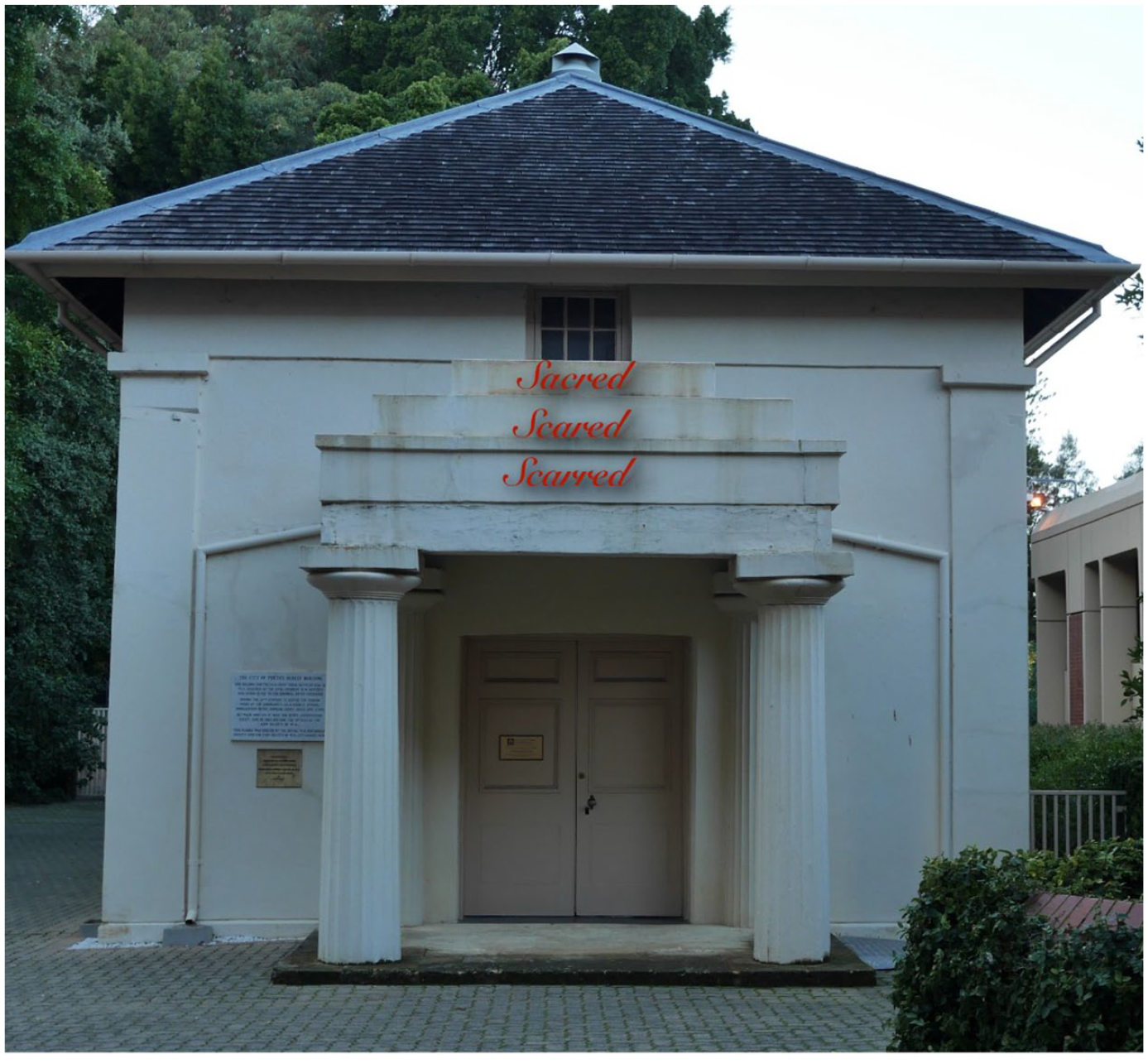
Artist Impression I See Red, red neon, acrylic and electrics, Old Court House, Perth, Western Australia. Image copyright and courtesy of Lee Harrop.
For the artist, the title I See Red alludes to the multiple interpretations of this artwork, such as the obvious visual encounters and more emotional responses to the site and its history. The colour red can signify danger and serves as a warning through which to interpret the words within the artwork. The title offers an encounter in the first person as a provocative statement to encourage viewer participation.
The use of neon text was a deliberate strategy and consistent with the treatment of heritage buildings that have been successful within international public art. An example is Martin Creed’s temporary neon installation shown in Figure 4, entitled Work No. 289, which reads ‘Everything is going to be alright’. 60 Creed’s work shows the obvious contrast with the new material of the neon distinct from the heritage fabric of the building. This contrast highlights that this new addition is an artistic statement and is not an official incorporation of the building.

Martin Creed Work No. 289, EVERYTHING IS GOING TO BE ALRIGHT, White neon approximately 0.3 x 16m © Martin Creed (image reproduced with artist’s permission).
The words ‘Sacred Scared Scarred’ were carefully selected for their relevance to the site whilst responding to the theme ‘red.’ They were further justified by a reading of Neville Green’s The Old Court House 1837: A Brief History. The artwork continued the artist’s interest in examining how violence is perpetrated by means of linguistic communication and developing an artistic critique of the institutions that have perpetrated violence. This interest originates from the artist’s former career in the New Zealand Police and resultant experiential observations of victims of crime within the New Zealand Judicial system. Observations included the perceived lack of protection promised by the judicial system for victims of crime. For example, a victim having to give evidence in court may feel re-traumatised 61 as a result of having to recall the act of violence, coupled with a feeling of vulnerability and exposure of having to do so in an open courtroom in full view of the perpetrator of that act of violence – and, further complicated by any consequent inability of the victim to clearly and coherently articulate that experience of violence, thus restricting the full potential of the victim’s participation in the court process. Any of the aforementioned experiences may cause a degree of emotional damage, at which point, the protection promised by the system is in abeyance. These views, originating from an informed position as a frontline police officer and forensic photographer, led the artist to question the efficacy of law in its relation to justice from a self-critical perspective.
Subsequently, the decision to resign from the police and further an artistic career enabled the suppression of a political voice to flourish. Returning to I See Red, to help explain the artist’s motivation each chosen word is addressed in turn.
Sacred
‘Sacred’ points to the historical use of the building. Not only was the building used for a time as the highest court in Western Australia, but it also for a time was used as a venue for church services. The use of the word ‘Sacred’ further acknowledges the role of the judicial system in making determinations about what constitutes a sacred site for Aboriginal people in the eyes of the law. The artist also anticipated less literal interpretations such as reverence, awe and power that might reference the building’s status as a courthouse and a heritage building.
Scared
The word ‘Scared’ was intended to encourage thoughts about the historical fact that some people would have been afraid when awaiting trial and sentencing, the fear espoused by school masters and fervent sermons, any of which, people may have encountered in this building. As outlined above, Green’s overview of the use of the courthouse includes the details of the first day of court where an elderly indigenous man who tried to steal some wheat was sentenced to one month in jail and 48 lashes. 62
Scarred
The word ‘Scarred’ is a reminder that at certain times when the Old Court House functioned as a court, both corporal and capital punishment were an integral part of the delivery of justice in Western Australia. 63 Scarring is also referred to in describing the site of the building by Green when he writes, ‘the Old Court House at the end of Court Avenue sought refuge under gum trees whose gnarled trunks bore scars, worn deep by the chain of countless Aboriginal prisoners who sat waiting their turn in the dock’. 64
The artist argues that these are examples of the numerous interpretations that may have been encouraged when reading the chosen words on the site. Placing I See Red on the Old Court House provided a multi-layered context in which to consider both the artwork and the site history. Viewers might consider the words in isolation and/or in relation to the site. They might rely on their existing knowledge in their interpretation or be encouraged to find out more about the history and significance of both the site and the artwork. This purpose was acknowledged by the TRANSART programme coordinator who commented: ‘I See Red’ is a work that was intended to make the invisible visible. Harrop’s work was intended to advertise the history of its site in a revelatory way, in a city where heritage is often close to illegible.
65
Surprisingly, the commission winning work ran into obstacles when permission from the judiciary was sought to install it.
IV. Decommissioning I See Red
Although the work was commissioned by the City of Perth, it was eventually decommissioned due to opposition from the sitting judiciary of the Supreme Court of Western Australia. What follows is an overview of the process that led to the decommissioning of the work.
The artist and programme coordinator met with the Law Society Manager of the proposed site for the artwork to discuss the necessary protocol for gaining approval for the installation. To install I See Red on the Old Court House, it was necessary to seek permission from the Department of the Attorney General (as owner of the Old Court building) and the sitting judges of the Supreme Court of Western Australia. The artist was told by the programme coordinator and Law Society Manager that the artwork had been well received and advised that ‘the general consensus is that the proposal is not controversial and we envisage the court will be agreeable’.
66
The programme coordinator sought approval from the judiciary for the installation of the artwork, but permission was denied by the Premises Committee and Management Committee of the Supreme Court of Western Australia. A letter addressed from the Chief Justice to the programme coordinator stated that the judiciary were ‘firmly opposed to the proposed installation’.
67
The letter continued: (. . .) the Old Court House has a very significant place in the heritage of Western Australia. (. . .) the building has long been associated with the administration of justice in this State. Having regard to that history, it is the view of the judiciary that a neon light installation, however temporary, is entirely incongruent. It is also our view that the application of the words ‘scared’ and ‘scarred’ to a building so long associated with the administration of justice in this State is entirely inappropriate.
68
The opposition by the judiciary sits at odds with the artist’s intention. As noted above, the use of neon text was deliberately chosen to ensure the artwork was seen as separate from the heritage building, as has been successfully done in Sydney, 69 Vancouver 70 and Edinburgh. 71 The words ‘scared’ and ‘scarred’ both were drawn from Green’s history of the Old Court House and referenced the multiple functions of the building, as well as the fear and scarring produced by a criminal justice system that incorporated corporal and capital punishment. While it was not the intention of the artist to call into question how justice was administered in the Old Court House, the judiciary’s opposition to the artwork due to the building’s ‘long association with the administration of justice’ begs consideration.
As discussed in the first section of this paper, the administration of justice as practiced in the Old Court House was systemically racist. Magistrates shot and killed Noongar people indiscriminately with legal immunity. In the Old Court House, small fines were given as punishment for killing Noongar people. Hundreds of Indigenous Australians were sent from the Old Court House to a jail established exclusively for Indigenous peoples, and this was an integral mechanism for dispossessing people of land that had physically and spiritually sustained them for tens of thousands of years. The enslavement of Noongar people was legally sanctioned and enforced under threat of whipping and imprisonment in the Old Court House. For the first four years of the Old Court House’s operation, the evidence of Indigenous peoples was inadmissible, and when this changed their evidence was frequently dismissed as unreliable. The Old Court House was a place of incomprehensible pain and fear for many Noongar people. Men practicing a foreign legal system in a foreign language had the power to tear Noongar people from country, or tear open their backs, or take their lives. The Old Court House surely at times provided some assistance to Noongar people, and greatly served the colonial community. However, the words ‘scarred’ and ‘scared’ seem quite appropriate as descriptors of the administration of justice as practiced in the Old Court House from the perspective of Indigenous West Australians, even if an in-depth consideration of how law was a tool of dispossession, oppression and exploitation of Noongar people within the walls of the courthouse was only one possible interpretation of the artwork.
Following the opposition from the judiciary, the programme coordinator sought to move the installation to Stirling Gardens. The artist was invited to modify the artwork to suit a central location in Stirling Gardens. The programme coordinator met with the Chief Justice to explain the artist’s intention, and that the words chosen were drawn from Green’s history of the site and were not intended as an attack on the legal system. In a phone call on 7 May, the Chief Justice informed the programme coordinator that he would not revise his decision, warned against placing the artwork anywhere in Stirling Gardens within view of the Supreme Court, and advised that he would instruct the Lord Mayor to remove any such attempt. Attempts were then made to move the work to the Old Deanery, and St George’s Cathedral. The initial discussions with stakeholders were positive. However, when the decision by the judiciary to not approve the original site was disclosed, thereafter the respective committees declined the proposal. Due to the paucity of information about the reasons for the decisions to decline the proposal, it cannot be known what influence the disclosure might have had.
As a suitable site could not be found for the work, the decision was made to include a description of the proposed work and the difficulties it faced in the printed TRANSART programme. The following passage written by the programme coordinator was proposed to be included in the programme: Red is a colour at the limits of human vision. Over the past two months, the City of Perth has been working with artist Lee Harrop to realise ‘I See Red’, a work commissioned by the City for the TRANSART program in 2015. Despite the elegant simplicity of Harrop’s proposal it has been impossible to present this work in the city in the way that the artist had intended. Rather than allow this work to fall off the visible spectrum altogether, we are telling this story in a different way. ‘I See Red’ is a work that was intended to make the invisible visible. Red neon is most often a medium that is employed to compel us to act or to sell an experience. Lee Harrop, in her work ‘I See Red’, proposed to use these materials – text, colour and light – to frame questions and to reference experiences that may not be our own and may even be remote in time. Harrop’s work was intended to advertise the history of its site in a revelatory way, in a city where heritage is often close to illegible. ‘I See Red’ would not have told a story so much as prompt us to seek out the wealth of stories set in these places. Harrop’s creative practice is concerned with the power of language. The great difficulty that we experienced in installing three words, ‘Sacred’, ‘Scared’ and ‘Scarred’, on sites in the city is a profound revelation of this power. Despite their openness to interpretation, and the valid historic resonance of these words with the sites we considered, these words themselves proved to be an insurmountable obstacle to gaining permission for installing the artwork. So whilst ‘I See Red’ has not taken its intended place in Perth’s streets as envisaged, the process has been a remarkable confirmation of the strength of the proposed work. This story is a powerful outcome, and sharing it ensures that this work remains an integral and visible part of the City’s TRANSART 2015: RED program.
The inclusion of this passage, and any reference to the artwork, was not approved by the CEO of the City of Perth. Subsequently, a part payment was made to the artist in recognition of the time invested. The artist also received a letter confirming her selection for TRANSART. However, her request for public acknowledgement regarding her selection for the programme was declined because the City of Perth was unwilling to publish any information that might encourage further enquiry. 72 This act of censorship initiated by the judiciary and adhered to by the City of Perth reveals much about how important the aesthetics of law is to maintain the myths that mask our legal system’s historic and current colonialism, but also how art can and should be a mechanism to disrupt these myths.
V. Art, Architecture, Politics and Law
Slavoj Zizek argues that every legal system is founded on illegitimate violence, and that this must be concealed in order for a legal system to be sustained. 73 In our view, the aesthetics of law play a major role in this concealment, and this must be confronted if a movement towards decolonisation is to gain any traction and deliver significant results. As discussed briefly above, the architectural style of courthouses can lend legitimacy to the legal system that operates within its walls. Modelling courthouses on ancient temples, for example, can give legal systems an eternal and ageless air that helps hide the violence and dispossession that accompanied the establishment of the legal system. Legal systems have a ‘visual vocabulary’ 74 and are ‘structurally dependent on aesthetics, upon the rhetoric of the ornament, to elicit faith in its ideals and principles’. 75 Neoclassical and gothic courthouses, statues representing justice modelled on ancient Greek and Roman gods, the priest-like robes of judges, and coats of arms all are symbols that can elicit a religious like faith that buildings like the Old Courthouse have only ever been concerned with the ‘administration of justice.’ The aesthetics of law are a central part of the web of meaning that supports the view that the sovereignty of the Australian government is unquestionable, and play into the myth of the immaculate conception of Australia’s legal system through terra nullius. Art in courthouses often serves these myths, 76 but can also challenge them.
When effective, political art acts as a disruption or a fissure in the myths necessary to maintain the status quo. Political art can mobilise protest by raising consciousness. 77 It can give voice to the silenced oppressed and symbolise resistance, 78 and can nurture solidarity with its accessible form that conjures emotion as well as thought. Political art points to the complex reality that myths can never completely cover; it draws to the surface that which is repressed by dominant ideology. Political art can speak truth to power in ways that capture popular imagination. Against the projected stability and eternality of the status quo, political art can emphasise the fluidity of meaning, visions of utopia and the possibility of radical change. It can normalise emancipatory and revolutionary practices.
It is not suggested that political art is a silver bullet to the horrors of colonialism. Art is but merely one small means to raise awareness of how unjustly treated Indigenous Australians have been and continue to be treated by legal institutions, and the need for restitution. It must be noted that art, and even political art, is not without its own politics. The I See Red saga highlights how public art festivals can be subject to censorship by powerful institutions. The politics of art are particularly pointed where indigenous issues are concerned. Is it only indigenous artists that should make political art concerned with indigenous issues? Or write about political issues concerning indigenous peoples like the article you are reading? What of the diversity of views within indigenous communities? And how likely are urban public art festivals like TRANSART to receive submissions from dispossessed and disenfranchised voices? Reflecting on these issues, two museum curators with experience in First Nations exhibitions write: Museums have far more relevance to the powerful – those capable of housing art and artefacts – than they do to the disempowered. Moreover, there is no such entity as the Native voice, one that speaks with authority for the entire community. There exist many voices, some of which speak for upholders of cultural traditions, others that address band and tribal politics, and still others that concern themselves with social issues (. . .) The encounter of different values, different priorities, often creates problems that can only sometimes be resolved.
79
Beyond these problems, political art itself makes no material impact on the continuing consequences of colonialism in the short term. Art does not return land to Indigenous people or recognise sovereignty. As such, art for some cannot and should not be called decolonisation. 80 However, these are not valid reasons to abandon the revolutionary potential of political art. Artworks like I See Red have the potential to draw attention to how the establishment and perpetuation of colonial societies requires dispossession and violence. This is the part of the ‘administration of justice’ hidden by the sandstone facades of colonial buildings that can be revealed by political art. Australians overwhelmingly overlook the violence that established the nation and pretend that this violence does not impact the present. That an artwork was censored by the judiciary that could have made more citizens reflect on this says much about the ideological power of the aesthetics of law, and the role the judiciary see themselves as playing in protecting it.
VI. Conclusion
The story of I See Red reveals much about the power of art, and the power of those in high offices to censor it. With respect to the judiciary of the Supreme Court, colonial courthouses should not be exempt from public art simply because they are associated with the administration of justice. As this paper has shown, the administration of justice as practiced in the Old Court House was systemically racist. Most people who live in Perth likely know little or nothing about the injustices perpetuated by colonial law in their city. Art is a powerful means to tell the truth about this history and highlight Indigenous perspectives that have largely never been heard. It is unfortunate and troubling that in 2015 an artwork that could engage people with these perspectives was silenced by the judiciary.
Footnotes
1.
City of Perth, TRANSART RED: Call for proposals (2015).
2.
Neville Green, The Old Court House 1837: A Brief History (Perth: The Law Society of Western Australia, 2012), p. 7.
3.
Ibid., 4–6.
4.
Letter from Judiciary of Western Australia to City of Perth public art programme coordinator (22 April 2015).
5.
Noongar (also spelt Nyungar, Nyoongar, Nyoongah, Nyungah, Nyugah, Yunga) are a constellation of Indigenous Australian nations in the South-West of Western Australia. We do not want to overshadow how other Indigenous nations were subject to dispossession, exploitation and state-sanctioned violence in Western Australia by only referring to Noongar people.
6.
For example, defence council Edward Landor wrote in his memoir published in 1847 that ‘nothing could be more anomalous and perplexing than the position of the Aborigines as British subjects’. Although unsuccessful, this argument was seen as worthy of running as a defence by Landor in 1842 in R v Wi-war. Cited in A. Nettelbeck, “Equals of the White Man: Prosecution of Settlers for Violence Against Aboriginal Subjects of the Crown in Colonial Western Australia,” Law and History Review 31 (2013), 355–90, 363.
7.
J. Stirling, Despatch, 26 January 1830, cited in R. D. Nicolson, “Seats of Justice – Court Houses as Places of History,” Royal Western Australian Historical Society 10(5) (1994), 629–46, 632.
8.
E. Russell, A History of the Law in Western Australia and Its Development from 1826 to 1979 (University of Western Australia Press for the Swan Shire Council 1980), 12.
9.
ibid., 9.
10.
ibid.
11.
ibid., 11 (citing Governor Stirling).
12.
A journal of the proceedings of a party of officers and men, belonging to His Majesty’s Ship Sulpher, 9 September 1829, in Journals of Several Expeditions Made in Western Australia During the Years 1829, 1830, 1831 and 1832 (J Cross Holborn 1833) 6 (Journals).
13.
Holborn, Journals, vii.
14.
Collie and Preston, Observations on the Coast Country from Cockburn Sound to Geographe Bay, in Journals, 35.
15.
L. Fison and M. Lewis, Kamilaroi and Kurnai (G Robertson 1880) cited in H. Reynolds, Why Weren’t We Told (Hawthorn: Penguin, 2000), p. 110.
16.
M. Bourke, On the Swan: A History of the Swan District of Western Australia (Nedlands: University of Western Australia Press, 1987), 68.
17.
Beringarra Police Station Bush Occurrences, cited in N. Green, “Aboriginal Sentencing in Western Australia in the Late 19th Century with Reference to Rottnest Island prison,” Records of the Western Australian Museum Supplement 79 (2011), 77–85, 81.
18.
WA Parliamentary Debates, 14 January 1892, 256, cited in Green, “Aboriginal Sentencing in Western Australia,” 82–3.
19.
In 1832 a naval officer visiting the Swan River wrote in his diary that the settlers were involved in ‘a most awful warfare’, the military commandant of the colony at the time sought to bring an end to what was in his view ‘petty and harassing warfare’, and his junior officer thought he had been sent to the district to ‘make war upon the natives’. This view was not confined to the early settlement but was expressed by a member of parliament who, in 1902, told his colleagues that it was necessary to shoot the northern Aborigines as ‘it was only a matter of warfare.’ H. Reynolds, Why Weren’t We Told (Penguin, 2000), pp. 145–46.
20.
Green (n 2) 3. We use inverted commas to describe stealing as the notion that the produce of a piece of land is the property of a landowner is at odds with Indigenous culture. Moreover, the land stolen from was in fact stolen from Indigenous people in the first place.
21.
Green, “Aboriginal sentencing in Western Australia,” 78.
22.
ibid., 112.
23.
A. Nettelbeck, “Equals of the White Man: Prosecution of Settlers for Violence Against Aboriginal Subjects of the Crown in Colonial Western Australia,” Law and History Review 31 (2013), 355–90, 364.
24.
ibid., 365.
25.
ibid., 376.
26.
See, for example, R. Reece, Aborigines and Colonists: Aborigines and Colonial Society in NSW in the 1830s and 1840s (Sydney: University of Sydney Press, 1974), 222–23.
27.
Court Records Indictment Files, series 122, cons. 3472, case 271, SROWA cited in Nettelbeck (n 23), 366.
28.
Quarter Sessions, Perth Gazette, 13 July 1842, cited in Nettelbeck (n 23), 366.
29.
Quarter Sessions, Perth Gazette, 6 January 1844, 2, cited in Nettelbeck (n 23), 367.
30.
One notable exception to this is Western Australian barrister EW Landor who, in 1847, questioned the basis of the British claim to Australia, saying why not ‘Say boldly at once, [it was based on] a right of power? We have seized upon the country, and shot down the inhabitants, until the survivors have found it expedient to submit to our rule. We have acted as Julius Caesar did when he took possession of Britain. But Caesar was not so hypocritical as to pretend and moral right to possession (. . .) We have right to our Australian possession, but it is the right of Conquest, and we hold them with the grasp of Power. Unless we proceed on this foundation, our conduct towards the native population can be considered only as a monstrous absurdity’. Cited in Reynolds, Why Weren’t We Told, p. 163.
31.
Nettelbeck (n 23), 369.
32.
‘Supreme Court Criminal Sittings 8 July 1886’ West Australia (9 July 1886) cited in Nettelbeck (n 23), 370.
33.
Green, “Aboriginal sentencing in Western Australia,” 80.
34.
Government of Western Australia, Royal Commission on the Condition of the Natives (Western Australian State Government, 1905), 5, cited in Green, “Aboriginal sentencing in Western Australia.”
35.
ibid., 15.
36.
ibid., 16.
37.
ibid., 8.
38.
ibid., 78.
39.
The act was amended in reference to Aborigines in 1868, 1882, 1886 and 1892.
40.
Green, “Aboriginal sentencing in Western Australia,” 82.
41.
WA Parliamentary Debates, 30 August 1886, 557, cited in Green, “Aboriginal Sentencing in Western Australia,” 83.
42.
Green, “Aboriginal sentencing in Western Australia,” 83.
43.
Reynolds, Why Weren’t We Told, p. 123.
44.
C. Goodsell, “The Architecture of Parliament Houses and Political Culture,” British Journal of Political Science (1988), 287–302, 288.
45.
A. Saarinen, Environmental Planning, Perception and Behaviour (Houghton Mifflin, 1976), cited in Law Reform Commission of Western Australia, Court perspectives: architecture, psychology and law reform: Review of the criminal and civil justice system in Western Australia (1999 Project 92 Consultation Papers 2), p. 1032,  .
.
46.
See M. Tafuri, “Toward a Critique of Architectural Ideology,” in Architecture Theory Since 1968 (M. Hays, ed.) (Cambridge: MIT Press, 2000); M. Tafuri, Architecture and Utopia: Design and Capitalism Development (Cambridge: MIT Press, 1973); D. Agrest, “Design Versus Non-Design,” in Architecture Theory Since 1968 (M. Hays, ed.) (Cambridge: MIT Press, 2000); N. Lahiji, “Reloading Ideology Critique of Architecture” in Political Unconscious of Architecture: Re-Opening Jameson’s Narrative (N Lahiji, ed.) (Surrey: Ashgate Publishing Ltd, 2011).
47.
D. Harvey, Social Justice and the City (Athens: Blackwell Publishers, 1993), p. 261.
48.
B. Wardle, “Legal Facades,” Griffith Law Review 25(4) (2016), 525–51, 538.
49.
ibid.
50.
C Goodsell, “The Architecture of Parliament Houses and Political Culture” drawing on D Milne, “Architecture, Politics and the Public Realm” (1981), 5, Canadian Journal of Political and Social Theory, 131–46.
51.
LRCWA, Court perspectives: architecture, psychology and law reform, p. 1026.
52.
T. Anthony and E. Grant, “Court house design principles to dignify spaces for Indigenous users: observations,” International Journal for Court Administration 8(1) (2016), 43–59, 43.
53.
54.
The Uluru Statement reads, ‘We seek a Makarrata Commission to supervise a process of agreement-making between governments and First Nations and truth-telling about our history’.
55.
LRCWA, Court Perspectives: architecture, psychology and law reform, p. 1056.
56.
58.
City of Perth, TRANSART RED: Call for proposals (2015).
59.
Hereafter referred to as ‘the artist’.
61.
Uli Orth, “Secondary victimisation of crime victims by criminal proceedings,” Social Justice Research 15(4) (2002), 313–25; R. Campbell and S. Raja, “Secondary Victimisation of Rape Victims: Insights from Mental Health Professionals Who Treat Survivors of Violence,” Violence and Victims 14(3) (1999), 261–75; R. Campbell, S. Wasco, C. Aherns, T. Sefl and H. Barnes, “Preventing the ‘Second Rape’: Rape Survivors’ Experiences with Community Service Providers,” Journal of Interpersonal Violence 16 (2001), 1239–59.
62.
Green, The Old Court House 1837: A Brief History, pp. 4–6.
63.
ibid., 3–4.
64.
ibid., 7.
65.
City of Perth public programme coordinator, ‘Infrared’, proposed essay for withdrawn publication 2015.
66.
Email from the Law Society Manager to the artist (15 April 2015).
67.
Letter from Judiciary of Western Australia to City of Perth public art programme coordinator (22 April 2015).
68.
ibid.
69.
Reko Rennie, “Always was, always will be.”
70.
Kit and Ace’s, “Time is Precious.”
71.
Martin Creed, “Everything is going to be alright.”
72.
Email from the City of Perth public art programme coordinator to the artist (16 June 2015).
73.
Slavoj Zizek, For They Know Not What They Do (Verso 1991), 8.
74.
Judith Resnik and Dennis Curtis, Representing Justice: Invention, Controversy, and Rights in City-States and Democratic Courtrooms (New Haven: Yale University Press, 2011), p. 89.
75.
Costas Douzinas and Lynda Nead, “Introduction,” in Law and the Image (Costas Douzinas and Lynda Nead, eds) (Chicago: The University of Chicago Press, 1999), p. 135.
76.
For a discussion of how the most popular figure in courthouse art, Lady Justice, serves the status quo see Ben Wardle, “Lady Injustice” in Research Handbook on Law and Art (Jani McCutcheon and Fiona McGaughey, eds) (Cheltenham: Edward Elgar, 2020), pp. 239–57.
77.
See, for example, R. Eyerman and A. Jamison, Music and Social Movements: Mobilizing Traditions in the Twentieth Century (Cambridge: Cambridge University Press, 1998).
78.
See, for example, Lyman G. Chaffee, Political Protest and Street Art: Popular Tools for Democratization in Hispanic Countries (Westport: Greenwood Publishing, 1993).
79.
Aldona Jonaitis and Richard Inglis quoted in James Clifford, “Looking Several Ways: Anthropology and Native Heritage in Alaska,” Current Anthropology 41(1) (2003), 5, 22.
80.
See Eve Tuck and K. Wayne Yang, “Decolonization Is Not a Metaphor,” Decolonization: Indigeneity, Education & Society 1(1) (2012), 1.