




Abstract
This study analysed the outlook of the parents of people with profound intellectual and multiple disabilities regarding the public space as a domain of interaction with other members of society. Few previous studies provide insights into this area. Adopting a biopsychosocial approach, semi-structured interviews were conducted with 20 parents of adult people with profound intellectual and multiple disabilities Data were analysed based on the principles of grounded theory. The findings indicated that interactions with other people in public spaces are taxing for the parents and caregivers of people with disabilities and can give rise to various problems, including social and interpersonal tensions. This suggests that, to improve our understanding of the interplay between the parents of people with disabilities and the general public, research needs to account for both individual and contextual factors, as well as individual physical, psychological, and social dimensions.
Keywords
Introduction
In keeping with the conventional family model in Poland, most people with disabilities live at home with their families (Krause et al., 2010). People with disabilities in Poland receive care in a cultural setting shaped by the concept of the welfare state, blending the assumptions of the medical model and family centrism. For this reason, the parents of people with disabilities play a key role in supporting their children, often throughout their entire lives (Żyta, 2004). However, people with profound intellectual and multiple disabilities require special care and support. With no capacity for verbal expression, combined with severe neuromotor and multidimensional conditions, they are dependent on others—specifically, their families—in all aspects of their lives (Nakken and Vlaskamp, 2007).
There is insufficient research on families in Poland who provide for a child with intellectual disabilities (cf. Hodapp, 2007; Hodapp et al., 2005; Solomon and Draine, 1995). Studies have shown that a child with a disability determines family life. That child’s presence entails various everyday challenges (Carey, 2013), including the possibility of compromising family members’ interactions with other people in public spaces. The main reasons are twofold. First, people with the type of disability under discussion are conspicuous in their behaviour, and sometimes their appearance, which means that others often take note of them and try to maintain distance. Second, for mobility require special arrangements and adaptations of available spaces, as well as assistance from others in the immediate vicinity.
Public space and relationship generation
Public space is defined as a shared utility asset, deliberately crafted by humans in accordance with social principles and values to meet the needs of the community (Charter of Public Space). Such spaces are fraught with socially charged connotations: utilitarian, able to attract (magnetic), interactive, civic and political, axiological, symbolic, and identity related (Bierwiaczonek, 2018, 2021). Public spaces in this study included indoor spaces, such as libraries and leisure centres, as well as parks, shopping centres, and public transport.
Users perceive public space in terms of not only its aesthetic design but also its usability. According to Majer (2010: 11), ‘People do not reside in an amorphous, featureless space, but live in a multidimensional environment that interacts with their feelings and influences their fate more or less directly’. Space thus requires a broader analysis that goes beyond material considerations to include psychosocial dimensions. The apparently simple act of passing through space calls attention to oneself, the environment, nature, and other people. The psychosocial salience of space is manifested in the opportunity to engage with other people and the ability to use urban space resources.
Public space might not afford anonymity to its users, as bystanders might not refrain from staring. Garland-Thomson (2017) defines this phenomenon as ‘the emergent relationship of shared humanity between the onlooker and the person being stared at’. He suggests that staring is instrumental for raising awareness of people’s diversity and emphasizes that physical differences are part of being human and reflect human diversity. However, this can be a problem for people with disabilities and their families if the staring becomes intrusive and evokes the sense of being ‘different’ and having stigma attached to them (Goffman, 1963).
Biopsychosocial approach to people with a disability and their environment
The biopsychosocial model affords a multidimensional account of the interrelations between a person and their environment (Imrie, 2004). It provides a broad view of disability by integrating the biological level with the psychological and social levels (Imrie, 2004). The biological level represents the individual’s physique, including physical abilities, limitations, and enhancement devices. The psychological level refers to individual expectations, interpersonal communication, and personality traits such as courage, resilience, and prudence. The social level spans interactions in the civic world people are immersed in, involving politics, law, urban planning, and shared values.
As Bickenbach notes (2012: 15), disability should be regarded as the net effect of personal characteristics and environmental features. Pineda (2008) introduced a socio-spatial model of disability centred on the interface between space and disability. Drawing on the socio-spatial model, disability can be understood as not just a social construct but a phenomenon whose emergence relies on spatial features (Armstrong, 2003; Jackson, 2018). Hence, spatial inclusion may be achieved by challenging the socially constructed environments, attitudes, relationships, and cultures that give rise to disability (Su et al., 2019).
Background situation in Poland
The transition from the non-integrational post-Soviet settings of developed areas to an inclusive environment began in Poland 30 years ago. The Act Regulating the Construction Law (JoL.89.414, 1994) stipulated that the planning of public utility buildings should be informed by the needs of individuals with disabilities. As the act failed to define disability, it merely introduced provisions related to wheelchair accessibility.
Although Poland has been an EU member since 2004, it was not until 2018 that legislation implementing EU regulations on the accessibility of buildings and public spaces came into force (e.g. Council of Europe Disability Strategy, 2017–2023, 2017). However, another year passed before the Act on the Assurance of Accessibility to People with Special Needs defined the basic concepts, including barriers, accessibility, and universal design (JoL.2019.1696, 2019). Crucially, both the physical and non-physical facets of accessibility were addressed. Based on the provisions of the New York Convention on the Rights of People with Disabilities of 2006 (JoL.2012.1169, 2012), the 2019 Act defined ‘people with special needs’ as ‘persons who, by virtue of their external or internal features or their circumstances, have to make an extra effort or employ additional means to overcome barriers to participate in various domains of life on an equal basis’ (Article 1).
Current study
Few studies provide insight into how people with disabilities, let alone their families, experience public spaces as stages of social interaction (Hamraie, 2017; Landby, 2019; McKenzie et al., 2021; Wakimizu and Fujioka, 2024). Studies tend to focus on specific issues, such as communal spaces (Hammond and Musselwhite, 2013; Imrie and Kumar, 2010; Parkin and Smithies, 2012) or particular types of barriers and difficulties people with disabilities and their families face in their daily routines Butler and Bowlby, 1997. Public utility areas (mostly urban green areas) in Poland have been investigated in terms of functions (Łaszkiewicz et al., 2020), perceptions, social preferences (Pietrzyk-Kaszyńska et al., 2017; Włodarczyk-Marciniak et al., 2020; Łaszkiewicz et al., 2019), and accessibility (Feltynowski et al., 2018). To our knowledge, however, no research in Poland has investigated the effect of urban public spaces on the interpersonal relationships of the parents of people with disabilities, let alone people with profound intellectual and multiple disabilities and their families. This study, therefore, aimed to analyse the outlook of the parents of adults with profound intellectual and multiple disabilities regarding public space as a domain of interactions with other members of society.
Method
Enrolment and participants
The materials considered in this study included information obtained from the parents of people with intellectual and multiple disabilities who were residents of Łódź (a city in Poland with a population of over 665,000). The inclusion criteria were as follows: an adult (over age 18) son/daughter with profound intellectual and multiple disabilities (developmental age < 2 years), a disability certificate for the child issued in accordance with Polish law, and a permanent residence in Łódź. Parents were recruited through Poland-based charities and organisations furnishing services or support for people with intellectual disabilities or their families. The information sent to families included full details of the study and the profile of candidates eligible for the study.
Twenty people participated in the study: 12 mothers and eight fathers (both parents were included in four cases). Parents ranged in age from 37 to 63 (mean: slightly below 52). Most parents (N = 12) were married, five were divorced, and three were widowed. Their children with profound intellectual and multiple disabilities ranged in age from 19 to 38 (mean: 25.5), of which nine were female and seven male.
Ethical approval was obtained in advance from the research ethics committee of the author’s institution. All participants were briefed verbally and in writing about the study design and their rights, including the right to withdraw at any time. Prior to the interviews, participants received informed consent and assent forms advising them that participation was voluntary and they could discontinue or skip any question at any time for any reason. All data were de-identified to protect participants’ confidentiality. All interviewees granted permission for their data to be used for publication purposes.
Data collection
Semi-structured interviews were conducted with all participants. Interviewees were asked to comment on the interpersonal relationships that arise when taking their adult children with profound and multiple intellectual disabilities to urban spaces. The interviews, which lasted 1–2 hours and took place at the participants’ homes between November 2022 and March 2023, were conducted in a bespoke, flexible manner, and the interviewees were allowed to freely express themselves. Data from 20 interviews were collected for analysis. All interviews were carried out directly by the researcher. Each interview began with an open-ended question about issues related to social interactions with bystanders in urban spaces. Toward the close of the interview, measures were taken to ensure full coverage of all topics deemed important by the participant. In addition, to avoid the omission of salient issues, the participants were granted a degree of control over the interview. If they deviated from the main subject of the interview, they were allowed to speak freely. This enabled them to speak in their own words on topics of their choice (Appendix 1).
Data analysis
All interviews were audiotaped and transcribed verbatim. Transcripts were thematically analysed using NVivo (Miles et al., 2014), and codes and themes were organised. The procedures for data collection and analysis were based on grounded theory (Charmaz, 2006). Thus, an inductive approach to analysis was adopted, allowing categories and themes to arise from the data. Analysis was carried out using a multi-stage open and axial coding process guided by the constant comparative method (Strauss and Corbin, 1990). This method informed the way all data units were compared with the emergent codes and sorted into categories. This ensured that data analysis was systematic and rigorous. The researcher used a line-by-line approach to identify the code of each piece of text, comparing the relevant data units with previously coded information to ensure they represented novel ideas (Creswell, 2013). Subsequently, the researcher compared the codes and developed a codebook. This resulted in a coding system used to code all interviews. Then, the researcher discussed the main findings and their correlations with other researchers from the same research centre. Each researcher then independently reviewed the data by applying the established codes. Each investigator was able to generate new codes, which were then compiled by the author into a single codebook. In addition, the other researchers validated the correlations between codes and categories to confirm previously identified themes. Lastly, the data units underwent cross-analysis (Creswell, 2013). The researcher analysed the demographic data and all coded data relevant to the generated categories.
Results
Domains and subdomains related to relationships with strangers in urban spaces from the perspective of a parent of a person with profound intellectual and multiple disabilities.
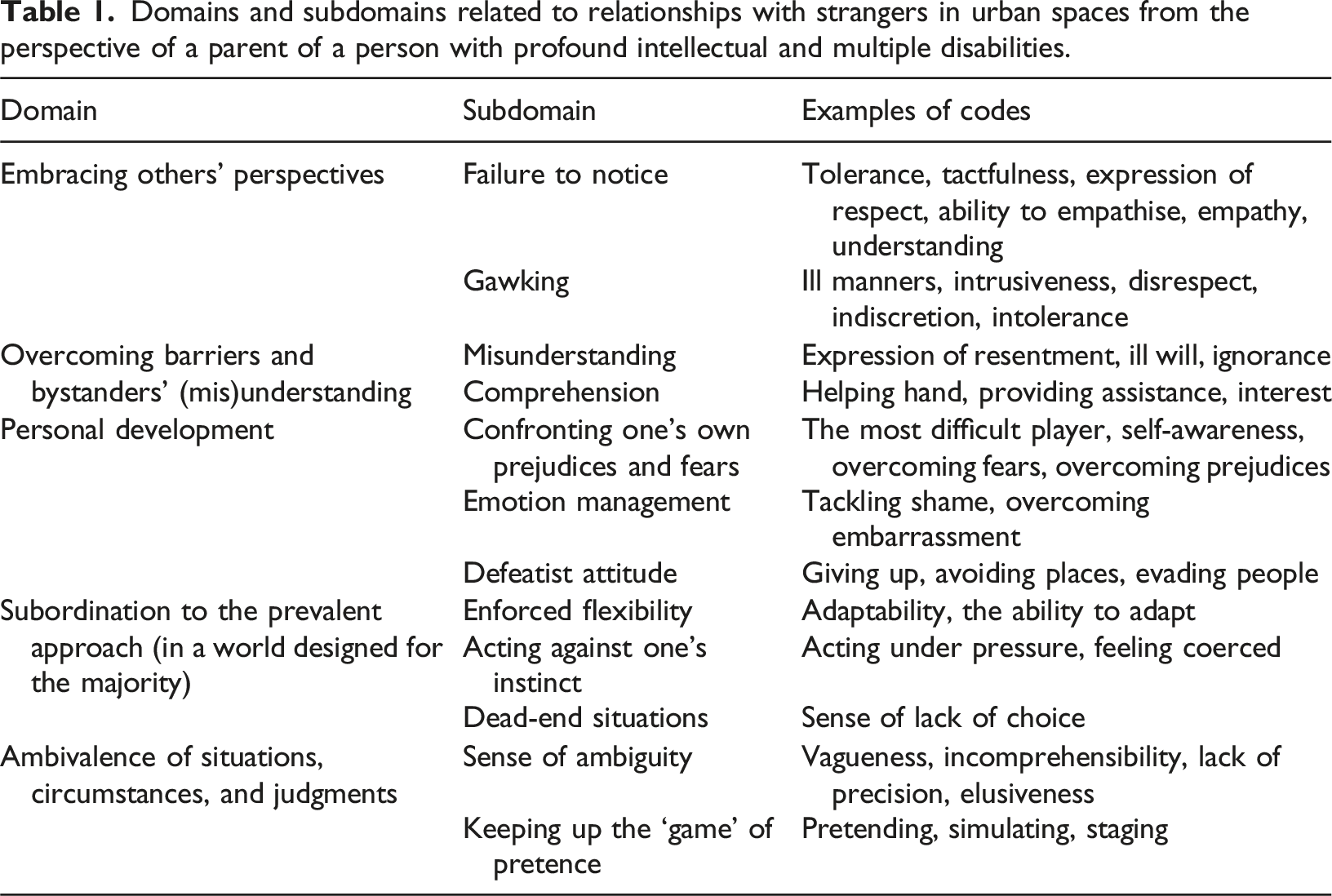
Theme 1: Embracing others’ perspectives
The first theme concerned how the interviewees perceived themselves and their loved ones with profound intellectual and multiple disabilities from the perspective of their interactional partners in public spaces. Within this domain, two subdomains were prominent: failure to notice and gawking. Interviewees attributed the attitudes falling within the first domain to either conscious indifference or an effort to maintain neutrality toward people with profound intellectual and multiple disabilities and their parents. The second category of attitudes arose from the confusion experienced by parents of people with profound intellectual and multiple disabilities when strangers ostensibly, albeit inadvertently, displayed interest.
Failure to Notice
Eleven interviewees noted repeated attempts by others in public spaces to not interact with them and their children, which they considered a manifestation of deliberate or inadvertent indifference (treated as something positive): In fact, most of the time, I get the impression that it doesn’t particularly interest anyone who is standing next to them. And it is likewise with us, as long as we manage not to draw attention to ourselves because of, for example, our son’s behaviour. (Mother-2)
Parents also described situations in which people in public spaces deliberately exhibited a lack of interest in them and their children with profound intellectual and multiple disabilities. This can be seen as an expression of staying neutral, based on Goffman’s concept of ‘tactful non-noticing’ (Goffman, 1963): I guess you could put it this way: At least some strangers simply try not to pay attention to us. I would describe it as courtesy or politically correct behavior. (Mother-6)
Gawking
In contrast to this, some parents cited encounters in public spaces with mostly negative overtones. These could be associated with stigmatisation expressed through ‘finger-pointing’: Unfortunately, there are situations when someone spots us and, more or less absent-mindedly, points fingers at us or looks at us in an unagreeable manner. (Father-10)
For the parents, such behaviour implied discourtesy and, in some cases, even intolerance of the ‘otherness’ represented by their children: Sorry to say this, but for me, this kind of behaviour, where you can’t ward off the curiosity of other people, where someone encroaches so obtrusively into your space, is just a sign of disrespect and a major indiscretion of such people. (Mother-7.1)
Theme 2. Overcoming barriers and bystanders’ (Mis) understanding
The second theme pertained to the need to overcome various barriers encountered in public spaces and the accompanying reactions from onlookers. Two categories surfaced within this domain. One was associated with the challenges posed by misunderstanding or resentment on the part of others toward the parents and their children. The second concerned the affability and discernment expressed by bystanders toward the parents of people with profound intellectual and multiple disabilities.
Misunderstanding
Eight interviewees recounted situations in which they were forced to overcome various obstacles, traceable not so much to spatial (physical) barriers but to the reluctance and sometimes ill will of others. One interviewee cited a situation involving a city transport driver: I’ll give you one such example: When the bus driver saw that we were trying to get into the vehicle with a wheelchair, instead of helping out somehow, all you could see was that he was very impatient that we were delaying his vehicle schedule. (Father-14)
Some interviewees also suggested that such attitudes indicated ignorance stemming from either a lack of knowledge or an unawareness of disability or ‘otherness’: It is worth bearing in mind, however, that most of the people you meet throughout your lifetime and life in that proverbial street have never dealt with a person with a disability, let alone having to manage disability itself. Such individuals, therefore, simply have no clue how to behave, and their behaviour may be perceived as inappropriate. (Father-16.2)
Comprehension
Not all parental voices were negative, and some indicated positive responses from others in public spaces, expressed as a willingness to help tackle any difficulties or barriers in public spaces: Upon seeing that I can’t cope with something because, for example, I’m having difficulty managing to get the wheelchair in somewhere, some people will come up, ask if they can be of help and if we need anything. (Mother-9)
The parents pointed out that, despite being complete strangers, these other users of public spaces could empathise with the parents and show genuine interest expressed in terms of genuine support: And it is undoubtedly very comforting and heartening to know that there are also people who are selflessly willing and able to help when they see us out in the street, on the tram, or anywhere else. (Mother-15)
Theme 3: Personal development
The interviewees described the pursuit of their own personal development in the wake of situations they experienced with passersby in public spaces. The analysis revealed three subdomains: overcoming one’s own prejudices and fears, committing to the management of one’s emotions, and defeatism.
Confronting one’s own prejudices and fears
Seven parents commented that they avoided certain venues and areas because of restrictions in movement and mobility, which only exacerbated anxiety and stress. Other parents said they aimed to learn and overcome their reluctance to ask for help from others. Their inner struggle stemmed from a fear of the unintelligibility of their condition to others and their likely rejection, as they tried not to expose themselves to the aggravating disappointment of other people’s disapproval: I always got stressed out when boarding the bus. I was at a loss lifting the wheelchair myself. I had no misgivings if someone came up of their own accord. It was worse if I had to ask for help. Somehow, I couldn’t cough up a word. (Mother-5)
Emotion management
For at least five parents, aversion to asking for help originated from their sense of pride. Asking for help meant admitting to helplessness and, therefore, feeling depreciated as parents in the eyes of strangers: There was a time when I didn’t go to the nearby park because there was no convenient driveway for the wheelchair. I was more afraid that others might give me a cross look. I had a sense of shame about it. But I told myself, ‘So what?’ and it turned out that this fear of mine was unwarranted once I brought myself to override it. (Mother-3)
Some parents acknowledged that they were paralysed by a sense of shame and embarrassment. Nevertheless, four interviewees mentioned attempts to counteract this and not give in to emotions such as shame or embarrassment: Yes, let’s face it, it’s not easy, even if it’s the umpteenth time you’ve heard it or you simply feel that you’re such an attractor of others’ attention. But over the years, as my expertise grew, I started to simply not respond or take notice. It is so much easier, and one feels less tense and stressed out then. (Father-8)
Defeatist attitude
Seven parents said they felt overwhelmed and could not overcome their apprehensions, which led them to avoid specific places. However, their tendency for avoidance was primarily driven not by purely spatial barriers or constraints but by possible exposure to ‘onlookers’ and the impending ‘agonising show’ with the parents feeling like inadvertent performers: I can’t bear it; I just give myself slack. My bad, but when I come to think about those onlookers and the spectacle with us as the actors, it paralyses me. (Mother-1.1)
Another parent put it thus: I once vowed to myself that there are things not worth such stress and strain, so when I realised that going somewhere with my son meant that I would have to expose myself to all this and then suffer the consequences, I preferred to pass on all such ‘attractions’. (Father-1.2)
Theme 4: Subordination to the prevalent approach
Another theme was the sense of other people’s influence on the circumstances of the interviewees and their children with disabilities. In this domain, three subdomains were distinguished, the first of which related to the flexibility required of the parents. This negated the desire for stability and predictability in the family’s life circumstances. The second subdomain corresponded to the interviewees’ sense of having to act against their inclinations, leading to the notion of a profound polarisation between society’s able-bodied and disabled members. The third subdomain involved a sense of ‘enslavement’ and dependence on the opportunities provided by others in public spaces.
Enforced flexibility
Five parents spoke of the need to adapt to different conditions and circumstances encountered in public spaces. This was especially the case during the modernisation of buildings, which typically resulted in a reduction of spatial functionality and accessibility, often not compensated by any interim offsets designed for people with special needs: Unfortunately, since the renovations started, it’s been much worse because some places have now been taken out of use, and it’s more difficult for us to get to the rehabilitation centre, for example. It takes much more effort, and we really have to go out of our way to reach the centre. (Father-14)
Some parents also mentioned situations where they had been forced to undertake additional activities to ‘normalise’ their relationships with others in shared public spaces. These accounts attested to a reversal of the logic underlying the social model of disability whereby proper external conditions need to be ensured to streamline the functioning of people with special needs. In the absence of such adaptation measures, such people are left to their own devices to accommodate the existing external conditions: And so it is in our reality that to be able to get to some specialist physician, for example, you have to overcome a whole machinery of bureaucracy, but you also have to take care of physically getting there yourself. I recall having to literally ask passersby in the street to help us up those few stairs to do the examination. (Mother-13)
Acting against one’s instinct
Four parents spoke of feeling compelled to undertake actions in situations created by other non-disabled people to do things that they would not have done voluntarily. This was true for architectural solutions, which, according to the interviewees, were not very functional or did not accommodate all categories of people with disabilities but were the only option available to reach a certain destination or access particular services or institutions: Yes, there is a ramp and even a lift, that’s true, but to get where I want to go, it’s much quicker to ask someone to help me up those three stairs. The lift is at the other end of the building from the ramp, and you still have to ask someone from the staff to get that lift going. (Mother-11)
Three parents also recounted situations of being under pressure and having certain solutions imposed on them, even though the solutions were suboptimal. However, for the sake of preserving harmony and to avoid public turmoil, they agreed to adopt solutions that sometimes contradicted their own expectations or actual needs: Let’s say we’re at a bus stop and we’re standing peacefully at a distance from the bus stop because it’s more convenient and we prefer it that way, and suddenly a gentleman comes along and says that he’s made room for us at the bus stop so that we’re more comfortable. It’s just that we are comfy the way we are, just the way we want it to be, but oh, what do we do when someone wants to help us out of sheer kindness? Then, we are sometimes pressed to do something in spite of ourselves. (Father-7.2)
Enslavement
A number of parents identified conditions and circumstances resulting in their exclusion from accessing specific public venues. They said their exclusion had little to do with spatial barriers or constraints. It was other people’s actions, failure to act or outright unwillingness that prevented them: Let me provide an illustration of just such a situation. My son and I are at the station and want to get on the platform. The facilitation infrastructure seemed to be in place, but when we wanted to use the lift, it turned out that the gentleman who knew how to operate it had gone somewhere and by the time he showed up, our train had already left. (Father-1.2)
Some of the interviewees spoke of facing situations in which they did not have, or at least did not see, a solution other than the one imposed on them by other people who were co-users of the public space in question: Sometimes we are left at the mercy of other people. These may be ordinary people, even passersby, on whom it really depends whether we get somewhere or not. For example, when there is roadwork and the pavement slabs are disassembled, if there is no suitable footbridge, we have no way of getting anywhere. (Father 8)
Theme 5: Ambivalence of situations, circumstances, and judgments
The fifth domain was the ambivalence parents felt about situations, circumstances, and judgments in interactions with bystanders and passersby in public spaces. Like the preceding domains, three subdomains were identified. The first was indicative of a sense of ambiguity and thus difficulty determining the actual intentions of other users of public space. The second subdomain reflected disapproval of the so-called ‘game of pretence’, which is popular with third parties in public spaces, according to the interviewees. The third subdomain focused on what the interviewees identified as political correctness, a manifestation of courtesy toward them as parents of people with profound intellectual and multiple disabilities.
Sense of ambiguity
Four parents mentioned problematic interpretations of the behaviours and actions of non-disabled people, given the ambiguity or contradictory character of their cues. One instance of such behaviour would be showing a willingness to help, followed by the individual’s withdrawal or evasion in interactions: It is not uncommon for a fellow passenger to help me with the wheelchair, but when the engine starts, they quickly run off to find a seat for themselves, leaving me alone in the middle of the aisle. (Mother-6)
Keeping up the ‘game’ of pretence
A number of interviewees also said they were misled by others regarding various aspects of shared public spaces: So here we are, following the gentleman from the staff, and he fondly announces to us that there is a crossing suitable for us where he is pointing with his hand. We’re glad because he’s such a nice man. But when we get to that spot, it turns out that, indeed, the crossing is there, but a few metres away, some construction work is being carried out, and the paving stones have been removed from the sidewalk. What a pity that this gentleman did not tell us about it right away. (Mother-12.1)
Parents also believed some people’s behaviour in public spaces was not genuine: There are also times when some people, especially in some professional roles, try to behave as courteously as possible toward us. However, it is not an expression of a real commitment but merely a manifestation of a certain exigency or demand placed on the person by a particular institution. (Mother-5)
Discussion
The interviewees’ negative experiences with urban spaces were a recurring theme. Urban settings presented a twofold challenge. First, the interviewees believed their options were limited by existing barriers, such as inadequate solutions in the organisation of urban space. Second, they harboured a sense of ‘enslavement’ and dependence on the opportunities afforded by urban spaces. In practice, this meant that the (in)accessibility of urban spaces determined the interviewees’ relationship with the environment and the ways their social interactions unfolded with others. This underscores the fact that the ‘physical fabric’ of the city needs to reflect the diversity and needs of its citizens. As noted by Lid (2014), space is relational, as the individual is embedded in the social and material milieu of the city. At the same time, city planning requires both mindfulness of human diversity and the ability to articulate such a mindset (Bickenbach, 2012; de Certeau, 1984).
The analysis highlighted the specificity with which the parents of individuals with intellectual and multiple disabilities perceived public responses to themselves and their children. Their statements revealed how they are treated in public places. These statements might also indirectly indicate that their image of themselves and their children derives from their interpretations of encounters in public spaces. On the one hand, they reflected on others’ indifference and semblance of neutrality. On the other, they shared experiences of being the object of attention expressed in an unhealthy or even hostile manner. Public space affords the status of an anonymous spectator to representatives of the general public while depriving the parents of privacy and the privilege of blending in or withdrawing to the sidelines.
The urban landscape was also associated with various barriers and constraints faced by parents and their adult children with disabilities. The presence of the parents with their children triggered various responses from people. The interviewees provided accounts of various behaviours and attitudes exhibited by other users of urban spaces, indicating a lack of understanding or awareness of the circumstances of the people with disabilities and their parents. Some parents also encountered kindness and understanding from strangers in urban spaces. However, these positive experiences could not compensate for the misunderstanding or resentment displayed by others toward the parents and their adult children with disabilities.
The results also revealed a sense of surrender to the non-disabled majority of society. This sense of social oppression included a need for enforced flexibility, a pressure to act against one’s instinct, and a feeling of ‘enslavement’ and dependence on the opportunities provided by others.
The interviewees also faced uncertainty regarding the possible reactions and behaviours of other people in public spaces. This ambivalence referred to a sense of incoherence between the motives and actions of others and, hence, the difficulty parents faced in assessing and determining the actual intentions of others sharing the public space. In some cases, this manifested as a so-called ‘game of pretence’ or political correctness exhibited by members of the public, a kind of courtesy extended to them as parents of people with profound intellectual and multiple disabilities.
Another issue raised by the interviewees was the pursuit of personal development in the wake of situations experienced with passersby in public spaces. This pertained to overcoming one’s own prejudices and fears as well as the challenge of managing one’s emotions. Nevertheless, some of the parents evinced a self-identified defeatist approach, mainly founded on an inner resistance to asking for help (derived from a sense of pride) but also a reluctance to admit their sense of helplessness, which was associated with their anticipated depreciation as parents in the eyes of strangers.
Overall, this study’s findings imply that the social and spatial environment may either foster or inhibit a person’s sense of self-worth and thus affect their ability to participate in society. This aligns with Lid and Solvang (2016), who suggested that courage and resilience are crucial when a physical setting is an obstacle to mobility and social participation.
The ambivalence of social responses to the presence of parents with children with profound intellectual and multiple disabilities in public spaces is also noteworthy. Particular attributes associated with a disability (e.g. a wheelchair) can carry stigma but can also cue other social actors to respond more positively to the characteristics and needs of a person with disabilities (Goffman, 1963). If interpreted accordingly by other users of urban spaces, they can promote a positive effect and increase the sense of comfort and safety for people with disabilities and their relatives. Butler and Bowlby (1997) and Imrie and Hall (2001) similarly found that blind people can expect fellow citizens to provide the assistance they need if they signal their loss of sight with a cane.
In view of the physical and social constraints presented by urban spaces, the interviewees repeatedly expressed an attitude of restraint and even resignation. McKinney and Amosun (2020: 8) reached similar conclusions in their study of how people with disabilities experience spatial exclusion. They found that participants’ interactions in a hostile urban environment ‘left them feeling rejected, inferior and questioning their identity in society’, similar to the parents in the present study.
Furthermore, this study found that the families of people with profound intellectual and multiple disabilities urban locations if the environmental factors proved unsupportive. Thus, a person with a disability and their relatives are less visible in urban public spaces, increasing the risk of leading their lives beyond salient realms of social interaction and forfeiting opportunities for integration. This is consistent with Bickenbach (2012), who suggested that disability is a product of the interactions between a person and their environment. Thus, people who are disadvantaged in terms of access to urban areas are also deprived of participation in urban social life.
Thus, person–environment interactions are multidimensional (Bickenbach, 2012). Understanding the physical accessibility of places while excluding other factors cannot fully account for accessibility. The psychosocial dimensions of accessibility were found to be crucial for explaining the interactions between participants and their environment and their reflections on accessibility in urban settings. The complexity of these relationships requires a theoretical framework that captures their specific nature. The research findings showed that these relationships occur at social, psychological, and physical levels. The biopsychosocial perspective draws on different levels of interaction between the person and the built environment in which disability emerges as a phenomenon. This study’s findings contribute to the determination of biopsychosocial levels.
Implications, practical guidelines, and avenues for further research
This study broadens our understanding of social relations in urban spaces between the parents of people with profound intellectual and multiple disabilities and other residents, as well as the effect of environmental factors on such interactions. The findings indicate a relationship between the participants and the challenges of the built environment, which may or may not be mediated by other people. This raises the question of whether interactions with others would be more positive if the physical environment, including public transport, were better adapted to the needs of people with mobility challenges. For a broader, more complete picture, future research should include participants differentiated in terms of age, place of residence, or type of intellectual disability (e.g. Down syndrome, autism). This could facilitate a more precise evaluation of the effect of urban spaces on social interactions from the biopsychosocial perspective of various groups of interviewees. Consequently, more carefully selected measures and targeted actions may be undertaken to improve the life circumstances of diverse representatives of persons with disabilities and their families.
This study’s findings could inform policies designed to meet the needs of people with disabilities and their families. Governments should undertake measures aimed at sensitising the public to the needs of people with disabilities and their families and instructing members of society on providing help and support. Governments should also pursue systemic changes related to the adaptation of public spaces, which could help enhance the social inclusion of families caring for people with disabilities.
Strengths and limitations
While many of the findings are consistent with previous research, the current study provides unique insights into the experiences of parents of people with profound intellectual and multiple disabilities related to social relationships with others in an arena of public space. Only limited literature has been available to date on the subject in question. This study presents novel findings on the situation of people with profound intellectual and multiple disabilities and their caregivers as exemplified by their interactions in public spaces in a major city in Poland, a pioneering endeavour to the knowledge of the Author. In addition, the inductive approach to data analysis provided a robust framework for understanding the participants’ experiences and enabled an investigation of the topic whose initial inductive investigation laid the groundwork for subsequent deductive treatment. Limitation of this study pertains to the applicability of the findings. First, the interviews were conducted with family members of people with profound intellectual and multiple disabilities, meaning the conclusions may not be applicable to cases involving other types of disability. Second, the study was retrospective, creating the risk of recall bias.
Conclusion
Based on grounded theory, this study found that interactions with people in public spaces are critical for the parents of people with disabilities and can give rise to various issues. The proposed core category, which captures social, political, and ideological dimensions as well as the experience of marginalisation, is the ‘public space as a mechanism of marginalisation and the (dis)inclusion of families of people with disabilities’. Thus, this study suggests that research in this area needs to be based on theories that take into account both individual and contextual factors, as well as physical, psychological, and social dimensions. A biopsychosocial perspective is useful in this respect, offering a unified approach to disability and environmental factors deemed to be interrelated phenomena.
The findings also indicated that public space can be treated as a realm for forging interactions with the environment. Accordingly, the way in which buildings, roads, and other public infrastructure facilities are constructed can induce social divisions, and the degree of accessibility of public spaces fosters certain attitudes, values, and social practices. Public areas thus assume political and ideological functions in the generation and reproduction of values and social relations, potentially creating oppressive and socially unjust spaces.
Even if designed to be physically accessible, public spaces may be indicative of the marginalisation of people with disabilities and their families as a ‘minority’ rather than as equal residents and users of public space. Public space thus relegates people with disabilities and their families to the margins of society, with limited, if any, involvement in social, economic, cultural, and political life.
Footnotes
Acknowledgements
The author extends his thanks to all respondents for sharing their personal stories and dr Katarzyna Kobos and Michael Doughty for their invaluable help in the translation and linguistic correction of the text.

Ethical considerations
All procedures performed in studies involving human participants were in accordance with the ethical standards of the institutional and/or national research committee and with the 1964 Helsinki declaration and its later amendments or comparable ethical standards. The study received approval from the University Institutional Review Board to conduct research with human subjects. Prior to the interview, participants were presented with informed consent and assent forms advising them that any participation was voluntary and that they could discontinue or skip any questions at any time for any reason.
Consent to participate
Each participant provided informed consent before participating in the study.
Funding
This research was funded in whole or in part by National Science Centre, Poland (no. 2023/51/B/HS6/00024).
Declaration of conflicting interests
There were no potential conflicts of interest in this study.
Data Availability Statement
Research data are not shared due to privacy or ethical restrictions.