



Abstract
This paper is based on an exploratory study conducted in a UK NHS oncology unit, informed by the interpretation of hermeneutic phenomenology by Van Manen and Dahlberg et al. Four senior oncology doctors (trainees) were recruited using homogenous purposive sampling. In-depth interviews were conducted to understand participants’ lived experience of decision making for oncology patients near the end of life. Analysis followed a line-by-line approach, with consideration of the lifeworld existentials identified by (Van Manen, 1990). Common themes were uncovered of empathy, the unacknowledged influence; dichotomy and conflict; and subverted emotion (uncovered through reflection). Findings are discussed in relation to current clinical decision-making theory, particularly cognitive continuum theory, current UK end of life care policy and practice, role socialisation and inter-professional team working.
Introduction
How people die remains in the memory of those who live on.
While structure exists in the UK to support EoLC, around 47% of the population in England die in hospital (National End of Life Care Intelligence Network (NEoLCIN), 2015), despite only 7% indicating this as their preference (Shucksmith et al., 2013). Both the Francis (2013) and One Chance to Get it Right (Leadership Alliance for Care of Dying People, 2014) reports identify that multi-professional teams struggle to provide consistent quality care and choice near the end of life.
Evidence suggests difficulties for doctors in prognostication (Glare et al., 2008) and recognition of approaching death, compounded by poor communication among patients, relatives and health professionals (Leadership Alliance for Care of Dying People, 2014). The EoLC Programme (2010) and General Medical Council (2010) suggest inconsistency in clinical decision making (CDM) (defined as ‘a choice between alternatives leading to an outcome’; Dowie, 1993: 8) near the end of life adversely influences patient choice regarding preferred place of death, and that minimising investigations or ‘aggressive’ medical management at this point may enable more people to die in a familiar environment.
The first author (the researcher), an experienced hospital palliative care clinical nurse specialist, used to acting autonomously and objectively, found one particular patient drew her more closely into the care of a terminally ill oncology patient and, ultimately, into the decision-making process in the last hours of a young person’s life. Reflection led to recognition of a perceived disparity between doctors’ and nurses’ approaches to CDM at the end of life and between doctors’ and nurses’ interpretation of ‘aggressive’ clinical management within an acute oncology setting, as well as what a ‘good decision’ is for patients thought to be in the last days of life.
In order to explore this perceived disparity the following research question was proposed: ‘What influences trainee oncology doctors’ decision making, around clinical intervention, in acute oncology patients, near the end of life?’
Literature search
A literature search to identify publications on decision making for oncology inpatients in the last days/weeks of life, conducted via CINAHL, PsychInfo, Embase, Ebsco host and Medline (via Ovid), resulted in 14 studies being included. The low number reflects the dearth of evidence around EoLC practice discussed by Smith et al. (2015).
Key words and derivatives related to the research question informed the search strategy: doctor, nurse, identification, oncology patient, palliative care patient, terminally ill, prognosis, qualitative research, decision making.
As Cresswell (1994)
suggests, literature was used ‘sparingly’ to maintain an exploratory approach to
enquiry. Nevertheless, a number of themes were identified: Differences in decision-making behaviour between professional
groups: whereas nurses tend to rely on a ‘felt sense’, doctors rely more
on measurable parameters (Dalgaard, 2010; Dee and Endacott,
2011; Salantera et al., 2003). Interprofessional conflict was explicitly noted as a finding by
Halcombe et al.
(2004) and was discussed by Dee and Endacott (2011) and
Dalgaard
(2010) in relation to identifying approaching death or other
critical junctures, and by Barthow et al. (2009) in
relation to oncology treatment options. Richardson
et al. (2010) describe the multiplicity of influences for
patients in a rural community in New Zealand around end of life decision
making, identifying feelings of disempowerment. Volker and Wu (2011) note the
importance of control and power for a racially and ethnically diverse
group of American patients. Both studies contextualised the research
question and findings, providing a more ethnically and racially diverse
perspective to the authors’ understanding of EoLC. The complexity of CDM for doctors was articulated in a number of
studies in relation to oncological (Dalgaard, 2010; McCullough et al.,
2010), hospice (Dee and Endacott, 2011; Shah et al.,
2006) and hospital (Uy et al., 2013)
settings. Work by Standing (2008) and Hamm (1988) explores CDM theory
and identifies cognitive continuum theory (CCT) as a range of
decision-making behaviour or ‘cognitive modes’ that health care
professionals employ when making clinical decisions. Hamm (1988)
identifies decision making on a continuum from ‘intuitive’ to
‘analytical’, while Standing (2008) presents a reinterpretation of this model of
CCT for nursing (Figure
1), proposing an expanded range of modes. The findings of
Salantera et al.
(2003) appear to place doctors’ CDM behaviour in the
quasi-rational or ‘analytical’ mode of CCT (Hamm, 1988; Standing,
2008), relying more on theoretical knowledge, with nurses taking
a more reflective approach to information gathering and problem
identification. Cader
et al. (2005) demonstrate that many general nurses work at an
intuitive level. Standing’s revised cognitive continuum of clinical
judgement and decision making in nursing – nine modes of practice.
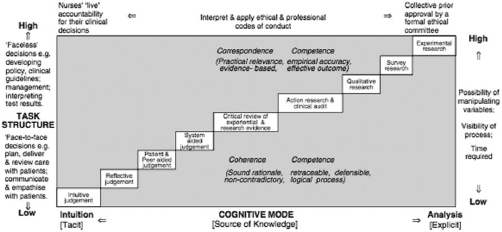
While recognising the risk of nurse/doctor stereotyping and polarisation, findings from the literature resonated with the first author’s reflection on experience regarding paradigm differences in CDM behaviour between nurses and doctors. However, it was not evident what influenced doctors’ CDM in the last weeks of a patient’s life. This was identified as a gap in knowledge and resulted in the question: ‘What influences trainee oncology doctors’ decision making, around clinical intervention, in acute oncology patients, near the end of life?’
Subsequently, the following aim and objectives for an empirical study were identified.
Aim
To generate new understanding of senior trainee oncology doctors’ lived experiences of the phenomenon of clinical decision making for oncology patients in the last days/weeks of life.
Objectives
To explore what senior trainee oncology doctors bring to mind when
making decisions around clinical interventions; to better understand the decision-making behaviour of these
doctors; to raise awareness, through dissemination, of doctors’ perceived
experiences in relation to this phenomenon.
Methodology
To reach the study aim and objectives, the researcher accepted the phenomenological concepts of a ‘tacit’ or unknown lifeworld (Gadamer, 1995, cited in Dahlberg et al., 2008: 35) and a ‘still mute’ experience to be made visible to understanding (Merleau-Ponty, 1968, cited in Dahlberg et al., 2008: 39).
A method of enquiry that brings the tacit world into the open, making it tangible and open to interpretation was necessary.
Epistemological interpretations by Streubert and Carpenter (2011) and Van Manen (1990) support phenomenological enquiry as the most effective approach to elicit understanding of the topic being explored.
In this study, the methodological philosophy of hermeneutic phenomenology, informed by Dahlberg et al. (2008) and Van Manen (1990), facilitated an intersubjective approach, ensuring a deep and rich understanding of the phenomenon.
Van Manen (1990) states that the chosen methodological approach must be suitable to answer the research question and that method should follow methodological principles. Rolfe (2006: 309) suggests that ‘responsibility for appraising research lies with the reader rather than the writer’. In accepting this premise, the writer assumes responsibility for providing sufficient information for the reader to be able to decide on the quality of the research.
It is proposed that the ‘human science’ approach of Van Manen (1990: 11) to hermeneutic phenomenology assures the reader of the credibility of the research by the application of the following principles: expectation that the researcher be ‘self-critical’, ‘systematic’, ‘explicit’ and ‘intersubjective’. This approach enables the reader to believe the findings are a true reflection of participants’ experiences. The scientific approach is further explicated by Dahlberg et al. (2008: 96), who describe the need for reflection at all stages of the research process, ‘openness’, and a purposeful leaving aside of expectations and assumptions in order to approach the research question naively and objectively. Dahlberg et al. (2008: 129) term this ‘restraining’ of preconceived ideas and beliefs, both known and hidden, as ‘bridling’. In terms of credibility, bridling is argued to limit bias when interpreting findings.
Adopting these suggestions conferred credibility on the chosen method.
The first author ensured a ‘bridled’ and reflexive approach throughout the research process by means of a reflective diary, and supervision sessions with the second author throughout the interview process and data analysis. Furthermore, a ‘holding in mind’ of the four lifeworld existentials (Van Manen, 1990: 101–105) – ‘temporality’, ‘spatiality’, ‘corporeality’ and ‘relationality’ – grounded the research in the fundamental principles of phenomenology, conferring a sense of reliability and truthfulness to the interpretation.
Methods
The appropriate research ethics committee and NHS research and
development department granted ethics approval in April and May 2014,
respectively. A homogenous, purposive sample of oncology ‘registrars’ (speciality
training doctors year 3 and above) from the oncology unit of a large UK
teaching hospital was recruited via poster and a third-party email
requesting volunteers. Potential participants contacted the researcher
and were provided with a participant information sheet, consent form and
the opportunity to ask questions. Consent forms were signed prior to
interview. Four participants (approximately 22% of the potential population),
generally representative of the gender and ethnic mix of trainees,
responded and were recruited and interviewed between May and July 2014.
Experience as an oncology trainee ranged from two to seven years.
Dahlberg et al. (2008: 104)
propose that the researcher should be ‘finely attuned’ to the participant and
‘immersed’ in the phenomenon. Therefore, a method enabling intersubjective
engagement between participant and researcher, or a ‘conversation’, which holds the
meaning or ‘essence’ of the phenomenon (Van Manen, 1990: 98) is preferable. Consequently an in-depth interview lasting 60–90 minutes was
conducted with each participant, digitally recorded and transcribed by
the researcher.
Non-verbal signs were included in transcriptions, adding clarity and meaning to the participants’ words (Streubert and Carpenter, 2011). To minimise bias, an initial question was utilised: ‘I am interested in your experiences of making clinical decisions for patients in the last weeks of life. Can you tell me about this?’
Both to provide structure to the interview and facilitate bridling of early presuppositions, the researcher held in mind the lifeworld existentials of Van Manen (1990). During interview, the researcher paraphrased responses as a form of triangulation, thus precluding the need for member checking, while ensuring the participants’ tacit view of the phenomenon.
After four interviews and concurrent reflection with the second author, it was clear that, despite the small number of participants, data saturation had been reached, with recurrent themes or data units emerging.
In adherence to the principles of hermeneutic phenomenology and the concept of ‘the
whole > the part > the whole’ (Dahlberg et al., 2008: 281), the ‘detailed
or line by line approach’ to analysis, suggested by Van Manen (1990: 93), was adopted: Initial reading and rereading of the transcriptions ensured deep
understanding of the ‘whole’ phenomenon in context. Subsequently, text was broken into meaning units – ‘the part’ –
and aligned to the lifeworld existentials (Van Manen, 1990) to bridle any
early interpretation of the data. These data were then re-read and assigned to themes or ‘structures
of experience’ (Van
Manen, 1990: 79) the researcher felt were representative of
individual experiences.
To return to the ‘whole’ of the phenomenon: findings were presented as a written description of the essences and meaning of the phenomenon (Dahlberg et al., 2008; Van Manen, 1990).
Results
Participants ‘Alex’, ‘Bobbie’, ‘Chris’ and ‘Dale’ are referred to in the masculine to preserve anonymity. The rich interview data, following analysis, enabled identification of common transcending themes that allowed naming of the essences of the phenomenon itself rather than the individual’s experience.
Through interpretation of the data, three essences were identified as illuminating
the fundamental meaning of the phenomenon: empathy, the unacknowledged
influence; dichotomy and conflict;
subverted emotion (uncovered through
reflection).
Empathy, the unacknowledged influence
Empathy, ‘the ability… to enter into the true feelings of the other’ (Holloway and Freshwater,
2007: 149), was not explicitly named by the participants as
influencing their CDM. However, it was clear that an empathic approach to a
situation influenced decision making both positively and negatively. ‘Bobbie’
noted that getting to know the patient means his own ‘internal environment is
enriched’ and that understanding the patient helped decision making. ‘Dale’
echoed this. However, ‘Bobbie’ also recalled situations where the act of
empathising clouded clinical judgement and decision making, particularly in
relation to his empathic recognition of families’ distress: It’s very difficult when you start naming relationships … your decision
making goes out the window when you are too emotionally entangled. I couldn’t see the patient.
‘Alex’ described how his understanding of situations becomes more insightful as
he gets older, thus making the decisions harder: … you find more connections … I also have kids and so … you see somebody
who’s going to leave behind a couple of relatively young children … and
that has a shock in a way that 10 years ago I wouldn’t have registered
at all.
‘Chris’ noted that his empathic concern not to overburden unwell patients led him
to avoid end of life conversations with patients. His empathic interpretation of
the situation appeared to hinder shared decision making: I find that very difficult to do and I guess I just expect people to be
feeling so sort of unwell and not able to discuss things and think about
things that I, I guess I sort of assume they would be me … but then I
don’t know if that’s what I would do either.
‘Alex’ appeared to reach the (unprompted) realisation that not involving patients
in shared decision making, although well meant, may not be a helpful approach: … the patient is sitting in bed thinking I’m pretty sick I must be dying
… why are we not talking about the fact that I am
dying.’
Overall, empathy is argued to both positively and negatively influence CDM, but may prevent doctors talking objectively to patients. These actions are not meant to harm; conversely, the doctors’ empathic response to these very sick patients near the end of life is to minimise distress.
Dichotomy and conflict
All participants acknowledged the difficulty of being a ‘trainee’ and ‘getting to
grips with’ the agreed levels of medical intervention (‘aggressiveness’) of
different oncology consultants and medical teams. The on-call aspect of the
role, particularly, brought this concept of uncertainty to the fore. All
participants described having to make decisions about previously unknown
patients under the care of an unfamiliar consultant, whilst still perceiving an
‘obligation’ to follow the treating consultant’s approach. There was a sense of
frustration at this dichotomous approach, in that they were relying on what they
saw in the moment, rather than what was known of the patient’s wishes,
particularly as there was seldom documentation of patients’ EoLC preferences.
This caused ‘Alex’ distress: … trying to discuss with the patient and their families those decisions
when you’ve never met them is horrible, it’s not the right way to do
it.
‘Chris’ described an incident when, because of differing expectations of the outcome for a patient with advanced cancer, the involvement of another medical team resulted in a ‘hideous’ outcome for the patient.
Each participant described making the clinical decision itself, that is, based on measurable parameters (analytical approach), as uncomplicated and ‘easy’. Conversely, there was a real sense of internal conflict in trying to balance this objective decision making with an understanding of patients’ and families’ wishes, despite acknowledging this as adding complexity to decisions.
‘Alex’ articulated that, while a lack of documentation about patients’ preferred
priorities of care was frustrating (a finding echoed by all participants), there
was a simultaneous recognition of internal conflict in trying to find the right
time to broach discussion about these issues in advance: … so when you are talking to people about response rates, improvements in
survival with this chemotherapy or that radiotherapy, to then discuss,
or at the same time discuss, what is going to happen at the end, there’s
no transition, smooth segue that I have ever found to do
that.
‘Dale’ felt that patients were less likely to admit their true problems or condition to the doctors, thus impacting on doctors’ ability to make informed decisions, and also recalled a situation where influence on CDM caused great conflict.
The real impact of these conflicts (internal and external), acknowledged to varying degrees by all participants, is articulated by ‘Alex’ when describing that the reality of imminent death can be ‘a bolt out of the blue’ for patients and families.
Subverted emotion (uncovered through reflection)
This essence was brought to awareness through the interviews with ‘Alex’, ‘Bobbie’ and ‘Chris, but was noticeably different in presentation with ‘Dale’.
‘Alex’ described the process of the research interview as ‘very cathartic in its way’, while ‘Bobbie’ stated that the interview helped him learn more. ‘Chris’, after discussing his concern that patients may find conversations burdensome, found that reflecting, through the interview process, on his own emotional experience of being gravely ill changed his previously held assumptions about how ill patients may cope with conversations.
Also apparent was that the emotional side of participants’ personality appeared to be subverted when in role. Both ‘Alex’ and ‘Bobbie’ became emotional and tearful during the interview but repeatedly tried to minimise the significance of this response, apologising and appearing embarrassed. One used the phrase ‘ridiculous’ to describe their tearfulness.
Conversely, ‘Dale’, despite acknowledging, after direct questioning, that talking to patients about death was difficult (‘I think it’s always hard yeah’), appeared to subvert the emotional impact of these situations so much that he either did not recognise, or felt unable to disclose, the personal impact for him. Even when discussing an extremely difficult case, there was little acknowledgement of the emotional burden on him other than to say it was ‘frustrating’.
A summary description could be: doctors can reflect upon and articulate strong emotions but do not seem to have permission or opportunity to do so, despite finding the process helpful.
Discussion
The first author’s preconceived view, substantiated by the literature review, was that doctors' and nurses' decision-making behaviour is paradigmatically different.
The findings, however, appear to demonstrate a new concept, not currently reflected in accepted CDM theory: that empathy, although a beneficent approach, may affect doctors’ CDM, adding to the difficulty in making decisions about clinical care of oncology patients near the end of life. Findings from a further literature review suggest the ability to empathise is perceived as a good and helpful characteristic (Selph et al., 2008) and ‘fundamental to effective patient care’ (West, 2012:243). Arguably, the findings of this study suggest the impact of empathy on CDM may adversely affect patient choice re EoLC. Furthermore, the concept ‘empathy’ is not represented in current conceptualisations of CCT by Hamm (1988) and Standing (2008) and is worthy of further investigation.
The essence dichotomy and conflict demonstrates that both internalised professional conflict and external inter-team conflict exist and are perceived negatively. Evidence from the literature illustrates that conflict in clinical practice is distracting and impedes task execution (Greer et al., 2012; Janss et al., 2012). Interpretation of role, learning team rules and placing themselves and their beliefs within this context appeared to cause most conflict for these four doctors. Participants did not describe conflict between nurses and doctors as a common problem. Contrary to the literature, comments generally suggested a perception of nurse–doctor interactions as usually positive and helpful. ‘Dale’ finds that understanding the patient’s perspective for him ‘hinges around the nursing team’. Comments on conflict between participants and nurses, raised in interview, represented differing interpretations of protocols rather than fundamental differences of opinion.
All participants acknowledged difficulty in making decisions when patient wishes were not documented, particularly if patients were perceived as too unwell to include in conversations around escalation and limits of care. However, despite this acknowledgement, an internal conflict exists about identifying the appropriate time to discuss EoLC choices. This reflects issues raised earlier around inconsistency and poor prognostication adversely affecting place of death (EoLC Programme, 2010) and appears worthy of further investigation.
The third essence, subverted emotion uncovered through reflection, was not apparent in the literature relating to senior oncology doctors and was interpreted as an element of the tacit or unknown lifeworld this research brought to light.
The interview process invited reflection on past experiences, appearing to fulfil a need for reflection in the participants. Each one, even ‘Dale’, who barely acknowledged the issue of emotion, appeared to have reached a new understanding of previous experiences and what they had brought to those decisions.
Taylor (2010: 29) suggests reflection may enable professionals to examine their protective behaviours or shields, utilised to limit the impact of the ‘relative tragedies and uncertainties of daily practice’. The unexpected degree of emotion felt and expressed by participants during interview demonstrated that participating in a research interview allowed an ‘unburdening’, begging the question of what support is available for senior oncology doctors in practice.
Further literature highlighted the concept of a hidden curriculum (Hafferty, 1998; Lindberg, 2009; Pitkala and Mantyranta, 2003) relating to doctors’ socialisation into a role or team. It is proposed that, although this concept is addressed for undergraduate doctors, the role development of trainees may involve a unique hidden curriculum that promotes subverted emotion as the norm.
Presenting this research to oncology doctors (trainees and consultants) from the participating organisation in September 2015 provided powerful validation of the findings. Doctors recognised the essences as a true representation of their world, with consensus among the audience that the findings, although previously unacknowledged or ‘subverted’, were true.
The authors acknowledges the following limitations: Participants self-selected for interview, potentially introducing
a non-response bias (Bowling, 2009). Participants were aware of the first author’s clinical role as a
palliative care nurse specialist. This may have affected the interviews
– the Hawthorne effect (Bowling, 2009). The exploratory nature of this study does not allow for
generalisation; however, this does not detract from the value of the
data, particularly in view of the endorsement of the findings by other
oncology doctors.
Future work should take account of these factors.
Conclusion
In conclusion, the authors propose that the chosen methodology and method – hermeneutic phenomenology, underpinned by the human science approach exemplified by Van Manen (1990) and Dahlberg et al. (2008) – ensured the aim and objectives were met. The findings illuminate the phenomenon of oncology doctors’ experience of decision making for patients in the last days/weeks of life.
Findings, expressed as essences of the phenomenon, demonstrate that in contrast to findings from literature and the first author’s own pre-reflective perceptions, doctors appear to bring more than an analytical approach to the act of CDM. Factors of empathy and their own world views impact and may cause conflict both internally and as part of the wider team structure. Expected behaviours associated with the role, including those that may be a result of the ‘hidden curriculum’, may impact negatively on outcomes for patients, who can feel powerless at this critical point of their lives, and create an emotional burden for doctors. These factors appear worthy of further enquiry.
The presentation of these findings may raise awareness of the impact of this complex process for both patients and doctors, and ultimately enable a more caring and empathic approach between professionals.
Further research into the impact of empathy on oncology doctors’ decision making with patients and further enquiry into the role of nurses in relation to decision making could influence practice and, ultimately, improve patient choice at the end of life.
Key points for policy, practice and/or research
The experience of CDM for oncology doctors is complex and can cause
distress for them. Nurses’ role in relation to CDM was not explored and is an area for
future study. Unrecognised influences, such as empathy, may create barriers to doctors
involving oncology patients in shared decision making at the end of
life. Current theory underpinning CDM does not appear to reflect empathy as an
influence or factor. This warrants further exploration. There is a conflict for doctors identifying when to talk to oncology
patients undergoing non-curative treatments about their options if they
become unwell and require acute admission to hospital. Clear
documentation of these patients’ preferred priorities of care is often
absent. The authors suggest that a change in practice relating to the above may
positively impact on whether or not patients die in the place of their
choice.
Footnotes
Declaration of Conflicting Interests
The author(s) declared no potential conflicts of interest with respect to the research, authorship, and/or publication of this article.
Funding
The author(s) received no financial support for the research, authorship, and/or publication of this article.