




Abstract
This paper describes how the medium of ‘found poetry’ is incorporated into a doctoral programme for nurses, educators and allied health and social care professionals at the start of their various doctoral journeys. It advocates a narrative practice approach to issues of researcher identity and reflexivity. ‘Finding’ the poems begins with the creation of collages as representational anchors for students to talk about themselves, their professional practice, their hopes and expectations of the doctoral experience, and their research ideas. (Re)presenting their transcribed talk as poetry involves culling and playing with words, phrases and segments, making changes in spacing, lines and rhythm to arrive at an evocative distillation (Butler-Kisber, 2002). This process enables each person to bring stories and/or fragments of experience into critical engagement with others. Poetic thinking functions pedagogically, helping students find a critical voice to enliven and hone their reflexive writing in relation to their doctoral experience and their research positioning. Arts-based methods of inquiry are an ongoing topic of interest in research communities. Found poetry is a useful starting point to explore creative means by which research participants can recount their stories, and equally, by which researchers can witness and disseminate what they have to tell.
Introduction
Language is charged with the task of making beings manifest and preserving them as such – in the linguistic work. Language gives expression to what is most pure and most concealed, as well as to what is confused and common. Indeed, even the essential word, if it is to be understood and so become the common possession of all, must make itself common. (Heidegger, translated from Krell 1993: 378)
The social landscape of practice has been described as a resource for constituting professional identity through cognitive maps and a powerful sense of self, rooted in shared stories and repertoires for practice (Wenger, 2008). To this extent, professional knowledge and identity are ‘territorialised’ (Sanders et al., 2011: 117). But such certainty and familiarity can be problematic in the ontological quicksands of unknown terrain and the emergent possibilities of alternative vantage points. Holding on might create tensions among one’s fellow travellers (e.g., peers and supervisors), but letting go is to feel exposed and vulnerable on the voyage, and as likely as not alienated from those back home (Petty et al., 2012). How will the ‘researching professional’, the ‘practitioner-researcher’, the ‘scholarly practitioner’ (the labels vary) be received? The ways that people let go of and negotiate new identities may be thought of as occurring in the liminal spaces of any new cultural environment in which we perceive threats to our established identities (Plump and Geist-Martin, 2013). Michael Bamberg (2011: 8–9) explicates this challenge as three dilemmatic spaces within which identity activities are navigated. They comprise: 1) constructing continuities and discontinuities (change) across time (‘who I’ve always been’ versus ‘someone new and different’), 2) setting up a self vis-a-vis others (‘I-am-who-I-am owing to my positioning in relation to others’), and 3) presenting a self as agent, or as subjected by social structures. Given that such a conceptualisation is ‘shot through with valuating practices [and] morally infested’, Bamberg (2011: 9) emphasises that positioning a sense of self in relation to it is a matter of degree, and that navigation is as much between as it is within these dilemmatic spaces.
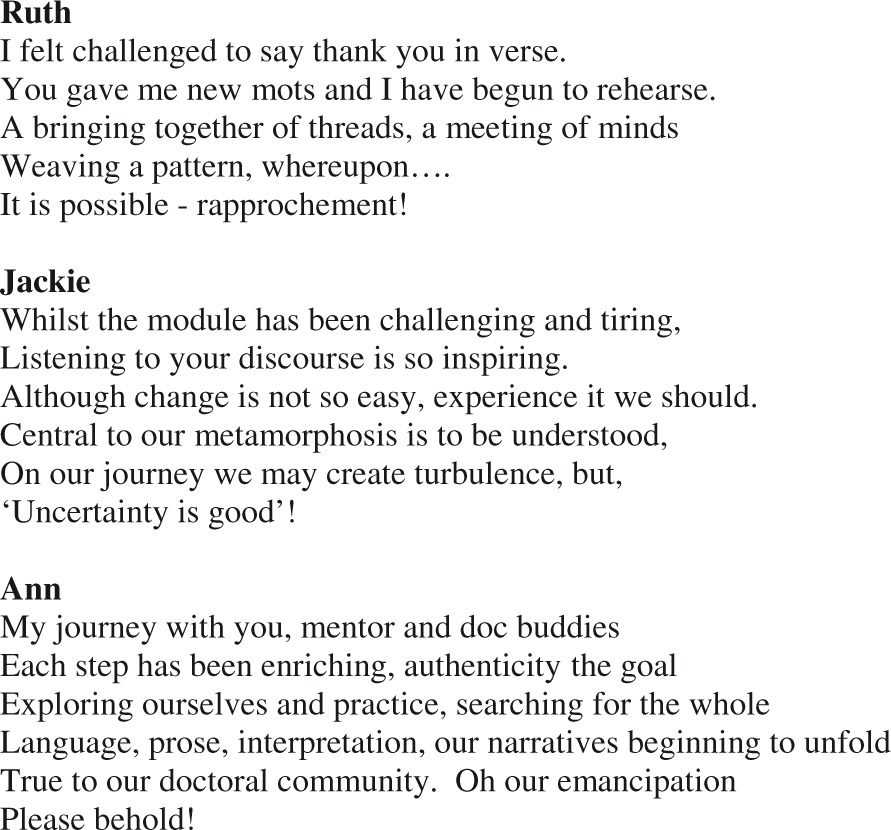
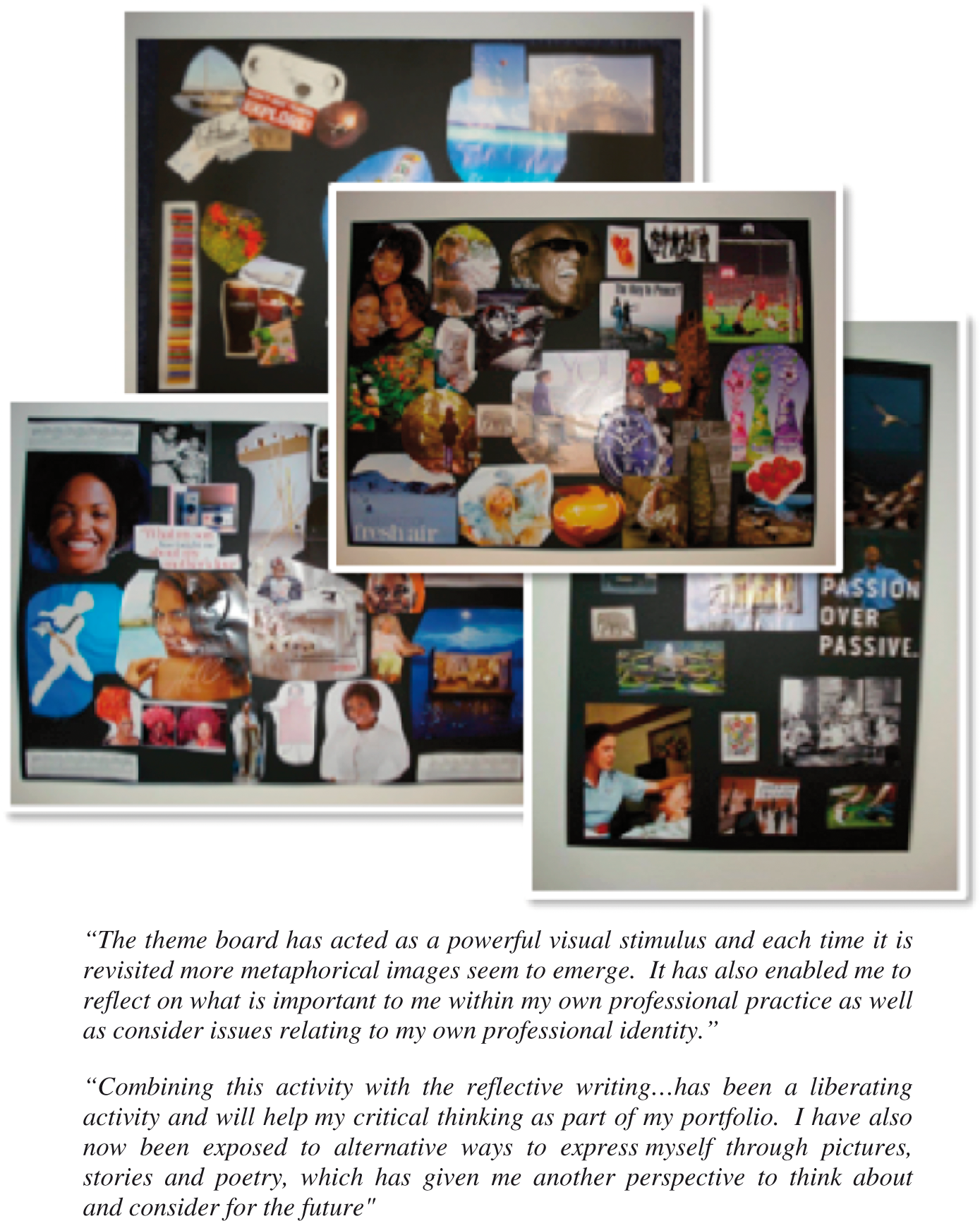
Bamberg (2011) advocates a narrative practice approach to personal identity work that encourages the sharing of ‘small’ everyday, mundane stories with others. This is consonant with Glynis Cousin’s view that ‘The textual “re-presentation” of life is what the researcher does’ (2013: 5). In relation to research, the fluidity of positionality demands that we do this out of an examination of place, biography, values, linguistic frameworks and discourses available to us. Critical reflexivity allows us to be transparent about how both big and small stories underlying this examination shape the analytic/interpretive exercise (Macbeth, 2001). We are … formed out of singular experiences. In particular, our biography includes what we have read, seen, touched and heard in terms of cultural experiences. … These are in the mix of what we bring to our interpretations. (Cousin, 2013: 5) Using theme board technique to talk about practice. Feedback poems from students. Student responses to the theme board activity (presented with permission).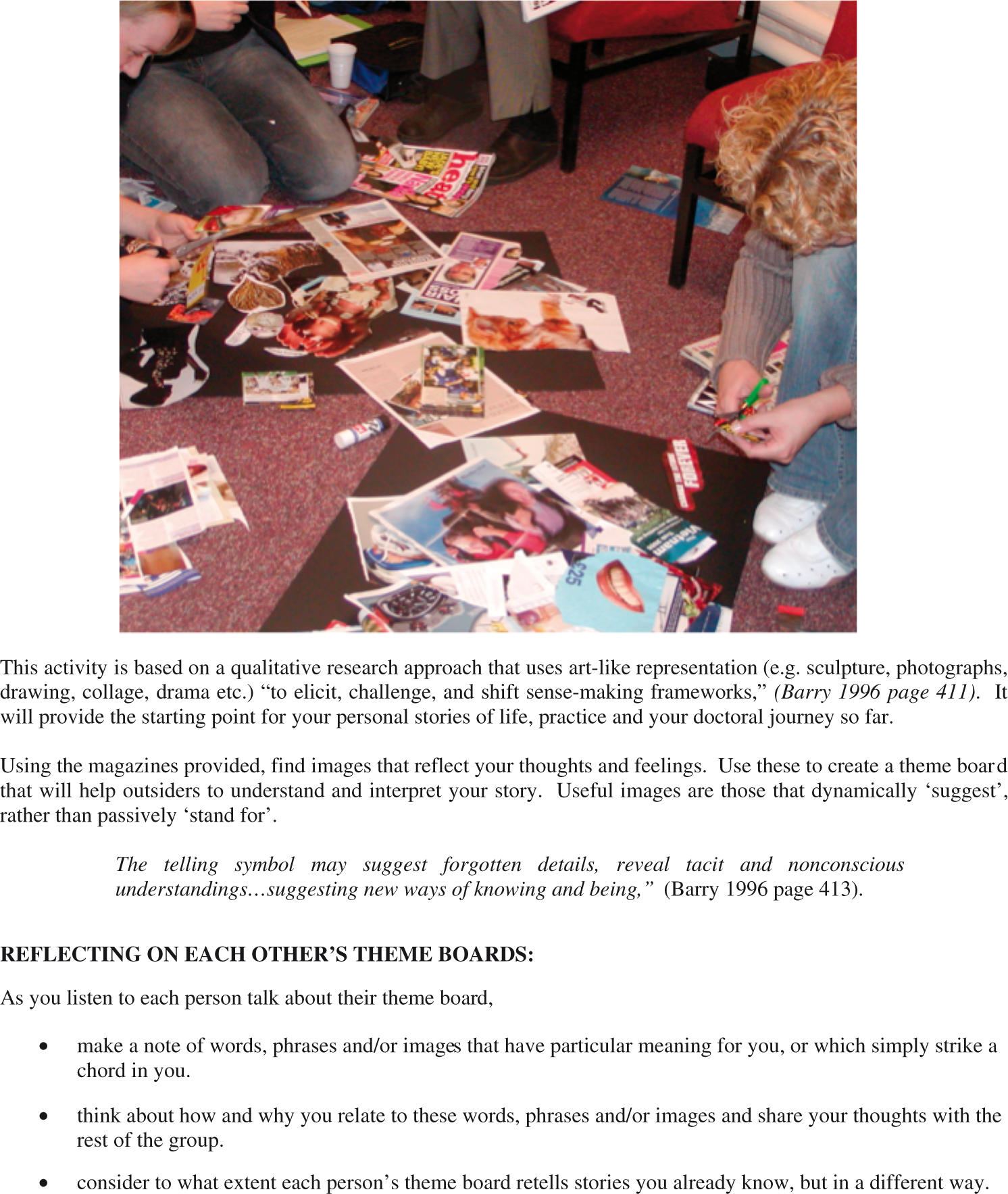
Poetic inquiry
Definitions of poetry, and aesthetic concerns about what constitutes ‘good’ or ‘effective’ poetry, are subjects of much debate (Faulkner, 2016). The scope of and enthusiasm for poetic inquiry as a way of knowing through poetic language and devices, and as an expression of affective experience, is wide (see Prendergast, 2009 and Faulkner, 2016 for comprehensive accounts). It may be categorised in terms of the voice engaged, for example researcher-voiced ‘poetic re-telling’ derived from field notes, journals or auto-ethnographical writing. Participant-voiced poems may be created de novo by participants or in collaboration with researchers, and may reflect singular or multiple voices. Other participant-voiced poems may be crafted from interview transcripts by researchers as an interpretive strategy. This is a type of found poetry that reconfigures research participants’ transcribed talk in poetic form (Butler-Kisber, 2002; Cross et al., 2016; Sherwin et al., 2014; Sparkes and Douglas, 2007). This involves culling and playing with words, phrases and segments and making changes in spacing, lines and rhythm to arrive at an evocative piece.
Theme board poems
Ann, Eney and Lawrence are doctoral students from the fields of nurse education, women’s health and mental health, respectively. They were generous in offering us their poems for this paper in their own names. The first poem, ‘Don’t just travel’, conveys the sentiment behind the title of this paper as expressed in Vinette’s found poem created from Ann’s theme board narrative. The next two: ‘My theme board poem’ and ‘Finding me’, comprise Lawrence’s found poem crafted from his own narrative, and Eney’s found poem crafted for Lawrence from his own narrative.
Keep things simple, like my poster Past, present, future I Tension Slices of difference, demarcations Where at first you see only a whole Let’s rewind Simple beginnings II But lots of books I began working in an office Got the bug to find out more III Don’t just travel Explore! Different angles Places in the dark and light IV You’re not what people see but Be what people expect (sometimes) It’s rare for everything to be accepted I like to be in the lead Searching for sense in all this It’s about the student journey V Making a place for them to grow About them making good choices And us choosing them I can’t imagine not being happy In what I do VI Fun is seen as frivolous But that’s not true You don’t have to stay At the top of the mountain VII Come back down And start again Don’t just travel Explore! (Vinette’s found poem crafted from Ann’s theme board narrative 2012)
I am a true reflection of myself Mirror, Mirror does not lie See myself as others do I The road is not clear But I can see the way I have challenges on my way Reading books is the only way Find comfort by hiding away Deep, deep down I need friends, colleagues II And mentors Researching is my job Finally I did it I did it III How??? I do not know! (Lawrence’s own found poem crafted from his theme board narrative 2015)
In a mirror I can see myself Slow and fast I follow my road I The books I read guide and mislead me But I know I am going Outside my comfort zone I am growing Can’t hide But always digging in and out II Aiming to find myself I am first and I have done it Not sure how Guess I need models III To find myself (Eney’s found poem crafted from Lawrence’s theme board narrative 2015)
When we decide to use stories, Frank (2010) says we should consider what we want to do with them, which raises issues of representation and subjectivity. So we must consider what purpose it serves to appropriate each other’s texts in this way. In suggesting that Ann’s poem ‘does work’ we adopt Frank’s (2010) approach to narrative, which is not so concerned with what stories reveal about the mind of the storyteller, but is more interested in seeing the story as a living actor dialogically engaged with us, as tellers and listeners. The important work that stories achieve is to provide a ‘selection/evaluation guidance system’ to direct our attention. ‘To select is already to evaluate; the processes are continuous, separable only upon reflection’ (Frank 2010: 46). The evaluative work of selection inherent in creating found poetry challenges students to assay multiple critical readings of each other’s text; to not only think about stories, but to think with stories. Thus, in conversation with Lawrence and Eney, ‘My theme board poem’ and ‘Finding me’ draw us into Bamberg’s (2011) dilemmatic spaces of identity work by appearing to wrestle with the ‘Who am I?’ question. First, an essentialist, same and continuous self appears to speak: ‘I am a true reflection of myself/Mirror, Mirror does not lie’ (Verse I). But ‘See myself as others do’ suggests a constructionist leaning towards self as positioned in relation to others, begging such questions as ‘What do I represent in the system, and what do other people think of my representation?’ Such a reading directs our attention to getting away from ‘who we think we are’ towards the question of how we perform ‘who we do’. ‘Finding me’ offers a different reading, a different image in the lines ‘In a mirror I can see myself/Slow and fast I follow my road’ (Verse I). So we might ask ourselves, ‘Is the man in the mirror in the act of walking away from a “same and continuous” self towards a different “positioned” self?’.
The poem ‘Don’t just travel’ contributes to this conversation: ‘You’re not what people see but/Be what people expect (sometimes)’ [Verse IV]. But it offers a critical twist – if we read Verse VI as a representation (the voice), of the doctoral programme (rather than hearing an individual student voice) the ambiguity of this tensioned space between structural discourse and dilemmatic narrative practice is revealed: ‘Different angles/Places in the dark and light/You’re not what people see but/Be what people expect (sometimes)/It’s rare for everything to be accepted’.
Final thoughts
Reflexivity is a social constructionist endeavour in which knowledge claims are negotiated and contingent. Hence the students’ collages are fragmented, non-linear and contingent. They make no secret of their fabrication as biographical texts. Nevertheless, we remain mindful that while reflexivity’s epistemological position is that what we see is shaped by how and where we have learned to look (Cousin, 2013), the challenge is to craft an account that is not simply self-consciously confessional, bounded by the limitations of a personal perspective. When it comes to practice, the process of engaging in reflexivity is perilous … Researchers have to negotiate the ‘swamp’ of interminable self analysis and self disclosure. On their journey, they can all too easily fall into the mire of the infinite regress of excessive self-analysis and deconstructions at the expense of focusing on the research participants and developing understanding. (Finlay, 2002: 212)
We opened with Heidegger’s (translated by Krell 1993) suggestion that thinking does more than merely represent or explain, and for familiar language and common speech to conceal more than they reveal (Heidegger). We are less likely to ‘hear’ or examine context in a critical fashion. Poetic thinking and writing, on the other hand, encourages un-concealing or uncovering through allusions, syntax and unexpected metaphors. Poetry engages us with language, nurtures the inner life, acknowledges the particular and local, encourages us to listen to our hearts, fosters flexibility and trust, and invites creativity and creative living. (Leggo, 2005: 454)
Footnotes
Key points for policy,practice and/or research
Scholarly challenges come to us from many directions and in often alarming guises. Our important task is to equip ourselves with the flexible and the unexpected response. Better to rejoice and engage in what we call critical reflexivity rather than attempt the discovery of poorly defined and outlandish research project claims.
Acknowledgements
Warmest thanks are due to our doctoral students Ann Philp, Lawrence Phiri, Energycayse Mhizha, Ruth Westerby and Jaquie Mitchell. They were generous in offering us their poems for this paper in their own names.
Author’s Note
The untimely death of my best friend brings home that narrative does not do normal, just entanglement. The work of Dr Cross has inspired not only me, but the many she has guided, cajoled and enabled in such imbroglio. Mess and muddle is what she enjoyed and taught me to recognise its poetic potential and I like many miss her anarchy. Dean-David Holyoake
Declaration of conflicting interests
The author(s) declared no potential conflicts of interest with respect to the research, authorship, and/or publication of this article.
Funding
The author(s) received no financial support for the research, authorship, and/or publication of this article.