



Abstract
Despite agreement that end-of-life conversations should happen early on in the illness trajectory, it is widely acknowledged that healthcare practitioners often engage in these conversations when death is imminent or avoid the conversation altogether. Healthcare practitioners’ feelings of distress influence how end-of-life conversations are approached, yet thorough exploration of this emotional experience and its impact are largely missing from the literature. The aims of this preliminary scoping literature review using poetic inquiry were to examine physicians’ and nurses’ emotional distress in their accounts of how they approach end-of-life conversations, and to map key concepts relevant to exploring barriers to these conversations. The poetic findings highlight the differing nature of distress for physicians and nurses. Physicians’ distress appears to stem from adhering to their role of ‘curer’ when communicating with terminally ill adult patients at the end of life, whereas the sources of nurses’ distress appear to be interprofessional hierarchies and conflicts. Future research and training that uses methods to decentre and disrupt hierarchies and ingrained practices will be important to nursing practice and in improving end-of-life conversations. Arts-based approaches are one such method that could be pursued.
Keywords
Introduction
In North America, end-of-life (EOL) conversations between healthcare practitioners and terminally ill adult patients often either take place too late, when death is imminent, or they do not take place at all (Larson and Tobin, 2000; Periyakoil et al., 2015). When EOL conversations are avoided, patients’ values and care preferences remain unknown and are therefore impossible to meet (Barnes et al., 2012), often leading to physical distress, worse quality of life (Zhang et al., 2009) and an increased rate of depression among bereaved caregivers (Wright et al., 2008). Furthermore, avoiding EOL conversations often elicits feelings of distress and moral dilemmas for both nurses and physicians (Hamric and Blackhall, 2007). Improving EOL conversations has been a research priority for decades, yet they continue to happen infrequently (Larson and Tobin, 2000; Peden-McAlpine et al., 2015). With our ageing population and increasing healthcare costs, new strategies and innovative research methods are needed to address this urgent public health concern (Tilden et al., 2011).
Research typically discusses three barriers to EOL conversations: lack of training (Barclay et al., 2011; Hancock et al., 2007; Larson and Tobin, 2000); uncertainty about disease prognosis (Barclay et al., 2011; Hancock et al., 2007); and fear of a negative impact on the patient (Barclay et al., 2011; Hancock et al., 2007; McLennon et al., 2013). Healthcare practitioners’ feelings of distress also influence how EOL conversations are approached (Hamric and Blackhall, 2007; The et al., 2000), yet a thorough exploration of this emotional experience and its impact is largely missing from medical literature (Meier et al., 2001). This scoping literature review explores physicians’ and nurses’ emotional distress and how this distress might impact how EOL conversations are conducted. Poetic inquiry was used to analyse the literature because it is a method that is well suited for naming and interpreting emotion in text (Wiebe, 2008).
Literature search
Systematic reviews of the literature are best for addressing somewhat precise research questions, whereas scoping reviews are well suited to broadly exploring areas of interest in which concepts are less well known and defined (The Joanna Briggs Institute, 2015). Since my area of interest has received little attention academically and the key concepts are still unknown, I chose to conduct a scoping review (The Joanna Briggs Institute, 2015).
The objective of my scoping review is to examine and map physicians’ and nurses’ emotional distress in their accounts of how they approach EOL conversations. The scoping review questions are ‘How do physicians and nurses talk about EOL conversations?’ and ‘In what ways is emotional distress expressed?’. To identify key concepts related to this area, I decided to experiment with poetic inquiry as a method of analysing the texts. As a preliminary exploration of using this method of analysis, only one database, PubMed, was searched. I chose PubMed for its broad focus on biomedicine and clinical practice.
For this scoping review I conducted two searches, one for qualitative articles that contained direct quotes from physicians and the other for qualitative articles with direct quotes from registered nurses. The searches were conducted separately for each profession because I wanted to hear the distinct voices and concerns of each – this is sometimes not available in interdisciplinary studies. The PubMed database was searched using the key words ‘physician’, ‘end-of-life conversation/communication’ and ‘qualitative research’, and again for nurses using the key word ‘nurse’ to replace ‘physician’. The inclusion criteria incorporated articles that were in English, were published within the last 10 years in order to hear experiences that reflected current practices, were conducted in North America in order to be context specific to my research location, presented qualitative data based on interviews with physicians or nurses, and included data that focused on physicians’ or nurses’ experiences of having EOL conversations with terminally ill adult patients – patients over 18 years of age whose death was anticipated within the next year. Articles were excluded if the research was interdisciplinary or based in palliative care, and if surveys were the primary data source. Articles about palliative care were excluded because I am interested in how EOL conversations are approached by healthcare practitioners who care for the dying but work within recovery-focused environments.
The search for literature on physicians yielded 87 articles; all of the abstracts for these articles were reviewed and 12 articles were retrieved for further review. After reviewing the texts, nine articles were excluded due to being interdisciplinary empirical studies, relying on surveys, focusing on aspects of EOL care other than communication, or being low quality regarding their rigour, credibility and coherence (Tracy, 2010). This left three eligible articles for this inquiry: Anderson et al. (2013), Jackson et al. (2008) and Yapp (2012). The physician’s specialty and the patient populations covered by these articles were heterogeneous. The commonality was that all physicians worked in cure-focused roles, including hospitalists (Anderson et al., 2013), general practitioners (Yapp, 2012) and oncologists (Jackson et al., 2008) who worked with patients experiencing cancer (Anderson et al., 2013; Jackson et al., 2008) and other illnesses such as diabetes, HIV and end-stage liver disease (Anderson et al., 2013).
The search for literature on nurses resulted in 115 articles; all of the abstracts for these articles were reviewed and 10 were retrieved for further review. After reading the texts, six articles were excluded for being interdisciplinary empirical studies, international empirical studies, based within palliative care, or low quality regarding their rigor, credibility and coherence (Tracy, 2010). Only four articles were eligible for this review: Peden-McAlpine et al. (2015), McLennon et al. (2013), Aslakson et al. (2012) and Calvin et al. (2009). The nursing specialties and the patient populations covered by these articles were also heterogeneous. The commonality was that all nurses worked in cure-focused settings, including intensive care nurses (Peden-McAlpine et al., 2015), inpatient and outpatient oncology nurses (McLennon et al., 2013), surgical intensive care nurses (Aslakson et al., 2012) and cardiovascular intensive care unit nurses (Calvin et al., 2009) as well as the many types of patients who receive care in these areas. I want to note that the limited size of this body of work highlights the lack of attention paid by researchers to practitioners’ personal experiences of EOL conversations.
Methodology
The integration of arts within scientific inquiry is known as arts-based research (Lafreniere and Cox, 2012). Increasingly, health scientists are using poetry, dance and other artistic practices for data generation, analysis and dissemination (Lafreniere and Cox, 2012; Parsons and Boydell, 2012). Arts-based research embraces multimodal intelligence and embodied and reflexive ways of knowing (Lapum et al., 2011). For example, poetic inquirers believe that knowledge is co-constructed, dialogical and dynamic (Prendergast, 2009; Thomas-MacLean, 2010), informed by the dialogue between various individuals’ interpretations of reality (Eisner, 1997; Lapum, 2004; Thomas-MacLean, 2010). Poetic inquiry disrupts power structures and dominant paradigms by making space for knowledge that is relational, emotional and inherently curious (Eisner, 1997; Thomas-MacLean, 2010). Engaging in this research is considered a ‘rebellious’ act because it questions traditional conceptions of knowledge production, making it akin to feminism and post-structuralism in its attempts to challenge positivism (Eisner, 1997).
The blending of the aesthetics of art and the rigours of science can communicate complex experiential accounts of human emotions, beliefs and interactions (Lafreniere and Cox, 2012; Parsons and Boydell, 2012) in ways that are accessible to diverse audiences, including patients, healthcare practitioners and the general public (Lapum et al., 2011; Parsons and Boydell, 2012). The empathetic and emotional knowledge that arts-based research can produce complements and expands upon cognitive knowing in ways that academic texts often do not (Bochner and Ellis, 2003). Furthermore, use of the arts can decentre and disrupt, leading people to question their beliefs and understandings (Titchen and McCormack, 2010).
Poetic inquiry is a type of arts-based research and an umbrella term for various poetic methods such as poetic transcription, poetic representation, poetic narrative and poetic analysis (Prendergast, 2009). It emphasises the emotionality and experiential nature of what is communicated, and presents interpretations not in concrete conclusions but as impressions that encourage further exploration by both researchers and readers (Bochner and Ellis, 2003; Wiebe, 2008).
Two common applications of poetic inquiry are participant-voiced inquiry, which uses participants’ words as the data source, and researcher-voiced inquiry, which uses field notes or reflective writing as the data source (Prendergast, 2009). Poems constructed from the words of participants and re-presented by the researcher are referred to as found poetry, which is a common form used by poetic inquirers (Glesne, 1997; Prendergast, 2009). The aim of poetic inquiry is often to respond to the text by adding another voice to the dialogue without replacing the text from which the interpretations came (Wiebe, 2008).
Poetic inquiry has no singular prescriptive method (Glesne, 1997; Lapum, 2004); however, Glesne's original work (1997) is frequently cited as an exemplary method of how to analyse text using poetry as an analytical tool and for the purpose of producing participant-voiced poems (Prendergast, 2009). Glesne’s process of inquiry is iterative and disobeys traditional rules of coding; instead, it demands a less structured approach in which interpretations of the data are filtered through poetic practices and the researcher’s emotional responses (Glesne, 1997). Questions, emotions and continued exploration are evoked when poetic inquirers present interpretations as possibilities rather than as ‘truth’ about reality (Glesne, 1997; Thomas-MacLean, 2010).
In poetic inquiry it is unlikely that the same poem will ever be recreated, even from the same data by the same researcher, because the context, awareness and beliefs that inform interpretation of the data are ever changing (Prendergast, 2009). Consequently, evaluating poetic inquiry does not utilise criteria such as replicability, but rather transparency, coherence and credibility (Prendergast, 2009; Tracy, 2010). Furthermore, the aesthetics and technical aspects of the poem are important to the quality of poetic inquiry. This requires adherence to poetic form, such as free verse, which is used in this inquiry, and experience (Lafreniere and Cox, 2012; Prendergast, 2009), which I gained by using poetry as a reflexive tool in other qualitative research (Carter et al., 2014).
Analysis
Reflexive poem and notes in response to Anderson et al. (2013).
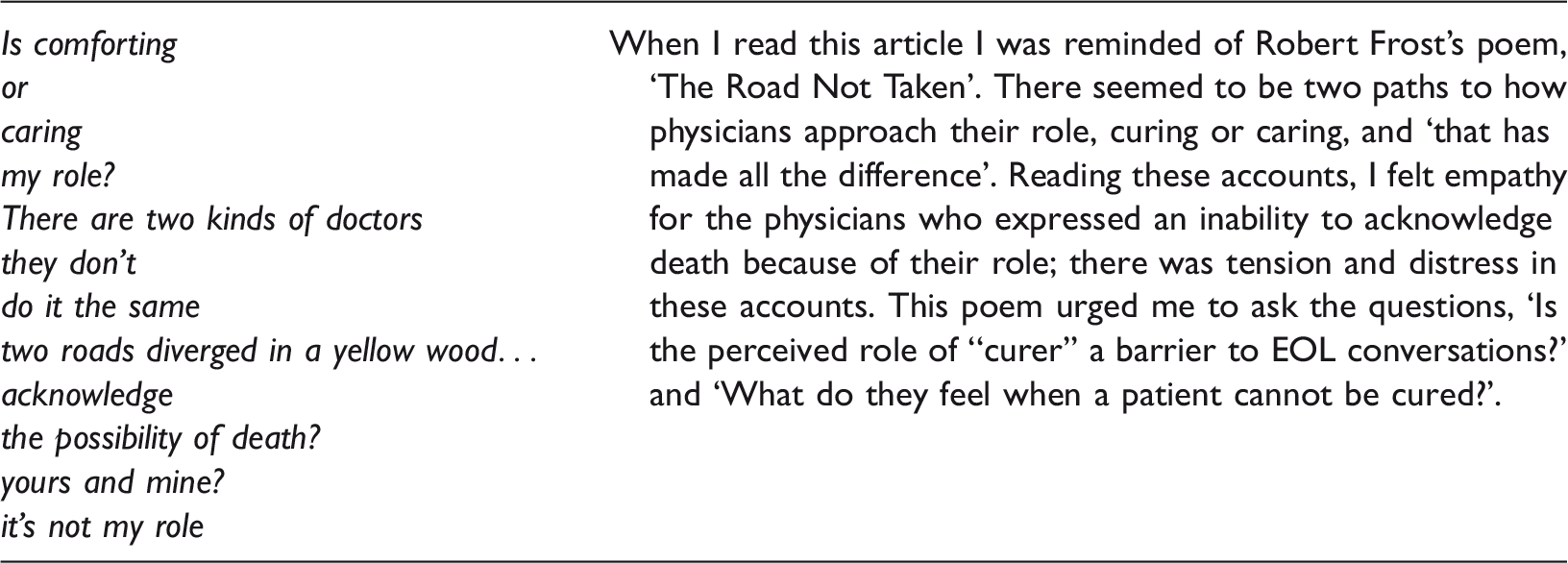
Several days after writing these reflections, I re-read the articles and my reflexive poems and found my interpretations of the texts still resonated. This process of re-reading after some time has passed allows for ideas to percolate and helps avoid unreflective interpretations. With the writing of each reflexive poem and corresponding notes, I explored my assumptions about the ways distress was expressed in the texts, and my beliefs about how that distress might be a barrier to EOL conversations (Carter et al., 2014). Being transparent about my process is important because it helps you, the reader, to trust my interpretations (Tracy, 2010).
Sample of highlighting the essence of the text.

Source: Yapp (2012: 108).
The third step involved putting all the highlighted words together and reordering and/or eliminating words to continue the analysis through the creation of a poem constructed from the words found within the articles. This form is known as found poetry. In crafting the poem I followed poetic inquiry rules, which state that words can be repeated, word endings can be added and dropped, verb tenses can be changed, and the data can be presented in the first or third person (Glesne, 1997). I crafted these two poems over several months by moving back and forth between my reflexive poems and notes, the articles and my emerging interpretive poem. During this process I asked: ‘What do I feel when I read these poems?’ ‘Is this a similar emotion that I felt when I read the original texts?’ ‘Which utterances communicate distress to me and why?’ ‘Can I evoke similar emotions with fewer words?’
Typical thematic analysis requires the creation of higher order themes that incorporate all smaller codes into tidy categories (Creswell, 2007). This type of analysis would have resulted in mapping reoccurring themes across texts and determining the most relevant concepts based on frequency (Creswell, 2007). Poetic inquiry does not demand this type of order. What become relevant within poetic inquiry are the emotionality, resonance and vividness of what is expressed even if only by one person at one time (Lafreniere and Cox, 2012; Lapum, 2004; Prendergast, 2009). This results in very different emphases and findings.
Poetic findings
How physicians talk about EOL conversations
Culture how I grew up my personal beliefs of death and dying have no impact I am acculturated. transitioned. trained. to remain analytical. disconnected. sterile. Other doctors can be like rabbis caring attached saying there are limits to curing saying technology becomes the enemy saying not to hurt them more But my role is to treat from diagnosis until death I can’t divorce from curing When asked for prognosis It’s an intricate interplay will I acknowledge the possibility of dying? No time not my role Another provider at another time. will help you say “I believe I’m dying” I keep compartmentalized creating an emotional chasm because death is not a natural progression it is my medical inability
How nurses talk about EOL conversations
As soon as I see them I start constructing the story of what is happening to their body I am the witness at the bedside my hands touching gently connected I notice subtle signs the fight starts lagging ‘am I going to die?’ I know it is time I must shift not knowing for certain but I must be honest getting them ready to come to terms with the story of demise asking how do you want to live or die? sometimes it takes days The doctors speak in components families can’t grasp they turn and ask for meaning I try to pull it all together But I know the consequences for overstepping that unapproachable doctor who shuts you down jumps down your throat chops you at the legs saying, ‘no, we still have another round, keep offering hope’ they have unrealistic goals the doctors aren’t saying not willing or accepting definitely not disclosing they go on fighting for life It’s not right not to tell them I must find a way from the side-lines to get them ready it’s distressing
Discussion
I pause and reflect on the emotions that arose for me during this inquiry and the key concepts that resonate for me as I continue this ongoing work. It appears to me that both physicians’ and nurses’ accounts of how they approach EOL conversations include strong feelings of distress that seem to be major barriers to EOL conversations. What I found interesting was how I felt and heard different expressions of distress from each profession that seemed to arise from different factors. Many physicians interviewed in the articles spoke about EOL conversations as if they were not part of their role but rather in conflict with it (Anderson et al., 2013; Jackson et al., 2008; Yapp, 2012). I felt that physicians’ distress appeared to be related to their desire to adhere to the role they were acculturated to – namely, that of biomedical curer (Meier et al., 2001) – despite the terminal status of a patient.
In contrast, when I read the nurses’ accounts, their distress did not seem to arise from adherence to a recovery narrative or avoidance of imminent death and dying. What I felt from analysing the nurses’ accounts was a knowledge grounded in day-to-day life informed by being at the bedside and acquainting themselves with the realities of death and dying (Aslakson et al., 2012; Calvin et al., 2009; McLennon et al., 2013; Peden-McAlpine et al., 2015). In the nurses’ accounts, I felt their sense of duty and a moral obligation to meet the needs of patients by being honest about the course of their illness. I also sensed that much of the distress among nurses arose from interprofessional practice that is non-collaborative, and from interprofessional conflicts with physicians in which they felt devalued and restricted. Some nurses’ accounts indicated a sense of fear and a feeling that their working relationships with some physicians were unsafe. That perceived lack of safety seemed to breed distress by disempowering nurses, leaving them feeling unable to meet the needs of patients. These thoughts are echoed in other work that links moral distress to feeling restrained from meeting responsibilities and fulfilling relationships (Peter and Liaschenko, 2013).
When I read back over these poems, several key concepts resonate with me as a way to understand physicians’ and nurses’ emotional distress around EOL conversations. Several musings that will guide my future work in this area include wondering about the way perceived roles and adherence to these roles impacts one’s ability to engage in EOL conversations. I also wonder about accepting and deferring responsibility. Last, I wonder about healthcare culture and the interprofessional hierarchies and conflict within it.
Limitations
In discussions of limitations, particularly in this kind of interpretive work in which knowledge is co-constructed, transient and provisional (Leung and Lapum, 2005), we need to think about how we are going to demonstrate truthfulness and how readers are going to believe what I say is true. In qualitative research, trust is built with transparency, coherence and credibility (Tracy, 2010). I believe this work is transparent because I outline my analytical process step by step and discuss my attitudes, beliefs and assumptions that informed my interpretations (Tracy, 2010). The coherence of this work comes from matching the methodology with the aim of the research (Tracy, 2010) and by interlinking the literature, research questions, findings and interpretations in congruent ways. The credibility of this work comes from the thick description and the poems that ‘show rather than tell’ (Tracy, 2010). However, triangulating multiple researchers, data sources and theoretical lenses could have strengthened the credibility of this work (Tracy, 2010).
Conclusion
Using poetic inquiry appears to have been an effective analytical tool for helping to identity key concepts within this scoping review that aimed to explicate emotion within accounts. True to poetic inquiry, this analysis does not provide concrete conclusions but instead adds to the conversation about what concepts might be relevant when addressing barriers to EOL conversations. Improving EOL conversations is a complex and challenging endeavour that will continue to require multiple perspectives at multiple levels. As this work continues, it will be important to explore perceived roles and adherence to roles, factors that impact accepting and deferring responsibility, and challenges embedded in traditional healthcare culture, such as interprofessional hierarchies and conflict, and how these factors might act as barriers to EOL conversations.
From a nursing perspective, these accounts highlight that some nurses’ distress appears to be caused by interprofessional practice that is non-collaborative and full of interprofessional conflicts. Research suggests that many interprofessional tensions arise from poor role clarification, poor team functioning, non-collaborative leadership and poor interprofessional conflict resolution (Health Professions Network, Nursing and Midwifery, Department of Human Resources for Health, 2010). These tensions are important to address because they negatively impact clinicians’ wellbeing, staff turnover, patient mortality rates, length of hospital stay and the occurrence of clinical errors (Beach et al., 2006; Health Professions Network, Nursing and Midwifery, Department of Human Resources for Health, 2010).
Although my findings are from a preliminary scoping review, they point to the need for future research and healthcare practitioner training to address interprofessional hierarchies and ingrained practices that can be problematic. One promising method is an arts-based approach that disrupts power structures and requires relational and emotional engagement (Eisner, 1997; Titchen and McCormack, 2010; Thomas-MacLean, 2010). This could elicit critical reflection (Titchen and McCormack, 2010) that supports nurses and physicians to practice interprofessional collaboration skills, such as active listening, respect, appreciation and sincere teamwork (Beach et al., 2006; Titchen and McCormack, 2010), which may lead to improved EOL conversations.
Key points for policy, practice and/or research
Poetic inquiry is a useful analytical tool for scoping reviews that aim to investigate emotions within accounts. Several key concepts that are important to explore regarding barriers to EOL conversations include perceived roles and adherence to roles, factors that impact accepting and deferring responsibility, and challenges embedded in healthcare culture such as interprofessional hierarchies and conflict. In some nurses’ accounts, distress appeared to be most influenced by non-collaborative and conflict-ridden interprofessional practice. Future research and training that uses methods to decentre and disrupt hierarchies and ingrained practices will be important to nursing practice and improving EOL conversations. An arts-based approach is one such method that could be pursued.
Footnotes
Acknowledgements
The author would like to thank Dr Lapum for her methodological guidance and D Wild for editing support.
Declaration of conflicting interest
The author(s) declared no potential conflicts of interest with respect to the research, authorship, and/or publication of this article.
Funding
The author(s) disclosed receipt of the following financial support for the research, authorship, and/or publication of this article: My doctoral work is funded through the Canadian Institutes of Health Research.