




Abstract
Background
Diversity exists in how storied data gathered in narrative inquiry is analysed and represented, more so when there is a need to combine multiple data collection methods, including photographs.
Aim
This paper discusses the use of an analytical framework entitled LEARNS developed as part of a PhD study that has potential to fill this gap.
Results
The step-by-step framework presented in this paper was developed in order to analyse the data collected in this research study and gives understanding and insight into the experience of mothers whose babies are removed at birth. The LEARNS framework provides transparency and credibility; it also negates the need to restrict findings to broad themes via content/thematic analysis.
Conclusions
LEARNS could offer other researchers a reliable framework to use for future social science research.
Introduction
This paper discusses the use of an innovative and robust analytical framework that was developed as part of a PhD study, exploring mothers’ and midwives’ experiences of babies removed at birth. The study discussed in this paper uses an original combination of oral narrative and photo-elicitation to listen and learn from those with experience. The introduction of photographs into narrative interviews and focus groups is innovative in design, which contributes to greater insight into human experience than that from oral data alone (Marsh et al., 2016). Creating an innovative research design can present many challenges in relation to finding an appropriate and robust analytical framework that supports the aspiration in order to present the participants’ stories and photographs, in a meaningful way. This paper presents and explains the development and application of a six-step approach to data analysis entitled LEARNS (Listen, Extract, Arrange, Refine, Name, Structure), offering health science researchers a framework to analyse and represent a combination of oral data and photo-elicitation techniques.
Background: Narrative and the narrative turn
Narrative inquiry was selected for this research study to explore mothers’ and midwives’ stories of their experiences of babies being removed at birth. The use of stories in research has become increasingly popular in the human sciences (Riessman, 1993) and provides researchers with a ‘rich framework through which they can investigate the ways human beings experience the world through stories’ (Holloway and Wheeler, 1996). Narrative inquiry is an effective method for the gathering of individual thought, feeling and experience, which are sensitive to the issues that may not be revealed by more traditional methods (Webster and Mertova, 2007).
Narrative inquiry is grounded in interpretative hermeneutics and phenomenology and is based on the belief that we are able to understand and give meaning to our lives, as human beings, through our stories (Andrews et al., 2008). This type of qualitative research realises this by collecting stories that are written, spoken or visualised, focusing upon the meanings that individuals attribute to their experience. The purpose and value of narrative research is to facilitate the meeting of an individual’s story with the reader, thereby creating an opportunity for the reader to engage with and experience the individual’s story and reactions from their perspective, at that moment in time (Webster and Mertova, 2007).
Analysis of narratives
Diversity exists in how storied data gathered in narrative inquiry is analysed and represented (Riessman, 1993), more so when there is a need to combine this with another, more creative data collection method. Analysis of narratives has been influenced by various scholars over the years and across a wide range of disciplines (Beal, 2013; Emden and Sandelowski, 1998; Polkinghorne, 1995; Priest et al., 2002; Riessman, 1993). Despite this, no singular theoretical approach or standard framework exists.
In response to this, researchers are developing data analysis methods that are sensitive to the contextual aspects of their study. McLeod and Balamoutsou (2001) support this, and while asserting the need to be transparent in identifying and justifying the process used, advocate for analysis methods that align with the study context and design.
Data collection streams.

Data collection
The transcribing of audio recordings from six focus groups involving eight midwives, eight face-to-face interviews with four mothers, observational field notes and 40 photographs were analysed. One-to-one interviews were selected for the mothers, and focus groups were selected for the midwives–both incorporating photo-elicitation techniques as described by Marsh et al. (2016).
The researcher met the mothers and midwives on three occasions. The first meeting was used to collect demographic information, explain the research process, gain consent and begin developing rapport with the participants. During the second meeting the first interview/focus group was undertaken and participants were invited to share their individual stories. After the second interview, all participants were invited to take photographs of what they felt most likely represented their thoughts and feelings of the experience they shared. At the third interview participants were asked to share the images they had taken.
As they shared their pictures, the participants also shared oral narratives. This linked other elements of their story together and collectively offered insight into their experience and personal meaning making. The interpretations and stories behind the images shared by participants formed the narrative for analysis. The images were then used to represent the stories in a meaningful way. A favourable ethical opinion, was obtained from the University Ethics Committee.
Developing a coherent analytical process
Various approaches to analysis were explored. Explanatory analysis of the data aims to understand why or how something happened and what the motivation of the individuals in the story was. This methodology then looks to make connections between the perceptions, actions and motivations of individuals, in order to arrive at a narrative explanation for a particular outcome (Polkinghorne, 1995). For example, how something happened or what actions in peoples’ lives led them to where they are now. This approach could have lent itself to this study; however, it did not answer the research question entirely, which was not to understand why babies were removed but to develop an understanding of what the experience was like for mothers at that time. Furthermore, our aim was to explore and identify what midwives need to know in order to provide the best care for this group of women. In comparison, a descriptive analysis produces a narrative account of the significant elements and common themes of the individual experiences and is particularly suited to research topics in which little is known about the phenomenon (Polkinghorne, 1995).
The experiences of mothers and midwives in relation to babies removed at birth are under-researched. The literature does show that mothers whose babies are removed at birth are often experiencing mental health issues, substance misuse issues and/or are living chaotic lifestyles (Everitt, 2013). Following removal of their baby, evidence indicates that they are at greater risk of prolonged grief symptoms, leading to further mental health issues and social exclusion (Chapman, 2003; Klee, 1998; Lewis et al., 1995).
For midwives, the challenge of providing emotional support to this group of women at this time is described as one of the most challenging aspects of midwifery practice. Midwives also recognise the juxtaposition and paradox of seeking to meet the needs of the mother–midwife relationship while upholding their responsibility to safeguard the baby. They also recognise the need for further education and training in this area.
Undertaking the analysis
With little evidence and a dearth of knowledge in this area, it was deemed important to report on the entire dataset, including the individual perspective as well as the dominant themes. Polkinghorne (1995) suggests that undertaking analysis in this way provides an accurate reflection of the whole dataset and not just the key themes.
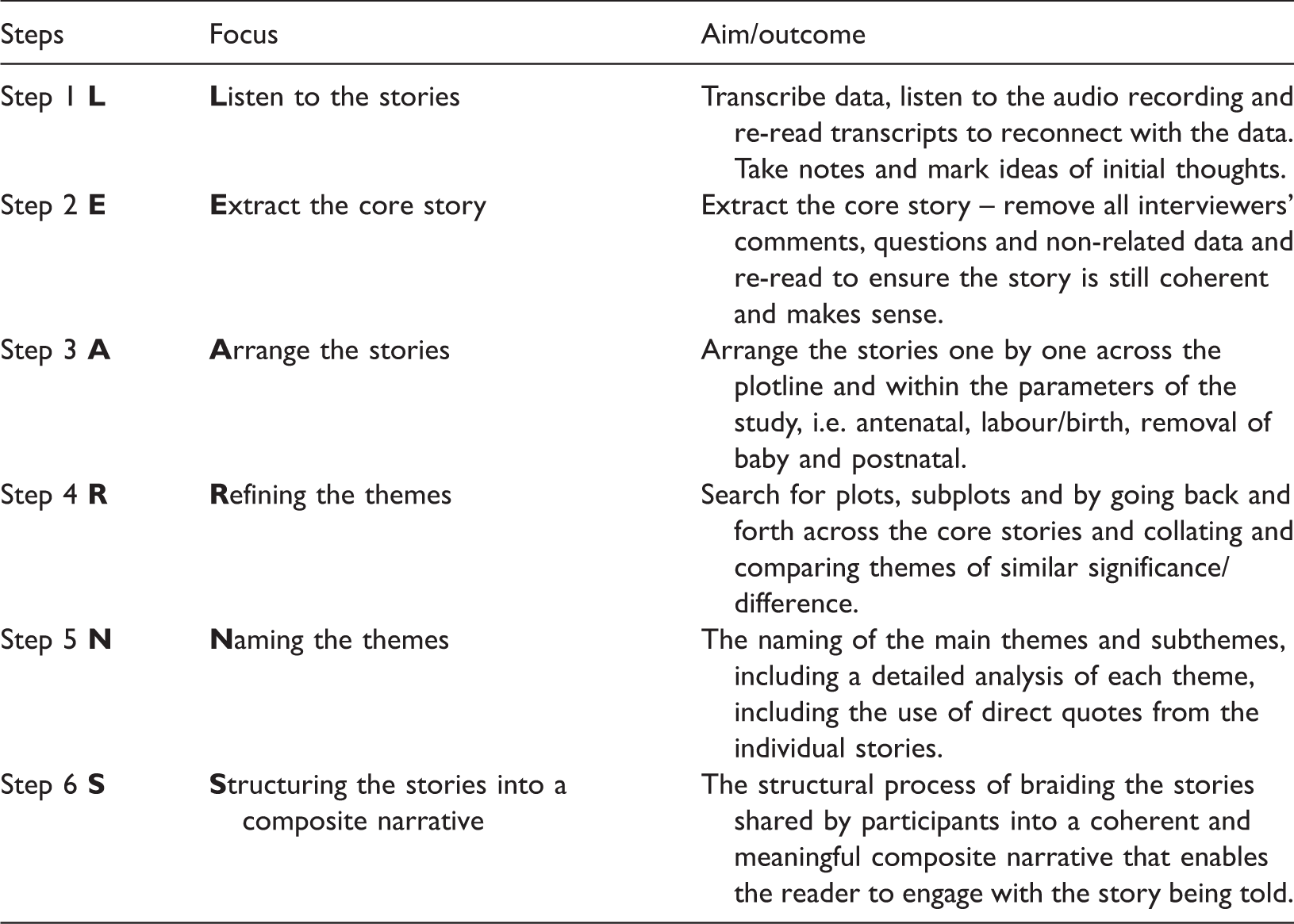
Steps taken to analyse data adapted from Polkinghorne (1995), Emden and Sandelowski (1998), Riessman (1998) and Beal (2013).
Learning to learn: Creation of the LEARNS approach to analysis in narrative inquiry
This step-by-step process was developed in order to find the best fit for the research study discussed in this paper, and was a strategy to make the analytical process transparent. The development of steps further enabled the consideration of different experiences and narrative formats, which could organise the data in such a way as to enable greater understanding and insight into the experience. As the steps emerged and were further developed, so their relationship and interrelationship with the study as a whole took shape. Informed by the work of Polkinghorne (1995), Emden and Sandelowski (1998), Riessman (1998) and Beal (2013) and via reflective discussion with the supervision team, the steps were listed in sequence and the acronym LEARNS was developed: L – Listen E – Extract A – Arrange R – Refine N – Name S – Structure
Step 1: Listening to the stories
The oral narratives from the focus groups and face-to-face interviews were transcribed verbatim into ‘textualised’ form, as only in ‘textualised form will the data yield results’ (Van Maanen, 1988: 95). A first read of the transcripts was undertaken alongside listening to the corresponding audio recording in order to reconnect with the story teller. This was enhanced by then re-reading the transcripts several times in order to immerse and engage with the data and make notes of initial thoughts, ideas and comments as I read the text.
Step 2: Extract the core story
Step 2 involved the removal of all interviewers’ questions, comments and elements that detracted the story from the storyteller and re-reading to make sure it was still understandable. This process was repeated several times to ensure that the text made sense and that the coherence of the story was not lost. This step of the analysis framework was informed by a process described by Emden and Sandelowski (1998) as core story creation. To achieve this, full-length stories were reduced to shorter ones, to see the plots and subplots across individuals’ stories within the whole collection when placed alongside others. Different colour paper was used for each participant in a simple but effective organisation approach.
Step 3: Arranging the stories across the plotline
The use of coloured paper enabled the researcher to retain the individual identities of the storytellers. One aim of holistic-content analysis is to search for plots and subplots across examples of stories. Polkinghorne (1995) describes this as emplotment. Emplotment involves working backwards, forwards and across the plots and subplots of individuals’ stories in a manner that highlights the significant elements (Emden and Sandelowski, 1998; Polkinghorne, 1995). In essence, emplotment ascribes sense to a story (Emden and Sandelowski, 1998) in such a way that the significance of the story is disclosed. This process can also be used in research to give accounts of why an event may have happened.
The purpose of the research was to use the data to describe the meaning and significance these stories hold for the individuals who shared them. This was done by first of all constructing a plotline on a large piece of paper, starting with the antenatal period and ending in the postnatal period. Polkinghorne (1995) suggests that all stories should have a bounded temporal period with a clear beginning, middle and end. The boundaries of the plotline for the stories in this study were set to ensure that actions and events spanned the four dimensions of the set story parameters. This included the period of time when a mother may have been in contact with a midwife, namely during the antenatal period, intrapartum period, removal of the baby, and the postnatal period.
These four dimensions aligned with the interview and focus group structures that had posed questions to elicit data around these time markers in order to find out what mothers’ experiences were of the maternity care given to them, not only at the time of the baby’s removal, but across the whole childbirth continuum. A few participants kept within these time parameters and shared their story in a chronological order, but the majority moved back and forward from retrospective historical parts of their lives, as early as their own childhoods, to the present of what life was like for them now.
While some areas covered within individual stories were not pertinent to the storyline parameters of this research, they offered historical context to the participants’ stories, which Polkinghorne (1995) suggests is essential in the emplotment process. Polkinghorne (1995) does not describe a clear procedure as to how to undertake the emplotment process and asks that researchers find their own course of action during this phase. Therefore, after careful consideration as to the best approach for this research, core stories were cut up and placed in temporal order one by one onto the lengths of paper in relation to one of the four dimensions.
Step 4: Refining the themes
Once all of the core stories had been placed on the sheets, events and happenings that were significant to the storytellers began to emerge (Polkinghorne, 1995). These were further defined by working systematically across the dataset comparing and contrasting both mothers’ and midwives’ stories. Equal attention was paid to each story within each of the four dimensions, using highlighters, post-it notes and colour coding to identify and categorise the emergent themes of significance. Further defining and refining of these themes continued until it was agreed by the supervision team that they demonstrated an accurate representation of the dataset.
Step 5: Naming the themes
Overarching theme, the mothers’ story: what midwives can learn from ‘women like me’.
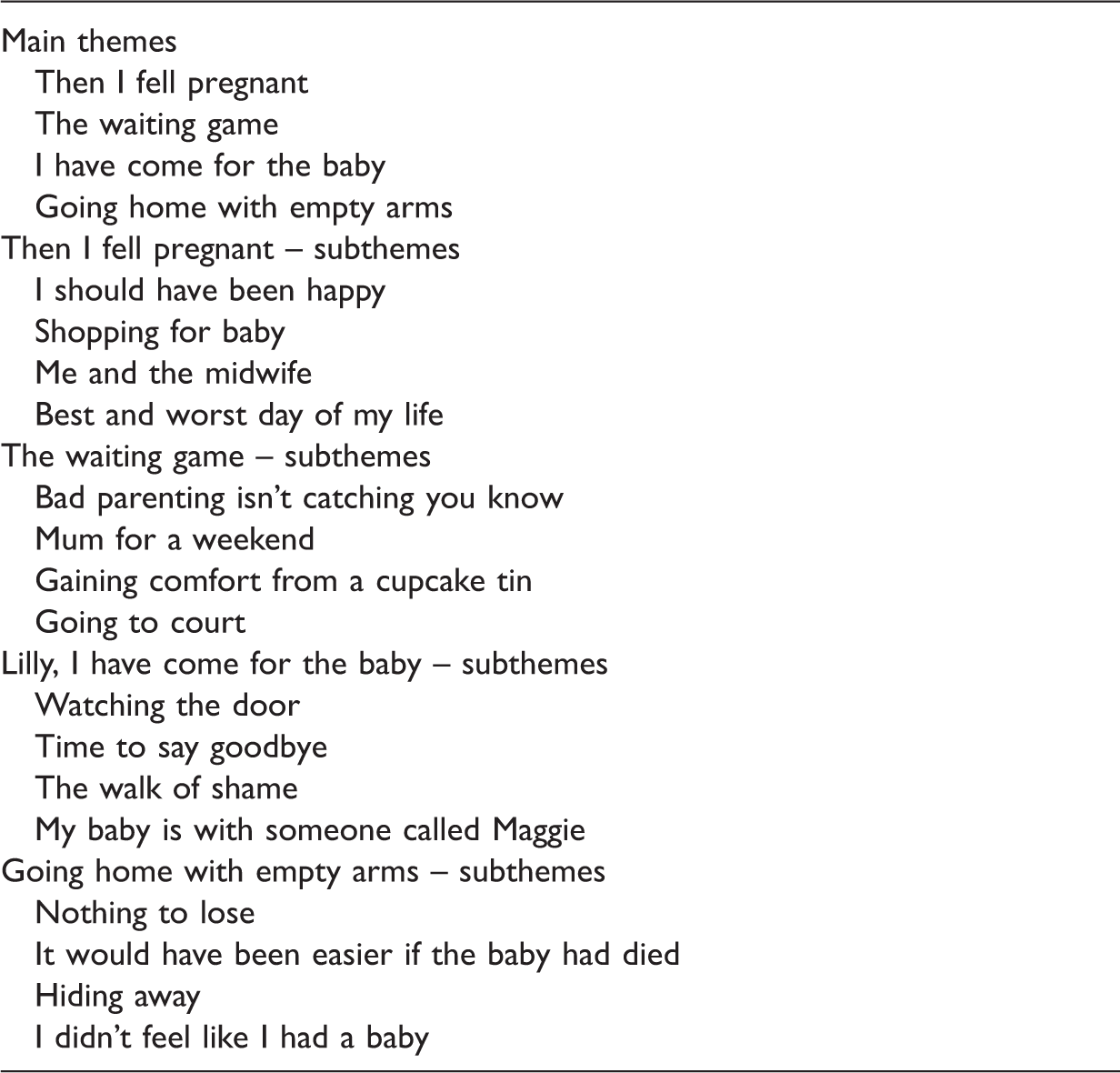
Overarching theme, the midwives’ story: it’s more than taking babies.

Step 6: Structuring the composite narrative
Step 6 of the process involved the braiding and retelling of all the stories shared by the mothers and midwives into two coherent and meaningful composite narratives that would engage the reader. The contextual stories reflect the mothers’ or midwives’ perspectives and experiences of babies being removed at birth. In order to be congruent to the analytical approach chosen, the data elements were linked together theme by theme to create a composite narrative.
As an example, the first theme presented in the mother’s story was entitled ‘Then I fell pregnant’ and signals the beginning of the mother’s story across the childbirth continuum. All mothers talked about the point when they became pregnant; the composite narrative captures all of their viewpoints, braids them together and shares how the mothers expressed similar feelings, namely shock, surprise, denial, alongside knowing that social workers would be involved. The paragraph of the composite narrative explaining this contains all of the mothers’ words/voices taken from the transcribed interviews to describe this moment. To illustrate the following process, the mothers are anonymised, highlighted in bold in the following extract to show their presence in the composite narrative. Key to the mothers’ voices: Lilly, Eve, Amber and Rose. I went to the doctors thinking there was something seriously wrong (
This braiding process continued through the themes, across the plotline of the entire childbirth continuum, and when linked together describes the mothers’ and midwives’ stories of babies removed at birth.
Conclusion
The data collected in this study have contributed to new knowledge in this area and provide valuable insight into a topic that has previously received minimal attention from a research perspective. In addition to this, the analysis framework LEARNS, developed as part of the analysis process, offers a reliable, transparent and credible way of analysing data generated from the combination of narrative inquiry and photo-elicitation techniques. This innovative framework could offer other researchers a reliable framework to use for future studies in social science research, and guide and empower novice researchers to seek to develop their own analytical frameworks to ‘best fit approach’ to their own studies.
Key points for policy, practice and/or research
The LEARNS step-by-step framework presented in this paper was developed in order to best fit the data collected in this research. The framework also offered the best possible opportunity to develop greater insight and understanding into the experiences of mothers whose babies are removed at birth. While it was developed initially as a framework to analyse the combination of both oral and creative data, it could be used for oral data alone and across a wide range of health and social care research. The composite narratives created as a result of this framework have also been used to create digital stories for the education of pre-registration midwives and allied health professionals. It also has the potential to be used for the education of health service staff involved in the removal of babies at birth.
Footnotes
Authors contribution
The authors were part of the supervisory team and contributed ideas to the development of the LEARNS framework and the construction of the paper.
Declaration of conflicting interests
The author(s) declared no potential conflicts of interest with respect to the research, authorship and/or publication of this article.
Ethical approval
A favourable ethical opinion was given by University of Surrey ethics committee and approved by the IRAS process in 2013.
Funding
The author(s) disclosed receipt of the following financial support for the research, authorship and/or publication of this article: Funding was obtained for the original research from the Centre for Research in Nursing and Midwifery Education.