



Abstract
Background
The journal club has been proposed as a tool to fill the gap between theory and practice.
Aim
The present research is an integrative review of studies focussing on journal clubs.
Methods
An integrative review. We searched the databases during 2010–2019 to find papers using the keywords journal club, nursing, evidence-based practice. The modified version of Cooper’s five-stage integrative review was applied.
Results
The results are presented in two sections – the benefits and challenges of nursing journal clubs and an outline of presentation guidelines. We also discuss the effectiveness of journal clubs in the promotion of evidence-based nursing.
Conclusions
The purpose of the nursing journal club is to review existing literature, discuss the latest information and evidence and identify practical changes required to ultimately improve patient outcomes. Further studies are needed to evaluate the effectiveness of journal clubs in patient care.
Introduction
Nursing research and evidence-based nursing practice have increased with the evolution of nursing as a profession (Campbell-Fleming et al., 2009). Preserving nursing competence requires taking care of patients based on the best existing evidence. Given the importance of evidence-based practice in contemporary nursing decisions, healthcare organisations must provide nurses with continual use of the best evidence (Häggman-Laitila et al., 2016). Generally, there is a huge gap between knowledge in clinical practice and what is applied in the real world. Therefore, the journal club has been proposed as a tool to fill the gap between theory and practice using the essential components involved in medical processes and evidence-based practice in many literatures (Honey and Baker, 2011).
In medical sciences, the journal club is one of the key methods for evidence-based education (Wilson et al., 2015). Owing to its flexibility and matching with many educational goals, the journal club method can be applied to teach different content (e.g. methodology and teaching methods). This approach improves critical thinking in learners and promotes evidence-based nursing (Szucs et al., 2017).
The journal club method was primarily exploited by physicians in academic environments as an educational tool. The first journal club was held by Sir William Osler, in medicine, in 1875, whereas the concept of the journal club in nursing was first proposed in the late 20th century (Dall’Oglio et al., 2018).
A journal club is a group of individuals gathered together to assess in a critical way the clinical applications of papers published in professional journals. Participants usually express their views in a critical assessment framework regarding the methods used, the suitability of research plans, statistics applied, weaknesses and strengths of results, and clinical relevance that may lead to new research or clinical applications. In fact, participants in the journal club study papers and discuss their content and use with instructors (Samy et al., 2019).
The journal club method provides an official structure for nurses’ important conversations about patient care, which is supported by guided discussions and literatures. The journal club offers an open session to discuss nursing issues in a friendly environment. In the session, nurses will also have a new opportunity to talk to experienced nurses about patient care issues. In addition, proper information is provided to nurses who seek new evidence in their work field. Historically, nurses have used the journal club to learn about research and promote evidence-based practice in the clinical environment (Johnson, 2016). Three key goals of the journal club in the field of nursing include updating the knowledge of the area by providing new literatures, affecting clinical practice and learning critical reading skills and critical thinking (Gardner et al., 2016).
While the journal club is recognised as an educational instrument in the curricula of various nursing courses, its use is not common and clinical nurses have no information about the approach. Therefore, the present study was performed to introduce this educational strategy, its method of use and its advantages in the promotion of evidence-based nursing and motivate nurses to use the approach. The purpose of the present study was to conduct an integrated review and combine the existing studies on promoting evidence-based nursing through the journal club. Two questions are raised in this research: how is the journal club run in nursing and what are its benefits and challenges? At the end, a discussion is provided on the effectiveness of the journal club in promoting evidence-based nursing.
Materials and methods
The present study was performed as an integrative review of the promotion of evidence-based nursing through the journal club after receiving a licence from the ethical committee of Tabriz University of Medical Sciences with the code of IR.TBZMED.REC.1397.643. Cooper’s five-stage integrative review method was used, as modified by Whittemore and Knafl (2005) to review and combine the existing knowledge in the field of the journal club in nursing. These stages are: problem identification, literature search, data evaluation (evaluation of data quality), data analysis (summarising the data), and presentation (Cooper, 1986; Whittemore and Knafl, 2005). This method was accompanied by the Preferred Reporting Items for Systematic Reviews and Meta-Analyses guidelines for reporting systematic searches. The first stage is problem identification (Whittemore and Knafl, 2005). In this stage, there is a need to review the literature related to the nursing journal club based on the initial search of literatures and comments of researchers to better comprehend the implementation of the journal club, as well as its advantages, challenges and effectiveness in the promotion of evidence-based nursing. Therefore, the current study was conducted as an integrative review to achieve these goals. The second stage involved data collection by searching the related literatures (Whittemore and Knafl, 2005). In this regard, we searched the data uploaded on databases of PubMed, Cochrane and CINAHL during 2010–2019 using the keywords journal club, nursing, evidence-based practice.
To achieve the goal of the study, the inclusion criteria which were determined to ensure the relevance of the data were: peer-reviewed papers, studies written in the English language, studies focused on the journal club in nursing, studies published during 2010–2019. Papers on journal clubs in other professions, editorials, non-peer-reviewed papers, dissertations, book chapters, conference reports and other grey literature were excluded.
At least two researchers evaluated the papers to decide whether the paper met the inclusion and exclusion criteria.
Search results
While 115 papers were found in the primary review, the complete texts of 13 papers were used after precise evaluation of papers and considering the research goals and after the elimination of repetitive cases (Figure 1). Preferred Reporting Items for Systematic Reviews and Meta-Analyses flow diagram (Moher et al., 2009).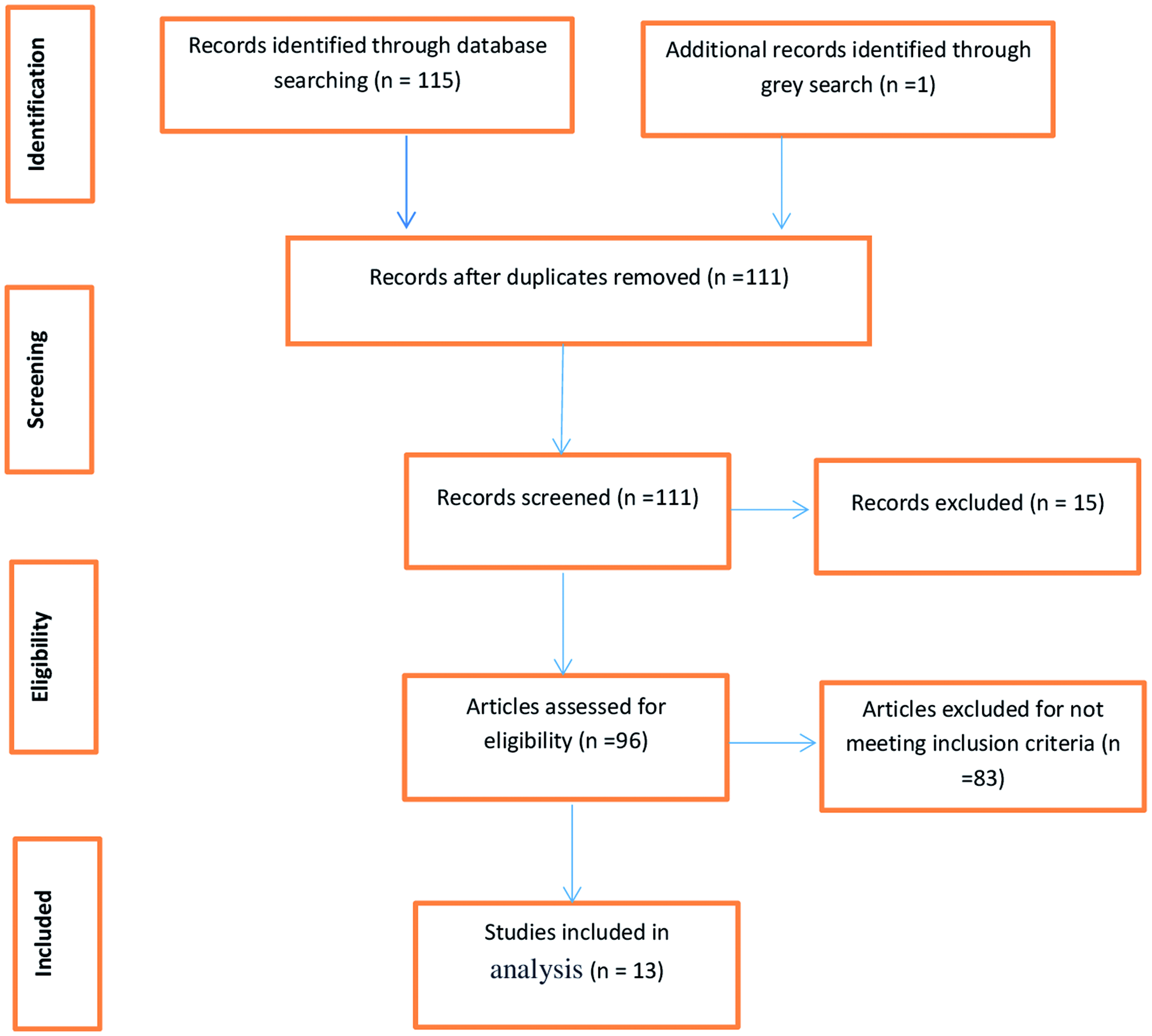
Critical evaluation of studies
Description and evaluation of 13 eligible studies.

The fourth stage was data analysis (summarising the data) (Whittemore and Knafl, 2005). In the first stage, all papers were studied to achieve a general view of the content. After the extraction of the data, all papers are summarised in Table 1 based on the first author, year of publication, purpose of the study, quality appraisal criteria, and conclusions and key findings. The next stage involved the analysis of content related to the nursing journal club.
The fifth stage was the integration of the data and presentation of the results (Whittemore and Knafl, 2005) obtained from all elements of the nursing journal club. At this stage, researchers assessed the paper multiple times and classified the contents independently. Afterwards, subsequent drafts were developed during joint discussions and, finally, a thorough analysis was carried out in collaboration with the four researchers.
Results
The 13 papers reviewed in this study were published during 2010–2018, and all of them were exclusively performed in the field of the nursing journal club.
Benefits and challenges of the nursing journal club
The benefits and challenges of running a nursing journal club, which have been highlighted by the evaluated studies, are summarised, as follows:
Benefits: Keeping nurses up to date with clinical research and knowledge (Dall’Oglio et al., 2018); Promoting professional studies (Lachance, 2014); Developing skills in the study and critical evaluation of studies (Lachance, 2014); Improving presentation, writing and communication skills (Lachance, 2014); Reducing the knowledge–practice gap (McKeever et al., 2016); Applying evidence in professional practice and patient care (Campbell-Fleming et al., 2009); Promoting interaction and dialogue between nurses (McKeever et al., 2016); Creating a structured social place to learn from one another and discuss evidence (McKeever et al., 2016); Promoting team building and interdisciplinary collaboration (interdisciplinary journal clubs) (Whiting, 2015); Changes in the organisation of patient care (Szucs et al., 2017).
Challenges: Issues related to employees, time and jobs (Sortedahl et al., 2018); Lack of expertise in medical statistics research and interpretation (Whiting, 2015); Lack of interest, lack of motivation, lack of perceived benefits (Wilson et al., 2015); Selecting papers that fatigue the employees (Wilson et al., 2015); Lack of familiarity (this method is not used in many nursing programmes and should be included in nursing curricula) (Nesbitt and Barton, 2014); Nurses may feel vulnerable if they share their views (Nesbitt and Barton, 2014); Lack of cooperation of organisations in the organisation of journal clubs and making changes in work processes (LaMar, 2017); Lack of proper skills or low self-confidence in presenters or participants (Johnson, 2016).
How to organise a journal club for nurses
There are two models of journal clubs: Review papers with an emphasis on content (content journal club); Review papers with an emphasis on critical evaluation skills (evidence-based journal club) Gardner et al., 2016).
Suggestions on how to organise a journal club are varied, some of which include: A paper;
Deciding on the paper: Several papers on one topic; A journal that involves several papers on different topics.
The ideal suggestion is a paper (Deenadayalan et al., 2008).
Who will attend the journal club?
The journal club can have different goals depending on the participating members. Some of the proposed participants include: Students (BSc, MSc, PhD); Nurses (who may be divided according to specialty, level of education, degree and work environment); Interdisciplinary and multidisciplinary teams (Nesbitt and Barton, 2014).
Tips to keep in mind while holding journal club meetings
It is best to have chairs in the journal club meetings in a U-shape or a circle (Raza, 2015). It is advisable for journal club sessions to be held in a clinical setting with regular timetables (Raza, 2015). The meetings are better held for between 1 and 2 hours (Szucs et al., 2017). The best time for group members to attend meetings should be fixed. A fixed time should be determined, and meetings must always be held on that day and time (Szucs et al., 2017). Once a month for 1 hour is the most ideal form (Szucs et al., 2017). It is emphasised that a week before the meeting, a reminder of the date, time and venue of the meeting and the subject to be discussed should be provided by the journal club. This can also be repeated the day before the journal club meeting, which allows regular attendees to attend meetings (Szucs et al., 2017). It is advisable to distribute a copy of the journal club papers at least one week before the meeting for the study of participants (Szucs et al., 2017). The evidence-based papers of the journal club must be distributed among the participants two weeks before the meeting to be studied and critically evaluated (Gardner et al., 2016). It is advisable for the organiser to review at least five papers and a maximum of 10 papers in each content journal club session (Gardner et al., 2016). It is advisable to have at least one and a maximum of two papers at each meeting of evidence-based journal club (Gardner et al., 2016). One person has to take over the leadership of the journal club. This person must be committed and interested and have enough time to run a journal club effectively (Deenadayalan et al., 2008).
The leader is responsible for planning each meeting and defining other members and their own roles in the group (Deenadayalan et al., 2008). Who will present the paper(s) at the meeting? Available options are:
The leader presents the paper and coordinates the discussions; The leader uses other members to present but coordinates the discussions themselves. The leader may help the presenter; The leader uses other members of the group to present and coordinate the discussions (Deenadayalan et al., 2008).
The session structure
The session begins with a brief presentation of the paper using PowerPoint and then continues with the discussion (Szucs et al., 2017). In the discussion, you will need to evaluate the study/studies depending on the needs of the journal club. Without prior knowledge of research methods, evaluation of studies would not be possible. Even with knowledge, it is recommended that a list of questions be considered beforehand to evaluate studies (Deenadayalan et al., 2008). Discussions should always be reflective. Pierre proposes the use of two questions: ‘What is the relevance of this paper to our practice?’ and ‘Should we change practice and policies based in this evidence?’ (Pierre, 2005). According to Denehy, questions of ‘So what?’ and ‘So what does this mean for me and my practice?’ are proper tools to summarise a discussion in the journal club (Denehy, 2004).
Guidelines for nursing journal club presentations (based on Pierre, 2005).

Discussion
According to the results of the present study, nursing journal clubs are proposed as an excellent strategy to promote evidence-based practice. In fact, sharing scientific evidence can improve quality of care. A nursing journal club may be a cost-effective strategy to keep nurses’ knowledge up to date with clinical evidence and a useful way to promote the application of evidence-based research and practice. In addition, owing to its flexible framework, the journal club can be used as a powerful educational tool to train students, nurses and other members of the health team, in both academic and continuing education.
In 2016, a systematic review was performed by Häggman-Laitila et al. to collect, evaluate and combine evidence existing in the field of the journal club and its effect on the promotion of evidence-based nursing. According to the results, there is insufficient evidence of the impact of journal clubs on evidence-based nursing, and further studies are required to evaluate the effectiveness of journal clubs in patient care. In evaluating journal club outcomes, all evidence-based learning categories should be considered with a focus on medium- and long-term effectiveness (Häggman-Laitila et al., 2016).
In 2016, Hill and Dillon conducted a study to assess the effect of the journal club on evidence-based nursing, reporting that journal clubs are helpful in promoting evidence-based nursing and provide areas for nurses to grow and areas for the advancement of the nursing profession. However, since this study was self-reported by nurses, it is difficult to say that journal clubs actually have a real impact on promoting evidence-based nursing. Nonetheless, the effectiveness of this evidence-based teaching approach can be assessed through pre-test/post-test studies, which is suggested for future studies (Hill and Dillon, 2016).
Over the years, the format of journal clubs has become multidisciplinary, and participants include various levels of nursing students, clinical education graduates, and physicians and nurses from a variety of clinical settings (Häggman-Laitila et al., 2016).
In a research by Dall’Oglio (2018), the results showed that multidisciplinary journal clubs were useful for clinical practice, improvement of quality of care and advancement of professional development. Journal clubs can be a quality improvement strategy to promote research among health professionals and thereby improve the quality of care (Dall’Oglio et al., 2018).
Nowadays, the advances in technology and increasing use of the Internet have led to the emergence of virtual journal clubs to include more staff and eliminate face-to-face journal club restrictions. Some of these journal clubs are managed by Twitter social media, and the online journal clubs on Twitter are a new and popular innovation and have been widely welcomed (Berger et al., 2011; Ferguson et al. 2017; LaMar, 2017).
Limitations
The limitations of this study included inaccessibility to the full text of several papers and not reviewing papers in languages other than English.
Conclusions
Nursing journal clubs are useful for clinical practice, improvement of the quality of care and professional development. However, further studies are needed to evaluate the effectiveness of journal clubs in patient care.
Key points for policy, practice and/or research
Nursing journal clubs are proposed as useful strategy to promote evidence-based practice. Sharing scientific evidence can improve quality of care. The nursing journal club is a helpful strategy to keep nurses’ knowledge up to date. The journal club can be used as a powerful educational tool to train students, nurses and other members of the health team. Nursing journal clubs are useful for professional development.
Footnotes
Acknowledgement
The authors would like to express their gratitude to the faculty members of the School of Nursing and Midwifery of Tabriz University of Medical Sciences for their invaluable cooperation in accomplishing this study.
Declaration of conflicting interests
The author(s) declared no potential conflicts of interest with respect to the research, authorship, and/or publication of this article.
Ethical approval
Ethical committee: Tabriz University of Medical Sciences. Ethical code: IR.TBZMED.REC.1397.643
Funding
The author(s) disclosed receipt of the following financial support for the research, authorship, and/or publication of this article: This work was supported by Tabriz University of Medical Sciences.