




Abstract
Background
Clinical Research Nurses (CRNs) care for study participants and manage clinical research studies; yet the CRN practice role is rarely covered in undergraduate nursing curricula in the United States. Despite a burgeoning need for CRNs, the pipeline of clinical research nurse positions remains sparse. The International Association of Clinical Research Nurses’s (IACRN) strategic goal to “engage with nursing schools to heighten awareness and inclusion of the CRN role competencies in nursing education” prompted the development of an educational lecture module to be disseminated to nursing schools. This project is a pilot launch of the module.
Methods
A task force of IACRN was formed to develop educational materials that could be used as outreach to undergraduate nursing schools. The content included a slide presentation covering an overview of clinical research, the CRN practice, three embedded videos showing CRN and study participant perspectives, and coverage of the care of participants of research by staff nurses. Due to COVID-19 we revised our live lecture approach using either a live synchronous webinar presentation, or an embedded asynchronous course module with YouTube videos for course learning management systems. We presented the content to 408 nursing students attending three academic programs. To evaluate effectiveness and satisfaction, an anonymous, post-presentation survey using web-based QualtricsXM was distributed to students.
Results
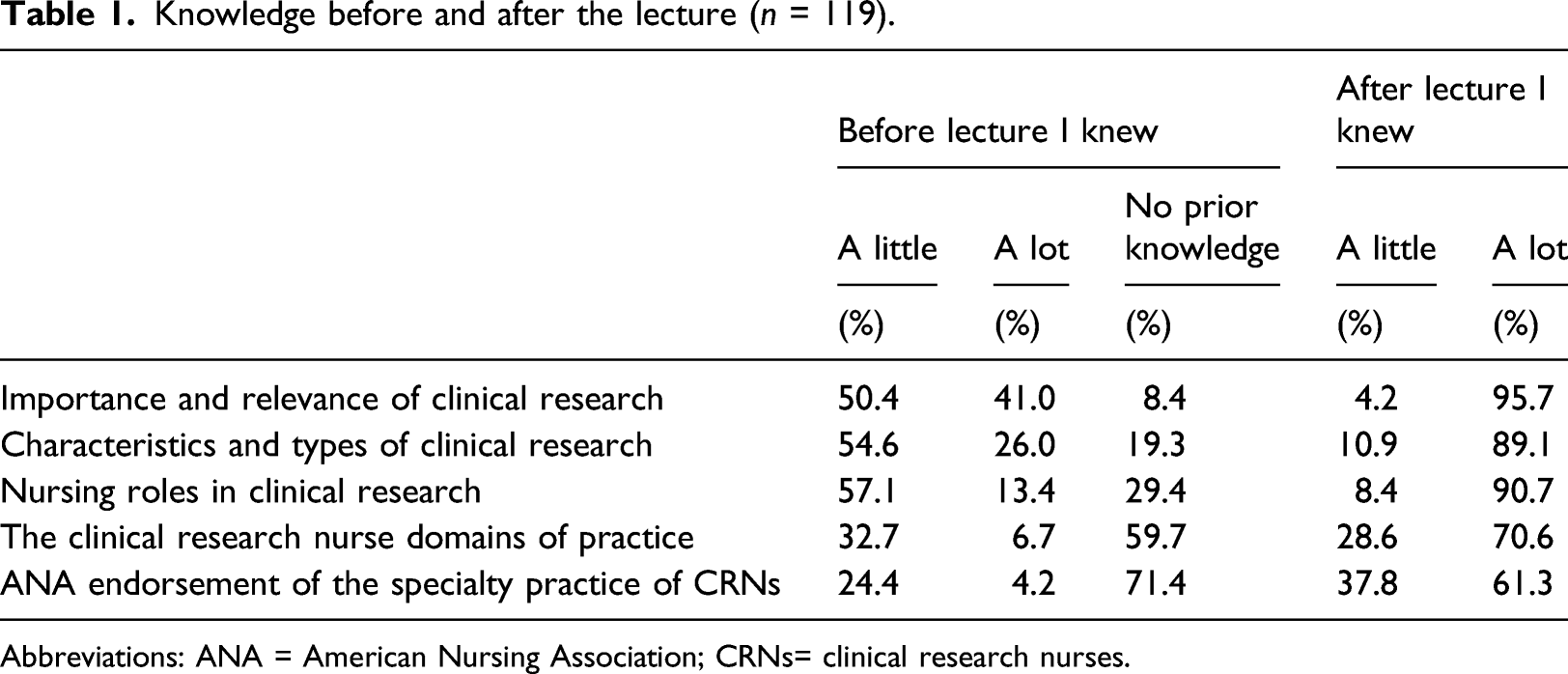
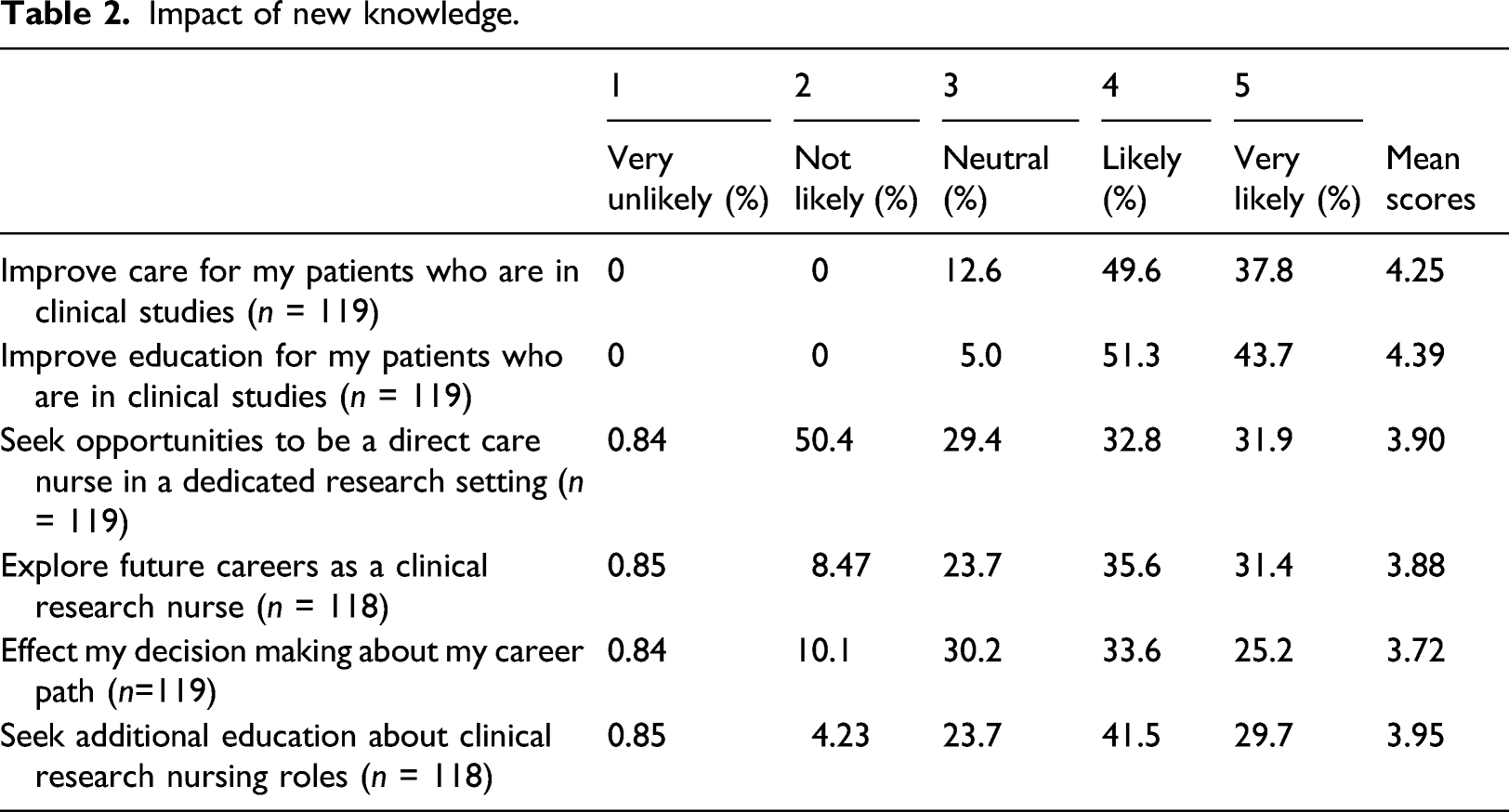
Content and delivery of the module was positively evaluated. There was an improvement in knowledge in each topic. Evaluation responses showed that the content could likely or very likely improve care for their patients (87.4%) and improve patient education for patients in clinical trials (95%).
Conclusions
Delivering a synchronous or asynchronous module about the CRN practice role to nursing students in academic nursing programs is valuable to increasing awareness of the care of patients in clinical trials, the CRN role, and future professional development.
Keywords
Introduction
Clinical research nursing (CRN) is a specialty practice of nursing that is gaining recognition for contributions to the clinical research enterprise (Hastings et al., 2012). There has been a growth in the number of nurses working as CRNs, especially at academic medical centers and in oncology clinical research (Spilsbury et al., 2008; Showalter et al., 2017). As a response to the growing need, the International Association of Clinical Research Nurses (IACRN) and the American Nurses Association (ANA) co-published the Scope and Standards of Practice for Clinical Research Nurses, leading to the ANA recognition of the CRN specialty practice (American Nurses Association & International Association of Clinical Research Nurses, 2016). The IACRN, was established in 2008, as an international professional association of clinical research nurses. IACRN defines clinical research nursing as “the specialized practice of professional nursing focused on maintaining equilibrium between care of the research participant and fidelity to the research protocol. This practice incorporates the five domains of (1) human subject protection; (2) care coordination and continuity; (3) contribution to clinical science; (4) clinical practice; and (5) study management, throughout a variety of professional roles, practice settings, and clinical specialties” (International Association of Clinical Research Nurses, 2012).
Established goals and initiatives of the IACRN include the development of a core curriculum textbook projected to be published in 2021, and the establishment of the CRN board certification (CRN-BC) pathway, launched in April 2021. Moreover, the IACRN recognizes that in order to expand the workforce and attract new nurses to this specialty, it would be advantageous to expose nursing students to the possibility of clinical research nursing as a field of future practice. Thus, IACRN’s strategic initiatives include a goal to “engage with nursing schools to heighten awareness and inclusion of the CRN role competencies in nursing education” (International Association of Clinical Research Nurses, 2016).
Nursing academic programs expose nursing students to various nursing specialties, which allow them to envision their chosen path following graduation. However, formal educational content about clinical research nursing is commonly not included in undergraduate nursing programs in the United States (Samborski et al., 2014). This is primarily due to the density of the baccalaureate nursing curricula (Galassi et al., 2014; Garner et al., 2016). Alsleben et al., (2018) pointed out that another contributing factor in deterring nursing students from becoming CRNs is the lack of awareness of the growing CRN specialty (Alsleben et al., 2018). Similarly, clinical research is often missed during staff development training for hospital nurses (Galassi et al., 2014). Therefore, engaging with nursing schools to heighten awareness and inclusion of the CRN role competencies in the undergraduate education is an essential step in advancing recognition of the role and stimulating future career pipelines.
Additionally, outside a dedicated hospital research unit, staff nurses in other units or clinics could be asked to serve as an invisible member of the research team. Their participation in clinical research may include the following: patient advocacy and support of the informed consent process, patient education, administration of study-related medications and treatments, monitoring study participants for potential side effects, collecting data, communication with the study teams, and documentation (Parrenco et al., 2012). Parrenco and colleagues (2012) reported that increasing staff nurse understanding of clinical research is vital to the research and confidence-building for the staff nurses. Moreover, the decentralization of clinical trials is quickly moving from a potential pipedream to a reality, especially given COVID-19 clinical trial modifications (Apostolaros et al., 2020; Nabhan et al., 2020). Ultimately more clinical trial activities will migrate outside the central clinical trial centers, into the community and in private medical offices (Apostolaros et al., 2020; Nabhan et al., 2020). This expands the need for nurses working in community medical office settings to have a greater understanding of clinical research.
The development, presentation, evaluation, and publication of an educational lecture that provides knowledge about the role of nurses in clinical research, including career pathways, will facilitate integration of this subject matter as an important component in undergraduate curricula and staff development. With the development of this lecture, IACRN can provide the link between clinical and research practice by sharing expertise with undergraduate and practicing nurses. Therefore, a task force was formed by members of the IACRN Education Committee and Research Committee to develop and pilot a brief lecture presentation to be delivered to students attending nursing schools in the United States to introduce the role of the clinical research nurse. The task force members developed the presentation and survey questions. The purpose of this paper is to describe and report on this pilot project to deliver and evaluate lecture content for future use.
Aims and objectives
The aim of this initiative was to develop, implement and evaluate an educational lecture designed to increase awareness of the role of clinical research nurses and the impact of clinical research on nursing practice for students of academic nursing programs.
The project objectives were to
1. Create and deliver two methods of content presentation (synchronous webinar lecture and an asynchronous embedded module). 2. Capture student perceptions of knowledge gained and general satisfaction evaluation of content and content delivery.
Methods
Setting
Members of the Education and Research Committees of IACRN were contacted by the IACRN board to develop and pilot an evidence-based lecture that could be used to introduce the role of clinical research nursing to academic nursing programs. The task force sub-committee created a pilot project plan that included the development of a slide set that included didactic and video content that presented the CRN domains of practice and featured the voice of clinical research nurses and clinical research study participants. An online evaluation survey was also developed to measure student participant perceptions of learning about the CRN role and their satisfaction with content delivery. The task force drafted the lecture materials and survey questions. The survey content was reviewed for face validity by members of the Education and Research Committees. Refinements were made to enhance the clarity of the materials prior to delivering the content to nursing students.
Content development
The content was initially developed to be offered as in-person presentations; however, due to the COVID-19 pandemic, the project was shifted to offer content in two formats (a) online, asynchronous module content and (b) live presentations using Zoom video conferencing (Zoom Video Communications, Inc. 2020).
The slide set consisted of 21 slides that addressed five learning objectives: 1. Define clinical research 2. Discuss nurses’ roles in clinical research 3. Describe the clinical research nurse (CRN) domain of practice 4. Define CRN role progression 5. Identify how clinical research studies affect staff nurse roles.
Embedded in the IACRN lecture slides were three brief the YouTube videos: 1. What is a clinical trial (1:48 min). National Cancer Institute, located at https://youtu.be/dsfPOpE-GEs 2. Clinical Research Nurses Making a Difference (4:05 min). IACRN Ohio Chapter, located at https://youtu.be/vIMIRU7IcwM 3. Why I participate in Alzheimer’s Research (2:14 min). National Institutes of Health, located at https://youtu.be/kWEzmhFJU1o
Three nursing programs were targeted, The Ohio State University (OSU), Columbus, OH, USA; Hunter College, New York, New York, USA; and New York University, New York, New York, USA. We planned our first session with OSU during summer 2020 Semester. Due to COVID-related instructional constraints, OSU instructors requested that we create a video of the content so that it could be embedded as an asynchronous module in existing course content in lieu of a live presentation. This was done to accommodate university schedule changes related to COVID. Therefore, the IACRN slide presentation was recorded to a private access YouTube account. The video was 24 minutes in length and included links to the embedded videos to showcase clinical research and the role of the CRN and study participants. During the fall 2020 semester, sessions were also offered as live Zoom webinars at New York University on 7 October 2020 and Hunter Bellevue School of Nursing on 11 November 2020, respectively. After general introductions, each session included a 35-minute live presentation and the three embedded YouTube videos.
Evaluation and analysis
We invited students to complete a post-session online anonymous survey using QualtricXM (Systems Applications and Products in Data Processing, Version, 2020). The links to the survey were disseminated by the academic course instructors. The QualtricsXM survey included questions to measure learning objectives by measuring pre- and post-session knowledge about clinical research, the role of clinical research nursing, perceived impact of the knowledge on nursing care and careers, and satisfaction with the presentation content and delivery. The first question in the survey included an informed consent; therefore, clicking forward to question two was enabled if consent was given. This was required because the evaluation survey included academic students.
Results
Content was delivered to 408 nursing students attending three academic nursing programs. At the OSU College of Nursing, students in two distance-learning courses (N = 130) were provided access to the IACRN Module via the Canvas Learning Management System (Instructure Inc, 2020) as an optional asynchronous module. The total number of students who viewed the module video and materials is unavailable; however, 77 (59%) responded to the post-module survey evaluation. Additionally, at New York University Rory Mayer’s College of Nursing, 256 students attended the live webinar presentation with 39 (15%) completing the survey. Finally, at Hunter Bellevue School of Nursing, 22 students attended the lecture with 10 (45%) students completing the post-presentation evaluation survey.
Of the 126 surveys completed, 64.7% were from student participants who were presented the content asynchronously through a course module. Student survey respondents were either in the traditional Bachelor of Science in Nursing (BSN) Program (17.6%); Registered Nurse (RN) to BSN Program (4.2%), Second-degree (Graduate Entry) BSN Program (67.2%), or Master of Science (MS) program (10.9%) track. The majority of students in the online module cohort were attending a Second-degree (Graduate Entry) program track (52.9%).
Knowledge before and after the lecture (n = 119).
Abbreviations: ANA = American Nursing Association; CRNs= clinical research nurses.
Impact of new knowledge.
Discussion
There are 376,381 clinical research studies registered in clinicaltrials.gov with nearly 141,800 (38%) being conducted in the United States (National Library of Medicine (US), 2021). The complexity and longevity of clinical research studies require a trained, dedicated staff of clinical research nurses and professionals to manage recruitment and study operations, track and protect human participants, adhere to ethical standards, collect and report data, and perform ethical quality control and improvement of studies (Getz and Campo, 2017). Most individuals who find a career in clinical research are poorly prepared for their roles, given the paucity of academic content about clinical research in undergraduate college and nursing programs and are trained “on the job” (Sonstein et al., 2014; Carter et al., 2007). Moreover, nursing students have difficulty distinguishing role differences between nurse researchers and clinical research nurses (Alsleben et al., 2018) or that a career trajectory for clinical research nurses exists (Kunhunny and Salmon, 2017). Nevertheless, the likelihood of nurses encountering and caring for patients who are involved in clinical trials is a reality that should not be under-emphasized (Eckardt et al., 2017). The American Association of Colleges of Nursing (AACN) newly released “Nursing Essentials” include an emphasis on evidence-based practice (AACN, 2021); however, content continues to lack information on clinical research nursing. We conducted a search of graduate nursing programs majoring in clinical research nursing in the United States and found very few existed. We found one clinical research nursing elective course at one institution (Garner et al., 2016). We also identified several post-graduate clinical research internships or residencies launched at academic medical centers. Such internships have risen to help address a paucity of eligible applicants for open CRN positions. An increase in other allied health professionals filling clinical research coordinator posts has emerged and such roles are possibly related to the general lack of education, knowledge or interest by nurses in the CRN role (Samborski et al., 2014). Moreover, these allied health professional staff lack clinical nursing skillsets.
Accordingly, the IACRN strategic initiative to “engage with nursing schools to heighten awareness and inclusion of the CRN role competencies in nursing education” is a positive step to mitigate shortages of CRNs and lack of awareness of the role (International Association of Clinical Research Nurses, 2016). In fulfilling this goal, we successfully piloted the IACRN educational slide lecture aimed at offering content on CRN roles and the impact of clinical research on nurses. Although the post-evaluation survey’s overall response rate may seem low in the live webinar group the results are comparable with other online course evaluations (Guder and Malliaris, 2013). Guder and Malliaris (2013) reported that faculty reminders and providing in-class time to complete course evaluations positively affect the course evaluations completion rate. Consequently, the overall response rate seen in this study is expected. Given that the IACRN speakers were visitors, and not the course faculty, and the limits of FERPA (Family Educational Rights and Privacy Act), we had no control over reminders to students to complete the post-evaluation survey. Moreover, when live presentations were conducted, no additional time was allocated for the students to complete the survey, but rather, students were asked to evaluate the presentation via an internet link that was provided in the chat box during the Zoom session, and through email reminders by instructors. Those in the asynchronous online courses had automated reminders to complete the voluntary survey but it was not a required assignment. Thus, we believe these factors may have negatively impacted the survey completion rate.
One caveat of this project is that the IACRN presentation was introduced to nursing students during the COVID-19 pandemic when the media coverage of clinical trials for vaccine development was front and center. It is possible that the students surveyed were more likely to see the importance of clinical trials than they would have been pre-pandemic. Likewise, the increased burden of COVID-19 social distancing and life events on students and faculty may have prohibited the bandwidth for student responses to a voluntary survey. Future analyses should include offering and evaluating asynchronous or synchronous modules in cohorts of nursing students from outside of the United States.
Conclusion
This initiative demonstrates that a short educational module can effectively be shared with nursing schools to incorporate nurses’ roles in clinical research, including the CRN specialty practice into program curriculums using either synchronous or asynchronous presentation methods to increase awareness of the clinical research nurse role. Future goals include refining and updating the module to reflect new information about the CRN specialty and clinical research, and broader dissemination into nursing programs. Continued pursuit of avenues to create awareness of the clinical research nurse role will remain a focus for IACRN.
Clinical research nursing is a specialty that is growing in demand as the clinical research enterprise expands in size and complexity. Front-line nurses working in clinics and hospital settings may care for patients who are participants in clinical research; therefore, a basic knowledge of clinical research and clinical research nursing roles is valuable to continuity of care. Educational modules delivered asynchronously via learning management systems or synchronously via live webinars are effective methods in academic and training sessions. There is an increasing need to ensure an ongoing pipeline of clinical research nurses to meet the growing field.
Footnotes
Acknowledgements
The authors would like to acknowledge the nursing faculty members at The Ohio State University College of Nursing (Dr Amy Jauch and Dr Melissa Baker), New York University College of Nursing (Dr Michele Crespo-Fierro), and Hunter Bellevue School of Nursing (Dr Abigail Kotowski) for inviting us to present this pilot module to their classes in support of this initiative. Also the members of the IACRN Research Committee and the IACRN Pilot Module Task Force for their input and support.
Declaration of conflicting interests
The author(s) declared no potential conflicts of interest with respect to the research, authorship, and/or publication of this article.
Funding
The author(s) disclosed receipt of the following financial support for the research, authorship, and/or publication of this article: This work was supported, in part, by the Ohio State University, Center for Clinical Translational Science, grant # UL1TR002733 and by the Rockefeller University Center for Clinical Translational Science grant # UL1TR001866 from the National Center for Advancing Translational Sciences (NCATS), National Institutes of Health (NIH) Clinical and Translational Science Award (CTSA) program.
Ethics
This project was reviewed by our universities IRB and designated as exempt.
