



Abstract
Background
The Refugee Health Program (RHP) is a nurse-led community initiative, introduced in 2005 with the aim of responding to complex health issues of refugees arriving in Victoria, Australia. Little is known about refugee health nursing in the resettlement context and the impact of dedicated refugee healthcare.
Aim
To explore the experiences and perspectives of Refugee Health Nurses (RHNs), Refugee Health Managers (managers) and refugees, gaining insight into professional relationships and the complexities of offering a specialised refugee health service.
Method
A focused ethnographic approach incorporated semi-structured interviews with five RHNs, two managers and eight refugees, two focus groups with refugees and participant observation within the RHP during April 2017 to December 2017. Data collection was undertaken across two sites and interviews, focus groups and observations were transcribed and thematically analysed. Social constructionism asserts that the focus of enquiry should be on interaction, group processes and social practices. Emphasis is placed upon relationships between RHNs, managers and refugees, with knowledge viewed as relational and interactional.
Results
Professional relationships between RHNs and refugees are complex, with power oscillating between them. Contrary to discourses of ‘vulnerability’ of refugees, both RHNs and refugees demonstrated power in their relationships with each other. Nurses also suggested that these relationships were stressful and could lead to burnout. Key themes were developed: (1) nursing autonomy and gatekeeping; (2) vicarious trauma and burnout; and (3) refugee negotiation of care.
Conclusions
The balance of power is central to therapeutic relationships. In relationships between RHNs and refugees, power fluctuates as RHNs are exposed to vicarious trauma and symptoms of burnout, while refugees exercise agency by recognising benefits to specialised care. In developing effective therapeutic relationships between RHNs and refugees, attention should be paid to how care is delivered to protect RHNs from burnout while ensuring that refugees receive appropriate care.
Introduction
Responding to the poor health and complex issues of refugees arriving in Victoria, Australia, the nurse-led Refugee Health Program (RHP) was introduced in 2005 and now operates in 17 community health centres across both metropolitan and rural/regional settings, in areas with high numbers of newly arrived refugees. The RHP is funded through the Department of Health and Human Services and aims to support refugees during the first year of resettlement (Victoria State Government, 2019).
Refugee Health Nurses (RHNs) are specialist nurses in the community, offering holistic care for refugees through a social model of health. Refugees are referred to the RHP by AMES Australia Humanitarian Settlement Program Service Delivery Network and RHNs provide targeted disease prevention and management, health promotion and education, as well as referral networks with other healthcare providers and connection with social support.
Many refugees develop physical or mental health problems during the early resettlement period (Marshall et al., 2016). According to Chiarenza et al. (2019), a high burden of chronic disease exists within refugee resettlement areas, with high rates of new diagnoses of hypertension, diabetes, chronic respiratory disease and cardiovascular disease commonly reported within the first year, often attributed to the stress of seeking asylum and acculturation. A nurse-led refugee health service has been suggested as a viable approach in offering dedicated healthcare for refugees on resettlement, improving health experiences and outcomes for this population (Ogunsiji et al., 2018).
Mutitu et al. (2019) acknowledge the importance of specialist nurse-led clinics in providing quality, patient-centred and cost-effective care for refugees in the community, but as an underutilised field, little is known about targeted refugee healthcare.
The aim of this study was to explore the experiences and perspectives of RHNs, Refugee Health Managers (managers) and refugees, gaining insight into relationships within the RHP in Victoria, Australia, to better understand the implications of a nurse-led refugee health service.
Methodology
Relativist ontology puts forward that nothing can ever be known for definite; there are multiple interpretations of reality, none having precedence over the other. This study adopted a social constructionist epistemology, proposing that knowledge is socially generated through interaction, group processes and social practices (Burr, 2015). Using a social constructionist stance, this study explored interactions between RHNs, managers and refugees, delving into social and professional relationships within refugee health nursing. Through social relationships, people can make sense of their world, and interpretation can change through time depending on engagement in new interactions or experiences (Weinberg, 2015).
Social constructionism is accused of being anti-realist, in denying that knowledge is a direct perception of reality (Lazzaro-Salazar, 2017). Dag Boe (2021, p. 222) argues that ‘ethical realism… pre-exists our interpretations and evaluations of what we confront, and thus, in a sense, precedes social, cultural, and historical constructs of meaning’. This suggests that the RHN obligation to support refugees comes directly from the trauma they see, unmediated by interactions and interpretations.
Nevertheless, it made sense to use social constructionist epistemology as it takes a critical stance towards taken-for granted knowledge. Young and Colin (2004, p. 381) refer to social constructionism as a ‘challenging springboard’, highlighting that it yields alternative discourses on experiences in healthcare. It is assumed in the literature that refugees are a vulnerable group (Nies et al., 2016); however, the social constructionist view maintains a suspicion of suppositions in relation to how the world appears to be (Burr, 2015).
Social constructionism is in line with focused ethnography as a methodology, as this approach concentrates on behaviours and shared experiences within a specific phenomenon (Higginbottom et al., 2013). Focused ethnography deals with distinct problems in specific cultural contexts, and it was deemed useful in evaluating and eliciting information on shared experiences of refugee healthcare in the resettlement context, acknowledging different groups with in-depth knowledge. This approach was used given the researcher’s (EH) own background knowledge of refugee healthcare, the short-term nature of field visits and participant observation, and the specific nature of the research questions (Higginbottom et al., 2013).
Focused ethnography is valuable in studies of how people understand health, with whom they share health concerns and what they do about health problems in their cultural context (Egger et al., 2020). However, due to the quick and convenient design, this methodology often does not integrate long and complicated fieldwork, which Rashid et al. (2015, p. 11) contest is a reminder of ‘armchair anthropologists’, who work mostly by re-evaluating textbooks and other archives to understand distinct and unknown cultures in a more expedient manner. Although it enables depth of insight as researchers remain focused on specific research questions, this methodological approach has been criticised for inconsistencies in its paradigmatic orientation and for allowing limited scope for immersion compared with conventional ethnographic approaches (Papoutsi et al., 2021).
The researcher was experienced in refugee health nursing within refugee camp environments and findings are based upon PhD research through the University of Edinburgh.
Sample
Two community health centres offering the RHP were included, one metropolitan site and one rural/regional site. The researcher was curious to discover similarities and differences in nursing care across metropolitan and rural settings, and the rationale for incorporating two distinct sites enables transferability of findings across both city and rural environments
Potential sites were selected and approached by the State-Wide Facilitator of the RHP, and invitation letters were sent to managers at one metropolitan and one rural/regional site.
This study incorporated a purposive sampling strategy, including RHN, manager and refugee participants who have personal in-depth knowledge and experience of the phenomenon under study.
Managers and RHNs were offered a verbal presentation about the study, as well as written study information. All participants understood that they could withdraw at any time.
Three RHNs from the metropolitan site and two RHNs from the rural/regional site agreed to take part. Experience working within the RHP ranged from 6 months to 9 years. Managers at both sites agreed to participate.
Purposive sampling was complemented by an additional strategy of snowball sampling. Snowballing takes shape when participants act as recruitment or referral agents for further participation (Higginbottom et al., 2013). RHNs agreed to act as referral agents for refugees, recommending potential refugee participants for semi-structured interviews and focus groups. The justification for snowball sampling related to the more hard-to-reach community of refugees and the notion that a relationship was required to gain access to this group.
RHNs initially approached English-speaking refugees and study information was offered. As the study progressed, a challenge arose in recruiting enough English-speaking refugees. Therefore, with the help of accredited translators, verbal information about the study was provided to non-English-speaking refugees.
In total, eight refugees agreed to take part in semi-structured interviews. All participants involved in semi-structured interviews gave written informed consent, with accredited translators verbally translating the information sheet and consent form for non-English-speaking refugees. Additional refugees were amenable to participate in observation and focus group discussions, with verbal consent obtained with the assistance of an accredited translator.
Refugee participants were from a broad spectrum of Asian and African countries. Pseudonyms are utilised throughout, and scarce demographic information is offered with regards to RHNs, managers and refugees, to protect the anonymity of participants. Refugees taking part in interviews had been living in Australia from less than 1 year to 5 years, four of whom were based at the metropolitan site and four at the rural/regional site.
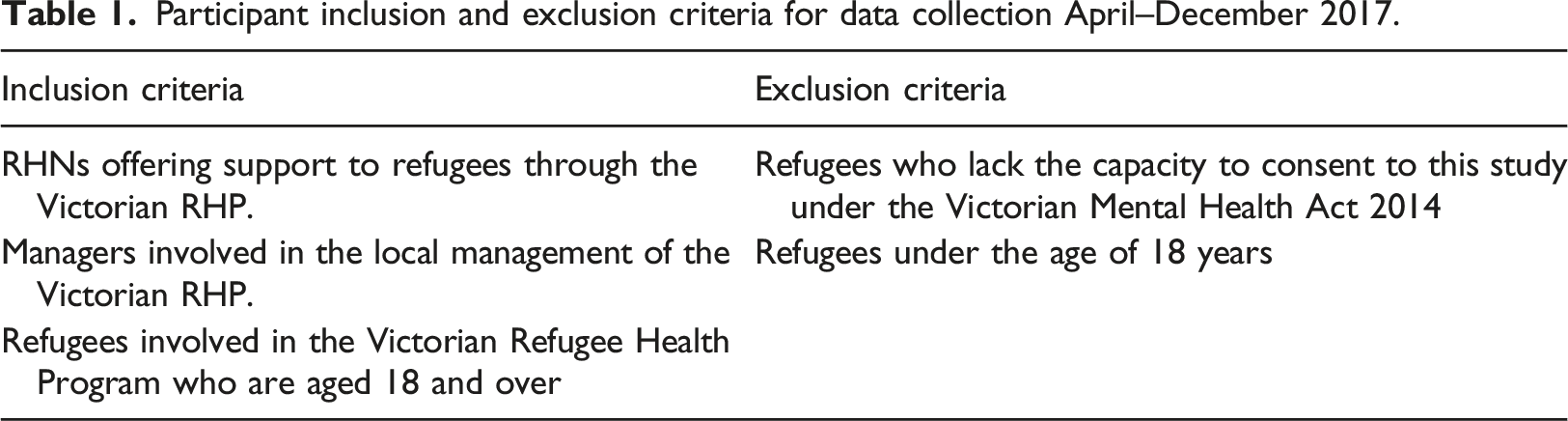
Participant inclusion and exclusion criteria for data collection April–December 2017.
Data collection
Data were collected by the first author between April 2017 and December 2017 across two community health centres offering the RHP. Methods of data collection were semi-structured interviews, focus groups, participant observation and review of RHP documents and guidelines.
Participant observation was undertaken throughout the data collection process, beginning in April 2017, and semi-structured interviews were conducted with five RHNs, two managers and eight refugees.
Consent for interviews was obtained from RHNs initially and therefore these interviews were conducted early in the study, followed by interviews with managers. All interviews with RHNs and managers were conducted in a private room within the community health centres. Interviews with refugees were conducted later in the study between October and December 2017, after some time spent in the field. Therefore, at interview stage, refugees were familiar with the presence of the first author.
Interviews with refugees were either undertaken in a private room within the community health centre or in the refugee’s home, as requested. Interviews typically lasted for 1 hour. Two semi-structured interviews were conducted in English and six interviews, as well as both focus groups, were conducted with the assistance of a translator. One interview was undertaken with two refugees simultaneously, as these participants were family members.
Towards the end of the time in the field, two focus groups were conducted with four refugees and five refugees, respectively, and none of these participants took part in semi-structured interviews. Focus group discussions were transcribed accordingly, each of which lasted for approximately 1 hour.
All interviews and focus groups were digitally recorded and re-checked for accuracy of transcription. Extensive field notes were generated from participant observation at both sites, which were transcribed after each observation session. Observations provided exposure to participants’ interactions, including clinic appointments and social activities within the RHP. Participant observation sessions occurred at each site once per week across a range of weekdays from April 2017 to December 2017, with observation sessions lasting between four and six hours. All observation sessions were negotiated in advance with RHNs at each site. The main purpose of observations was to gain insight into everyday activities undertaken within the refugee health service, as well as to build rapport with participants and provide contextual data about the resettlement environment.
Victorian refugee health policy, procedures and refugee assessment/review documents were considered to offer additional context to the RHP. These documents were not analysed, but rather, used to confirm or contrast interview and observation findings, by contemplating the ways in which these documents were utilised.
Data analysis
Consistent with an inductive-abductive approach to qualitative research, data were collected and analysed concurrently, and Thematic Analysis (TA) identified key themes.
TA is described as ‘a method for identifying, analysing and reporting patterns (themes) within data’ (Braun and Clarke 2006, p. 79). TA (Braun and Clarke, 2006) provides a rich, detailed and nuanced account of data, involving the search for and identification of common threads and latent themes that extend across an entire set of data (Saldana, 2009). This approach was deemed appropriate due to its accessibility and flexibility, offering a route into qualitative research that teaches the mechanics of coding and analysing qualitative data systematically, linking data to broader theoretical and conceptual notions. Focused ethnography can be analysed using TA or narratives, but TA was chosen due to the emphasis on shared experiences within refugee health nursing, looking for common themes across groups to tell an overall story of the data (Coffey, 2018).
Using a systematic approach to TA, the six phases as outlined by Braun and Clarke (2006) were employed. Data from interviews, focus groups and observation were analysed and this triangulation allowed the researcher to develop a comprehensive understanding of refugee health nursing.
The researcher undertook pattern recognition as a starting point for analysis, using charts and diagrams. Finding codes and categories allowed the identification of commonalities in the data, laying groundwork for the creation of meaningful themes (Saldana, 2009). Data analysis is a messy and intellectual undertaking, moving through a continual process of abstraction and creativity in dealing with empirical data. The process involved iterative, forward-back movements in relation to the whole data, contemplating and uncovering meanings and revealing hidden ambiguities; coding and re-coding as new categories or codes took shape.
A thematic map was used as a visual tool to organise the facets of developing analysis and to identify main themes, sub-themes and their interconnections (Braun and Clarke, 2006). As coding continued and categories were created, the process of coding became more analytic, and sections of data and codes were reviewed with academic supervisors on a regular basis. These processes of map-making and peer debriefing helped to refine thought processes and assisted in recognising data sufficiency.
Trustworthiness
Comparing data from field notes, interviews and focus groups strengthened the analysis. Reflecting on refugee health policy and refugee assessment/review documents uncovered the challenges of specialist nursing practice, as RHNs are tasked with meeting bureaucratic demands while responding to refugee needs. As interviews with RHNs were undertaken first, data from these interviews triggered focus for subsequent observations, and attention was paid to the concept of burnout in this nursing role. As interviews with refugees were conducted towards the end of the study, this allowed an opportunity to confirm insights from observation.
Thick description allows transferability due to the comprehensive accounts of participants and settings, and cross-checking was undertaken amongst the authors to ensure that evidence-based themes were developed. Trustworthiness was also demonstrated through extensive and prolonged engagement in fieldwork.
Reflexivity
Reflection on interviews, focus groups and observation sessions supported the researcher to contemplate their influence on the research process and data analysis, as well as the potential resulting bias.
Reflexivity was ongoing and the researcher’s thoughts, alongside the data collection process, were captured using a diary. This allowed the researcher to document ideas and emotions throughout the research process; reflecting on their academic and professional role in the field, as well as decisions which may have influenced the findings.
Results
While much of the healthcare narratives locate refugees as vulnerable and healthcare professionals as powerful within therapeutic relationships, this study uncovered the complexity of power relations that exist between nurses and refugees.
The notion of fluctuating power across groups in society, as put forward by Foucault (1980), will be used to frame discussion of the findings.
Nursing autonomy and gatekeeping
As managers have competing demands in overseeing other programmes, they offer RHNs autonomy in coordinating care for refugees. Ash (manager) suggests, ‘I think they pretty much have free reign, and I think that’s probably based on what each nurse wants to do. I don’t have a health background… I don’t have very good knowledge of the health system, and I guess medical, clinical approaches. That’s not where my skills lie’. Managers in this study therefore endorse RHNs as autonomous practitioners, trusting these specialist nurses to coordinate the service.
RHNs exert power by adopting a gatekeeping stance; guardians of the RHP and at the epicentre of refugee healthcare in the community. As a nurse-led initiative, RHNs use specialist knowledge to coordinate the operation of the RHP and are seen to be in a position of authority and control.
RHNs are intermediaries between refugees and other professionals, at the gate of which refugees must pass to access a range of services. RHNs exercise power in making decisions regarding the eligibility of refugees to access the RHP, referrals to specialised services and allocating resources.
‘Systematically, I’m set up to have control- power over them (refugees)... ‘It’s the position I have. It’s quite a powerful position’ (Pat, RHN). RHNs decide whether refugees can access the programme, using their professional judgement to determine care plans and whether refugees require referral to other services. According to field notes from the metropolitan site, one RHN says, ‘they need a doorway’, and ‘we are the gateway’.
Ali (manager) reports that RHNs permit access for refugees into the wider healthcare landscape, ‘through facilitating people to have refugee health assessment, through nurses providing care coordination, and enabling clients to access the health system’. As Pat (RHN) elucidates, ‘I’m the conduit to other services’.
However, while RHNs are in a position of power as gatekeepers to refugee healthcare, they are regularly exposed to sensitive information and harrowing stories from refugees, leading to emotional exhaustion.
Vicarious trauma and burnout
Although RHNs in this study exercise power as coordinators of the RHP, they develop therapeutic intimacy with refugees and subsequently experience symptoms of compassion fatigue.
The interactional form of empathy offered by RHNs can lead to an emotional and psychological closeness within the RHN/refugee relationship. Lou, a refugee, says, ‘I feel like she’s my mother. I feel she’s really caring with me. She is a friend, and a person that would help me and support me all the time. I feel comfortable’. According to Joe, another refugee, ‘She likes to help us from her heart, like- from inside. She is working from her heart… I can feel it’.’
RHN participants are consistently uncovered to the traumatic circumstances of refugees’ lives and consequently risk secondary trauma
Meg (RHN) considers, ‘It is hard to listen to the stories, we find it challenging to switch off after appointments’. Liz, another RHN explains that, ‘It’s quite challenging, it’s not just your normal ‘go to work and go home’ type of role… It’s very complex needs clients, and… you do get to hear a lot of stories that you didn’t expect you might hear, you know? It’s quite- it can be quite traumatic on your own self as well’. Ann (RHN) suggests that RHNs can ‘take that home’ with them after work and ‘ruminate on it for days’. According to Pat (RHN), ‘The challenge, I suppose, would be the stories that you hear and how you put those stories away and tell yourself, “they’re not your stories, they’re your client’s stories… So, it’s about separating that”’.’
RHNs discuss the importance of therapy in dealing with the emotional burden of their work, to prevent burnout. ‘I had a good dose of vicarious trauma when I first started and that taught me an awful lot, not always very positive. But I now see a counsellor- a generalist counsellor, and she’s challenged some of my work practices’ (Ann, RHN).
Similarly, another RHN suggests, ‘I think that debriefing, whether it’s formal or informal, secondary consultations help. You need colleagues who you can debrief with, because you’re hearing these stories all the time. I need monthly supervision for my own mental health, which helps me separate work from life, so I don’t burnout’ (Pat, RHN). RHNs in this study suggest that counselling, psychotherapeutic clinical supervision and de-brief sessions are paramount in helping them to cope with vicarious trauma.
Professional relationships in refugee health nursing are complex, with power fluctuating between RHNs and refugees. RHNs are exposed to vicarious trauma and symptoms of burnout, while refugees exercise agency by recognising the benefits to specialised care, negotiating prolonged access.
Refugee negotiation of care
Most refugees in this study recognise the benefits of a specialist service and use power by negotiating longer-term access at the end of the 1-year resettlement period, with some refugees becoming reliant on the support of RHNs. ‘Basically, I try to make sure that people are not dependent on me, but it’s not very easy to do’ (Ann, RHN).
Within the RHP, benefits to refugees include longer and more flexible appointment times, efficient referrals, continuity of care and consistent access to interpretation services. Len (refugee) contemplates, ‘I don’t think I could do it by myself if there is no refugee support here… They help us with everything’. Another participant argues that refugees would be unable to cope without access to specialised care. ‘Without the programme, some people may neglect their health, because some people are not highly educated. They cannot look after themselves’ (Jes, refugee).
Refugees become accustomed to receiving help with a range of everyday matters. ‘They always call us to remind us of our appointments, when to get there, what time it is and if we need assistance with going there. It would be very hard without the RHN, because she organises all of the interpreting too’ (Amy, refugee). If refugees are transferred from the RHP into mainstream community health services, there would be limited capacity to support them in the same manner.
Refugee participants suggest that the RHP gives them a sense of purpose. ‘What keeps us healthy is the fact that we’re coming here’ (Lyn, refugee). Refugees enjoy accessing proactive care that is specifically for them, provided by culturally competent and knowledgeable specialist nurses. ‘This is a programme that is only thinking about our well-being. Whatever they do, it’s good for us, and they try their best to help us only’ (Lyn, refugee). Refugee participants recognise the advantages of the specialised service compared with care offered through mainstream community health. Jes (refugee) suggests, ‘Here, it’s better. Another nurse would never know. The people who are here, they know our rights. Every appointment we see a different GP, it’s not always the same… But with the RHN, she has all the files and she is doing all our referrals’.’
Refugees in this study are reluctant to be discharged into mainstream community health services. Ali (manager) considers the challenges of discharging refugees from the RHP, commenting, ‘For more complex clients, that can be a hard transition… that can be difficult’.
While refugees are typically viewed as ‘vulnerable’, findings show the ability of refugee groups to exercise power in healthcare settings.
Discussion
Foucault (1980) stressed the decentralised nature of power, suggesting that power ebbs and flows in relationships and can be found everywhere, circulating among all groups in society. While RHNs seem powerful as specialist practitioners, refugees exercise control by influencing how their care is delivered, sustaining prolonged access to the specialised health service.
RHNs are gatekeepers of refugee healthcare, improving refugee access to primary care through targeted, proactive health support (McBride et al., 2017). However, despite their inherent power, RHNs in this study discuss symptoms of compassion fatigue and the risk of burnout, which is defined as ‘a psychological syndrome emerging as a prolonged response to chronic interpersonal stressors on the job’ (Maslach and Leiter, 2016 p. 103).
Ogunsiji et al. (2018) propose that RHNs may feel incapacitated by the various psychological impacts of working with refugees, leading to secondary post-traumatic stress and negatively affecting the mental health of these nurses. Zakeri et al. (2021) highlight the correlation between fatigue, burnout and clinical competence in nursing, reporting that when nurses take on too much and become emotionally exhausted; this can influence effective care giving.
The narrative around refugees is based upon vulnerability and they are often viewed as uniformly powerless during the resettlement period, adopting a passive, victim role (Nies et al., 2016). Nevertheless, having experienced the difficulties of conflict or persecution, refugees can display astuteness, capability and a sense of entitlement during resettlement (Gungor and Strohmeier 2020).
Foucault (1980) suggests that power cannot exist without resistance, and some refugees in this study exert power by negotiating longer-term care, refusing to be discharged. However, as refugees negotiate extended access to the specialised service, this leads to dependency on RHNs and prevents integration into mainstream health services. Woodland et al. (2010) report that a challenge facing specialised refugee health services in Australia relates to linking refugees with mainstream primary care providers after the initial resettlement period.
If effective therapeutic relationships are to be developed and sustained in refugee health nursing, attention must be paid to the ways that care is delivered to both protect RHNs from burnout and to ensure that refugees receive appropriate and timely care.
Limitations
Efforts to limit bias were made through triangulation of data and use of a reflexive diary to record thoughts and feelings, whilst also discussing what was seen and written with the co-authors (Higginbottom et al., 2013).
By including two sites, this ethnographic research offers depth rather than breadth of understanding and data sufficiency was achieved.
The State-Wide Facilitator may have proposed these two sites for inclusion in the knowledge that the service runs smoothly within these settings. There could have been bias in the selection process and this may have influenced the researcher’s perception of the RHP and thus, the presentation of findings. Both sites offer similar services for resettled refugees in terms of treatment options and care, and minimal differences were found in the refugee health service across metropolitan and rural settings.
As consent was gained from RHNs and managers early on, interviews were conducted with these sub-cultural groups before the researcher had fully immersed in the field and therefore, had not formed trusting relationships with participants. More sensitive or insightful data may have been collected from RHNs and managers if interviews were undertaken with these groups later in the study.
The use of computer-assisted qualitative data analysis software (CAQDAS) was not employed, as the researcher aspired to stay close to the data and use creative ways to decipher patterns. In terms of professional development of the researcher, it may have been beneficial to use CAQDAS to further practical learning of this software.
Conclusion
Due to increasing global movement and displacement, there is reason to consider a specialised health service to provide quality healthcare for resettled refugees.
Refugee groups often develop diabetes, heart disease and suffer from stroke during the early resettlement period, with many refugees feeling healthy on arrival but developing health problems during the first year (Marshall et al., 2016). Having experienced trauma and conflict, refugees are a unique population with distinct health needs, requiring culturally competent care and a proactive approach to optimise their health and well-being in the host country.
This study investigated a nurse-led refugee health programme in the resettlement context, drawing on Foucault’s (1980) concept of omnipresent and fluctuating power to illustrate the complex ways that power circulates between RHNs and refugees.
While the specialist RHN status confers power on professionals who often feel powerless in a medically dominated healthcare system, it also shows the ways that refugees exert power within the specialist system of care. This challenges the normalised discourse of ‘vulnerable refugee’ and demonstrates ways that they can exercise power within the healthcare system in Australia.
In areas of high-volume refugee resettlement, a specialised nurse-led refugee health service is recommended. After the 1-year resettlement process, the Refugee Health Nurse (RHN) should facilitate refugee transition into mainstream community health services. RHNs require access to peer-debriefing, counselling or psychotherapeutic clinical supervision to cope with vicarious trauma, protect nurse well-being and retain this workforce. Managers should have oversight of the nursing workload and monitor transition of refugees into mainstream community health services. A pilot study of the RHP model in the Scottish resettlement context is recommended, offering targeted healthcare for newly arrived refugees and evaluating this initiative after 1 year. Refugee health should become an essential element of the nursing curriculum in higher education. Postgraduate courses are available in Refugee Health and Well-Being at Australian universities, setting the precedent for nursing education in other high-income host countries.Key points for policy, practice and/or research
Footnotes
Declaration of conflicting interests
The author(s) declared no potential conflicts of interest with respect to the research, authorship, and/or publication of this article.
Funding
The author(s) received no financial support for the research, authorship, and/or publication of this article.
Ethics
Ethical approval was obtained from the University of Edinburgh in January 2017 (Reference: NURS020), and from the metropolitan site Human Ethics Advisory Group to access both fields, in February 2017 (Reference: 1701). Informed consent for full participation was sought from managers and RHNs in April 2017. Data collection began in April 2017 and informed consent was obtained from refugees at various times thereafter.
