



Abstract
Background:
Home care patients experience great difficulty in fulfilling their daily activities. One of these difficulties is related to urinary excretion. It is necessary for individuals to possess self-efficacy as well as self-confidence in order to be able to perform self-administered clean intermittent catheterisation (CIC).
Aims:
The present study aims to determine the relationship between the self-confidence and self-efficacy of home care patients in CIC.
Method:
The data were collected from patients receiving home care services from a hospital in eastern Turkey between November 2022 and February 2023. The study data were collected online via google forms. No sample selection was made and the entire population was included in the study (372). The study was completed with 240 patients.
Results:
A significant positive correlation was found between the scores obtained from the self-confidence and self-efficacy inventories for CIC. It was found that the self-efficacy total score had an effect size of 66% on self-confidence inventories for CIC. In addition, age, education level and working status also affect self-efficacy.
Conclusions:
In the present study, it was concluded that the level of self-confidence affects the level of self-efficacy in self-catheterisation. The success rate of catheterisation increases in parallel with self-confidence.
Introduction
Home care is a type of health service that meets the needs and demands of patients in a domestic environment. The demand for home care services is increasing day by day as they reduce the number of hospital admissions and hospitalisations, reduce costs, alleviate potential hospital complications and shorten the hospitalisation period even if the patient is hospitalised (Andrade et al., 2017). With the increase in life expectancy at birth and the decrease in fertility rates, today’s society is increasingly aging. Turkey is among the countries where a rapid aging process is expected. By the year 2040, an increase of 201% is expected in the older person population of Turkey (Mandıracıoğlu, 2010). This increase in the older person population has brought various health service models to the agenda. There has been a global transition from ‘clinic-centered’ to ‘patient-centered’ health services (Palm, 2012). In this context, home care services have emerged as a product of the evolving sense of health care and a requirement of the changing characteristics of society.
In order to improve individuals’ quality of life, it is necessary to focus on basic daily life activities such as bathing, nutrition, excretion, respiration and mobility (Birol, 2020; Camp et al., 2021). Home care patients in particular experience great difficulty in fulfilling their daily activities (Taşdelen and Ateş, 2012). One of these difficulties is related to urinary excretion. Home care patients who experience urinary excretion problems self-administer CIC to control their bladder, manage incomplete bladder discharge and improve their quality of life (Zachariou et al., 2020). CIC is an effective and reliable technique recommended for bladder drainage of patients suffering from urinary retention due to neurogenic or non-neurogenic causes (Çulha and Acaroğlu, 2020; Saadat et al., 2019). In addition, it is a method that increases individuals’ level of independence, reduces the risk of infection, enables the kidneys and bladder to perform their function and prevents kidney damage, reduces potential trauma to the urethra and bladder stones, does not restrict the sexual activities of patients, reduces urinary incontinence and increases self-esteem and self-confidence (Biaziolo et al., 2017). Self-confidence is a very significant concept that encourages individuals to receive better health care, to become aware of their own capabilities and to be able to self-apply CIC (Biaziolo et al., 2017; Çulha and Acaroğlu, 2020). Self-confidence alleviates feelings such as fear and shame in relation to an individual’s ability to perform an action, while boosting their sense of enthusiasm and faith, ensuring that the action is successful (Çulha and Acaroğlu, 2020). It is necessary for individuals to possess self-efficacy as well as self-confidence in order to be able to perform self-administered CIC. Keeping patients away from the hospital is an important goal of home care services. In line with this goal, home care patients should be able to perform self-catheterisation independently. It is of great importance to possess high levels of self-confidence and self-efficacy in order to achieve self-catheterisation. Therefore, the present study aims to determine the relationship between the self-confidence and self-efficacy of home care patients in CIC and to contribute to the related literature.
Study question
Is there a relationship between the level of self-confidence in CIC and self-efficacy of patients receiving home care?
Material and methods
Type of study: The study was planned in a descriptive cross-sectional design.
Place and time of study: Study data were collected from patients receiving home care services from a hospital in eastern Turkey between November 2022 and February 2023.
Study sample: The population of the study consisted of 372 patients who were followed in the home care services of a hospital in eastern Turkey between the study dates. No sample selection was made and the entire population was included in the study. The study was completed with 240 patients.
Variables: Sociodemographic features of home care patients and self-confidence in CIC constituted the independent variable of the study, whereas self-efficacy served as the dependent variable.
Inclusion criteria:
– To reside in the region where the study is carried out
– Patients without any impairment in motor functions
– Receiving home care services
– Performing CIC
– Patients who can answer study questions via Google forms
– Agreeing to participate in the study
Data collection
The surveys were delivered to the patients via Google forms, and the data were collected between November 2022 and February 2023. Home care patients who applied CIC were contacted by the researcher through the contact numbers in the system, they were informed about the study and their consent was obtained.
Data collection tools: In collecting data, a seven-question personal introduction form created by the researchers was used to ask participants about information such as gender, age, marital status, level of education, working status, assistance during CIC and problems with the urinary catheter (Taşdelen and Ateş, 2012). Additionally, the Self-Confidence Scale for Clean Intermittent Self-Catheterisation and the General Self-Efficacy Scale were used, with permission to use the scales.
The self-confidence scale for clean urinary intermittent self-catheterisation (SCSCISC): The scale was developed by Biaziolo et al. (2017). It was adapted into Turkish by Çulha and Acaroğlu (2020). Each item is scored on a 5-point Likert-type scale consisting of catheterisation application steps and short sentences describing the individual’s belief that they can perform the application. The total score that can be obtained from the scale consisting of 16 items ranges from 0 to 64. High scores indicate high levels of self-confidence. The scale does not include sub-dimensions. The Cronbach’s alpha coefficient of the original scale was calculated as 0.94 (Çulha and Acaroğlu, 2020). In the present study, the Cronbach’s alpha coefficient was found to be 0.99.
The general self-efficacy scale (GSE): The scale was developed by Schwarzer and Jarusalem (1979). It was initially prepared to include 20 items, which were then reduced to 10 items with revisions in 1981 and finalised in 1995 (Schwarzer and Jeruselam, 1995). The scale was adapted into Turkish by Aypay (2010). It tests various segments’ belief in the ability to cope with new and difficult tasks. The scale consisting of 10 items, all of which are positive, was prepared in the form of a 4-point Likert-type scale bounded by points of completely false and completely true. The internal consistency of the scale was calculated as α = 0.86 in a study conducted across all countries. High scores indicate high levels of general self-efficacy (Aypay, 2010). In this study, the Cronbach’s alpha coefficient was found to be 0.99.
Ethical statement
An Bingöl University Health Sciences Scientific Research and Publication Ethics Committee Approval (2022-E.85067) was obtained to carry out the study. Health Sciences Scientific Research and Publication Ethics Committee Approval (15.11.2022-E.85067) was obtained from a state university to carry out the study. Researchers followed the rules stated in the Declaration of Helsinki throughout the research. Participants were informed about the research by the researcher and their consent was obtained.
Data analysis
The data obtained from the study were analysed using SPSS 22 (IBM Corp, 2019). A frequency test was performed in the statistical analysis of the data, the independent samples t-test was performed in paired groups within parametric distributions, the ANOVA test was performed in comparisons of three or more groups within parametric distributions, and a correlation analysis was carried out between the total mean scores of the scales. The presence of relationships between the predicted variable (self-confidence in CIC) and the predictor variables (self-efficacy) was examined through Multiple Regression analysis and, afterwards, the Pearson Correlation Coefficients between the variables examined were calculated.
Results
It was found that 57.9% of the participants were male, the majority of the participants were older than 65 years and had a low level of education, and 84.2% of them were married. Additionally, 27% of the participants were actively employed, 53.9% of them sought help from others while inserting the urinary catheter, and 24.9% of them did not experience any problems related to the urinary catheter (Table 1).
Frequency analysis of demographic data.

CIC: clean intermittent catheterisation.
In the comparison between the sociodemographic features of the home care patients and the mean SCSCISC scores, a statistically significant difference was found between the mean scores of the participants aged 56–60 years (75.70 ± 7.58), the participants with a bachelor’s degree (78.0±6.34), and the participants who were actively employed (64.62 ± 17.88) (Table 2, p < 0.05).
Comparison of home care patients’ sociodemographic characteristics and their SCSCISC and GSE total scores.
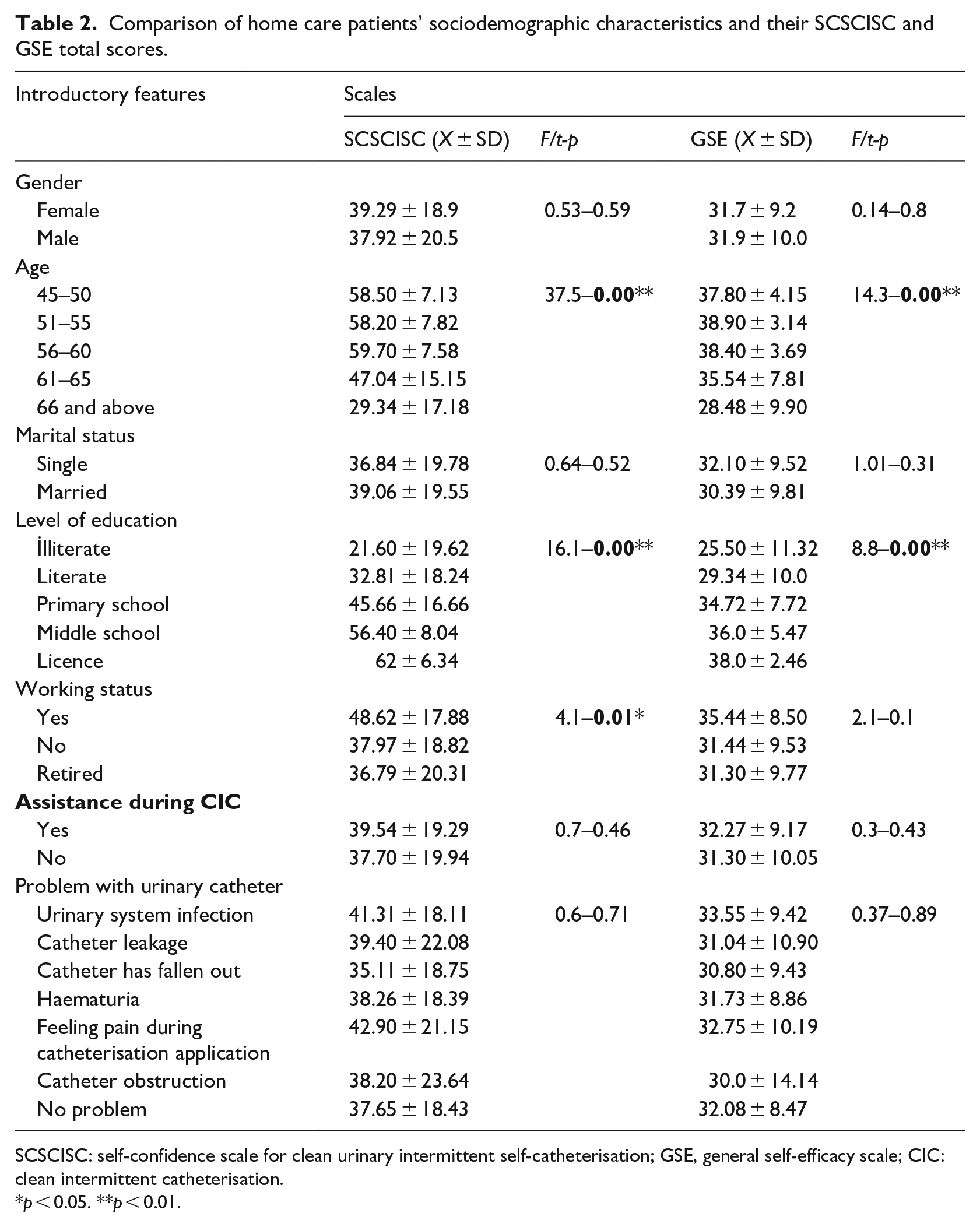
SCSCISC: self-confidence scale for clean urinary intermittent self-catheterisation; GSE, general self-efficacy scale; CIC: clean intermittent catheterisation.
p < 0.05. **p < 0.01.
In the comparison between the sociodemographic features of the home care patients and the mean GSE scores, A statistically significant difference was found between the mean scores of the individuals aged 51–55 (38.90 ± 3.14) and the participants with a bachelor’s degree (38.0 ± 2.46) (Table 2, p < 0.05).
Table 3 shows a significant positive correlation between the scores obtained from the SCSCISC inventory and those from the GSE inventory (r = 0.815, p < 0.01). In other words, self-efficacy levels increase in parallel with self-confidence in CIC (Table 3).
Correlation analysis between SCCSCISC and GSE inventory.
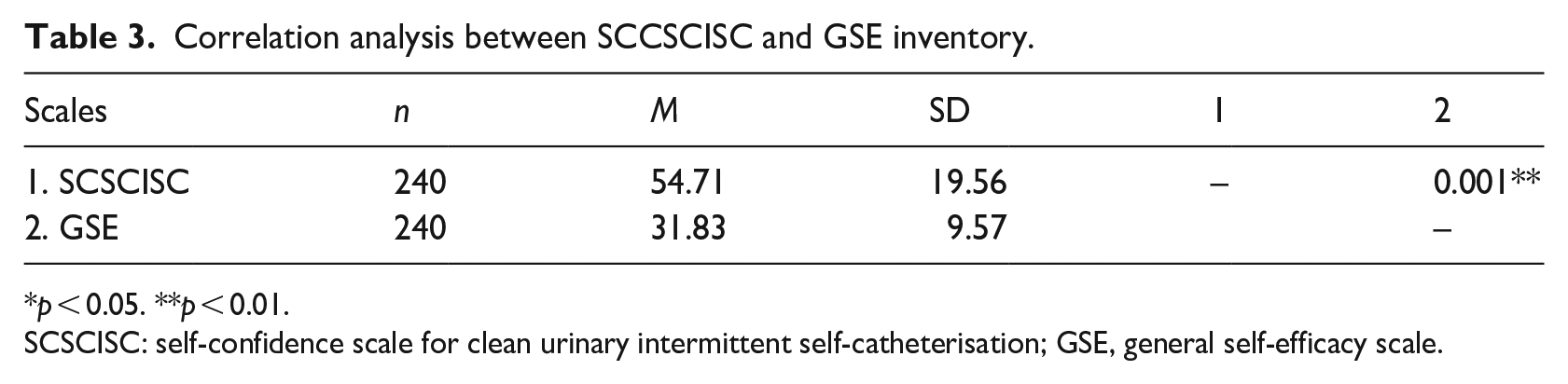
p < 0.05. **p < 0.01.
SCSCISC: self-confidence scale for clean urinary intermittent self-catheterisation; GSE, general self-efficacy scale.
The factors affecting home care patients’ level of the self-confidence CIC were tested through regression analysis. Self-confidence in CIC was taken as the dependent variable. GSE, age, gender, education level and employment status were taken as independent variables. Table 4 shows the results of the analysis.
Predictors of SCSCISC according to regression analysis.
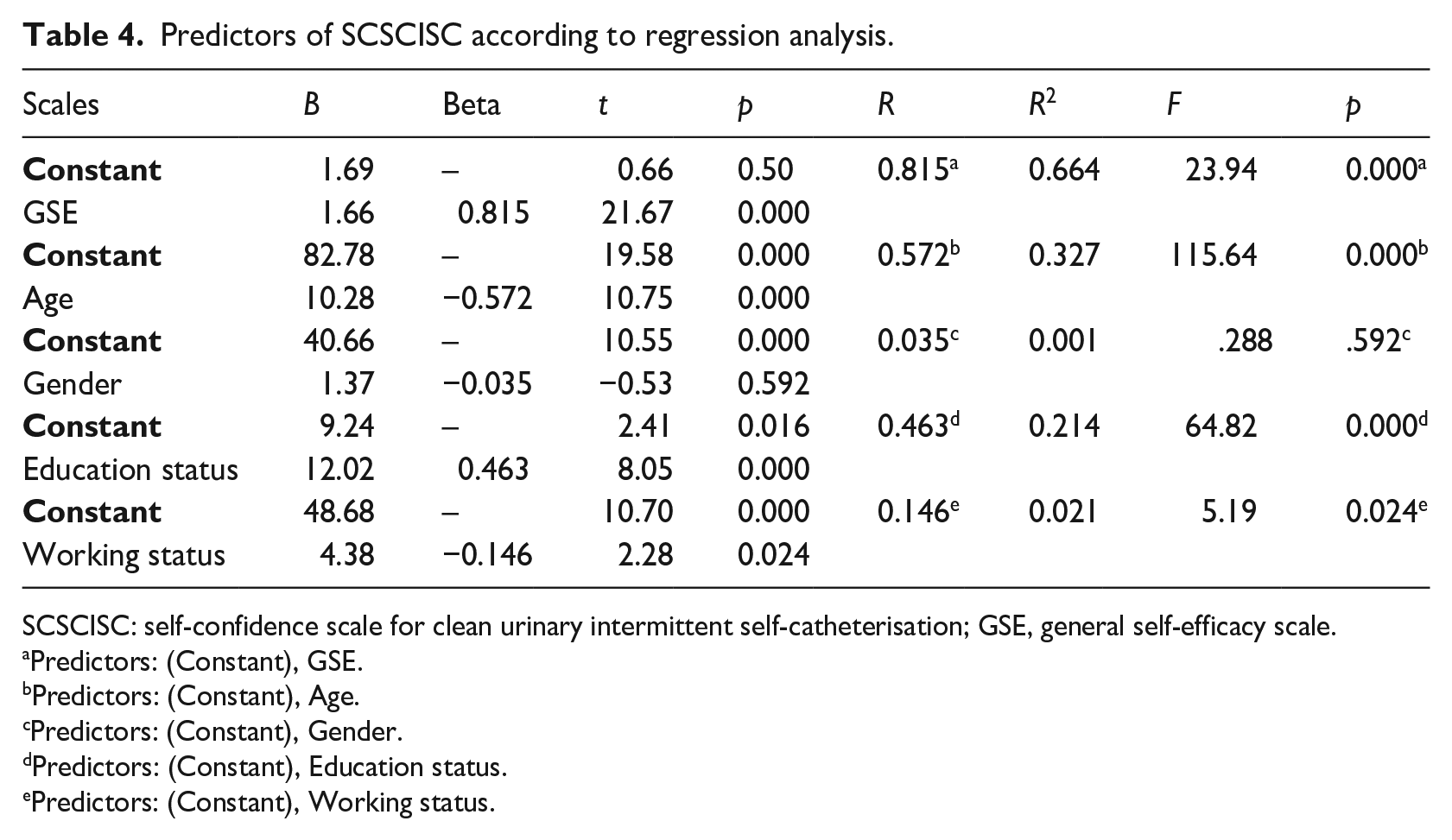
SCSCISC: self-confidence scale for clean urinary intermittent self-catheterisation; GSE, general self-efficacy scale.
Predictors: (Constant), GSE.
Predictors: (Constant), Age.
Predictors: (Constant), Gender.
Predictors: (Constant), Education status.
Predictors: (Constant), Working status.
Discussion
The literature review performed as part of the present study shows that although the number of home care patients is growing day by day, the number of studies demonstrating the current status, quality, qualification and success rate of home care in Turkey is very limited. One of the main reasons behind this is that the law on the provision of home care services was enacted in 2010. Therefore, it is thought that the present study will contribute to the theoretical framework of home care services.
While no significant difference was observed between the mean SCSCISC scores and the gender variable, a significant difference was found between SCSCISC and age (Table 2). The mean SCSCISC scores of the participants aged 56–60 were found to be higher compared to those aged 66 and over. Certain previous studies reported that there was no statistically significant difference between the mean scores of self-confidence and age groups (Akpınar and Yağan, 2019; Bostancı et al., 2018; Karagün, 2014). In another study, Henriksen et al. (2018) found a significant relationship between age and self-confidence groups (Henriksen et al., 2018). Although the SCSCISC levels of parents aged 56–60 were found to be high, individuals over the age of 65 constituted the majority of the participants. Individuals over 65 years of age were found to have low SCSCISC levels. It is thought that their self-confidence is low due to reasons such as decline in cognitive, affective and psychomotor functions due to advancing age and dizziness.
Although no significant difference was observed between SCSCISC mean scores and marital status, a significant difference was found based on education level (Table 2). The mean SCSCISC score of the participants with a bachelor’s degree was found to be higher than that of the non-literate participants. The literature suggests that individuals with higher levels of education have higher levels of self-confidence (Escolar and De Guzman, 2014; Kılıç et al., 2016). However, only one of the participants in the present study had a bachelor’s degree. The majority of the participants had an education level of primary school and below. The self-confidence levels of the individuals with a primary school education level were found to be moderate.
Although there was no significant difference in the mean SCSCISC scores based on the status of receiving assistance in urinary catheter insertion, a significant difference was observed in the mean SCSCISC scores based on the status of being actively employed (Table 2). The mean SCSCISC scores of the participants who were actively employed were found to be higher compared to those who were retired or not actively employed. However, the majority of the participants were either retired or not actively working. The SCSCISC levels of the individuals who were retired or not working in any capacity were found to be low. Actively employed individuals have certain responsibilities to fulfil. It is thought that they have high self-confidence as they fulfil their responsibilities.
Although no significant difference was found in the mean GSE scores based on gender, a significant difference was found based on age (Table 2). The mean GSE scores of the individuals aged 51–55 were found to be higher compared to the individuals aged 66 and over. Individuals’ level of self-efficacy decreases with increasing age, particularly for those over the age of 65. Previous studies report that self-efficacy levels increase in parallel with age (Dikmen et al., 2021; Saraçlar et al., 2022). However, in the present study, the self-efficacy levels of the participants over the age of 65 were found to be low. Numerous physiological changes occur in the body with aging (increase in chronic diseases, loss of vision and hearing, slowed reflexes, etc.). It is thought that the level of self-efficacy decreases in relation to these changes.
Although there was no significant difference in the mean GSE scores based on marital status, a significant difference was observed based on education level (Table 2). In the relevant literature, there are studies reporting significant differences between education level and self-efficacy and those reporting no significant differences (Çulha and Acaroğlu, 2022; Karahan and Balat, 2011; Khorasani et al., 2017; Wu et al., 2018). The mean GSE scores of the participants with an undergraduate education level were found to be higher than those of the non-literate individuals. However, only one of the participants in the present study had a bachelor’s degree. The majority of the participants had an education level of primary school and below. The self-efficacy levels of the individuals with a primary school education level were found to be moderate.
A significant positive correlation was found between the mean SCSCISC scores and GSE scores (Table 3). This suggests that as self-confidence in CIC increases, the level of self-efficacy also increases. When the related literature is examined, there are studies showing that self-confidence positively affects self-efficacy, whereas others report that self-confidence has no effect on self-efficacy differences (Dervişoğlu and Acarlı, 2018; Taytaş and Kardaş, 2022).
It was found that the self-efficacy total score had an effect size of 66%, age had an effect size of 32%, education level had an effect size of 21% and working status had an effect size of 2% on SCSCISC. It was found that gender had not have an effect on SCCSCISC (Table 4). These results show that there is a relationship between the level of self-confidence in CIC and the self-efficacy of patients receiving home care.
Conclusions
In the present study, it was found that the level of self-confidence affects the level of self-efficacy in self-catheterisation. The success rate of catheterisation increases in parallel with self-confidence. Furthermore, it was determined that there were significant differences and correlations between the level of self-confidence and self-efficacy in self-catheterisation. This relationship can be investigated more conclusively in future studies with different samples and methods.
Limitations
The limitations of the study are that the study was conducted in only one district, 240 patients could be contacted despite a study population of 372 individuals, the patient group’s advanced age, lack of technology literacy and the majority of the participants had a low level of education.
Key points for policy, practice and/or research
Confidence is essential to success in self-administered clean intermittent catheterisation (CIC). Therefore, approaches that will increase the self-confidence of the patient should be adopted while planning home care.
Since individuals aged 65 and over have low self-confidence levels in CIC, their self-confidence can be increased by creating an individualised care plan.
Individuals with higher education levels have higher self-confidence. Accordingly, their self-efficacy is also higher. Therefore, training on CIC may help increase self-efficacy.
Footnotes
Acknowledgements
We would like to thank Çelikhan home care services personnel who helped us collect the data.
Consent to participate
Informed consent was obtained from all the individual participants included in the study.
Declaration of conflicting interests
The author(s) declared no potential conflicts of interest with respect to the research, authorship, and/or publication of this article.
Funding
The author(s) received no financial support for the research, authorship, and/or publication of this article.
Ethical approval
Bingöl University Health Sciences Scientific Research and Publication Ethics Committee Approval (2022-E.85067) was obtained to carry out the study. Researchers followed the rules stated in the Declaration of Helsinki throughout the research.

Statistics
The statistics were checked prior to submission by an expert statistician, Behice ERCİ,