



Abstract
Background:
The methodologies for clinical research trials are evolving to greater usage of social media platforms, providing opportunities to incorporate smart technologies in their delivery. Research Nurses should consider how they can utilise platforms for public engagement in trials.
Aim:
To explore the experiences of social media platforms and clinical research trials in a healthy population group, to gain insight into how clinical researchers can utilise these platforms professionally and ethically.
Methods:
Using a critical realist qualitative focus group design with template analysis, we recruited 16 healthy members of the public aged 18–75 years. The data expands upon their thoughts and behaviours regarding social media platforms with their understanding of clinical research.
Results:
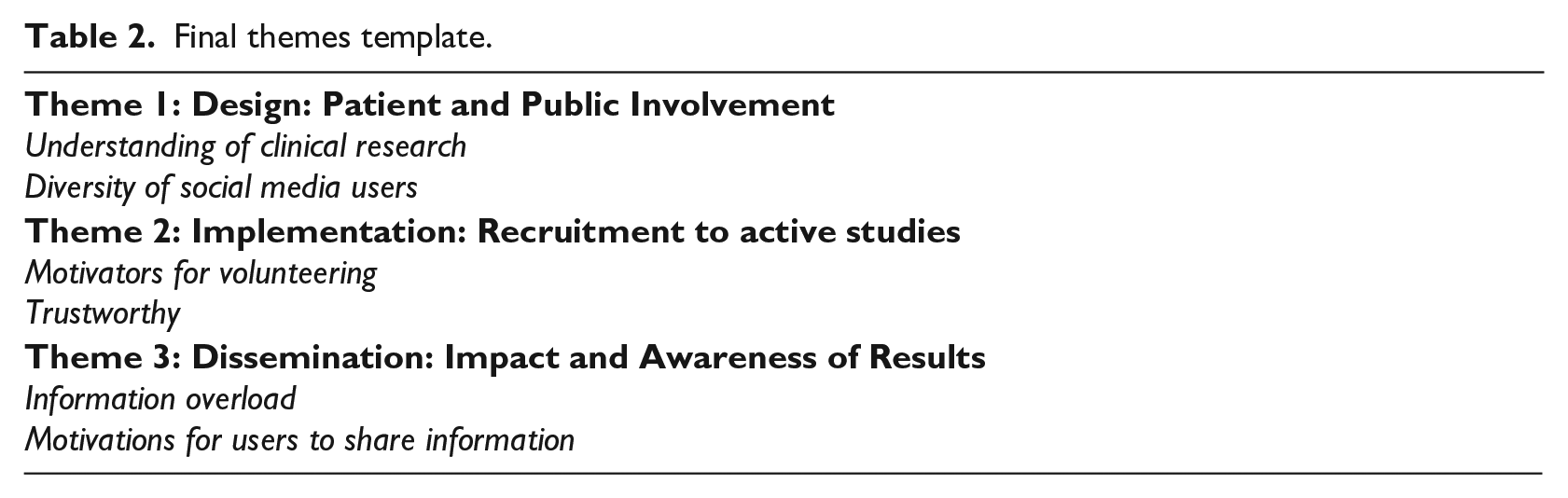
Three main themes along with their specific subthemes (1) Design: Patient and Public Involvement (Subtheme: Understanding of clinical research, Diversity of social media users), (2) Implementation: Recruitment to active studies, (Subtheme: Motivators for volunteering, Trustworthy), (3) Dissemination: Impact and Awareness of Results, (Subtheme: Information overload, Motivations for users to share information).
Conclusions:
This study has highlighted the need to consider the way different population groups use social media platforms and the information they share when looking to engage them in clinical research trials.
Introduction
Despite the limited guidance, clinical research trials are evolving to greater use of online tools, providing opportunities for participation via smart technologies and personal devices (Darko et al., 2022; Flood-Grady et al., 2021). Such efforts are brought on by the demonstrated cost-effectiveness and outreach potential to remote populations of social media (Sanchez et al., 2020; Whitaker et al., 2017). However, there are concerns regarding potential ethical challenges around promoting trust, transparency, autonomy and consent with privacy and data security when targeting social media users (Zimmermann et al., 2022). Moreover, disseminating research results through social media can prove challenging given the online climate regarding misinformation, especially healthcare information (Do Nascimento et al., 2022).
Previous research has explored approaches to utilising social media platforms, at various stages of the research process, to maximise engagement, participant recruitment and the dissemination of findings. For example, recruitment may benefit from using dynamic presentations, with some research showing young adults prefer engaging health promotion messages rather than pure text (Berry et al., 2018). To reach a wide range of participants research encourages the use of targeted advertisements (Ford et al., 2021; Ng et al., 2020) and a multi-social media platform approach (Dol et al., 2019; Guthrie et al., 2021; Sanchez et al., 2018). Additionally, Reeve (2018) highlighted that researchers also need to consider the internal motives, such as needs, cognitions and emotions, and external motives, such as environment, social and cultural, of social media users. However, only a limited number of studies have explored effective methods for patient and public involvement (Berry et al., 2018; MacDonald et al., 2022). Moreover, research which offers clear guidance on the use of social media for the various aspects of clinical research is yet to be developed. Therefore, this study aimed to explore the experiences of social media platforms and clinical research trials in a healthy population group, to gain insight into how clinical researchers can utilise these platforms professionally and ethically to maximise engagement, recruitment and dissemination.
Methodology
Study design
A critical realist perspective was adopted because it accepts that there are complexities inherent in any given social phenomenon and distinguishes between a real and observable world (Young and Ryan, 2020). The three main concepts of consideration in critical realism are experiences, events and causal mechanisms (Lawani, 2021). This study examines (observed) experiences and views of general social media users in the event of being exposed to information on clinical research trials (real-world events). The study then unpicks the structures that generate these experiences which in turn can inform practical guidance for clinical researchers (mechanisms). A qualitative focus group design was employed because the underlying assumption in this design is that opinions are socially produced and shaped by interactions with others and align with critical realism (Tonkiss, 2012). Ethical approval was obtained from the institution’s Ethics Committee (ETH2122-2586). Participants were provided with information about the study and what was involved in taking part in advance. They were also offered an opportunity to ask questions before obtaining fully informed signed consent before participation.
Recruitment
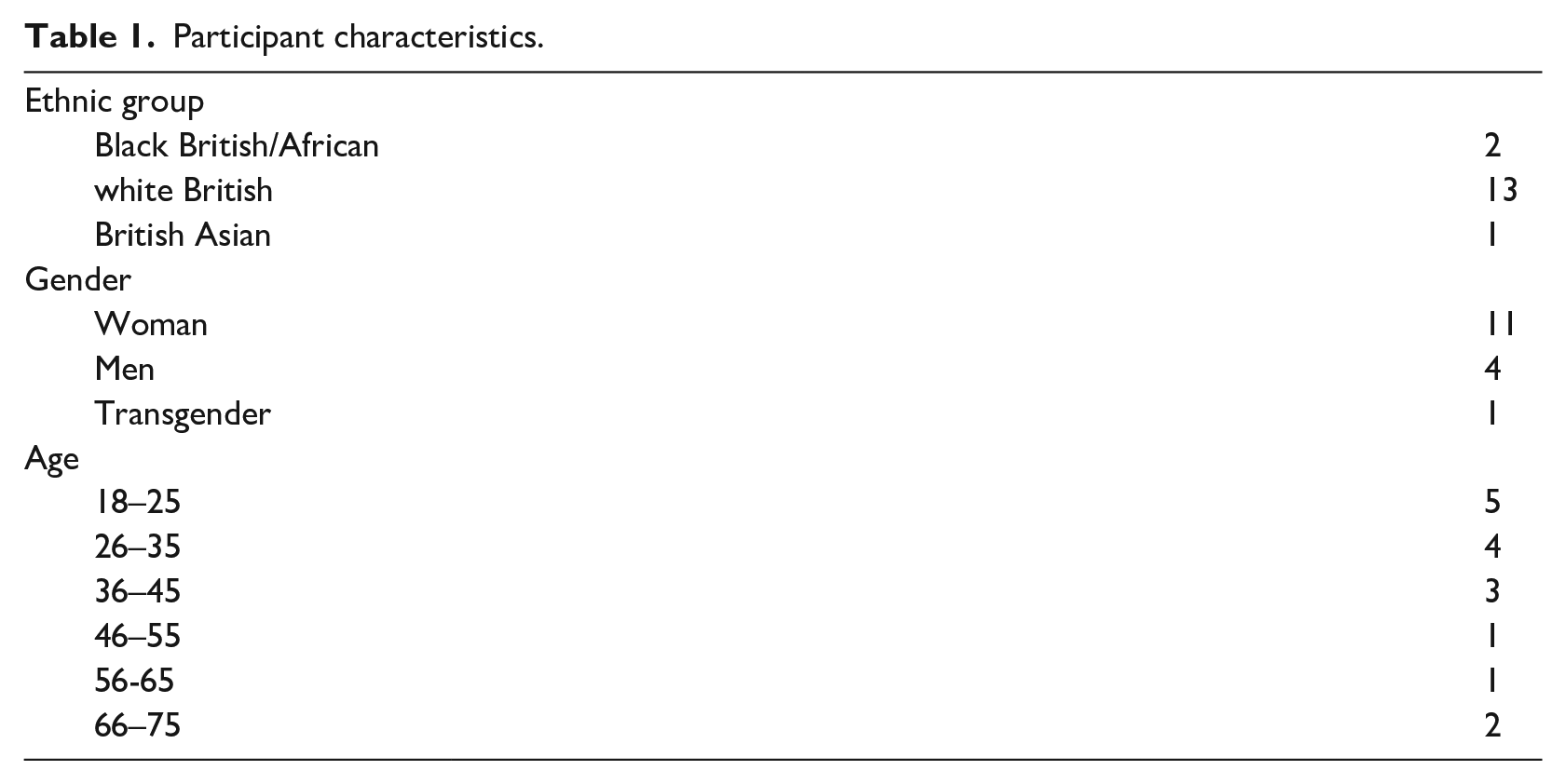
Participants were recruited through convenience sampling from a non-clinical population, targeting local communities and information networks across Derby City (e.g. notice boards in shops and community centres). Derby predominantly consists of working-age, white British (73.8%) residents but also has a large population of Asian and Asian British (15%; Office of National Statistics, 2024). The city has one of the newest acute teaching hospitals in the East Midlands with 1159 acute beds and 35 operating theatres (University Hospital of Derby and Burston NHS Foundation Trust, 2024). This potentially exposes the community to multiple clinical research trials. Participants were excluded if they were unable to converse in English. The sample included 16 participants, aged 18–75 years, in a total of five focus groups (see Table 1 for participant characteristics). These took place June–July 2022 and consisted of three in-person sessions, at the researchers’ institution and two virtual sessions, conducted via Microsoft Teams.
Participant characteristics.
Data collection
The focus groups contained two researchers, the first acting as lead facilitator and the second ensuring consistency across groups in terms of topics explored (Almutrafi, 2019). For the online focus groups, participants were given a link where they could log in anonymously. Participants provided a pseudonym and ground rules were determined (confidentiality and behaviour) before the focus group commenced. The interview schedule was designed to encourage conversation. Semi-structured questions were used to prompt and extrapolate the pertinent thoughts the participants held. Participants were first asked for their understanding of clinical research trials. They were then provided with the UK Medical Research Council definition and asked to respond. Some questions were specific, such as asking whether they use social media, what platforms they use, how often and why. Participants used a range of different platforms, including Facebook, Twitter, Instagram and Snapchat, in a variety of ways and for various durations. Three participants had experience engaging with clinical research as participants. However, the majority had no experience and were not members of a medical profession. The focus group duration ranged from 52 to 64 minutes and all focus groups were audio recorded and transcribed verbatim.
Data analysis
The analysis adopted a form of thematic analysis, which incorporates a structural process of coding textual data - template analysis (King, 2012). Priori themes were first defined through the information synthesised in the literature review. Then an iterative process applied the priori themes to the qualitative dataset. This involved two researchers and identified initial themes separately in NVivo. They then met to discuss their findings with the third researcher. All themes were discussed, redefined, or removed during this process to ensure all prominent themes had been explored and synthesised. Subsequently, once all researchers agreed the final themes were synthesed. The final themes have been integrated as findings and presented with corresponding quotations to illustrate the findings.
Findings
The following findings present and integrate a discussion of the three main themes and associated subthemes identified in the final template analysis (1) Design, Patient and Public Involvement, (2) Implementation: Recruitment to active studies, (3) Dissemination: Impact and Awareness of Results (see Table 2).
Final themes template.
Design: Patient and public involvement
Understanding of clinical research
A barrier to public involvement in clinical research is its perception. For example, Gene described: ‘Don’t you think, people think of men in white coats, with rabbits, with cigarettes in their mouths? You know, that’s an image for an awful lot of people’ (Gene, white British, man, 73). Here Gene is conveying a stereotype associated with research which he believes the wider public has. The perceived requirement of knowledge is also expressed when a person thinks of the word ‘research’. Another participant stated that this could also deter people from wanting to get involved: ‘Some people may be put off by the word “research” and might not feel that they are clever enough to get involved, they will think it’s not for them’ (Jane, white British, woman 52). These perceptions are in line with Brown and Cowdery (2021) who examined knowledge and attitudes toward clinical trials and highlighted the need for targeted educational interventions. Therefore, when seeking public involvement, using social media or other traditional means will be influenced by these perceptions.
The language of clinical research is not typically comprehensible to the wider public. As Sandra highlighted ‘I mean just the medical language is confusing for a lot of people. I know doctors are used to, and trained to relate to patients, but if you listen to a medical conversation, it’s crazy’ (Sandra, Black Africa Women, 23). Additionally, misunderstanding through the language used can result in misconceptions as Rita suggested ‘It leaves it open for people to infer it in their own way like there were people saying that there were chips in the vaccines’. (Rita, British Asian, woman, 21). Thus, the perception of clinical research as cryptic, and use of clear and understandable language regardless of education level, needs to be considered. Specifically, where social media brings opportunities to reach and engage with the general public, outreach messages should ideally encourage participants to engage using clear language, free of clinical research jargon.
Diversity of social media users
Different social media platforms have preferences in different population age groups. For example, Sue highlighted ‘My daughter doesn’t put anything on Facebook. . .. I mean she’s in her 30s, so it’s a generational thing because it used to be young people, didn’t it, on Facebook? Now it’s us older people’ (Sue, white British, woman, 67). This reflects recent research indicating patterns of Facebook usage differ across generations across North America and Northern Europe (Gil-Clavel and Zagheni, 2019). The younger participants were more commonly users of platforms such as Snapchat. For example, Sally stated, ‘Snapchat is just for like documenting like my life, so I’ll use that to reach out to my friends and stuff like that’ (Sally, Black British, woman, 23). The participants also described using different social media platforms for different purposes. For example, Paige, described her use of WhatsApp for actively networking ‘I have got lots of group chats, it can be horrendous. So I use that all day throughout the day, every day’ (Paige, white British, woman, 42). Diana described using Twitter for her professional role ‘I don’t often get social stuff from Twitter. It’s more about professional links and professional information and stuff like that’ (Diana, white British, woman 39).
Participants described social media usage in terms of convenience and highlighted feelings they experienced when using the platforms. For example, James stated ‘You get that nice little serotonin boost from seeing funny cat videos or you can communicate with friends’ (James, white British, man, 30). Sandra explained that she became accustomed to using social media when moving to the UK ‘I think coming to England has made me, like, more on social media, before I would never have posted a picture of whatever I’m doing, never’ (Sandra, Black African, women, 23). However, other participants, such as Fred, engage in social media but choose not to share their information ‘I don’t really like sharing things on my page’ (Fred, white British, transgender, 19). This demonstrates that different users engage with platforms in different ways and this needs considering when seeking to use social media to involve the public in research.
As well as using different social media platforms for keeping in touch with family, and friends, and networking professionally, some participants spoke about following celebrities who they viewed as influencers. Rita suggested that researchers could similarly use influencers to promote engagement in research ‘If they can promote something that is actually beneficial to people like research’ (Rita, British Asian, woman, 21). A recent study has examined the role of influencers in the consumer decision-making process and found that the promotion of some products through influencers may be more advantageous than others (Zak and Hasprova, 2020). However, to our knowledge, there are no research studies which have used this approach or examined its feasibility to engage people in clinical research. Paige did highlight that they had seen users from the health sector with a professional profile and that is how they found out certain information about the NHS ‘TikTok, you get a lot of doctors and like nurses, who will have their own public profile and then they’ll share that information out there’ (Paige, white British, women, 42). Therefore, this could potentially be an approach used by research nurses seeking to involve the public. However, further understanding of the impact of this is needed.
Implementation: Recruitment to active studies
Motivators for volunteering
The participants clearly explained what would motivate them to volunteer to participate in clinical research. There was a strong consensus that the participants had to have a personal connection with the subject matter. For example, Catherine stated ‘Unless it actually affects me and I know that sounds quite selfish, but I think, you don’t really need to know’ (Catherine, white British, woman, 55). This personal connection to the cause is evident in the wider literature on motivations for volunteering (MacNeela, 2008). Therefore, research nurses should consider how their messages for recruitment can enhance those personal connections and highlight their relevance to people. In other words, be clear about how their research will impact the target population.
Participants also suggested that volunteering in clinical research should contribute to a feeling of implementing change. For example, Tom pointed out ‘I think a lot of people sometimes sit there and think, oh, I don’t like this, but there’s nothing, I don’t have the power to change it’ if they could get involved and see that their voice does matter and they can change things’ (Tom, white British, man 41). Feelings of empowerment among those who engage in volunteer work are also noted in the literature (Cohen, 2009). Similarly, previous research has highlighted that the main reason individuals participate in clinical research was believed to be altruism, while logistical issues were considered important for those who declined (Newington and Metcalfe, 2014). In other words, the act of kindness, in this case volunteering in research, increases feelings of happiness, optimism and satisfaction. This was also explicitly evident for Daniel ‘So the things that made me engage with it was that it was relevant to me and it felt good to be able to help people who had experienced what I have’ (Daniel, white British, man 35).
Finally, although posting on social media has the potential for a wider reach it also has ethical consequences in that it will also increase the risk of enquiries. Huang et al. (2018) propose an upstream approach to recruitment that has the potential to produce a greater impact and reduce barriers. This might include how those who are motivated to engage but do not meet the eligibility criteria of the study are still able to volunteer. Rita suggested ‘If somebody isn’t eligible maybe they could almost sign up for updates about the trial’ (Rita, British Asian, woman, 21). This highlights the need for research nurses to consider the wider potential of social media users who show motivation to support the implementation of the research process.
Trustworthy
Some participants expressed scepticism about the information they read on social media. Gene highlighted that he had read about corporations’ unethical motivations to fund certain healthcare research ‘One of the latest reports is about the number of pharmaceutical companies that are actually sponsoring health research, you know, for the wrong reasons’ (Gene, white British, man, 73). Indeed, research suggests that trustworthiness is a key predictor of engagement with funders for research (Rowe et al., 2010). Paige also spoke about some people being vulnerable to scams or misinformation ‘My mum is usually really switched on but I think now that she’s getting older she doesn’t always fully read what she is reading and she does sometimes share clickbait’ (Paige, white British, woman, 42). The phenomenon described as ‘clickbait’ is a common feature in news headlines designed to induce anticipation and curiosity, encouraging readers to click on their link to forward the user to their website (Blom and Hansen, 2015). The participant noted they would avoid these types of headlines and has learnt to spot them over time. These approaches might increase reluctance to engage with research advertised on social media, meaning research nurses should ensure that they are explicit in describing who has funded their study and why.
A recent study suggested that health misinformation is prevalent and evident on all social media platforms (Suarez-Lledo and Alvarez-Galvez, 2021). Sally explained that what makes it additionally difficult is determining how far from the truth the information is ‘So, like it’s knowing how much of that is truthful versus if it’s exaggerated or not. And there’s like pretty bad stigmas and like stereotype as well, so you’ve got to be careful of those’ (Sally, Black British, woman, 23). This is in line with a wider study which revealed that user engagement increased significantly as the level of fear-arousing sensationalism increased (Ali et al., 2019). Therefore, research nurses must ensure information designed to engage the public needs to be unbiased and factual. Additionally, headlines used to engage should not be misleading. However, because of the potential value in designing information which can stimulate and increase user engagement on social media, the role of ethics committees should be aware of their role in safeguarding from these issues. Additionally, further research is needed to understand the susceptibility of this on users.
Dissemination: Awareness of results
Information overload
Participants defined what types of information they were more drawn to on social media, and likewise what type of information they did not see as necessary. For example, Sue stated, ‘I think also we are bombarded with messages that I get to the point where I just switch off. Well, I’d get them I just ignore all messages’ (Sue, white British, woman, 67). Diana also highlighted that there are users who may not know how to navigate the extensive different information they receive on social media ‘You get those who aren’t as comfortable with social media or don’t know how to find and filter out information that they want to get to. So, they’ll just get a bunch of random information, and then before they get to yours, they’re already out of it and they’re like I don’t care anymore’ (Diana, white British, woman 39). It is therefore important that a clear strategy for the dissemination of information is planned to ensure the most relevant information can reach the right population group.
Ann conveyed that her social media platform of choice, Instagram, relies more on imagery (photos) and therefore she stated that she would prefer not to read official statements on there from organisations such as the NHS ‘I wouldn’t read lots of text on Instagram. It’s very visual. So, if there was like an official statement from, say, the NHS, I wouldn’t expect to read that on Instagram’ (Ann, white British, woman, 32). However, Fred suggested displaying information in segments to avoid information overload on Instagram. Fred pointed out ‘Yes, give the information like slowly so you can swipe across and there is more, and then gradually just give the information. And link out to the full information’ (Fred, white British, transgender, 19). Here there is an expressed need to have options to seek further information once they have decided if it is relevant to them. Social media allows users to scroll through information quickly and therefore users can instantly determine whether they want to continue reading the information which is presented to them. It is therefore important to thoroughly consider the key information needed to convey the research, without causing information overload.
Motivations for users to share information
Viral marketing is a marketing form that contacts users, in particular, through word of mouth on the Internet (Krishnan et al., 2022). This is relevant for social media networks which prioritise shared content among friends and family compared to companies and organisations. This is important to consider in the dissemination of clinical research. The participants expressed different ways in which they shared information they found and hence contributed to its circulation. For example, on how often they tag (link their username) other individuals to highlight the social media post to them. Sally highlighted ‘On Instagram, you can tag a post, and then people find tags, and then they can find your post and like it’ (Sally, Black British, woman, 23). Research highlights factors underlying motivation to share information on social media, such as social currency, triggers and high arousal of emotion (Pressgrove et al., 2018). Rita also suggested that social posts containing ‘memes’ are more likely to be shared when using a close-up scale, contain characters, and include positive or negative emotions. ‘Good funny videos, they have a meaning and explain something. It’s quite creative. So, they find ways to kind of share what they want to share’ (Rita, British Asian, woman, 21).
Participants also recognised that the number of comments a post accumulates can also increase the chances of its visibility. However, this can work for both misleading and informative information. Ann highlighted this when talking about information they trust as to its accuracy ‘It almost reinforces the fact that it’s nonsense because the more comments there are the more it gets shared, and it gets even more ridiculous’ (Ann, white British, woman, 32). Therefore, when using social media for dissemination, it is important to recognise that there is a need for an official website with all the information about the clinical trial. This is particularly important in light of the unpredictability of how the information can be shared and the risk that the information can evolve into misinformation which was seen during the COVID-19 pandemic (Siddiqui et al., 2020; Skafle et al., 2022).
Finally, Gene expressed that there is a lot of negative information on social media that often affects their mental health ‘There are positive or negative and if there is so much of the negative than it starts affecting your mind’ (Gene, white British, man, 73). This highlights the ethical duty of clinical researchers here to consider the negative impact that disseminating the results of a research study on social media may have on the user’s mental health. This is particularly important if the research topic would be deemed sensitive or triggering.
Conclusion
The findings in this study have highlighted some important considerations for clinical researchers. However, there are several limitations which should be noted. Firstly, the sample included a healthy population with limited exposure to medical research. Whilst this is important to understand how to engage the general population in clinical research, further research should seek to understand the motivations of those with previous exposure to research. Additionally, it is important to consider that researchers working within the NHS staff will often require special permission from their organisation to access social media on their networks. Therefore, clinical research nurses will need to work closely with their NHS research design service and marketing colleagues to ensure permission and training to use different types of social media are embedded within their plans.
The key considerations this study has raised firstly include that it is important to recognise that the public will have preconceptions about what research is and their decision for involvement will be influenced by these. Consideration is needed to ensure all information is comprehensible, and free of jargon, to the wider public. Researchers should consider how information can enhance those personal connections and highlight their relevance to people. In other words, be clear about how their research will impact the target population. Additionally, the public might be reluctant to engage with research advertised on social media unless they can determine if the information they read is unbiased and factual.
The findings have also demonstrated that different users engage with different platforms in different ways which should be considered when seeking to use social media to involve the public in research. Using social media as part of a wider strategy is essential because it can further exclude individuals who do not engage with these platforms. Therefore, any sharing of study information should be planned to ensure the most relevant information can reach the right population group. Social media users can instantly determine whether the information presented to them is relevant and therefore it is important key information is conveyed without causing information overload. There should always be an option to seek further information from an official website once they have decided if it is relevant to them. Finally, nurses have an ethical duty to consider any negative impact disseminating results of a research study on social media might have on user’s mental health, particularly if the information could be deemed sensitive or triggering.
Key points for policy, practice and/or research
It is important to recognise that the public will have preconceptions about what clinical research is and understand that their decision to be involved will be influenced by these.
Research nurses should consider how information can enhance those personal connections and highlight their relevance to people.
Consideration is needed to ensure all information is comprehensible, free of clinical research jargon, unbiased and factual.
Research nurses have an ethical duty to consider the negative impact that disseminating the results of a research study on social media may have on the user’s mental health, particularly if the information could be deemed sensitive or triggering.
Footnotes
Declaration of conflicting interests
The author(s) declared no potential conflicts of interest with respect to the research, authorship, and/or publication of this article.
Funding
The author(s) disclosed receipt of the following financial support for the research, authorship, and/or publication of this article: This research was funded by Nottingham University Hospitals NHS Trust. The authors report no declaration of interest in the implementation of this research.
Ethical approval
Ethical approval was obtained from the University of Derby, College of Health, Psychology and Social Care Ethics Committee. Ethical approval number assigned ETH2122-2586. Participants provided fully informed written consent to take part.
