




Abstract
Background
Social media is a widely used source of health information, yet the quality and accuracy of shared content can vary. Menstrual and hormonal health are especially prone to misinformation, given their complexity, individual variability, and the limited strength and consistency of available research evidence. This study explored Instagram content related to nutrition and menstrual health, identifying commonly recurring themes and assessing the quality and credibility of the information by comparing claims with current evidence and examining account holder credentials.
Objectives
To identify predominant content themes and evaluate the quality and credibility of nutrition-related menstrual health information on Instagram.
Design
Qualitative study using inductive content analysis.
Methods
Instagram accounts posting nutrition content about hormonal and menstrual health were identified through a structured search conducted on 29/01/25, with the ten most recent posts per account analysed. Inductive content analysis was used to code 52 posts from eligible accounts into emerging themes using NVivo software.
Results
Of 50 Instagram accounts identified, 21 met inclusion criteria. Four main themes were identified: Marketing and Engagement Strategies; Nutrition and Dietary Recommendations; Hormonal and Physiological Claims; and Symptoms, Wellbeing and Lifestyle Factors. Across these themes, many posts included claims that were not fully supported by current scientific evidence or lacked important context and nuance, particularly those relating to hormonal regulation, cycle-based nutrition advice and supplementation.
Conclusion
Findings from this study suggest that nutrition-related Instagram content on menstrual health frequently includes claims that are not fully aligned with current evidence or are presented without sufficient context or nuance. These findings highlight the importance of critically evaluating online health information and the need for clearer, evidence-based guidance in this area.
Plain language summary
Social media platforms such as Instagram are commonly used to find health and nutrition information, but the quality of this information can vary greatly. This study looked at Instagram posts about nutrition and menstrual health to understand what topics are being shared and how trustworthy the information is. We searched for Instagram accounts that post about nutrition and hormonal or menstrual health and analysed 52 posts from 21 eligible accounts. Key themes or phrases from each post were grouped into four themes: Marketing and Engagement Strategies; Nutrition and Dietary Recommendations; Hormonal and Physiological Claims; and Symptoms, Wellbeing and Lifestyle Factors. To determine reliability, we assessed whether posts gave advice backed by research or official health guidelines. Claims that did not match these sources were considered inaccurate or unsupported. Overall, many posts included information that was not consistent with research or lacked important detail or context. Credibility was assessed by considering whether the information came from someone with recognised training or professional accreditation. Some had recognised health qualifications but lacked professional accreditation, and some had no clear qualifications. Posts from unqualified sources were considered less trustworthy, and some from qualified professionals included advice not fully supported by research, showing that training alone does not guarantee accuracy on Instagram. Because social media influences many people’s health decisions, it is important for users to identify misinformation. Users are encouraged to evaluate content by checking the author’s credentials, looking for references to evidence, and being cautious of exaggerated claims. These findings highlight the need for clearer guidance on nutrition for menstrual health and better support to help people recognise misinformation and assess health claims on Instagram.
Introduction
Social media platforms such as Instagram are increasingly used as sources of health and nutrition information, offering accessible and engaging content to a wide audience. Their influence is substantial, with 51% of participants in one cross-sectional study reporting that social media had altered their dietary habits. 1 However, information shared on these platforms is not always subject to scientific scrutiny or professional regulation, which can contribute to the spread of misinformation. This is particularly concerning in areas such as menstrual and hormonal health, where evidence is complex, evolving, and highly individualised.
The prevalence of nutrition misinformation on social media is highlighted in a content analysis that examined 676 posts from 47 Instagram accounts. 2 The study found that 44.7% of posts contained inaccuracies, with only 6.1% classified as high quality. Although posts shared by nutritionists and dietitians tended to be of higher quality, lower quality content generated greater engagement, emphasising the potential influence of misleading information on users’ health behaviours.
Study rationale
Despite the growing volume of content in this area, the quality and credibility of nutrition advice related to menstrual health on Instagram remains underexplored. This study aims to assess the reliability and credibility of nutritional advice provided on prominent menstrual and hormonal health Instagram accounts. Specifically, it examines the qualifications of account holders, identifies predominant content themes, and evaluates the most frequently occurring health claims against existing scientific evidence.
While previous content analyses have assessed the quality of general nutrition information 2 and menstruation-related content on social media, 3 no study to date has specifically explored the quality of nutrition advice for menstrual health on Instagram. By addressing this gap, the present study provides a focused evaluation of both the reliability of the advice and the credibility of the sources providing it.
Menstrual health
Menstrual health is influenced by a range of factors, including age, physical health, activity levels, dietary behaviours, hormonal variations, and environmental conditions. 4 It is defined as “a state of complete physical, mental, and social well-being and not merely the absence of disease or infirmity, in relation to the menstrual cycle”. 5
Primary dysmenorrhea, defined as menstrual pain without underlying pathology, affects a substantial proportion of menstruating individuals and can significantly impact quality of life.6,7 Despite its high prevalence, it is often normalised and under-recognised by both healthcare providers and those experiencing it.6,8,9
Nutrition and hormonal health
Nutritional status plays a key role in menstrual health, as deficiencies or poor dietary patterns can disrupt menstrual function and contribute to symptoms such as dysmenorrhea and premenstrual syndrome (PMS).10–12 Dietary interventions, including supplementation with vitamin D, calcium, magnesium, zinc, and curcumin, have shown potential benefits for managing PMS; however, variations in study design, dosage, and outcome measures limit the strength of these conclusions. 13
Dietary choices can also significantly influence sex hormone levels. Macronutrients contribute to the regulation of hormone secretion and sensitivity, while micronutrients support hormone synthesis, metabolism, and signalling. 14 Imbalances in these nutrients may disrupt the menstrual cycle and fertility, contribute to symptoms such as fatigue, anxiety, and weight gain, exacerbate PMS, and increase the risk of menstrual disorders, endometriosis, and cardiovascular disease.15–17
On social media, dietary strategies for “hormone balance” often emphasise specific foods or nutrients tailored to each phase of the menstrual cycle, which consists of four phases: menstruation, follicular, ovulation, and luteal. Although this targeted approach is popular, scientific evidence supporting its effectiveness remains limited. Given the role of nutrition in supporting menstrual function and hormonal regulation, the widespread sharing of inaccurate or misleading advice on Instagram has important implications for wellbeing and decision-making, highlighting the need for critical evaluation of content in this area.
For the purpose of this paper, the term “woman” is used to refer to any menstruating individual, although it is recognised that not all people who menstruate identify as women.
Methods
Ethics
An ethics application was approved by Coventry University Ethics (p181718). The study analysed publicly accessible Instagram content only. As no human participants were directly recruited or contacted, consent to participate was not applicable. Account holder names were not reported to anonymity of the included account holders.
Study design and data collection
Inclusion and exclusion criteria.

These criteria were designed to ensure that included accounts were active, had substantial reach, and provided content relevant and generalisable to menstrual health. Large brands or organisational accounts were excluded because they often share marketing content rather than personal nutrition guidance, while English language content was selected for logistical feasibility of analysis. Analysing the ten most recent posts provided a practical, consistent snapshot of current content likely to influence followers’ health behaviours.
It is acknowledged that these criteria may introduce sampling bias, for example by overrepresenting English-language content, larger accounts, or short-term posting trends. This potential bias has been considered in the interpretation of the study’s findings.
Data extraction
For each eligible account, the ten most recent posts as of 29 January 2025 were reviewed. Details about the account holder including credentials, nationality and estimated age range, were recorded in Excel. Post characteristics were also extracted, including format (reel, image or carousel), full caption text, hashtags and transcriptions of any spoken or on-screen content. Commercial intent was noted where relevant.
Statistical analysis
Inductive content analysis (ICA) was used, following the preparation, organising, and reporting phases. 20 All extracted material was collated in Excel, with each post treated as an individual unit of analysis. In NVivo 14, posts were examined line by line, and notable phrases, sentences, and visual elements were coded to capture key concepts. Codes were derived inductively from the data, rather than based on pre-existing categories.
After coding all posts, the frequency of codes was reviewed to identify the most commonly occurring topics. Related codes were grouped into sub-categories, which were then combined into four overarching categories representing the main themes of the content. Examples of post text illustrating each sub-category were retained for transparency and interpretation, and a word cloud was generated to visualise common hashtags used.
As this study was conducted by a single coder, formal inter-coder reliability was not assessed. However, all coding decisions were systematically documented, and emerging themes were reviewed and refined iteratively to maintain consistency and coherence. Because the coding primarily aimed to identify the most frequently occurring themes and characterise the content being shared, minor discrepancies were unlikely to affect the overall findings. As the sample was fixed in advance, data saturation was not a formal aim of the study. However, progressively fewer new codes were generated during the later stages of analysis, indicating that the main recurring themes had been adequately captured within the sample. As nutrition-related content was interwoven across much of the dataset, posts and coded extracts were categorised according to their primary communicative focus rather than assigning multiple codes to each segment. This approach was used to reduce overlap and improve the consistency of the final coding framework. The full coding framework is presented in Appendix 1.
Results
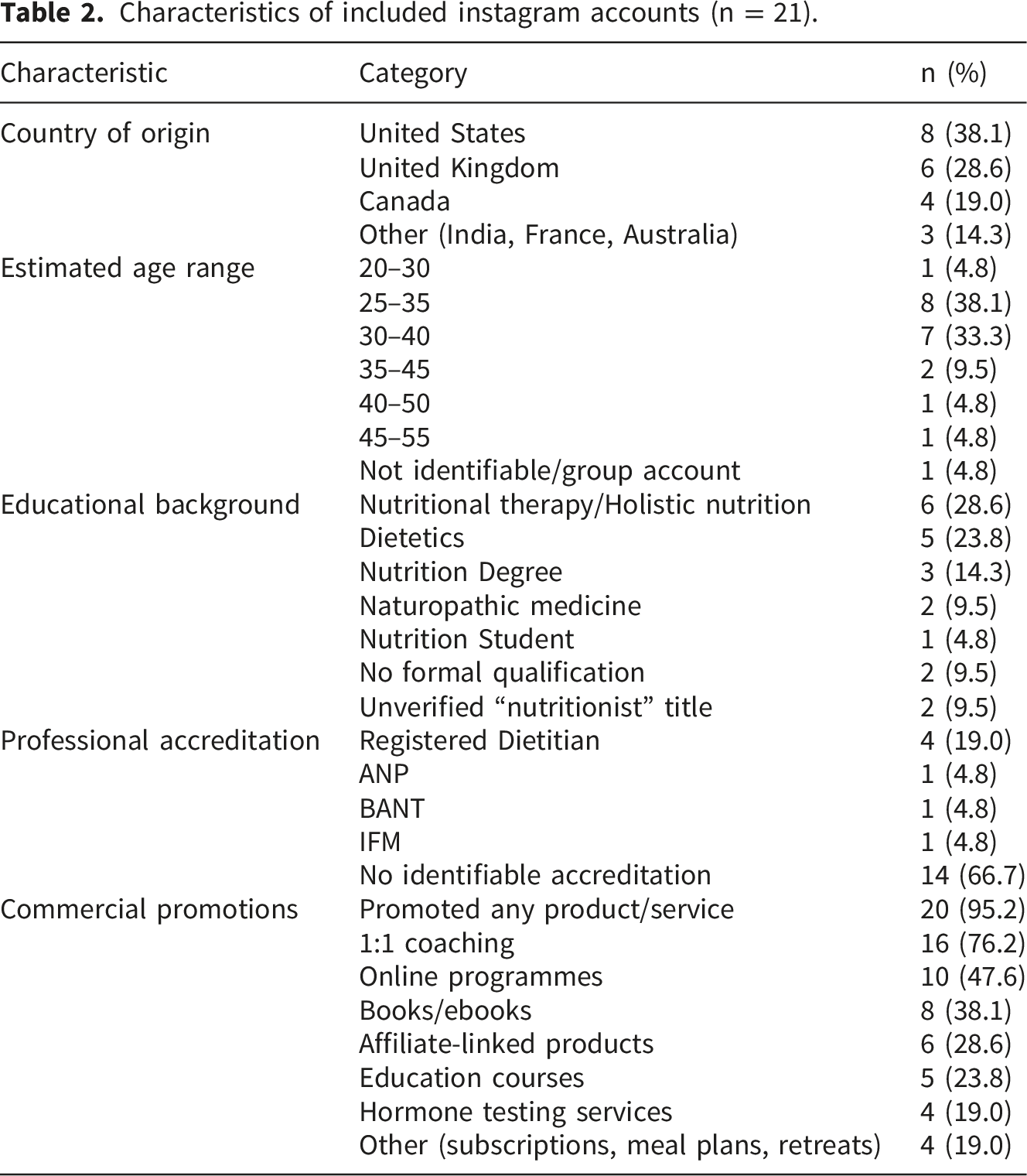
Characteristics of included instagram accounts (n = 21).
Content analysis overview
Twenty most frequently occurring codes in descending order by number of references.

Note. Accounts refers to the number of Instagram accounts in which each code appeared. References refers to the total number of references to each code across all analysed posts.
Main categories and sub-categories with quotes from example Instagram posts.


Word cloud showing frequency of hashtags used across sampled posts, with larger word size indicating higher usage.
Overview of key themes
Marketing and Engagement Strategies reflected the commercial and persuasive framing of content across the dataset. Posts frequently used promotional language, motivational phrasing, hashtags, and invitations to engage with paid services such as coaching, online programmes, or downloadable resources. Some posts also used myth-busting or balanced messaging, but commercial intent remained a prominent feature of the content analysed.
Nutrition and Dietary Recommendations was the most prominent category, encompassing posts focused on nutrients, supplements, functional foods, dietary patterns, meal structure, and cycle-phase specific nutrition advice. Recommendations commonly included magnesium, protein, fibre, healthy fats, and phase-specific foods, and were often framed as strategies to support hormone balance, reduce symptoms, or optimise menstrual health. While some posts referred to scientific concepts or research, supporting evidence was often limited, absent, or presented without adequate context.
Hormonal and Physiological Claims captured posts that explained menstrual and hormonal health through simplified biological mechanisms. These commonly related to oestrogen and progesterone support, cortisol regulation, inflammation, blood sugar balance, and detoxification. Such claims were often used to justify dietary or behavioural recommendations but were frequently presented with a level of certainty that was not consistently supported by current scientific evidence.
Symptoms, Wellbeing and Lifestyle Factors included posts linking nutritional or behavioural strategies to outcomes such as period pain, fatigue, mood, cravings, bloating, acne, gut health, fertility, and premenstrual symptoms. This category also included broader lifestyle advice relating to stress management, physical activity, sleep, hydration, and self-care. Although some recommendations were consistent with general health advice, many symptom-related claims were not accompanied by clear or appropriate scientific explanation.
Discussion
This study found that Instagram content on menstrual and hormonal nutrition commonly combined dietary advice, physiological explanations, symptom management strategies, and commercial messaging within the same posts. Notably, 20 of the 21 account holders promoted a product or service, and 14 of 21 had no identifiable accreditation with a recognised professional body. These findings raise concerns about the credibility of advice presented in this space, particularly where health recommendations are closely tied to self-promotion and professional oversight is inconsistent. Across the dataset, posts frequently focused on hormone regulation, symptom relief, and nutrition strategies presented as supportive of menstrual health. Although some recommendations aligned with existing research, many claims were communicated with greater certainty than the current evidence appears to support. Overall, the findings suggest that Instagram content in this area often presents menstrual health as highly responsive to dietary and lifestyle modification, whilst failing to acknowledge the uncertainty, complexity, and context surrounding many of these claims.
Commercialisation and credibility
Commercial messaging was a prominent feature of the content analysed, with marketing-related content evident within the analysed posts from 17 of the 21 accounts. Marketing and hashtags were also the two most frequently occurring codes, indicating that menstrual health advice was often presented in ways designed to attract attention and encourage engagement. Educational backgrounds were highly variable, ranging from dietetics and nutrition degrees to holistic or naturopathic training, with some account holders having no formal qualification or using unverified “nutritionist” titles. 66.7% of account holders were not registered with any professional regulatory body. This matters because those outside professional regulation are not held to the same standards intended to uphold evidence-based practice, accountability, and ethical communication. This may increase the risk of oversimplified or weakly substantiated advice being presented to users, making it harder to distinguish genuine evidence-based support from commercially driven messages lacking real scientific backing.
Hormone balance and physiological claims
Posts frequently framed menstrual health through simplified physiological claims, particularly around inflammation, blood sugar, and hormonal support. This suggests that symptoms were often explained through a small number of modifiable biological targets. Whilst nutrition is recognised as relevant to hormonal and menstrual health,10,14 this is not the same as evidence for the often highly specific and often curative claims commonly presented in Instagram posts. However, some of the mechanisms reflected in these posts may be supported to some extent by existing evidence. For example, preliminary research suggests that anti-inflammatory foods may help to reduce menstrual pain severity, although current evidence is limited and often inconsistent. 21 Wider research also suggests that balanced dietary patterns of nutrient-dense whole foods with minimal added sugar may help manage PD.22,23 These results suggest that balanced diets and a more holistic dietary approach may be more effective overall than focusing on individual nutrients as posts frequently suggested. Blood sugar regulation also has some relevance to appetite, satiety, and cravings, although the relationship is complex and improved glycaemic responses do not consistently translate into simple or predictable reductions in hunger or food cravings. 24 Therefore, cycle-related changes in cravings should not automatically be interpreted as evidence of a blood sugar imbalance that needs correcting. 25
Across the coding framework, there were 46 references to food recommendations linked to the four menstrual phases, showing that phase-based nutrition was a major feature of the content analysed. However, the evidence base for targeted dietary approaches within each phase remains limited. Although some research has suggested that appetite and energy intake may fluctuate across the menstrual cycle, 26 this does not support prescribing particular foods in each phase to reduce symptoms, improve menstrual health or balance hormones by following prescriptive dietary rules. A content analysis of self-help books described how hormone-balance discourse encourages women to pursue an idealised, potentially unrealistic state of balance through ongoing dietary and lifestyle self-management. 27 A similar pattern was evident here, where aspirations towards better periods, clearer skin, improved mood, and fewer symptoms were tied to specific dietary routines and, at times, to promoted testing or paid support. This reinforces the overlap between commercial messaging and the promise of achieving improved hormonal or menstrual health through continual self-management.
Symptom relief
Symptom-relief claims were also prominent across the dataset, particularly in relation to period pain, PMS, cravings, mood, fatigue, gut health, and fertility. Many posts recommended specific foods, supplements, or dietary routines as direct ways to improve these outcomes. Some of these strategies do have some support in the literature. For example, broader dietary patterns and certain nutrients, including omega-3 fatty acids, magnesium, zinc, vitamin D, and curcumin, have been associated with potential benefit for menstrual symptoms in intervention studies and reviews.13,28 However, the evidence is mixed, and its practical application is more complex than the simple and broadly applicable advice often presented on Instagram, with effects varying according to dose, source, duration, background diet, and wider lifestyle context. 13 Some supplements may also carry risks, interact with medications, or affect the absorption of other nutrients.29,30 As a result, the issue was not only that some recommendations lacked scientific backing, but that even partially supported strategies were often communicated without sufficient context on their limitations, risks, or appropriate application. This may make symptom relief appear more predictable and universally achievable than the current evidence suggests.
Instagram as a health information source
These findings suggest that menstrual health nutrition advice on Instagram was often shaped into content that was simplified, personalised and actionable, combining physiological explanations, symptom-relief promises, dietary routines, and commercial promotion within the same posts. Menstrual health was repeatedly framed as something that could be improved through food choices, supplements, lifestyle changes, and, in some cases, paid support. Paid support itself is not necessarily problematic, as nutrition and dietetic consultations often improve diet quality and related health outcomes. 31 However, concern arises when these services are promoted alongside bold claims and promises to eliminate symptoms or “balance” hormones, despite the evidence for such outcomes often being limited, mixed, or dependent on individual context. This raises cause for concern, as it also risks reducing complex and highly individual experiences to a set of solvable problems with clear dietary solutions. In this context, the issue is not only the presence of unsupported claims. Social media’s tendency to prioritise concise, persuasive, benefit-focused messaging over the more cautious and qualified discussion that health-related topics often require is also concerning. Recent research on Instagram and TikTok health content found that benefits were emphasised far more often than harms, promotional tone was common, and scientific evidence was rarely mentioned. 32 Additionally, nutrition Instagram content that was ranked as lower-quality generated greater engagement than higher-quality content 2 suggesting that these platforms can reward simplified and selectively framed messages while lacking the nuance required around complex health topics. This may also have implications for eating behaviours. Quick-fix nutrition advice may encourage an overemphasis on specific foods or nutrients at the expense of a more balanced and flexible approach to eating. Greater Instagram use has also been associated with increased orthorexic symptoms, 33 suggesting that repeated exposure to idealised nutrition messaging may contribute to more rigid or perfectionistic attitudes towards food.
Strengths and limitations
A strength of this study is its focus on Instagram as a source of menstrual health nutrition advice, an area that remains underexplored despite the growing role of social media in shaping health beliefs and dietary behaviours in this area. By examining not only the content of posts but also how advice was framed through physiological explanations, symptom-relief promises, commercial promotion, and markers of professional credibility, the study provides insight into the broader information environment surrounding menstrual health nutrition advice online.
Several limitations should be acknowledged. The analysis was limited to one platform and a relatively small sample of 21 accounts, which may not capture the full range of menstrual nutrition content available across social media. Data collection was conducted over a restricted time period and therefore may not reflect longer-term posting patterns or changing trends in content. As the analysis took place in January, when diet and health focused messaging is likely to be especially prominent, 34 some seasonal influence is also possible. In addition, coding and interpretation were conducted by a single researcher, which may have increased the risk of subjectivity in category development and data interpretation. The sampling criteria may also have introduced bias by overrepresenting English language content, larger accounts and short-term posting trends, thereby limiting the broader generalisability of the findings. The study also examined the content itself and cannot determine how users interpreted, trusted, or acted on the advice presented. The findings should therefore be understood as an analysis of how menstrual nutrition advice was constructed and communicated on Instagram, rather than as a measure of its direct impact on user behaviour or health outcomes.
Implications for practice and research
These findings suggest that healthcare professionals should be aware that patients may encounter menstrual health nutrition advice online that appears credible and evidence-based but is often presented without adequate nuance or context. Rather than dismissing such content outright, there may be value in helping patients to critically evaluate common claims relating to symptom relief, hormone balance, supplements, and cycle-specific eating patterns. There is also a need for clearer, accessible public-facing guidance on menstrual health nutrition that is transparent about both the potential benefits and the limits of current evidence. More research is needed on the mechanisms and effectiveness of many of the strategies frequently promoted in this space, particularly in relation to symptom relief, hormone regulation, and cycle-specific dietary approaches. This is important because part of the issue lies not only in how evidence is communicated on social media, but also in the limited and still-developing research base surrounding nutrition and menstrual health. Further research may also be useful in exploring how users interpret and act on this content, including the extent to which it influences dietary behaviour, supplement use, and help-seeking.
Conclusion
This exploratory content analysis found that Instagram posts on menstrual health nutrition often combined dietary advice, physiological explanations, symptom-management claims, and commercial promotion. Although some recommendations loosely aligned with existing evidence, much of the content was presented in oversimplified and actionable ways, with limited attention to uncertainty, complexity, and context. As a result, nutrition advice on Instagram may appear credible while lacking the nuance needed for complex and highly individual experiences of menstrual health. The prominence of marketing and inconsistent professional regulation may make it more difficult for users to distinguish evidence-based support from commercially driven or poorly supported claims. Clearer public-facing guidance is therefore needed to support more informed interpretation of menstrual health information on social media.
Footnotes
Acknowledgements
The authors would like to acknowledge the support of Coventry University during this research. The authors also thank Daniel Ashenden for their ongoing support and encouragement throughout the project.

Ethical considerations
Ethical approval for this study was obtained from Coventry University Ethic (approval number: p181718). The study analysed publicly accessible Instagram content only.
Consent to participate
As no human participants were directly recruited or contacted, consent to participate was not applicable. Account holder names were not reported to anonymity of the included account holders.
Author contributions
Eleanor Marks: Conceptualisation, methodology, software, formal analysis, investigation, data curation, visualisation, writing – original draft, writing – review & editing. Helen M. Jones: Conceptualisation, methodology, supervision, project administration, writing – review & editing.
Funding
The authors disclosed receipt of the following financial support for the research, authorship, and/or publication of this article: This research was supported by Coventry University through institutional resources. No specific grant from public, commercial, or not-for-profit funding agencies was received.
Declaration of conflicting interests
The authors declared no potential conflicts of interest with respect to the research, authorship, and/or publication of this article.
Data Availability Statement
The datasets generated and/or analysed during the current study are not publicly available in order to preserve the anonymity of the Instagram accounts included in the analysis but may be available from the corresponding author on reasonable request.
Declaration of Generative AI and AI-assisted Technologies in the manuscript preparation process
During the preparation of this work the authors used ChatGPT (OpenAI) to assist with refining phrasing, improving clarity, locating sources and ensuring adherence to journal formatting guidelines. After using this tool, the authors reviewed and edited the content as needed and take full responsibility for the content of the publication.