




Abstract
Psychological researchers have found that exposures to stimuli (primes) can subsequently influence people’s behavior by pathways that would seem to be quite remote. For example, people exposed to words associated with older adults may walk more slowly. Recently priming studies, particularly those showing dramatic effects on social behavior, have been under scrutiny because of the unreliability of empirical results. In this article, we shed light on the issue by describing a general model of intersensory interaction, in which two or more sources of information provide an estimate or “bid” on a property of the world, with the perceptual outcome being a weighted combination of the bids. When it is extended by adding bids that stem from memory or inference, the model identifies systematic factors that might undermine priming, including random variation in estimates, contextual influences on memory retrieval and inference, competition among information sources, and cognitive control. These factors are not only explanatory but are predictive of when priming effects can be expected. Our hope is that by promoting the understanding of underlying processes that may explain how primes can influence behavior, the bidding model and the general approach that it represents offer novel insights into the hotly debated area of priming research.
The field of psychological science is currently reverberating with questions about the reliability and validity of established findings in behavioral science (e.g., Abbott, 2013; Yong, 2012). A significant share of the debate has fallen on so-called behavioral priming studies, in which exposures to stimuli under supraliminal or brief subliminal conditions alter subsequent behaviors. The term priming has its origins in research concerned with the activation of a concept or neural site and its spread to others (e.g., Dehaene et al., 2001; Meyer & Schvaneveldt, 1971; Schacter & Buckner, 1998). Priming has further been extended to effects on complex behaviors that are often quite distal or remote to the primed concept. For example, studies in social psychology have shown that writing down attributes of a typical professor improves subsequent problem-solving performance (Dijksterhuis & van Knippenberg, 1998) or that unscrambling sentences with embedded words stereotypic of older adults causes participants to then walk more slowly (Bargh, Chen, & Burrows, 1996). Although these examples point to priming mediated by semantic concepts—intelligence and aging, respectively—recent research has also highlighted the possibility of embodied priming, in which stimulating sensory pathways alters socially directed behaviors. Studies in this embodiment domain show that holding a hot cup of coffee fosters interpersonal warmth (Williams & Bargh, 2008) or that spending time in a lemon-scented room increases charitable acts, linking physical to moral purity (Liljenquist, Zhong, & Galinsky, 2010).
It is understandable that the extension of priming beyond its roots in the millisecond scale of perception and memory to the complexities of social behavior elicits an “oh wow” reaction. Unfortunately, the excitement has been mitigated by some demonstrations of failures to replicate (e.g., Doyen, Klein, Pichon, & Cleerermans, 2012; Pashler, Coburn, & Harris, 2012; Shanks et al., 2013), and the resulting debate about reliability has made its way into various forums in the academic domain (e.g., Bartlett, 2013; Kahneman, 2012; Psychonomic Society, 2012). Much of the discussion has centered on the experimental and statistical approaches used in priming studies and their possible vulnerabilities. Our focus, in contrast, is on underlying psychological processes, as motivated by a model of intersensory interaction. We suggest that the model can be applied more broadly to shed light on issues surrounding the reliability of priming effects.
Research on intersensory interaction shows how inputs to multiple senses are combined in the act of perception (e.g., Ernst & Bülthoff, 2004). We emphasize here, however, that interactions that begin with sensory inputs are not confined to low-level perceptual processing. To the contrary, these interactions can be mediated by memory-based associations or can result from inference. It is also particularly noteworthy that as researchers move away from “bottom-up” perceptually driven effects to more “top-down” memory influences that they uncover factors that make priming phenomena inherently fragile and potentially subject to nonreplication.
In essence, in the present article, we attempt to connect two seemingly disparate bodies of research. One shows how the senses interact to combine cues about the physical world. The second demonstrates, not without controversy, that judgments and behaviors can be primed by information that seems intrinsically to be quite remote. The basic premise here is that by examining the first area, we can further the understanding of controversies that have plagued the second.
The article proceeds as follows. We begin with a general introduction to intersensory interaction in the form of a weighted bidding model. Although the initial model is developed around sensory phenomena, we extend it to embodied perception and socially directed behavior. The extensions require indirect bidding pathways that may or may not be followed, depending on the vagaries of stochastic processes or the influence of contextual cues. The model thus exposes inherent vulnerabilities to priming in the social domain. Finally, we consider predictions of the present approach for priming studies.
Intersensory Interaction Viewed as Integration of Weighted Bids
The physical properties of the world are varied, and specialized sensory systems—or in information-theoretic terms, channels—have developed to deal with them. Vision takes in photons of light, hearing takes in sound waves, olfaction takes in molecules, touch takes in mechanical and thermal interactions with the skin, and so on. Each of these systems has been intensively scrutinized from physiological and functional perspectives, and the standard sensation–perception textbook is generally constructed in modular form to honor sensory specialization.
Although it makes scientific sense to examine systems in isolation, in everyday perceptual experience, multiple sensory pathways provide information about the physical environment. When stirring a mug of coffee, one can sense the resisting forces, see whether the mug deforms, and hear sounds as the metal spoon contacts the walls. The degree of rigidity of the surface is conveyed by all of these sensations; some, like touch, more directly, and others, like sound, more inferentially (Klatzky, Pai, & Krotkov, 2000). As described later, research on perception from multiple sensory channels shows that the perception of rigidity can benefit from integrating information across all of these sensory channels, resulting in a representation that is distinct from what any one might produce in isolation.
A general model for intersensory integration suggests that each of multiple input sources produces an estimate, or bid, for the value of some physical property of the world, and these bids are weighted and integrated (e.g., Anderson, 1974; Ernst & Banks, 2002; Jones & O’Neil, 1985; Welch & Warren, 1980; similar models are applied in other areas, such as learning). Each independent input channel takes in some data from a stimulus event, from which it produces an estimate of the event’s magnitude along some quantifiable dimension. For example, the auditory channel uses a sound’s vibration to estimate the intensity of a songbird’s chirp, whereas a visual estimate might be produced by looking at the movement of the bird’s throat. A weight is assigned to each of the channels, and an integration process produces a weighted combination (often assumed to be a sum) as the result. This output constitutes the integrated estimate of magnitude along the underlying perceptual dimension. In turn, that estimate serves as the basis for further behavior, be it verbal report, action, or cognitive deliberation. When asked about the “loudness” of the bird’s chirp, one might report on the basis of the integrated intensity that comprises a weighted combination of the visual and auditory channels—or, as illustrated in Figure 1a, visually guided grasping of an apple could result in an integrated perceptual estimate of its size on the basis of bids from vision and touch.

Variations in how bids are produced: (a) direct perceptual avenues for apple size estimates; (b) mediated by a memory association between the category apple and stored data about apple size; and (c) mediated by a chain of associations from fruit, to apple, to stored size data.
The world described by this model will vary from moment to moment, for several reasons. The physical environment itself is in flux, of course, but even if the world was stable, there would be momentary fluctuations in the model’s description of it. These arise because perceptual channels are noisy and do not continually produce the same response to the same event; each bid quantity is subject to stochastic variation. Further variations arise because the details of the general bidding model can be specified in different ways, including which channels provide bids, how channels are weighted, and what kind of response is governed by the output. These variations in the model’s specifics become increasingly important as researchers move beyond perception to higher level cognitive and social phenomena.
Consider variations arising from which channels provide bids. When one judges the intensity of the songbird’s chirp, one may or may not look at its throat, and whether one does will determine whether an estimate is provided by vision. However, if one does look at its throat, the next question is, how are the bids generated? Perceptual and neural models describe precisely how the auditory system converts the vibratory signal into a sensation of loudness, but a bid from vision would seem to require some association between the visible vibration of the bird’s throat and sound intensity.
Another important factor that affects the output of the model is how bids are weighted. One particular version of weighting is described by a maximum-likelihood rule (Clark & Yuille, 1990): A bid is assigned a weight according to the reliability or precision of the input source, which is inversely related to the intrinsic variability in its estimate. The variability associated with a source reflects past experience but is also adjusted from ongoing cues in the perceptual context (Ernst & Bülthoff, 2004). More variable sources are discounted relative to other, more reliable sources that are present. This form of integration results in a shift in the mean estimate so that it lies in between the means of the source distributions (assuming nonzero weights) but closer to the more reliable source. Maximum-likelihood integration also has the useful property that the combined distribution has greater reliability (less variability) than the components (as shown in Figure 2). Evidence for this form of integration in perceptual judgments was provided by a study in which a virtual step edge was perceived through simultaneous stereo visual cues and fingertip forces (Ernst & Banks, 2002). As would be expected if weights follow reliability, reduction in the stereo cue (i.e., manipulating the disparities to randomly displace the depth of surface points) led to higher weighting of touch relative to vision. Maximum-likelihood weighting is not inevitable, however, even for perceptual judgments; for example, the model breaks down when the touched and visual objects appear to be in different locations (Helbig & Ernst, 2007).

Heuristic bidding for haptic distance estimate based on movement time is integrated with a bid from kinesthetic sensory input.
For purposes of the discussion here, the primary outcome of the bidding process is behavior, and the multiple forms this can take constitute another source of variation. In perceptual experiments, typical responses are verbal estimates or actions that indicate the magnitude of a physical property, such as reaching to an object to indicate its distance. However, any behavior responsive to the impact of environmental triggers can be affected by the weighted-bid process as it is conceived here, making the model relevant to social and other complex intellectual judgments. We consider such behaviors later in the article, after describing how the model can be extended to encompass them.
Extending the model: Mediated bids
The bidding model was originally developed to describe intersensory interactions between perceptual channels, each of which provides an estimate of a physical quantity, as depicted in Figure 1a. However, perceptual bids also interact with stored knowledge. Figure 1b illustrates this process when an estimate is mediated by retrieval from memory (e.g., on hearing the word “apple”). This version of the model is directly informed by efforts that have been made to characterize how knowledge can be converted into an estimate, including the following: retrieving multiple exemplars and computing a mean, or using the most accessible exemplar or a previously stored prototype to represent the category (see, e.g., Nosofsky & Zaki, 2002). Like perception, memory is noisy and subject to stochastic variation, which may undermine the weight given to an estimate resulting from such sources.
In a study that nicely illustrates how a mediated bid for a physical property can affect a behavioral response, the participant’s task was to reach for and grasp an object like an apple (Castiello, Zucco, Parma, Ansuini, & Tirindelli, 2006). Visually guided grasping is highly automatic for adult humans, and it is well documented that the size and timing of the hand aperture are closely coupled with the arm movement (Jeannerod, 1984). The critical manipulation in the experiment was to have participants begin some trials with a 2-s sniff of a smell associated with an object that differed in size from the visible target. Reaches were predictably distorted by the sniffed object. A person who smelled an orange before grasping a strawberry, for example, opened the hand while reaching to a larger aperture than would be predicted by the target size alone. Interpreted in terms of the bidding model, it appears that the orange smell led to the retrieval of orange size from memory, which generated an estimated size that was integrated with the bid derived from vision, ultimately modulating the behavioral response.
A more general pattern for intersensory interactions resulting from memory-based associations is shown in Figure 1c, which not surprisingly illustrates that associative chains can occur in memory to ultimately shape responses. A sensory input on one channel can lead to a retrieved association in memory, which triggers further associations in sequence (e.g., estimating the size of an apple after hearing the word “fruit”). Ultimately, an association yields a bid on the magnitude of the corresponding physical event, which is integrated with other sensory information. These chains linking basic inputs to responses raise important implications for sequential causal paths that are likely to be necessary for primes to affect often remote social behaviors (more on this later).
Extending the model: Heuristic bids
Mediated intersensory interaction relies not only on access to memory but also on the ultimate retrieval of an estimated magnitude for a physical event. In the grasping experiment described previously (Castiello et al., 2006), both the visual input and the smell-induced retrieval presumably led to an estimate of the target’s size, although the latter required some intermediate step, such as accessing a prototype. Another scenario, however, is for information to be triggered that is qualitatively different from the target perceptual dimension but nonetheless affects the estimate along it. If the smell was replaced by an intense sound, for example, one might perceive its loudness and then infer that it came from a large-size object, under the assumption that larger things emit louder sounds. Bridging the difference in the information content to produce a quantitative estimate of the target dimension—here size, not loudness—requires an inferential process, which we refer to as a heuristic bid.
An example of heuristic bidding, resulting from the common association between the duration of travel and the distance traveled, can be found in a haptic distance judgment. The reader can try it out as follows: Close your eyes and place your two index fingers next to each other on a table top, then glide the right finger along an arbitrary curved path to separate it from the left. Now estimate the straight-line distance between your fingers. If you are like experimental participants, your direct-distance judgment will increase with the time spent moving the fingers apart (Lederman, Klatzky, & Barber, 1985; Lederman, Klatzky, Collins, & Wardell, 1987—we note for completeness that path distance contributes as well). From the perspective of heuristic bidding, as depicted in Figure 2, perceived movement duration leads to a bid for the distance between the fingers in space, which is then integrated with an estimate based on position perception from kinesthetic (body based) receptors.
Heuristic bidding, like memory-mediated bidding, relies on stored knowledge. The distinction we intend is that in the heuristic case, what is retrieved is not itself an estimate of the dimension of interest but rather a pattern of association in past experience that relates that dimension to another estimate that is triggered by the current environment. The experiment just described shows that relations present in remembered action, as between time and distance moved, can penetrate current perceptual estimates.
Heuristic bidding is pushed still further by studies that suggest anticipated action affects the perception of environmental properties. For example, the perceived distance of a target reportedly increases with the effort that would be needed to reach it by walking or throwing (Proffitt, Stefanucci, Banton, & Epstein, 2003; Witt, Proffitt, & Epstein, 2004). This implies, in terms of the weighted-bids model, that estimates of spatial parameters result from a heuristic computation based on something like the prospective resource costs of action. Indeed, theories of embodied perception and cognition attribute just such computations to internal motor simulations (e.g., Grafton, 2009).
To the extent that anticipated action penetrates action judgments and even motor behaviors, an important issue is where the penetration occurs. One interpretation is that embodied computations directly affect the visual estimate (Proffitt, 2006). By the present argument, rather than its being attributed to visual processing per se, the effect of anticipated action on perception stems from an independent bidding source that is heuristic in nature. Its influence becomes integrated with that of vision at a later point, leading to the observed response.
Extending the model: Bids on social variables
To this point, we have focused the discussion on how sensory information can result in estimates or bids on physical quantities, albeit indirectly at times. How might this framework help explain social priming effects? Here, the generality of the bidding model comes into play. In essence, the model has only two requirements: First, there is an underlying quantitative dimension that governs behavior (however complex the dimension or the behavioral response); second, information in the current environment can be used to arrive at an estimate along this dimension (albeit along indirect pathways). These assumptions, we argue, extend to any behavioral domain, including socially influenced behaviors like those examined in remote priming studies.
Recall the well-publicized priming finding in which after holding a warm object (coffee cup or heating pad), people judged social targets as more generous and caring, and they themselves behaved more generously (Williams & Bargh, 2008). The authors proposed that body states contribute to social impression formation, ultimately affecting overt social judgments and interpersonal behaviors. The bidding model offers an account for how the physical sensation of warmth can change high-level interpersonal behaviors. The warm mug activates a memory representation of the general concept of warmth, which includes associations such as the physical warmth one may have experienced when in close proximity to others, like caregivers in early life. Through the semantic connection of physical warmth to social warmth, a quantitative estimate on some dimension of social warmth is generated, and this bid is further integrated with estimates based on more direct social cues.
The bidding model can be applied to stereotype social priming studies as well. Consider the finding that priming the concept of “elderly” with words unrelated to action (e.g., Florida, old, lonely) caused people to walk more slowly (Bargh et al., 1996). Figure 3 illustrates the basic bidding processes that might be involved: First, it is well demonstrated that reading or hearing a set of words related to a common underlying concept activates that concept, a phenomenon known as the Deese–Roediger–McDermott effect (Roediger & McDermott, 1995). Thus, we can assume that elderly is primed. The next requirement is that the concept of elderly prompts a quantitative bid on some dimension that ultimately affects walking speed. The experiments reviewed earlier, concerned with effects of prospective action on perception, offer a candidate dimension: energy resources. Age, in particular, has been found to accentuate the perceived steepness of hills (Bhalla & Proffitt, 1999), which has been attributed to older people’s having reduced energy available for climbing them. The next step in the bidding account proposes that the priming of the concept of advanced age by related words leads to a reduction in self-judged energy resources—that is, that priming agedness alters prospective energy estimates similarly to energy depletion from aging itself. The final step in the causal chain is for prospectively judged resources to have a direct effect on the regulation of walking speed.
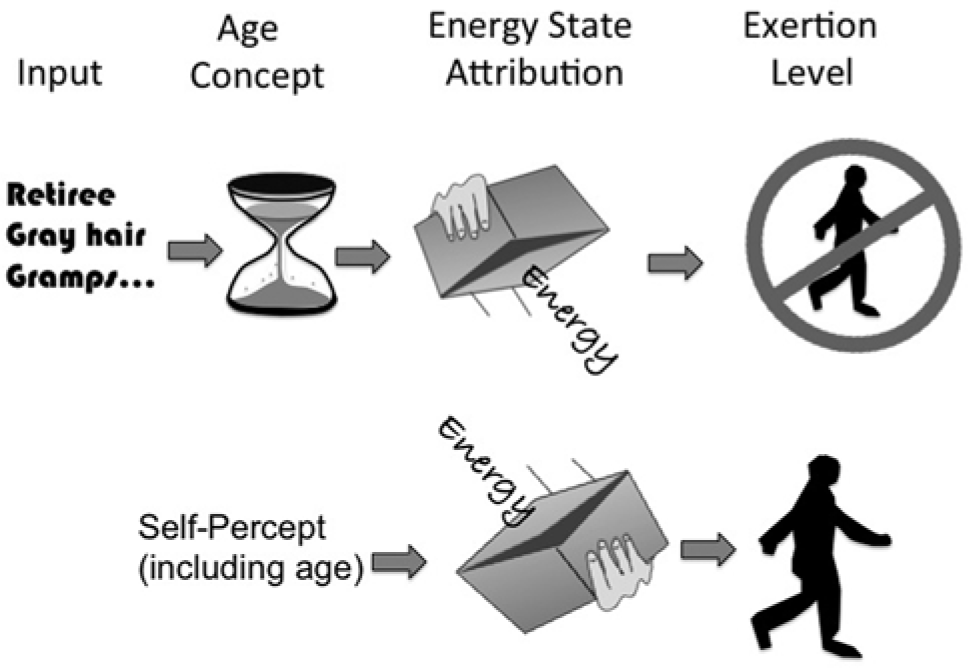
Exertion behavior based on energy state. Bids on energy state are triggered by age primes (top) versus unprimed self-perception (bottom), ultimately affecting walking speed.
Perhaps not surprisingly given the complexity of this account, multiple failures to replicate the elderly-walking effect have been published. In one replication attempt, Doyen et al. (2012) found that the effect was obtained only when the experimenters believed that participants given age cues would walk more slowly, leading Doyen et al. to presume that the priming cues were supplemented with environmental cues from the experimenters themselves. Pure demand characteristics were precluded by finding that faster walking (cf. the slower walking associated with age, the primed concept) was not elicited by experimenter expectations. The results are consistent with the present proposal that heuristically generated bids and their weightings depend on the strength of contextual cueing. They suggest, more specifically, that experimenter-derived cues amplify the context sufficiently for the elderly induction to work as described earlier.
Modulators and Limitations of Interaction
As the intersensory integration model is extended beyond perception per se to memory mediation, anticipatory heuristic processing, and to nonphysical properties of the world, something is lost in the process, namely, determinism. In the literature on priming, a distinction has been made between top-down and bottom-up influences on behavior, attributed to indirect, or primed, pathways and perceptual processes, respectively (Doyen et al., 2012). Rather than a dichotomy, the present approach suggests a continuum of complexity in the processes that lead to a bid and, hence, in their inherent vulnerability.
The model offers multiple routes to bid generation, including perceptually based estimation, memory retrieval, associative chaining, and heuristic inference. As for the first of these, intersensory interaction at perceptual levels is generally assumed to reflect low-level processes that, although they are subject to intrinsic stochastic variation, are relatively invariant across young, healthy adults. When interactions begin to involve associative and cognitive inferential processes, the potential arises for the underlying effects to be become more variable and less robust. Sources of variation are discussed later and are summarized in Table 1.
Sources of Variability in Different Bidding Processes
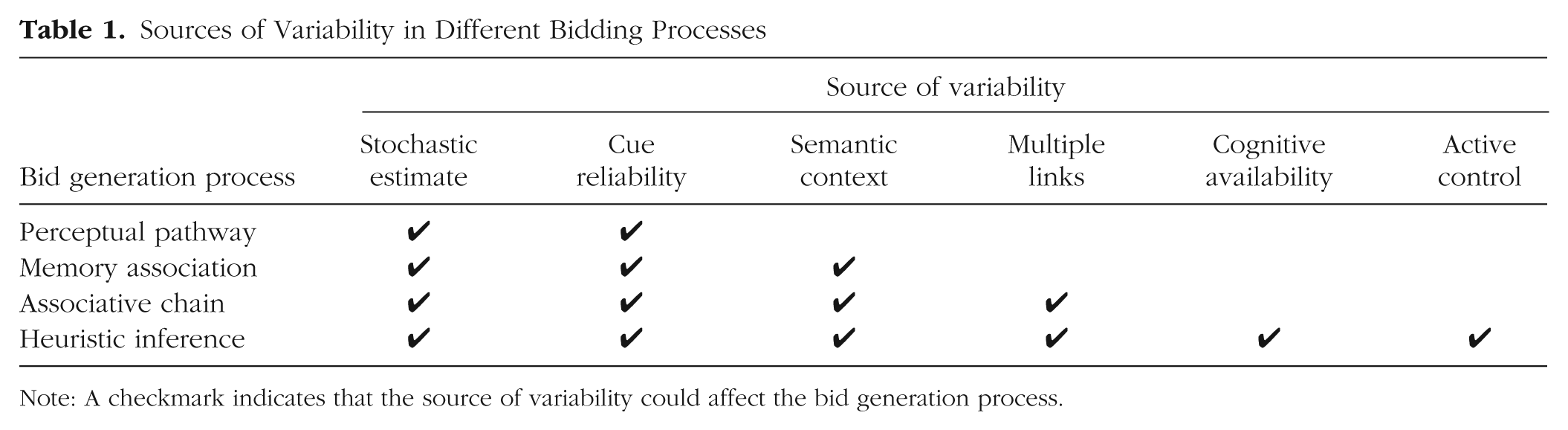
Note: A checkmark indicates that the source of variability could affect the bid generation process.
Let us start with the mediated bid model shown in Figures 1b and 1c, in which input on a sensory channel leads to a bid as a result of one or more memory-based associations. A specific version of associative effects, called semantic priming, is demonstrated when presentation of one word (like doctor) speeds access to another (like nurse) in tasks like reading or lexical decision. This effect has been attributed to the spread of activation along a path in memory leading from one concept to the next (Meyer & Schvaneveldt, 1971).
Spreading activation is a general mechanism to describe memory retrieval, and research on this phenomenon has implications for mediated bids. In particular, experiments on semantic priming have pointed to a number of factors that can influence whether a mediating connection is made. One is semantic context: When a polysemic word is presented, which meaning is selected depends on current or previous meaningful content; “cold” in the context of “hot” is different from “cold” in the context of “sneeze,” and the words it primes change accordingly (Zeelenberg, Pecher, Shiffrin, & Raaijmakers, 2003). The influence of context can be more subtle as well, shading a word’s meaning. For example, if the word “cold” is encoded in the context of “ground,” it may not be recognized in a memory test when it is retrieved in the context of “hot” (Tulving & Thompson, 1973), though in both cases the meaning is the thermal one. Language itself may contextualize meaning. The thermal sense of the word “warm” is no doubt paramount in speakers of American English, but readers of Galsworthy may retrieve a British English sense of the word meaning wealthy, and to speakers of German, it may connote homosexuality.
Another factor that can create variability in semantic priming is the length of a mediating chain. Although robust priming is generally found between two strong semantic associates, when successive words are associated only indirectly (e.g., cicada–drought–fire–light), the priming effect becomes smaller and more task dependent (McNamara, 2004). The weakening across chained associations is not entirely surprising if one considers that every link must be successfully followed for the desired end-to-end connection to occur. There is no guarantee, however, that this occurs, as associations appear to be stochastic rather than deterministic. The success of associative chaining requires an “and” operation on all the links and, hence, a multiplication of probabilities. As links are added or associations become weaker, the probability that the full chain is completed quickly becomes vanishingly small. As we discuss later, the associative chains needed to account for remote social priming effects would likely be quite complex.
Like bids based on semantic associations, heuristic bids are vulnerable. They require both that the underlying inference—for example, that old people lack energy resources—is called up in the given context and that the resulting heuristic bid is given a sufficient weight to affect the integrated percept. The use of heuristic bids will rely on engagement of the processes that generate them, which for cognitively based heuristics, at least, appear to go beyond the automatic retrieval described by spreading activation. Research on analogical reasoning and example-based learning clearly demonstrates fallibility in relating the substance of current deliberation to relevant knowledge, particularly when obvious surface or conceptual similarities are lacking (Gentner & Markman, 1997; Gick & Holyoak, 1983). For example, a description of secretive military deployment of spatially distributed soldiers can be analogically extended to the use of multiple distributed pathways in radiation therapy—but generally is not. Given the limitations in spontaneous use of related knowledge, contextual cues are an important tool for eliciting it (Schunn & Dunbar, 1996). The implication for present arguments is that variations in the cues provided by context will produce variations in heuristic availability. Heuristic bids cannot be reliably induced if they are not reliably cued.
Even when bids are generated, they must be given positive weights to prime behaviors. Variations in weighting likely constitute another basis for unreliability. A potential influence on weight is what other sources of information are available. In particular, the maximum-likelihood rule for integration predicts that heuristic inference should have a smaller effect on an estimate, as cues from more reliable sources increase. Although competition for weights potentially applies to all types of bidding (see Table 1), heuristic bids might be particularly susceptible because of contextual variation in the availability of alternate cues.
A further possible source of variability in heuristic priming effects, in particular, is that the use of cognitive inferences might be subject to an individual’s active control. There is evidence, to the contrary, of limited ability to tune out unwanted bids stemming from direct perceptual channels. For example, cross-talk between modalities was clearly demonstrated when the task was to count the number of taps on a finger while viewing flashing lights, or vice versa; in both cases, numerosity on the to-be-ignored channel affected counting on the primary one (Bresciani, Dammeier, & Ernst, 2006). Like the classic Stroop effect, this phenomenon suggests not only that there was automatic perception of the to-be-filtered channel but that its influence on later processes of integration and response generation could not be fully controlled. In comparison with perceptually based bids, however, heuristic bids seem more likely to be subject to high-level control. It is known that the impact of memory on cognitive judgments can be reduced by describing the source as unreliable (Hasher, Attig, & Alba, 1981). Independently of what other information sources are available, people might give low weights to heuristic bids when the underlying reasoning seems weak, and if this judgment varies across individuals, so will priming effects.
In summary, multiple mechanisms underlie bidding in our model. As described earlier and in Table 1, they include perceptually triggered memory retrieval, associative chaining through spreading activation, generation of heuristics by cognitive processes like analogical mapping, weighting by reliability, and cognitive control. These processes not only introduce sources of variability but they also govern the extent to which remote priming effects might occur, as is discussed next.
Implications of the Bidding Model for Robustness of Social Priming
Failures to replicate the results of some social priming experiments have drawn considerable attention. Nonreplications also plague researchers purporting to show that prospective action affects perception of environmental properties (e.g., Durgin et al., 2009; Durgin, Hajnal, Li, Tonge, & Stigliani, 2011; Firestone, 2013; Shaffer & Flint, 2011; Woods, Philbeck, & Danoff, 2009). We suggest that the process analysis provided by the bidding model derived from intersensory interaction may help researchers to understand the lack of robustness exhibited by priming—not just in social psychology but in the general sense used here: the influence on behavior from seemingly remote sources.
Others have suggested that the replication problem lies in the statistical approaches used, particularly in the vulnerability of designs to inappropriate rejection of the null hypothesis, or Type I error (e.g., Pashler et al., 2012). The present arguments are fundamentally probabilistic, but the probabilities pertain to the uncertainties of underlying processes. The approach described here points at least to the potential for Type II error, in the form of rejecting effects that are valid but that stem from inherently stochastic and context-dependent bases.
The present approach does not mitigate criticisms of priming studies that are made on a statistical basis. Rather, a complementary effort is intended, namely, to understand how the processes underlying such phenomena intrinsically contribute to the replication problem. Under the bidding model, although it is possible that thermal warmth may affect judgments of social warmth, the pathway is a vulnerable one. To the extent that associative chains and heuristics are contextualized by the physical environment, local semantics, and culture, and given that they may be actively controlled as well, it becomes inevitable that these bids will carry less weight and less reliably shape behavior. (However, notably, if the effects are understood, as is intended by our model, manipulations of context and control processes might be used to increase the potential for remote influences to occur.)
When discussing the processes that might undermine the bidding outcome, it is instructive to revisit the elderly-priming study to consider how variability can arise when studies are conducted in different cultures. Change in semantic context across language and culture is an obvious concern, to which social priming studies have been sensitive. In particular, when nonreplication studies were conducted with students at the University of Brussels (Doyen et al., 2012)—note that the initial elderly-priming study published in 1996 was conducted with New York University undergraduates—precautions were taken to use elderly stereotypic words that would be effective semantic primes for Belgian students (presumably, avoiding primes like “Florida” from the original). Without manipulation check measures, such as the Deese–Roediger–McDermott task (Roediger & McDermott, 1995; an established measure of priming by associations), we cannot know if prime manipulations produced similar amounts of activation of the concept elderly for students in New York and Brussels. Whether or not this was the case, the bidding model offers additional, perhaps more interesting, sources for cultural effects beyond semantic context. One is the magnitude of the bid resulting from priming a concept. Using the heuristic bid example presented earlier, it could be that the aging stereotype in a European population connotes less energy depletion than in the United States, in which case the impact of priming would be lessened, however active the underlying concept might be. Another effect offered by the model is the relative reliability of a bidding source, which reflects the variability behind the estimate. If aging stereotypes in Europe suggest more diverse activity levels than in the United States—that is, older European adults are less reliably stereotyped—this would lead a bid based on the aging prime to have a lower weight. In short, it is difficult to determine whether elderly-priming studies are intrinsically unreliable or whether people in different cultures are primed to different extents for predictable reasons. Brussels/U.S. differences could arise from the potency of the primes as semantic cues, the estimate evoked by the primed concept, or the weight assigned to that estimate.
Efforts to estimate effect sizes of social priming sometimes result in values that are surprisingly large (Harris, Coburn, Rohrer, & Pashler, 2013; Pashler et al., 2012). Large effect sizes may well arise from methodological limitations noted in previous critiques (e.g., small samples; bias not to publish nonreplication studies). These issues notwithstanding, aside from pure stochastic variation, the bidding model offers a limited set of mechanisms that modulate priming per se. In particular, the model suggests that priming should be promoted or discounted, according to whether factors present in the experimental context facilitate or impede access to mediators and heuristics or suggest that indirect sources of information are more or less reliable. Thus, although the thrust of the present argument is to explain why social priming effects are vulnerable, the same approach also suggests why a range of effect sizes might be possible.
Future Research
A virtue of any theoretical account is that it points to potentially profitable avenues for research. Research based on the bidding model, in which investigators attempt to understand factors that might modulate priming effects, would of course have little value if social motivations and judgments, and the behaviors they influence, simply are not subject to priming. Our approach starts out with at least an open stance on this point. The model then suggests that experiments that systematically manipulate contextual cues are likely to be particularly informative, as it proposes that context has multiple effects.
We offer here some admittedly speculative ideas about social priming studies that could be pursued on the basis of the model. One approach is to manipulate the semantics of the primed concept and, hence, the magnitude of the bid it generates. We suggest that the elderly-priming effect could be moderated by preexposing participants to images of either physically ailing older adults or active, vital older people, which should manipulate estimates of energy resources associated with the stereotype, and thus provide contexts when the priming of the elderly stereotype could slow or speed subsequent walking behavior. (This basic prediction can be extended to other contexts and experiments, such as comparing the elderly-priming effects obtained from people who coach retirees in golf with those who provide palliative end-of-life care.) Priming study reviews in the social psychology literature provide related predictions and extensions (see Wheeler & DeMarree, 2009).
Another avenue for research is to manipulate the reliability of an estimate. If memory sources can be discounted (Hasher et al., 1981), could estimates from the bidding model similarly be reduced in impact by disparaging their basis—for example, by explaining that most elderly stereotypes are inaccurate? Indeed, some research is consistent with this possibility (Hsu, Chung, & Langer, 2010; Levy & Langer, 1994). Another way to undermine a bid is to introduce competing, more reliable cues. This predicts that as overt cues to social qualities like caring and generosity increase, the influence of a warm coffee cup should be reduced; conversely, physical temperature should have greater effect on social judgments of people with poker faces (or Botox users).
We also propose that it would be useful to manipulate experimenters’ knowledge directly to assess the effects of cues they might provide. In particular, awareness of the experimental hypothesis might bias experimenters so as to affect the associations or heuristics of participants. For example, an experimenter who is aware of testing whether a warm mug influences warm interpersonal behaviors might inadvertently foster a context in which warm interpersonal behavior could occur and, thus, promote an association from physical to social warmth. We note that even when an experimenter remains blind to a particular participant’s experimental condition, his or her awareness of the primary outcome of interest can affect the cues that invoke that outcome.
Whereas direct attempts to replicate questionable experiments provide information about the reliability of the entire causal chain from sensory input to behavior, systematic manipulations of the environment will ultimately elucidate the processes that govern indirect influences on behavior. In so doing, they will help to explain why priming effects that conceivably could happen sometimes do not.
Footnotes
Acknowledgements

Declaration of Conflicting Interests
The authors declared that they had no conflicts of interest with respect to their authorship or the publication of this article.