



Abstract
Social scientists have traditionally argued that whiteness—the attribute of being recognized and treated as a White person in society—is powerful because it is invisible. On this view, members of the racially dominant group have the unique luxury of rarely noticing their race or the privileges it confers. This article challenges this “invisibility thesis,” arguing that Whites frequently regard themselves as racial actors. We further argue that whiteness defines a problematic social identity that confronts Whites with 2 psychological threats: the possibility that their accomplishments in life were not fully earned (meritocratic threat) and the association with a group that benefits from unfair social advantages (group-image threat). We theorize that Whites manage their racial identity to dispel these threats. According to our deny, distance, or dismantle (3D) model of White identity management, dominant-group members have three strategies at their disposal: deny the existence of privilege, distance their own self-concepts from the White category, or strive to dismantle systems of privilege. Whereas denial and distancing promote insensitivity and inaction with respect to racial inequality, dismantling reduces threat by relinquishing privileges. We suggest that interventions aimed at reducing inequality should attempt to leverage dismantling as a strategy of White identity management.
In 1965, Ebony magazine dedicated a special issue to what it called the “White problem in America.” By casting racial injustice as a problem of the dominant racial group, Ebony sought, in part, to emphasize the role of White racism in the subordination of Black Americans. By “White problem,” however, the editors intended something more than this—namely, that racial inequality would persist until White Americans face up to an internal “confrontation” with themselves (Bennet, 1965). Essays such as James Baldwin’s (1965) “White Man’s Guilt” and Kenneth Clark’s (1965) “What Motivates American Whites?” attributed racial injustice to tensions and contradictions within dominant-group members’ own mental lives. The core problem of inequality lay not with Blacks, according to Ebony, nor even with Whites’ perceptions of Blacks; rather, inequality ultimately stemmed from how Whites felt about themselves and their place in a purportedly meritocratic and democratic society.
Few social scientists would contest the notion that racial inequality is sustained by prejudice. Since Gordon Allport’s (1954) groundbreaking work, social psychologists have placed negative intergroup attitudes at the center of their analyses of racial ills (Dovidio & Gaertner, 2004; Greenwald, McGhee, & Schwartz, 1998; McConahay, Hardee, & Batts, 1981; Sears, 1988). Comparatively little attention has been paid to Ebony’s other thesis: that Whites’ self-perceptions as racial actors, independent of their positive or negative feelings toward other groups, drive inequality. This lacuna in the literature reflects the assumption, widely shared by scholars from across the social sciences, that whiteness is largely invisible to those who possess it (see Hartmann, Gerteis, & Croll, 2009; McDermott & Samson, 2005). We argue that this view is inaccurate and that racial inequality cannot be adequately understood without accounting for Whites’ perceptions of, and reactions to, their race and privileged position in the social order.
We contend that whiteness, far from being invisible, defines a problematic social identity that dominant-group members strive to manage in self-protective ways (cf. Shih, Young, & Bucher, 2013). Being White in America, for all its material benefits, carries two potential psychological costs—namely, the prospect that one’s successes are not fully earned and cognizance of membership in a morally suspect group. We argue that dominant-group members minimize these costs of whiteness by engaging in White identity management—actively “tuning” their cognitions concerning whiteness in ways that immunize the self from threat. Our deny, distance, or dismantle (3D) model articulates three identity-management strategies: denial of White privilege, distancing from whiteness, and dismantling of privilege. Further, we argue that Whites’ choice of strategy shapes their concern for racial inequality and commitment to measures that might reduce it. Before turning to our model of White identity management, however, we review evidence suggesting that Whites are much more aware of their race than has been previously assumed.
White Identity and the “Invisibility Thesis”
Psychologists have only recently begun to examine White Americans’ experience of racial identity and dominance (Knowles & Peng, 2005; Phinney, 1996; Wong & Cho, 2005). Scholars from other fields, however, including sociology (Frankenberg, 1993; Perry, 2002), legal studies (Haney-López, 1996; Harris, 1993), and history (Roediger, 1991), have long recognized the central role of whiteness in creating and reproducing racial inequality. 1 According to these practitioners of “critical white studies” (Delgado & Stefancic, 1997), Whites’ unique structural position and psychology serve to safeguard the dominant group’s place at the top of the intergroup hierarchy. A common version of this view holds that, although Whites have a “point of view”—a group-specific perspective on the world—they mistake their situated perspective for a “view from nowhere” (Nagel, 1986). Whites, in other words, have difficulty grasping that their perceptions of the world are filtered through the lens of racial group membership. To theorists, this does not make whiteness less important; in fact, whiteness is thought to be powerful precisely because it fades into the background, enabling dominant-group members to enjoy a range of privileges without ever having to acknowledge their racial origin. According to traditional whiteness theory, whiteness is potent because it is invisible—a social condition that “never has to speak its name, never has to acknowledge its role as an organizing principle in social and cultural relations” (Lipsitz, 1998, p. 1).
We concur that whiteness is an important attribute granting access to a wide range of unearned advantages. However, we depart from the traditional view that whiteness is important because it is invisible. Instead, we believe that whiteness is consequential because it is visible to many dominant-group members—forming, in fact, the basis of a problematic social identity with which Whites must often grapple. Yet if the invisibility thesis is correct, then attempts to measure White identity in any of its possible senses—whether as a mental association between categories of the self and ingroup (Smith & Henry, 1996; Tropp & Wright, 2001), an emotional investment in the ingroup (Leach et al., 2008; Wohl, Branscombe, & Klar, 2006), or a sense of shared fate with other group members (Castano, Yzerbyt, & Bourguignon, 2003; Gurin & Townsend, 1986)—are doomed to failure. 2 So, what are the arguments for the invisibility thesis, and how compelling are they?
The Perceptual Argument
The most common argument for the invisibility thesis is perceptual in nature. According to this view, White Americans’ status as the majority relegates whiteness to a perceptual “background” that they seldom notice (see McDermott & Samson, 2005). As fish might fail to notice the water they swim in (Brown et al., 2003), Whites rarely come to see themselves as belonging to a racial group—let alone as benefiting from an “invisible knapsack” full of race-conferred advantages (McIntosh, 2004). Lacking reminders of their racial group membership, Whites typically fail to develop a sense of racial identity. Consistent with the perceptual argument, theoretical and empirical work suggests that, if it is to become a central part of the self-concept, a person’s racial identity must be distinctive within the social environment (McGuire, McGuire, Child, & Fujioka, 1978; Turner, Hogg, Oakes, Reicher, & Wetherell, 1987). Whites, as the numerical majority, may find such distinctiveness lacking and thus rarely notice—or identify with—their whiteness. 3
The normative argument
One of the major themes emerging from the American civil rights movement was that of “color blindness”—the idea that individuals’ outcomes in life ought not to be determined by race (Brown et al., 2003). The primary cultural touchstone of color blindness was Martin Luther King Jr.’s “I Have a Dream” speech, in which he enjoined Americans not to judge others “by the color of their skin but by the content of their character” (Brown et al., 2003; Dyson, 2000). Unfortunately, many White Americans take this to mean that merely noticing race is itself racist (Apfelbaum, Pauker, Sommers, & Ambady, 2010; Apfelbaum, Sommers, & Norton, 2008; Norton, Sommers, Apfelbaum, Pura, & Ariely, 2006). Hence, Whites who adhere to color-blind norms may be loath to acknowledge—and even become practiced at avoiding—thoughts about their own racial identity (Hartmann et al., 2009). The pressure not to notice one’s whiteness is evident in the words of a White ethnographic subject who, when asked to recall the first time she noticed her race, claimed never to have “paid that much attention. . . . I guess [my father] was prejudiced, but . . . I’m still not prejudiced” (Frankenberg, 1993, p. 146). Having equated noticing race with racism, Whites avoid cognizance of racial identity (Frankenberg, 1993).
Whites’ apparent obliviousness to their racial identity could simply reflect an unwillingness to admit being aware of whiteness. However, individuals who equate White identity with racism may become so practiced at avoiding thoughts of whiteness that such avoidance becomes second nature (Macrae, Stangor, & Hewstone, 1996; Wegner & Zanakos, 1994). This notion is consistent with work suggesting that norms may be internalized so thoroughly that they prevent counternormative thoughts in the absence of awareness, intention, and cognitive resources (Glaser & Banaji, 1999; Moskowitz, Gollwitzer, Wasel, & Schaal, 1999; Wegner & Zanakos, 1994). Thus, although low racial-identity scores may in part reflect Whites’ self-presentational concerns, dominant-group members who are exposed to color-blind norms from an early age may be genuinely low in White identity.
Assessing the arguments
In recent years, the notion of barriers to White identity has been subject to challenge, with some scholars arguing that Whites frequently behave in ways that presuppose cognizance of whiteness and the privileges it confers (Chow, Lowery, & Hogan, 2013; Frankenberg, 2001; Knowles & Peng, 2005; Lowery, Unzueta, Knowles, & Goff, 2006). This racial self-awareness is possible, we argue, because the perceptual and normative arguments do not entail that whiteness is inherently invisible. Instead, the processes identified by these arguments—perceptual distinctiveness and color-blind norms, respectively—suggest that the elusiveness of whiteness is contingent on social conditions and ideologies that may not be shared by all White Americans.
The perceptual logic underlying the invisibility thesis is highly contingent on the social context. Although the argument may have some truth in White populations that have very little contact with non-Whites, many regions of the United States afford Whites extensive exposure to racial and ethnic outgroups (Knowles & Peng, 2005). Thus, a great many American Whites are living in areas where whiteness is at least somewhat distinctive in the local environment. Beyond merely exposing Whites to outgroup populations, diverse demographic contexts increase the likelihood of cross-race interpersonal interactions, which have been shown to make Whites acutely aware of their membership in the dominant racial group (Goff, Steele, & Davies, 2008; Plant & Butz, 2006; Shelton, Richeson, & Vorauer, 2006; Shelton, West, & Trail, 2010; Vorauer, Hunter, Main, & Roy, 2000).
Whites’ perceptual exposure to racial “others” transcends the local environment. The mass media ensure that few White Americans will escape awareness of racial diversity and, by extension, their own whiteness. Of course, not many Whites could have missed the campaign and presidency of the first non-White President of the United States, Barack Obama, in 2008. In fact, the public’s attention is regularly commanded by events of an inescapably cross-racial nature—the 1991 beating of Rodney King, a Black motorist, by Los Angeles police officers; the attack on Reginald Denny, a White truck driver, by Black assailants following the acquittal of the officers who beat King; the widely televised apprehension, trial, and acquittal of O. J. Simpson after the 1994 murder of his wife and her friend; or the 2012 death of Trayvon Martin, a black teenager, shot in his parents’ neighborhood by a neighborhood watchman who was later acquitted under Florida’s “stand your ground” law. By bringing Black–White racial dynamics into high relief, near-universal media coverage of these and similar events likely increases the salience of White ingroup membership. In all but the most isolated pockets of White America, then, the perceptual argument for the invisibility thesis is on shaky ground.
Normative arguments for the invisibility thesis also rest on a questionable assumption—namely, that color-blind norms impel a large majority of European Americans to avoid thoughts of their racial identity. In fact, adherence to color-blind norms is subject to substantial individual differences. Many Whites espouse a competing ideology, multiculturalism (Plaut, 2010; Richeson & Nussbaum, 2004; Wolsko, Park, Judd, & Wittenbrink, 2000), which urges that racial and ethnic differences be acknowledged and respected, not ignored. An analysis of data from the 1994 General Social Survey (GSS), a multiyear, nationally representative survey of Americans, found that only a plurality of Whites believed that racial and ethnic groups should “blend into the larger society” (39%) rather than “maintain their distinct cultures” (30%; Citrin, Sears, Muste, & Wong, 2001). Our own examination of GSS data reveals that a plurality of Whites under 30 endorsed multiculturalism in 1994 (34%), with support among younger Whites rising to 38% in 2000 (the only other year in which the question was asked). Thus, rather than simply embracing color-blind norms, an increasing number of Whites believe that racial and ethnic differences are positive aspects of American culture.
Even those Whites who endorse color blindness may not agree on the normative implications of this interethnic ideology. Although some dominant-group members see color blindness as prohibiting all race-conscious decision making (procedural color-blindness), others regard the ideology as requiring efforts to equalize different racial groups’ outcomes—even if such efforts involve explicit consideration of race and racial inequality (distributive color-blindness; Knowles, Lowery, Hogan, & Chow, 2009). There is little reason to believe that Whites who endorse color blindness in the latter, distributive sense will feel pressure to avoid thoughts of race and racial identity.
Consistent with the limitations of the perceptual and normative arguments, work in the early 21st century paints a nuanced portrait of White identity as sometimes elusive, yet not invisible. An illustrative study of White youths examined the identities of students at two California high schools: one in which Whites were the majority, the other the minority (Perry, 2002). Whereas respondents at the majority-White school had difficulty introspecting about their race, suggesting a “cognitive gap” with respect to racial identity, students in the minority-White school displayed an acute awareness of being White—often conveying elaborate sociopolitical views about their race. Another study found that White college students’ early exposure to demographic diversity positively predicted their scores on an implicit measure of racial identity (Knowles & Peng, 2005). These lines of research suggest that contact with outgroup members makes Whites’ own race perceptually distinctive, enabling racial ingroup membership to become a central part of their self-concepts (McGuire et al., 1978).
Results from the American Mosaic Project (AMP), a nationally representative sociological survey of Americans, provide perhaps the most extensive empirical assessment of the invisibility thesis. One analysis of the AMP found that only 26% of Whites characterized their racial identity as unimportant to them (Hartmann et al., 2009). Our own analysis of the data (University of Minnesota, 2004) suggests that these higher-than-expected levels of White identity may be traceable, at least in part, to dominant-group members’ experience living in racially diverse social contexts (cf. Knowles & Peng, 2005). We found that a measure of regional diversity (i.e., the population percentage of Blacks in respondents’ home counties) correlated positively with self-reported White identity (β = .08, p = .007). These results pose a serious challenge to the notion that Whites living in an increasingly diverse America cannot, or even typically do not, recognize their racial identity.
White Identity in Action
The best evidence against the invisibility thesis comes from studies attempting to document the consequences of White racial identification. Some of this work suggests that, like other identities, White identity forges a link between perceived self- and group interests, leading individuals to see the fate of the ingroup as relevant to the self. In one study, highly identified Whites displayed policy preferences intended to advance the material interests of the racial ingroup (Lowery et al., 2006). In this research, White identity was assessed in terms of racial identity “centrality,” or the degree to which a person defines herself in terms of her race (Sellers, Rowley, Chavous, Shelton, & Smith, 1997). Participants read about a fictitious company’s affirmative action policy, which was framed either as helping Black workers or harming White workers. In the “White harm” condition, which highlighted the negative effect of the policy on participants’ ingroup, White identification predicted opposition to the affirmative action policy. Thus, identification with whiteness was associated with what the historian George Lipsitz (1998) termed a “possessive investment in whiteness”—manifested, in this case, by opposition to policies that diminish White privilege.
Research also suggests that White identification focuses individuals’ attention on the interests of the ingroup (Branscombe, Schmitt, & Schiffhauer, 2007). This work examined the effect of thoughts of ingroup privilege—as compared with possible disadvantages of whiteness—on Whites’ attitudes toward Blacks. Among Whites led to consider the advantages of ingroup membership, racial identification was positively associated with anti-Black racism. In contrast, no identification–racism relationship emerged for Whites who considered disadvantages of whiteness. This pattern suggests that thoughts of unearned racial privilege made highly identified Whites feel insecure about their superior social position, which they in turn attempted to justify by derogating the less fortunate group (Hornsey, Spears, Cremers, & Hogg, 2003).
Other research has examined the attitudinal consequences of distinct types of White identity. This work investigated the associations among three qualitatively different forms of White identity—namely, prideful, power-cognizant, and weakly identified—and intergroup attitudes (Goren & Plaut, 2012). This research found that Whites who take pride in their racial ingroup display more negative outgroup attitudes than do those who express a critical awareness of the power and privilege conferred by whiteness. Prideful and power-cognizant Whites did not differ on a quantitative measure of White identification (Luhtanen & Crocker, 1992), although both identified more strongly than the weakly identified type, suggesting that White identity cannot be fully understood without accounting for both qualitative and quantitative dimensions (cf. Knowles & Peng, 2005; Sellers et al., 1997).
White identification predicts cognitive processes associated with better studied social identities. Knowles and Peng (2005) found that a measure of implicit (i.e., nonconscious) White identity (the White Identity Centrality Implicit Association Test) predicted three well-known consequences of ingroup identification: (a) self–ingroup merging, or the extent to which the self-concept and the ingroup category are linked in individuals’ memory (Smith & Henry, 1996; Tropp & Wright, 2001); (b) ingroup overexclusion, or the desire to maintain a pure ingroup by relegating racially ambiguous targets to the outgroup category (Castano, Yzerbyt, Bourguignon, & Seron, 2002; Yzerbyt, Leyens, & Bellour, 1995); and (c) accuracy motivation, or the desire to correctly determine whether novel targets belong to the ingroup or the outgroup (Blascovich, Wyer, Swart, & Kibler, 1997). The fact that a measure of White identity predicted these outcomes suggests that White identity is real and functions much like other social identities.
Political dynamics in the United States further belie claims of Whites’ racial ignorance. Many instances of “dog whistle” racial politics (Haney-López, 2014)—that is, political appeals that depend on coded racial cues—presuppose that Whites possess a sense of ingroup racial identity. George H. W. Bush’s infamous “Willie Horton” television advertisement told the story of a convicted murderer who stabbed a man and raped his fiancée, all while on a prison furlough presumably made possible by Bush’s presidential opponent, then Massachusetts governor Michael Dukakis. The fact that Horton was Black and his victims were White was critical to the ad’s success, as it evoked a powerful racist narrative of “the vile and violent black rapist victimizing white purity” (Haney-López, 2014, p. 106). Another television ad, created for Jesse Helms’s 1990 senatorial campaign, pictured a pair of White hands holding and crumpling a rejection letter from an employer who, the narrator said, was forced to select a less qualified minority candidate because of affirmative action quotas. The ad’s creators apparently intended to elicit “intergroup emotions” in Whites—specifically, anger at the idea of fellow ingroup members being treated unfairly (Smith & Mackie, 2008).
Summary
The reasoning and research described above suggest that whiteness is not invisible and that it forms the basis of a bona fide social identity much like any other. The perceptual and normative arguments for the invisibility thesis fail to account for variation in regional demography and interethnic ideology. Moreover, empirical research indicates that White identity is a viable and consequential individual difference that predicts a host of outcomes associated with other social and racial identities (Knowles & Peng, 2005; Lowery et al., 2006). In this light, we suggest that whiteness is a critically important attribute not because Whites cannot see it but because they can. White identity, we argue, comes with psychological costs that dominant-group members manage in ways that have profound implications for racial inequality in the United States.
Threats of White Privilege
Being White in the United States means having greater access to wealth, health, education, jobs, and justice than do other groups (Bertrand & Mullainathan, 2004; Brown et al., 2003; Kozol, 1991; Oliver & Shapiro, 1995). For all these material benefits, however, White identity is a double-edged psychological sword (Baldwin, 1965; Segrest, 2001). On the one hand, whiteness is associated with unparalleled power, status, and opportunity—attributes that might make it a subjectively affirming and highly sought-after social identity (Chow, Lowery, & Knowles, 2008; Tajfel & Turner, 1986). 4 And yet, as emphasized in Ebony, the prospect that one is advantaged by virtue of race is deeply threatening to White Americans’ self-image. We argue that this threat comes in two related forms: meritocratic threat, which occurs when individuals worry they are failing to live up to culturally sacrosanct achievement values; and group-image threat, which occurs when individuals acknowledge membership in a historically oppressive group that reaps undeserved benefits from the social order. Although these types of threat likely operate in tandem, they are nonetheless psychologically distinct, with meritocratic threat implicating the personal self and its competence and group-image threat affecting the collective self and its moral connotations.
Meritocratic threat
In the special issue of Ebony, Kenneth Clark (1965) noted an apparent contradiction between White Americans’ strong belief in “classlessness”—that is, meritocracy—and “the overwhelming evidence of rigid social and economic stratification throughout the country” (p. 74). Clark resolved this paradox by tracing Whites’ failure to acknowledge inequity to the meritocratic ideal itself, arguing that “insecure” Whites’ “desperate drive for status” within a system that supposedly rewards only talent and hard work blinds them to racial privilege. In social psychological terms, living in a putative meritocracy valorizes self-serving explanations for one’s life outcomes—that is, internal attributions for success and external attributions for failure (Campbell & Sedikides, 1999; Heine & Lehman, 1997; Miller & Ross, 1975; Sedikides, Campbell, Reeder, & Elliot, 1998).
The prospect of racial privilege threatens Whites’ self-serving attributions (Branscombe, 1998; Kelley, 1987; Morris & Larrick, 1995). Namely, racial privilege represents an external explanation that can discount the role of personal merit in one’s successes; thus, to acknowledge privilege is to countenance the possibility that “I succeeded not because of me but because I am White.” Making matters worse, racial privilege has the power to augment internal attributions for failure; accepting that one is privileged implies that “I failed despite the fact that I am White.” Thus, Whites who acknowledge privilege face the double predicament of having to take the blame for their failures while giving up credit for their successes.
Group-image threat
Aside from its power to threaten dominant-group members’ self-perceived merit, the prospect of privilege can taint the reputation of the racial ingroup. Social identification ties one’s self-concept to membership in a group; thus, an individual’s self-esteem is in part dependent on his or her regard for important ingroups. Because the self and group are connected in this way, individuals desire to maintain positive (or at least avoid negative) feelings toward ingroups (Deaux, 1996; Tajfel & Turner, 1986). Ingroup positivity is directly threatened when one self-categorizes as a member of a group guilty of past, or engaged in present, moral wrongdoing against outgroups (Wohl et al., 2006).
Research suggests that these principles of social identification apply to Whites. High levels of White identity are associated with self-conscious emotions, such as guilt, shame, and embarrassment, upon learning about historical wrongs committed by the racial ingroup (e.g., the widespread lynching of Blacks in the American South during the late 19th and early 20th centuries; Knowles & Peng, 2005). Similarly, manipulations that increase dominant-group members’ attention to their undeserved advantages engender collective guilt and, in some cases, improve intergroup attitudes (Branscombe, 1998; Powell, Branscombe, & Schmitt, 2005; Wohl et al., 2006). Together, this research suggests that acknowledging one’s membership in an unfairly advantaged and historically oppressive group threatens esteem for the group, thus threatening the (collective) self.
Defending Against the Threats
White identification yokes the self to the White category and all of its attributes, positive and negative. Though attractive in some respects, identification with whiteness also exposes the self to threat. Specifically, in an American cultural context that prizes both individual merit (Weber, 1904/2001) and fair-minded, democratic political values (Schildkraut, 2007), Whites cannot accept whiteness without exposing themselves to meritocratic and group-image threat. But how, given pervasive evidence that whiteness is an incredibly advantageous attribute, can Whites dispel these threats? To understand Whites’ efforts to do just this, we have developed the deny, distance, or dismantle (3D) model (Fig. 1). These mechanisms represent coping strategies for living with privilege in a purportedly meritocratic and democratic society. Below, we describe the strategies—noting which type of threat each best defends against—and trace their likely effects on patterns of racial inequality in the United States.
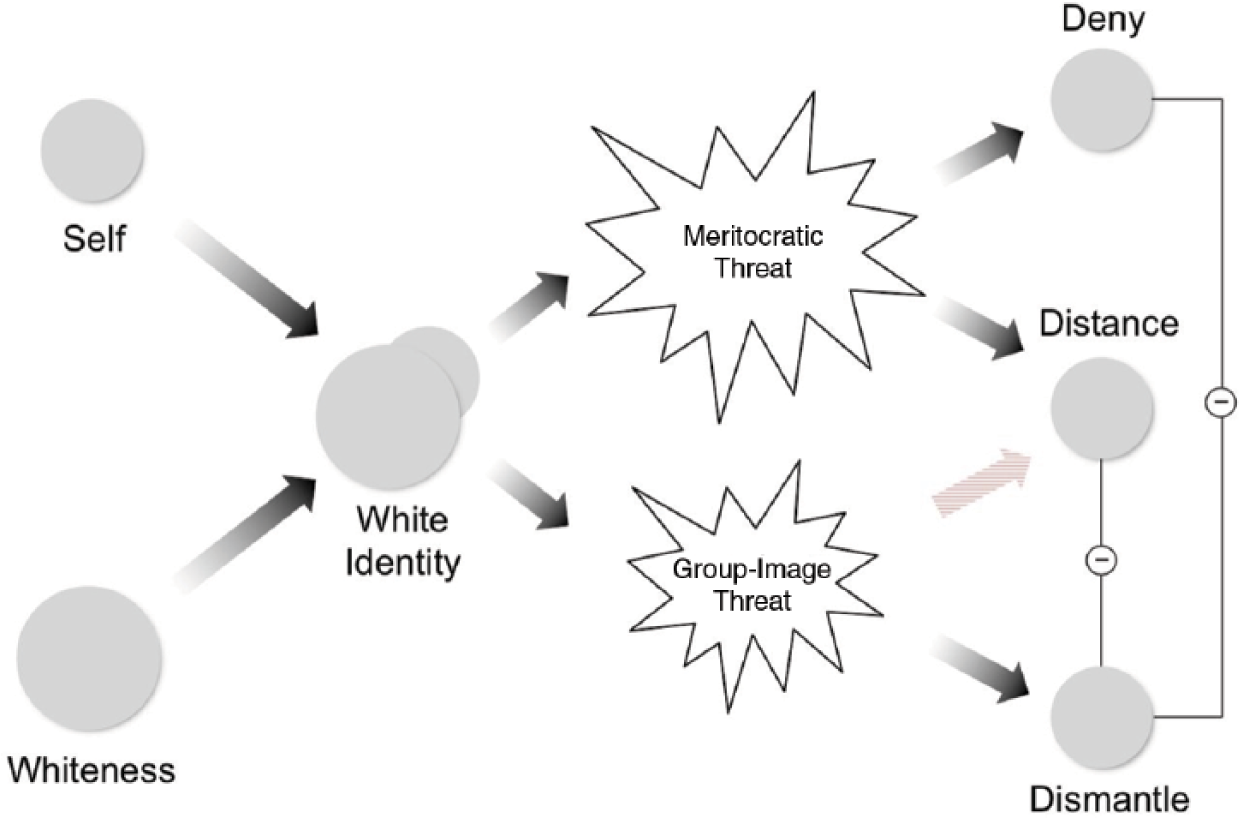
Theoretical model of White identity management. When dominant-group members identify with whiteness, the resulting threats to personal merit and the group’s image motivate identity-management strategies. Whites may reject the notion that their race affords unearned privileges (denial), downplay the importance of whiteness to the self (distancing), or work to reduce the ingroup privileges (dismantling). The model postulates that, in individualistic contexts such as the United States, meritocratic threat is more problematic than group-image threat; that distancing is only partially effective against group-image threat; and that dismantling is incompatible with both denial and distancing.
Deny
Denial is a defense tailor-made for combating meritocratic threat. This type of threat invites Whites to reinterpret evidence for their individual self-worth; if privilege is real, then aced tests, job offers, and glowing work reviews no longer constitute unimpeachable evidence of individual excellence. The denial of privilege represents a “revisionist” threat response, in which Whites alter their beliefs about social reality such that their accomplishments are once again clearly indicative of self-competence.
There is substantial evidence for the denial strategy. One study exposed Whites to meritocratic threat via a bogus intelligence test (Lowery, Knowles, & Unzueta, 2007). After completing the test, White participants were told that they had scored in either the 89th percentile or the 11th percentile. Participants whose intellectual competence was challenged subsequently acknowledged ingroup racial privilege to a lesser extent that those whose competence had been affirmed. Thus, after confronting a threat to their personal merit, White participants sought to restore self-regard by denying a different source of meritocratic threat—White privilege (cf. Campbell & Sedikides, 1999). In a second study, meritocratic threat triggered the denial of privilege only among individuals scoring high on a measure of White identification, further suggesting that denial serves a self-protective function (Lowery et al., 2007). The results of these studies remained robust after controlling for levels of anti-Black prejudice, indicating that self-image concerns are sufficient to trigger the denial of White privilege independent of feelings about the outgroup.
Work examining Whites’ beliefs about the nature of affirmative action further supports the notion that meritocratic threat leads dominant-group members to deny ingroup privilege (Unzueta, Lowery, & Knowles, 2008). This work posited that Whites derive a psychological benefit from the (incorrect) belief that affirmative action policies make use of aggressive minority quotas (a version of affirmative action that has been illegal in the United States since the late 1970s; see Regents of the University of California v. Bakke, 1978). In two studies, Whites’ belief in the existence of affirmative action quotas was measured and manipulated. Participants were then given false feedback on a bogus intelligence test (see Lowery et al., 2007). Among participants low in quota beliefs, negative test feedback reduced self-esteem. For Whites high in quota beliefs, however, negative feedback left self-esteem unscathed. Apparently, believing that the system disadvantages one’s racial ingroup—the opposite of acknowledging race-based privilege—buffered Whites against self-threat (see also Unzueta, Gutiérrez, & Ghavami, 2010). Consistent with the operation of meritocratic threat, the self-esteem buffering power of quota beliefs was mediated by the effect of these beliefs on Whites’ appraisals of their personal competence.
Other work provides additional evidence that the denial of privilege protects Whites from meritocratic threat (Knowles & Lowery, 2012). In this research, Whites’ embrace of meritocracy as a distribution rule for society was measured and manipulated. The participants’ incorporation of merit into the ideal self (Higgins, 1987) and their denial of racial advantages were also assessed. Whites’ endorsement of meritocracy led to low levels of perceived ingroup privilege. Moreover, this effect was mediated by meritocracy-endorsing Whites’ desire to regard themselves as talented and hardworking—that is, as living up to the meritocratic norm. These findings suggest that the American meritocratic cultural context itself induces Whites to deny privilege (just as Kenneth Clark argued in Ebony). Inculcation of the meritocratic norm—a product of the Protestant ethic commonly embraced by Whites (Biernat, Vescio, & Theno, 1996; Katz & Hass, 1988; Weber, 1904/2001)—defines a vision of the ideal self at odds with the notion of unearned group privilege.
Whites’ use of the denial strategy is likely to bolster existing patterns of racial inequality. Although the social and economic well-being of racial groups in the United States is not strictly zero-sum, patterns of racial inequality undoubtedly benefit White people at the expense of Blacks and others (Brown et al., 2003). Whites enjoy access to relatively unpolluted neighborhoods in part because non-Whites are relegated to more polluted areas (Pulido, 2000). Likewise, Whites benefit from well-funded, suburban public schools in part because the property tax revenue that sustains them does not flow to inner-city campuses (Kozol, 1991). Thus, reducing racial inequality will inevitably require Whites to give something up—that is, to accept the redistribution of some social and economic resources to non-White groups. Whites are unlikely to accept social policies that reduce the White group’s advantages if they reject the very notion of White privilege. Whites who defend against the threat of undeserved privilege by blinding themselves to its existence (Knowles & Lowery, 2012; Lowery et al., 2007) cannot be expected to embrace social arrangements that make sought-after property, school funds, or jobs available to non-Whites.
Redistributive social and economic policies are likely to be even less popular among Whites who take the denial strategy to an extreme, coming to believe that dominant-group members not only lack illegitimate privilege but are now at a disadvantage relative to other groups (e.g., because affirmative action quotas are ubiquitous; Unzueta et al., 2008). To those familiar with the ample evidence for White advantage (e.g., Oliver & Shapiro, 1995), the notion that it is materially costly to be White may seem implausible, to say the least. However, recent findings hint that a majority of American Whites now embrace just such a stigmatized consciousness. In a provocative study, a nationally representative sample of White Americans were asked to rate the severity of anti-Black and anti-White discrimination from the 1950s to the 2000s (Norton & Sommers, 2011). Respondents tended to concede that, from the 1950s through the 1990s, anti-Black bias was a more pressing problem than bias against Whites. However, a majority of White respondents also believed that, in the 2000s, anti-White bias became more prevalent than bias against Blacks. Moreover, other research has found that Whites high in anti-egalitarian sentiment interpersonally disparage Blacks who make discrimination claims but react positively toward Whites who claim “reverse” discrimination (see Unzueta, Everly, & Gutiérrez, 2014, Study 1). It is difficult to imagine these privilege-denying Whites seeing the need for policies that (in their minds further) redistribute social resources to non-Whites.
Distance
Whites can also defend against the threats of privilege by distancing their own self-concepts from the offending social identity. 5 In this way, dominant-group members can tolerate the existence of ingroup privilege because they temporarily downplay the importance of race to the self. We theorize that distancing relieves meritocratic threat and, to a lesser extent, group-image threat. Through distancing, dominant-group members reassure themselves that White privilege, if it exists, does not affect them, while also reducing the salience of the self’s association with a morally questionable ingroup. Thus, just as members of other racial groups sometimes distance themselves from sources of threat—as when African Americans disidentify from domains in which they are negatively stereotyped (Steele, 1997)—Whites may repel threats by mentally distancing from whiteness. 6
In a study relevant to the distancing strategy, White participants read about intergroup inequity framed either as Black disadvantage (i.e., “The SAT is biased against Blacks”) or as White privilege (i.e., “The SAT is biased in favor of Whites”; Chow et al., 2008). As expected, Whites for whom ingroup privilege was made salient scored lower on a measure of racial identity than did those who focused on outgroup disadvantage. Suggesting the joint operation of meritocratic and group-image threat, the distancing effect held only for Whites high in the desire for meritocracy (Davey, Bobocel, Son Hing, & Zanna, 1999) and was mediated by the negative effect of privilege on participants’ positive regard for the ingroup (Luhtanen & Crocker, 1992). In a similar study, White participants either listed ways in which they benefit from being White or ways in which Blacks are disadvantaged by being Black. Compared with those in the “Black disadvantage” condition, participants in the “White advantage” condition displayed more collective guilt, less racist attitudes, and a decrease in self-reported White identification (Branscombe et al., 2007). By creating psychological distance between the self and the racial ingroup, dominant-group members may have been attempting to shield themselves from the negative implications of White privilege.
Like denial, the distancing strategy likely acts to entrench existing patterns of racial inequality. Distancing possesses a natural theoretical affinity with other motives and ideologies whose purpose is to evade or distract attention away from issues of dominance and subordination. Color-blind ideology can be one such tool of “power evasion.” Research suggests that some Whites are attracted to color-blind ideology because of its potential to prevent discussion and critique of racial disparities (Knowles et al., 2009). More generally, members of dominant societal groups—particularly those who wish to maintain their dominance—often attempt to steer conversations with subordinate-group members away from power discrepancies and toward commonalities between the groups (Saguy, Dovidio, & Pratto, 2008; Saguy, Pratto, Dovidio, & Nadler, 2009). Distancing—which can be thought of as color blindness in the context of self-perception—may both justify and be justified by power-evasive preferences and ideologies.
If we are correct that the distancing strategy is part of a syndrome of color-blind ideology and commonality-focused thinking, then this identity-management strategy should desensitize Whites to inequity. In an illustrative study, researchers led a mostly White group of elementary school students to adopt either a color-blind mind-set deemphasizing racial differences or a “value-diversity” mind-set acknowledging and respecting such differences (Apfelbaum et al., 2010). Students were then read short scenarios, some of which contained ambiguous or explicit instances of racial discrimination. Compared with students in the value-diversity condition, children who had adopted a color-blind mind-set identified fewer instances of discrimination in the stories—suggesting that color blindness impeded children’s ability to detect bias when it occurs. These results imply that Whites who frequently distance themselves from whiteness, thus adopting a color-blind self-perceptual stance, may fail to perceive society-wide patterns of racial inequity.
Given its ties to power-evasive ideologies, distancing may contribute to Whites’ underestimation of—and thus inaction with respect to—intergroup disparities. In an initial test of this hypothesis, we surveyed 415 White American participants from the Amazon Mechanical Turk (MTurk) crowd-sourcing platform. 7 Distancing should manifest in low scores on measures of identification; thus, participants were administered a questionnaire gauging racial identity centrality (Sellers et al., 1997; e.g., “I have a strong sense of belonging to my racial group”). Participants also completed an expanded version of Knowles and colleagues’ Color-Blind Ideology Scale (2009; e.g., “People who become preoccupied by race are forgetting that we’re all just human”), a measure tapping belief in the existence of White privilege (Swim & Miller, 1999; e.g., “I feel that White skin in the United States opens many doors for Whites during their everyday lives”), and a scale gauging support for race-based affirmative action (e.g., “I support affirmative action to help underrepresented minority groups”).
To understand the relationships between these variables, we created a structural equation model specifying paths from identity to color blindness, color blindness to privilege beliefs, and privilege beliefs to affirmative action attitudes. (For ease of interpretation, identity, privilege, and affirmative action scores were reversed to reflect identity distancing, privilege denial, and affirmative action opposition.) As shown in Figure 2, distancing was positively associated with the endorsement of color-blind ideology, supporting the idea that when Whites engage in self-protective distancing, they tend also to endorse a more general color-blind worldview. Color-blind ideology was associated with the denial of White privilege, and privilege denial with opposition to affirmative action, suggesting that color blindness desensitizes Whites to their race-based advantages and, consequently, leads them to oppose redistributive social policies. The indirect effect from distancing to affirmative action opposition was significant (β = .06, p < .05), indicating that color blindness and privilege denial mediated a link between these variables. Although exploratory and correlational, these findings lend credence to the notion that the distancing strategy—though meant to protect the self against the threat of privilege—also reduces the likelihood that White Americans will take action against societal inequity. 8
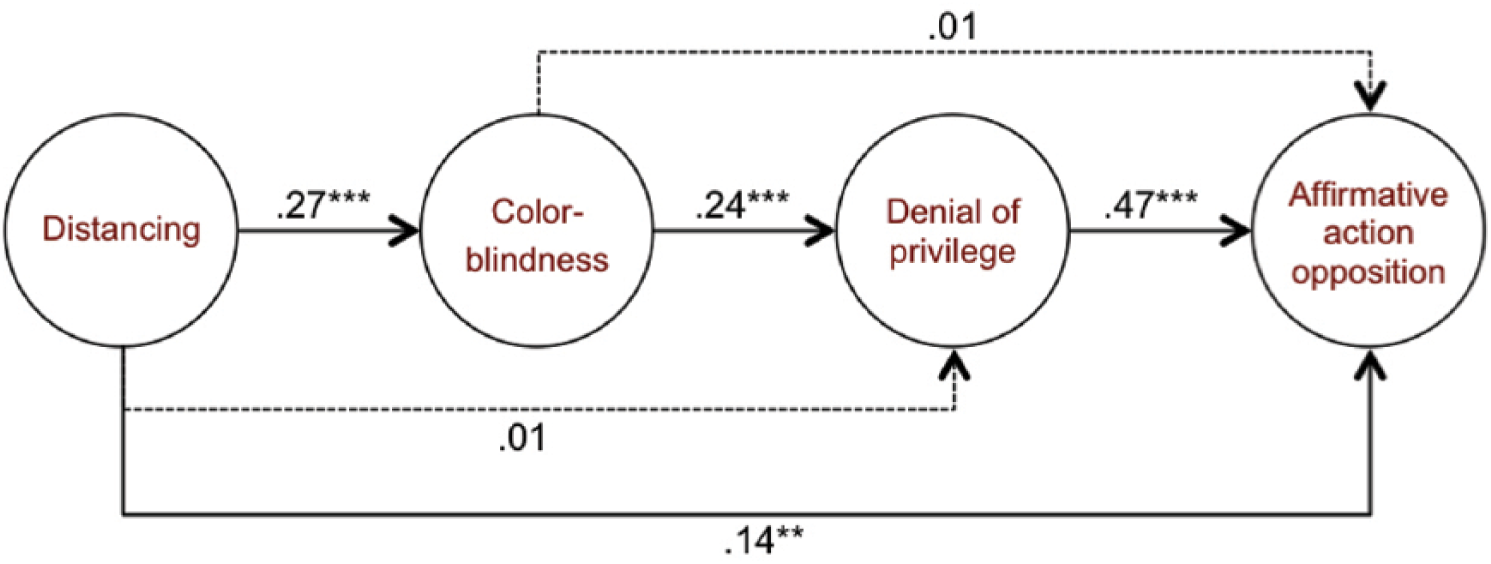
Distancing from whiteness is associated with color-blind ideology, the denial of racial privilege, and opposition to affirmative action. **p < .01, ***p < .001.
Dismantle
It may be that, for all their effectiveness against meritocratic threat, denial and distancing have less utility against group-image threat. Unlike concerns about one’s self-competence, reputational concerns cannot be comprehensively addressed by changing one’s beliefs about privilege and its impact on the self. Rather, reputational concerns involve not only how White Americans personally feel about their group’s moral standing but also how they believe other groups feel about Whites (Vorauer et al., 2000). Denying the existence of privilege addresses neither the White group’s historical misdeeds nor the group’s standing in the eyes of non-Whites. Moreover, although research reviewed above suggests that distancing may help reduce group-image threat (Chow et al., 2008; Powell et al., 2005), Whites who distance likely still expect others to categorize them as White—and are therefore still vulnerable to “meta-stereotypic” concerns about the ingroup’s moral standing.
Fully addressing group-image threat may require Whites to dismantle—that is, to embrace policies and behaviors aimed at reducing ingroup privilege. Dismantling is meant not to revise the past but rather to signal one’s egalitarian intentions as a member of the dominant group. Increasing one’s support for ingroup-costly policies, although it does nothing to recharacterize past achievements as deserved, helps to repair the self-perceived reputation of the White ingroup. The willingness to embrace ingroup-harming remedies establishes the individual as a positive group exemplar who recognizes past inequity and seeks to remediate it. Given people’s tendency to perceive high levels of interpersonal (Marks & Miller, 1987) and intergroup (Cho & Knowles, 2013) consensus, dismantling may even lead to the impression that such support is typical of dominant-group members—further repairing the group’s reputation in the eyes of Whites themselves.
Indirect support for the possibility that Whites use dismantling to dispel group-image threat comes from findings in which Whites who were induced to frame inequality in terms of ingroup privilege (vs. outgroup disadvantage) experienced elevated levels of collective guilt—a clear manifestation of group-image threat (Powell et al., 2005). This increase in collective guilt, in turn, mediated a reduction in anti-Black racism, reflecting a lessening of the desire to justify the ingroup’s advantages and, perhaps, a willingness to relinquish those advantages.
Work by Lowery and colleagues provides more direct evidence that the threat of privilege may lead to the desire to relinquish racial advantage (Lowery, Chow, Knowles, & Unzueta, 2012). Previous research (Lowery et al., 2006) showed that White Americans become less supportive of affirmative action policies when those policies are framed as hurting the ingroup—a finding that reflects concern for the group’s material interests. Yet the authors reasoned that if White privilege is threatening to the group’s image, then this effect could potentially be reversed. As in the earlier work, the researchers manipulated how the effects of a company’s affirmative action policy were framed (i.e., as helping Blacks vs. harming Whites). Critically, an additional manipulation was added in which the preexisting inequity at the firm was described either as Black disadvantage or White privilege. In the Black disadvantage condition, the previously observed pattern (in which Whites were less supportive of a policy that hurts the ingroup than one that helps the outgroup) again emerged. However, the pattern was reversed in the White privilege condition, such that Whites were especially supportive of a policy described as hurting the White ingroup. Suggesting the operation of group-image threat, the effect of White advantage on individuals’ esteem for the ingroup drove the effect of inequity frame on support for policies perceived to reduce Whites’ opportunities. These results provide striking evidence that Whites, in order to dispel the threat of privilege, will embrace policies that reduce the White ingroup’s dominance.
Denial and distancing contribute to Whites’ inaction concerning racial inequality. The dismantling strategy, though no less a product of self-protective motives than the others, has altogether different implications for the racial hierarchy. Dismantling suggests that Whites will most strongly embrace progressive policies when they regard inequality and privilege as self-relevant and simultaneously see policy endorsement as a means of relieving the resulting threat. When inequality is framed as ingroup privilege, Whites are attracted to ingroup-harming (i.e., privilege-reducing) policies as a means of repairing the reputation of the racial ingroup (Lowery et al., 2012). This shows that Whites can relieve the threat of privilege by taking action against inequality.
When Will Whites Dismantle?
From a social justice perspective, dismantling is the ideal White identity management strategy. Yet White Americans’ aversion to redistributive social policies (Sidanius, Singh, Hetts, & Federico, 2000), growing belief in the prevalence of anti-White bias (Norton & Sommers, 2011), and relatively low levels of ingroup identification (Hartmann et al., 2009) suggest that denial and distancing are dominant-group members’ preferred tools of identity management. Unfortunately, because the dismantling strategy requires Whites to accept the existence and self-relevance of privilege, denial and distancing preclude dismantling. To close this article, we consider conditions that might discourage denial and distancing and thus encourage dismantling as a strategy of White identity management.
The mutual exclusivity of threat-reduction strategies puts Whites in a bind. Do dominant-group members reject the existence of privilege (deny) or dissociate the self from whiteness (distance), knowing that these strategies do nothing to repair the reputational damage inflicted by the ingroup’s historical transgressions or to disabuse minorities of their views concerning the reality of White privilege? Or do Whites signal a willingness to combat White privilege (dismantle), thus leaving intact doubts as to the source of their past achievements? In our view, one of these trade-offs is more attractive to White Americans than the other. Namely, we believe that Whites are unlikely to sacrifice the ability to protect the personal self for a chance to enhance the ingroup’s reputation. This preference may be especially true in Western cultures that privilege the individual self over collective concerns (Markus & Kitayama, 1991; Singelis, Triandis, Bhawuk, & Gelfand, 1995). Given a choice between denial and distancing versus dismantling, there is good reason to believe that Whites will choose the former strategies, making dismantling an all-too-rare phenomenon.
If this reasoning is correct, then perhaps Whites would be more likely to dismantle (and thus dispel group-image threat) if they were less motivated to dispel meritocratic threat through denial or distancing. To this end, taking the meritocratic “sting” out of White privilege might help redirect dominant-group members’ attention to combating group-image threat. In fact, we believe that White privilege—construed in the right way—need not threaten Whites’ sense of self-competence and deservingness. Our approach centers on individuals’ lay theories (Morris, Ames, & Knowles, 2001) of privilege, that is, their causal understandings of precisely how whiteness affects their outcomes in life.
The prospect of privilege threatens Whites’ self-competence because of its power to discount individuals’ role in their own successes while augmenting their responsibility for negative life outcomes. This insight derives from classic work in attribution theory—in particular, Harold Kelley’s examination of the lay theories, or “schemata,” that embody people’s beliefs about how multiple causes produce an effect (Kelley, 1973). Kelley contrasted two kinds of theories: those that specify “multiple sufficient causes” for an effect and those that presume “multiple necessary causes.” When an individual applies the multiple sufficient causes (MSC) theory to an event, she assumes that any one of two (or more) factors can produce it. In the context of White privilege, the MSC theory implies that either merit (i.e., intelligence and work ethic) or whiteness is sufficient for positive life outcomes. Hence, to the extent that perceivers credit a person’s accomplishments (e.g., being admitted to a top university) to White privilege, they will come to doubt the role of merit—aptitude and hard work—in those outcomes. Under the MSC theory, “one cause casts doubt on another” (Morris & Larrick, 1995, p. 331).
Kelley’s other lay theory, multiple necessary causes (MNC), has very different implications for the self. When a person applies the MNC theory, he regards two (or more) causal factors as individually necessary but only jointly sufficient to produce an effect (Morris & Larrick, 1995). An MNC interpretation of privilege casts positive life outcomes (e.g., job offers and university admissions) as the product of an interaction between merit and racial advantage—meaning that any particular White person’s successes are a joint product of these factors. Thus, racial advantage amplifies the link between merit and success, whereas its absence mutes that association. 9
Critically, causal discounting of one’s success does not follow from the MNC theory (Morris & Larrick, 1995). Only when Whites construe merit and racial privilege as independent routes to success does privilege discount self-enhancing internal attributions for success and prevent self-protective external attributions for failure; when one is White, one does not need merit, and when one has merit, being White does not matter. On an MNC theory of privilege, in contrast, knowing that a person is successful and White does not suggest that he lacks merit. He may not have made it as far in life if he were non-White—but being White is, by itself, insufficient to explain his accomplishments. It follows that the experience of meritocratic threat depends on individuals holding an MSC theory of privilege.
What if White Americans could be induced to reconstrue racial privilege according to the MNC theory? Given an MNC theory of success, meritocratic threat should fall away. Such a reinterpretation of privilege, however, should not affect group-image threat: Whites would still possess an unearned attribute, the lack of which is a serious impediment to success and therefore one that taints the ingroup’s reputation. Having eliminated the meritocratic sting of privilege and therefore obviated the need for denial and distancing, Whites may embrace the remaining strategy—dismantling—in order to reduce the remaining threat to the group’s image.
Future research should investigate ways of encouraging Whites to construe privilege in a manner that does not impugn their personal self-worth—that is, according to the MNC theory. One possibility is simply to explain in everyday language that being White is not enough, by itself, to guarantee good socioeconomic outcomes and that aptitude and hard work are equally critical ingredients of success. At the same time, dominant-group members must understand that, without whiteness, it matters less how much merit individuals possess: socioeconomic success is inevitably less likely. We expect that Whites would no longer feel personally threatened by whiteness but nevertheless still, for group-image reasons, want to dismantle a system that makes one’s race an important key to self-actualization. We hope that our own and others’ future work will identify reliable routes to dismantling that navigate safely between the hazards of denial and distancing.
Generality of the 3D Model
In an important sense, the 3D model is a cultural-psychological theory of responses to ingroup dominance in contexts that are Western, democratic, and individualistic. Our model assumes that Whites subscribe to cultural values lionizing meritocracy and fairness—values whose universality should not be assumed. In a culture where individual merit or the fair treatment of groups is less prized, Whites (or whichever groups happen to be advantaged in that culture) ought not to experience threat at the prospect of privilege. For instance, the utility of the 3D model would likely be limited in a highly collectivist culture where group (not individual) goals and contributions are prioritized (Singelis et al., 1995) and in which pluralistic notions of respect and representation for all societal groups (Schildkraut, 2007) are deemphasized. In such a milieu, members of the privileged group could enjoy the fruits of advantage without the burdens of dissonance or compunction. However, in a world where global capitalism continues to spread, with its presumed emphases on individual achievement and unfettered opportunity, we suspect that the 3D model will be increasingly useful for understanding reactions to ingroup dominance outside of the American context.
Even in the United States, the utility of the 3D model will likely vary among different groups of Whites. Indeed, the model implies that some degree of identification with whiteness is necessary for the experience of meritocratic and group-image threat. This supposition is borne out in several of the studies reviewed above, in which only those Whites who were relatively high in racial identity displayed evidence of threat at the prospect of ingroup privilege (Branscombe et al., 2007; Knowles & Lowery, 2012; Knowles & Peng, 2005; Lowery et al., 2007). However, if we are correct that Whites possess a more acute awareness of their race than has been previously assumed, a large portion of the White population should be subject to potential threat. Likewise, it may be that Whites who have thoroughly and genuinely internalized a stigmatized consciousness—the notion that non-Whites now have a better chance than Whites in present-day society (Norton & Sommers, 2011; Unzueta et al., 2008)—experience no threat at the claim that Whites are unfairly advantaged. Of course, the extent to which Whites who report such beliefs truly feel that being White is a liability is an open question. We conjecture that most Whites would not want to trade in their whiteness if such a thing were possible.
Despite these and other possible boundary conditions on the 3D model, we expect our approach to be useful in understanding the behavior of a diverse array of White Americans. For example, Whites both high and low in socioeconomic status (SES) should be vulnerable to the threats of privilege. Meritocratic threat should loom large for highly successful Whites as well as those who feel disappointed with their accomplishments in life. The notion of privilege suggests that high-SES Whites have not completely earned their success and that their low-SES counterparts have failed to thrive despite having been born into racial advantage. In either case, privilege interferes with Whites’ self-protective interpretations of their life outcomes, good or bad. Nonetheless, we expect that high- and low-SES Whites will favor different means of combating meritocratic threat. High-SES Whites may rely on denial, simply dismissing the notion of racial advantage, whereas low-SES Whites may engage in a type of distancing, choosing to believe that class disadvantage excludes them from the general benefits of whiteness. These and other hypotheses concerning the dynamics of ingroup dominance in diverse populations of Whites await empirical test.
Conclusion
The August 1965 special issue of Ebony magazine, entitled “The White Problem in America,” presented an analysis of whiteness and racial privilege that, until recently, has been all but lost on social scientists. The Ebony authors, including James Baldwin and Kenneth Clark, argued that Whites’ lack of outrage and action against racial injustice had at least as much to do with self-doubt and the moral weight of their checkered history as it did with racial animus and fear. In stark contrast to Ebony’s spotlight on Whites’ fraught experience of their race, scholars have traditionally characterized whiteness as powerful precisely because dominant-group members fail to experience it. We have attempted to supplant this “invisibility thesis” with the notion that whiteness is powerful because it often impinges on Whites’ mental lives.
Not only do White Americans think racially, but identification with whiteness threatens dominant-group members’ personal and collective selves. White identity exposes Whites to the possibility that their successes are not wholly earned (meritocratic threat; cf. Clark, 1965) and forces them to countenance membership in a group that continues to reap benefits from a system of racial privilege founded on a history of oppression (group-image threat; cf. Baldwin, 1965). Whites maneuver to avoid these threats, tuning their beliefs concerning whiteness in self-protective ways. Three such strategies were identified here: denial (rejecting the notion that Whites are privileged), distancing (separating the subjective self from whiteness), and dismantling (committing to ingroup-costly policies that militate against the ingroup’s privileges).
The three identity management strategies have divergent implications for Whites’ efforts to reduce racial inequality. Denying inequity obviates the need for such efforts, leading to inaction in the face of inequality. Distancing, through its connection to race-blind ideologies that desensitize Whites to bias, may also reduce Whites’ commitment to combating inequality. Sometimes, however, Whites react to the threat posed by membership in the dominant group by seeking out ways to relinquish their advantages, thus promoting racial equality. Future theorizing and research should investigate ways to foster dismantling as a means of managing White identity—perhaps, as we have suggested, by actively shaping the manner in which Whites’ conceptualize the effects of whiteness on their lives.
Footnotes
Declaration of Conflicting Interests
The authors declared that they had no conflicts of interest with respect to their authorship or the publication of this article.