



Abstract
A core tenet of the American ethos is that there is considerable economic mobility. Americans seem willing to accept vast financial inequalities as long as they believe that everyone has the opportunity to succeed. We examined whether people’s beliefs about the amount of economic mobility in the contemporary United States conform to reality. We found that (a) people believe there is more upward mobility than downward mobility; (b) people overestimate the amount of upward mobility and underestimate the amount of downward mobility; (c) poorer individuals believe there is more mobility than richer individuals; and (d) political affiliation influences perceptions of economic mobility, with conservatives believing that the economic system is more dynamic—with more people moving both up and down the income distribution—than liberals do. We discuss how these findings can shed light on the intensity and nature of political debate in the United States on economic inequality and opportunity.
In the past several decades, financial inequality in the United States has risen dramatically, earning the country the dubious distinction of being one of the most economically skewed Western nations (OECD, 2011). In 2012, those in the top 10% of the income distribution earned half of the total national income, compared with a third in 1970 (Saez, 2013). Although the real income of the top 1% has risen an astonishing 86.1% during the last two decades, the income of the remaining 99% of the population has increased only 6.6% (Saez, 2013; see also Piketty, 2014). This rise in inequality has been accompanied by increasing hardship among those at the bottom. As of 2010, there were almost 650,000 homeless people in the United States (US Department of Housing and Urban Development, 2010) and an additional 9.5 million families (46 million people) were living below the poverty line (a 50% increase since 1980; U.S. Census Bureau, 2012). Furthermore, while inequality has risen steadily, the effective tax rates for the very wealthy (i.e., the tax paid on all sources of income, including capital gains) have dropped. At the same time that the taxable income of the top 400 earners in the United States quintupled (from 16.9 billion dollars in 1992 to 90.9 billion dollars in 2008), their tax rates dropped from 29.2% to 21.5% (Buffett, 2011; see also Internal Revenue Services, 2008).
Research suggests that this increase in financial inequality may pose a threat to overall societal well-being. An analysis of 4 decades of data reveals that the increase in inequality in the United States is correlated with diminished self-reported happiness and that this effect is especially strong among the bottom 40% of income earners (Oishi, Kesebir, & Diener, 2011). Cross-sectional correlational data indicate that areas of the United States with high income inequality tend to have higher divorce and bankruptcy rates than areas with more egalitarian income distributions (Frank, Levine, & Dijk, 2014) and they suffer from higher homicide rates (Daly, Wilson, & Vasdev, 2001).
Aware but Unconcerned
Although in recent years some have begun to sound the alarm about this issue (including the current presidential administration), Americans as a whole do not seem especially concerned about this increase in income inequality. Survey respondents acknowledge the rise in economic inequality, but very few see it as a major problem (Bartels, 2005; Pew Research Center, 2012). Reducing the income and wealth gaps between the rich and the poor does not rank highly in a list of priorities for most respondents (Gallup, 2013), and most believe the government should not be responsible for alleviating the problem (McCall & Kenworthy, 2009) but rather should focus on growing the economy (Gallup, 2011).
Faced with growing levels of inequality, why aren’t people more concerned about reining in, or reversing, rapidly rising income inequality? One reason might be a widespread belief in a high degree of social mobility. A World Value Survey found that 71% of Americans (compared with 40% of Europeans) believe the poor have a reasonable chance of escaping poverty (Alesina, Di Tella, & MacCulloch, 2004). Faith in the American dream—that everyone has the potential to climb high up the economic ladder—may make it easier to accept vast inequality of wealth and income. As President Obama put it in a speech delivered to a cheering Illinois crowd, Americans have “tolerated a little more inequality for the sake of a more dynamic, more adaptable economy… [in which] no matter how poor you started, if you’re willing to work hard and discipline yourself and defer gratification, you can make it, too. That’s the American idea” (Office of Press Secretary, 2013a). Viewing the United States as an upwardly mobile nation in which every citizen has the opportunity to succeed may make it easier to accept pronounced inequality as a minor side-effect of a well-functioning economic system that offers more equality of opportunity than equality of outcome.
Thus, the “rags to riches” element of the American dream and the ethos of the Protestant work ethic may combine to mitigate incipient negative attitudes about economic inequality. According to what’s been called the dominant ideology of American society, people are born equal and have an equal chance to succeed, with success thought to be determined by an individual’s competence and willingness to work hard (Kluegel & Smith, 1986). The wealthy are often perceived as having gained their riches largely through the exercise of effort and talent. The poor, in contrast, are seen as having not worked hard enough (Fong, 2001; Pew Research Center, 2014). From this perspective, the discrepancy between the rich and poor is not considered morally troublesome or unjust, a perception bolstered by frequent exposure to stories of self-made individuals. Indeed, when participants were exposed to stories of individual success, they tended to agree more with statements like “hard work is rewarded by success,” “people succeed when they put in a lot of effort” (Wakslak, Jost, Tyler, & Chen, 2007), “people get rewarded for their effort” (Sawhill & Morton, 2007), and “opportunity exists for anyone to get ahead” (Ho, Sanbonmatsu, & Akimoto, 2002). As long as everyone is perceived as having a reasonable shot at success, aversion to economic inequality is kept in check (Krawczyk, 2010; Lane, 1959). People may even come to expect (rather than merely accept) inequality as a necessary element of a socially dynamic system.
Surprisingly little research has assessed people’s perceptions of social mobility quantitatively. Most studies have assessed people’s general beliefs about opportunities to get ahead in life instead of systematically measuring the magnitude, nature, and scope of their beliefs. For example, a typical study may ask respondents to rate their agreement with such statements as “there’s plenty of opportunity and anyone who works hard can go as far as they want” (Fong, 2001), “hard work and effort guarantee success” (Ho et al., 2002), and “social mobility is possible” (Mandisodza, Jost, & Unzueta, 2006). Although such questions are valuable in assessing abstract beliefs about social mobility, they capture something more like an overall attitude on the subject rather than a set of detailed beliefs. In the studies reported here, we sought to fill this gap by systematically examining people’s concrete perceptions of income mobility in the United States.
The Aims of the Current Studies
What can be gained by capturing people’s concrete beliefs about economic mobility? Consider Norton and Ariely’s (2011) quantitative examination of people’s beliefs about wealth inequality in the United States (see also Eriksson & Simpson, 2012; Norton & Ariely, 2013). Their research revealed a marked discrepancy between people’s beliefs and economic reality. They found, for example, that whereas the bottom two quintiles in the United States (i.e., the bottom 40% of the population) own 0.3% of the total wealth in the country, they are thought to possess about 10%. Such a pronounced miscalibration would not have come to light had the researchers asked their respondents more general questions about the distribution of wealth. By measuring people’s beliefs about the wealth distribution in concrete detail, Norton and Ariely were able to get a more informative picture of the public’s beliefs about inequality and to contrast public perception with economic reality.
Quantifying perceptions of economic mobility may be as important as understanding beliefs about income inequality—perhaps even more so. Whether people are troubled or pleased by their standing is a product of both their current circumstances and how they expect to fare in the future. People derive more satisfaction from negative experiences that end on a positive note than from positive experiences that end on a negative note (Ross & Simonson, 1991); from improving health outcomes than from declining outcomes (Chapman, 2000); and from gradually increasing wages than from fixed or declining wages (Frank & Hutchens, 1993; Loewenstein & Sicherman, 1991), even when the final salary is the same (Hsee, Abeslon, & Salovey, 1991). Moreover, a belief in upward mobility may foster hopeful thinking, which has been shown to affect individual achievement in academic (Ciarrochi, Heaven, & Davies, 2007; Day, Hanson, Maltby, Proctor, & Wood, 2010; Snyder et al., 2002), athletic (Curry, Snyder, Cook, Ruby, & Rehm, 1997) and self-help settings (Geraghty, Wood, & Hyland, 2010). Note, however, that political participation is motivated disproportionately by negative emotions such as anger and dissatisfaction (Valentino, Brader, Groenendyk, Gregorowicz, & Hutchings, 2011) and so any personal benefits of hopeful thinking must be considered in conjunction with potential collective costs of inaction. Thus, to fully comprehend people’s attitudes regarding economic inequality, it is necessary to know their beliefs about economic mobility.
In pursuing this focal goal, we were also able to examine several issues that have yet to be addressed in the literature. First, we could compare beliefs about upward and downward social mobility. The studies conducted to date have focused exclusively on upward mobility, assessing people’s perceptions of the likelihood of climbing up the economic ladder. But because the income distribution is relative, the rise of one person necessarily entails the decline of another. Although a rising tide lifts all boats, the relative rise of one boat (i.e., movement to a higher income quintile) is accompanied by the relative drop of a second one (i.e., movement to a lower income quintile). From a logical perspective, beliefs about upward mobility should mirror those about downward mobility.
We suspected this would not be the case. The American dream focuses on personal success and self-made individuals, calling little attention to those headed in the opposite direction, and we thought that this asymmetry would be reflected in people’s beliefs about the degree of upward and downward mobility. Indeed, when participants in one study were asked to write a brief definition of the term social mobility, 40% defined it in terms of upward mobility alone and only 31% referred to both upward and downward mobility (Mandisodza et al., 2006).
Second, our concrete assessments allowed us to compare people’s beliefs about mobility with actual mobility data, as provided in a recent report by the Pew Economic Mobility Project (2012). Do people have an accurate sense of the degree of social mobility in contemporary America, or are their beliefs systematically off the mark—possibly in ways that might impact how they think about the economic and political issues of the day?
Third, just as Norton and Ariely (2011) were able to compare people’s beliefs about existing levels of wealth inequality with the levels of inequality people consider ideal, our concrete assessments of people’s beliefs about economic mobility allowed us to compare impressions of “what is” with beliefs about “what should be.”
Finally, we examined demographic and ideological differences in perceptions of economic mobility. Although past research has found a remarkable degree of consensus among high and low-income earners and among Democrats and Republicans with respect to perceptions of wealth inequality (Norton & Ariely, 2011), we suspected that beliefs about social mobility might differ across income levels and partisan lines. Since the belief in social mobility is a handy device in the system justification toolbox (Mandisodza et al., 2006; Tyler, 2011; Wakslak et al., 2007), and since the financial dependence of low-income individuals on the system increases their tendency to engage in system justification (Kay et al., 2009; Shepherd & Kay, 2012), we thought that high and low income earners might differ in their beliefs about mobility. In addition, since conservatives are more likely than liberals to justify the system (Jost, Glaser, et al., 2003), we expected liberals and conservatives to differ in their beliefs about mobility. Thus, although liberals and conservatives might agree on how things stand in terms of the (static) state of inequality in the United States (Norton & Ariely, 2011), they might nonetheless differ in their assessments of more dynamic properties of the economy, such as the likelihood of a person overcoming the barriers that inequality entails.
Measuring Concrete Perceptions of Social Mobility
A nationwide cross-sectional sample of 3,034 Americans, aged 18–90, was surveyed online between February 21st and February 25th, 2014, by Harris Poll on behalf of the Northwestern Mutual financial services organization. We gave each participant a definition of income quintiles accompanied by a graphic depiction of the five different quintiles (Norton & Ariely, 2011). Next, to elicit their beliefs about either upward or downward intergenerational income mobility, we asked respondents to assess the likelihood of a “randomly selected” American born to a family in the poorest or richest quintile ending up as an adult in each of the five quintiles. In the upward mobility condition, for example, participants were asked to imagine a randomly selected American born to a family in the lowest income quintile and to estimate his or her likelihood of either remaining in this quintile as an adult or rising to each of the four higher income quintiles. In the downward mobility condition, participants assessed the likelihood that an American born to a family in the richest 20% would either remain in the top quintile or drop to each of the four lower income quintiles. Participants were instructed that their assessments must total 100% and were unable to proceed with the survey if they failed to do so. 1
We focused participants’ assessments on the mobility of people born to families in the richest or poorest quintiles for two reasons. First and foremost, we only had data on actual rates of mobility for these quintiles, to which we were able to compare participants’ responses. Although this prevented us from examining people’s perceptions of mobility on the part of the middle class (i.e., the perceived likelihood of a person born to a family in the middle quintiles moving up or down the income ladder), it nonetheless allowed us to measure the perceived mobility of 40% of the population: the top and bottom 20%. Second, people’s beliefs about mobility are likely to be more crystallized for the two extreme quintiles than for the three middle quintiles because extreme exemplars tend to stand out more in people’s minds (Gilovich, 1991; Morewedge, Gilbert, & Wilson, 2005). With respect to economic mobility, rags-to-riches and riches-to-rags stories are more likely to attract attention and become folklore than are less dramatic examples of mobility, such as when a person moves from the middle class to either the lower- or upper-middle class.
Moving on up
As a measure of mobility, we summed participants’ assessments of the likelihood that a person born to a specific quintile (either the top or bottom quintile) would have moved by adulthood at least two income brackets. Thus, in the upward mobility condition, we summed the perceived likelihood that a person born into the lowest quintile would rise as an adult to the middle quintile or higher. In the downward mobility condition, we summed the perceived likelihood that a person born into the highest quintile would drop to the middle quintile or lower.
Overall, participants thought that a randomly selected American is significantly more likely to experience upward mobility than downward mobility. Whereas participants believed that an individual born into the bottom quintile has a 43% chance of moving up to the middle quintile or higher, they thought someone born into the top quintile has only a 33% chance of dropping to the middle quintile or lower, t(3032) = 12.12, p < .0001.
Another way of analyzing these data is to examine participants’ estimates of the likelihood that people will simply inherit their parents’ economic standing. From these data, it is clear that people believe that the economic standing of the rich is “stickier” than that of the poor. Whereas someone born into the richest quintile was believed to have a 49% chance of remaining at the top, a person born into the poorest quintile was believed to be only 33% likely to remain at the bottom, t(3032) = 16.73, p < .0001. Thus, whereas the rich are seen as highly likely to remain rich, poverty is seen as more likely to be a temporary state.
Accuracy of perceptions
How accurate were participants’ assessments of economic mobility? Figure 1 juxtaposes participants’ perceptions of intergenerational income mobility with actual upward and downward mobility rates (Pew Research Center, 2012). As these graphs make clear, the accuracy of participants’ estimates depended on whether they assessed upward or downward mobility. Participants vastly overestimated the amount of upward mobility, estimating a 43% likelihood of a person born into the poorest quintile rising to the top three quintiles—a value significantly higher than the actual 30% chance of this happening, t(1528) = 23.53, p < .0001. In contrast, participants underestimated the prevalence of downward mobility, albeit to a smaller extent. Although 37% of the individuals born into the richest quintile drop to the middle quintile or lower as adults, participants estimated that only 33% do so, t(1504) = 6.32, p < .0001.

Perceptions of upward and downward mobility in a nationally representative sample (N = 3,034): Perceived and actual quintile of where someone born to a family in the bottom (left) or top (right) quintiles ends up.
Who believes in social mobility?
Norton and Ariely (2011) found considerable consensus among Americans with respect to perceptions of wealth inequality. We examined whether the demographic characteristics of our respondents affected their estimates of social mobility. Building upon the ideas of system justification, system dependence, and system inescapability, we expected people who are most dependent on the financial system to have a more pressing need to justify it (Kay et al., 2009). That is, because they lack the power to “escape” from the system (e.g., by moving to a different country), we expected those who are most disadvantaged by the current economic system—poorer individuals and members of the minority—to justify it by believing that it offers more mobility (Jost, Blount, Pfeffer, & Hunyady, 2003).
Consistent with our predictions, low-income participants indicated that there is more economic mobility in the United States than did high-income participants. Low-income respondents (i.e., an annual income lower than $25,000) believed that moving more than one quintile from the top or bottom is significantly more likely (Mmobility = 44%), t(760) = 4.19, p < .0001, and that both poor and rich individuals are less likely to remain at their parents’ income level (Mmaintain parents’ level = 38%), t(760) = 2.55, p = .01, than did higher income respondents (i.e., an annual income higher than $100,000; Mmobility = 36% and Mmaintain parents’ level = 43%, respectively). 2 In addition, non-White participants believed that social mobility is more likely (Mmobility= 44%), t(2998) = 4.93, p < .0001, and that staying in the same bracket is less likely (Mmaintain parents’ level = 37%), t(2998) = 3.67, p < .0005, than did respondents who identified as White (Mmobility = 37% and Mmaintain parents’ level = 42%, respectively). Those who have more to lose from the current financial system, it seems, are more likely to see it as more dynamic.
Liberals and conservatives are both accurate and inaccurate: Supplementary survey
Another notable finding of Norton and Ariely’s (2011) study of perceptions of inequality is the surprising political consensus regarding the actual (and ideal) distribution of wealth in the United States. Although there are pronounced differences of opinion across the political spectrum regarding economic policies designed to address wealth inequality (e.g., progressive taxation and welfare programs), “Americans may possess a commonly held ‘normative’ standard for the distribution of wealth” (Norton & Ariely, 2011, p. 12). Is there a similar consensus with regard to economic mobility? Although people on opposite ends of the political spectrum may agree about income inequality, their opinions might diverge when it comes to economic mobility. Furthermore, because conservatives are more likely to justify the system (Jost, Glaser, et al., 2003), we expected conservative participants to believe there is more mobility than liberal participants.
We weren’t able to assess political orientation in the survey conducted for us by Northwestern Mutual, so we surveyed a separate sample of 290 Mechanical Turk participants from the United States (52% female; average age = 30.4). These participants completed the same measures of upward or downward income mobility and reported their political affiliation on a five-point scale, ranging from “very conservative” to “very liberal” (with “moderate” as the midpoint). Participants who self-identified as “conservative” or “very conservative” were coded as conservatives and those who self-identified as “liberal” or “very liberal” were coded as liberals. First, we replicated the main findings from the nationally representative sample: Participants believed that upward mobility (i.e., rising to the middle quintile or higher) is significantly more likely than downward mobility (dropping to the middle quintile or lower), t(288) = 3.74, p < .0001, and that rich children are more likely to maintain their parents’ economic standing than poor children, t(288) = 5.78, p < .0001. Second, as in the main study, participants overestimated the amount of upward mobility, t(146) = 3.35, p < .005, and underestimated the amount of downward mobility, t(142) = 5.7, p < .0001. Finally, we found a strong effect of political affiliation on participants’ perceptions of economic mobility. Overall, conservatives indicated that there is more economic mobility in the United States than liberals did. Self-identified conservatives believed that moving more than one quintile from the top or bottom is significantly more likely (Mmobility = 39%), t(168) = 3.25, p < .01, and that both poor and rich individuals are less likely to remain at their parents’ income level (Mmaintain parents’ level = 38%), t(168) = 3.12, p < .01, than did liberals (Mmobility = 28% and Mmaintain parents’ level = 51%, respectively).
Whose beliefs are more accurate, liberals or conservatives? It depends. Figure 2 presents participants’ beliefs about upward and downward mobility broken down by political affiliation. A quick glance at these graphs reveals that the accuracy of liberals’ and conservatives’ views is dependent upon the type of mobility—upward or downward—under consideration. With respect to upward mobility, liberal participants were significantly more accurate than conservatives (left panel, Fig. 2). Whereas liberals accurately estimated the likelihood of a person from the poorest quintile rising to the middle quintile or higher (Mestimated = 32% vs. actual 30%; one-sample t < 1), conservatives substantially overestimated this likelihood (Mestimated = 44%, one-sample t(22) = 3.27, p < .005). The accuracy of participants’ estimates flipped when it came to downward mobility. Whereas conservatives accurately estimated the likelihood that a person from the richest quintile would drop to the middle quintile or lower (Mestimated = 35% vs. actual 37%, one-sample t <1), liberals underestimated this likelihood (Mestimated = 23%, one-sample t(68) = 4.85, p < .0001). The accuracy of liberals’ and conservatives’ beliefs about economic mobility thus depends on whether they are thinking about upward or downward mobility.
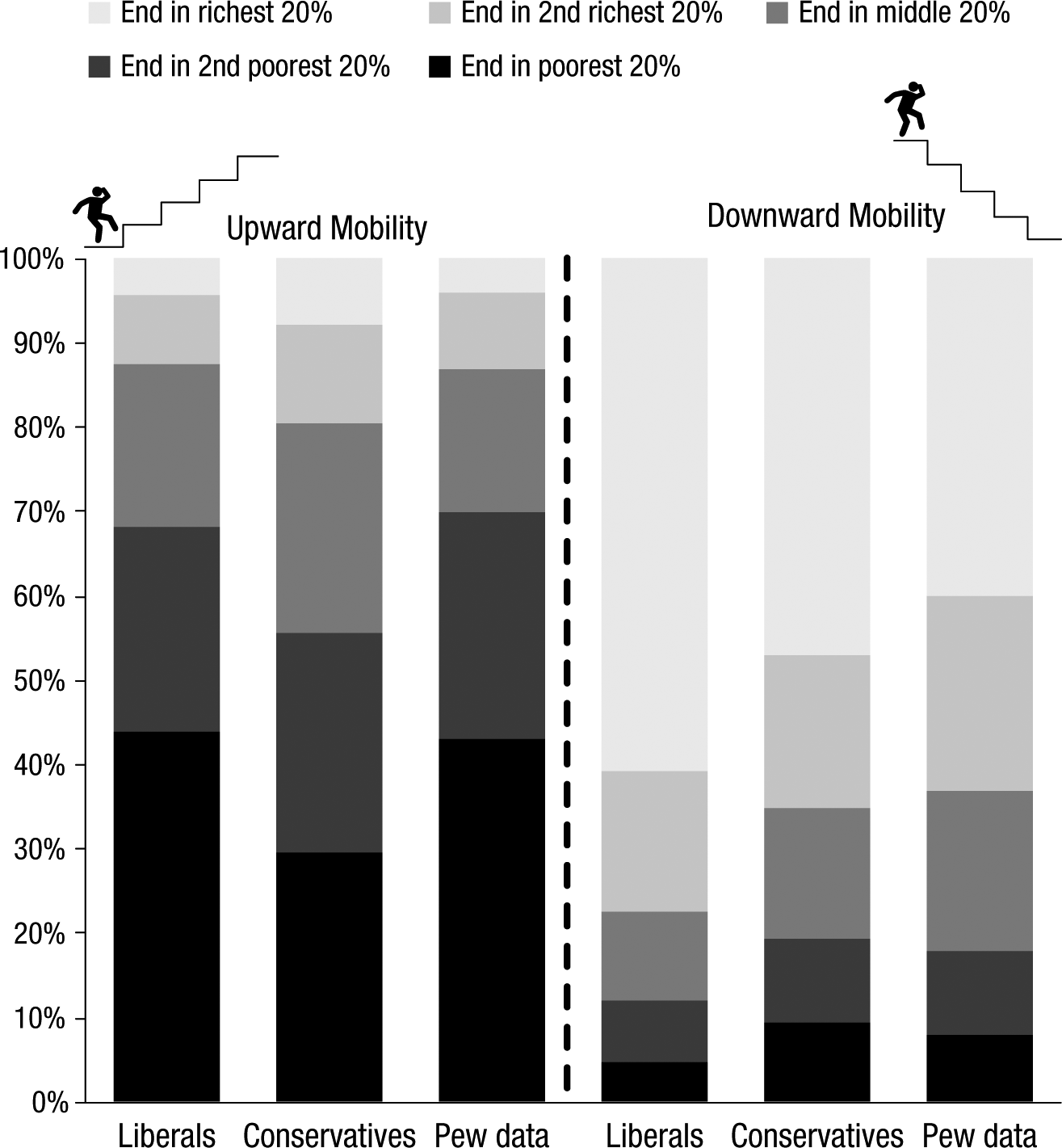
Perceptions of upward and downward mobility in a Mechanical Turk sample (N = 290) broken down by political affiliation. Perceived and actual quintile of where someone born to a family in the bottom (left) and top (right) quintiles ends up.
Ideal mobility assessments
To more fully understand people’s beliefs and attitudes about economic mobility, we also asked the Mechanical Turk participants about their ideal level of economic mobility. More specifically, in the upward mobility condition, participants were asked what likelihood a person born into the lowest income quintile should have of rising to each of the four higher income quintiles. In the downward mobility condition, participants were asked what likelihood a person born into the richest 20% should have of dropping to each of the four lower income quintiles.
Unsurprisingly, participants preferred a more mobile economic system when thinking about upward mobility than when thinking about downward mobility. As can be seen in Figure 3, when asked about upward mobility, participants believed that in an ideal economic system a person should be equally likely to end up in each of the five income quintiles. In contrast, when asked about downward mobility, participants believed that an ideal system should allow a high level of inertia among those at the top. For instance, when asked about upward mobility, participants believed that a person born into the poorest quintile should have a 43% chance of remaining in the bottom two quintiles and a 31% chance of rising to the top two quintiles. 3 However, when asked about downward mobility, participants believed that a person born into the richest quintile should have a 61% chance or remaining in the top two quintiles and only a 23% chance of dropping to the bottom two. Interestingly, when asked about downward social mobility, participants’ ideals were strikingly similar to the actual level of economic mobility. For example, participants believed that a person born into the top quintile should have a 42% chance of remaining there, a value not significantly different from the actual 40% chance of such a person doing so, t < 1. Echoing Norton and Ariely’s (2011) findings of political consensus in the perception of the ideal society, we found that liberals and conservatives agreed in their perceptions of the ideal levels of upward and downward mobility (Fig. 3).
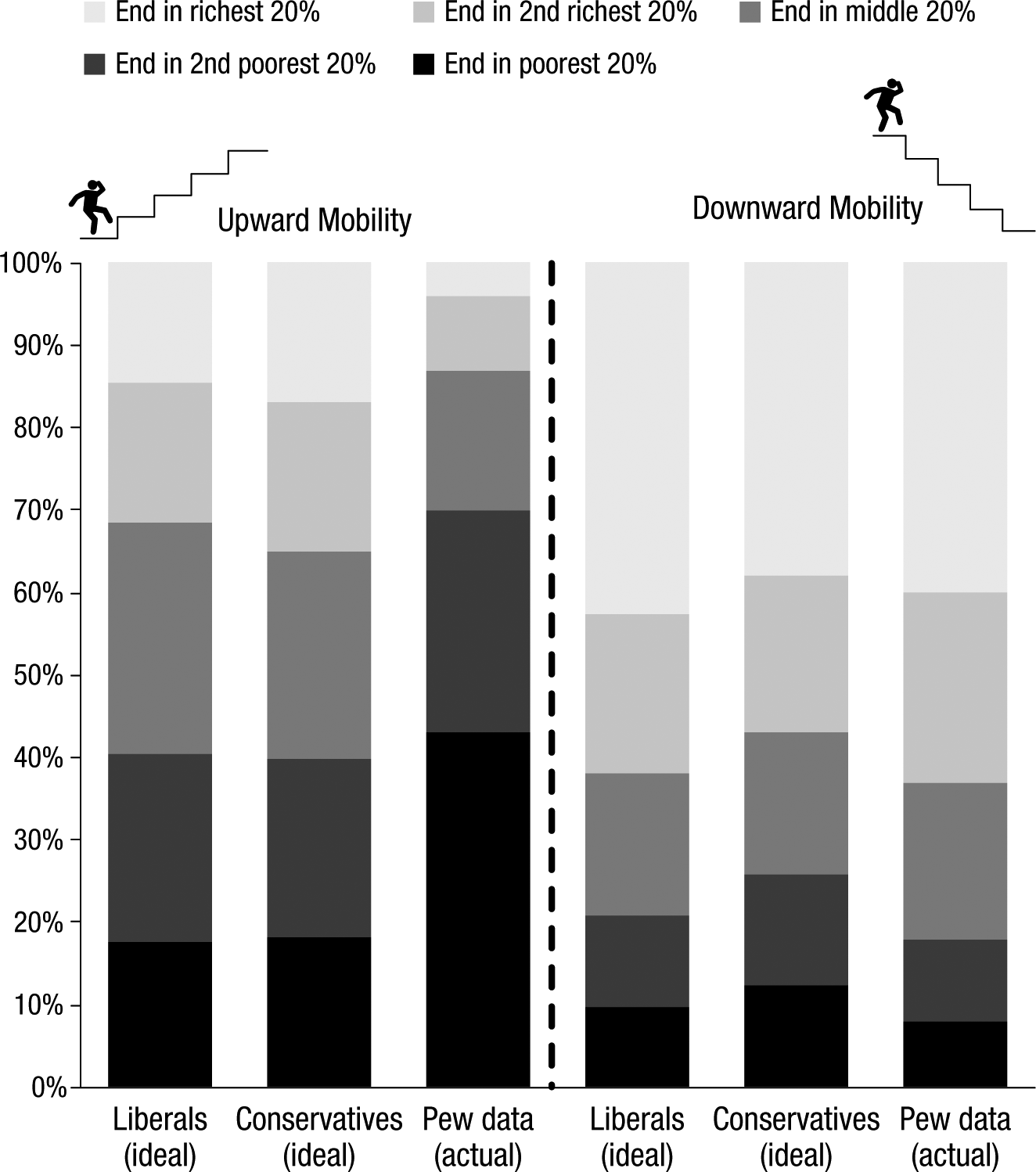
Ideal upward and downward mobility in a Mechanical Turk sample (N = 290) based on political affiliation. Ideal and actual quintile of where someone born to a family in the bottom (left) and top (right) quintiles ends up.
General Discussion
Our results demonstrate the importance of studying perceptions of the economic system in quantitative terms. Although which concrete measures best capture people’s economic beliefs is not without controversy (see Eriksson & Simpson, 2012, 2013, and Norton & Ariely, 2013), such measures are an improvement over past measures that have assessed people’s attitudes about the economy in abstract terms. Our concrete measures of perceived mobility enabled us to address some novel and informative questions regarding perceived economic mobility. First, in both a large, nationally representative sample and a smaller sample of Mechanical Turk participants, we found evidence of a pronounced difference in perceptions of upward and downward mobility. Complementing past findings on the influence of different frames on support for redistributive tax policies (Chow & Galak, 2012; Lowery, Chow, & Crosby, 2009), we found that people perceive the economic system as less rigid when thinking of upward rather than downward mobility. Second, our concrete measures of people’s beliefs about economic mobility allowed us to assess the accuracy of people’s perceptions. Here too we found an influence of direction: The accuracy of participants’ estimates of social mobility was dependent on whether it was thought of in terms of upward or downward mobility. Although our participants as a whole overestimated the likelihood of upward social mobility, they vastly underestimated the likelihood of downward mobility. Third, we found that demographics affect people’s perceptions of mobility: Low-income individuals, and those who identify as members of minority groups, see the system as more socially mobile than do high-income individuals and members of the majority group. Finally, we found that conservatives and liberals differ in their perceptions of social mobility: Conservatives overestimated the likelihood of upward mobility and liberals underestimated the likelihood of downward mobility. Together, these findings underscore the importance of using concrete assessments of the public’s beliefs about complex social issues.
Asymmetrical perceptions of upward and downward social mobility
Why do perceptions of upward and downward mobility differ so dramatically? We suspect that three mechanisms are at play. First, the belief that upward mobility is more prevalent than downward mobility may serve to justify the existing economic system (Mandisodza et al., 2006). Although willing to acknowledge the vast income inequality in society, people have a deep desire to believe that the economic system is fair, legitimate, and just (Jost, Glaser, Kruglanski, & Sulloway, 2003; Tyler, 2011). Indeed, as system justification theory would lead one to suspect, we found a difference in perceptions of social mobility between conservatives and liberals, poor and wealthy individuals, and between respondents who identify as minorities or members of the majority. Because conservatives are more inclined to justify the existing economic system (Jost, Glaser, et al., 2003), they may be more motivated to see it as offering greater mobility. Furthermore, given that those who are most dependent on the system are most motivated to perceive it as just (Jost, Pelham, Sheldon, & Sullivan 2003; Kay et al., 2009; Shepherd & Kay, 2012), it is to be expected that poorer participants and those who identify as minorities would also perceive the economic system as more mobile. Such a belief provides assurance that the “have-nots” can nonetheless rise up the social ladder and that the economic system works as it should.
The observed difference in people’s beliefs about upward and downward mobility may also be due to a persistent theme in American discourse, a theme encapsulated in the term “American Dream.” The idea of upward social mobility is part of the American ethos (Kluegel & Smith, 1986). Success and economic wealth are thought of as the products of personal drive, hard work, and great ability or talent; poverty is thought of as the result of sloth, a lack of effort or ability, or unwise financial decisions (Cozzarelli, Wilkinson, & Tagler, 2001; Fong, 2001; Kay, Jost, & Young, 2005; Lane, 1959; Mandisodza et al., 2006). Notably absent from this cultural ethos is the prevalence of downward social mobility. The cultural obsession with upward social mobility (and its complementary lack of attention to downward mobility) is almost certain to contribute to the asymmetry in perceptions of mobility that we observed in our research.
Finally, there is reason to believe that the asymmetry between upward and downward social mobility reflects a more general cognitive bias, one which leads people to think that a rise in any ranking is more likely than a decline. For example, when predicting the future performance of NBA teams based on their ranking at the end of the previous regular season, people believe the likelihood that a team ranked near the bottom will rise to the top of the league is higher than the likelihood that a team ranked near the top will drop to the bottom (Davidai & Gilovich, 2014). Moreover, whereas a team’s rise to the top of the league tends to be attributed to its efforts and talent, a decline in a team’s rank is more frequently attributed to external constraints (e.g., other teams). Because every team’s intention is to rise in ranking, a rise seems a more likely outcome than a decline. Returning to the domain of economic mobility, because people wish to climb the economic ladder (or secure their position at the top), their likelihood of succeeding may be overestimated, leading to stronger impressions of upward mobility than downward mobility.
Implications and future directions
There are several important implications of our research. First, whether one is interested in perceptions of inequality or mobility (Norton & Ariely, 2011; see also Norton & Ariely, 2013), using concrete quantitative measures paints a more intricate and informative picture of public views that would not be possible using general attitudinal questions about the economic system. In addition, by not relying on general attitude questions, there is less danger that people will respond in socially desirable ways. Because participants in our study were asked to estimate economic mobility rather than express their attitudes about it, it is less likely that they tailored their responses to fit what they believe is expected of them. This is especially important in assessing attitudes on such sensitive issues as the economy.
Our findings also shed light on a perplexing psychological phenomenon. Although people have been shown to experience intense aversion to even minor financial inequalities in the lab (Dawes, Fowler, Johnson, McElreath, & Smirnov, 2007; Henrich et al., 2006; Johnson, Dawes, Fowler, McElreath, & Smirnov, 2009; Loewenstein, Thompson, & Bazerman, 1989; Sanfey, Rilling, Aronson, Nystrom, & Cohen, 2003), they seem to accept much higher levels of financial inequality outside of the laboratory. How can these two opposing truths be reconciled? Lab-induced inequalities are obviously different from societal inequalities, and many factors surely play a role in people’s much stronger reactions to the former than the latter. But one important element, we argue, is the strong belief in upward mobility we have observed here. A strong faith in the possibility of upward mobility (along with relatively little concern about downward mobility) may dampen people’s reactions to prevailing economic inequality outside the laboratory. By providing people an opportunity to justify inequality as fair and equitable, the steadfast belief in upward mobility may serve as a mute button on the sound system of public debate about economic justice.
Focusing public attention on downward mobility, in contrast, may enhance people’s concerns about economic equality and thereby encourage social action. As we have shown, when the question is posed in terms of downward mobility, people vastly underestimate mobility rates, leading to the perception of a highly static economic system. Though erroneous, this belief may serve to motivate social action by highlighting ways in which the country falls short in terms of fairness and opportunity. Channeling the public debate to revolve around either downward or upward mobility may therefore serve to encourage or inhibit social action, respectively.
Finally, by highlighting political differences in perceptions of economic mobility, our findings may shed light on the partisan divide over the issue of economic inequality. A core tenet of social psychology is that when people disagree about something, their disagreement is often more about the “object of judgment” than the “judgment of the object” (Asch, 1948). Opposing views, in other words, may not stem from divergent valuations of a given problem or topic, but from different construals of what the problem or topic is. Political affiliation and ideology, furthermore, are known to be associated with such differences in construal (Ross, Lelkes, & Russell, 2012). In this case, when liberals and conservatives argue about social mobility, their disagreement may stem in part from their assessments of the amount of social mobility that is actually out there. As we have shown, liberals and conservatives do differ in their assessments of the existing amount of economic mobility, and their divergent assessments are likely to influence what they think about the current state of the economy and different proposed policies designed to influenced it. Informing policy makers and the public about actual mobility rates (rather than relying on biased perceptions of mobility) is therefore likely to be a helpful first step in advancing the political debate surrounding this issue.
Conclusion and Future Research
We have found that beliefs about the amount of upward economic mobility are different than those about downward mobility, and that beliefs about economic mobility are different among people on different sides of the political spectrum. As we noted, these findings have both theoretical and applied implications. Nevertheless, our findings have some limitations and we note them as a starting point for future research. First, future studies should examine whether our findings apply to other types of social mobility. Our studies focused on intergenerational income mobility. Although people don’t generally use that term, their beliefs about social mobility often take essentially this form. Popular media depictions of upward mobility, for example, typically involve a person rising to a class higher than the one into which he or she was born. Future research might also examine beliefs about intragenerational income mobility (e.g., the likelihood of moving up or down the social ladder during one’s career) as well as beliefs about wealth mobility (e.g., the likelihood of moving up or down the ladder of overall wealth rather than income). In addition to perceptions of relative mobility, it would also be informative to examine people’s beliefs about absolute mobility (e.g., the likelihood of having a higher income—in absolute terms—than one’s parents). Data reflecting such beliefs need to be collected and interpreted with a great deal of care, however, because people have trouble thinking clearly about money in terms of its real monetary value (Shafir, Diamond, & Tversky, 1997). Note, furthermore, that regardless of people’s beliefs about absolute mobility—whether they are richer now than they were before, regardless of how others are doing—the rags-to-riches ethos in American culture is one in which a person vastly exceeds her parents’ station in life rather than merely having more purchasing power.
Future studies might also profitably examine the connection between beliefs about economic mobility and more specific political attitudes, such as views on economic policies and voting behavior. We assessed political affiliation with a general, one item measure, and future studies could try to discern the different dimensions of political affiliation (e.g., social, fiscal, and moral liberalism or conservatism) and their relation to perceptions of mobility. Finally, future longitudinal studies could ascertain whether perceptions of social mobility are evolving and, if so, in what direction. Answers to these questions are important, as reflected in President Obama’s recent characterization of contemporary trends in inequality and mobility as a “fundamental threat to the American Dream” and “the defining challenge of our time” (Office of Press Secretary, 2013b).
Footnotes

References
Supplementary Material
Please find the following supplemental material available below.
For Open Access articles published under a Creative Commons License, all supplemental material carries the same license as the article it is associated with.
For non-Open Access articles published, all supplemental material carries a non-exclusive license, and permission requests for re-use of supplemental material or any part of supplemental material shall be sent directly to the copyright owner as specified in the copyright notice associated with the article.
