




Abstract
Developmental and animal research has established play as important to well-being, yet little is known about implications of play by human adults, particularly within close relationships, where it is most likely to occur. Although this is an important emerging topic for psychology, several obstacles have impeded research in this area, including definitional issues and the lack of a guiding framework. In this article, we direct attention to this neglected research area and propose a perspective on play in adulthood that provides a definition of the construct (a behavior or activity that is carried out with the goal of amusement and fun, involves an enthusiastic and in-the-moment attitude or approach, and is highly interactive among play partners or with the activity itself) and identifies potential immediate outcomes (e.g., positive affect, feelings of being accepted and valued, reductions in daily stress) and long-term outcomes (e.g., psychological, physical, and relational health) of play in adulthood, with an emphasis on play occurring within the context of close relationships. In doing so, we elucidate important avenues for future research on this topic (e.g., development of standardized measures, examination of biological mechanisms), which is ripe for investigation.
Keywords
Dancing together, having Nerf gun shoot-outs, mock wrestling, hiding surprises around the house for each other to find, and becoming fully immersed in a competitive game together are examples of ways in which people in close relationships might engage in play. Research on relationships has traditionally focused on the investigation of negative or serious events that occur within relationships (e.g., conflict, social support) while overlooking more routine, positive events that may be more representative of typical day-to-day functioning within relationships (Baxter, 1992; Duck, 1990; Hays, 1989). We propose that engagement in play exemplifies such important, positive, and routine aspects of people’s lives that researchers should consider as a potential predictor of health and well-being (Aune & Wong, 2002; Baxter, 1992).
Playing with abandon is a uniquely liberating and fulfilling experience. In childhood, opportunities to play are abundant, and research has established links between well-being and play in children (e.g., Barnett, 1991; Coolahan, Fantuzzo, Mendez, & McDermott, 2000; Erickson, 1985; Fantuzzo & McWayne, 2002; Fantuzzo, Sekino, & Cohen, 2004; Hurwitz, 2003; Shonkoff & Phillips, 2000; Singer, Singer, & Sherrod, 1980; Sutton-Smith, 1970; Tamis-LeMonda, Shannon, Cabrera, & Lamb, 2004) and in young animals (e.g., Burghardt, 1998; Harlow & Harlow, 1962; Power, 2000). However, very little theoretical or empirical work has considered the functions and implications of play in adulthood. To address this gap, we advance a perspective on play in adulthood from which to launch future research in this area (see Fig. 1). First, we specify a functional, standardized definition of play, which is a crucial first step in building an empirical foundation for this emerging area. Next, we identify important immediate (see Fig. 1, path a) and long-term (see Fig. 1, path b) outcomes of play in adulthood and review existing evidence for these outcomes. Finally, we outline an agenda for future research.
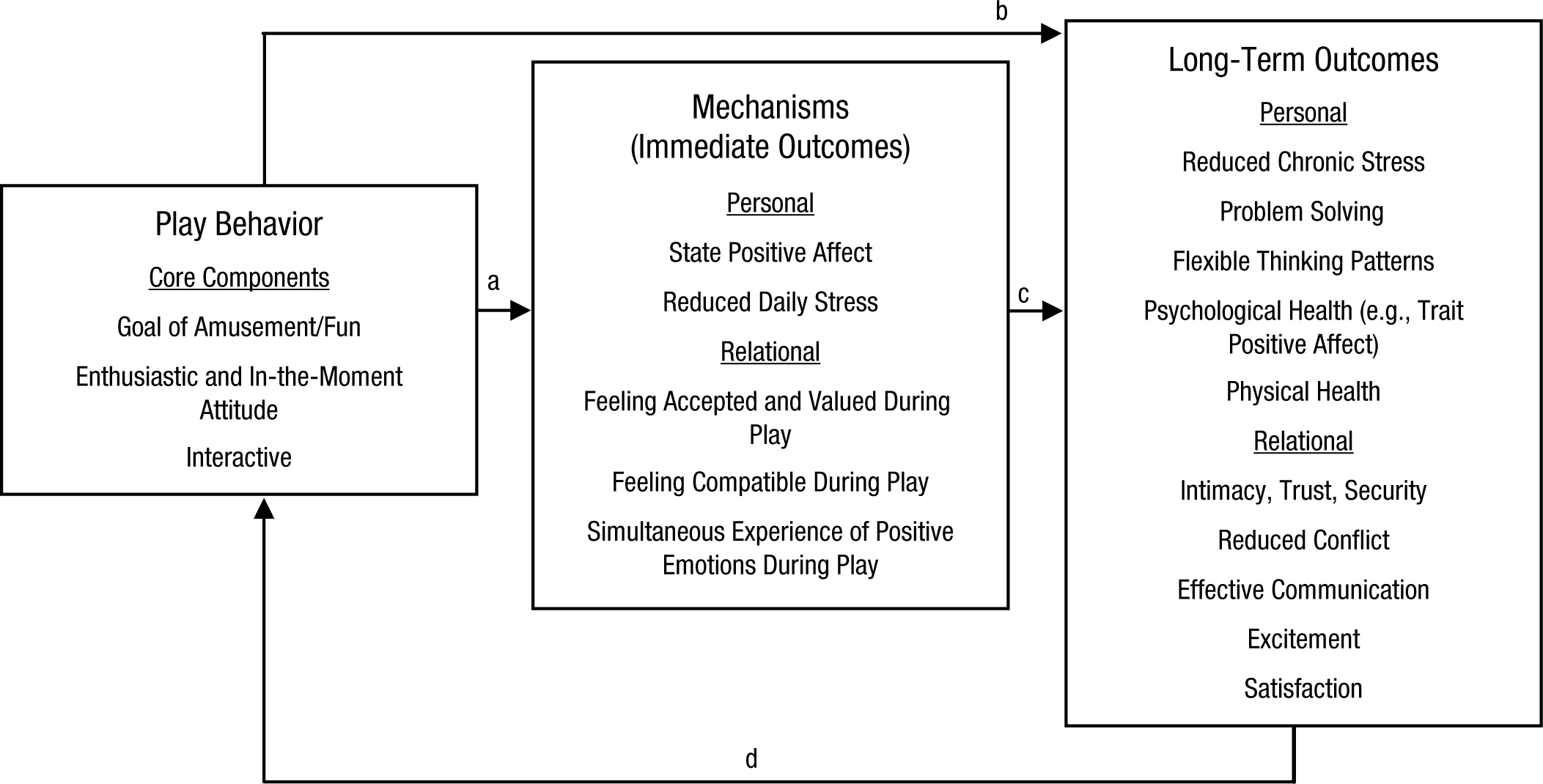
Model of the effects of play in adulthood.
Defining Play
There is much debate about the definition of play (e.g., Ablon, 2001; Abramis, 1990; Barnett, 1991, 2007; Betcher, 1981; Casado-Kehoe, Vanderbleek, & Thanasiu, 2007; Csikszentmihalyi, 1975; Glynn & Webster, 1992, 1993; Guitard, Ferland, & Dutil, 2005; Lauer & Lauer, 2002; Schaefer & Greenberg, 1997; Starbuck & Webster, 1991; Terr, 1999), but here we identify, and then focus on, three key features of play. First, we conceptualize play as a behavior or activity that is carried out with the goal of amusement, enjoyment, and fun. The word play conjures images of children excitedly playing hide-and-seek or acting out imaginative scenes in the moment, without concerns for outside stressors or responsibilities, as well as images of dogs bounding across parks with unbridled enthusiasm. Thus, even in adulthood, it seems essential to its definition that play involves an enthusiastic and in-the-moment attitude or approach to the activity. This approach momentarily directs attention away from individuals’ hassles, stressors, and responsibilities. It is likely this attitude that makes play the intensely enjoyable experience others have described (Ablon, 2001; Betcher, 1981; Casado-Kehoe et al., 2007; Csikszentmihalyi, 1975; Lauer & Lauer, 2002; Terr, 1999). Third, play with others involves a high degree of active interaction among partners, and solitary play requires active interaction with the activity itself. Thus, we define play as an activity or behavior that (a) is carried out with the goal of amusement and fun, (b) involves an enthusiastic and in-the-moment attitude or approach, and (c) is highly interactive among play partners or with the activity itself. These core components differentiate play from leisure, which is generally defined as time free from work or duties (Leisure, n.d.), and activities pursued during this time (e.g., reading, watching television, hiking, social activities, sports). Play is one type of leisure activity, but not all leisure activities are play because they do not all involve the goal of amusement and fun, the enthusiastic and in-the-moment approach, or the interactive quality we outline above. It is important to note that play can take many forms (cooperative, competitive, novel, familiar, planned, spontaneous, creative, idiosyncratic, physical, structured) and thus vary on other dimensions; however, all forms must involve these core components to be considered play.
What Happens When People Play?
Play produces both immediate and longer-term effects, which include both personal (individual) and relational benefits. Here, we describe likely outcomes of play in adulthood (regardless of the specific form that play takes), with a special emphasis on play that occurs within close relationships.
Immediate outcomes of play
Immediate personal outcomes
As shown in path a of Figure 1, engaging in play should immediately generate feelings of state positive affect, given that it is an activity that is approached with the goal of amusement and fun. This positive affect/emotionality may take a variety of forms, including happiness, joy, excitement, interest, amusement, serenity, and inspiration. Play is also likely, more than most any other type of activity, to generate laughter. In addition, play should immediately reduce or eliminate feelings of everyday stress by providing a temporary escape from one’s concerns, since genuine play requires an individual to become fully absorbed in the present activity (Lauer & Lauer, 2002; Winnicott, 1971). This allows one to feel liberated and uninhibited in ways that other contexts do not.
Immediate relational outcomes
Because play is a completely voluntary, non-obligatory behavior in relationships (unlike other behaviors—e.g., support provision, in which there is some normative pressure to engage), shared play with others is likely to produce feelings of being accepted and valued by others. Play also provides a relationship context that is ideal for demonstrating partners’ compatibility. Compared to other activities, play lends itself more to unexpected, casual banter, repartee, and both fluid and coordinated communication/interaction. Some support for this assertion can be found in research in which married couples have reported play as an important aspect of their relationship because they felt particularly “in synch” with one another during play (Betcher, 1981). Feeling in tune with one’s partner should lead one to feel understood and validated and to feel that one’s partner is a uniquely well-suited match.
Another immediate relational outcome of play is the shared experience of positive emotions with one’s partner. The spontaneous experience of positive emotions is likely to amplify the positive emotions elicited by the activity itself. Supporting this idea, research on capitalization (the social sharing of good news and positive events) has established that the sharing of these positive events augments the positive emotions generated by the event itself (when the partner responds actively and constructively to the good news) and predicts relational quality (Gable, Gonzaga, & Strachman, 2006; Lambert et al., 2013). The sharing of positive emotions with one’s partner is likely to be a strong immediate outcome of play linking shared play to long-term relational benefits.
Long-term outcomes of play
Long-term personal outcomes
As shown in paths b and c in Figure 1, play is likely to produce several important personal benefits over time. First, immediate reductions in stress experienced during play should, over time, decrease overall perceived stress in one’s life (DeLongis, Coyne, Dakof, Folkman, & Lazarus, 1982).
Furthermore, the broaden-and-build theory of positive emotions (Fredrickson, 1998, 2001, 2003) suggests that positive emotions should lead to more diverse thought-action repertoires and, in turn, enduring personal resources, such as resilience and problem-solving skills. Because play is likely to generate strong positive emotions, play should over time improve one’s ability to think flexibly or in an unconventional manner (Betcher, 1981; Lauer & Lauer, 2002). Some support for this proposition can be gleaned from work by Isen and colleagues (Isen, Daubman, & Nowicki, 1987; Isen, Johnson, Mertz, & Robinson, 1985), who found that positive emotions, in comparison to negative or neutral affective states, predicted better performance on a problem-solving task.
Moreover, play should broadly contribute to positive psychological and physical health over time, either by reducing chronic stress, which has been linked to poorer psychological and physical health (Cohen & Williamson, 1992; Herbert & Cohen, 1993), or by immediately generating high levels of trait positive affect and happiness, which have been linked with indicators of psychological and physical health (Diener & Chan, 2011; Lyubomirsky, King, & Diener, 2005; Pressman & Cohen, 2005). Play is also likely to contribute to physical and mental health because many forms of play involve physical and mental activity or stimulation, which should be health-protective (Carey, 2009).
Long-term relational outcomes
Play in a relational context should also result in long-term relational benefits. Specifically, the immediate benefits of play that include feelings of being accepted and valued by others and feeling compatible with one’s play partner should contribute to feelings of intimacy, trust, and security over time. Reciprocated bids for play may both communicate and validate partners’ feelings of intimacy, trust, and security with one another (Baxter, 1987, 1992; Dicks, 1963; Johnson, 2003; Oring, 1984). In contrast, nonreciprocated bids for play may communicate lack of interest in developing intimacy and perhaps a lack of acceptance, which may erode intimacy, trust, and security over time. Empirical work showing a link between frequency of play with one’s best friend and feelings of closeness (Baxter, 1992) provides some initial support for these predictions.
Another relational benefit of engaging in play is that it results in long-term reductions in relational conflict, either by predisposing partners to experience conflict less often or by endowing them with useful skills that facilitate effective conflict resolution (i.e., effective communication). Play shared between partners is likely to be an emotionally positive experience that contributes to the relationship’s emotional capital (Feeney & Lemay, 2012). Through play, partners can build reservoirs of positive experiences and feelings for each other from which they can draw during times of conflict (Terr, 1999). Therefore, partners who play routinely are less likely to be affected by negative relational experiences. Routine play with close others is also likely to equip partners with skills for effectively resolving conflict when it is encountered (Betcher, 1981). Play provides a unique relationship context free from negativity and seriousness in which partners can express themselves and become more adept at reading each other’s cues. These skills are likely to carry over into more serious or negative contexts, such as more skillful communication during conflict and social support interactions. Supporting evidence for these assertions comes from research indicating that self-reported frequency of play with one’s spouse is associated with better communication and conflict-resolution skills (Vanderbleek, Robinson, Casado-Kehoe, & Young, 2011).
Another important relational benefit of play is that it is likely to spark feelings of excitement within the relationship and combat relationship boredom over time (Baxter, 1987; Lauer & Lauer, 2002). After repeatedly sharing play with one’s partner, feelings of excitement that were originally elicited by play are likely to become associated with the partner, leading to long-term boosts in relational excitement (Dutton & Aron, 1974). This is supported by research showing that sharing novel and exciting activities combats relationship boredom and enhances relationship quality (Aron & Aron, 1986; Aron, Norman, Aron, McKenna, & Heyman, 2000; Reissman, Aron, & Bergen, 1993), and by research in which couples have reported that the purpose of their relational play is to elicit feelings of excitement and fun (Baxter, 1987; Lauer & Lauer, 2002).
Finally, as a result of the many proposed relational benefits just described, play should enhance feelings of relationship satisfaction over time. Existing research has shown consistent links between reported frequency of play shared with one’s partner and relationship satisfaction (Aune & Wong, 2002; Baxter, 1992; Vanderbleek et al., 2011). Play also may lead to feelings of satisfaction through the shared experience of positive emotions. This is consistent with research indicating that positive affect experienced within one’s relationship accounts for the association between frequency of play in the relationship and satisfaction (Aune & Wong, 2002).
Our model further predicts that the long-term personal and relational benefits gleaned from play are likely to predispose individuals to engage in play more frequently over time (Fig. 1, path d). For example, positive relationship functioning should provide a safe context for play, similar to how the provision of a responsive relationship context facilitates exploration (Bowlby, 1988; Feeney, 2004, 2007; Feeney & Thrush, 2010). In addition, individuals who are more mentally and physically healthy (and less chronically stressed) should have more personal resources for engaging in play.
Future Research Agenda
Worthy of special emphasis are a few basic steps needed to launch this area of research. The development of standardized play measures for adults that reflect the proposed definition of the construct is imperative in moving this research area forward. Such measures will enable researchers to examine outcomes of play and mechanisms underlying links between play and outcomes, and to both differentiate play from and relate it to other constructs in the psychological literature. Current measures of play (Betcher, 1977; Vanderbleek et al., 2011) ask participants to report frequency of engaging in a wide variety of behaviors thought to be play without capturing their goals or demeanors during such activities. We hope that the defining features of play advanced here will provide a foundation for developing empirically useful and standardized measures of these constructs.
Furthermore, the development and use of observational, experimental, and longitudinal methodologies will be important in advancing this area of research. Relatedly, the development of theoretically based, well-constructed, and validated coding systems for observational work on play will be a much-needed improvement. Once valid and reliable measures and procedures have been devised, researchers can further test the immediate and long-term outcomes of play, as well as questions regarding changes in immediate and long-term outcomes of play across the relationship span or life span. Findings acquired from such research may eventually serve as a basis for play interventions for adults (e.g., to assist in strengthening relationships or alleviating loneliness; Qualter et al., 2015). In addition to considering play in general, it may also be useful and informative for researchers to examine the various forms that play may take (e.g., cooperative, competitive, novel, familiar, planned, spontaneous, creative, idiosyncratic, physical, structured) and the extent to which specific forms of play are more or less likely to influence the predicted outcomes of play.
Obtaining all play partners’ perceptions of specific play episodes also would add new richness to the literature by enabling researchers to investigate whether all partners need to approach an activity as play in order for the activity to be beneficial to each individual. We suspect that because play with others is inherently interpersonal, it will lead to the relational benefits proposed only when all play partners share a goal of amusement and fun, have an enthusiastic in-the-moment approach, and interact with one another during the activity. Mismatching on these goals or attitudes during a play opportunity may negate the benefits of play and may even have deleterious effects, since one partner may feel rejected after a bid to play is not reciprocated.
Relatedly, it will be important for future research to identify conditions under which play may not be uniformly beneficial or may even be detrimental to an individual or relationship. The perspective advanced here presupposes that play will generally have beneficial effects. However, there may be an optimal amount of play in adulthood that best predicts well-being given other life responsibilities that adults have. Obsessive play (e.g., compulsive gaming) or play done to avoid important issues (e.g., family/marital problems) may be detrimental to well-being because it interferes with other aspects of life to which adults must attend (e.g., work and family responsibilities). Also, there are likely to be specific contexts in which play may not lead to positive outcomes. For instance, if an individual were in a state of distress and needed support and understanding from a relationship partner, the partner’s pursuit of play (even in an attempt to distract or cheer the individual) would ignore or minimize the individual’s needs and would not be beneficial for either partner or the relationship. In fact, such behavior may be harmful to personal and relational well-being because it is unresponsive and insensitive to the partner’s needs (Feeney & Collins, 2014; Reis, Clark, & Holmes, 2004). This is currently unexplored territory that will be important to chart in order to identify the boundary conditions for adaptive play in adulthood.
Future work in this area should also identify biological processes that occur during play, which may help to explain links between play and its proposed outcomes. Because play is likely to be shared primarily with close others (or those with whom one would like to develop greater intimacy), hormones associated with affectional bonding are likely to be released during play. Oxytocin and vasopressin, hormones that are thought to play important roles in the formation of attachment bonds (Bartz & Hollander, 2006; Carter, 1998; Carter & Cushing, 2004; Lim & Young, 2006) and intimate forms of social behaviors among animals (DeVries, DeVries, Taymans, & Carter, 1996; Keverne & Kendrick, 1992; Williams, Catania, & Carter, 1992; Winslow, Hastings, Carter, Harbaugh, & Insel, 1993), may be released during play. In support of this claim, recent work has implicated release of oxytocin in fathers’ play with their children (Gordon, Zagoory-Sharon, Leckman, & Feldman, 2010; Naber, van IJzendoorn, Deschamps, van Engeland, & Bakermans-Kranenburg, 2010). The release of hormones associated with affectional bonding during play (e.g., oxytocin and vasopressin) may serve as a pathway through which play increases intimacy, trust, and security over time. Endorphins, hormones that act on opiate receptors and produce feelings of euphoria and analgesia, also have been implicated in social bonding among primates (Dunbar, 2010; 2012) and should be linked with the enjoyment experienced during play. These effects are consistent with research linking social laughter with greater pain thresholds (indicative of endorphin release; Dunbar et al., 2012) and suggest that the link between relational play and feelings of excitement may be partially explained by the immediate release of endorphins during play.
The purpose of this article has been to identify important benefits of play in adulthood, with a focus on play shared among adults. It is important to note that there are many types of relationships in which play occurs in adulthood (e.g., friendships, romantic relationships, sibling relationships) that deserve empirical attention. Also, adults engage in play interactions with their children and with their companion animals. Such exuberant, active, and non-evaluative play partners are likely to model the appropriate goals and demeanors of play to adults and thus may be particularly powerful in predicting the proposed benefits of play. These are all important empirical questions that must be addressed in laying the basic groundwork for this emerging research area.
In conclusion, we propose that play continues to be an important phenomenon in adulthood and that it will be of interest to a wide array of psychologists (including social, developmental, cognitive, and clinical psychologists). Play in adulthood is likely to foster thriving by helping individuals develop and sustain healthy relationships, by providing mental and physical stimulation across the aging process, by equipping individuals with flexible thinking patterns and improved problem-solving abilities, and by providing a means of reducing the impact of life stressors. Without a doubt, there are limitless avenues for researchers who wish to work toward establishing this exciting and potentially fruitful research area.
Footnotes
Declaration of Conflicting Interests
The authors declared that they had no conflicts of interest with respect to their authorship or the publication of this article.