




Abstract
For centuries, decision scholars paid little attention to emotions: Decisions were modeled in normative and descriptive frameworks with little regard for affective processes. Recently, however, an “emotions revolution” has taken place, particularly in the neuroscientific study of decision making, putting emotional processes on an equal footing with cognitive ones. Yet disappointingly little theoretical progress has been made. The concepts and processes discussed often remain vague, and conclusions about the implications of emotions for rationality are contradictory and muddled. We discuss three complementary ways to move the neuroscientific study of emotion and decision making from agenda setting to theory building. The first is to use reverse inference as a hypothesis-discovery rather than a hypothesis-testing tool, unless its utility can be systematically quantified (e.g., through meta-analysis). The second is to capitalize on the conceptual inventory advanced by the behavioral science of emotions, testing those concepts and unveiling the underlying processes. The third is to model the interplay between emotions and decisions, harnessing existing cognitive frameworks of decision making and mapping emotions onto the postulated computational processes. To conclude, emotions (like cognitive strategies) are not rational or irrational per se: How (un)reasonable their influence is depends on their fit with the environment.
Do emotions have the power to shape decisions, with potentially detrimental or beneficial effects, or are they epiphenomenal bystanders of the true forces behind decisions? For much of the 20th century, scholars clashed over the power of emotions to steer and explain behavior. The early Freud (1915), for instance, thought of emotions as discharges of instinctual energy, and he explained certain forms of human thought and behavior as symptoms and products of unconscious emotions. The appeal of these explanations resided in their ability to find potential meaning and purpose in cognition and behavior that otherwise seemed bizarre and pointless. 1 In contrast, Skinner (1972) dismissed any explanatory reference to emotions outright. He considered the language of feeling to be imprecise and denied any “causal connection between the reinforcing effect of a stimulus and the feelings to which it gives rise” (p. 107). For Skinner, feelings were mere epiphenomena of other processes—prescientific concepts that had no place in the scientific analysis of behavior.
Curiously, decision scientists have been largely indifferent to this 20th-century conceptual battle over emotions. Indeed, ever since the epistolary exchange in 1654 between the French mathematicians Pascal and Fermat—often viewed as the birth of the notion of mathematical expectation and the systematic study of decision making (Hacking, 2006)—scholars of decision science have shown little concern for emotions’ potential leverage over behavior (notwithstanding influential economic treaties in the 18th and 19th centuries; e.g., Smith, 1759/2010). 2 The milestones of the discipline (see Table 1)—from Bernoulli’s founding text on expected-utility theory (1738/1954), von Neumann and Morgenstern’s (1944) groundbreaking text on game theory, and Savage’s (1954/1972) and Edwards’s (1954) influential work on subjective expected utility to Tversky and Kahneman’s (1974) programmatic account of biases in people’s probabilistic reasoning—were all largely mute on the role of emotions. 3
Brief Descriptions and Definitions of Major Theories of Decision Making Under Risk
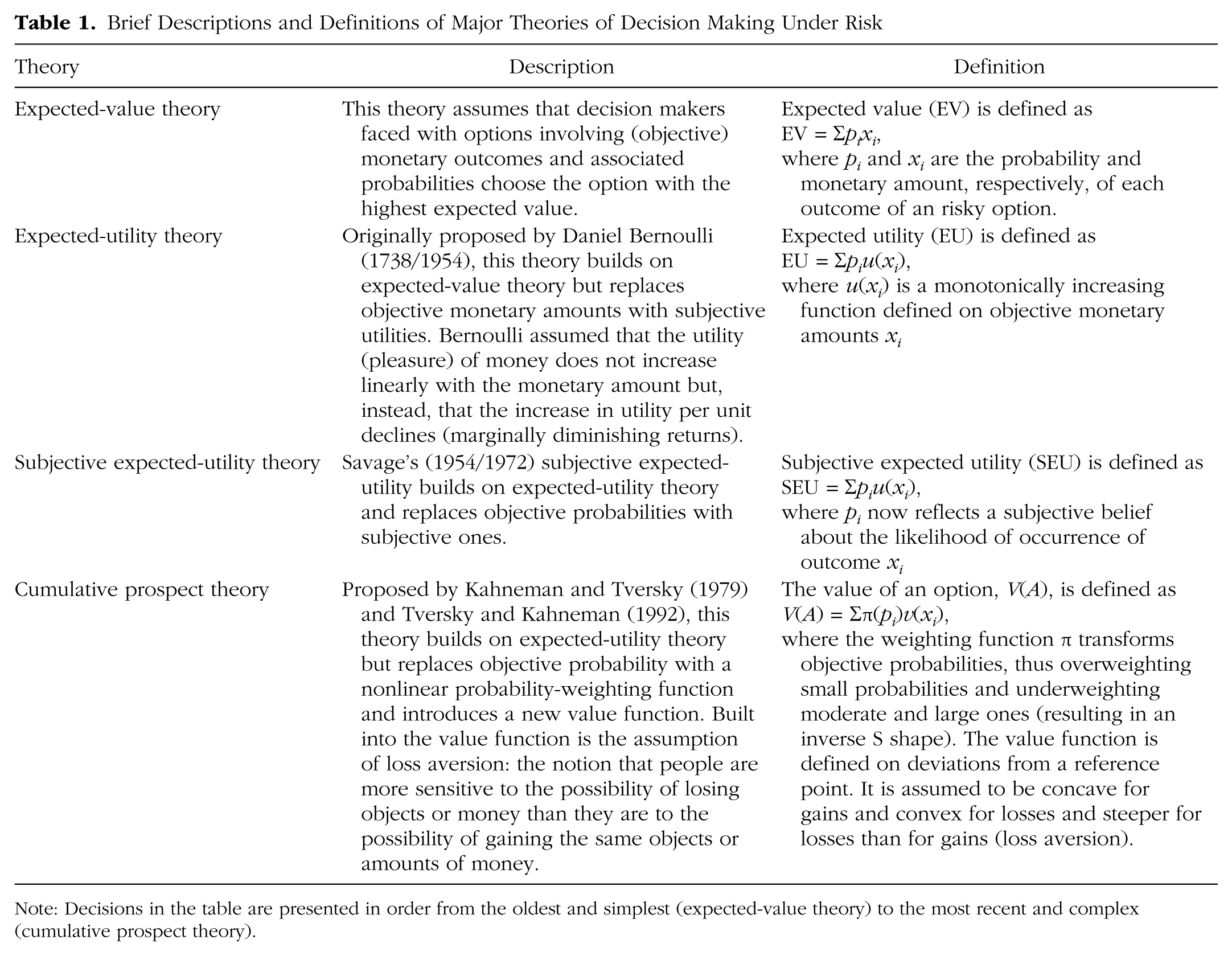
Note: Decisions in the table are presented in order from the oldest and simplest (expected-value theory) to the most recent and complex (cumulative prospect theory).
This disregard of emotions is perhaps most surprising in Tversky and Kahneman’s (1974) treatment of systematic blunders in people’s judgments and choices (the “heuristics-and-biases program”). After all, the irrationality that they attributed to fallible cognition (i.e., cognitive strategies such as the availability heuristic) had previously—over a period of centuries—been blamed on an antagonistic relationship between rationality and emotions and on the subversive effect of the latter (see Elster, 1996). It was only many years after Tversky and Kahneman’s seminal 1974 Science article that proponents of this program advanced heuristics that process affect-rich events and information: the peak-end rule (Kahneman, Fredrickson, Schreiber, & Redelemeier, 1993) and the affect heuristic (Finucane, Alhakami, Slovic, & Johnson, 2000). Later still, Kahneman (2003) endorsed the view (proposed, e.g., by Sloman, 1996) that the cognitive architecture can be divided into two systems: System 1, which is fast, intuitive, and emotional and sometimes causes human choices to deviate from the rules of rationality (Kahneman, 2011, p. 14), and System 2, which gives rise to slow, rule-governed, and deliberate reasoning and is (emotionally) neutral. Emotions were thus assumed to reside within the less-than-rational System 1, reaffirming the old antagonism between rationality and emotions. 4 Interestingly, the notion that the mind consists of two systems has also been influential in neuroscience. In fact, according to Phelps, Lempert, and Sokol-Hessner (2014), the dual-systems approach has been the “prevalent view of the role of emotion in decision making” (p. 264) in neuroscience.
To conclude, from the development of probability theory in the Enlightenment (Hacking, 2006) until the recent past, descriptive and normative investigations of human decision making had very little to say about how emotions influence the computations behind decisions. It is only recently that this disregard has been supplanted by an unprecedented surge of interest.
The Emotions Revolution: Vague Concepts and Muddled Conclusions on Rationality
Over the last one to two decades, the number of publications concerned with the role and function of emotions in the behavioral and neuroscientific study of decision making has skyrocketed. This “emotions revolution” (Weber & Johnson, 2009, p. 64; see also Lerner, Li, Valdesolo, & Kassam, 2015), which has put affective processes on an equal footing with cognitive processes, was triggered by various developments. In neuroscience, it was likely led by the work of Damasio and colleagues (H. Damasio, Grabowski, Frank, Galaburda, & Damasio, 1994), who suggested that people in the process of making decisions harness their “somatic markers” (gut feelings). These markers are not at the disposal of the emotionally disabled, which—in Damasio’s view—robs them of a “biasing device” that abets deliberations by highlighting some options (either good or bad ones) and eliminating them from subsequent consideration. Nearly a decade later, in a neuroimaging study of how emotions affect behavior in the ultimatum game 5 (one of the key strategic games studied by experimental economists), Sanfey, Rilling, Aronson, Nystrom, and Cohen (2003) concluded that “models of decision-making cannot afford to ignore emotion as a vital and dynamic component of our decisions and choices in the real world” (p. 1758). Since then, numerous researchers have heeded this advice, employing both behavioral experiments and neuroscientific methods to study the impact of emotions on decision making. 6
Despite the surge in studies probing how emotions interact with decision-making processes, however, there has been disappointingly little progress in modeling this interaction. Emotions are no longer neglected, but they are too often reduced to vague and practically unfalsifiable concepts. And it would seem that neuroscientific investigations of the interplay between emotions and decision making are particularly guilty of a “grab bag” approach to emotions.
A perplexing regularity
We illustrate this argument with a small but growing body of investigations that together suggest a perplexing regularity: Neurological and mental abnormalities appear to foster conformity to various norms of rational decision making endorsed in economics and psychology, whereas fully intact cognition appears to stand in the way of rationality thus defined. Reviewing this body of work, we (Hertwig & Volz, 2013) observed that many of the studies in question implicated emotional processes—or, more specifically, their disruption—in the production of (more) rational behavior. We discerned this pattern in studies investigating a variety of choices, from preferential and moral to investment decisions.
In some studies, people with impaired emotion processing did not show the classical reasoning biases (e.g., loss aversion, framing) typically observed in neurotypical participants. For example, Koenigs and Tranel (2008) suggested that a lack of “emotional associations” (p. 4) enables patients with damage to the ventromedial prefrontal cortex (VMPFC) to have consistent consumer preferences. Neurotypical participants preferred Pepsi to Coke in a blind taste test but reversed their preference when brand information was disclosed (the “Pepsi paradox”). In contrast, VMPFC patients consistently preferred Pepsi over Coke in both tests.
Another study investigated the role of emotions in patients with stable focal lesions in brain regions suggested to be related to emotions (Shiv, Loewenstein, Bechara, Damasio, & Damasio, 2005): In an investment-decision task, participants repeatedly decided whether to invest or to keep $1. For each invested dollar, there was a 50/50 chance of losing the dollar or gaining $2.50. The investors with impaired emotional processing made more advantageous decisions and ultimately earned more money than the emotionally fully functional investors. The authors concluded that patients with deficient emotional circuitry had dampened emotional responses to the possibility of losses, which liberated them from extreme levels of risk aversion. 7 Also dealing with the possibility of loss, other authors have suggested that a failure to “integrate emotional contextual cues into the decision-making process” (De Martino, Harrison, Knafo, Bird, & Dolan, 2008, p. 10746) permits autistic patients to choose in an internally consistent way; that is, independently of option framing (i.e., loss vs. gain).
Emotional processes or their disruption are also invoked in studies of social behaviors. Reviews of the neurobiology of moral behavior have concluded that weaker emotional reactions to the possibility of causing others direct harm enable patients with lesions to the VMPFC and orbitofrontal cortex (OFC) to overcome emotional revulsion about the means of an action (e.g., smothering a baby to quiet him or her). This liberates them to focus on the ends of the action (e.g., saving the lives of several others), facilitating a utilitarian response (see Mendez, 2009; Young & Koenigs, 2007). Finally, damage to the dorsolateral prefrontal cortex has also been suggested to weaken “the emotional impulses associated with fairness goals” (Knoch, Pascual-Leone, Meyer, Treyer, & Fehr, 2006, p. 829), thus permitting people with such lesions to follow their selfish impulses without restraint and thereby to maximize their material income.
Thought-provoking results but rudimentary explanations
Neurological and mental abnormalities foster rational behavior, whereas fully intact cognition thwarts it. These findings are remarkable. The explanations offered for them, however, are rather nebulous. Our thumbnail summaries are admittedly only brief excerpts from the respective articles, yet they represent the kind of conceptual vagueness on display in the literature. The emotional processes in question tend to remain unspecified or to be portrayed in generic terms: emotional associations, emotional reactions, impulses and responses, deficient emotional circuitry, and so on. These concepts are hard to pin down, let alone test. Furthermore, they are fluid enough to allow emotions to take on a split personality. Depending on the author, emotions or their disruption may be portrayed as either allies or enemies of rationality. Let us meet this dual personality.
Enter Dr. Jekyll and Mr. Hyde: The split personality of emotions
A. R. Damasio (1994) suggested that “reduction in emotion may constitute an . . . important source of irrational behavior” (p. 53; emphasis added) and that “the powers of reason and the experience of emotion decline together” (p. 54). Similarly, the regulation of emotions has been suggested to be critical for moral cognition and human morality (e.g., Ciaramelli, Muccioli, Làdavas, & di Pellegrino, 2007; Young & Koenigs, 2007), economic decision making (Koenigs & Tranel, 2007), the ability to generate counterfactual emotions such as regret (seen as fundamental “in regulating individual and social behavior”; Camille et al., 2004, p. 1169), and adaptive behavior in social environments (Larquet, Coricelli, Opolczynski, & Thibaut, 2010).
In contrast, many authors see emotions as sand in the decision-making machinery responsible for turning out rational behavior. Sanfey and colleagues (2003), for example, blamed emotions for luring people to reject unfair offers in bargaining games, thus causing them to lose money. Similarly, the emotion system has been suggested to play a key role in mediating decision biases such as the framing effect (De Martino, Kumaran, Seymour, & Dolan, 2006; see also McClure, Laibson, Loewenstein, & Cohen, 2004). This effect refers to the finding that choices change systematically depending on whether otherwise equivalent options are described in terms of a gain outcome (e.g., “keep $20 of the $50”) or a loss outcome (e.g., “lose $30 of $50”). According to the findings of De Martino and colleagues, the framing effect is associated with activity in the amygdala, suggesting that an emotional system is involved in the production of what many deem a manifestation of irrationality (e.g., Tversky & Kahneman, 1986; but see also Sher & McKenzie, 2006). From this perspective, taming emotional reactions or having a “more refined representation of their own emotional biases” (De Martino et al., 2006, p. 687) enables people to be more “rational” (Keysar, Hayakawa, & An, 2012).
One reading of the stormy entry of emotions into the decision neuroscience literature is this: Emotions now figure prominently in many contemporary studies of behavior and decision making, in neuroscience and beyond. The new kid has arrived on the block. Yet many of the underlying concepts and processes remain largely undefined. New theories of how emotions influence decision processes have barely been developed. Old theories have hardly been further elaborated. As a consequence, theoretical progress has been limited (see also Phelps et al., 2014). Given this admittedly provocative portrayal, where should the field go from here?
We next discuss three complementary directions that could be taken to foster the transition of the study of emotion and decision making from agenda setting (done!) to theory building. Of course, we do not claim to have all of the answers. It is also worth remembering that other fields of inquiry struggle with similar problems and that decision-making research can learn from their discussions of future steps (e.g., Locke, 2015). Nevertheless, it is time to start discussing how decision scientists and neuroscientists can move on from the early, anarchic days of the emotions revolution.
Taming Reverse Inference
What are the obstacles to theory building? One major hindrance is an explanatory strategy commonly used in in the neuroscientific study of decision making.
The problem of reverse inference
Reverse inference occurs when researchers infer that a specific mental process is involved when a particular brain area is activated, based on their interpretations of previous studies that have found activations in the same area. For illustration, consider De Martino et al.’s (2006) work on the framing effect, which the authors summarized as follows:
8
The framing effect was specifically associated with amygdala activity, suggesting a key role for an emotional system in mediating decision biases. Moreover, across individuals, orbital and medial prefrontal cortex activity predicted a reduced susceptibility to the framing effect. This finding highlights the importance of incorporating emotional processes within models of human choice and suggests how the brain may modulate the effect of these biasing influences to approximate rationality. (p. 684)
Figure 1 illustrates the steps involved in the authors’ chain of reasoning (see Poldrack, 2006, 2008, 2011a): First, activation within the amygdala was observed in the current choice task. Second, previous studies have found amygdala activation to be associated with emotion processing. Third, because activation within the amygdala has previously been associated with emotion processing (Arrow 1 in the figure), the current task, which prompted amygdala activation, is also assumed to engage emotion processing (Arrow 2 in the figure).
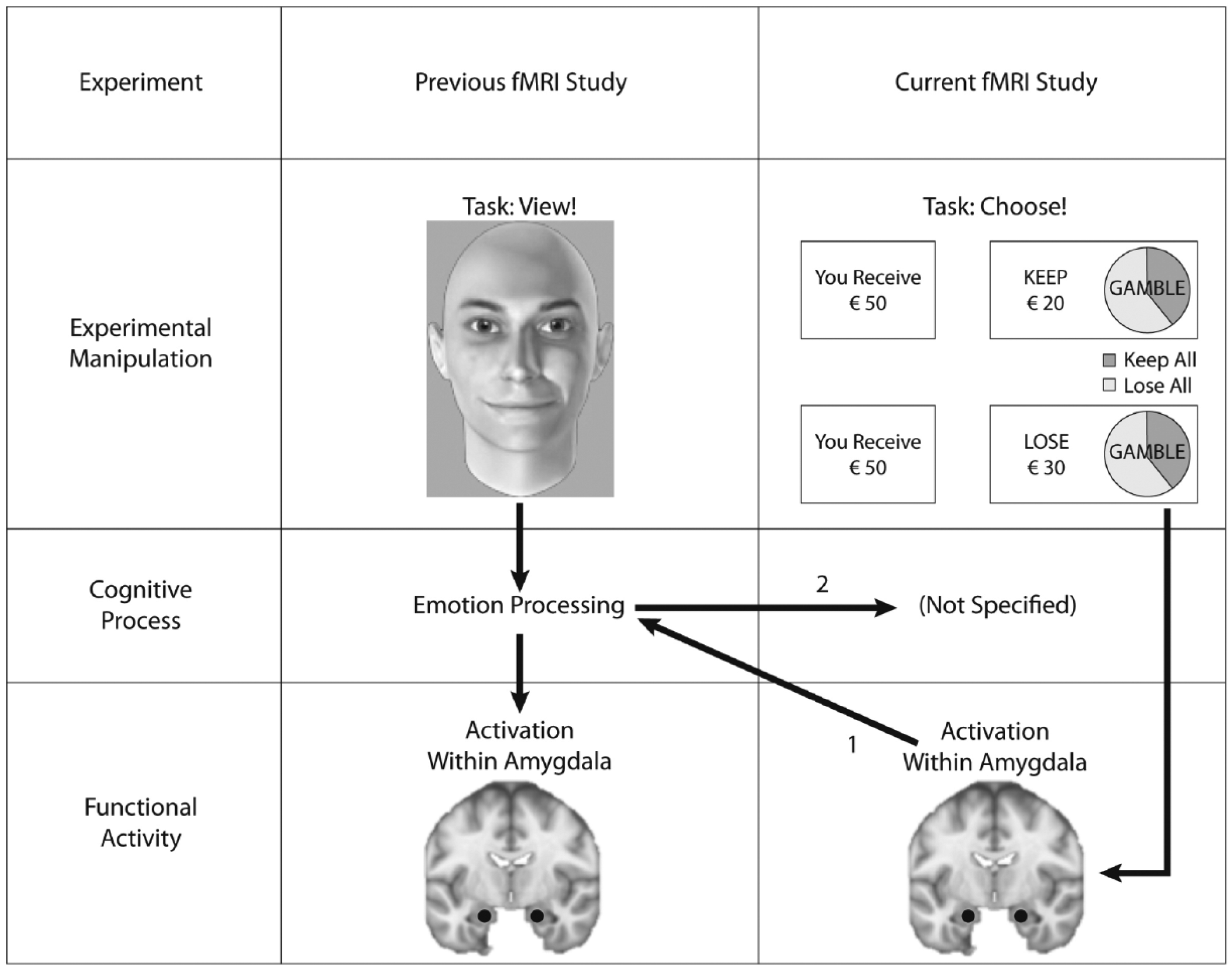
A schematic illustrating the anatomy of reverse inference. A previous functional MRI (fMRI) study varied three-dimensional facial expressions (positive, negative, or neutral) assumed to invoke emotion processing. Results revealed heightened amygdala activity for valenced expressions relative to neutral expressions (see Vrticka, Lordier, Bediou, & Sander, 2014). A current fMRI study varies the framing of choice options (gain frame vs. loss frame). The framing effect (an increase in the choice of the “gamble” option under the loss frame relative to the gain frame) is associated with amygdala activity (see De Martino, Kumaran, Seymour, & Dolan, 2006). Based on reverse inference (Arrow 1), it is concluded from the activation in the amygdala that emotion processing occurred. By extension (Arrow 2), it is concluded that the framing effect involves emotion processing. This relation is not directly tested, however, but is inferred from past research. It is thus the search for “causes of effects” (Gelman & Imbens, 2013).
The problem of this reverse inference is the following: For it to be valid, there needs to be a unique (selective) context-independent structure–process mapping between the putative process (e.g., emotion processing) and a specific brain structure (e.g., the amygdala), such that the structure is active if and only if the person is engaged in the respective mental process. Without this mapping, reverse inferences commit the logical fallacy of affirming the consequent (Klein, 2010; Poldrack, 2008, 2010; Raz, 2011). To date, no such one-to-one context-independent mapping has been established (Poldrack, 2010, p. 754). In fact, the architecture of the brain may make the attempt to identify selective associations between mental processes and brain structures a futile undertaking: “It is readily apparent that brain regions are involved in many functions, and that functions are carried out by many regions” (Pessoa, 2012, p. 158).
For a particularly lurid example of reverse inference and lack of selective association, consider the insular cortex. In an op-ed piece in the New York Times, the branding consultant Lindstrom (2011) reported exposing people in the scanner to the sound and image of a ringing and vibrating iPhone. Among other activations, he found a high level of activation in the insular cortex, which in his reading of previous literature was associated with feelings of love and compassion. His conclusion: People “loved their iPhones” (para. 10; emphasis in original). Poldrack (2011b) objected, arguing that this brain region is active in as many as one-third of all brain-imaging studies.
This problem of lack of selectivity is not limited to relatively large regions like the insula. Broca’s area is a relatively narrowly circumscribed brain region. Originally thought to be uniquely associated with language function, it is now known to be engaged during activities as diverse as movement preparation, action sequencing, and motor imagery (e.g., Anderson, 2007; Binkofski et al., 2000; Fiebach & Schubotz, 2006). By extension, mapping cognitive processes onto large brain areas such as the insula, which encompasses subareas with distinct cytoarchitecture, connectivity, and receptor density, is even more problematic: Established anatomical differentiations demonstrated to be associated with different cognitive processes are lumped together for the sake of a coarse-grained reverse inference.
The problem of lack of mapping and selectivity becomes even more severe when researchers try to map emotional categories onto gross anatomical regions (see Hamann, 2012a, 2012b; Murphy, Ewbank, & Calder, 2012; Rothenberger, 2012; Scarantino, 2012; Swain & Ho, 2012) and (hard-wired) anatomical networks (Lindquist, Kober, Blissmoreau, & Barrett, 2012). To add insult to injury, a region may be engaged in emotional processing at one point and in non-emotional processing at the next, as emphasized by Hamann (2012a). 9
The value of reverse inference
Does this mean that reverse causal inference should be proscribed altogether? No, because it has various valid functions, including motivating research, discovering new hypotheses (Poldrack, 2006, 2011a), and estimating “effects of causes” (Gelman & Imbens, 2013). Even in the context of hypothesis testing, reverse inference can be put on more solid ground if at least two steps are taken: One is to stop equating reverse conditional probabilities; that is, to stop inferring the probability that a certain process is engaged given an activation in a specific brain area from the probability that the area is activated given that the process is engaged. Instead, the probability that a process is engaged given the activation of a brain area needs to rest on Bayes’s rule—in other words, both the base rate of a brain area’s activation and the probability that the area is active given the process is not engaged need to be factored in (Hutzler, 2014; Poldrack, 2006, p. 60). The accuracy of this Bayesian inference depends on how well the quantities entered can be estimated. In order to increase this accuracy, researchers can take a second step, namely, to estimate the base rate of activation and respective probabilities on the basis of meta-analyses of past research. Platforms such as neurosynth.org (Yarkoni, Poldrack, Nichols, Van Essen, & Wager, 2011) and brainmap.org provide such large-scale, automated syntheses of fMRI data. These two steps do not constitute a carte blanche, however. For instance, the accuracy of the estimated probabilities will depend on how well the psychological process under investigation was initially classified in the meta-analysis.
More generally, researchers need to carefully qualify their findings and to not forget these qualifications across time. For instance, hypotheses to be tested must not morph into tried-and-tested findings from one study to the next. Let us return to De Martino et al.’s (2006) observations about the framing effect for an example. When interpreting their observation that making a decision in a foreign language (e.g., Japanese instead of English) reduces the magnitude of the framing effect, Keysar et al. (2012) took De Martino et al.’s finding at face value. They made no reference to the selective structure–process mapping hypothesized in the initial interpretation:
Making a decision in a foreign language could reduce the emotional reaction, thereby reducing bias. There is evidence that the framing effect is associated with increased activation of the amygdala (De Martino et al., 2006), which suggests that it results from a strong emotional attraction to sure gains and a strong aversion to sure losses. . . . Using a foreign language might weaken these emotional reactions, making choices more comparable across gains and losses. (p. 667)
Let us conclude with a final observation, also illustrated by the above quotation. The less precisely a mental process is specified, the easier it is to interpret activation of a particular brain system as evidence for its existence. This lack of specificity makes it easier to conjure a family resemblance between the process under investigation and processes previously associated with activation in that brain region. Which generic emotional processes, reactions, associations, and impulses could a blanket emotional system not accommodate? There are several ways to ensure that the study of the interplay of emotions and decisions is based on more substantial concepts. In the following sections, we focus on two.
Harnessing the Behavioral Science of Emotions
Undoubtedly, the concept of emotion presents a thorny problem (Scherer, 2005); there is, for instance, no consensus on a single definition of “emotion” (Cabanac, 2002). Nevertheless, psychological research on emotions offers a valuable repertoire of typologies and distinctions (see Kleinginna & Kleinginna, 1981; Plutchik, 1980; Scherer, 2005; Vohs, Baumeister, & Loewenstein, 2007). They can enrich the generic concept of emotion processing and thus foster the testing of processes and, ultimately, theory building. Let us consider one pertinent distinction.
Integral and incidental emotions
One of the key distinctions made in the science of emotions is between integral and incidental emotions. Both belong to the category of immediate emotions (Loewenstein & Lerner, 2003; Loewenstein, Weber, Hsee, & Welch, 2001) and are experienced on-line at the time of decisions (as opposed to expected emotions, which are conditioned on the outcome of specific events; Mellers, Schwartz, Ho, & Ritov, 1997). Integral emotions are triggered by the processes of preparing a choice, such as thinking about and representing the choice alternatives and anticipating their emotional consequences (Lerner et al., 2015). Incidental emotions, in contrast, are background emotions, often also referred to as moods. They are also experienced at the moment of choice but stem from dispositional or situational sources that are orthogonal to the task at hand and are carried over from a different situation (e.g., watching a sad or happy movie before making an investment decision; Rick & Loewenstein, 2008). 10
Let us apply the distinction between integral and incidental emotions to our running example, the framing effect. If, as De Martino et al. (2006) suggested, the emotional system, represented by activity in the amygdala, mediates the framing effect, then one test to further explicate the processes operating would be to examine whether and to what degree integral emotions—but not incidental emotions—mediate the framing effect. Both of these types of emotions are experienced at the moment of choice. But only integral emotions “arise from thinking about the consequences of one’s choice” (Rick & Loewenstein, 2008, p. 138); consequently, they should be associated with whether choice alternatives are represented in terms of gains or losses. Incidental emotions, in contrast, arise from dispositional or situational sources unrelated to the task at hand (Rick & Loewenstein, 2008). For instance, the prospect of getting into an MRI tube may make some individuals more anxious than others.
Integral and incidental emotions can both be varied experimentally, allowing their association with amygdala activation to be tracked. If integral emotions arise from thinking about the consequences of one’s choice, then upping the ante should increase their strength. This could be achieved, for instance, by presenting risky versus riskless gains and losses or by increasing the risk. These manipulations reliably affect the framing effect (Kühberger, 1998). The question is to what degree they trigger parallel changes in the (assumed) integral emotions, the framing effect, and amygdala activation. At the same time, amygdala activation and the framing effect should not be correlated with (experimentally manipulated) variations of incidental emotions. If incidental emotions did, however, prove to be (also) associated with the framing effect and amygdala activation, the mediation process of the emotional system on the framing effect would need to be conceptualized quite differently (e.g., as in the affect infusion model; Forgas, 1995). This is just one illustrative line of exploration suggested by one of the distinctions discussed in the behavioral science of emotion. There are others and, in all likelihood, more innovative ones. Our example simply illustrates that the neuroscientific study of decision making stands to benefit from the repertoire of typologies and distinctions available.
The functions of emotions
Another route to enrich generic concepts of emotion processing is to consider functionality. In Scherer’s (2005) component process model, for instance, each emotion component has a specific function: a cognitive component for the evaluation of objects and events, a neurophysiological component for system regulation, a motivational component for preparation and direction of action, a motor expression component for communication of reaction and behavioral intention, and a subjective feeling component for monitoring of internal state and organism–environment interaction. The functionality of emotions could also be explored by adopting a narrower focus; namely, on decisions. Pfister and Böhm (2008), for instance, proposed four functions of emotions: (a) to provide a common currency for the construction of preferences and the trade-off between different options; (b) to enable rapid choices when time is of the essence; (c) to focus attention on the key aspects of a problem; and (d) to ensure one’s commitment to making socially and morally important decisions. Other functions of emotions in the context of decision making may pertain to the planning and pursuit of future goals (Maglio, Gollwitzer, & Oettingen, 2014; see also Lerner et al., 2015).
Evolutionary theorists also offer a functional perspective. Fiske (2010), for instance, has suggested that social emotions are motives representing the social consequences of a person’s action—in other words, proxies for the basic systemic states of relationships—and distinguished among appetitive, consummatory, self-controlling, reparative, punitive, relinquishment, and loss emotions. Similarly, Cosmides and Tooby (2000) have suggested that the mind’s many subprograms are coordinated by “a set of superordinate programs—the emotions” (p. 92).
Barrett and colleagues have considered the function of a specific emotion-related skill: emotion differentiation, or the ability to discern between and label emotions with a high degree of specificity. In their view (e.g., Gendron & Barrett, 2009), emotions such as fear and anger are not basic mental building blocks or natural kinds (e.g., in terms of basic emotions; Ekman, 1992) but mental events. These events are constructed, meaning that rather than reflecting specific emotion networks, they emerge from the interaction of other domain-general processes (e.g., interoception, exteroception, conceptualization, attention, executive control). What matters for decisions is that people’s ability to distinguish accurately between different mental events (emotions) helps them to cope with negative experiences and makes them less susceptible to unhealthy emotion-regulation strategies (e.g., binge drinking; see Kashdan, Barrett, & McKnight, 2015).
Of course, none of these distinctions, typologies, and functions are beyond debate. They are hypothetical constructs rather than hard facts. Indeed, current typologies of emotions—whether based on higher-order cognitive-appraisal processes (e.g., Frijda, 1986; Lazarus, 1991a, 1991b; Scherer, 1993) or on the idea that emotions represent phylogenetic adaptations (Cosmides & Tooby, 2000; Tomkins, 1982)—rarely agree on the number or the precise nature of specific emotions. But to ignore these constructs is to discount a rich nomenclature, associated theorizing, and a whole toolbox of methods. Many of the approaches outlined above come ready-equipped with sophisticated techniques and tools that can be used to induce, manipulate, and gauge emotions and affective processes (e.g., Coan & Allen, 2007; Westermann, Spies, Stahl, & Hesse, 1996).
Harnessing the behavioral science of emotions is one approach to enriching generic concepts; another is to begin by modeling the purported emotional processes or their effect on other processes. In the following section, we use recent research on the effect of emotions on risky choice to illustrate this approach.
Modeling the Influence of Emotions on Decisions: The Case of Risky Choice
Models of how cognition and emotions interact are still rare exceptions, and there is no clear blueprint for building them. One way to make their construction easier is to start with an existing model of decision processes and to consider which of the processes may be altered by emotions. We illustrate this approach in the domain of risky choice, referring—admittedly somewhat vaguely—to generic affect rather than specific emotions (see also Russell, 2003).
The Enlightenment philosophers Arnauld and Nicole (1662/1996) described the reckoning of how good or bad an outcome is, weighted by the likelihood that it will occur, as the backbone of the emerging doctrine of pragmatic rationality (Gigerenzer et al., 1989). Indeed, the assumption that choice can or should be modeled as if people multiplied some function of probability by some function of value, and then maximized (i.e., chose the best expected prospect), is the key building block of the most influential descriptive and normative theories of risky choice, ranging from expected-value and expected-utility theory to (cumulative) prospect theory (Table 1). Yet the multiplicative integration of outcome and probability does not necessarily reflect everyone’s (or even most people’s) reasoning. Frightening events, as Arnauld and Nicole noted, may evoke such fear that people forget how unlikely they are to happen:
Many people . . . are exceedingly frightened when they hear thunder. . . . If it is only the danger of dying by lightning that causes them this unusual apprehension, it is easy to show that this is unreasonable. For out of two million people, at most there is one who dies this way. . . . So, then, our fear of some harm ought to be proportional not only to the magnitude of the harm, but also to the probability of the event. (pp. 274–275)
By the same token, hope may cloud people’s reasoning about the probability of a joyous outcome. In 17th- and 18th-century Europe, the average gambler paid little attention to the hopelessness of the odds (Daston, 1988): A big lottery win was the only way to escape the lack of social mobility that no amount of talent or courage could circumvent. Today, the poor are still the “leading patron of the lottery” (Ariyabuddhiphongs, 2011, p. 25), and the hope of winning remains unshaken by the miserable odds.
Thus, probabilities do not seem to enter into the deliberations of people in the grip of fear or hope. Both of these emotions seem inconsistent with the assumption that choices rest—or should rest—on a multiplicative trade-off between the magnitude and the probability of the possible outcomes. Is it possible to model the impact of the affect that triggers such a “nonprobabilistic mind-set” (Rottenstreich & Kivetz, 2006) using a framework according to which people behave as if they multiplied some function of probability and some function of value, and then maximized? It is indeed possible, and cumulative prospect theory (CPT) offers one such framework.
Affect and the nonlinear weighting of probabilities
Echoing the anecdotal observations of Arnauld and Nicole (1662/1996), decision scientists have observed that choices between risky outcomes differ systematically depending on whether or not the outcomes evoke affective reactions. 11 Building on the concept of decision weights in prospect theory, Rottenstreich and Hsee (2001) proposed that affective reactions to outcomes result in a systematic change to the weighting of probabilities. Specifically, prospect theory assumes that the value of each outcome is multiplied by a decision weight, rather than by the outcome’s objective probability (as in expected-value or expected-utility theory; see Table 1). Decision weights measure the impact of events on the desirability of an option and often suggest a nonlinear weighting pattern. According to the commonly assumed decision-weighting function, unlikely events are overweighted and common events are underweighted. Affect, according to Rottenstreich and Hsee, amplifies this already nonlinear pattern.
In one of Rottenstreich and Hsee’s studies, participants chose between the option of receiving $50 in cash and the opportunity to meet and kiss their favorite movie star—an event that would leave few of us cold. Most (70%), however, preferred the cash to the kiss. A second group was presented with the same two options, but they were now described as lotteries offering a 1% chance of winning the cash or the kiss. Now, most participants (65%) preferred the kiss. This preference reversal is consistent with the idea that the decision weight associated with the 1% probability is greater for the affect-rich kiss than for the affect-poor cash (Rottenstreich & Hsee, 2001, p. 187). In other words, the 1% probability of the kiss has more psychological impact than the 1% probability of cash.
This early work did not directly test the hypothesized amplification of the overweighting of rare events in the weighting function by fitting it to actual choices. Recent work did and found amplified overweighting of affect-rich and rare events in choices involving the risk of medical side effects (see Pachur, Hertwig, & Wolkewitz, 2014). Another analysis fitted the weighting function to individuals’ choices rather than to aggregate choice (as Pachur et al. did). Again, a stronger S-shaped weighting function (Suter, Pachur, & Hertwig, 2015) was found in outcomes that evoked richer affective reactions, as Figure 2a shows.
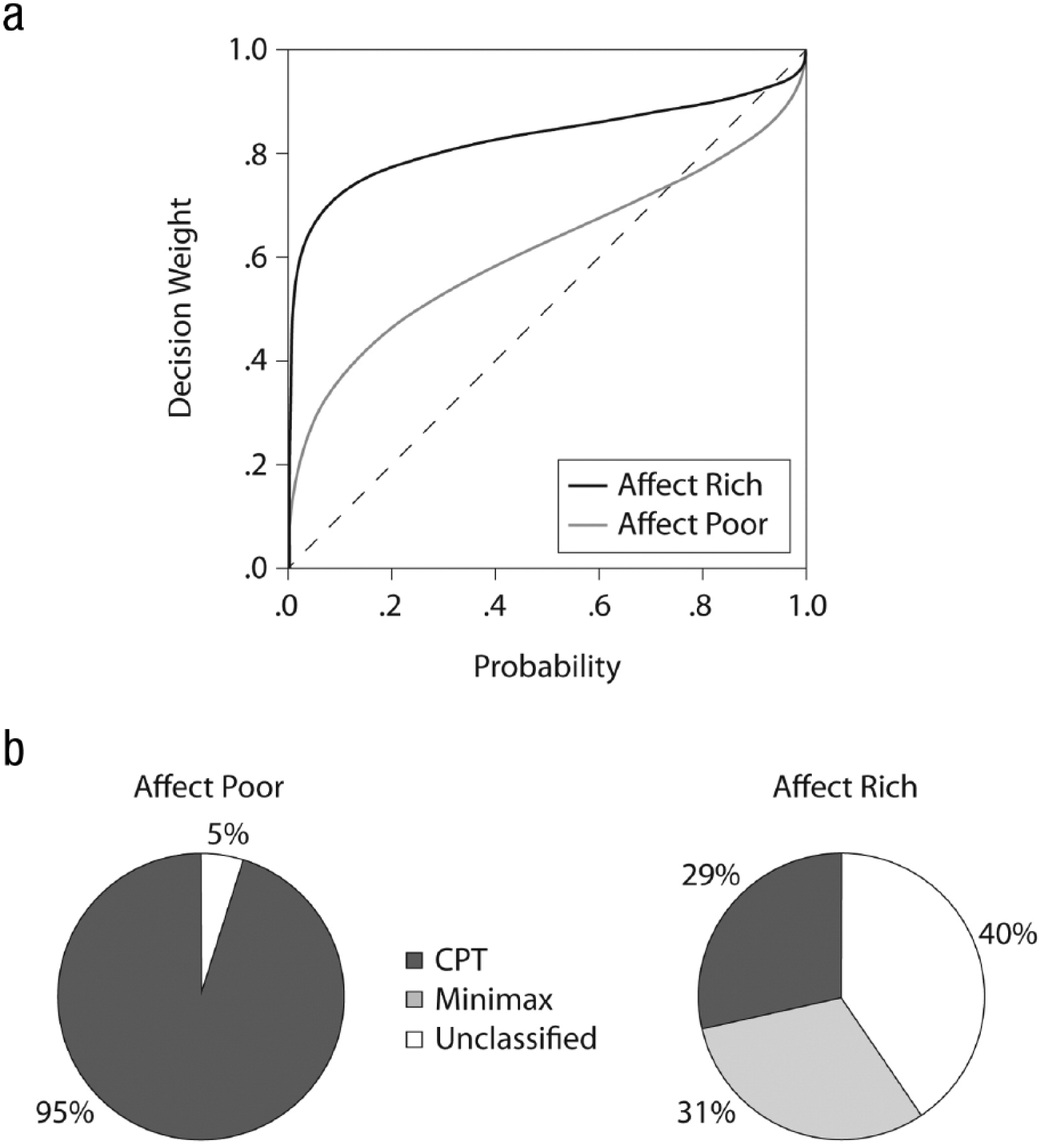
Cumulative prospect theory’s weighting function for affect-poor and affect-rich problems (a) and classification of participants (b). Suter, Pachur, and Hertwig (2015) fitted a two-parameter weighting function (Gonzalez & Wu, 1999), shown in panel (a), to the choices of individual participants. They found a much more pronounced inverse S-shaped weighting function for affect-rich than for affect-poor outcomes (the pattern remained unchanged when affect-rich outcomes were associated with numerical information; see McGraw, Shafir, & Todorov, 2010). Participants were classified as adhering to cumulative prospect theory (CPT), were classified as adhering to the minimax rule, or remained unclassified; panel (b) shows these classifications separately for affect-poor and affect-rich problems (for details of the classification methodology, see Suter, Pachur, & Hertwig, 2015). Adapted from “How Affect Shapes Risky Choice: Distorted Probability Weighting Versus Probability Neglect,” by R. S. Suter, T. Pachur, and R. Hertwig, 2015, Journal of Behavioral Decision Making, advance online publication. Copyright 2015 by Wiley. Adapted with permission.
In sum, these analyses map out one route by which affective reactions evoked by the imagery of possible outcomes alter the process underlying choice. The influence of the affective reactions is gauged in terms of decision weights that measure the impact of outcomes on the desirability of options. Strong affective reactions lead to a stronger departure from linear treatment of probabilities—assumed to be the normatively appropriate weighting of probabilities—than observed otherwise. This is not the whole story, however. Affective reactions may also enter the computation processes underlying choice via a totally different route, namely the discounting of probabilities.
Affect and strategy selection
There is another, perhaps more radical interpretation of Arnauld and Nicole’s (1662/1996) and Daston’s (1988) portrayal of the impact of fear and hope: Rare events (e.g., being struck by lightning) are not just overweighted. Rather, their probabilities do not enter into the computation at all (Sunstein, 2002; Sunstein & Zeckhauser, 2010). How could such a complete neglect of probabilities be modeled?
The minimax heuristic is a choice strategy that focuses on the worst possible loss, regardless of probabilities. Its policy is to recommend the choice of the option whose worst loss is smallest. Savage (1954/1972), who proposed this heuristic, did not raise the issue of emotions. Yet it is conceivable that the goal of preventing the worst possible loss is activated by, for instance, the dread evoked by the mental imagery of being struck by lightning. Moreover, Savage discussed the minimax heuristic in the context of choice under uncertainty, in which the probability distribution over outcomes is unknown, and multiplicative integration of probabilities and outcomes is thus impossible. Minimax’s blindness to probabilities thus makes it an exceptionally interesting candidate heuristic for decisions under risk, in which affect-rich outcomes may cause the unmitigated neglect of known probabilities.
Investigating this possibility, Suter, Pachur, and Hertwig (2015) conducted a model competition to determine the fit of CPT and minimax to choices with outcomes poor or rich in affect. Figure 2b plots the percentages of participants whose choices were classified as consistent with CPT, were classified as consistent with the minimax heuristic, or remained unclassified. The distribution differed considerably and significantly between affect-poor and affect-rich problems. When responding to outcomes poor in affect, most respondents were classified as following CPT and not a single person as following minimax. When responding to outcomes rich in affect, by contrast, almost a third of respondents appeared to follow minimax.
These results are not totally conclusive, with many participants in affect-rich choices being left unclassified (Fig. 2b). However, they suggest a different way of modeling the impact of affect on risky choice. Instead of having an impact on the decision weights associated with affect-rich outcomes, strong affect may trigger the selection of simple choice strategies. Such strategies may discount probability information, as do the minimax heuristic in the domain of losses and the maximax heuristic in the domain of gains (maximax has the policy to choose the gamble with the highest possible monetary payoff, regardless of the probabilities). This interpretation is also consistent with process-tracing data showing that people pay less attention to probability in affect-rich than in affect-poor problems (Pachur et al., 2014).
Summary
There are at least two approaches to modeling how affect evoked by the imagery of possible outcomes impacts the computational processes giving rise to choice. One, employing prospect theory as a cognitive-choice model, postulates that affect alters the default pattern of probability weighting—from weak to strong nonlinear weighting (Fig. 2a). The difference is thus one of degree, not of kind. Another approach, employing models of heuristics as a cognitive-choice framework, postulates that people are adaptive users of simple heuristics (Gigerenzer, Hertwig, & Pachur, 2011; Payne, Bettman, & Johnson, 1993) and apply different cognitive strategies depending on factors including affect. Affect is thus assumed to qualitatively alter the processing mode of probability and outcome information—from processing and integrating all available information to using a heuristic choice process in which probabilities do not feature. The difference is thus one of kind, not of degree.
Interestingly, these two approaches need not be exclusive—and they are, of course, not exhaustive (see Mellers, 2000; Mellers, Schwartz, & Ritov, 1999). Using computer simulations, Suter, Pachur, and Hertwig (2013) showed that CPT could, in principle, offer a good fit to choices generated by heuristics. Consequently, strong nonlinear weighting of probabilities and neglect of probabilities could offer two possible accounts of how affect alters the computational process. Yet these accounts suggest qualitatively different predictions about brain activation in affect-rich versus affect-poor domains. According to the probability-weighting account, which assumes a multiplicative combination of values and probabilities, activations during affect-poor and affect-rich choice should both indicate the recruitment of executive function and calculative processes. According to the heuristic account (minimax), in contrast, activation of calculative processes is not to be expected in the affect-rich domain. Furthermore, affect-rich choices should reflect the representation of the outcomes’ emotional value. A recent fMRI study observed brain activation consistent with the predictions of the heuristic account (Suter, Pachur, Hertwig, Endestad, & Biele, 2015). 12
Beyond the Rationality Muddle
One reason the emotions revolution is so stimulating is that it offers a new opportunity to conceptualize the interplay of rationality and emotions. Perusal of recent articles from the neuroscientific study of emotion and decision making, however, leaves the careful reader perplexed. Some authors argue that emotions thwart the pursuit of rational goals, whereas others contend that emotions are central to rationality. One view of emotions as a rational force is that the brain’s emotional systems have managed to encode and track the basic quantitative parameters (e.g., expected reward) of classic normative models of decision science and economics (Quartz, 2009). Ironically, such a mapping, if it existed, would reduce the modeling of emotions to the emotionally “flat” (normative) models of the past. Only time will tell whether the approach advocated here—starting with a cognitive framework of decision processes and modeling how emotions alter the assumed computational process—will prove more productive. In either case, researchers can use such models as a basis to begin to evaluate the extent to which emotions have good or bad consequences for rationality.
For instance, nonlinear weighting of probabilities and its amplification via affective reactions (as depicted in Fig. 2) is commonly treated as a deviation from rationality. In contrast, the use of heuristics such as minimax or maximax may serve adaptive functions. For instance, focusing the decision maker on the best or worst possible outcomes, at the expense of their probabilities, amplifies the impact of options representing either extraordinary opportunities (e.g., mating, social status) or irreversible harm and dangers (e.g., predators, natural hazards, health risks). Faced with such opportunities or dangers, a decision-making system that forgoes a time-consuming trade-off process (between outcomes and probabilities) and instead triggers an immediate avoidance or approach response may equip the agent with an edge in terms of response time and prioritization of goals and actions (Cosmides & Tooby, 2000; Simon, 1967).
Admittedly, this is all speculation. Yet, from this perspective, emotions—like heuristics (Gigerenzer et al., 2011)—are not rational or irrational, good or bad per se (see Shiv et al., 2005). Instead, the rationality of emotions is ecological rather than logical (Todd, Gigerenzer, & The ABC Research Group, 2012). In other words, how (un)reasonable the influence of a specific emotion is depends on environmental circumstances. The question to be answered is thus the following: In which real-world environments and under what circumstances do emotions and their consequences result in successful or unsuccessful outcomes? The rationality of emotions can be decoded only by investigating the match or mismatch between their influences on computational processes and the demands of the environment in which the organism is situated.
Footnotes
Acknowledgements
Both authors contributed equally to this manuscript. We thank Susannah Goss for editing the manuscript.
Declaration of Conflicting Interests
The authors declared that they had no conflicts of interest with respect to their authorship or the publication of this article.
Funding
This research was supported by a grant from the German Research Foundation (DFG) to Ralph Hertwig (HE 2768/7-2) and by the Werner Reichardt Centre for Integrative Neuroscience (CIN) at the Eberhard Karls University of Tübingen. The CIN is an Excellence Cluster funded by the DFG within the framework of the Excellence Initiative (EXC 307).