



Abstract
Exercising self-control is often difficult, whether declining a drink in order to drive home safely, passing on the chocolate cake to stay on a diet, or ignoring text messages to finish reading an important paper. But enacting self-control is not always difficult, particularly when it takes the form of proactively choosing or changing situations in ways that weaken undesirable impulses or potentiate desirable ones. Examples of situational self-control include the partygoer who chooses a seat far from where drinks are being poured, the dieter who asks the waiter not to bring around the dessert cart, and the student who goes to the library without a cell phone. Using the process model of self-control, we argue that the full range of self-control strategies can be organized by considering the timeline of the developing tempting impulse. Because impulses tend to grow stronger over time, situational self-control strategies—which can nip a tempting impulse in the bud—may be especially effective in preventing undesirable action. Ironically, we may underappreciate situational self-control for the same reason it is so effective—namely, that by manipulating our circumstances to advantage, we are often able to minimize the in-the-moment experience of intrapsychic struggle typically associated with exercising self-control.
The supreme art of war is to subdue the enemy without fighting.
Ordinarily, when we think of exercising self-control, we think about how hard it is. Perhaps we smoke and wish we did not. Perhaps we spend hours watching TV and wish we went to the gym more often. Perhaps we stay up late and wish we got more sleep. Whatever it is that makes us feel better now but worse in the long run, struggling—and often failing—to exercise self-control is familiar territory for all of us. It is no surprise that across the life span and around the world, people rate themselves lower in self-control than in kindness, fairness, honesty, gratitude, curiosity, and most other aspects of character (Park & Peterson, 2006; Park, Peterson, & Seligman, 2006).
Conceiving of self-control as difficult is very much in keeping with the contemporary scientific literature, which has predominantly investigated effortful attempts to align actions with goals and standards (Fujita, 2011). But is self-control always exhausting? Consider commonly dispensed advice for avoiding overindulgence around Halloween. For example, Better Homes and Gardens magazine recommended buying candy you do not like, storing treats out of sight, and keeping sugar-free gum on hand as a substitute for high-calorie indulgences (Pearson, 2009). When discussing such clever situational manipulations, Schelling (1984) said, “What I’m talking about is different from what is usually thought of as self-control or self-discipline. I am not talking about the development of inner strength, character, or moral fiber” (p. 69).
In this article, we suggest that manipulating our surroundings to advantage is, in fact, a highly effective form of self-control. Integrating classic and contemporary scholarship on self-control, we conceptualize self-control as the self-initiated regulation of conflicting impulses in the service of enduringly valued goals. The more direct our interaction with a particular temptation and the more effortful it feels to resist it, the more obvious it is that we are exercising self-control. However, there are less obvious means of adjudicating self-control conflicts, and the full range of self-control strategies can be organized using the process model of self-control (Duckworth, Gendler, & Gross, 2014). This framework predicts that situational strategies should be more effective than intrapsychic strategies because they are deployed earlier in the process of impulse generation. That is, we suggest that strategies targeted at influences outside of the mind are in general better than strategies targeted at downstream mental processes. We review empirical evidence consistent with this prediction and highlight a number of promising directions for future research.
Conceptualizing Self-Control
As with many topics in psychology, an interest in self-control predates the origins of the field itself. In the following sections, we first review classical perspectives on self-control. We then showcase contemporary perspectives and identify two core features of self-control.
Classical perspectives: The struggle of self-control
Many of the examples adduced in the classical philosophical and psychological literatures on self-control have taken the familiar form of effortful, in-the-moment self-mastery in the face of pressing temptation. For instance, Plato likened the soul to a charioteer driving two horses, one pliable and the other resistant, which pull the soul in alternate directions: The horse that is on the right, or nobler side, is upright in frame and well jointed, with a high neck and a regal nose; his coat is white, his eyes are black, and he is a lover of honor with modesty and self-control; companion to true glory, he needs no whip, and is guided by verbal commands alone. The other horse is a crooked great jumble of limbs with a short bull-neck, a pug nose, black skin, and bloodshot white eyes; companion to wild boasts and indecency, he is shaggy around the ears—deaf as a post—and just barely yields to horsewhip and goad combined (370 BCE/1995, 246A–254A).
Plato’s metaphor emphasizes the brutality of this sort of intrapsychic struggle: There is a palpable feeling of being pulled in multiple directions by competing internal tendencies. Plato’s student Aristotle also depicted the soul as divided, as did philosophers in the stoic tradition who considered emotions to be “perturbations” that needed to be overcome in order to attain a state of apatheia: freedom from passion.
A preoccupation with effortful, in-the-moment, intrapsychic maneuvers for overcoming temptation is also evident in the classical psychological literature. For example, James (1899) describes lying in bed on a cold winter morning. He thinks “it is time to get up,” but at the same time, “there is present to my mind a realization of the extreme coldness of the morning and the pleasantness of the warm bed” (p. 174). James saw only two possible moves. First: “I may forget for a moment the thermometric conditions, and then the idea of getting up will immediately discharge into act: I shall suddenly find that I have got up” (p. 174). Alternatively: “Still mindful of the freezing temperature, the thought of the duty of rising may become so pungent that it determines action in spite of inhibition” (pp. 174–175). In either case, the battle between temptation and a more valued outcome is waged and won in the moment and in the mind: “To think, in short, is the secret of will” (p. 187; emphasis in original).
Freud was also fascinated by the effortful resolution of dueling intrapsychic motives. Indeed, it was Freud (1916–1917/1977) who gave psychology the notions of the pleasure-seeking, pain-avoiding id and its adversary, the moral and principled super-ego, as well as the logical, patient ego whose function is to adjudicate between them. Though the mapping is not perfect, there is an important resonance between Freud’s proposed structure of the psyche and Plato’s trinity of the wild black horse, the noble white horse, and their commanding charioteer. According to Freud, successful development hinges upon the development of the ego, which enables the child “to renounce immediate satisfaction, to postpone the obtaining of pleasure, to put up with a little unpleasure, and to abandon certain sources of pleasure altogether” (Freud, 1916–1917/1977, p. 444). As with James, Freud’s suggested alternative to repressing the immediately gratifying impulse—vivid ideation of the deferred treat—was a cognitive maneuver.
Contemporary perspectives: Beyond effort
Whereas particulars vary by author, self-control is now widely understood as the self-initiated regulation of conflicting impulses in the service of enduringly valued goals (Baumeister, Heatherton, & Tice, 1994). In Table 1, we provide some of the terms that have been used by scholars to describe the dueling motives that underlie self-control conflicts.
Terminology for Dual Motives in Self-Control Conflicts by Date of Publication
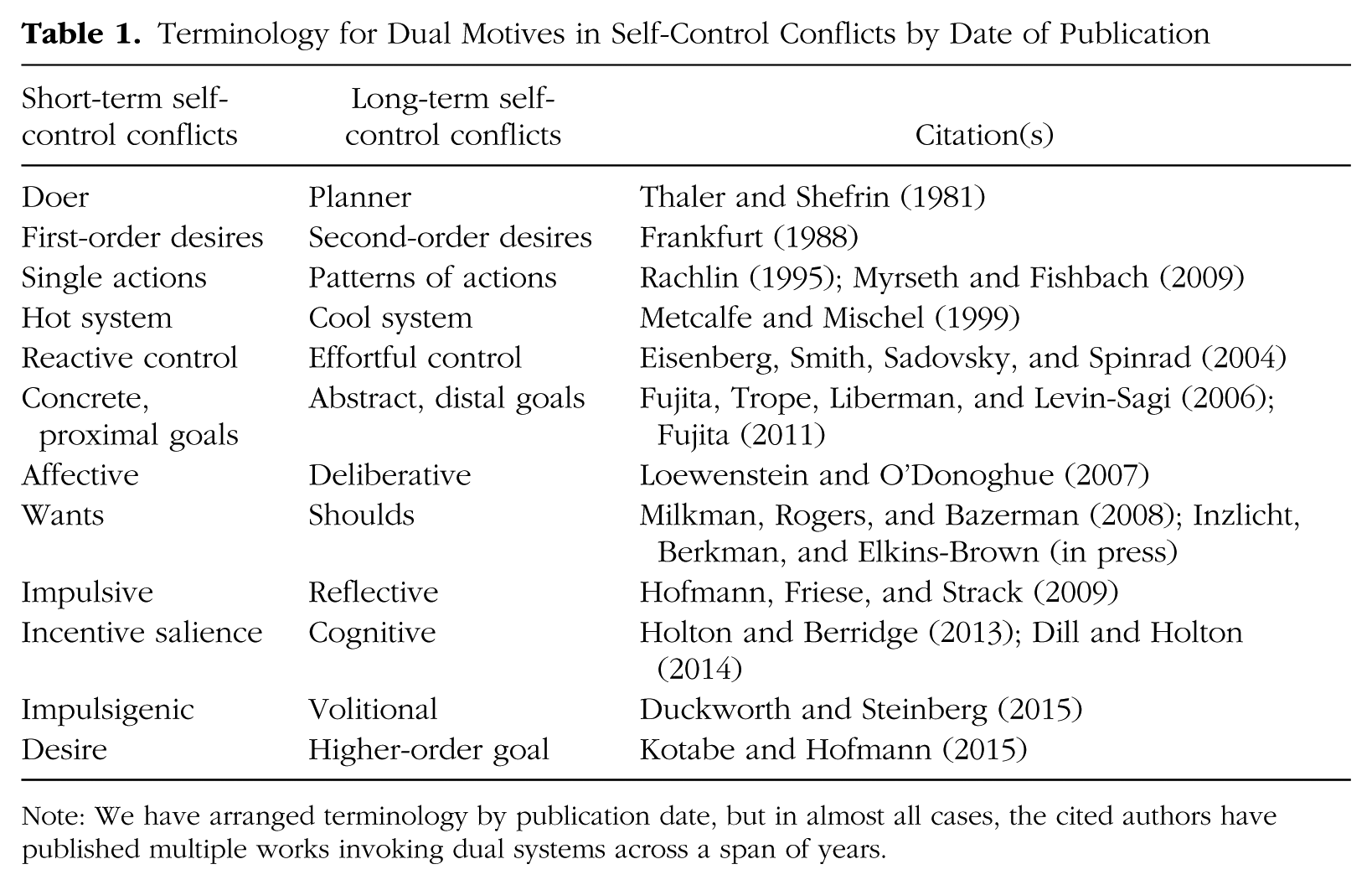
Note: We have arranged terminology by publication date, but in almost all cases, the cited authors have published multiple works invoking dual systems across a span of years.
Two defining features of self-control
Whatever terms are used, this consensual definition of self-control has two defining features.
First, self-control is called for when we are torn between two mutually exclusive options, one expected to bring immediate gratification and the other expected to further more enduring and important goals. Crucially, these valuations are asymmetric, with the more potent desire predicted to yield only momentary reward and the less potent desire predicted to yield greater returns in the long run. In contrast, choosing between two comparably important goals (e.g., spending time with our children vs. staying late at the office to meet a deadline) may be tortuous, but it is not an exercise in self-control per se. Nor is choosing between two equally rewarding-now-but-bad-for-me-later temptations (e.g., chocolate lava cake vs. ice cream sundae).
Second, self-control must be initiated by the individual with the intention of furthering a more valued goal over a less valued one. This distinguishes self-control from “accidental” desirable behavior (e.g., getting exercise while shopping all day when the exercise itself was not an intended positive outcome). This also distinguishes self-control from beneficial actions taken at the behest of another person. Compliance with authority, for example, is not self-control, even when the motives of the authority figure are benevolent: A child who forgoes eating dessert before dinner to avoid a scolding is not exercising self-control, but an adult who does the same for the sake of long-term health goals is. By this criterion, self-control need not be enacted with conscious awareness, but all acts of self-control must, at some point in time, have been self-initiated (Bargh, Gollwitzer, & Oettingen, 2010; Galla & Duckworth, 2015; Trope & Fishbach, 2000; Wood, Labrecque, Lin, & Rünger, 2014).
The lure of phenomenology
Mentally suppressing one prepotent impulse while elevating its rival can be very hard work. Consider, for example, the preschool delay-of-gratification task, colloquially referred to as “the marshmallow test.” In this paradigm, an experimenter gives the child a choice between a smaller amount of a favored treat right away (e.g., “one marshmallow now”) or a larger amount after an unspecified delay (e.g., “two marshmallows when I come back into the room”). Watching children delay gratification—their small faces adorably contorted, their eyes darting back and forth between the larger and smaller treat—suggests that the intrapsychic dilemma of self-control can be tortuous (W. Mischel & Ebbesen, 1970; W. Mischel, Shoda, & Rodriguez, 1989).
Similarly, adults who complete tasks designed to tax their self-control report markedly higher levels of effort, difficulty, and fatigue than adults who complete similar tasks without a self-control component (Hagger, Wood, Stiff, & Chatzisarantis, 2010; Kurzban, Duckworth, Kable, & Myers, 2013). For example, one paradigm contrasts the self-control task of eating raw radishes while simultaneously resisting candies and cookies with the control task of eating candies and cookies while resisting raw radishes (Baumeister, Bratslavsky, Muraven, & Tice, 1998). Another compares doing a complex copyediting task (e.g., crossing out the letter e except when it is directly adjacent to or one letter removed from other vowels) with a simple one (e.g., crossing out the letter e wherever it appears; Baumeister et al., 1998). Debate over the origins and consequences of mental effort continues, but there is no question that its phenomenology (i.e., the felt subjective experience) is under most circumstances decidedly aversive (Inzlicht, Schmeichel, & Macrae, 2014; Kool, McGuire, Wang, & Botvinick, 2013; Saunders & Inzlicht, in press; Westbrook, Kester, & Braver, 2013).
The phenomenology of directly regulating impulses helps to explain the ongoing preoccupation, evident from the earliest days of philosophy and psychology, with effortful, intrapsychic means of adjudicating conflicts between temptations and goals (Fujita, 2011; Gillebaart & de Ridder, 2015). Thus, whereas formal definitions of self-control do not typically refer to the subjective experience of exercising self-control, contemporary terminology hints strongly at accompanying mental strain. For example, in developmental psychology, self-control is commonly referred to as effortful control (Eisenberg, Smith, Sadovsky, & Spinrad, 2004; Rothbart & Rueda, 2005). The related constructs of ego control and ego resilience, rooted in Freud’s psychoanalytic theory, suggest that the control and flexible modulation of impulses is essentially an internal process. Likewise, in social psychology, the ego-depletion model proposes that every act of self-control progressively exhausts a finite store of intrapsychic strength (Baumeister et al., 1998). Finally, willpower persists as the most common, if least illuminating, lay term for self-control. In sum, the assumption that “effort of attention is thus the essential phenomenon of will” continues to influence modern thinking (James, 1890, p. 562).
The Process Model of Self-Control
As contemporary conceptions of self-control make clear, there is a stunning multiplicity of means—other than brute-force suppression of impulses—that may be used to rein in errant impulses. Consider, again, children in a delay-of-gratification experiment (W. Mischel, 2014). In archival footage, one little boy stares at the ceiling while kicking his legs rhythmically. A little girl turns her back on the treats altogether. Another reenacts the directions given by the experimenter, reinforcing the contingency between waiting and the delayed treat. A recent observational study revealed just how creative preschool children in this paradigm can be (Carlson & Beck, 2009). Some children sang (e.g., “I’m waitin’, I’m waitin’, I’m waitin’”); some sat on their hands or covered their eyes with their hands; others repeated the task instructions aloud (“If I wait, I get this pile; and if I don’t wait, I get this pile”). Only 10% of children used no strategy at all, and all 17 of these children failed to wait for the larger reward. The difference in wait time between those who used a strategy and those who did not was highly reliable (p < .0001).
The array of self-control strategies that W. Mischel (2014) and others (Ariely & Wertenbroch, 2002; Carlson & Beck, 2009; W. Mischel & Ayduk, 2004; Perry, Hechter, Menec, & Weinberg, 1993; Poston & Foreyt, 2000; Rachlin, 2000; Schelling, 1978; Wansink, 2007) have described is dizzying in both number and variety. Taking an inclusive conceptualization of self-control presents a serious challenge: Once we broaden our conception of self-control to include everything individuals might do or think in order to adjudicate between competing impulses that differ in their short- versus longer-term value, the universe of possible moves that constitute self-control expands dramatically. How can we organize the innumerable little “tricks” we play on ourselves in order to advance our enduringly valued goals? In this section, we present the process model of self-control, a theoretical framework that describes both the stages by which impulses are generated and the strategies by which they can be regulated.
Impulse generation
As noted earlier, contemporary conceptions of self-control presuppose that an individual can be of two minds about what to do, think, or feel. The process model of self-control formalizes this idea by positing the existence of multiple valuation systems, which, as we go about our everyday life, can be activated simultaneously (Gross, 2015). Each valuation system is sensitive to different aspects of any given situation, and each activates action impulses relevant to its own evaluation of that situation. The concurrent activation of multiple valuation systems frequently leads valuation systems to interact with one another. Very often, valuation systems are mutually supportive. For instance, the impulse to eat a banana is compatible both with a valuation system oriented toward satisfying hunger and with one oriented toward long-term health goals. However, in cases of self-control conflict, one valuation system inclines the individual toward immediately gratifying temptation (e.g., a donut) while another disposes the individual toward a more enduringly valued option (e.g., a banana).
Figure 1a illustrates the stages through which impulses come into being and are either augmented or weakened over time. Each cycle begins with an individual encountering a particular situation, then deciding whether to modify it, next paying attention to particular features of the situation, followed by appraising the situation as good or bad, and, depending on this valuation, finally experiencing an impulse or response tendency. As shown in Figure 1b, the impulse to eat a donut, for example, may begin with an individual standing in a kitchen. This individual’s gaze is soon drawn to an open box of donuts, an image that in turn spurs the thought “Tasty treat!”, which in turn leads to the impulse to eat one. As suggested by the circular figure, each situation-attention-appraisal-response process is iterative. A response (or even a lack of response) brings the individual back to the situation stage where, again, impulses wax or wane over time depending on what happens at each successive stage. Impulses of sufficient strength are enacted; those that fail to reach threshold are not. For instance, if the individual decides to stay rooted at the kitchen counter, staring at the donuts and salivating at the thought of their sugary deliciousness, the impulse to grab and eat one might over several cycles grow strong enough to be discharged into action.
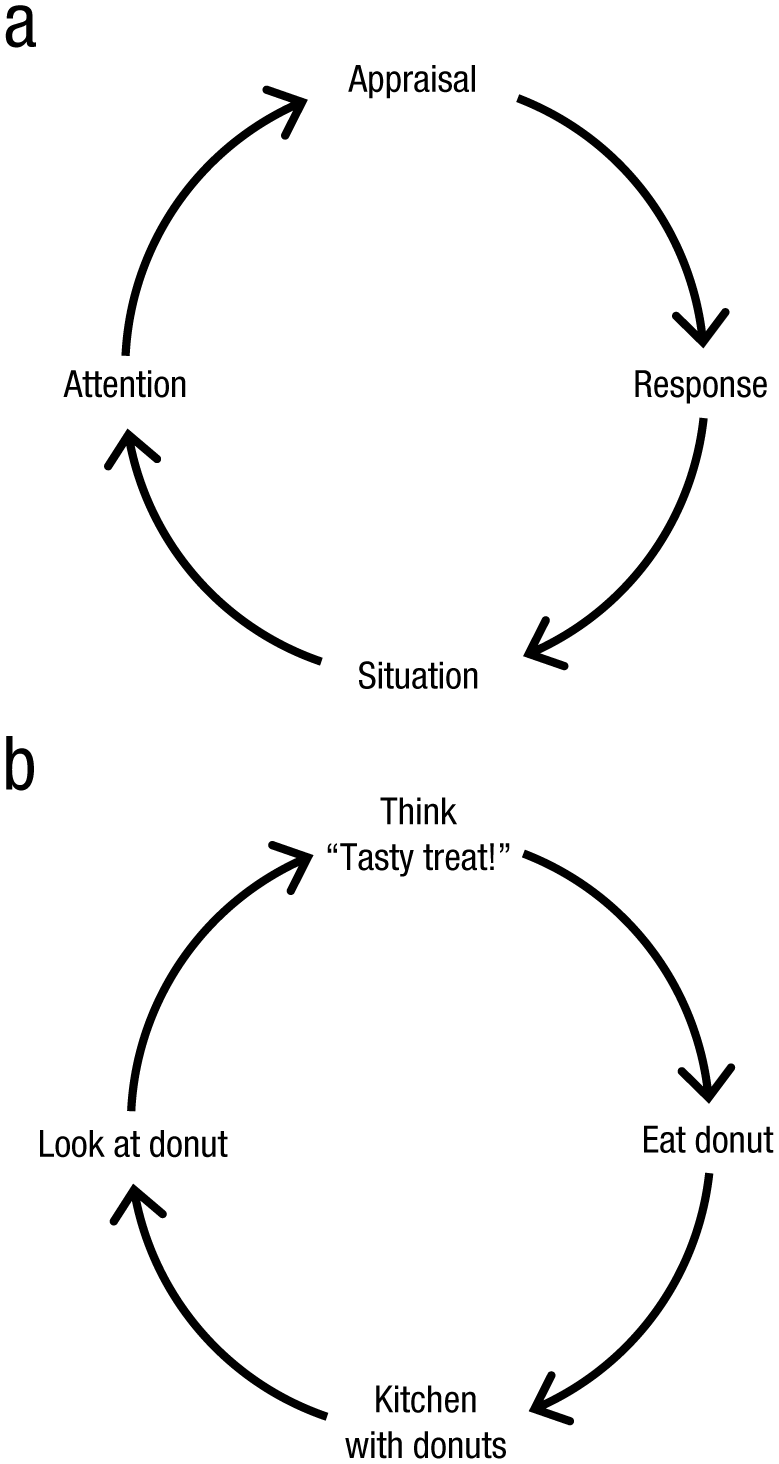
The process model of self-control posits that impulses develop in an iterative cycle, beginning with the situation and ending with a response tendency. Panel (a) depicts this cycle, and panel (b) illustrates an example of how a pleasure-oriented impulse might develop in a situation-attention-appraisal-response sequence.
Crucially, response tendencies for most temptations tend to dominate those for rival long-term goals. As a consequence, our default response is to do things that feel good right away, even if we have enough life experience to anticipate regretting doing so after the fact. In a recent study, young adults used a computer mouse to indicate their preference between pairs of food items varying in healthfulness and tastiness (Sullivan, Hutcherson, Harris, & Rangel, 2014). By analyzing the micro time course of the computer-mouse trajectories, researchers discovered that food tastiness was processed about a fifth of a second faster than food healthfulness, a lag that was reliably longer in less self-controlled individuals. Likewise, preschool children who delay their response on a task in which they are asked to say “moon” when they see a picture of a sun perform better if they must wait to give their answer, allowing the prepotent but incorrect impulse to dissipate (Diamond, Kirkham, & Amso, 2002; Simpson et al., 2012). These findings complement earlier studies in which increases in cognitive load (e.g., keeping a long string of numbers in working memory) inclined individuals to choose tastier but less healthy snacks, presumably by impairing the valuation system motivated by distal but important health goals (Friese, Hofmann, & Wänke, 2008; Shiv & Fedorikhin, 1999; Ward & Mann, 2000).
Impulse regulation
As shown in Figure 2, the process model of self-control suggests that intervention is possible at each stage in the situation-attention-appraisal-response cycle. For instance, an individual who would rather snack on bananas than donuts after work might decide to enter her home via the living room (rather than the kitchen), calling out to her husband to hide the box of donuts she knows she left out on the kitchen counter that morning. Then, ensuring that her gaze falls anywhere but on those donuts, she might deliberately think to herself “Calorie bomb!” and thereby strengthen her resolve not to eat any (see Fig. 3a). Alternatively, the same individual might enter the kitchen after work, immediately taking bananas out of a shopping bag. Looking at the bananas, she might think to herself “Healthy snack!” and then peel and eat one (see Fig. 3b). Readers familiar with the process model of emotion regulation will recognize this theoretical framework (Gross, 1998), which we expand here to include other types of conflicts (Duckworth et al., 2014; Magen & Gross, 2010). Indeed, we suggest that the dynamics of impulse generation are similar, no matter whether impulses are attentional, emotional, or behavioral in nature or whether they pertain to the domains of health, interpersonal relationships, finances, or work (Duckworth & Tsukayama, 2015).

Within an impulse-generation cycle, situational self-control strategies (shown in the light boxes) precede intrapsychic strategies (shown in the dark, solid boxes).
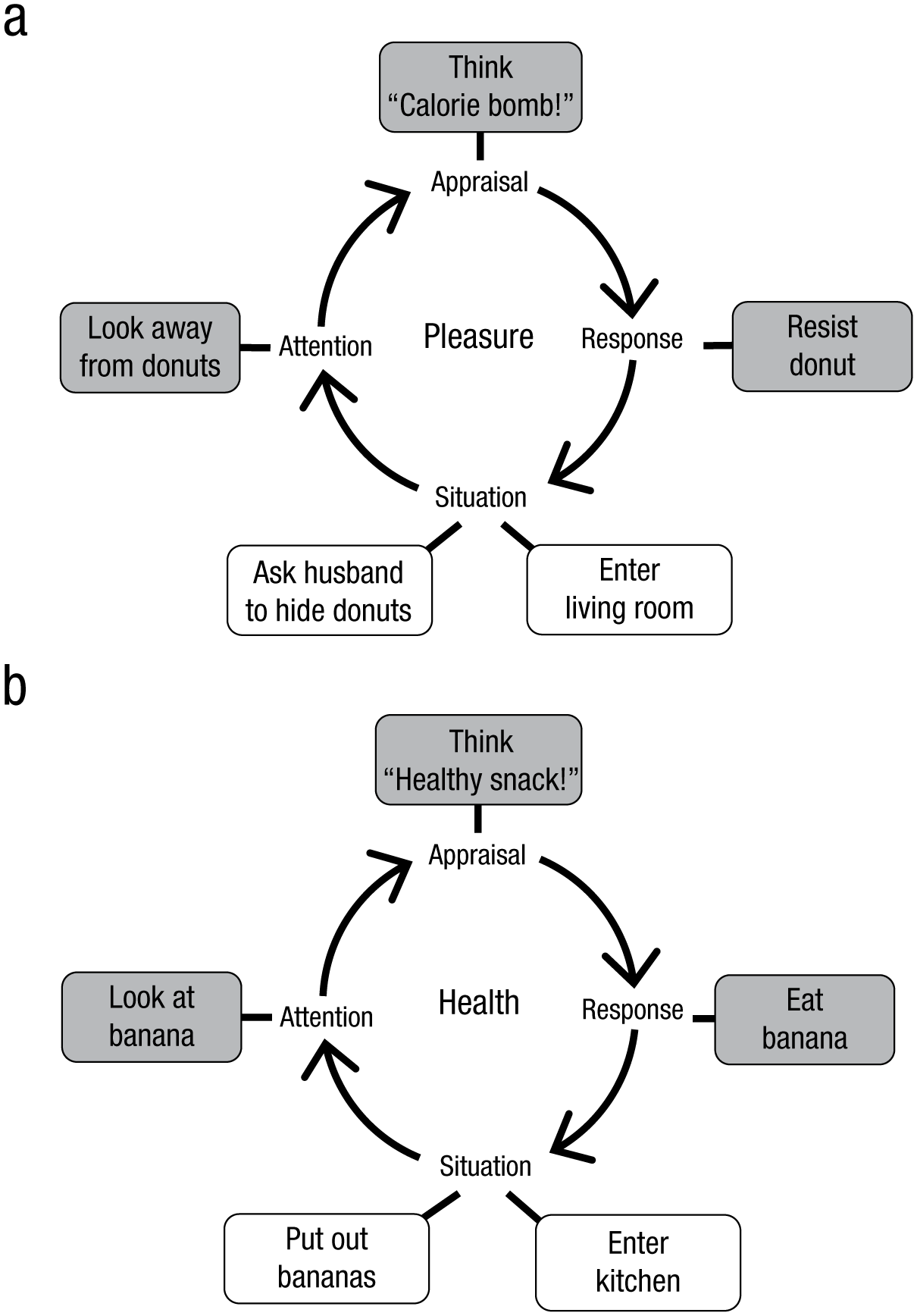
Examples of situational and intrapsychic strategies that (a) weaken a pleasure-oriented impulse or (b) strengthen a health-oriented impulse.
Consistent with prior observations (Aspinwall & Taylor, 1997; Fujita, 2011; Hofmann & Kotabe, 2012; Trope & Fishbach, 2000), our approach makes a clear prescriptive recommendation as to when and how self-control is most effectively deployed: As a rule, earlier intervention is best. For instance, prompt intervention, when the impulse to eat donuts is still nascent, is wiser than waiting until the impulse has grown so strong that Herculean efforts are required to make a healthier choice. As Montaigne (1580/2003) observed of his own hot temper, it is best to intervene proactively, rather than procrastinate: “The infancies of all things are feeble and weak. We must keep our eyes open at their beginnings” (p. 1154; for similar arguments, see Hofmann & Kotabe, 2012; Hofmann & Van Dillen, 2012; Magen & Gross, 2010; Sheppes & Gross, 2011).
What the process model adds to the general earlier-is-better insight is that self-control strategies can be subdivided according to the stage in the process of impulse generation when they are deployed. Within a given cycle, earlier situational stages in the cycle influence later cognitive stages—but not vice versa. This path dependency plays out as follows: Where we are constrains what we can do to modify our situations; our situations influence what we pay attention to; what we perceive in turn constrains how we appraise our situations; and finally, these valuations encourage us to act in one way or another.
Situational Versus Intrapsychic Strategies for Self-Control
The process model of self-control organizes strategies into five families, each described briefly below. At the earliest stage of impulse generation, there are two situational strategies describing how we can select and modify our circumstances, respectively, to favor actions that make us better off in the long run. Next, there are three intrapsychic strategies that describe how we can use attention, cognitive change, and response modulation, respectively, to advantage.
Situational strategies
Situation-selection strategies are the most forward-looking of all self-control maneuvers and involve intentionally choosing to be in situations that favor goal-oriented valuation systems over temptation-oriented valuation systems. For instance, studying is generally easier to do at the library than in a noisy dorm room. Exercising is easier at the gym than in the living room. Abstaining from junk food is easier at home than at the movie theater. Likewise, virtuous behavior is easier when we surround ourselves with people whose behavior we hope to emulate. In a recent mixed-age focus group on academic success, we listened to a tenth grader sagely counsel a fifth grader: “If I knew at your age what I know now,” the older girl said, shaking her head, “I would have chosen different friends. I got into the wrong crowd, and it was really hard to get back on track.” In other words, our circumstances are not just physical but also social, and their influence on our behavior not just transient but potentially enduring.
Often, we are not free to select our situations but, nevertheless, are able to make changes wherever we find ourselves. Situation-modification strategies entail purposefully changing our circumstances to advantage. The tale of Odysseus returning from the Trojan War provides three illustrative examples. First, warned by the goddess Circe of the fatal allure of the Sirens, whose island he would sail past on his journey home, Odysseus preemptively plugs the ears of his oarsmen so they will be deaf to the Sirens’ song. Second, wanting to hear the singing himself but anticipating its seductive power, Odysseus binds himself to the mast. Finally, he makes a social contract, ordering his men not to release him during their passage no matter what he orders them to do. This trio of preemptive maneuvers allows Odysseus to escape unharmed. Modern examples come from Schelling (1978), who assembled a catalogue of actual situational “contrivances,” including Christmas Club savings plans, layaway plans, and enlisting friends to police our cigarettes, among others. And whereas James (1899) considered only intrapsychic strategies for getting ourselves out of a warm bed on a cold morning, Schelling offers a more clever suggestion: “Place the alarm clock across the room so we cannot turn it off without getting out of bed” (p. 290). The Clocky alarm clock takes this logic one step further: It literally jumps off of the nightstand and runs around the room, beeping loudly, until you get out of bed, track it down, and shut it off.
As with situation-selection strategies, situation-modification strategies can take aim at our physical or social situations. But there is third aspect of our situations that we can modify, even if we cannot swap it entirely for one we prefer: our bodies. Schelling (1978), for example, mentioned that wiring our jaws shut is one radical way to prevent overeating. Today, gastric bypass surgery, in which the capacity of the stomach is radically reduced, is a common surgical treatment for morbid obesity (Buchwald & Oien, 2013). But there are other less extreme ways in which we can modify our somatic environment to advantage. We can eat a nutritious lunch in order to avoid junk-food cravings later in the afternoon, we can get a good night’s sleep in order to avoid waking up “on the wrong side of the bed,” and we can drink coffee to make paying attention to our work a bit easier.
Intrapsychic strategies
Sometimes, we are confronted with situations we can neither choose nor change. In such cases, we can employ attentional-deployment strategies to direct our focus to features of the situation that facilitate, rather than undermine, self-control. Without direct tutelage, children learn this strategy fairly early in life (Carlson & Beck, 2009; Peake, Hebl, & Mischel, 2002), but more recently, Sesame Street’s Cookie Monster has been providing direct instruction. In one episode, after learning how to pronounce “delayed gratification,” he models looking away from a cookie he is trying not to eat. “Me going to look away from cookie,” he declares, turning his back (PBS, 2013, September 4). Ignoring temptations can help us resist them, but it is often the case that noticing them can be a good thing, especially when doing so interrupts the otherwise mindless enactment of immediately gratifying impulses (Wansink & Sobal, 2007). For instance, directing attention to what we are doing can prevent our absentmindedly eating an entire bag of potato chips while engrossed in a riveting television show. In either case, deliberately attending to some features of our situation rather than others may be easier to initiate than to sustain. Cookie Monster, for example, finds it hard to keep his back turned to temptation: “Me not going to look at. . .” he declares, but then—sniff, sniff—he turns to glance again in the cookie’s direction and, swiveling away once again, cries, “Oooh! This hard! This hard for Monster!”
When attending to temptations is unavoidable, we can use cognitive-change strategies to diminish our undesired impulses and amplify our desired ones. Cognitive-change strategies entail thinking about our situation differently. For example, we can think about a cookie as a delicious treat or, alternatively, as a vehicle for saturated fat and refined sugar. One mental representation amplifies the benefits of eating the cookie; the other amplifies the long-term costs of doing so. Likewise, thinking about the money we have in our pocket as a windfall inclines us to spend it, but mentally framing it as part of our future income stream or as a previously acquired asset inclines us to save it (Milkman & Beshears, 2009; Shefrin & Thaler, 1992). Money, of course, is fungible, but appraising assets differently according to their provenance is a cognitive-change tactic that many individuals use in order to avoid succumbing to the temptation of overspending.
An especially effective form of cognitive change entails extracting ourselves from the here and now and instead mentally construing our situations in high-level, abstract terms (Fujita, 2011; Fujita & Han, 2009; Kross, Ayduk, & Mischel, 2005; Trope & Liberman, 2010). These high-level appraisals tend to support goal-directed valuations. For example, inducing high-level construals by prompting participants to consider why they are doing something, as opposed to how they are engaged, increases preference for delayed versus immediate outcomes as well as physical endurance in a handgrip task (Fujita, Trope, Liberman, & Levin-Sagi, 2006). Imagining ourselves as a third-party spectator, rather than a first-person combatant, in arguments with our spouse can preserve marital satisfaction (Finkel, Slotter, Luchies, Walton, & Gross, 2013). In the field of negotiations, the same third-person perspective is a well-known emotion regulation technique, often called “going to the balcony” (Ury, 2007). More generally, separation in time (not now), space (not here), hypotheticality (not real), and egocentricity (not me) seem to all serve to increase psychological distance—essentially constituting different ways to transcend an egocentric and immersed perspective (Trope & Liberman, 2010).
Of all the self-control strategies, response modulation is the most straightforward. In the heat of the moment, we can voluntarily suppress undesirable impulses or amplify desirable ones. Unfortunately, the human capacity to exert cognitive control over goal-incongruent impulses is far from perfect (Carlson, Zelazo, & Faja, 2013; Cohen, 2005; Diamond, 2013). For instance, adults make mistakes on simple tasks of executive function, which require exercising top-down control over conflicting subcortical impulses. For instance, the classic Stroop task takes advantage of the fact that reading is a relatively automatic response for mature adults (Stroop, 1935). In this task, individuals try to state aloud the color of the ink in which a contrasting color word is printed (e.g., saying the word “blue” when presented with the word “red” written in blue ink). Even when successful, exercising executive function is reliably effortful and, in most cases, at least mildly aversive (Inzlicht, Legault, & Teper, 2014; Kurzban et al., 2013; Westbrook & Braver, 2015). Similarly, hiding our emotions (e.g., trying not to cry when sad or trying not to smile when amused) sometimes works but often does not and, even when successful, takes a physiological toll (Gross & Levenson, 1993).
Intrapsychic mechanisms underlying situational strategies
Considering the underlying mechanisms by which situational strategies operate leads to the insight that they are, in fact, indirectly intrapsychic. That is, circumstances outside the mind are the direct target of situational strategies, but it is the downstream effect these changes have on our attention, cognitive appraisals, and response tendencies that in turn mediate the benefits of situational strategies for self-control.
How, exactly, do situational strategies work? Building upon Elster (2000) and Shefrin and Thaler (1988), we suggest that our physical, social, and somatic circumstances can influence self-controlled behavior in three principal ways. First, where, with whom, and in what physiological state we find ourselves can influence what we pay attention to. Second, our situations can influence the expected costs and benefits of responses we have yet to enact. Third, our situations can influence our response options themselves. In this way, situational strategies can be considered indirectly intrapsychic. Specifically, situational strategies can be thought of as maneuvers that activate downstream intrapsychic mechanisms at the attention, appraisal, and response stages of impulse generation.
Most proximal to the situation in the process model is the attention stage. We have previously noted that indulging in immediate temptation is the default, automatic, and thus mindless option. Therefore, guiding our attention to what we are doing can prevent absentminded indulgence. Alternatively, when we are already aware of what we are doing yet have trouble resisting a potent temptation, it can be useful to distract ourselves. What the process model adds to these basic insights is that we can choose or change our situations to encourage attention in these ways. For instance, many smokers intentionally buy their cigarettes pack by pack, rather than in multipack cartons, and many consumers are willing to pay more, per calorie, for “indulgent” snacks sold in smaller serving sizes (Wertenbroch, 1998). Why? Many of us know ourselves well enough to recognize what has been shown empirically—that we tend to consume more from larger packages than smaller ones (Wansink, 1996). One reason, among others, why smaller packages might influence behavior is that opening the next box or package is a very salient cue of consumption, and this cue facilitates monitoring of an otherwise automatic indulgence (see also Geier, Wansink, & Rozin, 2012). Another application of this same principle is that many dieters are willing to pay extravagant sums to vacation at spas where it is easy to forget about junk food altogether and where cues to eat healthfully abound.
Situational strategies can also operate by skipping over the attention stage and directly influencing how we appraise our situations. In particular, we can choose or change our situations in ways that increase the value of long-term goals or decrease the value of momentarily gratifying temptations. We can, for example, arrange in advance post hoc contingencies that favor self-control. Many of us agree to give talks or write articles by a deadline, knowing full well that the shame of not delivering on schedule will induce us to work harder and get started earlier than without an externally enforced target. By agreeing to this social contract, we increase the cost of procrastination, which gets us off the couch (or our e-mail) in order to attend to the work at hand. In the behavioral-economics literature, such maneuvers are referred to as precommitment devices (Bryan, Karlan, & Nelson, 2010). Most entail self-imposed punishments (e.g., forfeiting savings in the event of not going to the gym; Royer, Stehr, & Sydnor, 2012), but they can also take the form of bundling rewards with long-term goals (e.g., reserving a guilty pleasure like a trashy novel for visits to the gym; Milkman, Minson, & Volpp, 2014).
A third mechanism by which situational strategies operate is by restricting the set of available responses one can enact. This can mean choosing or changing our situations such that tempting but regrettable options are not available at all. Kessler (2009), for instance, offered this heroic story: One evening I checked into a hotel room and found a plate of freshly baked chocolate chip cookies waiting for me. I knew I could easily eat them all, and I knew with equal certainty I didn’t want to do that. There was only one way to gain the upper hand, and I had to act quickly. I tossed the cookies into the trash. (p. 220)
It is also possible to make beneficial decisions inevitable. Odysseus lashing himself to the mast of his ship before passing by the island of the Sirens is one example; depositing money in a nonreversible savings account and choosing to dine at a restaurant with only healthy menu options are yet others.
Empirical Evidence for Situational Strategies
The process model of self-control makes a strong claim about the superior efficacy of situational versus intrapsychic strategies within any given cycle of impulse generation. What empirical evidence is there to substantiate this prediction? In this section, we first describe recent studies that have linked higher levels of trait self-control to encountering fewer temptation-ridden situations. Next, we summarize evidence that situational cues can have surprisingly powerful effects in the domains of substance use, eating and exercise, studying and academic work, and retirement savings. Though provocative, this evidence base is in our view incomplete, and we therefore turn our attention in the final section to urgent questions awaiting future research.
Trait-level self-control
A handful of compelling studies have recently documented that more self-controlled individuals find themselves in situations that facilitate adherence to valued goals. In the first, an experience-sampling-method study, adults who were more self-controlled according to a trait questionnaire were markedly less likely to report experiencing desires that were deemed “problematic” by an independent sample of raters (Hofmann, Baumeister, Förster, & Vohs, 2012). In the same study, the mere presence of other people reduced the likelihood of enacting desires that conflicted with personal goals, whereas being around people who were enacting the forbidden desire increased the likelihood of enactment. In other words, individuals were less likely to give in to temptations when around other people, except if those people were doing exactly what the individuals were themselves trying to resist.
In a second study, young adults completed a questionnaire assessing trait self-control and, in addition, reviewed a list of common temptations (e.g., playing video games, procrastinating) and desirable actions (e.g., exercising, being on time) whose inhibition or activation, respectively, advanced long-term goals like health and achievement (Imhoff, Schmidt, & Gerstenberg, 2013). For each item, participants indicated how tempted they usually felt, how frequently they tried to directly modulate their responses, and how successful they were, ultimately, in acting in their long-term interests. Consistent with a situational-control account, more self-controlled individuals felt less tempted and directly modulated their responses less frequently and yet reported being more successful in acting in accordance with long-term goals.
In a third study, adults completed the same trait-self-control questionnaire and indicated the extent to which they typically took steps to proactively choose or change situations to advantage (e.g., “I avoid situations in which I might be tempted to act immorally”; “I choose friends who keep me on track to accomplishing my long-term goals”; Ent, Baumeister, & Tice, 2015). Trait self-control was strongly related to avoiding temptation. In a fourth study by the same authors, undergraduates completed trait-self-control questionnaires and then completed an anagram task, with larger payments for more anagrams solved. Participants could work in a noisy lounge right away or wait a few minutes to work in a quiet lab room. More self-controlled individuals were more likely to choose the quiet lab room. Finally, in a conceptual replication, more self-controlled adults were more likely to request an IQ test without distracting graphic decorations (Ent et al., 2015).
To our knowledge, no studies other than those described above have examined how more self-controlled individuals manage situational influences on their behavior. It is worth noting, however, that the entire social-psychology literature—literally thousands upon thousands of studies—explores the power of the situation over how we act, think, and feel. Moreover, much is known about the influence of domain-specific situational cues. We now turn to relevant research on substance use, eating and exercise, studying and academic work, and retirement savings. Across these diverse domains, we find evidence that corroborates the view that situational strategies are especially powerful means of self-control.
Substance abuse
It is well established that among drug addicts trying to quit, abstaining is much more likely among those who experience a significant change of setting (Goldstein, 1994; O’Brien, 1976). Indeed, encounters with trigger cues (i.e., physical or social cues that have through past experience become strongly associated with taking drugs) may be the single most potent impediment to abstinence (Bonson et al., 2002; Kelley, 2004; Weiss, 2005), and addicts who break ties with drug-using associates are four times more likely to remain abstinent than those who do not (Schroeder et al., 2001). In fact, it may be that encounters with trigger cues are more important than physiological withdrawal processes in the precipitation of drug craving (Goldstein, 1994). For example, United States soldiers who became addicted to heroin and opium while serving in Vietnam and then returned home relapsed at dramatically lower rates than young male addicts who became addicted but did not make a dramatic physical move during the same period (Robins, Davis, & Goodwin, 1974).
The same correlational patterns hold with more common but still problematic substance use. For example, a longitudinal study of high school students found that decreases in heavy drinking and marijuana use over the 3 years following graduation were associated with getting married and moving into a new home (Bachman, O’Malley, & Johnston, 1984). More generally, adolescents who spend more time in unstructured social situations (i.e., in leisure situations with peers in the absence of responsible authority figures) are more likely to engage in heavy drinking and marijuana and other drug use, as well as criminal activity and dangerous driving (Osgood, Wilson, O’Malley, Bachman, & Johnston, 1996). And in communities where purchasing alcohol becomes more convenient, alcohol consumption and related medical and criminal harms increase in tandem (Campbell et al., 2009).
Accordingly, drug treatment programs often advise moving to new locations, thereby avoiding old haunts where previous consumption took place (Doyle, Friedmann, & Zywiak, 2013). Another common recommendation is for addicts to precommit to self-punishment should they partake of their foresworn substance. For instance, alcoholics can take Antabuse, a drug that causes severe nausea and vomiting upon ingestion of alcohol (Banys, 1988). Smokers can deposit money in an account that they forfeit if their urine tests positive for nicotine (Giné, Karlan, & Zinman, 2010). Smokers can also chew nicotine-laced chewing gum, which reliably reduces cravings for cigarettes (Shiffman et al., 2003). Of course, addicts do not always take advantage of situational devices that would help them regulate their behavior (Cummings & Hyland, 2005), and we take up this important issue in the final section of this article.
Eating and exercise
As early as 1971, Schachter proposed that obese individuals are especially sensitive to environmental stimuli (e.g., quantity and taste of food offered to them) as opposed to internal, visceral cues (e.g., gastric motility). Rodin (1978) later argued that normal-weight individuals, too, are powerfully influenced by situational cues. In an early demonstration of the universal influence of situational cues on eating, Meyers and Stunkard (1980) found that no matter how much patrons at a cafeteria weighed, they all served themselves high-calorie desserts when they were within easier reach. Likewise, when a freezer lid was closed, 5% of normal-weight and 3% of obese patrons served themselves ice cream; when the lid was open, those percentages jumped to 16% and 17%, respectively (Levitz, 1976).
In more recent experimental work, Wansink and his collaborators have demonstrated the surprisingly large influence of seemingly trivial situational cues on eating (see Wansink, 2014, for a comprehensive review). For example, adults eat less when using smaller dinner plates and drink less when using tall and skinny glasses (Wansink, 2014). Office workers eat more candy when it is kept in a clear (vs. opaque) jar and when it is within arm’s reach (vs. several feet away; Wansink, Painter, & Lee, 2006). Students are more likely to make healthier food choices when they encounter those foods in the beginning, rather than the middle, of the cafeteria line. Adults also purchase fruit and vegetables more often if such healthy foods are within easy reach (Rozin et al., 2011).
Correlational field studies have corroborated experimental findings and confirmed the power of situational cues over everyday eating decisions. For instance, at all-you-can-eat Chinese buffets, thinner diners are more likely to use smaller plates, to sit where the buffet itself is not in their direct line of sight, and to use chopsticks rather than forks (Wansink & Payne, 2008). Women who keep breakfast cereal in their kitchen cabinets weigh less than women who keep cereal on their kitchen counters; conversely, women who keep fresh fruit on the counter weigh less than women who do not (Wansink, 2014). Sometimes, what is going on around us simply distracts us, leading to mindless eating: Families who eat dinner in the kitchen or dining room are leaner compared to families who eat elsewhere (e.g., in the living room in front of the television; Wansink & van Kleef, 2014). Social cues also matter. We snack more when we see other people around us eating (Schüz, Bower, & Ferguson, 2015), and we eat more in the company of heavy diners than lean ones (Shimizu, Johnson, & Wansink, 2014). Longitudinal social-network analyses have suggested that peer effects can accumulate over time: Individuals with a friend who becomes obese are at higher risk of becoming obese themselves (Christakis & Fowler, 2007).
Studying and academic work
A national survey recently found that a majority of American middle school students would rather eat broccoli than do their math homework, yet most also believe math is important to the achievement of their long-term goals (Raytheon Company, 2012). Experience-sampling-method studies paint an even more vivid picture of the good-for-you-eventually versus fun-for-you-now tug-of-war students face when deciding whether to engage in academic work. When beeped randomly throughout the day and asked what they are doing and how they are feeling, middle and high school students report that academic activities feel important to their personal future goals—but are less fun and intrinsically rewarding—than anything else they do (Galla, Duckworth, Rikoon, & Haimm, 2015). Even gifted and talented and straight-A students would rather play sports, watch television, talk to their friends, or even “do nothing” than sit in class, study, or do their homework (Galla et al., 2015; Wong & Csikszentmihalyi, 1991).
A large literature on “self-regulated learning” has found that more successful students deliberately manipulate their surroundings in ways that make concentrating on their studies easier (Zimmerman, 1989). Dubbed “environmental structuring,” such actions include turning off the radio and finding a quiet room for studying (Zimmerman & Pons, 1986). In one observational study, high school students wrote essays in an experimental room rigged with stimuli that could either facilitate or impede writing (Marcus, 1988). Those who opted to adjust the sound of the television and use a clock to monitor their progress wrote better essays. More recently, more self-controlled high school students reported fewer distractions (e.g., cell phone, television) in their direct line of sight when studying (Galla et al., 2015). The absence of distractions in turn predicted relatively greater enjoyment and intrinsic motivation while doing homework in comparison to their more impulsive counterparts.
The influence of situational cues extends to the classroom as well. Seating disruptive or inattentive students by the teacher’s desk is an age-old classroom-management technique, and it has been shown that academic engagement is indeed higher among students who sit at the front of the classroom (Schwebel & Cherlin, 1972; Walberg, 1969). In one experimental study, elementary school students who were randomly assigned to sit in the front of the classroom were subsequently rated as more attentive by both peers and teachers (Schwebel & Cherlin, 1972).
Retirement savings
Most people undersave for their retirement, even when financial instruments for making appropriate saving decisions are advertised by their employers (Benartzi & Thaler, 2013). A major reason for such financial myopia is that saving now to be better off later comes at the cost of immediate consumption: Socking away money in our 401(k) retirement plan does not feel as enjoyable in the moment as, say, buying a new pair of shoes or going out to a particularly nice dinner. In recognition that individuals do not always make rational choices—even for tremendously consequential life decisions for which they have been equipped with complete information about the relevant costs and benefits—behavioral economists have recently made spirited arguments for “light paternalism” (Loewenstein & Haisley, 2008) and “choice architecture” (Thaler & Sunstein, 2008).
In essence, the idea is that public and private institutions should create situations for consumers that nudge them, ever so subtly, in the direction of choices that will benefit them in the long-term. For example, when employers make saving a portion of wages for retirement the default option, requiring actively opting out rather than actively opting in, their employees are more likely to commit to a saving plan (Beshears, Choi, Laibson, & Madrian, 2009). Likewise, the Save More Tomorrow plan allows individuals to agree to future increases in retirement savings, but these escalations in payments are cleverly tied to pay raises so that employees do not see their take-home income fall (Benartzi & Thaler, 2013). Both automatic enrollment and automatic escalation dramatically increase savings rates (Benartzi & Thaler, 2013; Madrian & Shea, 2001). It is also possible to entice some individuals to voluntarily restrict their future savings through a bank account that limits withdrawals until an individually prespecified goal has been reached (e.g., a certain date has passed or a certain savings amount has accrued; Ashraf, Karlan, & Yin, 2006).
Future Directions
As we have seen, empirical findings across a range of domains suggest that whether we act in our long-term interests or succumb to immediately gratifying temptations depends a great deal upon the particulars of our physical, social, and somatic situations. In certain circumstances, it is nearly impossible to exercise self-control; in others, it is trivial to do so. Furthermore, correlational studies have more recently demonstrated that self-controlled individuals tend to choose or change situations in ways that facilitate adherence with their valued goals.
Although suggestive, the evidence currently available about the impact of situational self-control falls short in several ways. First, research to date has not directly investigated foundational questions concerning the relative efficacy of situational versus intrapsychic strategies or their underlying mechanisms. We suspect that the relative efficacy of different self-control strategies will vary by context—as seems to be the case with other forms of self-regulation (Aldao, 2013; Gross, 2015)—but empirical work is needed to test this idea. Second, fields of psychological inquiry that have been centrally focused on self-control, including developmental, clinical, social, and personality psychology, have yet to take situational strategies as seriously as intrapsychic strategies. And third, more theoretical and empirical work is needed to understand how self-control plays out over longer timescales and within the context of wider social influences. We turn to each of these three issues in the following sections.
Efficacy of situational versus intrapsychic strategies
Perhaps the most urgent question for future research concerns the claim of the process model that situational strategies should outperform other self-control strategies. The most straightforward test of this hypothesis would be an experiment in which individuals are randomly assigned to different self-control strategies identified in the process model and the consequent effects of condition on subsequent self-controlled behavior are measured. To our knowledge, such an experiment has yet to be attempted. Instead, a great deal of energy has been invested in examining the benefits of earlier-deployed intrapsychic strategies (i.e., maneuvers in the attentional-deployment and cognitive-change families) relative to the “last-ditch” intrapsychic strategy of response modulation. Thus, the causal role, and the relative efficacy, of situational strategies have theoretical support but have yet to be established empirically.
Relatedly, research is needed to identify when situational strategies are especially effective, relative to other means of self-control. For example, situational strategies may be particularly useful in furthering second-order goals when cognitive resources are necessarily diverted to some more urgent activity (e.g., Mann & Ward, 2007). Similarly, if we anticipate a series of demands on our self-control, we may benefit from selecting or modifying situations to neutralize potent temptations (Baumeister, 2014). Situational strategies may be especially helpful for unsuccessful dieters, whose encounters with food cues tend to suppress the activation of goals to eat more healthfully (Papies, Stroebe, & Aarts, 2008). More generally, it may be that situational strategies are most useful when intrapsychic strategies are not sufficient.
On the other hand, it is also important to consider the costs of choosing and changing our situations. For example, avoidance has been shown to be an effective coping strategy for dealing with stress, but more directly dealing with the source of troubles may be more effective in the long term (Werner & Gross, 2010). A side benefit of using more intrapsychic approaches to self-control is that when they do work, they might more effectively bolster our confidence than situational strategies. Along these lines, certain temptations may be more easily avoidable than others. And some situational changes are more reversible than others. In the children’s story Cookies, Frog and Toad end their cookie binge by placing the cookies in a jar, tying it up with rope, then taking a ladder out to place the jar on a high shelf (Lobel, 1979). Soon enough, however, they use the same ladder to take the jar down, untie the rope, open the jar, and recommence eating. Likewise, even after gastric bypass surgery, some individuals eat enough to regain a significant amount of weight (Freire, Borges, Alvarez-Leite, & Correia, 2012). And, infamously, although Antabuse has been available for over four decades, it has not eradicated alcoholism for the simple reason that many alcoholics refuse to take the medication consistently (Garbutt, 2009). The obvious solution to the reversibility problem is permanent situational changes, yet weaker restrictions may ultimately be more effective insofar as individuals are more inclined to self-impose them (Beshears et al., 2015; Bryan et al., 2010; Karlan & Linden, 2014).
In this article, we have suggested that situational strategies should work better than intrapsychic approaches to self-control because they modify impulses earlier in the process of generation, when they are weaker. But we have also speculated that situational strategies “leverage” downstream intrapsychic mechanisms—operating by directing our attention, changing our cognitive representations, or restricting our response options. This supposition flows from our model, but it has not been tested empirically. If confirmed, the idea that situational strategies indirectly instigate intrapsychic processes opens up several alternative possibilities for their superior efficacy. First, it may be that there is some phenomenological benefit to externalizing self-control conflicts. In particular, it may feel relatively less tortuous to submit to some external enforcement (“I would love to have a cookie, but, alas, there are none in the house!”) than to force ourselves to forgo temptation (“I would love to have a cookie, but I will instead look away from them!”). A second explanation for the efficacy of situational strategies is that, in many cases, they require more effort and time to undo than intrapsychic strategies. We have already noted that many situational maneuvers can, in fact, be reversed, but it seems obvious that driving to the store to replace cookies we have thrown in the garbage demands more time and energy than simply glancing back in their direction. It is also plausible that manipulating our situations is easier than manipulating our intrapsychic processes for other reasons. Young children, for example, tend to regulate the behavior of their peers before they are able to do the same with respect to their own behavior (Bodrova & Leong, 2007; Prencipe & Zelazo, 2005).
Applications to subareas within psychology
In the developmental subarea, one important question is whether the use of situational strategies increases linearly with age. Such trends would be consistent with generally improving metacognitive and prospective capacities across childhood and adolescence (Atance, 2008; Coughlin, Lyons, & Ghetti, 2014; Dimmitt & McCormick, 2012; Eisenberg & Morris, 2002; White, Kross, & Duckworth, 2015). Alternatively, it may be that cognitive strategies displace situational strategies as age-related improvements in executive-function ability, in turn, facilitate attention deployment and cognitive change. Normative age trends are not necessarily ideal, of course. By age 6, children know that placing a plate over the marshmallow makes it easier to resist (H. N. Mischel & Mischel, 1983), but many adults ask their dining partners for “just one bite” of their chocolate cake only to find their appetites stimulated, rather than sated, by this misguided situational move. Another relevant question relates to how older adults use situational strategies—one possibility is that as executive function declines, the utility of situational strategies is enhanced (Urry & Gross, 2010).
In the clinical literature, impulsivity has recently been implicated as a transdiagnostic feature of many forms of psychopathology (Johnson, Carver, & Joormann, 2013). Accordingly, we recommend a more explicit focus on situational strategies for managing conditions such as ADHD, obsessive-compulsive disorder, and substance-use problems, among others. Nearly a half century ago, a handful of studies demonstrated that such strategies could be taught in a clinical setting (Mahoney & Thoresen, 1972; Stuart, 1967). This approach was by no means the rule, even at the height of behaviorism; however, a minority of clinicians were compelled to advocate passionately for recognition that “self-control is integrally bound up with immediate environmental considerations” (Mahoney & Thoresen, 1972, p. 2). Certainly, many contemporary therapists encourage their clients to manage their physical, social, and somatic environments to advantage, but the joint implementation of such situational strategies with purely intrapsychic strategies (e.g., questioning irrational thoughts) makes it difficult to estimate their independent effects.
Historically, personality researchers have focused on domain-general individual differences in behavior, whereas social psychologists have been especially interested in how behavior differs as a function of context. The individual-differences approach to studying self-control has led to the discovery that some individuals are generally more self-controlled than others across situations and, further, that domain-general self-control may be as important as any other trait to long-term life outcomes (de Ridder, Lensvelt-Mulders, Finkenauer, Stok, & Baumeister, 2012; Hofmann, Fisher, Luhmann, Vohs, & Baumeister, 2013; Moffitt et al., 2011). On the other hand, individuals act in a more self-controlled manner in certain contexts than others (Duckworth & Tsukayama, 2015). How might the apparent tension in these findings be resolved? One possibility is by invoking the capacity for individuals to proactively choose and change their environments (Bowers, 1973; Buss, 1987; Diener, Larsen, & Emmons, 1984). Because we can anticipate the future and imagine alternative scenarios contingent upon our own actions, we can to some extent choose or change our situations (Bandura, 2001; Seligman, Railton, Baumeister, & Sripada, 2013). In addition, most individuals feel more tempted by certain vices than others (Duckworth & Tsukayama, 2015). Thus, it may be that self-controlled individuals recognize their idiosyncratic temptations and adeptly navigate around them. Indeed, how we voluntarily select and modify our situations may ultimately explain more variance in our behavior than how, once in the grips of situational forces, we navigate them (Doris, 2002).
The bigger picture: Longer timescales and broader contexts
We believe that the process model of self-control provides a useful taxonomy for organizing and understanding the many creative maneuvers individuals can make to advance valued goals over immediately gratifying alternatives. However, much more remains to be said about the dynamics of self-control. We have zeroed in on a single situation-attention-appraisal-response cycle of impulse generation, mentioning only in passing that the process by which impulses come into being and change in strength is iterative. Earlier is better within a cycle, and by extension, earlier is also better across cycles. The latter—intervening in an earlier cycle than a later one—may be at least as important as intervening earlier within a cycle. For example, it may be that a cognitive-change strategy initiated in an earlier cycle (e.g., making a plan hours in advance, like “If my husband asks me to share a dessert, then I will decline!”) may be even more effective than a situational maneuver deployed in a later cycle (e.g., pushing the chocolate cake out of arm’s reach). In general, rules and plans formulated well in advance of encounters with temptation may trump situational strategies deployed in later cycles of impulse generation.
Considering the dynamics of self-control over the timescale of weeks and months and years brings us to another unanswered question, which is how the process model can reconcile intentional self-control behaviors with automatically initiated habits. Unlike the tactics described in this article, habits are actions executed in response to a specific stimulus, which, having been reinforced repeatedly over time, do not require conscious intention for their execution (Wood et al., 2014). Not surprisingly, more self-controlled individuals have well-established “good” habits (e.g., to study, exercise, eat healthfully), and these habits in turn help explain the benefits of self-control for positive life outcomes (Galla & Duckworth, 2015). The automaticity of habits suggests that the situation-attention-appraisal-response process we have described can eventually be abridged. For instance, upon rising, many of us have a habit of brushing our teeth, and the urge to do so is independent of any reflective consideration of the costs and benefits of dental hygiene. In this case, a particular situational feature leads automatically to a particular response. One interpretation of habits, therefore, is that they bypass the appraisal stage of impulse generation altogether. Maybe so, but in any case, much more thinking and empirical work remains to be done to link self-control to habit.
Finally, there remains the central question of whether it is the individual or society who properly bears the onus of responsibility for enacting situational changes. Recognizing the power of the situation has led us to propose that individuals take responsibility for choosing or changing their circumstances to advantage. We can exercise self-control over our eating, for example, by eating off of smaller plates and drinking out of narrower cups. However, a broader view may lead prescriptive recommendations in a different direction. It may be naive to think that individuals can do as much to influence their environments as, for example, the state. Rather than asking individuals to steer away from fast-food joints offering bacon double cheeseburgers for a dollar each, perhaps we need restaurants to revise their menus to make healthier choices more appealing or more salient (Mann, Tomiyama, & Ward, 2015). Perhaps we need legislation taxing sugary soft drinks, especially when dispensed in inhuman “super-sized” servings. The failure of such legislative efforts suggests that many voters are suspicious of paternalistic governmental policies. Our own view is consonant with behavioral economists who advocate for psychologically wise social structures (see Camerer, 2006; Loewenstein & O’Donoghue, 2006; Thaler & Sunstein, 2008). A completely laissez-faire approach to social policy may seem to maximize individual freedom and welfare, but a more accurate understanding of human decision making, especially when choices require the exercise of self-control, suggests that externalizing the burden of self-control may in fact be in everyone’s self-interest.
Concluding Comment
War, as the ancient Chinese military genius Sun Tzu pointed out, is an art that relies more upon wit and insight than on sheer strength and offers tremendously varied possibilities for creatively and efficiently subduing the enemy. So it is with self-control, and we have argued that we are well served by keeping in view the full range of possible self-control strategies.
Given that contemporary scholars of self-control define self-control broadly, why is more attention not given to the “less obvious” but highly effective forms of situational control that we have emphasized here? We see three possible noncompeting explanations. First, as noted earlier, the subjective experience of effortful self-control can be misleading. Specifically, feelings of strain associated with directly modulating our responses can draw our attention away from the fundamental mechanics of self-control, leading us to assume, wrongly, that the most obvious cases of self-control represent all cases of self-control (Fujita, 2011). In one study of participants who were “debriefed” after being given situational cues to overeat (e.g., large bowls rather than small ones), 21% denied having eaten more, 75% attributed overeating to other reasons (e.g., hunger), and only 4% attributed their behavior to the situational cue. It seems that when regulating food intake, individuals tend to look inward rather than outward for explanations—and manipulations—of their behavior.
Second, contemporary psychologists tend to be more interested in covert, mental events than in overt, physical actions. Our most venerable forebears were similarly preoccupied. Indeed, apart from a brief interlude in the mid-20th century—Skinnerian behaviorism—the project of psychology has been to understand what goes on in the mind more than what goes on in the world outside. In this regard, perhaps the cognitive revolution, which affirmed the existence and causal importance of cognitive mechanisms, went a bit too far. If we ignore the importance of external rewards, punishments, and discriminative stimuli, we have indeed thrown out the baby with the bathwater. In particular, we may overlook the potential for individuals to voluntarily initiate changes in their environments that in turn have desired intrapsychic effects.
A third factor has to do with methodology. When studying self-control in the laboratory, we invariably contrive situations in which research participants are directly confronted with temptation. For example, we sit research participants at a table with bowls of candy, asking them to refrain from eating anything but the radishes that we have also placed there (Baumeister et al., 1998). But we do not allow them to get up and put the candy back into the cabinet, which is exactly what they might do in their own homes. Likewise, when we assess aspects of executive function, we do not allow individuals to write anything down, hold their fingers on the computer screen, or otherwise strategically approach the tasks at hand. This stricture in the standard administration procedures may explain why correlations between executive function and questionnaire measures of self-control are minute (e.g., Duckworth & Kern, 2011; Sharma, Markon, & Clark, 2014). For example, an individual with subpar working memory, response inhibition, or task-switching capacity may arrange his life in ways that make encounters with temptation less likely. Indeed, there are well-developed approaches to treating children and adults with especially poor executive function that encourage exactly such proactive situational strategies (Ramsay & Rostain, 2008; Strayhorn, 2002). The general insight that experimental situations force individuals into situations they would neither choose nor accept in everyday life is not new (Diener et al., 1984), but the extent to which we as a field keep in mind (and put in practice) this basic insight is debatable.
We advocate a broad conceptualization of self-control that includes any voluntary action intended to advance more enduringly valued goals over momentarily more alluring alternatives. This includes tweaks we make to the world we live in—that is, using our minds to control the worlds that will shape our actions. The cognitive revolution has tremendously advanced our understanding of self-control (see Higgins, 2012; W. Mischel et al., 1989), and it is now clear that what people pay attention to and how they mentally represent their situation matters a great deal. By comparison, we know very little about the way people intentionally manage their environments to the same ends and, indeed, via the same intrapsychic mechanisms. Wansink (2014) recently concluded: One sentence summarizes 25 years of my research: Becoming slim by design works better than trying to become slim by willpower. That is, it’s easier to change your eating environment than to change your mind. . . . Yet while there are many solutions to mindless eating, most of them will go undiscovered because we don’t look for them. (p. 6)
We share the conviction that situational self-control strategies may be as effective as they are underappreciated. In self-control, the enemy is within. Nevertheless, the most effective way to do battle with our inner demons may be, in fact, by taking the battle outside of the mind.
Footnotes
Declaration of Conflicting Interests
The authors declared that they had no conflicts of interest with respect to their authorship or the publication of this article.
Funding
This research was made possible by the National Institute on Aging (Grants K01-AG033182-02 and R24- AG048081-01), the Character Lab, the Bill and Melinda Gates Foundation, the Robert Wood Johnson Foundation, the Andrew Mellon Foundation, the Spencer Foundation, and the John Templeton Foundation. The content of this article is solely the responsibility of the authors and does not necessarily represent the official views of the funding agencies.