



Abstract
In this article, I argue that scientific fame and impact exists on a continuum from the mundane to the transformative/revolutionary. Ideally, one achieves fame and impact in science by synthesizing two extreme career prototypes: intrinsic and extrinsic research. The former is guided by interest, curiosity, passion, gut, and intuition for important untapped topics. The latter is guided by money, grants, and/or what is being published in top-tier journals. Assessment of fame and impact in science ultimately rests on productivity (publication) and some variation of its impact (citations). In addition to those traditional measures of impact, there are some relatively new metrics (e.g., the h index and altmetrics). If psychology is to achieve consensual cumulative progress and better rates of replication, I propose that upcoming psychologists would do well to understand that success is not equal to fame and that individual career success is not necessarily the same as disciplinary success. Finally, if one is to have a successful and perhaps even famous career in psychological science, a good strategy would be to synthesize intrinsic and extrinsic motives for one’s research.
Leaving one’s mark in this world is a ubiquitous and universal motive for ambitious people. Often people have an unconscious motive to give meaning to their life in the face of its certain end (Greenberg, 2012; Greenberg, Koslov, Solomon, Cohen, & Landau, 2009). Fame and a desire for a legacy are common means of seeking meaning in one’s existence. Scientists are not the only group driven by a desire to leave a mark or have an impact on their profession—in short, to be famous. But what does it mean to be famous in science and how do we measure scientific fame?
In this article, to address the question “Am I famous yet?” I argue for two distinct extreme prototypes to scientific fame—ones that are more often than not combined. The argument I make is dialectic, in that the prototypic thesis and antithesis are ideally and often combined in a balanced synthesis. The one prototypic extreme is to follow one’s interest, curiosity, gut, and intuition for important undiscovered topics, and the second is to follow the money, grants, and/or what is being published in top-tier journals. The first is more intrinsically motivated; the second, more extrinsically motivated. Relatively few people use one prototypic strategy or the other, although different scientists tilt more to one extreme or the other, with most falling in the middle. Before delving into these two prototypes to fame in more depth, I address the definition and gradations of scientific fame and the main foundation on which fame is based and evaluated, namely the peer-reviewed scientific article and other publications, such as chapters and books.
Continuum of Fame
What is scientific fame? Thomas Kuhn’s well-known distinction between normal and revolutionary science is one answer to this question (1970). His distinction, however, is probably too simplistic (Sternberg, 1999). Similar to Sternberg’s seven levels of creativity, I argue that a few important gradations are needed and propose a total of four distinct categories on the continuum of fame (see Fig. 1). At the lowest level of the continuum is the mundane or imitative science, where someone conducts a study that is a replication or slight advance of already published research. Its impact is little more than personal, affecting the person conducting it but few other people—the kind that might happen in an undergraduate research methods class. Normal science is when one takes an idea or theory from within an existing theoretical paradigm and tests it. The vast majority of scientific research falls in the normal category. Its impact often remains regional and/or narrowly national. Moving further right on the continuum of fame, we have creative science, which is of moderate to high impact science, meaning it is heavily cited by other scholars in the field and can sometimes garner regional, national, or even international awards. Finally, we have the rare transformational/revolutionary science that changes the entire field and whose impact is both international and historic. The field is different from then forward—in Kuhn’s words, a new paradigm has been created, from which a new normal science begins.
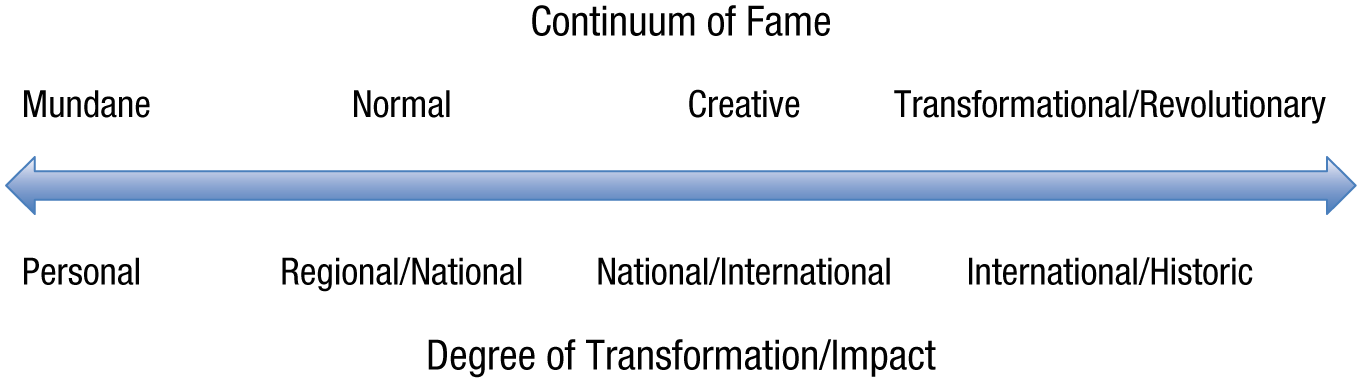
Continuum of fame model.
Evaluating Proposed and Completed Scientific Research
After the question of what is fame comes the question “how is fame evaluated?” The scientific community evaluates ideas at three time-points: before the research starts (i.e., grant proposals), before it is published (i.e., peer-reviewed articles), and after it is published (citations and altmetrics).
Evaluation of grant proposals
If the peer-reviewed article is the currency of a scientific career, then funding is its bread and butter. For most scientists, research is simply not possible without funding in ever increasing amounts. The National Science Foundation (NSF) evaluates proposals on their intellectual merit and broader impacts, with review elements including whether the proposed activities “explore creative, original, or potentially transformative concepts” (Revised NSF Merit Review Criteria, 2013). Inspired by Thomas Kuhn’s notion of revolutionary (as compared to normal) science, the NSF formally introduced transformative as a review element in 2009 (Anderson & Feist, 2016). The question that is begged however is “What is transformative science?” Answers to that question seem to converge on an intense change in direction for a field of science (Anderson & Feist, 2016; Frodeman & Holbrook, 2012). Barrett Anderson and I proposed that transformative science exists if it creates a new branch in the tree of scientific knowledge; that is, each node in a cladogram of knowledge is a transformation (see Fig. 2). In Sternberg’s propulsion model, these nodes are new directions in which new fields are propelled (Sternberg, 1999). To operationalize transformative research, we recently developed a measure of “generativity” based on the assumption that transformative science generates other works of high impact (Anderson & Feist, 2016). That is, generative publications are not only highly cited themselves but also then generate (stimulate) other works that are also highly cited. If they generate enough new works of high impact, they can reasonably be called “transformative.”

Example cladogram of psychology from 1875 to present.
Evaluation of peer-reviewed articles
Publication count is the primary traditional measure of the research output and productivity of individuals (and departments, institutions, and nations as well; Feist, 1993, 1997; Garfield & Dorof, 1992; Glänzel, Debackere, Thijs, & Schubert, 2006; Soler, 2007). One of the most obvious and consistent findings in publication analysis, the distribution of published articles, is always extremely positively skewed in the population, with most people producing little to no creative works and a few producing many or most of them (Feist, 1997; Lotka, 1926; Simonton, 1988). Numerous studies have validated the general nature of this law (Chung & Cox, 1990; Gupta, 1987; Huang, & Yang, 2012; Simonton, 1988). Skewed distributions of creative achievement confirm what we know: Creative output is a rare commodity.
Once published, articles are either ignored or exert some kind of influence on the field. Influence or impact is assessed most commonly through citations analysis. Together, publication and citation counts are relatively reliable and robust measures of creative output in science (Bouabid & Martin, 2008; Feist, 1993, 1997; Garfield & Dorof, 1992; Glänzel et al., 2006; Simonton, 2004).
As valuable as citation counts are, however, they are not without problems. One limitation is the assumption that scientists cite any and all work that has influenced their current research and this appears to not be the case. By one estimate, only about 30% of influences are cited (MacRoberts & MacRoberts, 2010). Moreover, databases that count citations (e.g., Web of Science, Scopus, Google Scholar, and EBSCO) are not internally consistent and sometimes give widely different values (Shema, 2013). Lastly, papers with several authors are more likely to be cited simply because of the greater exposure: Each author “brings in” his own network of scientific relations, and this paper is available to a wider network of researchers (VanDalen & Henkens, 2001).
Partly in response to these limitations, other more integrated measures of productivity have been developed that correct for some of these problems. The most prominent of these is Hirsch’s (2005) so-called h index: when an author of N articles has h number of publications cited at least h number of times and the rest of the articles receive no more than h citations (Egghe & Rousseau, 2006). For example, if a scientist has an h index of 10, this means he or she has published at least 10 papers that have been cited at least 10 times. By implication, if he or she published more than 10 papers, then the rest of his or her publications must have fewer than 10 citations per paper.
A more recent improvement on citation and publication counts is Soler’s (2007) creativity index, which estimates scientific creativity based on the total number of published papers, total number of citations that the paper receives, and the total number of references that the paper makes to the previous papers normalized by the total number of authors per paper. According to Soler, a paper that has many references but is not highly cited will have a low level of creativity, whereas a paper that has many citations will have a very high level of creativity. Soler’s creativity index is the only metric of impact that also takes the number of authors per paper into account (Thompson, Callen, & Nahata, 2009).
One problem with traditional, citation-based metrics of impact is the time lag between when an article is published and when citation indexes catch up. To address this problem, a very recent (first coined in 2010) measure of impact derives from online and social media data concerning articles and is called “altmetrics” (i.e., “article level metrics” or ALM; Priem, Taraborelli, Groth, & Neylon, 2010). Altmetrics assess article outcomes such as number of times an article is viewed, liked, downloaded, discussed, saved, cited, tweeted, blogged, or recommended. A major advantage to altmetric data over traditional citation counts and h index is their speed. Rather than taking years, altmetric data can be counted immediately upon publication and with real-time updates at any given time. That is not to say altmetrics have no drawbacks and criticisms: likes, mentions, and discussions can be gamed or bought (Beall, 2013). Given that the publishing world, however, is moving more and more online, there can be little doubt that online metrics of impact and fame will become increasingly widespread.
Publications are a necessary but not sufficient condition for citations, but in general those who publish the most are cited the most. Indeed, publication and citation data are strongly positively related, with effect sizes (correlation) ranging from .50 to .80 (Feist, 1997; Hagstrom, 1971; Simonton, 1988). Even with a relatively strong correlation between the two, however, there are those who publish a lot and do not get cited much, just as there are those who publish relatively little but are heavily cited. Splitting both publication and citations into high and low groups, we get four types of scientists: prolific (high publications and citations), silent (low in publications and citations), mass producer (high in publication but low in citation), and perfectionist (low in publication, but high in citations; see Fig. 3; cf. Cole & Cole, 1967).

Four types of productive scientists.
Prescriptions for a Successful Scientific Career
To more directly address the question of “am I famous yet?” I end this article with some conclusions and prescriptions for a successful scientific career that I have come to after studying scientific creativity for a couple of decades and evaluating thousands of graduate student applications, hundreds of manuscripts, and dozens of grant applications.
Success ≠ fame
Understand that doing high quality (i.e., successful) work and being famous in science (like most any profession) are not perfectly synonymous. One can do very good work, but the field may or may not pay much attention to it. Many of the most heavily cited papers in psychology for example make a methodological or statistical advance and hence are of practical importance but may not be of much theoretical importance. (Nosek et al., 2010).
Individual success ≠ disciplinary progress
Ideally, psychologists—as well as those who hire, promote, and retain psychologists—would better understand the difference between individual success and disciplinary progress. What is good for one’s career is not always what is good for science. One example of this is when new scholars, in an attempt to “make a name for themselves,” slap new labels on older, more established ideas and become famous, but the field as a whole might suffer from disjointed themes and ideas being promoted, and the theoretical and empirical progress of the discipline may be hampered. As Simonton (2015) has in fact shown, the social sciences have lower rates of peer consensus on what the important findings are than do the biological or physical sciences, and I would argue one reason for the lack of cumulative and consensual progress in social science is the desire to make a name for oneself to the detriment of the consensual accumulated progress of the field as a whole.
Another reason for lack of consensus is the fact that journals and editors historically have eschewed replication studies—only in the last 10 to 15 years has there been a focus on effect sizes and synthetic meta-analytic results from dozens of studies in contrast to single study high-profile results that may or may not replicate (Asendorpf et al., 2013; Klein et al., 2014; Open Science Collaboration, 2015). For instance, the Open Science Collaboration (2015) recently reported that, although 97% of the published studies in psychology reported statistically significant results, upon replication that figure dropped to 36% and the magnitude of effect sizes shrunk by half. If this is the case, psychology as a whole may be too quick to accept findings of single studies as true.
In response to these problems, researchers have recently begun to make recommendations to authors, editors, and instructors of research methodology to increase replicability, such as increasing transparency by preregistering predictions, clearly justifying sample size decisions, and publishing raw data (Asendorpf et al., 2013).
Balance extrinsic and intrinsic interests in your research
I said at the outset that the intrinsic and extrinsic strategies are prototypes on the extreme ends of a continuum and that, fortunately, most psychological scientists find a way to marry their intrinsic interests with its extrinsic reward and impact.
Finding that sweet spot between the two extremes of joy and recognition may be the best definition of success in science that we can come up with. So if I were to recommend a strategy for up and coming scientists it might be this: develop a research program that combines intrinsic fascination and interest with extrinsic recognition and career advancement. Follow your heart and your head. Explore and develop the riskier, more potentially transformative and creative lines of research at the same time that you develop the safer, more fundable ideas. This might occur by developing two separate lines of research, or better yet, by finding one research program that is both intrinsically motivated and then other people also recognize, appreciate, and reward you for it. If you can do both of these, you stand the best chance of surviving, succeeding, and maybe even becoming famous in the competitive world of academic psychological science.
Footnotes
Declaration of Conflicting Interests
The author declared no conflicts of interest with respect to the authorship or the publication of this article.