




Abstract
We proposed that the premise that monogamy is the exemplary form of romantic partnership underlies much theory and research on relationship quality, and we addressed how this bias has prompted methodological issues that make it difficult to effectively address the quality of nonmonogamous relationships. Because the idea that consensually nonmonogamous (CNM) relationships are functional (i.e., satisfying and of high quality) is controversial, we included a basic study to assess, in a variety of ways, the quality of these relationships. In that study, we found few differences in relationship functioning between individuals engaged in monogamy and those in CNM relationships. We then considered how existing theories could help researchers to understand CNM relationships and how CNM relationships could shed light on relationship processes, and we proposed a model of how CNM and monogamous relationships differ. Finally, in a second study, we determined that even researchers who present data about CNM are affected by the stigma surrounding such relationships. That is, researchers presenting findings favoring polyamory were perceived as more biased than researchers presenting findings favoring monogamy.
. . . sexual exclusivity [is] the cornerstone of modern coupledom. (
The optimality of monogamy, we suggest, is an implicit premise underlying both formal theories of relationship functioning and laypeople’s implicit theories about how relationships work. In this article, we specifically address monogamy in the context of research and theory about outcomes associated with dyadic relationships. The presumed superiority of monogamy may promote a bias in favor of monogamy vis-à-vis other types of relationships among laypeople. Further, this bias may cause researchers to unfairly judge relationships that do not include a sexual exclusivity agreement. We propose that given the current idealization of monogamy, examination of the premise that monogamy yields higher relational functioning than alternative romantic configurations is of the utmost social and theoretical relevance. That is, examinations of the premise of monogamy may lead society to question presumptions about relationship structures and researchers to re-evaluate dyadic relationship dynamics that were founded on assumptions of monogamy.
To support these assertions, we have integrated discussions of the quality of consensual nonmonogamy and consensually nonmonogamous (CNM) relationships with discussions about the stigma surrounding those relationships, especially as that stigma influences the process and publication of research on monogamy and nonmonogamy. We have alternated discussions of stigma and dyadic adjustment because we have found that the stigma surrounding these types of relationships influences the perceptions of dyadic adjustment CNM groups and the evaluation of research about CNM.
We first review existing research on stigma surrounding alternatives to monogamy (i.e., CNM relationships). Next, we discuss evidence that this stigma has influenced relationship research methods and theories. We present an example study that, in concert with other research findings, provides evidence about whether relationships that are not based on monogamy can be functional. We then consider theories that could be useful in the study of CNM relationships and hypothesize differences between monogamous and CNM relationships (focusing specifically on one type of CNM relationship, polyamory). Finally, returning to the issue of stigma, in a second study, we show that researchers who present data that portray CNM positively are also stigmatized—as being biased in favor of CNM relationships.
In sum, our goals in this article were (a) to demonstrate that presumptions of monogamy as a norm constrain relationship research and (b) to provide initial insights into current research and guidelines for future inquiry into alternatives to monogamy. Thus, we hope this article can spur conversations about both monogamy as a relationship structure and about bias and its effect on research processes more generally. We begin by defining the alternative to monogamy that we consider throughout this article—consensual nonmonogamy.
CNM
CNM is a relational arrangement in which partners agree that it is acceptable to have more than one sexual or romantic relationship at the same time (Conley, Moors, Matsick, & Ziegler, 2013). CNM can take many different forms, including swinging (in which a couple may have other sexual partners, generally at social events designed for this purpose), polyamory (in which people are free to maintain multiple loving or committed relationships), and open relationships (in which a primary couple pursues outside relationships, which are generally expected to be only about sex). 1 In untargeted convenience samples (i.e., samples in which participants are not recruited on the basis of the type of romantic relationship in which they are involved), approximately between 3.5% and 5.0% of individuals in relationships identify as being swingers or being in a polyamorous or open relationship (Conley, Ziegler, Moors, Matsick, & Valentine, 2013). Nationally representative samples of single Americans have shown that about 20% of single people have participated in a CNM relationship at some point during their life (Haupert, Gesselman, Moors, Fisher, & Garcia, 2016).
Contemporary CNM has its roots in the activities of gay communities. Gay men’s engagement in consensual sex outside their primary relationship was documented first in the early 1980s (Blumstein & Schwartz, 1983). The high engagement rate of 61% (albeit drawing from convenience sampling) helped fuel research on relational functioning in gay male CNM relationships. Over the past several decades, researchers have generally found that that gay men in CNM and monogamous relationships are equally satisfied with their relationships (e.g., Blasband & Peplau, 1985; LaSala, 2004; Parsons, Starks, Gamarel, & Grov, 2012). This research—some of it now 30 years old—does not appear to have been especially controversial, perhaps because dominant groups have less interest in regulating the sexuality of marginalized groups than of other dominant group members.
Further, monogamy was likely established at least partially as a system to control female reproduction and thus quell paternity concerns (e.g., Betzig, 1995; Goody, 1976; Lukas & Clutton-Brock, 2013; Opie, Atkinson, Dunbar, & Shultz, 2013). Therefore, to the extent that the possibility of reproduction is absent for a given social group, then, society may less strictly enforce monogamy for that group. For these reasons, gay men’s nonmonogamy does not substantially threaten the social order in the same way that heterosexual nonmonogamy does.
By contrast, nonmonogamy between women and men could cause more societal friction because heterosexual people are the dominant social group and because monogamy is a more entrenched cultural belief among heterosexuals because of its (at least historical) association with paternity. For these reasons, in the current research, we consider the more transgressive act of heterosexual CNM.
Stigma and CNM
Despite the growing evidence that CNM is at least as common as homosexuality, significant bias is directed toward these relationships. In a number of studies, researchers used a vignette-type design in which participants were asked to read about and rate either a monogamous or some type of CNM relationship; they found that laypeople believe that monogamous relationships are considerably more trusting, committed, passionate, and more sexually satisfying but less likely to involve jealousy than other relational arrangements (Burris, 2013; Conley, Moors, et al., 2013; Grunt-Mejer & Campbell, 2016; Hutzler, Giuliano, Herselman, & Johnson, 2015; Matsick, Conley, Ziegler, Moors, & Rubin, 2014; Moors, Matsick, Ziegler, Rubin, & Conley, 2013). In our studies, some participants even have indicated that monogamous relationships cure jealousy entirely, making references to monogamous relationships as having “no jealousy issues” (Conley, Moors, et al., 2013, p. 10). By contrast, CNM relationships are perceived exceptionally negatively. As one example, on a measure of perceived relationship quality, a hypothetical CNM couple was perceived as having a mean level of relationship quality of 2.86 on a 6-point scale, in contrast with a mean of 4.82 for a hypothetical monogamous couple. Thus, the perception is not merely that CNM relationships are unusual or unfamiliar and hence confusing to the perceivers; they are perceived to be dysfunctional.
In sum, we have ample reason to believe that a bias exists against CNM relationships. We now address how this bias may affect research on close relationships.
Theoretical Perspectives and Methods Favoring Monogamy
Because of the high degree of stigma toward CNM relationships, bias may also emerge in the study of relationships as a result of monogamy being the assumed default. That is, researchers appear to possess similar stereotypes surrounding monogamy as the lay public, which are reflected in the relationship theories espoused within psychology and related disciplines. Indeed, given that most researchers live in the same culture and receive the same messages about monogamy that participants in the studies of stigma toward CNM do, it would be difficult to believe that researchers would not share these negative perceptions. That is, given that social scientists are not immune from unintentional bias (see Banaji & Greenwald, 2013), it is important to consider the ways in which bias may influence the research process when researchers are investigating stigmatized social perspectives.
Consistent with laypeople’s stigma surrounding CNM, many psychological perspectives imply (implicitly or explicitly) that monogamous partnering is standard or ideal. For example, Erikson’s (1982) psychosocial development framework includes a stage in young adulthood, intimacy versus isolation, in which the specific importance of dyadic (i.e., monogamous) partnering is emphasized. Attachment researchers regularly use the term pair bonding. Pair bonding refers to an individual’s development of a monogamous relationship with one (and only one) other person (e.g., Hazan, Campa, & Gur-Yaish, 2006: Hazan & Shaver, 1987). Likewise, sexual exclusivity is an accepted indicator of success in romantic relationships; researchers who study extradyadic sex utilize terms like “infidelity” or “cheating.” The partner of a person who has had extradyadic sex is often referred to as the “offended party” or “betrayed partner” (Charny & Parnass, 1995; Fife, Weeks, & Stellberg-Filbert, 2013).
The assumption that monogamy is optimal often emerges in offhand comments of researchers. Rusbult and Buunk (1993) commented, “If we are lucky, we may seldom or never be challenged by tempting alternatives (to our relationships)” (p. 194)—thus presuming that monogamy is the ideal, and departures from it are undesirable. Similarly, Miller (2012) advised readers to “seek a social network that will support your faithfulness instead of undermining your monogamy and handle attractive alternatives with caution” (p. 430), assuming that the belief that monogamy should be maintained is a given. Further, the premise that monogamy is superior to other types of nonmonogamous relational arrangements continues to permeate the ways in which researchers construct and test theories of love and intimacy. Despite the large number of psychologists who focus on romantic relationships, we are aware of no psychological theories of relational adjustment that counter the idea that monogamous relationships are optimal or, for that matter, should be the norm.
In accordance with theoretical perspectives presuming monogamy, measures of relational adjustment have similarly been created with the implicit assumption that monogamy is the most desirable relationship style. A few examples illustrate this point: One commitment scale (Lund, 1985) includes the item “How attractive would a potential partner have to be for you to pursue a new relationship?”—the presumption being that the presence of a second relationship would indicate lack of commitment to the first. A scale measuring investment (Rusbult, Martz, & Agnew, 1998) identifies partners as less invested if they respond affirmatively to the item “It is likely I will date someone other than my partner in the next year.” CNM individuals may well already be dating another person or seeking another relationship while being fully committed to another partner. The Passionate Love Scale (Hatfield & Sprecher, 1986) includes the item “I’d get jealous if I thought [my partner] were falling in love with someone else.” This item is based on the assumption that less jealousy about a third party is equivalent to less passionate love; however, researchers have found that CNM individuals may actually experience positive affect in response to a partner finding a new relationship (i.e., a partner may feel happy when a loved one is finding joy in other relationships; Ritchie & Barker, 2006; Sheff, 2014). Thus, measures designed to assess relationship functioning include items that inadvertently favor monogamous relationships. As a result of this assumption, participants who are in CNM relationships would score lower on many relationship-functioning measures, yielding higher relational quality for those engaged in monogamy.
At the same time, the assumption underlying research on sexual unfaithfulness (i.e., nonconsensual nonmonogamy) is that any extradyadic sex is infidelity. The presence of extradyadic encounters is assumed to be evidence of low relationship quality (for a review, see Blow & Hartnett, 2005; Jones & Weiser, 2014; Lammers & Maner, 2016; Moller & Vossler, 2015; Treas & Giesen, 2000). A more valid approach would be for researchers to ask questions about whether the couple has agreed to be monogamous or whether instead they have extradyadic partners because they have agreed that it is acceptable to engage in nonmonogamous sexual behaviors.
Moreover, virtually all relational adjustment scales refer to a single partner (instead of partners)—ignoring the possibility of multiple-partner arrangements and making it difficult, practically, for CNM individuals with multiple partners to respond to the items. Thus, the premise of monogamy idealization is implicitly (and sometimes explicitly) integrated into many measures of relational adjustment. CNM relationships may appear substandard or deficient by virtue of being measured by monogamous standards. 2
In sum, evidence supports the assertion that both laypeople and researchers at least implicitly subscribe to the belief that monogamous relationships are the most well-adjusted relationship configuration. We now turn our attention to providing one test of the idea that CNM relationships are substandard.
Study 1: An Illustrative Study of Dyadic Adjustment in CNM and Monogamous Individuals
Cultural presumptions of monogamy as standard and the overt stigma surrounding nonmonogamy among the general public may cause people (including psychologists) to be suspicious of these relationships. We present here a study to help address, in concert with other research on the topic, the possibility that CNM relationships are substandard or dysfunctional.
Given the substantive scholarly inquiry regarding gay men’s experiences in CNM relationships, in this article we focus on relational quality among heterosexual (i.e., female–male) CNM and monogamous relationships. Although some researchers have compared relational quality and functioning among people in mixed-gender CNM and monogamous relationships, they often have relied on smaller samples, compared people in only one type of CNM relationship with people in monogamous relationships (Aumer, Bellew, Ito, Hatfield, & Heck, 2014; Jenks, 1985, 1998; Morrison, Beaulieu, Brockman, & Beaglaoich, 2013; Rubel & Bogaert, 2015), relied on samples that are not necessarily known to be monogamous (i.e., responses from the General Social Survey; Bergstrand & Williams, 2000; Fleckenstein & Cox, 2015), or failed to consider individuals’ sexual orientation (Bergstrand & Williams, 2000; Jenks, 1985, 1998). Moreover, these researchers have tended to assess relational functioning narrowly. For instance, satisfaction with one’s marriage has been assessed by one item (e.g., Fleckenstein & Cox, 2015). Two recent studies were exceptions to this narrow approach. Mogilski, Memering, Welling, and Shackelford (2015) and Morrison et al. (2013) used multiple validated measures of relational functioning (e.g., intimacy, sociosexuality, and satisfaction) in their assessments. However, in both cases, the researchers collapsed across sexual orientation in their comparisons, and moreover, they used relational adjustment measures that still were limited (e.g., furthering the understanding of satisfaction in both types of relationships but not, for example, jealousy). Thus, in the present research, we identified an explicitly monogamous sample, focused specifically on individuals in heterosexual relationships (male–female pairings), and included a broad range of relational measures, including general satisfaction, trust, commitment, jealousy, and passionate love.
We examined dyadic adjustment in several ways. First, we compared monogamous relationships with CNM relationships (independent of specific CNM relationship type). To make a parallel comparison, we only considered the responses of participants who had a “primary” partner (i.e., one partner to whom they were significantly more committed to than other partners). 3
Next, we compared the three CNM types we identified (polyamorous relationships, swinging relationships, and open relationships) with monogamous relationships. Third, extending previous scholarship (Mitchell, Bartholomew, & Cobb, 2014; Mogilski et al., 2015), we compared the quality of the primary relationship with the quality of the secondary relationship among CNM individuals with two partners. If two primary partners are engaging in CNM, people assume that the primary partners would rather be with other people than with each other (Conley, Moors, et al., 2013). Thus, the quality of the primary partnership can be assessed only by comparing it with the quality of the secondary partnership. The extent to which participants rate the primary partnership more negatively than the secondary partnership suggests that the assumption that people in CNM relationships would prefer to be with someone other than their primary partners is supported, at least partially.
Method
Participants and procedure
Participants were recruited via two methods. First, we recruited by posting on Internet sites, including the volunteer sections of Craigslist.org and sites devoted to polyamory, open relationships, or swinging. We recruited for participants who were in relationships. Approximately 89% of the sample was recruited through this method. The remaining participants (11%) were recruited by a large group of psychology undergraduate students (approximately 125) who posted requests to complete the survey on their social networking pages (e.g., Facebook) and received extra credit for participating in the recruitment process. Participants completed the survey online anonymously.
Identifying participants’ relationship status
To make certain that the participants were in relationships, we asked participants to respond to the following question: “Right now, are you romantically or sexually involved with one or multiple partners?” All participants responded affirmatively to this question.
Identifying participants’ monogamy or CNM status
To assess participants’ romantic relationship configuration, we asked participants the following question: Have you and your partner agreed to be monogamous? By monogamy we mean that you have agreed to have a sexual and romantic relationship with only one person. This may include a specific conversation about monogamy or may be implied in your relationship.
Those who reported “yes” were identified as monogamous. Those who selected “no” were given another question in which they were asked to select one of three CNM relationship types (i.e., open relationship, polyamory, or swinging; see the Appendix) that best described their relationship. Participants who engaged in one of these three main types of CNM were coded as being in a CNM relationship. Approximately 8% of participants who responded that they were not monogamous with their partner did not fit into one of the specified categories (i.e., open, polyamorous, or swinging). These participants indicated that they had not had a monogamy discussion, were having exclusively sexual (not romantic) relationships with their partners, were in a relationship with a partner who was cheating, and so on. We deleted these responses for the purpose of focusing on people who could be determined to be actively CNM, rather than those who simply may not have had a discussion with their partner about monogamy or who actually may be in a cheating situation with their partner (neither of these circumstances is a CNM relationship).
Next, we asked participants who were in CNM relationships whether they had a primary partner. Specifically, we asked, “Do you have a ‘primary’ partner? That is, do you have one romantic partner you are more substantially committed to than any other partners you might have?” Those who answered “yes” were retained for these analyses.
Identifying participants in heterosexual relationships
To focus on heterosexual relationships, we also selected people who either identified as female and reported having a male (primary) partner or who identified as male and reported having a female (primary) partner.
Additional inclusion criteria
Additional inclusion criteria were completion of the entire study instrument, identification as being age 25 years or older, and current engagement in a heterosexual CNM or monogamous relationship. We selected individuals age 25 and older because we wanted to focus on noncollege relationships and, more important, because very few people younger than 25 in the sample identified as being in a CNM relationship.
Final sample
The final sample included 1,507 individuals in monogamous relationships and 617 individuals in CNM relationships. Among those in CNM relationships, 51% were in polyamorous relationships, 25% were in swinging relationships, and 25% were in open relationships (percentages add to more than 100% due to rounding). Additionally, 63% of participants identified as female, and 83% identified as White European American; the average age was 39 years (range, 25–78 years). The average length of relationship was slightly over 10 years (121 months) and ranged from 1 month to 624 months.
No differences emerged between the monogamous and CNM groups in age, ethnicity, or level of education; length of relationship with the primary partner; or identification as a college student at the time of the survey. Although there were differences in the gender distribution in each group (with significantly more males in the CNM group), gender did not interact with relationship configuration (monogamous or CNM) and hence will not be considered further.
Measures
Participants responded to a battery of measures related to dyadic relationship quality and functioning. If respondents reported having both a primary and a secondary partner, then they completed the measures twice, once for each partner. We focused on dimensions in which participants would respond either about the general quality of their relationship or about their relationship partner.
The measures included global relationship satisfaction (Relationship Assessment Scale; Hendrick, Dicke, & Hendrick, 1998) and trust (Dyadic Trust Scale; Larzelere & Huston, 1980). These two measures consisted of items rated on 7-point scales.
We also included two measures of jealousy. One measure concerned reactions toward hypothetical extradyadic interactions—Anticipated Sexual Jealousy Scale (Buunk, 1982). Notably, we are impressed with this measure for its lack of monogamist assumptions; the measure simply asks the participants how positively or negatively they would feel if their partner engaged in a variety of sexual activities with another person, and participants respond to items on 9-point scales. The other measure was the Behavioral Jealousy subscale of the Multidimensional Jealousy Scale (Pfeiffer & Wong, 1989). This measure addresses how often participants engage in various detective and protective behaviors (e.g., “I question X about his or her phone calls”) with items rated on 7-point scales.
We also measured passionate love (Passionate Love Scale; Hatfield & Sprecher, 1986) and commitment (Commitment Scale; Lund, 1985). These scales also require participants to respond on 7-point scales.
In each scale, we removed or adapted any items that reflected an assumption of monogamy. These updated measures are available from the first author. For all measures, higher means indicate a greater amount of the relationship dimension referenced in the scale name. All measures had high internal consistency.
Results
We conducted three sets of analyses. First, we considered relational adjustment between those in monogamous and those in CNM relationships. Next, we compared monogamous participants with participants who were in different types of CNM relationships (polyamorous, open, and swinging). Finally, we assessed differences between primary and secondary CNM relationships by asking participants who had both a primary partner and a secondary partner (all of whom were polyamorous) to rate both the primary and secondary relationships on each of the dyadic adjustment dimensions.
Differences in relational adjustment between monogamous and CNM participants
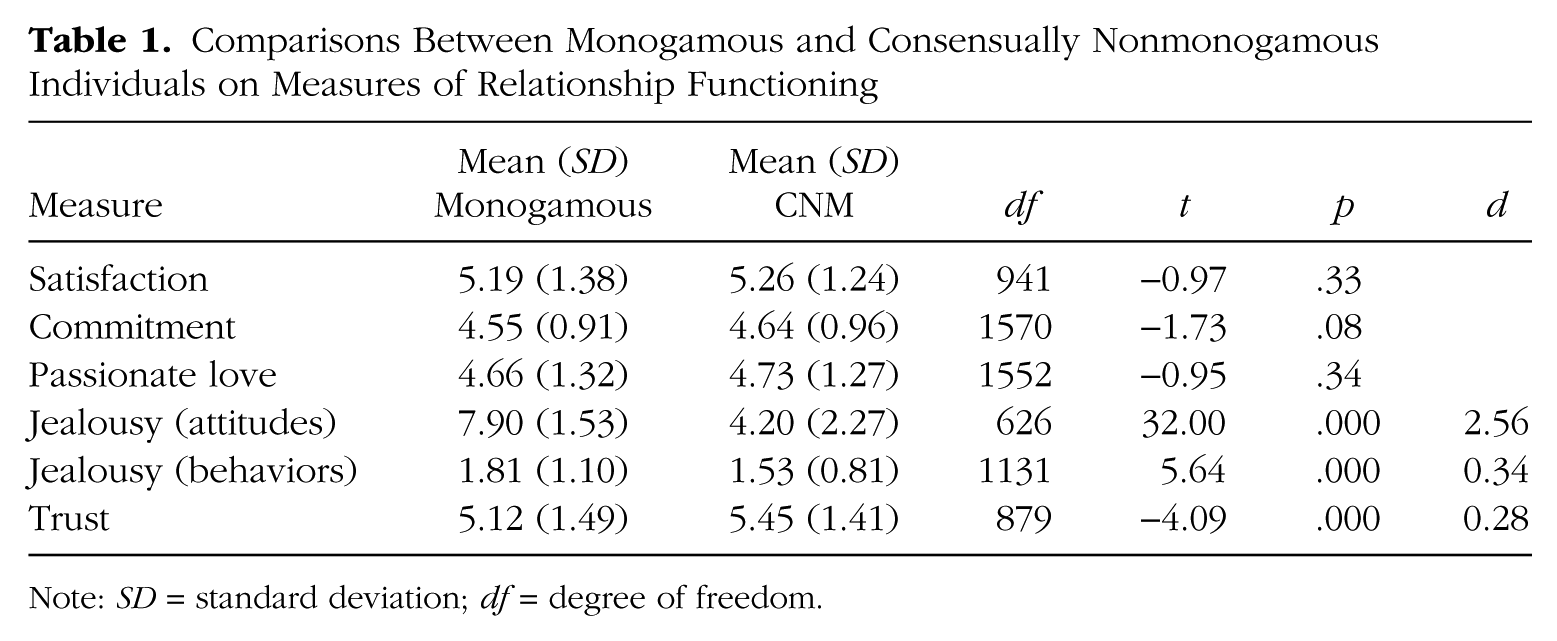
We found no differences between the two groups on several measures of relationship functioning. As shown in Table 1, despite more than ample power in the sample, no differences emerged between the two groups on global satisfaction, commitment, or passionate love. Thus, engagement in CNM does not appear to preclude general satisfaction with the relationship or commitment to the relationship. Individuals engaged in monogamy and CNM also reported similar levels of passionate love, the intense love feelings often characteristic of new relationships. Notably, means on all scales indicate generally high levels of relational adjustment in both groups.
Comparisons Between Monogamous and Consensually Nonmonogamous Individuals on Measures of Relationship Functioning
Note: SD = standard deviation; df = degree of freedom.
However, jealousy was lower and trust was higher among those engaged in CNM. Recall that we included two measures of jealousy in this study. The first was simply a measure of how negatively a respondent would feel if a partner engaged romantically with another person. Of course, the CNM group should be lower on this dimension because extradyadic behaviors are allowed in these relationships but are not allowed in monogamous relationships. One could argue that people who are not jealous are more attracted to CNM relationships, and therefore, jealousy levels are lower in these relationships. Such a conclusion is plausible. However, the finding is still consequential; the wider societal presumption has been that monogamy prevents or inhibits jealousy (as expressed by participants in Conley, Moors, et al., 2013). Likewise, relationship counselors may assume that CNM relationships are infeasible because of jealousy (see Moors & Schechinger, 2014; Perel, 2006). Contradicting these perceptions, monogamous individuals scored substantially higher on anticipated jealousy (and this was a very large effect). The fact that individuals engaged in CNM scored lower on this measure of jealousy suggests that for those who choose CNM relationships, jealousy can be controlled and managed at least as effectively as it is in monogamous relationships (e.g., Ritchie & Barker, 2006; Sheff, 2014; Visser & McDonald, 2007).
The second measure of jealousy focused on jealous behaviors, such as those represented by such items as “I look through my partner’s drawers, bags, and/or pockets.” The means on this measure were quite low, suggesting that neither CNM nor monogamous people engaged in these behaviors frequently, but monogamous individuals did report more jealous behaviors than CNM individuals.
Trust was significantly higher in CNM relationships than in monogamous relationships. This was, again, a small effect, and people in both types of relationships reported generally high levels of trust for their partners. Whether people who are more trusting favor CNM relationships, or, alternatively, whether the dynamics surrounding CNM cause increases in trust (as those in polyamorous relationships believe; see Barker, 2005) is another avenue for future research.
Differences in relational adjustment among monogamous people and people in polyamorous, swinging, and open relationships
Next we examined whether there were differences among individuals in monogamous, polyamorous, swinging, and open relationships. We first considered existing differences among these groups on demographic variables. There were no differences among the four groups in education level, their status as an undergraduate student, or age. We could not compute differences in the ethnic distribution because of small sample sizes and empty cells. There were gender differences in the distribution of women and men across different groups; however, gender did not interact with the type of CNM on any of the measures and hence will not be considered further.
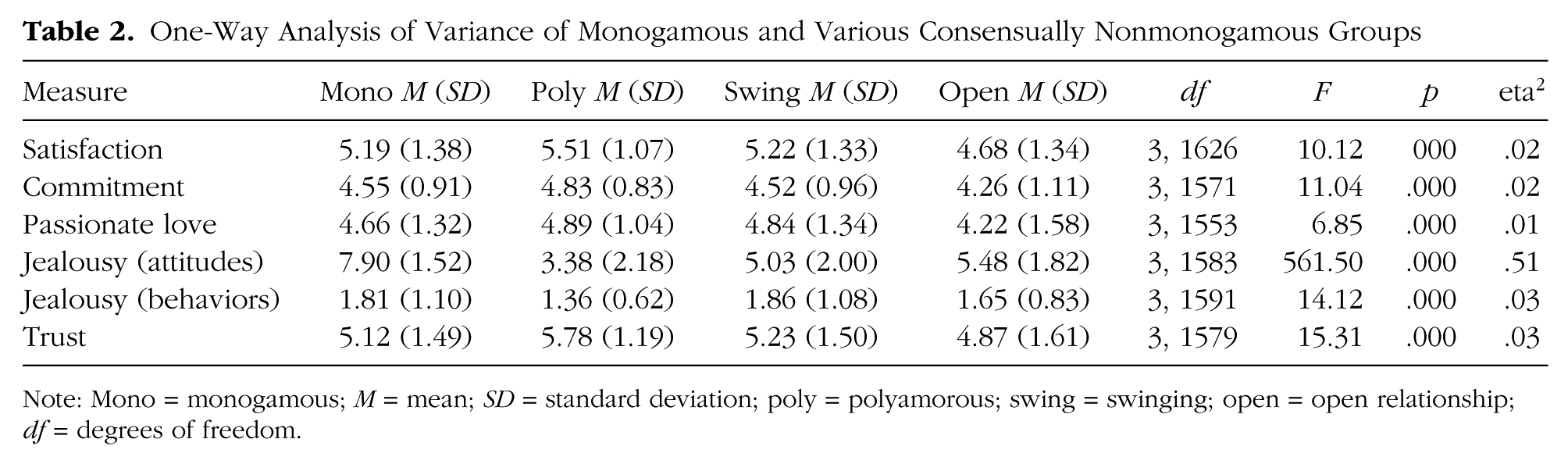
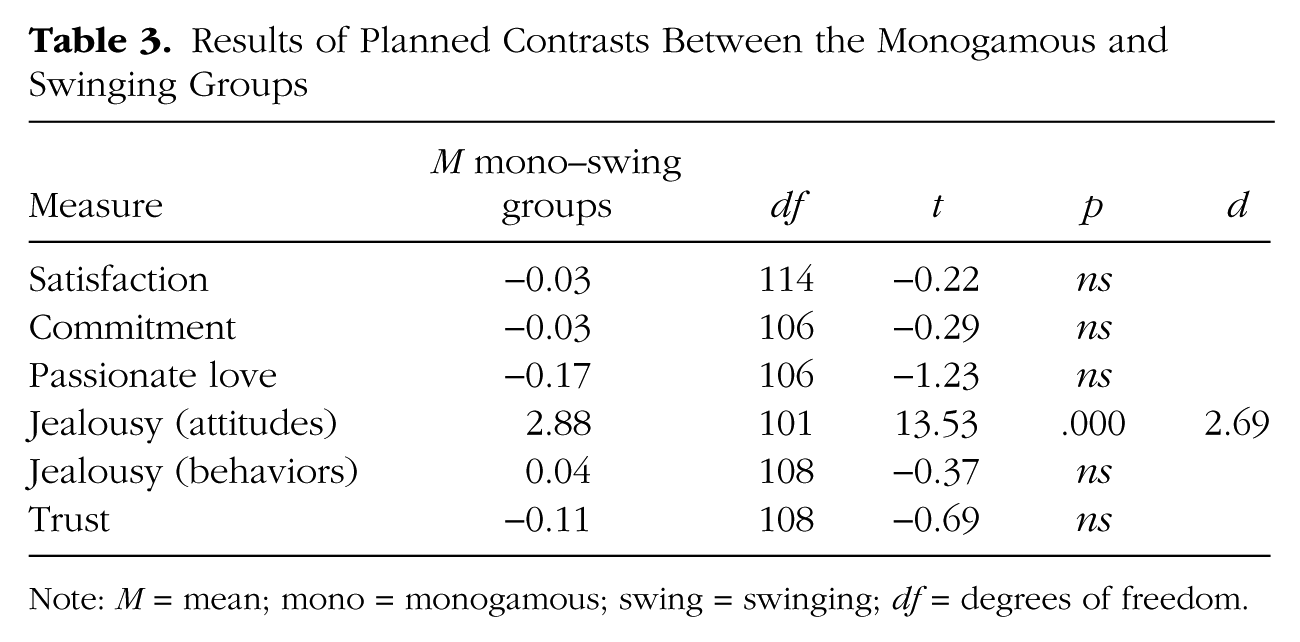
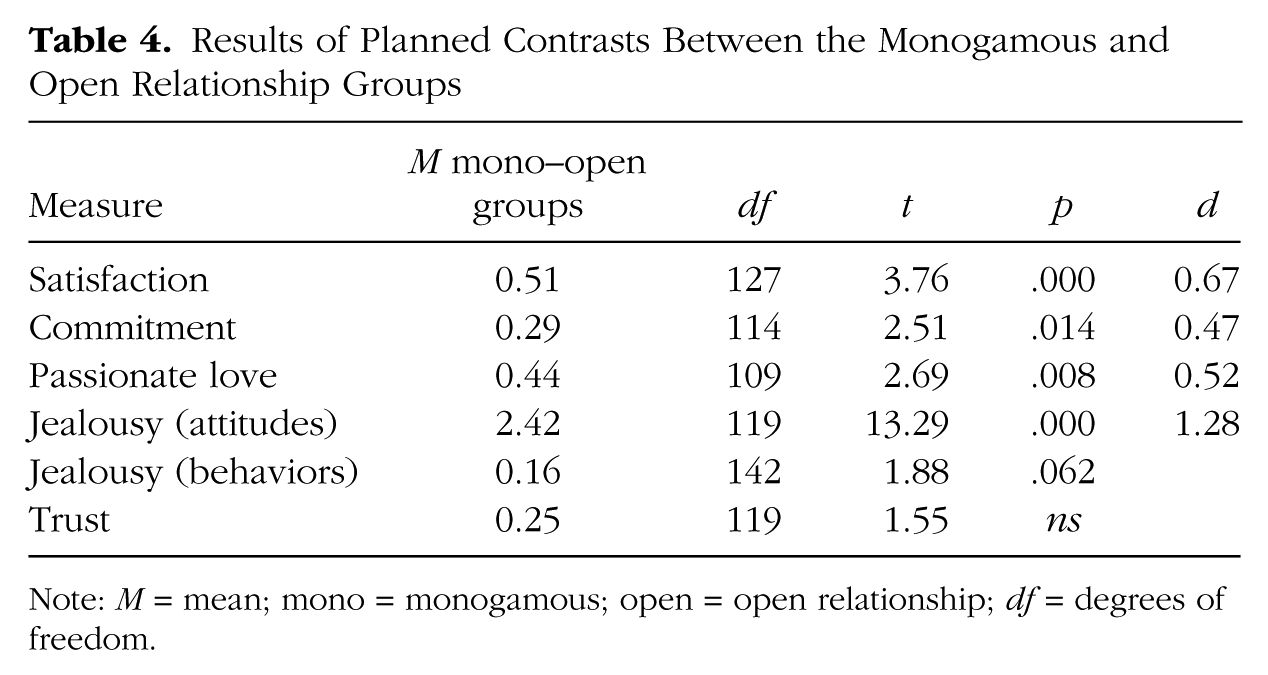
Significant differences emerged among groups on each of these measures (see Table 2). Therefore, we conducted planned comparisons between monogamous and swinging relationships, between monogamous and open relationships, and between monogamous and polyamorous relationships. 4 The results of the individual comparisons are presented in Tables 3, 4, and 5.
One-Way Analysis of Variance of Monogamous and Various Consensually Nonmonogamous Groups
Note: Mono = monogamous; M = mean; SD = standard deviation; poly = polyamorous; swing = swinging; open = open relationship; df = degrees of freedom.
Results of Planned Contrasts Between the Monogamous and Swinging Groups
Note: M = mean; mono = monogamous; swing = swinging; df = degrees of freedom.
Results of Planned Contrasts Between the Monogamous and Open Relationship Groups
Note: M = mean; mono = monogamous; open = open relationship; df = degrees of freedom.
Results of Planned Contrasts Between the Monogamous and Polyamorous Groups
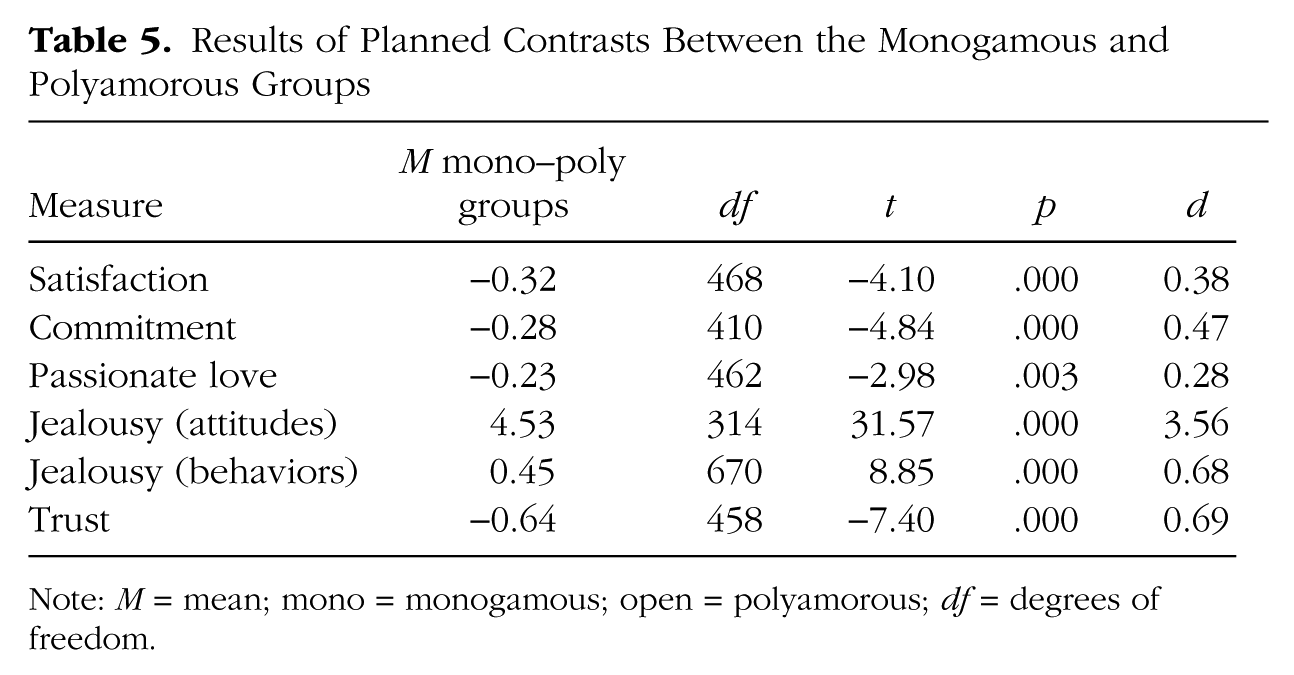
Note: M = mean; mono = monogamous; open = polyamorous; df = degrees of freedom.
Monogamous–swinging comparisons
Swingers largely reported similar relationship outcomes to those in monogamous relationships. Swingers reported significantly fewer jealous cognitions than monogamous individuals. No other significant differences emerged between monogamous individuals and swingers.
Monogamous–open comparisons
People in open relationships generally reported somewhat poorer relational functioning than monogamous individuals. Individuals in open relationships were significantly less satisfied and less committed to their relationship than their monogamous counterparts. Moreover, they reported lower levels of passionate love. They reported fewer jealous cognitions than monogamous people and also scored marginally lower on the index of behavioral jealousy than monogamous individuals. There were no differences in trust of the partner.
Monogamous–polyamorous comparisons
Overall, polyamorous people reported more positive outcomes than monogamous people on measures of relationship adjustment. Compared with monogamous people, polyamorous people were significantly more satisfied, more committed, and more trusting of their partners. They also had lower levels of jealous cognitions and behaviors than did their monogamous counterparts. Passionate love was also higher among polyamorous individuals than monogamous individuals.
In summary, although the average for each group of participants was on the positive end of the relational adjustment dimensions, these findings suggest that the types of CNM that people engage in have implications for relationship functioning. Notably, we suspect that there are different ways people engage in monogamy and that these different approaches may also have implications for relationship functioning. Determining different ways in which couples enact monogamy—for example, more or less restrictive approaches to monogamy (see Conley & Moors, 2014) would be a productive avenue for future research.
Why might these differences emerge? The fact that the polyamorous groups reported greater relational outcomes on most measures could indicate that the polyamorous style of relationships—in which both sexual intimacy and emotional intimacy with multiple people are allowed—is particularly effective. If one of the purposes of sex is emotional intimacy (e.g., Cacioppo, Bianchi-Demicheli, Frum, Pfaus, & Lewis, 2012; Donnan & Magowan, 2010), perhaps it is more difficult for an individual to be satisfied in one relationship while attempting to suppress emotional and romantic feelings for others with whom that individual is sexual, as is expected in strictly open relationships or swinging. Another possibility is that polyamorous people are more likely to utilize communication strategies that are effective. Conley and Moors (2014) noted that many of the communication strategies that are expected within polyamorous relationships also are demonstrably the most effective methods of communication for maintaining positive dyadic relationships. By contrast, these differences could mean that individuals who self-select into specifically polyamorous (rather than open, swinging, or monogamous relationships) make communication about relationships a more significant part of their lives.
On the other hand, people in open relationships reported lower relationship functioning than monogamous individuals. We suggest several possible reasons for this difference: First, as we previously mentioned, suppressing emotional reactions to sexual partners may be difficult. However, more practical concerns could be driving this difference. In the comments section of the survey instrument, those in open relationships sometimes reported that their partners were not physically present (e.g., a partner was in the military) or were incapable of having the type of sex that they would prefer to have. Therefore, some people in open relationships may be nonmonogamous as a result of circumstances that they cannot control, rather than a purposeful desire to engage in CNM. Finally, to our knowledge, there are few social opportunities, support groups, or online forums dedicated specifically to people in open relationships and the unique problems that people in open relationships may encounter. Therefore, those in open relationships may have less social support and fewer sources of practical advice about their relationship configuration than members of swinger or polyamorous communities. In the future, researchers could test how these various dynamics within open relationships predict relationship quality.
Comparison of relationship functioning of primary and secondary partners
Next, we compared the relationship functioning of primary versus secondary relationships. Dyads who are consensually nonmonogamous commonly are assumed to not care about each other, to be unhappy in their primary relationship, and to be seeking a better relationship (e.g., Conley, Moors, et al., 2013; S. M. Johnson, Giuliano, Herselman, & Hutzler, 2015; Moors et al., 2013). We were curious whether this image of CNM people would be supported by the participants’ assessment of their various relationships.
Despite these perceptions, the participants in this sample appeared to be very pleased with their primary partners vis-à-vis their other partner on relationship adjustment dimensions (see Table 6). They reported more satisfaction, trust, commitment and passionate love in their primary than in their secondary relationship. They also had more jealous cognitions in their primary relationship than in their secondary relationship.
Comparison of Primary and Secondary Partners
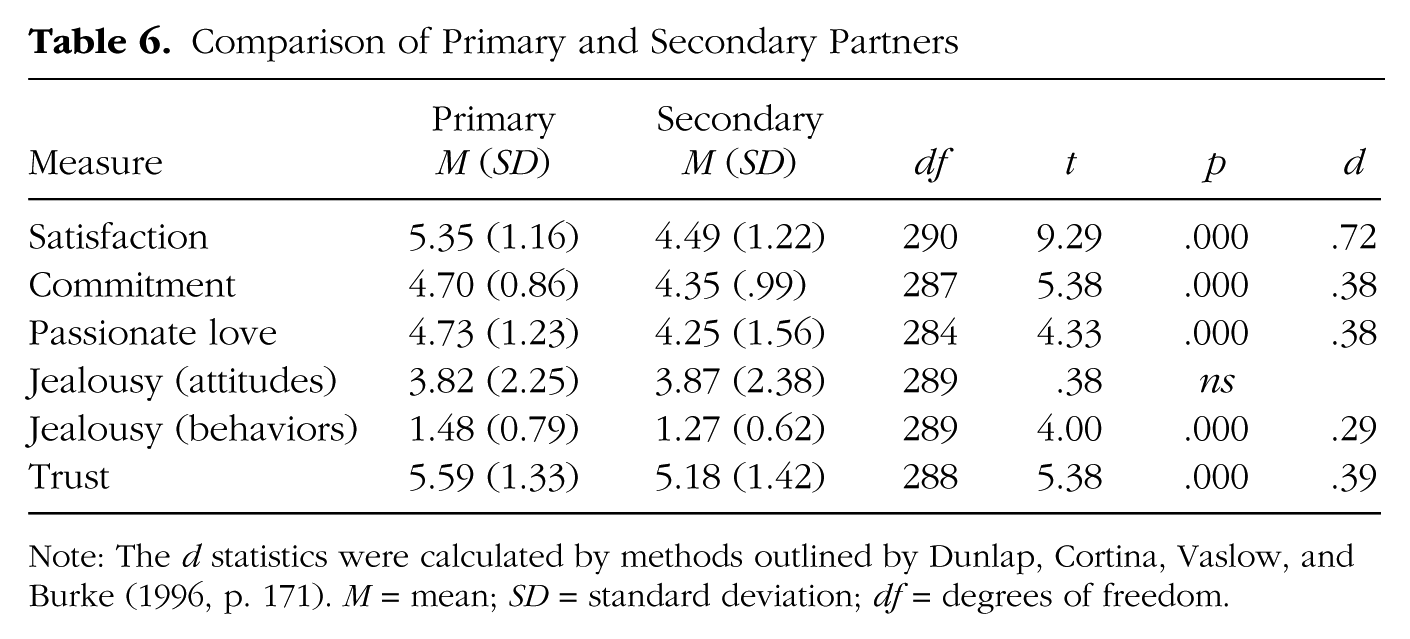
Note: The d statistics were calculated by methods outlined by Dunlap, Cortina, Vaslow, and Burke (1996, p. 171). M = mean; SD = standard deviation; df = degrees of freedom.
Of course, participants had been with their primary partners substantially longer (about 124 months) than they had been with secondary partners (about 42 months). However, controlling for differences in the length of relationship between the primary and secondary partners, we found no effects on general satisfaction, jealous cognitions, jealous behaviors, trust, passionate love, or commitment.
Discussion
Overall, the outcomes for monogamous and CNM participants generally were the same—indicating no net benefit of one relationship style over another among people who, of course, self-selected into these relationships. Polyamorous relationships fared somewhat better than monogamous relationships and open relationships fared somewhat worse. We consider some of the limitations of this research.
Limitations: Sampling and social desirability
Two related limitations of the present study are that participants were not randomly selected, and, hence, the participants that we recruited may have been motivated to provide socially desirable answers. We welcome research on relationship adjustment (both monogamous and CNM) using implicit and unobtrusive measures (e.g., an implicit-association test to determine the extent to which CNM and monogamous individuals associate their relationship with positive and negative words; Banaji & Greenwald, 2013; or a randomized response technique; Warner, 1965). However, we believe that the data presented here are still useful. Here, we address these two limitations within the broader literature of sexuality and relationship research.
In studies of marginalized groups, researchers consistently have used convenience sampling procedures to access a large number of people who would be difficult to access otherwise. Indeed, this may be the only way to study heavily stigmatized groups (a category to which CNM belongs) because participants may be unwilling to reveal their stigmatized status to a researcher who has identified them nonanonymously. Therefore, convenience sampling is an effective way to reach members of stigmatized groups. Despite potential problems of convenience samples (most prominently, concerns about socially desirability), this type of research has had tremendous significance for the lives of marginalized groups. For example, social science research was cited in the monumental Obergefell v. Hodges (2015) marriage equality case and in related lower court rulings as well (Kurdek, 2005) despite the fact that much of the research cited relied on self-report measures and nonrepresentative samples.
More specifically, research on other sexual minorities has been widely accepted despite the fact that it was gathered in a sociopolitical environment much more likely to promote socially desirable responses than the environment for CNM relationships today. That is, participants in research addressing the quality of lesbian and gay (LG) relationships within the past 20 years or so were responding within a specific sociopolitical context; marriage equality was on the horizon. Lesbians and gay men in studies from the past two decades likely felt some degree of pressure to portray their relationships as satisfying, trusting, committed, and so on (i.e., to show that they are equivalent to heterosexuals). Thus, LG people might have been somewhat motivated to portray their relationships as having more positive qualities than they objectively did, and similarly, people in lower quality relationships conceivably could have neglected to participate in studies so that they would not hurt the cause.
Yet, research indicating that LG relationships are equivalent to heterosexual relationships, relying often on convenience samples and self-report, is accepted. That is, despite these methodological problems, we are aware of no calls for research that attempts to address this lacuna in the LG relationships literature or no conceptual pieces arguing that these relationships not be considered equivalent to heterosexual relationships until ample representative and non-self-report data have been gathered. Is it possible that social scientists have simply accepted that LG relationships are as valid and functional as heterosexual relationships because social scientists themselves have overcome their biases about these relationships?
Because there is no large-scale political movement associated with consensual nonmonogamy at this moment (or at least none on the same scale as that for marriage equality), it seems plausible that the current research could be less subject to social desirability concerns than LG relationship research. Moreover, we are reluctant to believe that those in CNM relationships have overly positive perceptions of such relationships. In previous research (Conley, Moors, et al., 2013), we found that those in CNM relationships had the same bias in favor of monogamous relationships as those who were in monogamous relationships. This bias on the part of CNM people would suggest that CNM participants would, if anything, provide more negative representations of their own personal relationships. Further, when we controlled for social desirability issues in some of our previous research projects (Conley, Moors, Ziegler, & Karathanasis, 2012), it did not account for differences in how CNM and monogamous participants responded to the questions.
Notably, we are constrained by other sample concerns, as well. This was a largely White, American sample with a limited age range.
Summary
We can draw some conclusions on the basis of the current study and prior research on CNM and monogamous relationships. It appears that many beliefs that the lay public hold about the quality of CNM relationships are unfounded. CNM relationships generally have equally positive relational outcomes as monogamous relationships, though this is qualified by the type of CNM, with polyamorous relationships generally being associated with more positive outcomes and open relationships being associated with more negative outcomes than monogamous relationships. All types of CNM had averages above the midpoint of relational adjustment measures. CNM individuals with two partners are generally happy with their primary partners, responding more positively to them than to their secondary partners.
Although we welcome future research replicating these findings, our opinion is that given the limited time and resources available to researchers, further research on the basic questions of whether CNM relationships are functional is not imperative. Researchers have now amassed have a fair amount of data to suggest that relationship quality questions have been answered, albeit imperfectly.
More important, CNM relationships are happening, regardless of whether they are as successful as monogamous relationships, and intriguing theoretical questions that are associated with CNM relationships exist independently of the relative quality of CNM relationships vis-à-vis monogamous relationships. It is these theoretical questions that we turn to next.
Theoretical Perspectives Applied to CNM Relationships
What are the implications of CNM relationships for psychological theories of dyadic processes? In our prior research, we have already engaged with attachment theory (Hazan & Shaver, 1987; see Moors, Conley, Edelstein, & Chopik, 2015) and Finkel’s suffocation model of marriage (a conceptualization grounded in Maslow’s hierarchy of needs; Finkel, Cheung, Emery, Carswell, & Larson, 2015; Finkel, Hui, Carswell, & Larson, 2014; see Conley & Moors, 2014). However, our previous work barely scratches the surface of our interest in applying theories of social relationships to a CNM context. In our assessment of other theories, we came to the conclusion that CNM could challenge, intriguingly reposition, or provide texture to each theory of close relationships that we encountered. By the same token, several social psychological theories could explain the dynamics of CNM relationships. We considered two theories of close relationships and one social-cognitive theory that may help researchers explore the dynamics of CNM relationships.
Specifically, we first drew upon principles of interdependence theory to theorize about relationship dissolution rates among monogamous and CNM people. In the next section, we used self-expansion theory to frame how relationships are affected as people transition from monogamy to CNM relationships. Finally, we examined principles of the paradox of choice to elucidate dynamics that may foster (dis)satisfaction in CNM relationships.
Interdependence theory
The basis of interdependence theory (Kelley & Thibaut, 1978), as applied to romantic relationships, is the assumption that interactions between individuals in relationships impose costs and afford benefits to the partners involved. Partners stay in a relationship on the basis of the ratio of costs and benefits in the relationship, as well as how mutually involved individuals are in each other’s lives. Interdependence theory is broad and could have any number of applications to CNM; we have addressed two small aspects of the theory here. To simplify the discussion and to specify the dynamics of interdependence, we focused on polyamorous relationships. In general, two partnered polyamorous individuals should likely be less involved in each other’s lives than members of a monogamous couple. That is, polyamorous individuals with more than one close relationship have a more diversified relationship portfolio vis-à-vis monogamous individuals who are focusing on only one romantic relationship. Therefore, one would predict that polyamorous relationships would be less enduring than monogamous relationships but that the relationship dissolutions would be less rancorous because of less intense levels of involvement in any one relationship.
More specifically related to the experience of polyamory, however, is the way polyamorous individuals versus monogamous individuals interface with comparison levels (CL) and comparison levels of alternatives (CLalt), as outlined in the Investment model of commitment (Rusbult, 1980), which draws upon interdependence theory.
Comparison level (CL) is the general sense that people have concerning what they deserve or what they can get in relationships. One might expect polyamorous people to have experienced more relationships and therefore to have more accurate CLs. However, differences in CL might be expected to disappear after one has controlled for the number of close relationships that an individual has experienced.
The CLalt for monogamous versus CNM relationships is potentially more interesting. CLalt is commonly interpreted as other possible relationships that one could have instead of the current relationship in which one is involved. Of course, a major difference exists in the premise of CLalt for monogamous versus polyamorous relationships. That is, within monogamous relationships, a new relationship necessarily entails dissolving the initial relationship. Within monogamy, it is not acceptable to go out on dates and actively try to create a new relationship before exiting the established relationship.
By contrast, in a polyamorous structure, a new relationship would not necessitate a loss of the established relationship. That is, within a polyamorous relationship, it is acceptable for the partners to date others while maintaining existing relationships. Within a monogamous relationship, it is not. Thus, the risk associated with actively searching for a new relationship (by dating others) is considerably greater in monogamy than in polyamory.
A new relationship is still a potential threat to a polyamorous relationship, however. A searching partner could decide that a new partner should replace the existing partner; an unsatisfying relationship could always be eliminated and replaced by a new relationship. More mildly, the primary relationship could be demoted, in a sense, to a less prominent or central emotional position. Effectively, such an arrangement means that polyamorous individuals would be allowed (continuously, if partners agree) to explore alternatives to the existing relationship—including alternatives that could replace the existing relationship—with little cost to doing so.
Within newer polyamorous relationships, such exploration might hasten the eventual dissolution of relationships—that is, relationships may be shorter term with greater turnover. For example, a monogamous person with reservations about a given relationship may be reluctant to exit the existing relationship to search for alternatives (i.e., by dating others). A polyamorous person who has some reservations about one relationship may start to date others actively and therefore would have a much better chance of identifying a more desirable relationship. Thus, polyamorous people are more likely to find an acceptable substitute to the original relationship. By contrast, people who are in reasonably desirable monogamous relationships would be much more motivated to stay in that relationship because dating others would entail leaving the existing relationship, with the possibility that no other desirable partner will be found. Thus, one would predict that newly formed polyamorous relationships would be more likely to dissolve and would dissolve more quickly than newly formed monogamous relationships.
However, the pattern might be different in long-term relationships (monogamous and polyamorous). In long-term polyamorous relationships, alternatives likely have been amply explored through dating others. In long-term monogamous relationships, alternatives have not usually been explored, and therefore, the idealized possibility of alternatives may have grown over time. Satisfaction typically declines within relationships over time (Blumstein & Schwartz, 1983; Finkel et al., 2015; Finkel et al., 2014). In monogamous relationships, this decline of satisfaction may lead to greater idealization of hypothetical alternative relationships. In polyamorous relationships, the exploration of other relationships—relationships that inevitably have their own sets of problems—may instead lead to a reduction in general CL. That is, having realized that all relationships have drawbacks, the original relationship may be judged to be more satisfying.
Self-expansion theory
Self-expansion theory suggests that relationships are more satisfying and successful when people see others as part of themselves and, in doing so, expand their sense of self (e.g., Aron & Aron, 1996). This is a broad multifaceted theory with many applications. As in our previous discussion of interdependence theory, we focus on a few key points that highlight distinctions between CNM and monogamy.
Relationships with others serve as a source of self-identity; specifically, knowledge and access to resources are increased through one’s relationship partner. It would be interesting to understand how self-identity is formed in the context of people who have multiple concurrent partners. In general, having multiple partners would give individuals many more opportunities for self-expansion, both through the experience of navigating those relationships and because the individuals in these relationships have unique personalities and diverse interests. Being close to different people would lead to a greater variety of activities and experiences that would provide impetus for self-expansion.
One specific tenet of self-expansion theory is that passionate love among established couples is increased when they try exciting activities together. Thus, a specific prediction of self-expansion theory is that long-term relationships are more satisfying when members of the couple engage in a novel activity together. It is important to note that this should happen even if this experience is negatively valenced (Aron & Aron, 1996). That is, couples who experience positive novel experiences together should find their relationships more satisfying, but so should couples who experience negative novel experiences together. For a long-term monogamous couple, opening up the relationship to the possibility of other relationship partners (with consent) would undeniably be exciting. Of course, whether that excitement is positively or negatively valenced varies from dyad to dyad. Some may find the experience of partnering with others outside the primary dyad to be rewarding. However, more (perhaps most) would find it to be stressful and unpleasant. For a formerly monogamous couple, other partners may serve as sources of novelty (e.g., going on exciting dates with new people), which would expand the self. Self-expansion theory would suggest positive relationship outcomes associated with this transition although such an outcome may not happen immediately and although the original couple may choose to return to monogamy.
To test this hypothesis, one would need information about how long each participant’s current relationship has been CNM. It could be predicted that for long-time CNM practitioners, all else being equal, their relationship satisfaction with their primary partner would be increased by starting a new extradyadic relationship. In self-expansion theory, the outcome would be predicted to be a positive outcome for established couples (although the excitement factor would not necessarily translate into the couples’ remaining CNM). A better study would involve a longitudinal design, following partners in a formerly monogamous relationships as they transition to CNM.
CNM and the paradox of choice
A third theoretical framework of utility in understanding differences between monogamous and CNM relationships is not about close relationships per se but rather the detrimental effects of choice. In our society, having more choice is presumed to be better than having less choice (Schwartz, 2004), as evidenced by everything from our patriotic ideologies (which celebrate freedom of choice) to the multiple versions of popular candy bars such as Snickers, which now come in original, almond, and peanut butter varieties and dark and milk chocolate in at least five different sizes. However, consensus is emerging that, counterintuitively, these choices disrupt our satisfaction (Iyengar & Lepper, 2000; Schwartz, 2004; Simonson & Tversky, 1992; Tversky & Shafir, 1992). That is, the experience of having to choose between too many options may lead to anxiety and stress. By the same token, having more choices in relationship partners may make us less pleased with our choices and promote overall dissatisfaction.
Once people commit to monogamy, they may insulate themselves from other choices, which could reduce this paradox. Essentially, they may limit themselves to, perhaps, a dark chocolate Snickers bar in the 2-oz size (and do their best to put blinders on to other choices). Research on the effects of choice seems to indicate that this would be an effective way for monogamous people to maintain satisfaction with their relationship partner.
The situation is more delicate for people who are CNM. By definition, a hallmark of CNM is the exploration of other relational and sexual choices. Presuming that CNM people see themselves as having more choice than monogamous individuals, one would expect polyamorous people to feel less satisfied with their choice of relationship partners. Research on the effects of choice also would lead one to predict less commitment to primary partners among CNM than among monogamous individuals.
Of course, this dynamic was not observed in the current research. CNM and monogamous people displayed similar amounts of satisfaction and commitment. This finding perhaps can be explained by an important individual difference that emerges in research on choice—the difference between satisficers and maximizers (Schwartz et al., 2002). Satisficers are those who seek acceptable results and are satisfied with any above-threshold alternative. By contrast, maximizers are those who seek the best or most optimal alternatives. In nonromantic contexts, maximizers tend to be less satisfied with their choices and have poorer psychological outcomes (e.g., Parker, De Bruin, & Fischhoff, 2007; Polman, 2010). Emerging evidence suggests that maximizers have poorer dating outcomes as well (Mikkelson & Pauley, 2013). Perhaps CNM people either tend to be or, after years spent in CNM relationships, tend to become satisficers rather than maximizers.
More generally, the greater availability of other relationship choices—including no-fault divorce, ample online dating sites (for sexual unfaithfulness and otherwise), and CNM—undoubtedly have changed the dating landscape. How an individual interfaced with choices perhaps was less of a factor in relationship longevity when choices were fewer and relationship dissolutions were more difficult. In the current social landscape, where a person falls on the satisficer–maximizer dimension may be (by our estimation) a largely overlooked predictor of relationship satisfaction and longevity. The necessity of incorporating issues of choice would seem true especially in a relationship configuration like polyamory, in which the individual is exposed to many choices and afforded the option to act on many relationship possibilities. There is at least one other possible explanation for why satisfaction generally is not lower in CNM relationships. Research on choice has focused on situations in which an individual can only choose one option from a variety of alternatives. This is clearly true of monogamy. Choosing one individual in a monogamous context, by definition, entails rejecting others. However, CNM people may not believe that their choices are constrained in this way. Overall, CNM people probably feel less pressure to find the perfect partner because they can have more than one partner to satisfy different needs. Therefore, they may be less disappointed in existing partners and less likely to break up because any given person is not “perfect.” Exploring choice in the context of CNM and monogamous relationships would be an intriguing topic for future research.
Other Conceptual Implications of CNM
The consideration of CNM also has implications for other conceptual and theoretical issues in relationships. We consider a few here.
Infidelity
CNM bears, most obviously perhaps, on empirical conversations about infidelity. Researchers often measure infidelity by asking whether study participants have been involved sexually with anyone else during their current relationships (e.g., Jones & Weiser, 2014; Lammers & Maner, 2016; Moller & Vossler, 2015; Treas & Giesen, 2000). A monogamy agreement is assumed. Arguably, results of studies in which this method has been used should be interpreted with caution. The effects of sexual unfaithfulness (i.e., nonconsensual nonmonogamy) have been conflated with CNM in previous research. Some participants labeled as cheaters actually may have been in CNM relationships—that is, they were having consensual extradyadic experiences. Therefore, any national estimates of the percentage of individuals who are unfaithful to their partners may be inaccurate if the figures do not account for individuals who are in CNM relationships. Further, if researchers remove from these samples couples who are consensually pursuing other relationships (and not unhappy about these encounters), the deleterious effects of cheating may be even worse. That is, a certain percentage of people identified as cheaters or offended parties (terms that are prescriptive rather than descriptive) may actually be in CNM relationships and are likely satisfied with their relational arrangement. Hence, they would show no negative effects as a result of their partner engaging in extradyadic behaviors. Once researchers remove these (satisfied) individuals from the sample, the detrimental effects of nonconsensual nonmonogamy may become more pronounced.
Jealousy
We have discussed jealousy at several points in this article. Dynamics of jealousy in CNM relationships provide insight into the study of this controversial construct. Jealousy generally has negative effects for relationship functioning; it is commonly linked with general relationship conflicts and more pronounced relational impacts, such as distrust and intimate partner violence (Andersen, Eloy, Guerrero, & Spitzberg, 1995; Barnett, Martinez, & Bluestein, 1995; Puente & Cohen, 2003). Additionally, jealousy also is positively associated with relationship longevity, which has led researchers to conclude that it may be evolutionarily beneficial (see Attridge, 2013, for a review). Study of CNM relationships could help resolve this conundrum—as CNM relationships appear to be low in jealousy but high in satisfaction. As one hypothesis, perhaps in monogamous relationships, jealousy both decreases satisfaction but increases investment in the relationship because the existence of one relationship precludes all others. If this were the case, one would expect the converse in CNM relationships: CNM individuals with high levels of jealousy could be expected to have relationships that are both unsatisfying and brief. That is, because the involved partners are not obligated to forego other opportunities to remain in a relationship with the highly jealous partner, they could more quickly find suitable (and less jealous) alternatives.
Other issues surrounding jealousy could also be addressed by CNM relationships. For example, women arguably are more bothered by emotional betrayals and men by sexual betrayals (cf. Carpenter, 2012). It is unclear whether this finding is the result of distal causes (e.g., evolutionary adaptation) or more proximal cues (e.g., cultural scripts). CNM relationships appear to have more relaxed gender norms than monogamous relationships (Ritchie & Barker, 2007; Sheff, 2005). Thus, women in CNM relationships may not be bound to the same gender mores that are purported to promote gender differences in jealousy.
Trust
Trust in close relationships commonly is understood as a sense of comfort or safety due to a partner’s presence (e.g., Holmes & Rempel, 1989). Additionally, trust facilitates stronger connections between partners (Murray, Lupien, & Seery, 2012). Many monogamous individuals believe that CNM would seriously undermine their trust for their partner, yet those participating in CNM relationships report that high levels of trust are one of the chief benefits of their relationship style (Ritchie & Barker, 2006). Descriptive data appear to indicate that monogamous relationships seem to focus on reducing opportunities to break sexual trust, whereas CNM relationships remove barriers to trustworthiness by easing strict lines of sexual faithfulness (Barker, 2005; Rusbult & Buunk, 1993; Miller, 2012). Exploring these processes might show alternate ways that dyads can bolster or maintain trust in monogamous romantic relationships; processes the CNM couples use to establish trust could be productively used by monogamous couples as well. For example, it is possible that lifting the extreme prohibition on extradyadic relationships (to the extent that even thinking about others is sometimes prohibited; see Frank & DeLamater, 2010) could actually improve trust, even among mostly monogamous individuals (Perel, 2006).
Intimate partner violence
Abuse in relationships is a pressing social problem of interest to psychologists (e.g., Arriaga & Capezza, 2005, 2011). Researchers have identified a number of dimensions that make abusive (intimate terrorism type) relationships difficult to leave (Arriaga & Schkeryantz, 2015; Davis, 2008; Jackson & Oates, 1998). For example, abusive relationships often are characterized by isolation and restricted access to others; however, having romantic or sexual relationships in addition to the primary relationship is a hallmark of CNM relationships. It is interesting to note that many of these factors may not be present in CNM relationships, perhaps first and foremost, because those who are inclined to control their partners would not consent to participation in a nonmonogamous relationship.
CNM relationships might also prevent people from becoming abusive. Perhaps the relative lack of jealousy within the relationships could inhibit the forms of control that are associated with abusive relationships. Thus, partners in CNM relationships may not have the same expectations of exclusivity and the same controlling behaviors that foster the development of intimate terrorism. If this is true, CNM relationships could have unique protective benefits, which would contradict prevailing views of these relationships as damaging (see Perel, 2006).
Diffusion of relational responsibility versus expanded social support networks
In the illustrative study of dyadic adjustment presented in this article, we showed that CNM relationships generally appear to be just as satisfying as monogamous relationships. However, one theoretical perspective, diffusion of responsibility (Wallach, Kogan, & Bem, 1964), would suggest that individuals in CNM relationships would get less attention from their partners. Within monogamy, it is very clear that a person is responsible for one (and only one) relationship partner. One could presume that the one person in an individual’s life to whom that individual is devoted is more likely to be fulfilled in this targeted relationship than in a more diffuse situation of CNM in which multiple partners may be pressured to juggle many others’ needs. On the other hand, the social support literature indicates that people who have a large array of (all types of) relationships have better outcomes in times of stress than those who have a single intense relationship (e.g., Cohen, 2004; Reblin & Uchino, 2008; Sarason, Sarason, & Pierce, 1990). Relying exclusively on one person is associated with poorer psychosocial outcomes, as evidenced by the psychological fallout of divorce (DePaulo, 2007). Do people in monogamous relationships or CNM relationships fare better in times of stress? Researchers investigating CNM versus monogamous relationships in times of crisis could test competing hypotheses of the social support and the diffusion of responsibility literatures.
Love versus sex
The preoccupation with relationships based on love versus those based exclusively on sex pervades both popular culture and relationship research. Is it beneficial to have sexual relationships without love—or romantic relationships without sex? To whom are such relationships beneficial? CNM relationships provide a host of ways to address these issues. Among the broad category of CNM relationships, some types of CNM permit only sexual (but not love-based) relationships outside a primary dyad (e.g., swinging relationships and open relationships). By contrast, some types permit the development of multiple loving partnerships (e.g., polyamorous relationships).
These relationships provide something of a natural experiment that can be used to address provocative questions. We consider two here. For one, the idea that one should only love one person has been invoked in everything from romantic poetry to justifications for an affair (i.e., “I don’t love her/him; it was just sex;” Anderson, 2012; Matsick et al., 2014). Comparing polyamorous relationships (in which the importance of having multiple loving relationships is espoused) with swinging and open relationships (in which developing love relationships often are discouraged) could allow researchers to address the feasibility and desirability of having a relationship without love. That is, one may presume that no one could ever feel secure knowing that his partner loved someone other than him (but could possibly feel secure if his partner was only having sex with someone else). That hypothesis could be tested by comparing the security levels of those in polyamorous versus other CNM relationships.
A related point stems from research on condom use. People are much more likely to use condoms in casual relationships than committed relationships (e.g., Conley & Collins, 2005; Conley, Matsick, Moors, Ziegler, & Rubin, 2015; El-Bassel et al., 2003; Katz, Fortenberry, Zimet, Blythe, & Orr, 2000; Misovich, Fisher, & Fisher, 1997; Varghese, Maher, Peterman, Branson, & Steketee, 2002). Why would this be? Is it because love blinds people to risk, or is it that monogamy agreements cause people to avoid safer sex because of the (albeit sometimes unwarranted) cultural association between monogamy and safety (Conley & Rabinowitz, 2004)? These competing hypotheses could be tested by comparing the safer sex behaviors of polyamorous people with those of swingers as well as monogamous people. Polyamorous relationships are based on love; therefore, if love is the dynamic that inhibits safer sex, then polyamorous individuals would use condoms less and practice fewer safer sex behaviors (e.g., frequent testing) than swingers or those in open relationships. By contrast, if monogamy agreements themselves inhibit safer sex practices, then all types of the CNM relationships would have higher rates of safer sex practices than those in monogamous relationships.
In sum, we believe that a great number of fascinating conceptual and theoretical questions can be explored by considering alternatives to monogamy. Considering alternatives to monogamy expands the understanding of relationship theories and issues. Similarly, we now turn to considerations of difference between monogamous and CNM relationships, with a specific focus on polyamory.
Dimensions of Difference for Traditionally Monogamous and Prototypical Polyamorous Relationships
In the current research, we assessed differences in relationship quality as a function of relationship configuration. All CNM groups expressed feelings about their partners that were on the positive side of the assessment scales. People in polyamorous relationships reported relationship quality as high as people in monogamous relationships and sometimes higher. Swinger relationships were approximately equivalent to monogamous relationships, and people who identified as being in an open relationship reported generally having less positive relational outcomes than monogamous individuals. Clearly, the type of CNM that individuals are participating in matters.
Given the distinct ways in which CNM can be enacted, we believe a generic model of CNM relationship processes is inappropriate. However, a modest but impactful package of data has now been collected that specifically address the processes of polyamorous relationships (Aguilar, 2013; Barker, 2005; Mitchell et al., 2014; Moors et al., 2015; Ritchie & Barker, 2006, 2007; Sheff, 2005, 2014). In this section, we propose dimensions that distinguish between traditional monogamy and polyamory (and exclude other CNM relationship configurations).
As we discussed earlier, polyamory is a relationship style in which all individuals involved openly acknowledge and agree that it is acceptable to have more than one romantic or sexual relationship at the same time—and, further, that it is acceptable to love other partners. Notably, it is not a requirement that all the relationships in a polyamorous configuration be loving. Casual or sex-only relationships may certainly be allowed within polyamorous relationship configurations; however, a central tenet of polyamory is the expectation that it is acceptable for more than one relationship to be loving. This tenet distinguishes polyamory from swinging or open relationships.
We chose to focus on polyamory here as a working representation of CNM for three reasons. First, this is the style of relationships that we perceive to be most dissimilar to monogamy, in that it encourages the development of other loving or sexual relationships. Swinging and open relationships preserve more of a monogamous relationship structure in that the extradyadic encounters are typically only sexual and are generally compartmentalized so as not to interfere with the structure of the primary couple’s relationship (Conley et al., 2012). Second, more data have been collected and, therefore, more information is available about polyamorous relationships than the other types of relationships (Aguilar, 2013; Barker, 2005; Mitchell et al., 2014; Moors et al., 2015; Ritchie & Barker, 2006, 2007; Sheff, 2005, 2014). Third, polyamorous individuals are the largest subsample of CNM participants in our studies.
We contrast polyamorous relationships with what we call traditional monogamy—defined as the type of monogamy that is the most circumscribed and adherent to social norms. We are not implying that all monogamous relationships incorporate all the beliefs and activities that we delineate. In fact, we believe that many approaches to relationships advocated by polyamorous people could be successfully employed by monogamous couples (see Conley & Moors, 2014). However, we are referencing a general cultural understanding of how monogamy is expected to be enacted (see Frank & DeLamater, 2010; Haag, 2012; M. P. Johnson, 1991; Kipnis, 2004). Likewise, we are not proposing that all polyamorous relationships precisely fit our representation; these are generalizations. Finally, we are proposing not categorical differences between monogamous and CNM relationships but rather continua on which monogamous relationships and CNM relationships tend to fall at different ends.
We suggest seven dimensions on which polyamorous and monogamous relationships should be expected to differ. The current model is based on writings of polyamorous individuals, clinical observations, and qualitative data as a guide for future quantitative empirical research. These dimensions serve merely to start a conversation about differences in the navigation of monogamous and polyamorous relationships and generate hypotheses about the dynamics of these two relationship types. In sum, the following discussion is intended as a compass, rather than a road map.
Dimension 1. Emphasis on personal fulfillment versus selflessness for maintenance of a specific relationship
In the context of their relationships at least, polyamorists are likely to endorse independence, whereas monogamous individuals embrace interdependence. One of the manifestations of this difference is that CNM and monogamous people view their relationships—including the quality of those relationships and whether and when those relationships end—in distinct ways.
We see evidence in writings on polyamory that polyamorous relationships have an ethos of personal need fulfillment to a greater extent than monogamous relationships (e.g., Anapol, 1997; Sheff, 2014, 2015). For example, according to clinical psychologist Anapol (1997), “Polyamorous relationships tend to put more emphasis on . . . allowing for individual autonomy” (p. 7), and “[i]f it’s important to you to maintain a sense of yourself as an individual in addition to any group or couple identity you might adopt, [polyamory] could be right for you” (p. 27).
Monogamous people place a greater emphasis on sacrificing individual needs for a particular relationship and emphasizing that relationship over individual needs. As Buunk and Dijkstra (2006) noted that “the relationship is supposed to have primacy over individual interests” (p. 111). Therefore, when a monogamous couple marries, they traditionally vow that the relationship will end only in death (see, e.g., M. P. Johnson, 1991). Because of the heightened emphasis on maintaining a particular relationship within monogamy, when a marriage (or other relationship) dissolves, it is considered a “failed” relationship (e.g., Gray & Silver, 1990; Kellas & Manusov, 2003). The language of failure seems notably absent from discussions within polyamory communities (Sheff, 2014).
Although the relationship maintenance approach espoused in more traditional monogamous approaches clearly has benefits (Finkel et al., 2015; Finkel et al., 2014; Rusbult & Buunk, 1993), potential drawbacks manifest themselves as well. Specifically, a monogamous person may resent having to allow a relationship to subsume individual desires, which may promote reactance. This type of reactance may be an underlying factor in the decision to cheat on a monogamous partner (Emmers-Sommer, Warber, & Halford, 2010). Therapist Perel (2006) reported, provocatively, that simply discussing the possibility of nonmonogamy may increase sexual desire between two monogamous people. This clinical observation bolsters the assessment of monogamy as a social structure that sometimes may promote reactance.
By contrast, within polyamory, one relationship need not end for another to begin. Therefore, people participating in polyamory logically would feel little pressure to derogate an existing or prior relationship to justify a new one (cf. Rusbult & Buunk, 1993). As a result, a relationship would be successful to the extent that the partners involved received something valuable from it—even if those rewards were fleeting or the relationship ceased. 5
Perhaps one of the biggest shifts that relationship science may encounter in polyamory is the relative lack of concern with maintenance of a particular relationship as a goal in and of itself—which, by contrast, is a major theme in monogamy. Within polyamory, relationships should exist only as long as they are satisfying and useful to the individuals. As a result, comparing the longevity of monogamous and polyamorous relationships may be fraught. Polyamorists generally reject the premise that longevity is necessarily a sign of success in relationships: In a large qualitative study, Sheff (2014) found that polyamorists pointed to many enduring but unhappy monogamous relationships as evidence of the illegitimacy of longevity as a basis for relationship success. Consistent with this hypothesis, in their research on the investment model, Rusbult, Agnew, and Arriaga (2012) found that “strong commitment—not high satisfaction—is the psychological state that characterizes partners in an enduring relationship” (p. 222). We suggest that statement would better reflect the reality of monogamous than polyamorous relationships.
The most straightforward prediction from this premise is that polyamorous relationships likely will be of shorter duration (but not lower in satisfaction) than monogamous relationships. However, such a prediction would have to be qualified by another factor, which we address further in Dimension 2.
Dimension 2. Defined versus flexible relationship styles
In traditional monogamy, a very clear relationship structure exists. There are to be two (and, of course, only two) individuals in the relationship. Sex, flirting and, in some cases, even thinking about others are disallowed activities (Frank & DeLamater, 2010). In traditional monogamy, even platonic friendships or activities that interfere with time spent on the monogamous relationships can be frowned upon (Finkel et al., 2015; Finkel et al., 2014; Rusbult & Buunk, 1993). Within polyamory, the lack of such boundaries promotes almost limitless possibilities for relationship structures. There are as many ways to be in polyamorous relationships as there are ways to be friends with another person (e.g., Barker, 2005). People can have a relationship and only see each other once per year. People can have a relationship that is only about sex. People can have a relationship in which there is sexual attraction but no physical sexual contact or one in which there is ample affectionate contact but no sexual attraction. And of course, polyamory provides space for outside friendships more generally, because sexual attraction as a threat to an existing relationship does not loom in the air.
The added problem of making a prediction about relationship longevity, then, is that when a polyamorous relationship “begins” and “ends” is equivocal. Polyamorous individuals report preferring to allow relationships to change over time rather than have a definite break up (Sheff, 2014), as partners usually do in monogamous relationships (M. P. Johnson, 1991). For example, the sexual component of a given relationship may end, but the companionate or friendship aspect of that relationship may persist. Would that be a dissolution? If so, when would the ending date of the relationship be: the last time the couple had a sexual encounter or the day they had a discussion about ceasing their sexual contact? What if such a conversation never occurred?
One of the primary lessons from Dimensions 1 and 2 is that it may be necessary for relationship researchers to conceptualize longevity in a very different way to accommodate polyamorous relationship styles. We also predict that polyamorous individuals will have less rancorous relationships with former partners than monogamous individuals do. That is, the lack of a failure narrative in polyamory, logically, should translate into less blame concerning dissolutions; if the relationship did not fail, the attributional search for a cause of the dissolution is likely to be absent or less prominent. For this reason, we expect that divorces among married polyamorous couples would be, on average, less acrimonious than among married monogamous couples and that other nonmarital dissolutions should follow the same pattern.
Dimension 3. Belief in acceptance versus transgression of social norms
Traditional monogamy incorporates many social norms. Adherence to these norms may be reassuring to the participants, promote relationship stability, and reduce conflict within the relationship (Rusbult & Buunk, 1993). One of the purposes of societal structures is to provide, essentially, heuristics for how to navigate the world (Durkheim, 1950; Hechter & Opp, 2001). Removal of monogamy as an ideal, then, would be likely to cause some degree of upheaval (making the stigma surrounding these relationships understandable). Scores of norms that are just understood in monogamy must be dissected within polyamory (and other CNM relationships). Even minor rules must be explicated. (Notably, research suggests that all this negotiation and communication are time consuming and challenging; see Aguilar, 2013; Anapol, 1997; Sheff, 2014; Wosick-Correa, 2010; we discuss this topic more in Dimension 6.)
Norms help people avoid stigma. If polyamory is a choice, why would individuals choose a polyamorous relationship over a monogamous relationship, given how much stigma is likely to be faced in the process of expressing this identity? Stigma is a significant source of stress for stigmatized individuals, regardless of whether their stigmatized identity is known to others (e.g., Arbona & Jimenez, 2014; French & Chavez, 2010; Goldbach, Tanner-Smith, Bagwell, & Dunlap, 2014; Meyer, 2003, 2007; Wei et al., 2010). The stigma surrounding polyamory is bound to be a source of stress for polyamorous individuals. Of course, there are many reasons to choose stigmatized identities. However, one might be that polyamorous individuals are more inclined to actually relish flouting societal conventions (cf. Klesse, 2006; Sheff, 2014); they may believe in the importance of transgressing social norms. It would likely be adaptive for polyamorous individuals to revel in their role as libertines, given the significant amount of anxiety that accompanies membership in a marked group.
Given extensive research on the impact of minority stress on health (e.g., Major, Mendes, & Dovidio, 2013; Meyer, 2003, 2007), it is hard to imagine that those in polyamorous relationships and other CNM individuals would not report more negative psychological and physical outcomes than monogamous people. However, we would expect these detrimental outcomes to be mediated, in part, by the preference for transgression of social norms within polyamorous communities.
Dimension 4. Paths to relationship security: Exploration versus restriction
In traditional monogamous relationships, a generally approved method of protecting the existing relationship is to restrict access to alternative relationship possibilities (see D. J. Johnson & Rusbult, 1989; Rusbult & Buunk, 1993; Rusbult, Van Lange, Wildschut, Yovetich, & Verette, 2000; Van Lange & Rusbult, 1995). This restriction might mean making sure that monogamous partners do not spend time with someone to whom they feel attracted (e.g., limiting time at social events with co-workers if there is an attractive co-worker who attends) or orchestrating activities so that they are not alone with attractive people without the presence of the monogamous partner (e.g., a heterosexual person avoiding time alone with opposite-sex individuals or a couple forbidding unescorted dinners with ex-girlfriends or ex-boyfriends). Given the goals of monogamous relationships (to preserve this romantic relationship and prevent others from developing), this strategy is very sensible. However, there are costs. If one’s monogamous partner has not explored other options, a person may begin to wonder whether their partner would leave her or him for a better option, assuming one became available (cf. Schwartz, 2004). Such a hypothetical could in turn promote greater anxiety about the stability of the relationship among monogamous individuals. Likewise, the monogamous partner who, at times, might fantasize about exploring alternatives may idealize other possible relationships, in a “grass is always greener” mindset (cf. Goetz, Ehret, Jullien, & Hall, 2006).
Polyamorous individuals have alternative means of developing relationship security. Partners in polyamorous relationships constantly are allowing their relationships to be measured against other alternatives. We suggest the possibility that allowing partners to explore multiple relationships in depth could have some benefits to the primary relationship. The exploring polyamorous partner may be more likely to realize that all relationships have strengths and weaknesses and that terminating their existing relationship to replace it with another would simply be swapping one set of joys and sorrows for another.
Moreover, a partner who after ample exploration maintains the existing relationship rather than leaving it, may validate and flatter his or her mate. Consider A and B, a committed polyamorous couple. If B explores numerous other relationships but still continues to desire a relationship with A, then A would likely feel gratified and pleased. Even though other options were available, the exploring partner chose the existing relationship. Repeating this process of choosing one’s existing partner over and over again would seem, logically, likely to fortify and enrich the relationship. 6
Even if a new partner is perceived to be significantly better than the original partner, this is not necessarily a disaster for the original partner in a polyamorous situation. The new partner can be incorporated into the existing relationship as an additional primary partner or may remain in (or perhaps on the fringes of) the original dyad even if the new partner actually is perceived as “better” on some or all fronts. In other words, the commitment of the original couple in the relationship need not be disturbed, because within polyamory, it is not required that a person exchange one relationship for another. For example, Sheff (2014) described one polyamorous woman who felt fortunate to still celebrate her 50th wedding anniversary, even though her relationship with her husband was substantially less prominent in her life at that time than her other romantic relationships.
We once again return to jealousy: One manifestation of these differing techniques for managing relationship threat could be in the patterns of jealousy over time in relationships. That is, we would expect that jealousy would drop precipitously over time in polyamorous relationships, as primary partners have experiences with others. When primary partners observe that extradyadic relationships do not disrupt the primary relationship, it would seems logical that they would be less likely to view future extradyadic relationships as a threat. By contrast, we would expect a relatively stable pattern of jealousy in monogamous relationships, consistent with research that jealousy remains a source of conflict and stress among middle-aged couples and older partners (Levenson, Carstensen, & Gottman, 1993). The threat of another more attractive partner would continue to exist throughout the course of a monogamous relationship.
Dimension 5. Stability versus novelty
Within polyamorous relationships, an ethic of embracing novelty over stability is prominent. When reading narratives about polyamory, one senses that the experience of being in a relationship consumes more time in that relationship configuration than it does in monogamy (e.g., Sheff, 2014, 2015); it involves more conflict and discomfort, as well as strong emotions, both positive and negative. Those who are in prototypical polyamorous relationships are likely to be more satisfied if they embrace novelty and diversity of experiences.
An adage within the polyamory community is that a more appropriate term for the arrangement would be “polyagony” (Deri, 2011). Deri (2011) reported a great deal of relational turmoil in these relationships—including jealousy, hurt feelings, and need for frequent renegotiation of boundaries. Thus, a corollary of preference for novelty among successful polyamorous individuals is, we predict, tolerance for “relationship drama” (Sheff, 2014).
As an example, in the simple case of a primary couple in which both members have one outside partner, any of three romantic dyads may dissolve or at least change drastically over time. Therefore, the likelihood of an enduring relationship unit is small. A person who decides to embrace the emotional highs but remain relatively unfazed by the emotional lows of relationships will be better suited to polyamory than one who finds such peaks and valleys perilous or distressing.
By contrast, with only one dyad to manage (and one that involves scripts about the acceptable progression of relationships), monogamous relationships can be predicted to be, on average, more emotionally stable over time. Stability has many advantages. People benefit from being able to be able to predict and control their environments (e.g., Glass, Reim, & Singer, 1971; Rodin, 1986). This locus of control may lead to better psychological and physical health outcomes for monogamous people.
On the other hand, through the basic sensory process of habituation, a monogamous individual has a good chance of becoming sexually uninterested in her partner over time. Habituation is likely responsible for the drop in sexual attraction and sexual frequency that happens in most couples (e.g., Blumstein & Schwartz, 1983; Call, Sprecher, & Schwartz, 1995; Masters & Johnson, 1970), and that, in monogamous couples, could mean an overall reduction in sexual satisfaction (given that the monogamous partner is the only legitimized source of sexual contact) over the course of the relationship. It would be interesting to determine whether different trajectories of attraction exist within a primary dyad across the course of monogamous versus polyamorous relationships.
Preference for stability versus novelty involves a trade-off. In polyamory, the individual has to contend with substantially more relationship drama and turmoil. Within monogamy, the threat to the relationship is boredom. Which of these is “preferable” or “superior” seems to us to be a matter of personal choice, without an obvious right or wrong answer.
Dimension 6. Communication: Scripted shorthand versus voluminous exchange
For monogamous dyads, relationship expectations are clearer because the couple is free to draw upon existing social (and sexual) scripts (Gagnon & Simon, 1973; Holmberg & MacKenzie, 2002). Scripts can dictate what should be discussed and when; for example, they can guide when it is time to discuss whether the partners are a couple and the appropriate amount of time that should pass before it is appropriate to discuss a commitment. By contrast, polyamorous relationships take a greater variety of forms and thus require both more communication overall and communication of greater complexity.
One dyad can more easily be decoded than multiple dyads, especially when those dyads are interwoven. Thus, consider a primary polyamorous couple (X and Y) in which each member has an outside partner (X’s outside partner is A; Y’s outside partner is B). Each member of the primary couple now has five dyadic relationships to manage. X must consider the relationship between X and Y, between X and A, between Y and A, between Y and B, and between X and B. Even if X and Y are relatively uninvolved with their metamours (the polyamory community’s term for the partner of one’s partner; Ritchie & Barker, 2006; Sheff, 2014), these dyads will affect their lives. That is, a dissolution of any of these relationships—or indeed, any sort of tension in one of the dyads—could affect any of the other dyads. Of course, if any of the partners in the primary dyad have more than one partner, the number of dyads with which they are contending grows exponentially. Moreover, within polyamorous groups, a social norm is that each of these dyads will be attended to and fostered thoughtfully (Sheff, 2014). Polyamory how-to books and online resources strongly emphasize clear and empathetic communication (Conley & Moors, 2014; Sheff, 2014; see also polyamory manuals, e.g., Easton & Hardy, 2009). As discussed in Dimension 3, such communication is time consuming and complicated (Sheff, 2014), particularly because there are few norms for appropriate behaviors in such relationships. Because polyamorous relationships are often hidden and stigmatized, we suggest that communication may be more difficult and emotions may be more extreme and less predictable. Equitable responses to emotionally volatile disputes need to be constantly negotiated, and with multiple people involved, there are likely many conflicting opinions about what is equitable in any given situation (Sheff, 2014).
Given the ethos that constant communication is a must in polyamorous relationships, we suggest people who prefer more scripted communication and prescribed relationship norms would be better suited to monogamy. On the flip side, successful polyamorous people should have more complex communication skills, either through self-selection or through honing of their communication skills by navigating multiple dyads. Of course, people who enjoy communication also can have rewarding monogamous relationships. Our point is merely that these communications skills are more necessary in polyamorous relationships than in monogamous relationships; it would be very difficult to participate in polyamory without these skills. We suggest that monogamy is a more comfortable environment for people with a preference for less expressive or direct communication. Again, monogamy can also work quite well for those who like to communicate about relationships extensively. In this way, monogamy may accommodate a wider variety of preferences and polyamory may be more narrow in the types of people for whom it can work effectively.
Dimension 7. Relationship challenges: Devotion to one versus nurturing many
Both monogamous and polyamorous communities have opinions about the struggles associated with their relationship configurations. Long-term monogamous partners often believe that choosing only one person is a sacrifice, but they believe this sacrifice is merited because of the perceived benefits of monogamy and, at least in some cases, because of a perceived lack of other choices (Conley, Moors, et al., 2013; Haag, 2012; Rusbult & Buunk, 1993). This is a very reasonable approach for many couples; there are, indeed, many benefits associated with monogamy for those who choose it.
Polyamorous people see challenges in their relationships as well. In particular, they see the need to communicate amply and effectively with all partners as a burden, at least sometimes (Sheff, 2014); at times, they may prefer to opt out of managing the relationship drama endemic to complex relationship configurations. Polyamorous people, too, have guiding principles that bolster their commitments to their lifestyle. For example, they typically espouse the belief that monogamy does not work or is not natural (Barker & Langdridge, 2010; Sheff, 2015; Worth, Reid, & McMillan, 2002). They also espouse the belief that the work they put into careful and thoughtful communications is worth the effort because it makes their relationships deeper, stronger, and more satisfying than monogamous relationships (Easton & Hardy, 2009; Lee, 2015; Ryan, 2015; Sheff, 2014).
In a sense, the research we presented in this article disconfirmed both of the monogamous and polyamorous perspectives on sources of “work” within their relationships. That is, we have little evidence that polyamorous or monogamous relationships are superior. Rather, we suspect that these ideas are rationalizations that support either monogamous or polyamorous relationship structures, depending on the perceiver.
We suggest that partners in any relationship should be mindful of the specific burdens associated with their relationship configurations. When possible, partners could work to alleviate each other’s burdens. For example, polyamorous individuals might allow their partners freedom from constant vigilance about perceived inequities or slights in any of the dyads that exist within the relationship structure. More traditional monogamous couples might allow their partners freedom to explore more (nonsexual) interests outside the relationship—be those career commitments, hobbies, or flirtations (just flirtations) with others. In a sense, recognizing alternatives to monogamy could make monogamous people more understanding of the sacrifices (joyful though those sacrifices may be) that their partners make to be with them.
Summary
These seven dimensions of difference can help researchers generate hypotheses useful in exploring relationship processes in diverse types of relationships. However, we have found that even hypotheses suggesting that polyamorous or CNM relationships might have some advantages, in some circumstances, over monogamous relationships is often met with defensiveness above and beyond what we experience in publishing other research. For example, researcher Elisabeth Sheff (2014), conducted extensive research on the children of polyamorous parents and found evidence that the children are thriving. She discussed the unusual response she received from the scientific community about her research: “The specific tone of the reviews and the recurrent nature of the negative feedback signal a deeper, institutionalized issue of sex negativity.” (p. 127). She further explains that, although every academic is critiqued, “not every critique is so defensive and vitriolic in tone.” 7 Because stigma toward these relationships is, in our experience, closely intertwined with understanding these relationships, in the next section, we return to the issues of stigma that we addressed earlier and present evidence, beyond anecdotal experiences, that presenting data that reflects positively on CNM relationships causes researchers to be evaluated negatively.
Study 2: Perceptions of Researcher Bias in the Study of CNM and Monogamous Individuals
Given that our findings might be unanticipated by (or jarring to) many psychologists, we would like to return to the issue of bias against CNM. As discussed earlier, CNM individuals and their relationships are clearly perceived negatively. If researchers who conduct research into CNM are perceived as biased, then research addressing CNM populations will fall on deaf ears.
Upon reading the preceding findings, did the reader conclude that the authors of this article are biased in favor of CNM or that the researchers are themselves engaged in CNM relationships? Did it appear that the analysis of differences between monogamous and polyamorous relationships was biased in favor of polyamory? We have already discussed bias against CNM individuals. Given the extent of the bias toward people who are CNM, we were curious as to whether this is a situation in which researchers experience stigma by association (e.g., Neuberg, Smith, Hoffman, & Russell, 1994) when they present positive representations of CNM people.
Nauroth, Gollwitzer, Kozuchowski, Bender, and Rothmund (2016) have shown that research that threatens an individual’s identity is perceived as more biased than that which affirms an individual’s identity. We reasoned that findings that suggest CNM is of equivalent quality to monogamy might serve as an identity threat to monogamous people.
Further, social stigma also has been shown to taint not only the stigmatized people themselves but also those who have relationships with stigmatized people (e.g., Pryor, Reeder, & Monroe, 2012). Is it possible that the stigma surrounding CNM could extend to the researchers who address the topic? We evaluated these hypotheses by having monogamous participants read summaries of research findings that varied only in which group (monogamous or polyamorous) was portrayed as being higher in dyadic adjustment.
Method
Participants
Participants were respondents recruited through Amazon’s Mechanical Turk subject recruitment service. Twenty-eight people were removed because they did not complete or failed a required manipulation check at the end of the questionnaire in which participants were asked to recall whether the research findings indicated that those in monogamous or polyamorous relationships showed better adjustment. Further, to be included in the study, participants had to be monogamous. Thirteen people were removed because they did not identify as monogamous. After applying these exclusion criteria, we had 103 participants in the study, 57% of whom were male. The group was 71% White or European American, 8% Asian American, 7% African American, and 7% Latina/o; the remainder identified as other ethnicities. The mean age was 33 years (range, 18–67 years).
Procedure
Participants were each paid $2 for completion of the study. Their full participation in the research entailed completing a longer questionnaire designed for different purposes. The participants answered the questions relevant to this study first, however. In the questionnaire, we explained to participants that they would be reading a brief description of a hypothetical research study and that they would be asked about their perceptions of the researchers on the basis of the type of research that they did. We explained that they would be reading about research concerning the relationship quality of people in monogamous or polyamorous relationships. Then they read the research description, answered questions addressing researcher bias, and completed the unrelated portion of the study. At the end of the questionnaire, they completed the demographic measures and finally the manipulation check.
Measures
Research description
We provided participants with one of two summaries of research findings. The summaries were worded exactly the same way, except that in one case, polyamorous relationships were reported to have more positive outcomes than monogamous relationships. In the second, monogamous relationships were reported to have more positive outcomes than polyamorous relationships. The polyamorous positive research statement was “In general, polyamorous couples had more positive outcomes than monogamous couples. Polyamorous couples were more satisfied than monogamous couples. Polyamorous couples also had more trust for their partners and were more sexually satisfied than monogamous couples.” In the monogamous positive research statement, the wording was exactly the same, except that the order of the terms “monogamous” and “polyamorous” was switched such that monogamous couples were portrayed as having more positive relationships than polyamorous couples.
Measures of bias
The participants responded to statements about possible bias of the researchers on 6-point scales with endpoints ranging from strongly disagree to strongly agree. The items are provided in Table 7.
Perception of Researchers Based on the Presentation of Monogamous-Positive or Polyamorous-Positive research
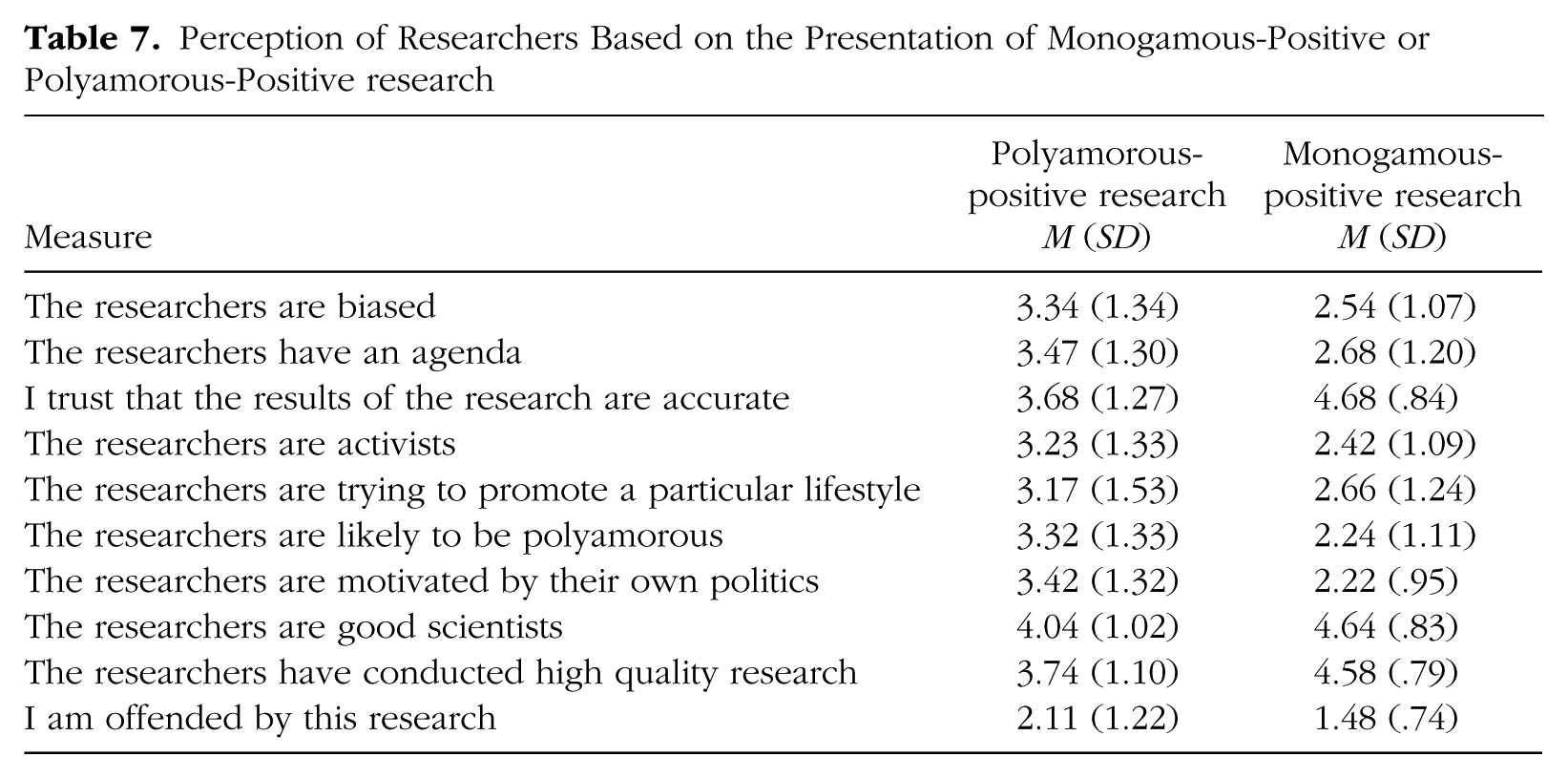
Results and discussion
We conducted a multivariate analysis of variance comparing the participants’ reactions to the polyamorous-positive and the monogamous-positive research summaries on the 10 dependent measures. The participants perceived researchers who wrote the polyamorous-positive statement to be significantly more biased than researchers who wrote the monogamous-positive statement, F(10, 92) = 4.41, p < .0005, with partial η 2 = .32. The means for the individual items are presented in Table 7. Recall that we found this effect even though the wording of the research passage was exactly the same as the wording of the passage suggesting that those in monogamous relationships fare better than those in polyamorous relationships.
These findings suggest that researchers who address monogamy and CNM may be faced with perceptions that they are biased regardless of how even-handedly they frame their findings. Of course, we ideally would replicate these findings among actual scientists; however, as mentioned previously, scientists are not immune to the biases displayed by the general public (see Banaji & Greenwald, 2013).
So, we have come full circle, in a sense, in the current examination of both monogamy and biases in favor of monogamy. In this story-within-a-story framework, we have presented data that address CNM relationships and their conceptual implications because data about marginalized groups and stigma surrounding these groups intermingle, we have also considered the social context into which such findings are received. We found support for the idea that monogamous relationship configurations are not necessarily better than CNM configurations. Moreover, reporting positive data about CNM groups puts researchers at risk of being perceived as biased and as being members of the socially undesirable group that their data portray positively.
Conclusion
In this article, we have provided evidence for promonogamy assumptions underlying research on close relationships. We concluded, along with many other observers, that monogamy is perceived in contemporary society as foundational for a healthy, satisfying relationship (Conley, Moors, et al., 2013; Easton & Hardy, 2009; Haag, 2012; Kipnis, 2004; Moors & Schechinger, 2014; Perel, 2006; Sheff, 2014; Smith, 1991). We also argued that these sorts of biases, while undoubtedly unintentional, have negative implications for the accurate investigation of CNM relationships. We reviewed research on dyadic processes in monogamous and CNM relationships. Finally, we presented suggestions for future research on monogamy and CNM by reviewing theories that could provide compelling future theoretical and conceptual directions for this research.
Departures from monogamy—specifically, CNM— present researchers with a unique opportunity to address a variety of theoretical questions of interest to psychologists and society in general. We suggest that stigma surrounding these relationships heretofore has inhibited or discouraged exploration of these fascinating questions. We conclude that enough evidence exists that CNM relationships are functional. It would be beneficial to devote future research to incorporating these relationships into theories of love and intimacy.
Footnotes
Appendix A
Declaration of Conflicting Interests
The authors declared no conflicts of interest with respect to the authorship or the publication of this article.