




Abstract
In our 2004 “Beyond Money” article, we argued that national accounts of psychological and subjective well-being should complement the economic indicators that frequently guide policy decisions. We claimed that economic indicators fail to reflect important aspects of quality of life that well-being indicators capture. Since the time of our article, progress has been made, and scores of nations have used some forms of well-being measures. The National Academy of Sciences of the United States and the Organization for Economic Cooperation and Development both issued reports on accounts of well-being. Researchers have pointed to policies that are supported by the findings, such as environmental and economic policies. The emergence of “big data” has opened major new pathways for measuring well-being in inexpensive, unobtrusive, and nonreactive fashion. Psychological researchers now need to create superordinate combinations of subjective and objective measures of well-being to study the impact of the policies they advocate. The accounts can serve as a lever for convincing policymakers to enact policies that increase human flourishing.
In 2004, we proposed that societies need to assess well-being, in addition to standard economic indicators, to help policymakers guide their policy decisions (Diener & Seligman, 2004). Our proposal was based on several observations. The first was that economic indicators and analyses have a very large impact on policy decisions. For example, economists calculate the costs in dollars per life saved, for example, of spending on road safety, health programs, and medical research. These calculations are routinely consulted by policymakers. Further, economic growth continues to serve as one of the key goals of virtually all governments in the world, and employment and other economic statistics are consulted by policymakers on a daily basis.
Our second observation was about the limitations of these indicators. They fail to reflect factors such as crime and illness that are core elements in quality of life. Indeed, more crime and worsening health, termed “regrettables,” also can increase the gross domestic product by demanding spending in these areas. Measures of the economy also have blind spots, such as the gray and black economies: Home production—gardening, cleaning, childcare, laundry and other productive activities performed by people themselves—are not counted in the economy, although they are counted when other people are hired to do them. Thus, the economic measures are far from perfect. In addition, they suffer from overlooking what economists call “externalities,” outcomes due to economic activities that go unmeasured. For example, a factory’s output in goods is counted, but not the increased traffic, pollution, and noise it might cause. Thus, economic activities can have negative outcomes that are not reflected in the indicators.
In a 1968 speech, Robert F. Kennedy summed up the limitations of economic indicators: Too much and for too long, we seemed to have surrendered personal excellence and community values in the mere accumulation of material things. Our Gross National Product. . . counts air pollution and cigarette advertising, and ambulances to clear our highways of carnage. . . . Yet the gross national product does not allow for the health of our children, the quality of marriages, the intelligence of our public debate or the integrity of our public officials. It measures neither our wit nor our courage, neither our wisdom nor our learning, neither our compassion nor our devotion to our country, it measures everything in short, except that which makes life worthwhile.
In response to the shortcomings in economic measures, other quality-of-life indicators have been created, such as education, health, and crime statistics. The issue with these is that it is difficult to determine how those factors should be weighted and combined. How, for example, should education be weighted compared with health? For these reasons, we proposed national accounts of well-being, possibly as the final common path of all these disparate measures, to give societies an overall metric of quality of life. In measuring people’s individual subjective well-being, we reasoned, a society could gain insights into how people perceive and react to the quality of life in their societies. After all, if people enjoy life, are satisfied with their own lives, and do not suffer from chronic negative feelings, the quality of their lives must be experienced as good. For democracies in particular, it makes sense to consult citizens on how things are going.
Our article seems to have been popular, and one reason might be because it provided a new way that psychology could become involved in policy. A second reason for its popularity might be that economic development is only one aspect of quality of life and that well-being can provide a more rounded indicator of quality of life by including social and environmental quality—and perhaps a final common path that combines all external indicators.
Reasons for National Indicators
A major reason for the well-being indicators is that subjective well-being—happiness and life satisfaction—are things that people highly value, and therefore it is a democratic imperative to track and create conditions for high well-being. Another reason for well-being indicators is that extensive research now reveals that life satisfaction is not just an epiphenomenon; it causes many beneficial downstream effects on health and behavior (Diener, Kanazawa, Suh, & Oishi, 2015; Lyubomirsky, King, & Diener, 2005). People higher in subjective well-being tend, on average, to be healthier, to live longer, to have better social lives, to earn higher incomes, and to be better citizens. Longitudinal and experimental studies suggest that although the associations might be bidirectional, there is a causal influence moving from subjective well-being to the desirable outcomes.
History of Accounts of Well-Being
In 2000, Diener proposed the idea of national accounts of well-being in an American Psychologist issue devoted to positive psychology (Diener, 2000; Diener, Oishi, & Lucas, 2015), and it was this idea that we fleshed out in our 2004 Psychological Science in the Public Interest article (Diener & Seligman, 2004). After that, Diener (2006) published guidelines for national accounts of well-being, with eminent signatories to the document from psychology, economics, and other areas. In 2008, Diener addressed the United Nations Development Program, and they thereafter included well-being indicators in the 2010 decennial report. In that same year David Cameron, the Prime Minister of the United Kingdom, announced that the United Kingdom would collect national measures of well-being to be consulted to quantify the success or failure of policy. Analyses of the validity and use of the well-being indicators, which were largely positive, were issued by the U.S. National Research Council (2013) and by the Organization for Economic Cooperation and Development (OECD; 2013). In all, more than 40 nations now assess the well-being of their citizens. In the United Kingdom, the accounts of well-being exposed the tremendous misery caused by mental illness and helped stimulate a huge new funding initiative to make mental health care more widely available (see Layard & Clark, 2015). Data from the accounts have also helped fine-tune the amount of funding in the United Kingdom for research on the various illnesses.
Policies Suggested by Analyses of the Accounts of Well-Being
Researchers have analyzed policy questions using societal measures of well-being, and we review a few of them here to give an idea of the breadth and importance of policy questions that well-being measures imply. Government policies regarding economic issues such as unemployment, inflation, and income security programs have been studied in some detail. For instance, researchers have shown the pernicious effects of unemployment on life satisfaction (e.g., Helliwell & Huang, 2011; Lucas, Clark, Georgellis, & Diener, 2004). Even when people get reemployed and their income returns nearly to previous levels, they seem to have been scarred by the experience (Clark, Georgellis, & Sanfrey, 2001).
In terms of income support, a number of scholars have found that income-security programs and some redistribution of income are associated with higher well-being (e.g., Davidson, Pacek, & Radcliff, 2013; Radcliff, 2013). Market income inequality is associated with lower subjective well-being of nations, but redistribution of income tends to cancel this effect as net equality is increased (Zyphur et al., 2016). Oishi, Schimmack, and Diener (2012) found that progressive taxation is associated with higher well-being in nations, controlling for both mean income and overall rates of taxation.
In the domain of a healthy environment, negative factors such as air pollution are related to lower well-being (Ferreira et al., 2013), and reducing that pollution increases life satisfaction (Luechinger, 2009). Green space has been associated with higher well-being in a number of studies using different research methods (e.g., MacKerron & Mourato, 2013; White, Alcock, Wheeler, & Depledge, 2013), and active commuting to work is also related to higher well-being (Martin, Goryakin, & Suhrcke, 2014). In contrast, long and difficult commuting to work tends to lead to lower well-being (see Diener, Lucas, Schimmack, & Helliwell, 2009), and this appears to be true of both personal and public transportation. These examples point to specific policies that should enhance citizens’ well-being.
The Future of Well-Being Indicators
We have two main suggestions about the future of this work. First, most of the existing studies focus on subjective well-being (e.g., self-reported life satisfaction and happiness). These were used primarily because they had been used in prior surveys, and so they provided an easy foot in the door. Seligman (2011) has suggested broadening these indices to encompass pleasure (subjective well-being), engagement, good relationships, meaning and purpose, and accomplishment (collected under the acronym “PERMA”). Subjective and objective indicators of PERMA can be combined to create more valid superordinate well-being indicators. In addition, surveys might include measures of satisfaction within specific areas of life relevant to policy questions, such as the environment, local schools, or public transportation.
Second, we have now entered a new and better era of measurement. The rise of Big Data complements and might even eventually displace questionnaires. It is cheaper, provides much bigger samples, and it is less intrusive and less reactive than questionnaires. It is particularly useful for measuring well-being: there are more than 50,000 PERMA and anti-PERMA words and phrases in English. Figure 1 gives an example of the word clouds that measure PERMA and anti-PERMA in English. Seligman’s group scans tens of millions of tweets and Facebook statuses to measure well-being in real time across the planet.
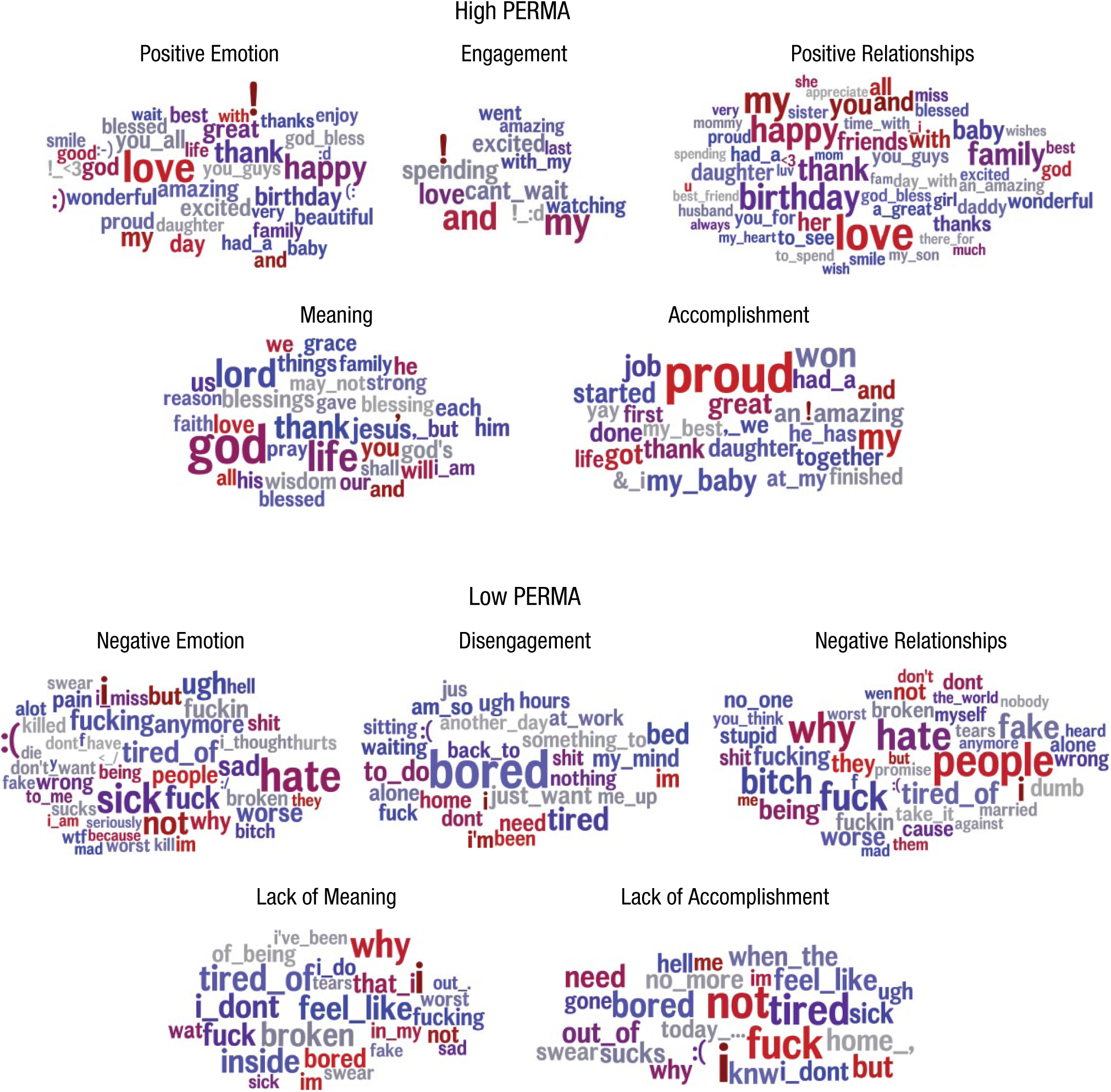
Words and phrases that most distinguish Facebook and Twitter posts rated as high in the PERMA dimensions. The larger the word, the larger its statistical association with the PERMA dimension; the color indexes frequency, from rarely used (gray) to moderately used (blue) to frequently used (red). The data are from 10,100 posts annotated by MTurk workers (for full methods, see Schwartz et al., 2016).
Strangely, very few psychologists work on national accounts of well-being. The area has been largely preempted by economists, sociologists, and others who use the well-being numbers to analyze policy alternatives. We encourage more psychologists to become involved in this area. Broadened measures of well-being can be used to test the impact of a host of psychological interventions, from antibullying in the schools to diversity programs in corporations. Psychologists research and advocate for many types of programs, but they rarely rely on well-being accounts to add weight to the idea that their proposals will improve life.
In conclusion, we believe our 2004 article had a noticeable effect. Pointing out that well-being can and should be measured and then used as a bottom line for public policy has led to scientific and governmental progress. The next strides, in our opinion, will come from broadening well-being beyond purely subjective measures and from merging big data and questionnaire techniques for more valid measurement.
Footnotes
Declaration of Conflicting Interests
The author(s) declared that there were no conflicts of interest with respect to the authorship or the publication of this article.