




Abstract

Put the data you have uncovered to beneficial use.—Chinese fortune cookie
At the dawn of the cognitive revolution, the study of language was viewed as a window onto the human mind. Chomsky (1980) had deftly shown that behaviorist models could not account for the generativity or recursivity of human language. Fueled by this new theory of language, and by the advent of new techniques for peering into a baby’s mind (though not yet their brains), scientists began to explore the rudimentary pieces of words and grammar that are used to construct the complex human communication system. It was a time when scholars such as Jean Mandler (1988) were writing, “How to build a baby” and when science was about to discover how toddlers learn to say full sentences well before they learn to tie their shoes.
Some of the early findings in baby language were stunning—offering us an entirely different perspective on how babies are prepared to learn from the world around them. Babies can even remember some of what they heard in the womb after being born (DeCasper & Spence, 1986). Babies can distinguish between their own and a foreign language at just 5 days old (Nazzi, Bertoncini, & Mehler, 1998), and some understand as many as 100 words at 12 months old (Fenson et al., 1994). Soon we learned that babies are little statisticians who take the language input they hear and find which syllables go together in the data, which makes it possible for them to find some words (Saffran, Aslin, & Newport, 1996).
As young scientists, we were “born” into this fertile intellectual climate and helped to develop methods that peered into what children understand before they can talk (Golinkoff, Hirsh-Pasek, Cauley, & Gordon, 1987; Golinkoff, Ma, Song, & Hirsh-Pasek, 2013). We also quickly soaked up the new learning in neighboring fields such as linguistics and probed how children think about rudimentary grammar. Could 17-month-olds with as few as two words in their productive vocabularies nonetheless know that the sentence “Big Bird’s tickling Cookie Monster” meant that Big Bird was doing the tickling rather than Cookie Monster tickling Big Bird (Hirsh-Pasek & Golinkoff, 1996)? They can, and this contributed to the argument that babies are using word order—the first grammatical device to appear in English—to understand sentences.
Although our knowledge about language development was spiraling, research from the study of early reading also affirmed that a strong language base was the key to becoming a good reader (Scarborough, 2009). How else can children understand what they are reading once they “crack the code?” Because reading is parasitic on language, it is essential that children learn more than code-related skills such as spelling-sound correspondences. They also need the vocabulary and world knowledge that books will contain (Dickinson, Golinkoff, & Hirsh-Pasek, 2010). Thus, sitting in the flow of language research put us toe to toe with both basic psychological science and educational science. Simply put, and as our more recent research illustrates, language is the single best predictor of later academic success (Pace, Alper, Burchinal, Golinkoff, & Hirsh-Pasek, 2018). It is imperative that we do whatever it takes to help communities infuse strong language skills in their young children.
Ah—but here’s the rub. The latter part of the 20th century was marked by a great divide between basic science and applied science. If you lived in psychology departments, you were to do the former and never touch the later. We, however, felt this driving need to pull the two together. It had to be possible to do strong basic science with an eye toward application. Indeed, in his now classic book, Daniel Stokes (1997) offered a way out through what he called “use-inspired basic research.”
To this day, our work has centered on ways to chart this new terrain within the study of early language development. We thought of our initiative as creating what we called “edible science”—that is, science that is accessible, digestible, and usable. When we tip-toed into the real world with a book for parents and practitioners called How Babies Talk (Golinkoff & Hirsh-Pasek, 1999), we felt like pioneers who were ready to share the findings—from multiple labs—that strong language skills breed strong reading skills. Only a few of our colleagues had written for lay audiences—notably Gopnik, Meltzoff, and Kuhl (1999) with their best seller, The Scientist in the Crib. With so few taking the plunge into the real world, we were concerned that we might be putting our scientific credibility on the line. In fact, one grant reviewer from the National Science Foundation remarked that we managed to do our scientific work despite having written a popular press book.
We felt a two-fold obligation to bring our science to the public. First, our research is funded by agencies of the federal government. Writing for the lay public is a form of payback because the public’s tax dollars supported our research. Second, we wanted to share our excitement about language development to help parents understand the nature of the experiences that fueled it. What do children really need to learn language? Was there any scientific consensus on the issue, and could we share what we knew more widely?
But little by little we realized that as long as we were careful to respect the integrity of the science and its nuances along the way, we could bring the science to parents and practitioners and attempt to improve actual practices in the real world by writing in a more popular voice (Golinkoff & Hirsh-Pasek, 2016; Hirsh-Pasek & Golinkoff, 2003; Hirsh-Pasek, Golinkoff, Singer, & Berk, 2009). We worked with those in the reading community and we even branched out to apply science to the policy world.
In this article, we outline two of our bolder attempts. The first, the Quick Interactive Language Screener (QUILS), morphs our lab-based comprehension method (the intermodal preferential looking paradigm; Golinkoff et al., 2013; Fig. 1) into a tool for early language assessment for 3- through 5-year-olds (Golinkoff, de Villiers, Hirsh-Pasek, Iglesias, & Wilson, 2016). The second example uses our basic findings on the importance of high-quality adult-child conversations and examines whether we can construct architectural environments that prompt the very interactions known to support strong language development.
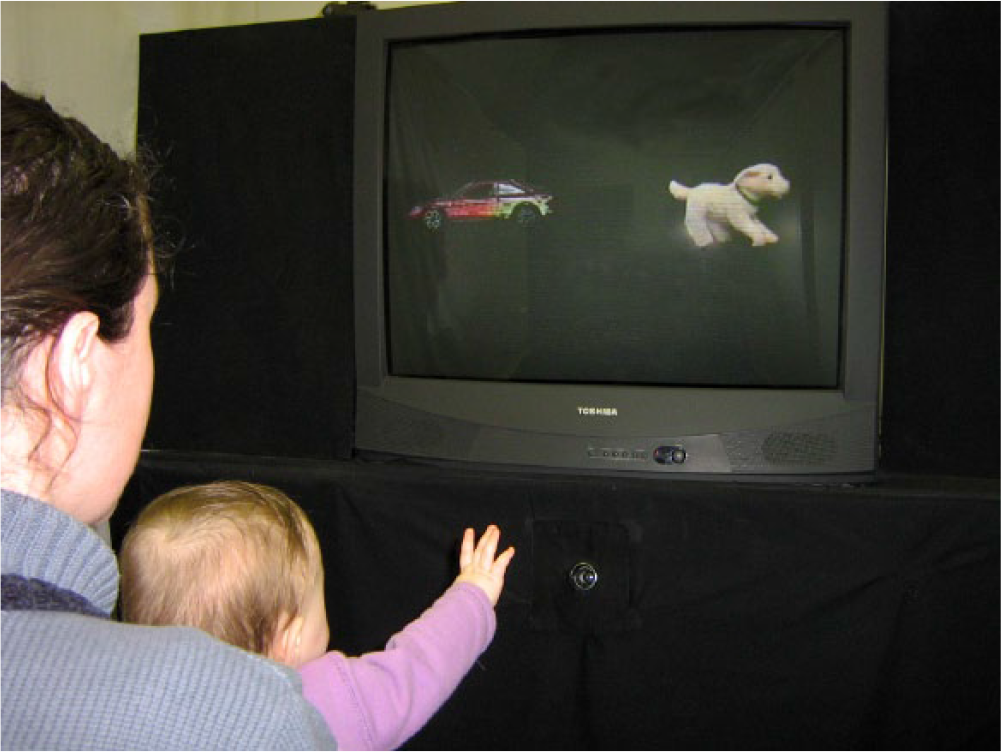
The intermodal preferential looking paradigm.
The Quick Interactive Language Screener
The QUILS (Golinkoff, de Villiers, Hirsh-Pasek, Iglesias, & Wilson, 2017) was designed to bring the latest and best science into the assessment world. If strong language skills are central to children’s trajectories, then catching language problems early could be a boon. We were constantly shocked when we would speak to groups of speech-language pathologists who told us that they had just discovered a 4- or 5-year-old who spoke little and seemed to understand less. Under these circumstances, there was little justification for keeping our findings in the ivory tower.
The intermodal preferential looking paradigm (Golinkoff et al., 2013), with its simultaneous presentation of two scenes accompanied by one matching audio track, gave us the platform on the QUILS for exploring grammar, vocabulary, and even how readily children learned new language items (we called this process). Surely, and given children’s love of technology, we could now use digital tablets to present items to young children so that we could chart what they know when and even how they learn new structures. Now, some 1,000 children later, we find that with a mere touch of a screen, we can track children’s early language development. Its Spanish-English counterpart (QUILS: ES; Iglesias, de Villiers, Golinkoff, Hirsh-Pasek, & Wilson, in press), designed to study bilingual children, is soon to be released. Here, our use-inspired basic research took us from the technique we birthed in the laboratory to an up-to-date, evidence-based, touch-screen evaluation that can be done by paraprofessionals and that generates targeted views of a child’s language development in 20 min or less. Furthermore, with larger sample sizes than are usually available in language research, we were able to discover how the development of basic word learning relates within—but not across—languages and how grammar—though not words—seems to be consistent across English and Spanish (Pace, Luo, et al., 2018).
Infusing Children’s Experiences With Language
Because language is foundational to learning, we also wanted to find new ways to share the science of early language learning with people who might not see the books or use our screener. How could we infuse children’s environments with the lessons from our science?
This second project again began as basic research and dovetailed with applied aims. We call it Playful Learning Landscapes (Grob, Schlesinger, Pace, Golinkoff, & Hirsh-Pasek, 2017; Hassinger-Das, Bustamante, Hirsh-Pasek, & Golinkoff, 2018; Ridge, Weisberg, Ilgaz, Hirsh-Pasek, & Golinkoff, 2015; Zosh, Fisher, Golinkoff, & Hirsh-Pasek, 2013). Our research in the lab was centering on how the quality along with the quantity of talk might play an important role in building words and grammar (Hirsh-Pasek et al., 2015). The findings of our studies suggested that having back and forth, contingent conversations was the gold mine for language learning. Although the world mobilized around the 30-million-word gap (i.e., the quantity of talk), we thought that these conversational duets contained the quality to foster children’s language learning. Our findings and a number of other studies supported these conclusions (Cartmill et al., 2013; Gilkerson et al., 2018; Perry et al., 2018; Romeo et al., 2018; Rowe, 2012). Remedies for the word gap were likely to be found in the serve-and-return of conversation rather than playing the television to increase language input or overheard speech from conversations between adults (Golinkoff, Hoff, Rowe, Tamis-LeMonda, & Hirsh-Pasek, 2018). Furthermore, the words you drop into those conversations can become the bedrock for learning about space and number (Ferrara, Hirsh-Pasek, Newcombe, Golinkoff, & Lam, 2011; Gunderson & Levine, 2011; Pruden, Levine, & Huttenlocher, 2011).
The big idea here was to leave traditional ways of sharing this information in brochures, texts, and books and to try an edible science that we called experiential dissemination. Our initiative would mesh science with placemaking and even with architectural design. And we would do the research to determine whether our ideas worked.
Our first foray started in 2010, when, in collaboration with the Children’s Museum of Manhattan, we put the science of learning on display in Central Park. The Ultimate Block Party featured 28 activities for children and families, all rooted in nuggets of science and developed with the assistance of a superb scientific advisory board and the seven National Science Foundation Science of Learning Centers around the country. One activity, bilingual bingo, sponsored by the LIFE center at the University of Seattle, allowed parents and children to do a real flanker task and to see the advantages of two languages. As one Latino mother proudly said leaving the exhibit, “Until today, I never knew that having two languages was a good thing.” Over 50,000 families participated in the Ultimate Block Party. Survey research conducted with families who attended the event (Grob et al., 2017) indicated that the more of these activities that parents attended, the more they came to appreciate the link between play and learning.
Inspired by the success of the Ultimate Block Party, we wondered whether we could reach into everyday spaces and literally transform them in ways that organically sparked learning moments. We continued to use the science as our base—but in real-world settings such as the grocery store. Could we amp up conversation between caregiver and child at a grocery store by placing signs with prompts such as “I am a cow. I have milk. What else comes from milk?” Simple and cheap, this intervention cost a total of $60.00. Yet we found that when the signs were up in a low-income grocery store, caregivers talked 33% more to their children than they did when the signs were down (Ridge et al., 2015).
If it worked in a grocery store, why not at a bus stop? Visit a bus stop in your neighborhood, and caregivers are passing the time on their cell phones while children are often wandering around aimlessly. How much conversation, if any, is going on between them? With architect Itai Palti, we created puzzles on the back of benches to prompt spatial language, a hopscotch game designed to improve executive function, and a stories activity that allowed children to move deftly from icon to icon as they invented their own narratives (see Fig. 2; Hassinger-Das et al., 2018). Initial results suggest that families use more targeted language that draws on science, technology, engineering, and mathematics (STEM) and stories as they wait for the bus. And the results suggest that they talk more to each other than do parents and children at a nearby playground.
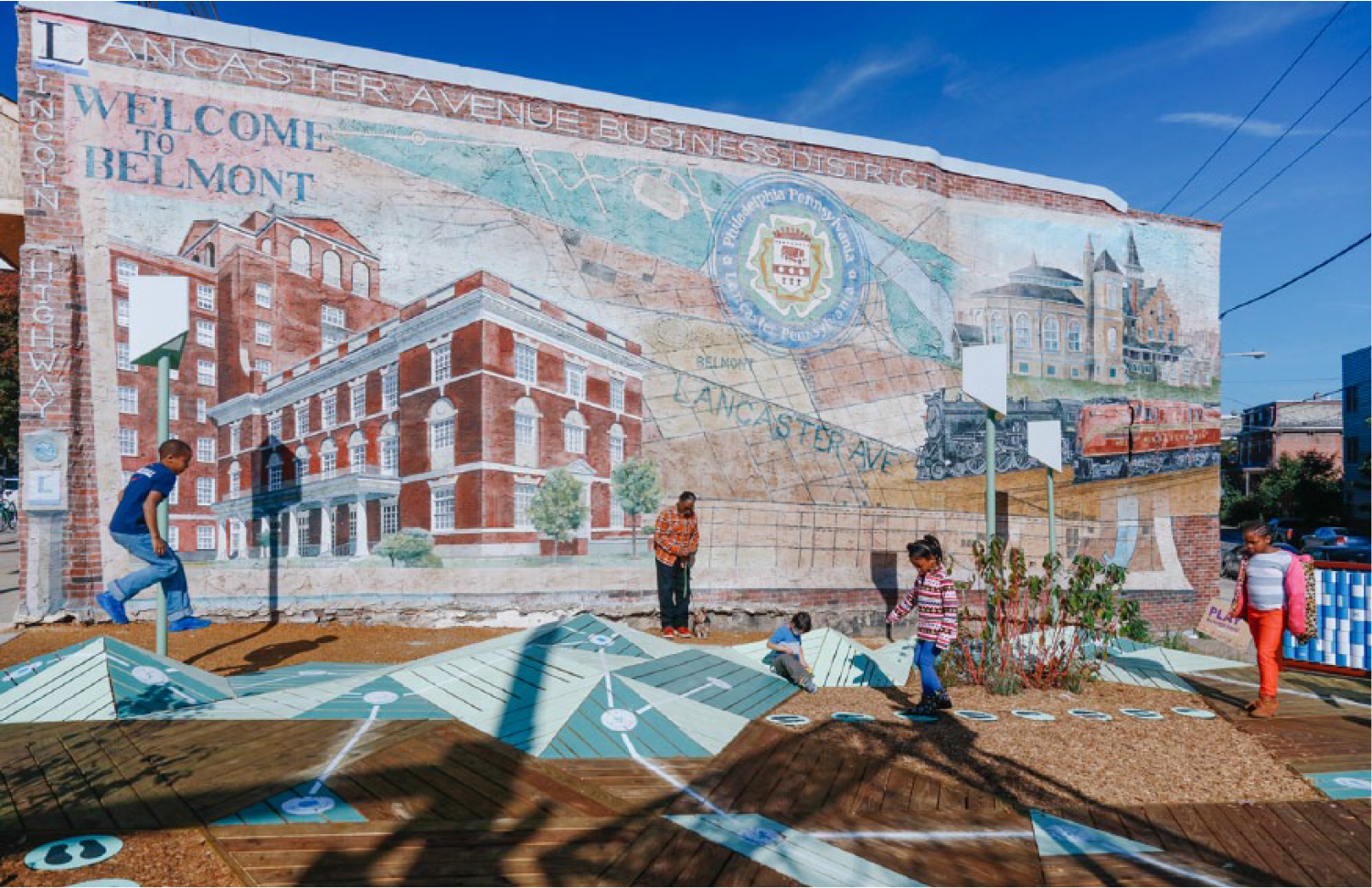
Urban Thinkscape.
The ultimate goal is to improve and expand children’s learning skills by encouraging conversations between children and families during the 80% of the time children spend outside of school (Meltzoff, Kuhl, Movellan, & Sejnowski, 2009). Our research indicates that, by modifying everyday public spaces and redesigning common objects (e.g., streetlights), families are moving, talking, and thinking about language, literacy, mathematics, and science (Bustamente, Hassinger-Das, Hirsh-Pasek, & Golinkoff, in press; Hassinger-Das et al., 2018).
Finally, there is Parkopolis, a 30 × 30-ft human board game that revolves around STEM learning. Children move around the board by, among other things, spinning dice imprinted with fractions, selecting science- and math-based cards that ask them to carry out various tasks, and measuring how far they can jump on a large ruler. All of the tasks are vetted through scientists who work in early science and mathematical learning. Preliminary results indicate that even compared with a rocket-building exhibit, Parkopolis encourages the kind of language that builds STEM skills (Bustamante et al., 2018). Again, our path was from the basic science to its application and then to testing the use-inspired basic research to determine whether it worked.
Conclusions
This is but a small taste of the many projects that are ongoing in our labs and are designed to help fertilize early language growth. We have already grown tremendously by doing this kind of research and by doing it in ways that are informed as much by the communities we work with as by our eminent colleagues. What have we learned? As a starter, we think that scientists are well prepared to enter the marketplace of ideas and to contribute to real-world solutions that help children thrive. We are well placed to do use-inspired basic research. Although much of our job is about finding the gaps in the literature, it is sometimes refreshing to take stock of where we have come and how our work can be transformative.
We have also learned that basic science and applied science are not antithetical to one another. If we keep our eye on theory and on the science, we can answer deep questions in a context that makes a difference for real people. We can also make our message a positive one by bringing out what the research tells us is good for children and families and truly promotes development. We know quite a bit about what facilitates child development—and certainly more than the marketplace that seeks to capitalize on parents’ fears and concerns. The research is on our side and our desire to bring scientific findings into the world can be our strong suit. Perhaps we can all be inspired by that saying on the fortune cookie: “Put the data you have uncovered to beneficial use.”
Footnotes
Acknowledgements
We thank Hannah Puttre, Hannah Tokish, and Haley Weaver for their help in preparing the bibliography. We have worked with so many superb postdoctoral fellows, graduate students, and undergraduates that we cannot thank them all, but they accompanied us and provided their wonderful talents on this journey into the real world.
Action Editor
Marjorie Rhodes served as action editor and June Gruber served as interim editor-in-chief for this article.
Declaration of Conflicting Interests
The author(s) declared that there were no conflicts of interest with respect to the authorship or the publication of this article.
Funding
This work was supported by grants from the Institute for Education Sciences and the National Science Foundation. Learning Landscapes is supported by the William Penn Foundation and the New America Foundation.