



Abstract
In this article I generalize the notion of multiple self-aspects to create a descriptive framework in which lives are partitioned into containers of activities called strands. Strands are nearly decomposable life modules, structured, stable, and concurrent longitudinal streams of extended duration whose momentary cross-sections constitute self-aspects. They are differentiated by five features: the person’s role, the cast, the setting, norms and values, and habits and routines. Strands contain projects and episodes and are replete with narrative. Each strand is continuous (i.e., strands persist when a person moves between them), and for the most part strands are mutually asynchronous. From a first-person perspective, the strands are continuous and concurrent, but only one strand is in the foreground at a given time (i.e., transitions between strands are akin to a figure-ground reversal). Furthermore, a life is different from the sum of its strands: It is a nonlinear system that can take on configurations not predictable from a comprehensive description of the individual strands. Two such examples are the achievement of greatness despite severe handicaps and instances of extreme self-sacrifice. I also discuss the research potential of a proposed smartphone app called LifeMaps.
This article, which complements Kubovy (2015), offers a descriptive framework for psychology. It rests on three propositions:
Modularity: From a first-person point of view, lives are approximately modular. These modules, called strands, are containers of activities. This modularity holds whether we consider a life longitudinally or at a given moment. From a longitudinal point of view, strands form a set of structured and stable streams of related activities and episodes. At a given moment strands constitute stable and enduring aspects of the self.
Asynchronous concurrency: Research in perception shows that under some circumstances we perceive events alternating in time as if they were asynchronous concurrent streams. To a first approximation, this is the case with strands: When a person inhabits one strand, the person’s other strands are not interrupted. Likewise, also to a first approximation, strands are asynchronous. The order of events that took place in the same strand is much more likely to be registered than the order of events that occurred in different strands.
Nonlinearity: A life is different from the sum of its strands. The relation between the current and the other strands in a person’s life resembles the perceptual relation between figure and ground. The gestalt of a life (including the person’s subjective well-being) may be a nonlinear function of (a) the manner in which a person allocates time to different strands and (b) the distribution across strands of a person’s satisfaction or dissatisfaction.
Before I proceed, a word about the importance of description: “Rutherford used to divide science into physics and stamp collecting,” wrote Bernal (1939, p. 9; see also O’Toole, 2015). But careful and systematic description is not stamp collecting. Without it there is no science. As Grimaldi and Engel (2007) point out, biological classification is still based on Carl Linnaeus’s Species Plantarum of 1753 (Ohl, 2018), the geological timescale is derived from the maps of William Smith (2015), begun in 1799; and the periodic table, created by Dmitri Mendeleev in 1869, is alive and well (Scerri & Restrepo, 2018). In the study of the behavior of animals, including humans, Darwin’s (1859/1987) descriptive work On the Origin of Species remains a foundation of psychology, as does the ethological work of Lorenz (1937) and Tinbergen (1939), who were influenced by von Uexküll (1909). As for psychology, several important figures did descriptive work in several disciplines: Wertheimer (1912) on apparent motion, Piaget (1924) on cognitive development, Bartlett (1932) on memory, and Gibson (1950, 1966, 1979) on perception.
Despite these achievements, psychologists have rejected description as theory-free fact collecting (dismissively called “dust-bowl empiricism” by Meehl, 1956) and declared that without theory psychology could not be a science (Spence, 1944). And so psychology finds itself with a surfeit of theories (Greenwald, Leippe, Pratkanis, & Baumgardner, 1986) and a dearth of descriptions. 1
This article is divided into two parts. First, I lay out the description of lives as partitioned into strands. Second, I show how this description is consistent with well-known perceptual and cognitive phenomena.
The Benefits of Modularized Lives
Simon (1994, 1999) proposed that some systems (natural or artificial) are made up of modules. In the context of lives, I call these modules strands.
In some cases, modules operate independently of each other, which makes the system completely decomposable. In other cases, although the modules are not completely independent, the interactions between them are weak, in which case the system is nearly decomposable.
Simon (1962, pp. 474–475, Fig. 1) gives the example of a building as a nearly decomposable system. It consists of cubicles, whose walls readily conduct heat, and rooms, whose walls are good insulators. To illustrate how a nearly decomposable system evolves, suppose that at t0 there are large temperature differences between cubicles. At a later time, t1, the variation in temperature among cubicles will be small, but among rooms they will still be large. Eventually, at time t2, all temperature differences within the building will have vanished.
If strands are nearly decomposable, then even when a life event disturbs one strand (e.g., an illness, analogous to temporarily putting a space heater in one of the cubicles), the effect on other strands is small and dissipates quickly. In the short run, changes in one strand have little effect on other strands. When something bad happens in one strand, other strands are insulated from this harm. It is also easier to improve one’s situation in one strand without having to consider all the others. At the same time, if a life is nearly decomposable, then in the long run events in one strand may affect all the others, as would befit a single system.
However, this description of lives as nearly decomposable is but a first approximation because Simon’s systems are linear (they are modeled by a system of linear differential equations). In linear systems, the whole is equal to the sum of its parts. In the second part of this article, I show that this is not the case with lives and that a collection of strands should be thought of as a nonlinear system.
My descriptive framework starts with the notion of the self (Calkins, 1900, 1915; Curtis, 1915; Gamble, 1915; W. James, 1890/1981). Over the years, for a variety of reasons, a growing group of scholars abandoned the idea of a unitary self in favor of the idea of multiple selves, multiple self-aspects, or the self as an organized system of roles (Donahue, Robins, Roberts, & John, 1993; Lester, 2017; Marks & MacDermid, 1996; McConnell, Shoda, & Skulborstad, 2012; Showers & Zeigler-Hill, 2007). A similar view evolved in organization studies (particularly the work of Ashforth, 2001) and in research on organizational identity (Pratt, Schultz, Ashforth, & Ravasi, 2016). My description takes the notion of multiple selves and generalizes it into the longitudinal structures I call strands.
Strands may be characterized in two ways: by features that differentiate each from the others and by features they all share. Although one might want to know first what features they share, these features are rather abstract and not easy to understand without concrete examples. On the other hand, the differences between them are concrete and easy to present. So I begin with the differences.
Features that differentiate strands
Strands differ from each other in five ways: the person’s role, the cast, the setting, norms and values, and habits and routines.
Role
Imagine the case of Sarah, an attorney and a single mother. She might think of two of her strands as Attorney and Mother. In each of these she has a position (or status) role, one associated with her position in an organization (such as her law office) and the other associated with formally organized groups, such as her family. 2
Cast
When Sarah is in her Attorney strand, she interacts with a cast of people who inhabit it or enter into it. Some of them have long-term roles in relation to her (colleagues, partners, or staff), or others have transitory ones (clients, other officers of the court, or government bureaucrats).
Setting
Sarah’s Attorney strand has a primary setting, her office, and secondary settings, such as court or other places where her professional activity may take her, or even home, where she may need to do some of her work. A strand that can be enacted in more than one location is said to be flexible (Hall & Richter, 1988). Her Mother strand also has a primary setting, home, and many secondary settings, such as the supermarket, daycare center, a friend’s home, or the home of Sarah’s parents. Clearly Sarah’s Mother strand is more flexible than her Attorney strand. When she’s in a public secondary setting she does not exit the Mother strand, although she may need to adjust her behavior to suit the setting (such as breastfeeding or changing diapers; Giles, 2018).
Values and norms
People’s understanding of the context or situation in which they find themselves modulates their thoughts, feelings, and actions (Mischel, 2004; Mischel & Shoda, 1995, 2010). And because a strand is a particular kind of situation—one that is familiar and predictable—it constrains behavior by triggering values and norms (Cialdini, Reno, & Kallgren, 1990; Judge, Simon, Hurst, & Kelley, 2014; Kallgren, Reno, & Cialdini, 2000; Leung & Morris, 2015).
Values
To illustrate how values may vary from strand to strand, I draw on Schwartz’s view of the organization of values (Borg, Bardi, & Schwartz, 2015; Cieciuch, Davidov, Vecchione, & Schwartz, 2014; Schwartz et al., 2012). When Sarah is in her Attorney strand, she needs to be self-directed, focused on achievement and power. But when she is in her Mother strand, she is benevolent and tolerant, values that do not leap to mind when we think of attorneys. Of course, some values may be strong in both strands, such as a desire for security, both personal and social. 3
Norms
Just as values vary from strand to strand, so do social norms that govern (or restrain) our behavior (Bargh & Williams, 2006, p. 1). Take clothing, for example: As Attorney, Sarah is likely to adhere to a dress code that requires formal clothing (Farmer, 2010; Gurung, Brickner, Leet, & Punke, 2017; Slepian, Ferber, Gold, & Rutchick, 2015). 4 But as Mother, Sarah will find few constraints on how she should dress at home (e.g., Wallace, 2015), and she may not care much. Language too is strand-dependent: As Attorney she needs legal English (Tiersma, 2000), but as Mother she may use “motherese” (Blount & Kempton, 1976).
Habits and routines
As Ersche, Lim, Ward, Robbins, and Stochl (2017) remark, Our daily lives involve high levels of repetition of activities within similar contexts. We buy the same foods from the same grocery store, cook with the same spices, and typically sit at the same place at the dinner table. However, when questioned about these routine activities, most of us barely remember the details of our actions. Habits are automatically triggered behaviours in which we engage without conscious awareness or deliberate control. (p. 73)
In other words, habits are strand-specific activities with two central features: routineness, implying frequent repetition, and automaticity, implying minimal demand for cognitive resources (Ersche et al., 2017, Section 3.1). 5 Although habits generally resist change (Nordfjærn, Şimşekoğlu, & Rundmo, 2014), under some circumstances they may change to minimize effort (Zhu & Risko, 2016), and under other circumstances they may even become virtuoso performances (Bourdieu, 1977, pp. 8, 79; 1990, pp. 57, 107), such as the efficiency of a master chef, the effortless grace of an athlete, or a brilliant performance by a musician. 6
Each strand draws on strand-specific habits, skills, scripts, and plans (Schank & Abelson, 1977). For example, in her Attorney strand Sarah may write appellate briefs, mostly assemblages of boilerplate, and in her Mother strand she may follow well-honed routines to provide her child’s daily needs (such as feeding and dressing), as well as the household’s needs (such as planning the week’s menu and shopping).
Enumerate strands?
Some strands, such as Son or Daughter, are universal. Others are widespread, such as Spouse or Parent. This raises the question of whether we can, or should, enumerate strands. I do not think that this would be advisable, because doing so a priori would not be in keeping with adopting a first-person point of view. Nevertheless, it may be possible to categorize strands in a manner inspired by Andrews and Withey (1976), who in their work on social indicators of well-being defined life domains as “places, things, activities, people, and roles.” Drawing on previous work (Andrews & Withey, 1976; K. James & Asmus, 2001; Roberts & Clement, 2006), such categories could include family, work, shelter, health, community, leisure, and politics.
Features strands share
Please see Figure 1 for an encapsulation of the following description.

Strands, themes, and projects.
Projects and episodes
Strands contain events and activities. If Sarah remembers that an event took place, even if she cannot recall when, she will remember that it began and ended at determinate times. These are temporally determinate events or activities. Most temporally determinate events occur within a strand.
Other events—which Kubovy (2015) called preoccupations—are not determinate in time because they infiltrate current events or activities. They may involve the past (such as guilt, regret, or pride), the future (such as hope, fear, or worry), or the present (such as pain, hunger, or the need to void). When they are negative and persistent (and involve the past or the future), they are instances of rumination (Lyubomirsky, Layous, Chancellor, & Nelson, 2015). If they are positive or neutral, they constitute mind wandering (Smallwood & Schooler, 2015).
Temporally determinate activities fall into three categories: projects, episodes, and routine activities (as discussed earlier). Projects and episodes consist of a sequence of events (Fig. 2). Each has an initial event and a terminal event.
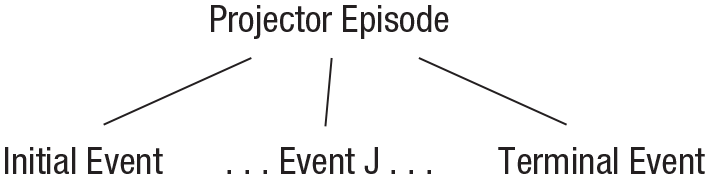
Projects and episodes consist of a sequence of events.
Projects
Projects are sequences of activities designed to achieve a goal. For example, in her Mother strand Sarah will promote good hygiene practices (Matson, 2017), model emotional responses to good and bad behavior (Quinn, 2003; Quinn & Mathews, 2016, pp. 372–378), and shape her child’s use of language (Duranti, Ochs, & Schieffelin, 2012) and political values (Quintelier, 2013).
People have at least four reasons to initiate a project. These reasons are outlined and described as follows:
Strand obligatory: For example, the project of toilet training is built into the Mother strand. How Sarah goes about this project is up to her, but it is likely to be influenced by her upbringing (Spinelli et al., 2015) and her educational attainment (Sieben, 2017).
Self-initiated: For example, Sarah buys a piano and hires a piano teacher for her child.
Assigned: For example, in her Attorney strand, Sarah may be assigned the task of working on a merger of two companies.
Obstacle clearing: Obstacles are inevitable because projects often run into trouble. For example, in the midst of merger negotiations, Sarah may run up against a disagreement between parties about intellectual property, and she will need ingenuity and diplomacy to resolve it.
Little and colleagues (Argyle & Little, 1972; Little, 1983, 1993, 1996, 1999a, 1999b, 2000, 2013, 2014; Little, Leccl, & Watkinson, 1992) have suggested that there is another important, perhaps essential, category of project: personal or intrapersonal projects such as “be more outgoing with my clients,” “try not to get angry at the kids for being away all the time,” and “be more open to others.” The examples they offer suggest that such projects do not encompass all the domains of a person’s life. Instead, they unfold within strands: Being more outgoing with clients would be pursued in a Work strand, not getting angry with the kids would be pursued in a Parent strand, and being open would be pursued in a Socializing strand.
Episodes
In addition to habits, routines, and projects, lives contain episodes. As Bruner (1991) puts it, episodes are generally the result of “an implicit canonical script [having] been breached, violated, or deviated from” (p. 11). Some episodes may be confined to a strand, such as the events leading up to the firing of a partner in Sarah’s law firm, but many are not. Some episodes Sarah experiences firsthand (having her car rear-ended while driving to an appointment), others she experiences secondhand (hearing of the confirmation of a Supreme Court justice), and yet others she experiences virtually (through a work of literature, film, or visual art; Kubovy, 1999).
Episodes have two central features: (a) They often engender narratives, and (b) when these narratives are shared or remembered, they are continuous.
Narratives
According to Labov and Waletzky (1997), narrative is a “verbal technique for recapitulating experience—in particular, a technique of constructing narrative units that match the temporal sequence of that experience” (p. 4). The temporal sequence of events that can be inferred from a narrative has been called (according to Shklovsky, 1965, and other Russian formalists) the fabula of the narrative. Undoubtedly, a story may become more interesting if the narrator uses devices such as flashbacks, in which case the telling deviates from the chronological order of events (the Russian formalists called this the narrative’s sujet). Although flashbacks have been used in literature since at least the Odyssey, they are rare in personal narratives (Labov, 1997).
The circumstances for the generation of a narrative are social. A typical prompt is as follows: “Okay, so tell me how you have reached this situation, that you are a single mother of a 10-year-old boy. You may start wherever you wish” (see Labov, 2006; see also, e.g., Zilber, Tuval-Mashiach, and Lieblich, 2008).
Another common impetus for the generation of a narrative is the conclusion of a project. When a goal is achieved (and sometimes when it is not) it is eminently reportable or tellable (Fludernik, 1996; Norrick, 2005) or noteworthy (Kubovy, 2015). Likewise, an episode gives us a reason to generate a narrative because, as discussed earlier, the essence of an episode is to contain a tellable event.
Continuity
Earlier I argued that strands contain two kinds of narratable sequences of events: projects and episodes. This narratability endows strands with continuity.
Let us revisit the project undertaken by Sarah in her Attorney strand: the merger of two companies. Suppose that, in the course of negotiations, there is a disagreement about intellectual property, which takes a few days to clear. During this time, Sarah lives her life as usual, alternating between strands: Mother → Attorney every morning, and Attorney → Mother every evening (these are microtransitions; see Fig 1; Ashforth, Kreiner, & Fugate, 2000). Indeed, she lives what Simmel (2002) called a metropolitan life, which requires that “all of its activities and reciprocal relationships [be] organized and coordinated in the most punctual way into a . . . framework of time” (p. 13). In other words, it is governed by clock-and-calendar time (Postill, 2002). But there is reason to believe that strands are not governed by clock-and-calendar time. Organizing our activities by strand is incompatible with it. Indeed, memory is not organized by temporal continuity but by narrative coherence (Friedman, 2004; Hintzman, 2016). To quote D. C. Rubin and Greenberg (2003), Narrative establishes a major form of organization in autobiographical memory, providing temporal and goal structure. Autobiographical memories are usually recorded as narrative; they are told to another person and to oneself. Inclusions and exclusions depend in part on the narrative structures used. If information is not central to the narrative structure, it is less likely to be remembered. (p. 61)
Wagenaar (1986) provides a vivid example. Over a period of 5 years he kept a diary of personal events. For the days on which the diary contained at least two events, he tested whether the presentation of one of them would elicit a recollection of the other. It did not: Out of 314 pairs, he succeeded only 22 times. And when he did succeed, it was because the two events occurred in the same location; that is, they probably took place in the same strand.
This does not mean that we are necessarily good at remembering sequences of events that occurred within the same strand. Unless two events within a strand are spontaneously inserted into the same narrative, their order might be difficult to remember.
Returning to Sarah’s negotiations: After she concludes them, she needs to report the successful outcome to her client. In generating her narrative, she has no reason to remember (let alone report) that between drafting two sections of the agreement, a microtransition took place, because she went home. Neither her recollection of the project nor the narrative she may construct is likely to mention such interruptions. This is true in general: When one recalls a project, clock-and-calendar time interruptions are suppressed. 7 This is tantamount to saying that we tend to represent projects to ourselves, and to others, as continuous. Or perhaps it might be more prudent to say that when we recollect projects, we elide discontinuities unless doing so would reduce the informativeness of the account. 8
There are, however, inevitable discontinuities in lives. Some scholars (Bohn & Habermas, 2015; Brown, 2016; Brown & Lee, 2010; Brown, Schweickart, & Svob, 2016; Enz & Talarico, 2015; Pillemer, 2009; Shi, 2017; Uzer & Brown, 2015) have drawn a distinction between turning points in lives, which are changes in life direction, such as St. Augustine’s conversion at Ostia (Saint Augustine of Hippo, 1997, pp. IX, x, 23–25), and transitions, which are external changes in daily circumstances, such as Primo Levi’s transport to Auschwitz in 1944 ( Levi, 1948/2015). Regardless of whether they are internally driven or externally caused, these have been called macrotransitions (Fig. 1; Ashforth et al., 2000).
Within a culture, some macrotransitions are shared by many (such as leaving home or taking a first job) and occur in a fairly predictable order and at a fairly predictable age. Shi (2017) has called these script-consistent transitions. 9 It is important to keep in mind, however, that the scripts themselves have been changing over time (Burgin, Schumacher, & Ritschard, 2017), such that many transitions that are script-consistent today would not have been so a century ago. Other transitions are script-divergent (such as a breakup or the death of a close friend) and are most often painful and involve loss; their timing is unpredictable.
Because projects and episodes lie at the core of strands, their continuity is true of strands as well. When one recalls the evolution of a strand, interruptions are not represented. Exceptions may occur, however, when a strand undergoes a macrotransition, as would occur were Sarah to take an extended maternity leave (I return to this issue later).
Even if a life undergoes a severe macrotransition that destroys a strand (such as a divorce or losing a job), a larger-scale continuity is possible. When such a transition occurs, there is often the possibility (and the desire) to begin a new strand of the same general kind, that is, belonging to the same theme (such as Relationship, Mother, Work; see Fig. 1). Themes manifest themselves in autobiographical memory (Barsalou, 1988; Belli, 1998; Conway, 1992, 1996; Conway & Pleydell-Pearce, 2000). Burt, Kemp, and Conway (2003) had students record their experiences over their summer vacation. Subsequently, for each day in a student’s diary, the experimenters transcribed at most one entry onto a card. Then the diarists were given their entries in a random order and asked “to arrange them so as to describe themes in your life.” By and large, these clusters shared content rather than temporal sequence (see also Burt, Kemp, & Conway, 2008; Kemp, Burt, & Malinen, 2009). (In laboratory studies, Tzeng & Cotton, 1980, have shown that the order of events is remembered far better when items are semantically related, suggesting that people would also remember the order of autobiographical events if they belonged to the same strand. 10 )
Relations among strands
Boundaries
Strands partition our lives into categories that provide us cognitive economy (Daniel, Schuck, & Niv, 2015; Huys et al., 2015; Rosch, 1978) and social clarity (Ashforth et al., 2000; Kallens, Dale, & Smaldino, 2018; Nippert-Eng, 1996; Zerubavel, 1991, 1996, 2016). This partition implies boundaries (Allen, Cho, & Meier, 2014; Barrett, 2014; Daniel & Sonnentag, 2016; Fleming & Waguespack, 2007; Nippert-Eng, 1996; Pachucki, Pendergrass, & Lamont, 2007), which have been a core concern of the work–family literature. In this field, scholars have made two distinctions 11 (Ashforth et al., 2000): (a) thick or impermeable strand boundaries (i.e., compartmentalizing Attorney and Mother) versus thin or permeable strand boundaries (i.e., blending Attorney and Mother), and (b) two types of strand transitions, microstrand transitions, which are frequent (e.g., the commute from Mother to Attorney to Mother again), and macrostrand transitions, which are infrequent and often involve permanent change (such as a promotion or a divorce).
Even when the boundary between strands is thick, intrusions between them are inevitable. For example, Sarah may need to take a day off from work if her child is ill.
The possible existence of impermeable boundaries raises the issue of extreme compartmentalization, which—according to Showers (1992) and colleagues (Showers, Ditzfeld, & Zeigler-Hill, 2015)—may be maladaptive for some individuals.
Asynchrony
Boundaries do not only separate strands from each other; they create asynchronous clock domains, a concept I borrow from the field of semiconductor design. In electronic devices, different modules may have clocks with different frequencies. This is surely the case with strands. Whereas Sarah’s Mother strand is dense and involves many events each day, as long as her mother does not require frequent assistance, and is still independent, her Daughter strand may consist of one phone call a week. Even though the strands do not share a clock, one can say that many events in her Mother strand occur between events in her Daughter strand.
Although in electrical engineering the problem of cross-clock-domain data transfer is crucial, this is not the case with strands. There is rarely a good reason for events in one strand to be registered in another. Take the case of an intrusion of one strand into another, a fairly common occurrence. Imagine a time when Sarah’s Daughter strand intrudes into her Attorney strand: While Sarah is at work, her mother calls to ask that she renew a prescription. Sarah makes a mental note of the request (generating a prospective memory; Rummel & McDaniel, 2019), and when she has a free moment, she takes care of it. But there is no reason for her to also make a mental note of what she was doing when she received the call. The event belongs to her Daughter strand and has no place in her Attorney strand.
There are exceptions to the asynchrony of strands. There are times when macrotransitions occur at the same time in many strands (such transitions were discussed earlier, where examples of leaving the parental home or getting a first job were given). According to transition theory (Brown, Hansen, Lee, Vanderveen, & Conrad, 2012; Svob & Brown, 2012), subsequent events may be timed in relation to these transitions (Uzer & Brown, 2015), much as historians divide the calendar into BCE (before the common era) and CE (common era). Furthermore, if a sudden transition threatens the entirety of one’s strand structure, a person might register a flashbulb memory (Hirst & Phelps, 2016; Hirst et al., 2015; Kraha, Talarico, & Boals, 2014).
Intensity, importance, and satisfaction
Not all strands are equally intense, nor need we assume that their intensity is constant over time. For example, Sarah’s Mother strand waxes and wanes over time and eventually (under usual circumstances) diminishes. Just as one can assess the effort required by a job (Cooman, Gieter, Pepermans, Jegers, & Acker, 2009), one could assess the intensity of a strand. Sarah’s Daughter strand would likely become more intense as her mother grows dependent on her. The degree to which it feels intense to Sarah depends on the previous quality of the relationship, the investment of time it entails, the frequency with which it intrudes on other strands, the conscientiousness it demands, and the persistence it requires.
Even if two strands are of equal intensity, they may be of different importance. Consider the case of Stephen Hawking, the prominent cosmologist who suffered from amyotrophic lateral sclerosis, which is frequently accompanied by pain (Moisset et al., 2015) and depression (Kübler, Winter, Ludolph, Hautzinger, & Birbaumer, 2005) and requires 5 to 15 hours of care per day (Chiò et al., 2006). And yet, in his autobiography, Hawking (2013) mentions his illness only six times; he talks mostly about the evolution of his theories and to a lesser extent about his personal life.
Single Stream Versus Multiple Streams
As illustrated in Figure 1, themes and strands contain parallel tubes. One might question this representation because it does not show that one can inhabit only one strand at a time. The very question arises from a deeply ingrained view of lives, which I will call the single-stream view. After I portray this view, I present an alternative: the multiple-stream view.
The single-stream view
The idea of life as a single stream has been the default in many fields of thought. For example, Descartes emphasized singleness: “When I consider the mind—i.e. consider myself purely as a thinking thing—I can’t detect any parts within myself; I understand myself to be something single and complete” (Descartes, 1641/2017, p. 32).
Nearly two and a half centuries later, William James (1884) added continuity to singleness: We can . . . represent . . . the subjective stream by a continuous line, and if . . . we wish to isolate any portion of it for examination, we can symbolise that isolation by making cross-strokes. But . . . the cross-strokes do not pre-exist. They are “artefacta”; and the natural function of every segment of the line is to lead continuously into the next segment and carry consciousness along unbroken. (p. 9)
This idea has been so widely embraced that it has become axiomatic. I will call it the “William James axiom”.
When psychology came of age, it did not question the William James axiom. Late in the 20th century it was represented by what Barker (1963, 1965) called stream of behavior. His colleague, Dickman (1963), wondered how we parse the continuous stream of consciousness into perceived temporal units. A decade later, Newtson (1976) and his colleagues (e.g., Newtson, Hairfield, Bloomingdale, & Cutino, 1987) addressed the question systematically. After Newtson’s program went dormant, it was revived by Zacks and Tversky (2001), and it became a burgeoning field of study (summarized by Radvansky & Zacks, 2017).
The William James axiom was also adopted by theorists of consciousness such as Baars (2011), who writes: “There is no such thing as true psychological simultaneity of two distinct events” (p. 68). It is also appealing because it comports with our linguistic intuitions. We have no trouble understanding Dante when he opens the Inferno (1472/1996) with “Midway on our life’s journey, I found myself / In dark woods, the right road lost” (Canto I, 1–2) because—as Lakoff and Turner (1989) point out—it draws on the universal conceptual metaphor that life is a journey; that is, it is a single stream.
The multiple-stream view
Despite this wide agreement, there are good reasons to explore an alternative view. Consider Sarah’s Attorney and Mother strands. There is nothing inherently wrong in describing a day in her life as a series of interleaved Attorney and Mother experiences, as depicted in Figure 3a. But if we took this description at face value, it would imply that while she is in her Attorney strand, her Mother strand is interrupted, which is surely not how she experiences her life. Although she may not pay attention to her Mother strand while at work, she surely does not momentarily experience herself as being childless.
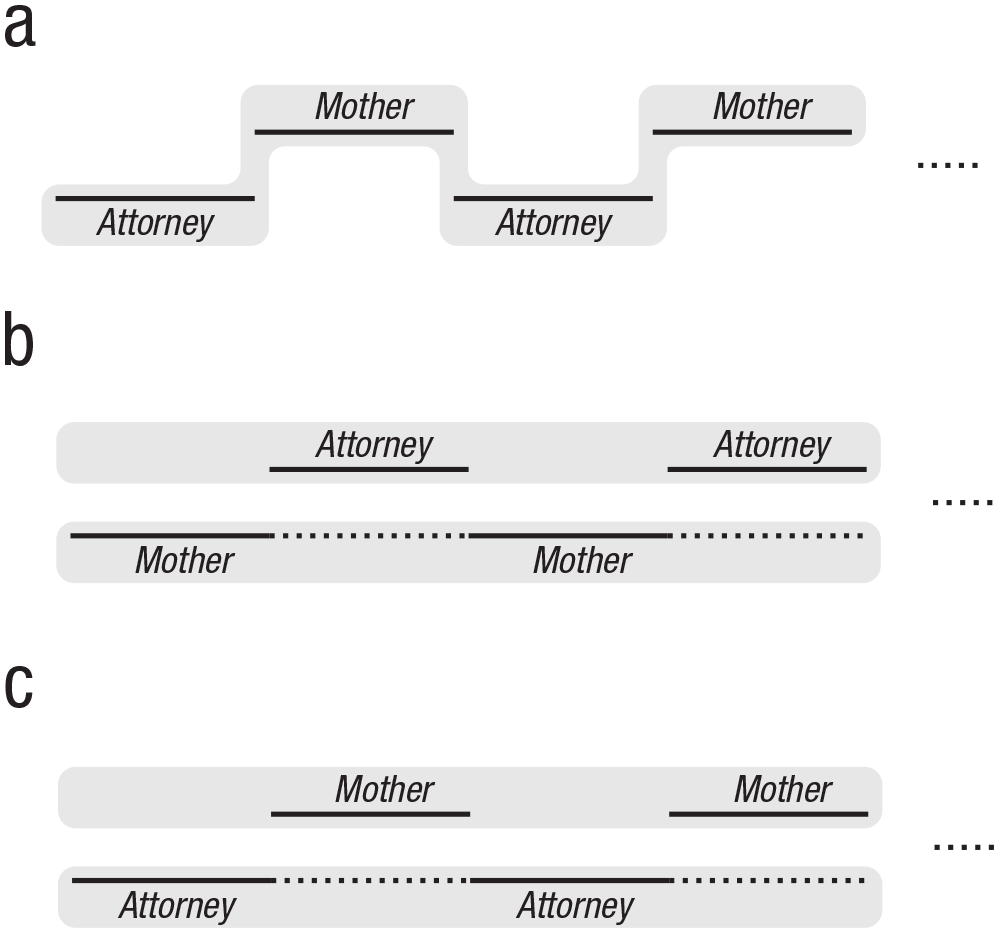
Graphic representations of two views of the structure of lives. One view (a) represents a life as a single stream alternating between strands. The other views (b and c) represent a life as multiple streams with concurrent strands that alternate between being figure and ground.
A more faithful representation of her experience is illustrated in Figures 3b and 3c. Her Mother strand is continuous and uninterrupted, but when she is at work, her Mother strand is in the background. In other words, each time she arrives at her office, there is an initial moment in her Attorney strand, but there is no corresponding terminal moment in her Mother strand. Likewise, when she leaves her office, there is a terminal moment in her Attorney strand but no concurrent revival of her Mother strand.
Of course, the idea comes from perception. In Rubin’s famous vase/faces demonstration (E. Rubin, 1915, 1915/1921, 1958; Wagemans et al., 2012), when we see the vase in the foreground, the edges of the vase are vase edges, but there are no corresponding face edges. We see the black area as an uninterrupted backdrop extending behind the vase; the faces are not present. 12
There is an even better analogy between multiple streams and perception. This analogy is referred to as auditory stream segregation. 13 For example, how do we perceive tones played in an ABA–ABA–ABA–ABA–ABA pattern? When the tempo is moderate and the pitches of A and B are not too far apart, it sounds like a single stream of notes that form a galloping rhythm, no? But when they are alternated at a faster tempo and their pitches are further apart, we hear two streams. It is remarkable that when we hear these two streams we also have trouble hearing the temporal relationship between them (van Noorden, 1975); they are perceptually asynchronous.
An analogous cognitive phenomenon is threaded cognition (Salvucci & Taatgen, 2008). Suppose a cook is preparing a meal of baked fish, pasta, and a cake. The recipes for each dish are independent—a skillful cook could readily replace any of these dishes with another—but the resources (the cook, the single oven) are not. Cooks, even though they can do only one thing at a time, must hold multiple concurrent tasks in mind and execute the next step in each recipe, taking into account available resources. As a consequence they must keep track of those tasks that are unfinished.
Memory reflects the pervasiveness of such tasks. Indeed, we often remember incomplete tasks better than completed ones, a phenomenon known as the Zeigarnik effect (Zeigarnik 1927, 1938; replicated by Seifert & Patalano, 1991).
These two phenomena, auditory-stream segregation and threaded cognition, show that humans have the wherewithal to experience multiple concurrent streams of behavior. This idea has begun to gain traction. In light of Kubovy (2015), Richmond and Zacks (2017) believe that accounts of how behavior is parsed into temporal units (mentioned earlier) should include a multiple streams component.
Nonadditivity
Is the value of a life the sum of its parts? This question can be interpreted in two ways: Is it the sum of the value of its moments within a strand, and is it the sum of the value of its strands at a particular moment?
Over time
Kahneman and Riis (2005) distinguish between an experiencing self and a remembering self.
An individual’s life could be described . . . as a string of moments. [Assuming] that each of these moments of psychological present may last up to 3 seconds . . . people experience . . . upwards of 500 million moments in a 70-year life. . . . What happens to these moments? . . . they simply disappear. . . . When we are asked ‘how good was the vacation,’ it is not an experiencing self that answers, but a remembering and evaluating self, the self that keeps score and maintains records. Unlike the experiencing self, the remembering self is relatively stable and permanent. It is a basic fact of the human condition that memories are what we get to keep from our experience, and the only perspective that we can adopt as we think about our lives is therefore that of the remembering self. (pp. 285–286)
14
What I have been describing in the article appears to be a fleshing out of Kahneman and Riis’s remembering self.
But Kahneman and Riis take this idea a step further: They claim that when we evaluate an experience, we should rely not only on the remembering self but also consider the value of an experience (and by extension, of a life) as the sum of the values of its moments. To persuade us, they offer an example: Consider a music lover who listens raptly to a long symphony on a disk that is scratched near the end, producing a shocking sound. Such incidents are often described by the statement that the bad ending “ruined the whole experience.” But, in fact, the experience was not ruined, only the memory of it. The experience of the symphony was almost entirely good, and the bad end did not undo the pleasure of the preceding half hour. The confusion of experience with memory that makes us believe a past experience can be ruined is a compelling cognitive illusion. The remembering self is sometimes simply wrong [emphasis added]. (p. 286)
They undoubtedly have a point when they claim that the bad ending would not have ruined every minute of the experience. But by the same token, it makes little sense to claim that the shocking sound would have only ruined a 3-second “moment.” To enjoy music we must retain what we just heard and experience the “sweet anticipation” (Huron, 2006) of how the music is likely to unfold. Husserl (1917/1991, p. 37) called this protention, which Blaiklock (2017) illustrates as a deceptive cadence in Bach’s Passacaglia and Fugue in C minor, BWV 582, [in which] a series of dominant chords . . . lead[s] us to protend a coming dominant cadence resolving to the tonic, but instead there is an unexpected D flat major chord. We hear in protention the melody resolving one way . . . [but] what we get instead is a different chord and the continuation of the piece. (pp. 476–477)
Nor are such devices restricted to “classical” music (Capitain, 2018). The duration of protensions varies from one musical style to the other, but during the time of Haydn, Mozart, and Beethoven (Rosen, 1972), for example, music was based on four-measure phrases no less than 10 s long (for a review of the relevant empirical evidence, see Bigand & Poulin-Charronnat, 2006), which were often combined into “sentences” of eight measures (Caplin, 2000, p. 59). This is also true of popular music (Robins, 2017). In other words, even the experiencing self does not just live in a 3-second present.
The momentariness of the experiencing self becomes even less persuasive if we consider suspense. Carroll (1990) asks us to reflect upon a “shopworn example,” that of the heroine tied to the railroad track, a locomotive steaming at her. Will she die or will she be saved?
Suspense requires two ingredients: (a) a future-oriented emotion such as hope (e.g., of getting a job) or fear (e.g., of being found guilty), coupled with (b) an estimate of likelihood. In the case of the heroine on the track, we experience suspense because we cannot see how she could be saved. So we fear that she will die, a high-probability event, and we hope that she will be saved, a low-probability event (Table 1). But hope and fear are not about the present; they involve complex constructive processes. As Kahneman and Miller (1986) convincingly showed, many emotions (such as surprise, frustration, regret, hope, or fear) require a tacit comparison of one reality (either past or future) to a counterfactual one. So if Kahneman and Riis’s experiencing self can experience such emotions, it cannot be very different from the remembering self.
The Structure of Suspense

Note: Based on Carroll (1990) and updated by Lehne and Koelsch (2015).
If the sum of the value of moments represents the value of an experience then we must also believe that once we have had an experience it cannot be changed. Indeed, historic events cannot be changed once they have occurred; no one will deny that Krakatoa erupted in 1883. But experiences are not historic events. Experiences are never uninterpreted, never raw, never free from constructive processes. Thus, it is inevitable that the value of some experiences may be reassessed in the light of subsequent information. Isabel Allende’s novel In the Midst of Winter (Allende, 2017) illustrates this point. Lena is informed that her husband—whom she had loved “from the age of seventeen with unswerving devotion”—has died. Soon thereafter she learns that her husband was a bigamist. Lena’s mourning was transformed into a storm of resentment and retrospective jealousy. She spent months scouring the past for lies and omissions, piecing things together to explain every suspect act, every false word, every broken promise, doubting even the way they had made love. (pp. 53–54)
For all these reasons, I believe that experiences acquire value not through the accretion of moments but as an emergent property of the organization of such moments, much like a melody is an emergent property of the organization of its notes.
Across strands
There are two arguments against the additivity of the values of a person’s strands in determining her evaluation of her life at a given moment. To make these points, I deviate from the approach taken up to now in two ways. First, I do not rely on a description of lives in general. Instead I consider people who are uncommon and admired. Second, I depart from the first-person perspective. Instead, I describe a third-person understanding—not necessarily accurate—of the first-person perspective of these individuals.
The first argument draws on the example of severely challenged people who acquire skills out of the reach of most of us and yet appear to live (at least from a third-person point of view) a rich and fulfilling life (Table 2). This suggests (a) that the strand in which the great achievement was attained was insulated from the suffering caused by illness or the challenge posed by the physical limitation and (b) that the person could relegate to the background the strand in which the suffering occurred, while maintaining as figure the strand in which great things were being done.
People Who Achieved Greatness While Severely Handicapped

The second argument against additivity comes from cases of extreme self-sacrifice. So when is an act of self-sacrifice seen to be worthy of sanctification? Only when the act appears not to be in the martyr’s best interest, as understood by those who venerate it.
There is a symmetry between these arguments. We give admiration and even reverence to two categories of individuals: those who can foreground a strand in which they have notable achievements, while appearing to disregard strands in which they experience great suffering, and those who appear to disregard strands in which they have love and satisfying work, while they foreground a strand devoted to a higher cause in which they will experience great suffering. 15
Data: A Proposal
What would it take to obtain a first-person view of an individual’s strands and an understanding of the relations among them? To this end, Mondol et al. (2016) have created a smartphone app called LifeMaps. Currently in its prototype form, LifeMaps is designed to be an online diary system that collects structured data from a person using both automatic sensing and manual inputs. It would also accept special-purpose extensions designed for clinical applications and behavioral studies. 16
Figure 4 shows a simplified version of the user interface. The leftmost column in the right-hand field of the interface is a list of times at which each activity began. The next column lists the type of activity (whether it is routine or part of a project) selected by a dropdown menu. If the user indicates that the activity is part of a project, then a screen opens to allow the initial moment of the activity to be selected, thus linking all the activities of a given project. In the next column is an indication of the location of the activity (presumably identified by GPS and information from the person’s linked calendar app). In the fourth column, the user is invited to briefly describe the activity. The fifth (and final) column is crucial. It gives the user the opportunity to designate which of the day’s activities are noteworthy. For each activity marked as noteworthy, the user is given an open-ended opportunity to write about the activity, explaining why it is noteworthy.

A mock-up of a screen of the LifeMaps smartphone app.
In the central area of the user interface each activity is numbered and placed in an icon with a shape that corresponds to the type of activity indicated in the second column. Each of these icons can be dragged into the black field on the left, into one of many boxes that can be added and given the a name to represent a cluster of activities. These boxes persist from day to day and are empty at the beginning of each day. These are candidate strands.
LifeMaps combines features of the experience-sampling method (ESM; Palmier-Claus, Haddock, & Varese, 2019) and the day-reconstruction method (DRM; Kahneman, Krueger, Schkade, Schwarz, & Stone, 2004), but it allows us to go beyond what Kubovy (2015) has described as a “flat” succession of episodes. For example, ESM can sample only discrete moments of a life with respect to a small number of categories, thus giving neither a comprehensive view of the cross-sectional structure of a life nor a sense of its longitudinal structure. Likewise, the DRM asks people to treat their activities during a day as if they were a chronological sequence of scenes in a film. This too can get only at the surface structure of lives, because it does not offer tools for the recognition of the thematic link between (say) work before lunch and work after lunch.
The implementation of a successful LifeMaps-based research program would have to satisfy four challenging, but currently achievable, requirements. First, it would not burden the user. To achieve this, LifeMaps should automatically collect data on the user’s life (such as activities, mobility, and location) using sensors and learn to infer the current activity with sufficient accuracy to minimize the number of corrective interventions required of the user. Second, it would guarantee the user’s privacy. Third, it would have a large user base. To allow nomothetic results to be extracted from such idiographic data, it would have to be used by a sufficiently large and representative sample of a population. Finally, it would host research projects. The developers of LifeMaps would offer a tool kit for the creation of special-purpose modules that would allow research groups to leverage the default data collected by the application. The modules could be just about any tool used in empirical cognitive or social-psychological research, such as periodic ESM queries, questionnaires, implicit-bias studies, and so on.
What kinds of data might one collect using LifeMaps? The easiest data to collect would be a cross-sectional study of the number of strands defined by users of different ages (keeping in mind the limitations of interpreting cross-sectional data). These data would allow us to estimate the growth and decline of the number of strands over the life span.
Somewhat more involved would be an attempt to estimate the number of concurrent projects a user is juggling—especially those denoted noteworthy. This might allow us to assess the complexity and attentional demands of each strand. At the same time, by adding questionnaire extensions to the app, a we could find out how well users like each project, the strand as a whole, and their life satisfaction. And so we might hope to address empirically the question raised earlier: Is our evaluation of our lives at a given moment an additive function of how we evaluate our strands?
Finally, let us see how LifeMaps would be synergistic with current research. As an example, consider a study by Beck and Jackson (2019). They used a two-period ESM (in which the assessments were either 1 or 2 years apart) to explore the stability personality assessed idiographically in a sample of students. Their models suggested that “some people were completely stable across two years whereas others were very unlike their former selves” (abstract). Even though the results are interesting, Beck and Jackson recognize that their study was limited by the ESM method, which constrained it to assessing only nine behaviors from the Big Five Inventory. They recommended that future research assess a broader range of behaviors, using a larger number of time points, taken over a longer period, with a sample of adults rather than students.
If this study were done within the framework of LifeMaps, one could readily design an extension to achieve these goals. It would allow the study to sample a broader range of idiographic data, to take many more assessments, and to sample a broader population. In addition, one could trigger ESM probes when the user enters one of the default locations for important strands (e.g., home for the Mother strand and office for the Attorney strand). Questions such as, “During the last hour, how happy were you?” or “How ’outgoing, sociable’ were you?” would be asked within different strands. This would allow researchers to determine the extent to which a person’s personality differs in structure and stability from strand to strand.
Conclusion
In the introduction I gave reasons for developing a descriptive psychology. Of course, this is only an initial effort. But now that it is done, we should better understand its nature. It is best understood as an effort to put into words a shared understanding (a term of art in knowledge engineering; see Uschold & Gruninger, 1996)—much of which is tacit—of the structure of lives. Absent such an articulation, psychologists do not only risk communicating poorly, partial, parochial, and incommensurable conceptual frameworks.
But is it science? The standards by which the claims made here should be tested are not all that different from those used in linguistics (Schütze, 2016). Linguists use grammaticality judgments. Readers must judge what in this account fails to capture the shared understanding in question and how they might improve on it. If it does not describe their lives, it is wrong.
In his seminal article “What Is It Like to Be a Bat?” Thomas Nagel (1974) wrote, At present we are completely unequipped to think about the subjective character of experience without relying on the imagination—without taking up the point of view of the experiential subject. This should be regarded as a challenge to form new concepts and devise a new method—an objective phenomenology not dependent on empathy or the imagination. Though presumably it would not capture everything, its goal would be to describe, at least in part, the subjective character of experiences in a form comprehensible to beings incapable of having those experiences. (p. 449)
The structure of lives is such an attempt.
Footnotes
Acknowledgements
I thank the many careful readers who have contributed to earlier versions of this article: J. T. Cargile, J. E. Cutting, W. R. Epstein, S. Gepshtein, L. Hallowell, J. A. S. Kelso, P. R. Killeen, A. Marasoiu, J. Shatin, M. Sheets-Johnstone, M. Sternberg, B. A. Teachman, T. D. Wilson, and J. M. Zacks.
Transparency
Action Editor: Laura A. King
Editor: Laura A. King
