Abstract
Steps involved in the creative process have been described in previous research, yet the exact nature of the process still remains unclear. In the current study, we take this investigation further, referring to two flying machines developed by Leonardo da Vinci and his other notes. Nine iterative steps are described with a focus on motivation and cognition: (a) vision and curiosity; (b) social recognition; (c) asking questions; (d) analogical thinking; (e) trial and error; (f) abductive reasoning; (g) incubation and forgetting; (h) overinclusive thinking, latent inhibition, and illumination; and (i) schema elaboration. The influence of da Vinci’s socio-historic context is also briefly discussed. The analyses show how general psychological mechanisms can explain extraordinary acts of creativity. The steps discussed can be further formalized in future research to advance the modeling of creativity.
A bird is an instrument working according to mathematical law . . . such an instrument constructed by man is lacking in nothing except the life of the bird, and this life must be supplied from that of man.
Guilford (1950, 1968) described creativity as the process of coming up with novel and useful products and ideas. Leonardo da Vinci’s flying machines were definitely creative. He was the first to describe such elaborate ideas about flying (Isaacson, 2017), and his designs paved the way for the invention of airplanes and helicopters 400 years later. The first goal of this article is to describe the creative process by interpreting da Vinci’s notes on flying machines.
Creativity has long been attributed to genius or great talent—characteristics one is believed simply to be born with. Although we acknowledge that people differ in the extent of their talent, our assumption is that every human being is capable of creativity and already using some aspects of creative thinking one way or another (e.g., Funke, 2008; Weisberg, 2010) and that the creative process follows steps similar to those of ordinary motivational and cognitive processes. Therefore, our second goal is to attempt to describe da Vinci’s creativity and explore how he reached his extraordinary conclusions by making use of general psychological processes common to every human being.
The Creative Process—Very Briefly
The most influential model on the creative process is Wallas’s (1926) four-stage model, comprising preparation, incubation, illumination, and verification. The first and fourth stages are conscious and controlled. Thus, the function of preparation is gathering information and learning about a domain, and verification consists of testing and evaluating ideas.
The second and third stages, incubation and illumination, are unconscious. During incubation, one refrains from consciously thinking about a problem by diverting attention to something else. Then, “a series of unconscious and involuntary (or foreconscious and forevoluntary) mental events may take place” (Wallas, 1926, p. 86).
Associations made unconsciously eventually pop into conscious awareness as a “final ‘flash’ or ‘click’” (Wallas, 1926, p. 94)—the illumination stage—which often produces a solution unexpectedly. The creative person is surprised by the sudden leap of the solution from the unconscious. How initially unrelated concepts suddenly become connected with the problem-relevant information can be explained through spreading activation theory, which postulates that activation travels through neural networks (Collins & Loftus, 1975; Sio & Rudowicz, 2007).
Wallas (1926) also included a fifth stage called intimation (e.g., Kihstrom et al., 2014; Sadler-Smith, 2015), which is said to happen before illumination. It describes the vague feeling that a solution is developing but one does not know yet what the solution is.
Wallas’s (1926) model has influenced many researchers, and different aspects of the four-stage model have been further developed (Amabile, 1996; Runco, 2007; Sadler-Smith, 2015; Sawyer, 2012). Despite the many advances made in the study of creativity, Lubart (2001) suggested the current models were limited and incomplete. Arguing for more detailed explanations of the various subprocesses, he said, “Theories of the creative process need to specify in much greater detail how the subprocesses can be sequenced to yield creative productions” (p. 305). More recently, Kleinmintz et al. (2019) suggested for future research to “focus on examining the different stages of creativity” (p. 137). In this article, we attempt to satisfy this need by providing clarification and more detailed descriptions of the creative subprocesses. Three sets of questions will guide the further development of a theory on creativity based on the subprocesses:
Where does the motivation to discover new domains come from?
According to Wallas’s model, only unconscious processes can produce creative ideas. What kind of conscious reasoning can produce creative ideas or products?
What exactly happens during incubation and illumination?
To describe the creative process in detail, we will refer to two flying machines developed by Leonardo da Vinci as examples of innovation. From there, we will reconstruct the creative process to show how da Vinci may have come up with these inventions. We will also refer to da Vinci’s notes as evidence to support the various stages discussed. da Vinci produced more than 500 drawings and 35,000 words in his notes on the topic of flying (Isaacson, 2017, p. 181).
Two Examples of da Vinci’s Flying Machines
Leonardo da Vinci was born on April 15, 1452, in Vinci, Italy. He was an illegitimate child and had no real formal education in the sciences (Isaacson, 2017). Yet he became one of the most famous painters, inventors, and scientists of all time. We could have selected so many different works of da Vinci, but because flying has always been a dream of humankind, we selected two of his flying machines for this article.
The first flying machine he developed is now known as the “ornithopter” (Fig. 1). This design, made in 1485, was meant to mimic the flight of birds or bats. The wingspan of the ornithopter was about 30 ft. In some drawings, the pilot was sitting down in the middle of the “aircraft” body/fuselage and using hands and feet to move the wings. In other drawings, the pilot was lying down. Some notes suggest the head could be used for steering. Figure 1 2 also shows some parts of da Vinci’s characteristic left-handed mirror writing, reading from right to left. 3
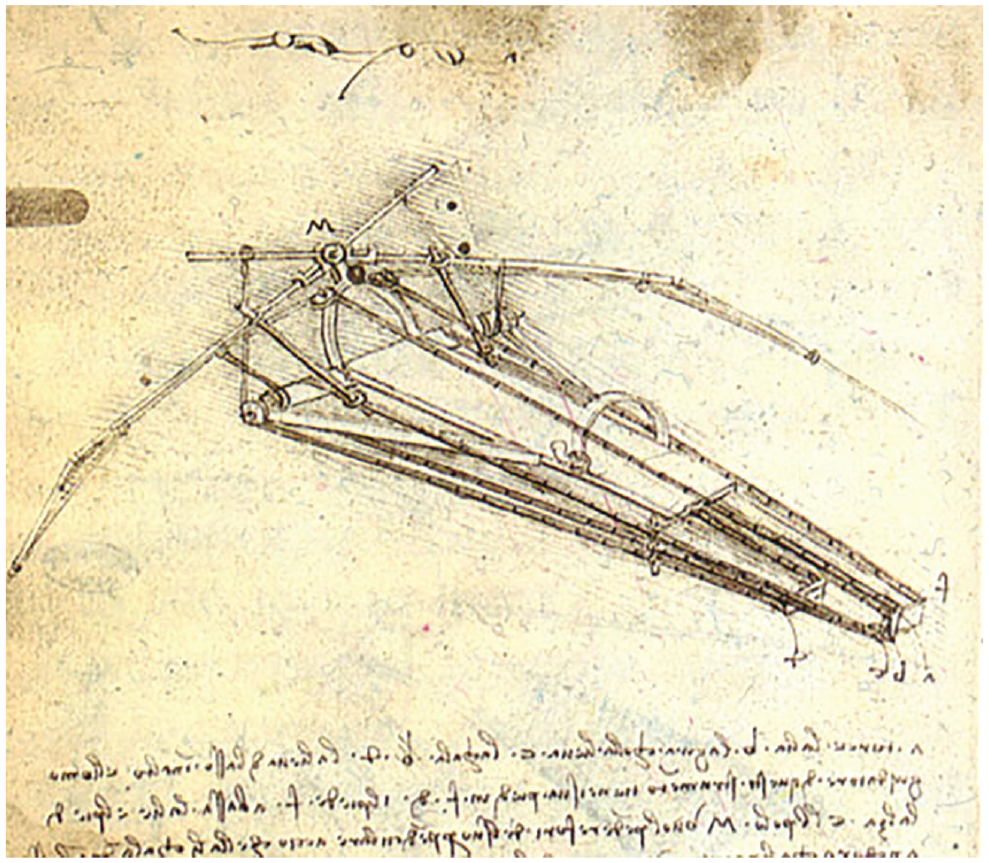
Flying machine “ornithopter” (da Vinci, Manuscript B, folio 74 v.). Image from https://upload.wikimedia.org/wikipedia/commons/d/d4/Design_for_a_Flying_Machine.jpg.
The second flying machine is often called an aerial screw, screw air, or helicopter (Fig. 2). Aerial screw or screw air is an object analogous to a screw, and helicopter refers to its likeness to modern-day helicopters, crediting Leonardo da Vinci for this invention. The drawing made in 1489 (designed between 1483 and 1486, according to Bartoli et al., 2009) shows a screw-like object of iron wire covered with linen, perhaps based on a pine or reed construction. It supposedly would rise in the air if it were propelled. Leonardo da Vinci describes it in his notes as shown in Figure 2.
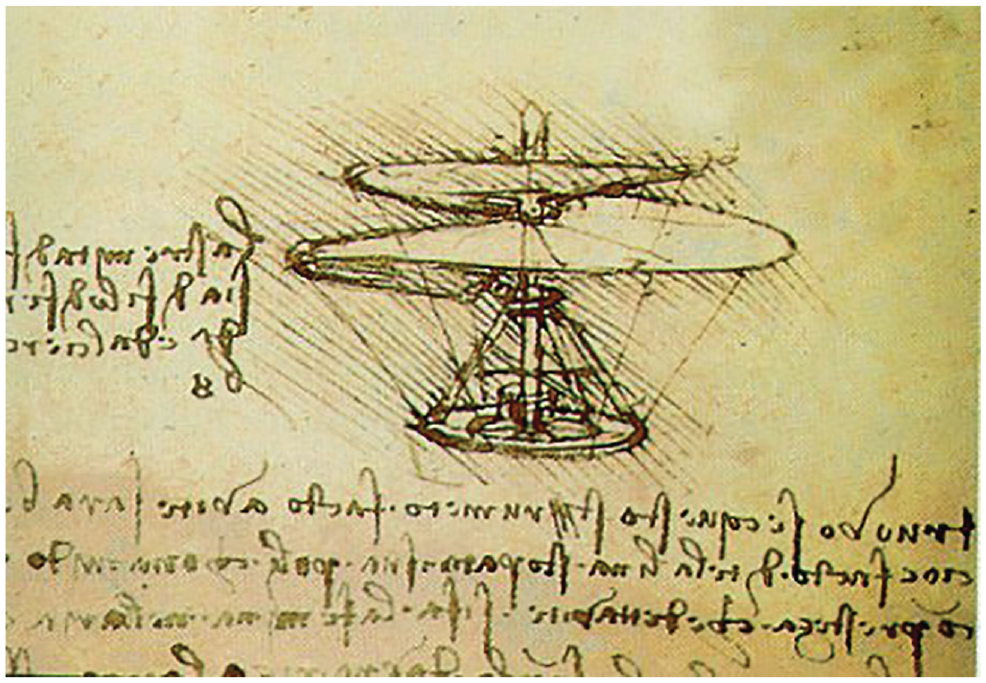
Screw air (da Vinci, Manuscript B, folio 83 v.). “Let the outer extremity of the screw be of steel wire as thick as a cord, and from the circumference to the centre let it be eight braccia [48 ft]. I find that if this instrument made with a screw be well made—that is to say, made of linen of which the pores are stopped up with starch—and be turned swiftly, the said screw will make its spiral in the air and it will rise high” (da Vinci, Manuscript B 83 v.; da Vinci, 1939, p. 500). Image from https://upload.wikimedia.org/wikipedia/commons/5/54/Szkic_%C5%9Bmig%C5%82owca.jpg.
It is unclear whether da Vinci indeed tested his flying machines. If he did, his attempts were probably unsuccessful. Otherwise, they would likely be known. The ornithopter and aerial screw never really flew, simply because human muscle force would not be able to provide the necessary power to make them fly (Capra, 2007, p. 186). But with the detailed notes and drawings, they were the foundation for building airplanes and helicopters about 400 years later.
How did Leonardo da Vinci come up with these two ideas of flying machines? Figure 3 summarizes the nine steps of the creative process according to our proposed interpretation of da Vinci’s creative process. The steps in Figure 3 correspond to the sections in the article. Although we discuss these steps in a particular order, that order should not be construed to be meaningful or necessary. These steps are nonlinear. There are frequent iterations between stages.
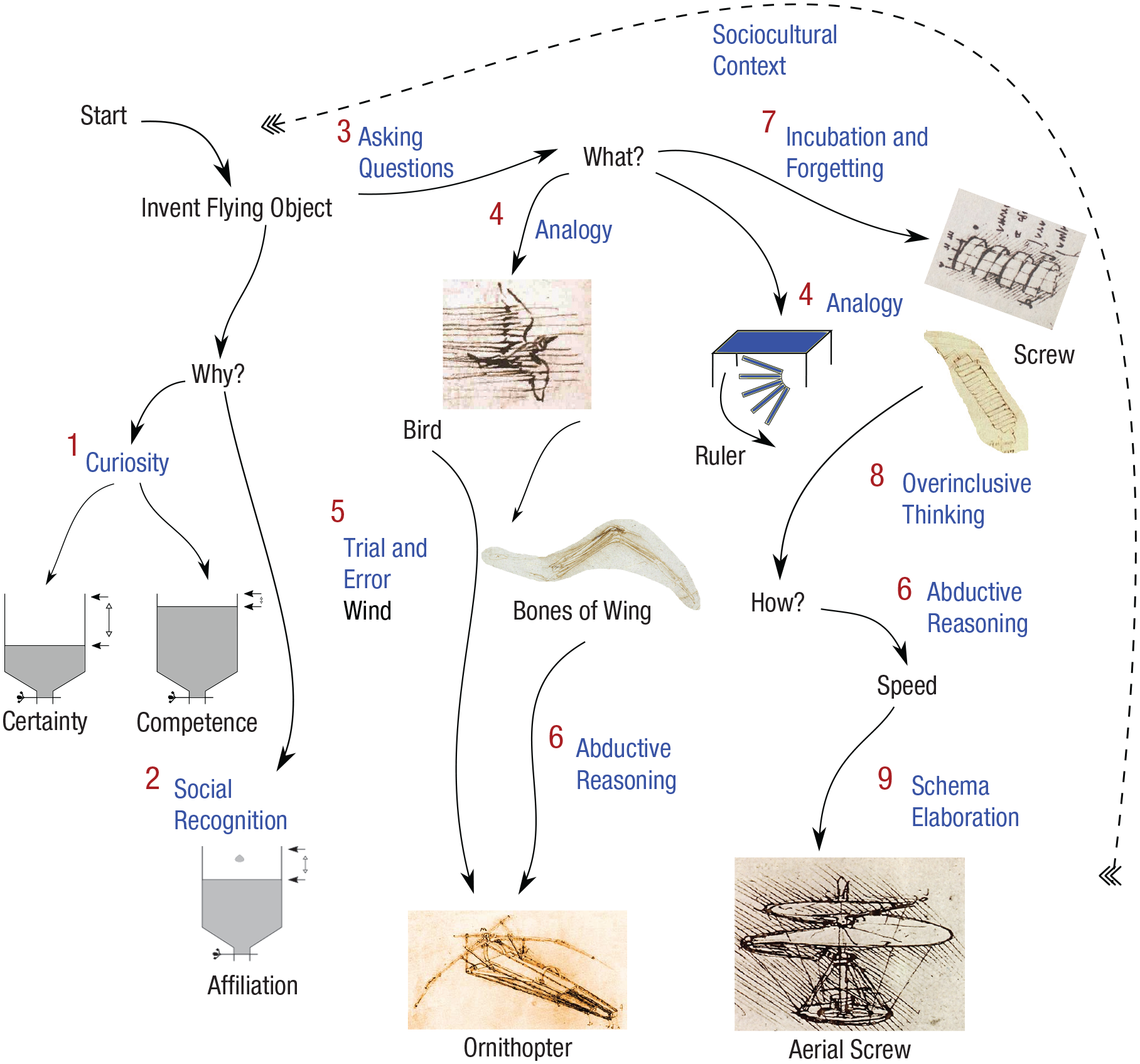
The step-by-step creative process of inventing two flying machines. It includes images, questions, motivation, and cognitive operations in blue. The numbers in the figure correspond to the order of the sections in which they are discussed in the article. Bird image from https://upload.wikimedia.org/wikipedia/commons/7/76/Leonardo_da_Vinci_-_Codice_volo_uccelli_6r.jpg (da Vinci, about 1506, Codice volo uccelli 6 r.). Archimedes screw image from https://upload.wikimedia.org/wikipedia/commons/1/1d/Facsimile-of-codex-atlanticus-screws-and-water-wheels-laminate.jpg (da Vinci, Codex Atlanticus, folio 386 r.).
The Dream of Flying: Curiosity as a Motivation to Discover
All great inventions have been preceded by great vision or even a consideration of achieving the impossible. Where does this curiosity come from? Curiosity can be defined as “a desire to know, to see, or to experience that motivates exploratory behaviour directed towards the acquisition of new information” (Litman, 2005, p. 793). Why was da Vinci so driven to discover and learn about so many different domains and interests, even about phenomena that seemed distant from his immediate interests? For example, da Vinci’s to-do list included understanding how the tongue of a woodpecker works (Isaacson, 2017, p. 525). He was interested in understanding simply for the sake of understanding. That is probably why he has been characterized as “the most relentlessly curious man in history” (Clark, 1969, p. 135).
Curiosity and the desire to think about “unthinkable” phenomena are essentially motivational processes. Psi theory is a psychological theory that attempts to formalize the processes of motivation, emotion, and cognition. Psi theory—named after the Greek letter Ψ, which is often used as an abbreviation for psychology—maintains (Dörner, 2003; Dörner & Güss, 2013) that there are five groups of basic human needs: existential needs such as thirst, hunger, sleep, and pain avoidance; the sexuality need; the social need for affiliation; the need for certainty; and the need for competence.
Curiosity could be described as the simultaneous activation of the needs for certainty and competence. The need for certainty (Berlyne, 1960) becomes active when a situation is novel or unexpected and one wants to understand it and accurately predict what will happen (How can humans fly?). As da Vinci stated, “The natural desire of good men is knowledge” (Codex Atlanticus 119 v. a; da Vinci, 1939, p. 88). The need for competence becomes active when a problem arises that cannot be solved in the moment. One wants to come up with a solution that allows effective interaction with the environment (taking to the air in a flying machine).
Da Vinci described a promising attempt that could satisfy the need for certainty: You will make an anatomy of the wings of a bird together with the muscles of the breast which are the movers of these wings. And you will do the same for a man, in order to show the possibility that there is in man who desires to sustain himself amid the air by the beating of wings. (da Vinci, Codex Atlanticus 45 r. a; da Vinci, 1939, p. 421)
The needs can be understood through a tank metaphor (see Fig. 4 showing five tanks for the five groups of needs). If a need arises (e.g., the problem “How can humans fly?” increases the need for certainty), liquid drops out of the tank, and the liquid level deviates from the ideal set point. The satisfaction of a need results in pleasure, whereas its lack of fulfillment results in discomfort. Pleasure occurs as the tank is filled, and reduction in pleasure occurs when the tank level drops below the set point (see Dörner, 2003).
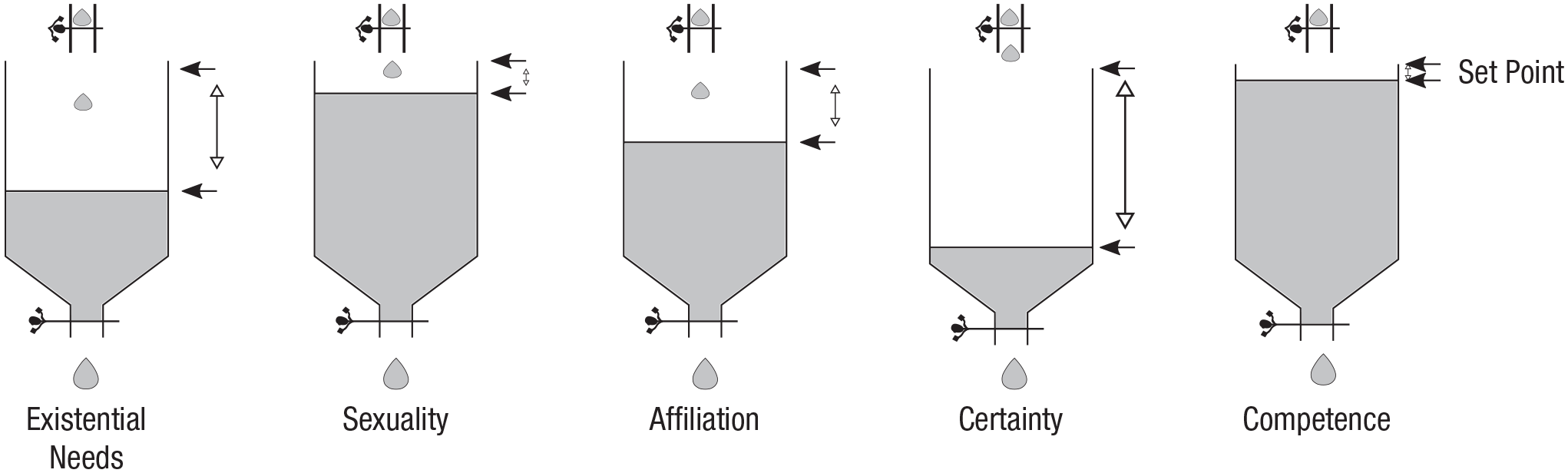
Tanks showing the five needs.
The set point is shown at the right side of each tank with the upper horizontal arrow. The set points and the speed at which liquid drops in and out of the tank can differ among individuals. The set-point deviation is the discrepancy between the liquid level in the tank and the set point. The higher the set-point deviation, the stronger the need. Following the homeostasis principle, an organism would try to restore a balance and reach the set point again, for example, by gathering information. If a need is satisfied (e.g., by studying birds, wings, feathers, and air and learning about how birds can fly), then liquid drops into the tank, and the liquid level rises again until it reaches the set point.
Leonardo da Vinci’s certainty tank could be described as a tank that lost liquid more quickly than most. Compared with da Vinci, most people lose liquid very slowly. It takes longer for the certainty need to become active and therefore longer for them to engage in information-seeking behaviors. As soon as da Vinci was confronted with a phenomenon, he became interested in understanding it and took immediate action to do so. Thus, curiosity can be described as a quick and strong set-point deviation in the certainty need tank. A high need for certainty drives people to find answers to their questions.
The strong discomfort generated by an unsatisfied need for certainty can be explained by its close connection to the need for competence. An increasing need for certainty indirectly increases the need for competence. Not understanding what is happening (uncertainty) also affects how one can deal effectively with a situation (competence). Satisfying the need for certainty by receiving clarity about a situation also indirectly satisfies the need for competence.
For a curious person to “dive into” and explore a new problem domain, a high certainty need has to be paired with a weak competence need. If competence and certainty needs are both strong, then a person would engage in safeguarding behaviors, confirmatory perception, or flight (see Dörner & Güss, 2013)—in short, they would engage in anything that could restore competence quickly rather than in explorations of a new domain. This interplay of a high increase in the need for certainty but a low decrease in competence has been described in other terms, such as frustration tolerance (e.g., Rosenzweig, 1938, p. 153) and the ability to endure difficult situations (see also creative frustration, as discussed by Sapp, 1992).
We assume that da Vinci’s competence need was not strong when his certainty need was. Although he worked on a new domain, such as flying, da Vinci could rely on his vast knowledge and skills. He had successfully created numerous inventions, drawings, and paintings and could rely on his successful strategy to divide a big problem into tiny problems that could be mastered (as we will show below). He had not only epistemic competence (i.e., enormous knowledge and skills) but also heuristic competence (i.e., trust and confidence in his own ability to master new situations and problems successfully; e.g., Dörner, 2003).
It has been acknowledged that many of da Vinci’s attempts failed. For example, if he could not complete a painting as he wanted it to be (e.g., the Battle of Anghiari or the Adoration of the Magi; see Isaacson, 2017, p. 522), he abandoned it. However, the following quote shows that da Vinci’s need for competence did not become easily activated because he could trust his knowledge and skills to master unknown situations and domains—even though he had no formal education: “Though I may not, like them, be able to quote other authors, I shall rely on that which is much greater and more worthy:—on experience” (da Vinci, Codex Atlanticus 115a; 357a, around 1490; da Vinci, 1888/1970a, p. 15).
It was most likely curiosity or the high need for certainty, paired with a stable level of competence from preexisting stores of knowledge and the anticipation of enormous success as an imagined source of competence, that allowed da Vinci to continue pursuing the study of flight and of flying machines over a period of several years.
Social Recognition as Motivation
Leonardo da Vinci was aware that no flying machines existed and that if he succeeded in developing such machines, he would achieve fame and glory. He wanted to test his flying machines on the hillsides of Mount Cecero, which was north of Florence, near Fiesole. “The great bird will take its first flight;—on the back of his great swan [magnio cecero]—filling the universe with wonders; filling all writings with his fame and bringing eternal glory to his birthplace” (da Vinci, Codex on the Flight of Birds, folio 18 v.; da Vinci, 1888/1970b, p. 430).
Receiving “fame and glory” for developing a functioning flying device refers to social recognition. Social recognition—and related to it, financial gain for an artist during the Renaissance period—can, of course, also be motivations to pursue discovery. Furthermore, the basic human need for affiliation (i.e., the social need to belong) may also be satisfied, such as from a smile or from a clap on the shoulder, because these signals show that one is accepted by a group (“signals of legitimacy”; Boulding, 1978, p. 173). Past researchers have not only stressed the importance of intrinsic motivation in creative achievements but also have discussed the important role of the social context (e.g., Amabile, 1996; Amabile & Pillemer, 2012; Csikszentmihalyi, 2014). In addition, newer research has shown that it is not an either/or concept but rather that sometimes intrinsic and extrinsic social motivation together can foster creativity (e.g., Fischer et al., 2019; Malik et al., 2019; Xue et al., 2018).
In da Vinci’s case, however, striving for social recognition might have played a less important role simply because he was already at the top. De Beatis referred to Leonardo as “the most eminent painter of our time” (cited in Isaacson, 2017, p. 502). Although Leonardo had to live from commissions for his work, he worked for highly influential families, such as the Borgias, the Sforzas, and the Medici, and later even received regular stipends from the Vatican under Pope Leo X and the French kings Louis XII and Francis I. Wealth and material possessions were not of great interest to him, and he “lacked that instinct to cater to patrons when painting” (Isaacson, 2017, p. 83).
Asking Questions
Curiosity—asking questions, such as “How can humans fly?”—triggers an important part of the creative thought process. Questions show what information is not yet known. They point to “knowledge holes” and provide direction for further thought. A “why” question demands an explanation. Why would building a flying machine be important in the first place?
A “what” question asks about an object (a bird), the specific details of an object (wings), or even more specific parts of the details (feathers). This information is organized in hierarchical schemas or partial schemas. A schema is a framework or organized setting influenced by previous experiences, within which novel information can be interpreted (Bartlett, 1932). “What else can fly?” requires the consideration of different objects (e.g., bats).
A “how” question requires a description of a specific way something can happen. How can a bird fly? What processes must work together to make it happen? Leonardo da Vinci describes the interplay of the birds’ shoulders and wings to compress air and sustain motion: When the bird by the beating of its wing wishes to rise, it raises the shoulders and it beats the points of the wings towards itself, and so condenses the air which lies between the points of the wings and the breasts. The tension (of the condensed air) lifts up the bird. (da Vinci, Sul Volo degli Uccelli, folio 13 (12) r.; da Vinci, 1963, p. 178)
In the course of his research, da Vinci used a variety of thinking tools, which will be described in the following steps.
Analogical Thinking
Leonardo da Vinci used birds as an analogy for his machines. So, the search for an answer to the question of what else can fly was guided by this analogy: If birds can fly, then a human being imitating a bird can fly as well. Leonardo regarded nature as an important source of inspiration for his inventions. “There is no result in nature without cause; understand the cause and you will have no need for an experiment” (da Vinci, Codex Atlanticus 147 v. a; da Vinci, 1939, p. 64).
The bird analogy referred both to the structure of the components and the process of flying (Chen, 2002, called it structural similarity and procedural similarity). The ornithopter reflects both the structure of birds, such as their body and wings, and the process of flying (i.e., the movement of wings). Even da Vinci’s further analysis of why birds can fly was guided by an analogy (i.e., comparing wind with water). “To arrive at knowledge of the motions of birds in the air, it is necessary to acquire knowledge of the winds, which we will prove by the motions of the water” (da Vinci, Paris Ms E, 54 r., cited in Isaacson, 2017, p. 178).
The analogy to birds seems relatively obvious for the development of the ornithopter, but how did da Vinci come up with the idea of the aerial screw? A screw is not something one would normally associate with flying. There are several possible explanations.
The first is that da Vinci used analogical thinking to associate a screw with flying, perhaps from his work with screws in some of his other engineering projects. We will elaborate on this possibility in the section on incubation. The second explanation is that da Vinci may have seen some of the “whirligigs” children used as toys. A child would pull a spindle that then would turn the toy’s rotation blades (Gibbs-Smith, 1962, p. 229). Potentially, these toys served as an analogy and/or a starting point for his aerial screw.
Trial and Error
Trial and error is often the first approach employed when developing a new creative idea or product. One takes the first idea that comes to mind and tests it to see whether it works (Thorndike, 1901). If it does not, one moves on to try the next action or idea in a random or a more deliberate fashion. It involves chance variation in behaviors to reach a goal.
One might think that a strategy as simple as trial and error would be used most frequently by novices, but research has shown that experts often use it, too (e.g., Simon & Simon, 1962). The trial-and-error approach can be also seen in da Vinci’s changing assumptions about the role of wind in flying. Although da Vinci wrote many pages on the subject of birds and wind (e.g., folios 5–10 in the Codex of Flight), the following quote from the Codex of Flight suggests that initially, da Vinci did not fully understand the dynamics of wind and wings: When the bird by the beating of its wing wishes to rise, it raises the shoulders and it beats the points of the wings towards itself, and so condenses the air which lies between the points of the wings and the breasts. The tension (of the condensed air) lifts up the bird. (da Vinci, Codex Atlanticus, folio 5 v.; da Vinci, 1963, p. 178)
In reality, the cause of flying is not the wing movement compressing the air beneath it. The wing splits the incoming wind and guides both air streams downward because the wing is bent. Air moves faster over the curved wing than it does under. When air moves faster, its pressure decreases. Therefore, the pressure is lower above the wing and higher under the wing, creating a force that pulls the wing and attached body upward. However, the next note suggests da Vinci was beginning to understand the dynamics of flight: When a bird with a wide wingspan and a short tail wants to take off, it will lift its wings with force and turn them to receive the wind beneath them. The wind, forming a wedge, will quickly propel it up high. (da Vinci, 1505, Codex on the Flight of Birds, folio 17 v.)
Because most of the Codex Atlanticus was written before the year 1500, it is very likely the second quote was written much later than the first quote, illustrating that da Vinci gained a deeper understanding of the topic through his intensive studies—most likely through mental trial and error. He was aware that many of his approaches to solve problems involved trial and error, and some failed (Isaacson, 2017).
Abductive Thinking
How do people use logic to come up with something novel and useful? The two most widely discussed forms of reasoning are deductive and inductive reasoning. Deductive reasoning starts with a general theory, statement, or premise and makes specific predictions or hypotheses. Inductive reasoning starts by observing specific instances and moves to a generalized conclusion. Yet both deductive and inductive reasoning stay within a domain, are self-contained, and do not lead to new findings in the conclusion.
Peirce (1878, 1883) discussed a third form of reasoning, abductive reasoning. Abductive thinking relies on observations of phenomena and reflections about the possible explanations for these phenomena (Peirce, 1878, 1883). These explanations are then tested. If they do not make sense, they are rejected. The “best” hypothesis should be economical, simple, and plausible given the constraints of uncertainty. Unlike deduction and induction, abduction introduces new knowledge as an explanation for a phenomenon. This explanation is not part of the original premises, and it could be right or wrong (Kolko, 2009).
Leonardo da Vinci described abductive reasoning in his own words as a process that shows why something works in a specific way: First I shall do some experiments before I proceed farther, because my intention is to cite experience first and then with reasoning show why such experience is bound to operate in such a way. And this is the true rule by which those who speculate about the effects of nature must proceed. (da Vinci, 1513, Manuscript E, folio 55 r.; Capra, 2007, p. IX)
The following example of da Vinci’s notes clearly show the interplay of observation, explanation, and abductive thought: Those feathers which are farthest away from their points of attachment will be most flexible. The tips of the feathers of the wings therefore will always be higher than their roots, wherefore we may with reason say that the bones of the wings will always be lower when the wing is lowered than any part of the wing. . . . Because the heavier part will always be the guide of the movement. (da Vinci, Sul Volo 4 v.; da Vinci, 1939, p. 403)
As da Vinci reflects on the design of wings, we can see his abductive thought process. He observes wings going up and down but also observes that the wing consists of different parts that do not all follow the movement at the same time. Why? The explanation he gives for certain parts of the wing being higher than other parts during flight is related to weight and gravity (i.e., that heavier parts of the wings guide movement and the heaviest parts of the wings are the bones). This is a tentative and new explanation worthy of further investigation.
In Peirce’s (1903) words, the abstract form of the logic of abductive thought can be described as The surprising fact C is observed, But if A were true, C would be a matter of course; Hence there is reason to suspect that A is true.
To apply Peirce’s formal rule to the example of da Vinci, Not all parts of the wing move at the same time/speed, Weight and gravity make the heavier parts of the wing lower first, which is why not all parts of the wing move at the same time/speed. Hence, there is reason to suspect that the law of weight/gravity is true.
After a possible explanation is inferred, it can be tested. Leonardo da Vinci could have experimented and tested his assumptions by measuring the weight of wing bones, wing muscles, and feathers.
What are the psychological tools humans use to reason abductively? We start with semiotic theory—how meaning is constructed, according to Peirce (1998): I define a Sign as anything which is so determined by something else, called its Object, and so determines an effect upon a person, which effect I call its Interpretant, that the latter is thereby mediately determined by the former. (p. 478)
Thus, a sign has three interrelated parts: a representation, an object, and an interpretant. The word dove, for example, is a representation that points to an object. The object can be the actual bird or a visual schema of an imagined dove. This dove as an interpretant has different meanings for different people. A devout Christian might regard the dove as a symbol of the Holy Spirit. For a hunter, a dove might trigger thoughts about the hunting season. An artist might see the dove as part of an evening scene of pastures and hills in the Tuscany region. Given this semiotic triangle of representation, object, and interpretant, the tools for abductive thinking are schemas of words and images and related experiences. We come back to the semiotic triangle in the section on schema elaboration.
Incubation, Forgetting, and Creating Abstract Schema
Previously we have discussed two analogies, a screw or a whirligig toy, that could have been used for the development of the aerial screw. The third explanation is related to the psychological process of incubation. da Vinci could have observed seeds flying and turning in the wind and gotten the idea of his aerial screw from these observations. Maple seeds or ash tree seeds, for example, turn like a helicopter propeller when they fall from trees. Other seeds, such as dandelion or oleander seeds, glide through the air. da Vinci wrote about seeds several times; for example, Take a vase, fill it full of pure earth and set it up on a roof. You will see how immediately the green herbs will begin to shoot up, and how these, when fully grown, will cast their various seeds. (da Vinci, Codex Atlanticus 265 r. a.)
Later, when working more deliberately on flying machines, these earlier observations about seeds that were set aside might have triggered the first ideas about the aerial screw.
This psychological process has been called incubation. During incubation, one refrains from consciously thinking about a problem by putting the problem aside and working on something else. Being interrupted and working on an unrelated task helps to find a solution for the problem one has been working on before—as a review of numerous studies showed (Ellwood et al., 2009). Often, the solutions that pop up are unpredictable and surprising.
Incubation helps in coming up with a solution by allowing the mind to rest and to forget about unsuccessful attempts to solve problems, paving the way for new solutions (Smith & Dodds, 1999). Without the ability to forget, our minds would rely heavily on prefabricated (or ready-made) answers (for an empirical study showing that forgetting enhances creativity, see Storm & Patel, 2014). While working on other topics, the concrete details of a bird-flying schema with wings and feathers might have become blurred so that at one point, an abstract, fuzzy schema was created. Forgetting may also have allowed da Vinci to relax his focus and become less fixated on using one or several specific ideas to solve the flying problem (see also forgetting fixation hypothesis, Smith & Blankenship, 1989).
Other evidence for the importance of incubation can be seen in da Vinci’s studies on birds, winds, and flying objects over a period of many years. As mentioned previously, he produced more than 35,000 words on birds and drew 500 sketches depicting birds, air, wings, and flying machines (Jakab, 2013). This work may have inspired the modifications he made to his design and conceptualization of flying machines. For example, the drawing of water-lifting devices (1480–1482) from the Codex Atlanticus (541 v.) shows he worked on the Archimedes screw shown in Figure 3. Leonardo likely used the screw as an analogy for his flying machine, the aerial screw, which was drawn in 1487 or 1498, several years after his work with hydraulics.
Overinclusive Thinking, Latent Inhibition, and Illumination/Insight
The analogy of a screw as a flying object mimics the movement of a screw being turned into wood. So both the form and function of the screw would be similar to the abstract flying object schema. The aha moment, insight, or illumination of seeing the screw as a potential flying object (Wallas, 1926) came when the screw schema matched the abstract flying-object schema, leading to the realization that a giant screw with large threads could fly. This realization required mental imagery (Kosslyn et al., 2003)—that of a gigantic screw finding its way through the air.
An alternative explanation for the screw analogy could be the ruler analogy. For example, while da Vinci was working, he may have seen a ruler fall from a table and rotate while falling to the ground. Using overinclusive thinking and seeing the analogy of a rotating flying device, da Vinci could have elaborated on this idea to come up with the aerial screw: “Take the example of a wide and thin ruler whirled very rapidly in the air, you will see that your arm will be guided by the line of the edge of the said flat surface” (da Vinci, Manuscript B 83 v.; da Vinci, 1939, p. 500).
Overinclusive thinking means that seemingly unrelated material cannot be inhibited; conceptual boundaries are not preserved. The capacity to block irrelevant stimuli from conscious awareness is also called latent inhibition. Research has shown that highly creative achievers showed lower latent inhibition than less creative achievers (Carson et al., 2003; Kéri, 2011). da Vinci could have learned to notice similarities between two seemingly unrelated objects. Instead of blocking out information, as many people would, da Vinci—having low latent inhibition—allowed himself to widen his perception and to follow his thoughts as they wandered in different directions. This might explain his interest and success in so many different domains, such as biology, anatomy, painting, geology, hydraulics, art, astronomy, medicine, and mathematics.
Overinclusive thinking and latent inhibition are important to break the limitations related to expertise. It can take years for someone to become an expert in a domain: more than 10 years or over 10,000 hours of deliberate practice, according to researchers on expertise (Ericsson et al., 1993). Yet expertise is a double-edged sword in relation to creativity. On the one hand, expertise provides the necessary wealth of background knowledge and skills that could be applied to solve problems in a novel way. On the other hand, expertise can hinder creativity because expertise consists of well-learned thoughts and behaviors. One is in danger of repeating patterns of behavior that have proved successful in the past, whereas a new situation with different characteristics often demands the implementation of new ideas.
Leonardo da Vinci overcame these pitfalls of expertise. He was able to recognize his own failed attempts. For example, he studied the earth’s water flows for about a decade and revised his thoughts many times. Then again, these failures were also part of his success. As Isaacson (2017) put it, “One mark of a great mind is the willingness to change it” (p. 435). Eventually, da Vinci even gave up on his work on flying machines, realizing that human muscle would never produce the necessary energy to propel a flying machine through the air (Isaacson, 2017; see also comment of Palmer, 2011).
Testing and Working Out Details: Schema Elaboration
The screw as a flying object was just a first thought. It took da Vinci years to further develop this idea. “How could a giant aerial screw fly?” “What process must happen so the screw could be propelled in the air?” Here, da Vinci followed abductive reasoning again (i.e., finding the best answers to the question). The screw must be created with light materials, such as linen, through which air cannot pass. The screw must have enormous bent threads to direct the air flow. The screw must have enormous speed. In da Vinci’s own words, The external edge of the aerial screw is a thick wire with a maximum radius of about four meters (13 feet). To make this instrument correctly, you would need to use starched linen cloth, so the air does not pass through. If it is rotated quickly, this machine will spin as though it were a screw that penetrates the air, and it will rise. (da Vinci, 1489, Manuscript B, folio 83 v.)
The mechanical details of the ornithopter also had to be worked out in detail. The large, overarching schema of the flying machine with its body and wings had to be divided into many small schemas of the connected parts: the fuselage/body of the ornithopter, the wings, and the connection of the wings to the body. These parts had then to be divided into even smaller schemas, such as the area of a person in the fuselage/body and the terminal parts of the wings. da Vinci elaborated on the part–whole relationship: “Whence we may evidently say that the image of each object exists, as a whole and in every part, in each part and in the whole interchangeably in every existing body” (da Vinci, Codex Atlanticus 176b; 531b; da Vinci, 1888/1970a, p. 42).
These schemas of the fuselage/body of the ornithopter and of the wings can be called sensory schemas (i.e., schemas of objects). The act of the pilot paddling inside the ornithopter or moving the hands and arms to activate the wings are motor schema, or schemas for movements. Combinations of sensory and motor schemas are called sensory-motor schemas (Dörner, 2003).
Creative thinking would involve elaboration of schemas along two dimensions: abstract–specific and forward–backward (Dörner et al., 2002; Dörner & Güss, 2013). On the one hand, schemas can be elaborated on from abstract to specific, which represents the hierarchical organization of schemas we mentioned earlier; for example, from the abstract schema of the ornithopter to the specific schema of a wing to the more specific schema of a wing ending. On the other hand, schemas can be elaborated on from the specific to the abstract, for example, going back from the specific wing-ending schema to the whole wing schema.
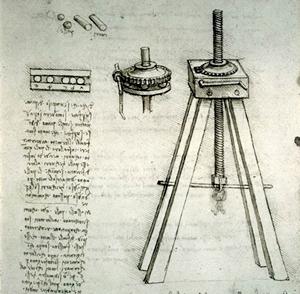
An example of the part–whole analysis is the screw jack that da Vinci came up with to lift heavy objects (da Vinci, Codex Madrid 1, 26 r.). On the right side is the whole object (see Fig. 5). Toward the left is the part showing the ball bearings intended to minimize friction. Again, to the left are the parts of the parts, the balls and bolts.
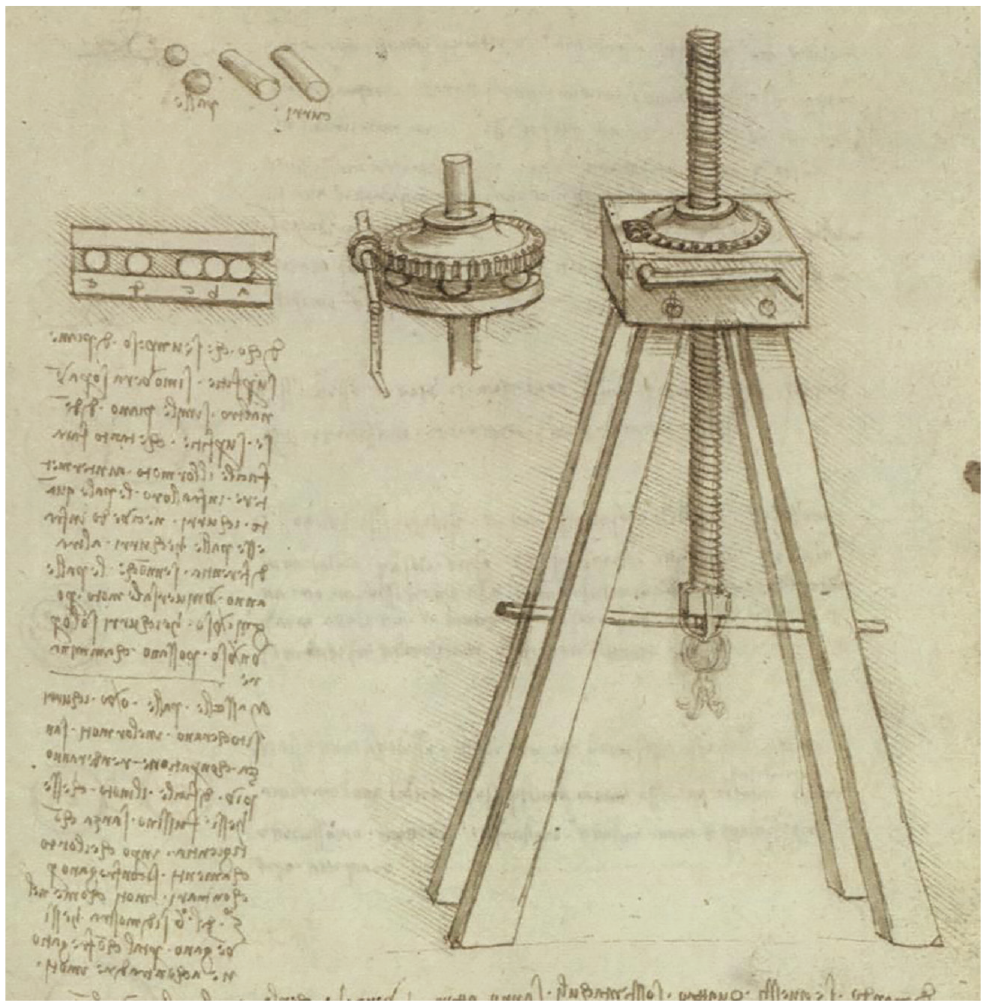
Screw jack (da Vinci, Codex Madrid 1, 26 r.). Image from https://vitruvio.imss.fi.it/foto/4645_1611_0572/4645_1611_0572-025rs.jpg.
To a certain extent, da Vinci’s drawings also served as thought experiments (Isaacson, 2017, p. 196) in which he thought through the mechanisms of his machines and all the details he could imagine and visualize whether they actually would work. His elaborate and skillful drawings can be regarded as a test bed for his thoughts. For more details on the interplay between asking questions and schema elaboration, see the General Recursive Analytico-Synthetic Constellation Amplification (GRASCAM) process (Dörner, 2013).
The second dimension, forward–backward, refers to space and time. For example, a forward schema of an ornithopter would lead to another schema in which a person in the ornithopter moves hands and legs, which trigger the movements of the wings. The next schemas would contain the wings moving upward and then moving downward.
To be more specific, the sequence just described is a chain of sensory-motor schemas: the sensory schema of the person sitting in the ornithopter, the motor schemas of the person moving hands and legs, the sensory schema of wings moving upward, the motor schema of the person moving hands and legs, and the sensory schema of the wings moving downward.
Several qualities allowed da Vinci to come up with elaborate schemas (see also, Isaacson, 2017, pp. 519–521): his detailed observation of phenomena; his imagination, curiosity, and expertise in many domains; his fantasy and tendency to ask questions; and his talent for drawing and thinking visually.
Sociocultural Context: The Renaissance
Up to this point, we have discussed the characteristics of an individual inventor and two of his creations. An individual, however, always lives in a certain historic time, place, and sociocultural context, which heavily influences that person (Csikszentmihályi, 1996).
Leonardo da Vinci lived during the Renaissance, an age marked by innovation. The Renaissance began around the 14th century, as the European feudal system broke down and a developing economy led to advances in art, literature, architecture, music, and technology. A complex web of factors allowed the Renaissance to become the start of modern times (see Roeck, 2017).
Florence, Italy, was the center of the Renaissance because of its wealth from banking. Rich, powerful families such as the Medici, Strozzi, and Perucci were willing to pay artists for paintings, sculptures, and buildings/architecture, so producing art became a well-paid profession. The most creative works of the early Renaissance period in Florence were either commissioned by wealthy families or guild unions. For example, the Merchants’ Guild covered the living expenses and costs of materials for six artists for one year as they competed to make doors for the Florence Baptistery. After 23-year-old Lorenzo Ghiberti was selected for the task, the guild funded him for the next 50 years as he completed a series of bronze reliefs of scenes from the Old and New Testaments (for more details, see Csikszentmihalyi, 2014, p. 57).
It was relatively easy to discover artistic talents during the Renaissance because the style of artwork was very realistic and could easily be judged as authentic and talented. Abstract painting, in vogue during the 1960s at the height of abstract expressionism, cannot be judged by such criteria but perhaps by emotionality and spontaneity (Csikszentmihalyi, 2014). Thus, it was easy to recognize da Vinci’s exceptional skills. As mentioned previously, the incredible quality of da Vinci’s work was already noticed by his contemporaries; only a few were invited to work for the pope and for the French king.
da Vinci was born on April 15, 1452, near Vinci and Florence. As an illegitimate child, his professional trajectory in life would have been impeded during different historic times. However, during the Renaissance, illegitimate children were not uncommon and were generally accepted. General acceptance of his status gave him the freedom to pursue his interests. In contrast, had he been born as the legitimate son of Ser Piero Antonio da Vinci, he would have had no choice but to follow his father’s legal career and become a notary. As an illegitimate child, da Vinci was at the margins of society, a factor that freed him from some societal conventions. However, da Vinci was not excluded (Isaacson, 2017).
Discussion
This article had two goals: first, to develop a theory of the creative process involving subprocesses, further elaborating on Wallas’s (1926) model, and second, to attempt to describe the extraordinary creativity of da Vinci using general psychological terms.
In retrospect, it is “easy” to analyze and describe parts of the creative process da Vinci experienced when he developed his flying machines. However, nothing was known about these flying machines at the time. Since the days of the early Greeks and the myth of Daedalus and Icarus, it has always been humankind’s dream to fly. But the levels of detail and of the quantity related to da Vinci’s notes on birds, flight, and flying machines were unprecedented.
Our main goal was to elaborate on a theory of the creative process. We asked three questions, the first of which refers to the motivation behind creativity—curiosity. We attempted to explain curiosity to discover by referring to human certainty and competence needs. A high certainty need and a low competence need can explain a person’s specific exploration (Berlyne, 1960) of a new area or domain.
The second question asked for an explanation of how new and useful ideas and products are developed through conscious thought—the deliberate aspect of creativity (Dietrich, 2004). Wallas’s (1926) model, in explaining creativity, refers primarily to unconscious processes. What kind of conscious reasoning can produce creative ideas or products? We referred here to Peirce’s (1878, 1883) concept of abductive reasoning. It involves observing a phenomenon and reflecting on the possible causes and explanations. These possible causes and explanations are then tested, and the most plausible one is retained (see also Kolko, 2009). The tools for abductive reasoning are words, meanings, and images, as described in the semiotic triangle (Peirce, 1998), and schema elaborations following primarily the abstract–concrete and forward–backward dimensions (e.g., Dörner, 2003; Dörner & Güss, 2013).
The third question addressed the specific processes happening during incubation and illumination, the stages that Wallas (1926) described. What happens unconsciously when one lets a problem rest and suddenly has an aha insight on how things could work? We have discussed forgetting schema details and unsuccessful attempts to find solutions as possible processes (see also George & Wiley, 2018; Storm & Patel, 2014). Seeing the screw as a flying object could also be explained by analogical and overinclusive thinking. Overinclusive thinking (e.g., Chiu, 2015) and latent inhibition (e.g., Carson et al., 2003) mean that seemingly unrelated material is not inhibited during incubation, the scope of one’s perception is widened, and conceptual boundaries are not preserved (e.g., Gabora, 2010). This allows people to see seemingly unrelated objects as related.
da Vinci’s expertise in so many areas provided a knowledge foundation that facilitated overinclusive thinking. This knowledge base also allowed analogical reasoning. The importance of analogies in the creative process has also been described in other research (e.g., Chan & Schunn, 2015; Chen, 2002) and in case studies on creativity.
Our analyses have limitations that can be addressed in future studies. One limitation is our focus on the elaboration of Wallas’s (1926) model of creativity. Future research could discuss the creative process from different model perspectives and compare those models with each other. We referred to da Vinci’s notes and drawings, but we do not have data about his actual thought processes. It is impossible to determine whether the aerial screw was invented through analogical reasoning, partial forgetting, overinclusive thinking, trial and error, or a combination of the processes. One way to get a concurrent thought process—still not fully concurrent, however—is the use of thinking-aloud or verbal protocols (e.g., Güss, 2018). Another way to get empirical data is through interviews with experts about their creative work (e.g., Güss et al., 2018; Mace & Ward, 2002). Interviews, however, show post hoc reflections about one’s creative work and do not show concurrent thought processes.
Future research could also further formalize the creative process, ultimately allowing the modeling of creativity. For example, trial and error, as the process of taking one alternative thought or decision and testing whether it works, could be simulated relatively easily. Which objects could help a human to fly? A computer could go through a randomly created list of a million objects and examine whether the object could be attached “meaningfully” to a human and enable that human to fly. Of course, for us humans, this is a very cumbersome and inefficient way to proceed, and it is most likely not the way we usually approach such problems. However, it is possible for computers to take this course (see e.g., the new Master chess program AlphaZero, which has beaten the world’s best chess program, Stockfish 8; Pete, 2019).
Our second goal was to attempt to describe the extraordinary creativity of da Vinci using general psychological terms (see also Simonton, 2018; Sternberg, 2018; Weisberg, 2010). Yes, Leonardo da Vinci was special, a genius. He had an enormous store of knowledge about many different domains. He was also a brilliant artist. He studied every single part of a bird, from the feathers at the tip of the wing to the tail, from the head to the chest. He attempted to build a human bird, studying the mathematical laws of wind and birds, applying everything he learned about birds, so that man could become a flying instrument “lacking in nothing except the life of the bird, and this life must be supplied from that of man” (da Vinci, Codex Atlanticus, 161 r. a; da Vinci, 1939, p. 493).
None of us is Leonardo da Vinci, but all of us are a little like him. The creative process we described is based on general psychological mechanisms common to all humans. This creativity is at the heart of human intelligence, of the ability to invent, solve problems, and adapt to new situations.