



Abstract
What explains the acquisition of exceptional human performance? Does a focus on intensive specialized practice facilitate excellence, or is a multidisciplinary practice background better? We investigated this question in sports. Our meta-analysis involved 51 international study reports with 477 effect sizes from 6,096 athletes, including 772 of the world’s top performers. Predictor variables included starting age, age of reaching defined performance milestones, and amounts of coach-led practice and youth-led play (e.g., pickup games) in the athlete’s respective main sport and in other sports. Analyses revealed that (a) adult world-class athletes engaged in more childhood/adolescent multisport practice, started their main sport later, accumulated less main-sport practice, and initially progressed more slowly than did national-class athletes; (b) higher performing youth athletes started playing their main sport earlier, engaged in more main-sport practice but less other-sports practice, and had faster initial progress than did lower performing youth athletes; and (c) youth-led play in any sport had negligible effects on both youth and adult performance. We illustrate parallels from science: Nobel laureates had multidisciplinary study/working experience and slower early progress than did national-level award winners. The findings suggest that variable, multidisciplinary practice experiences are associated with gradual initial discipline-specific progress but greater sustainability of long-term development of excellence.
Some people are vastly superior to other people in their level of performance in complex domains. Consider that the Kenyan runner Lawrence Cherono’s winning time in the 2019 Boston Marathon was approximately 1 hr and 45 min faster than the average time in the highly select field. This means that Cherono was more than 12 miles ahead of the average runner in the race when he crossed the finish line. Or consider that the odds of a highly skilled master-level chess player beating Magnus Carlsen—ranked first in the world—are approximately 1 in 1,000,000,000 (Labelle, 2019). It is more difficult to quantify performance level in domains such as music, art, writing, and science, but individual differences are plainly evident in these domains as well.
What explains such vast individual differences in performance? This question is the subject of one of the oldest scientific debates. One long-standing view is that exceptional performance reflects “natural ability” (e.g., Galton, 1869). The countervailing view is that greatness reflects favorable environmental conditions (e.g., de Candolle, 1873; Watson, 1930). This question has captured the popular imagination in recent years through several bestselling books such as Malcolm Gladwell’s (2008) Outliers, Daniel Coyle’s (2009) The Talent Code, David Epstein’s (2013) The Sports Gene and (2019) Range, and Ericsson and Pool’s (2016) Peak.
Given that exceptional performance of any complex skill requires a considerable amount of experience, the current article focuses on different types of activities high-performers undertook in the process of developing their performance. We attempt to answer a question that has long been discussed in virtually all domains of human performance and educational curricula: Does a focus on intensive specialized practice facilitate excellence, or is a more diversified, multidisciplinary practice background better (e.g., Bear & Skorton, 2019; Ellis & Fouts, 2001; Hatano & Inagaki, 1986; National Academy of Sciences, National Academy of Engineering, and Institute of Medicine, 2005; National Association of Schools of Music, 2019; Repko & Szostak, 2016)?
In this meta-analysis, we investigate the development of exceptional performance in sports. We use sports as our empirical testbed for four reasons. First, like many real-world domains, performance in sports is complex and involves multiple, interacting cognitive, perceptual, motoric, and physiological processes. In this way, sport is an exemplar model for human performance in a wide range of complex tasks. Second, unlike in some other domains, performance in sports is measured by objective, internationally standardized criteria and rules across all levels, from local to international. Third, competitive sport is popular across cultures worldwide, and the massive participation leads to keen competition at all levels. Finally, a number of data sets involving athletes at the highest performance levels have become available only very recently, making meta-analytic comparisons between world-class and national-class athletes viable for the first time.
Early Specialization Versus Early Diversification
We focus on two questions. First, does rapid initial progress predict adult success? And second, what types of sport activities and what amount of each sport activity have elite athletes engaged in during their process of acquiring exceptional performance? There are highly publicized examples of elite athletes who began specialized training at a very young age and progressed rapidly. Introduced to golf by his father, Tiger Woods made his television golf debut at the age of 2, won the Junior World Championships six times as a teen, and became the world’s number one-ranked golfer at age 21 (Woods, 2020). Venus and Serena Williams each started playing tennis at age 3, each turned professional at age 14, and each won her first Grand Slam at age 17 (Buckley, 2017).
On the other hand, Sir Chris Hoy, the most successful racing cyclist of all time, did not start track cycling until age 17 and won his first gold medal at age 26 (Mackay, 2017). College basketball player Donald Thomas started practicing the high jump at age 22 and became world champion in the high jump at age 23 (Denman, 2007). Furthermore, athletes widely regarded as the greatest of all time in their sports, Roger Federer, Michael Jordan, Wayne Gretzky, Michael Phelps, and Sir Chris Hoy, all played a diverse range of sports throughout childhood and adolescence rather than specializing in their main sport at an early age (Epstein, 2019; Landers, 2017; Hawkins, 2014; Mackay, 2017; DeHority, 2020).
These contrasting examples illustrate a major, multidecade debate in the expertise literature and in sports science: Should participation during childhood and adolescence be specialized or diversified (Côté et al., 2007; Hill & Simons, 1989; for recent reviews, see Bell et al., 2018; DiSanti & Erickson, 2019; Kliethermes et al., 2019)?
The different types of sport activities athletes engage in can generally be differentiated on three dimensions (Fig. 1): coach supervision (coach-led vs. youth-led), playfulness (practice vs. play), and sports (single vs. multiple sports). Accordingly, the age, duration, and volume of participation in each activity may vary, leading to countless compositions of different activity types (Thomas & Güllich, 2019).
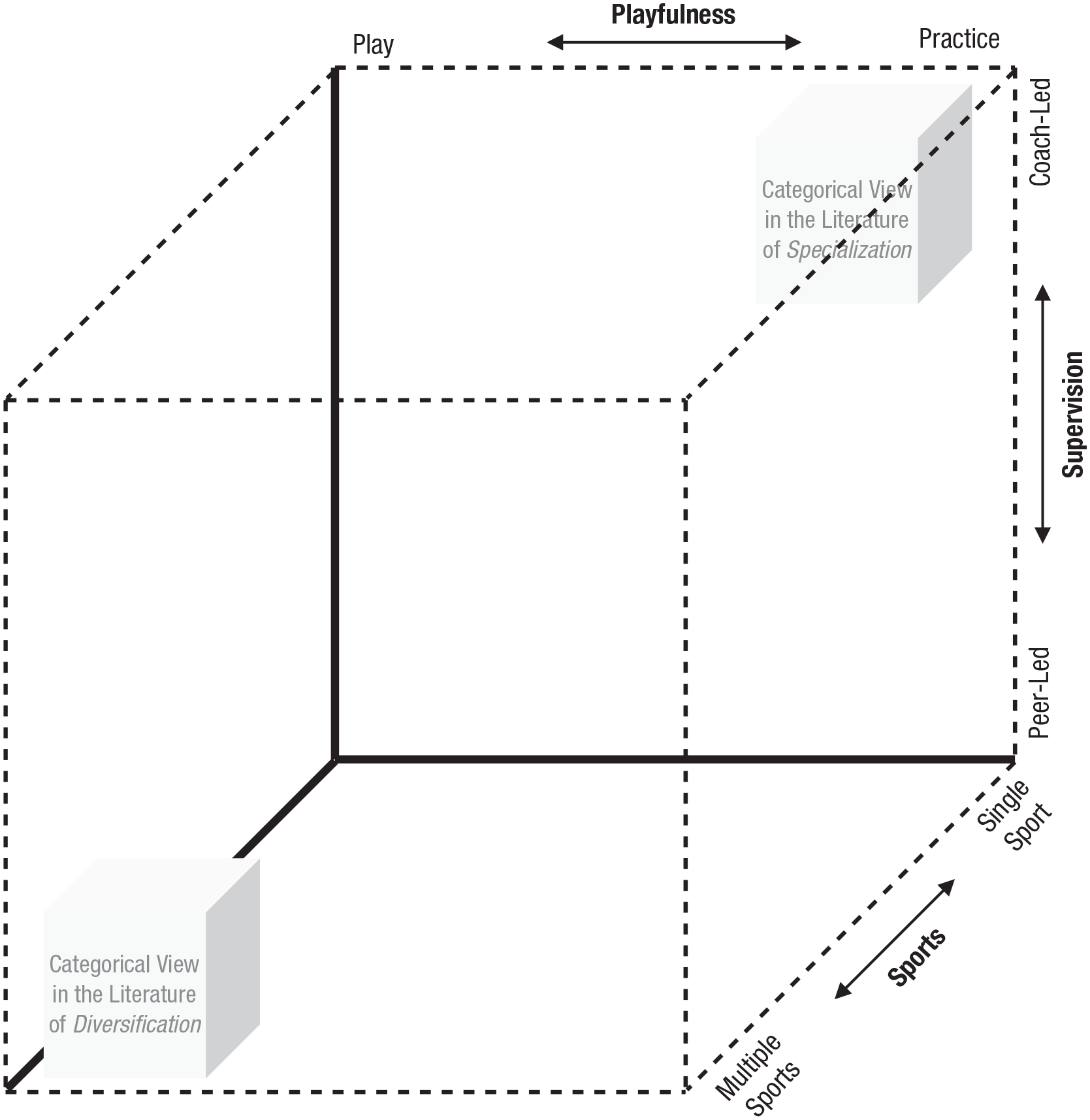
Analytical dimensions of the types of sport activities in which athletes participate.
Out of the many possibilities, two contrasting participation patterns located in opposite areas of the three-dimensional space (Fig. 1) are often described in the literature and labeled early specialization and early diversification. The early-specialization hypothesis holds that people are more likely to progress rapidly and achieve elite performance when they begin intensive, specialized coach-led practice at an early age and focus exclusively on one sport. The early-diversification with late-specialization hypothesis counters that people are more likely to achieve elite performance if they participate in multisport playful childhood/adolescent activities (pickup games) and specialize in a single sport and intensify specialized coach-led practice at later ages. The patterns are implied in the most influential (i.e., most-cited; see Bruner et al., 2010) conceptions of talent development in sport-science literature, the deliberate-practice view (Ericsson et al., 1993) and the Developmental Model of Sport Participation (DMSP; Côté et al., 2007).
Ericsson and colleagues (1993) emphasized the importance of early specialization (for specific reference to sports, see Ericsson, 2013). The deliberate-practice view holds that an athlete’s level of performance is a monotonic function of the amount of accumulated deliberate practice: task-specific practice that is instructed and monitored by a coach and is undertaken to improve one’s performance, involves frequent repetition of a task, is highly effortful, and not inherently enjoyable (Ericsson et al., 1993). Ericsson et al. (1993) advocated maximizing deliberate practice and emphasized that an early start is critical: “the higher the level of attained elite performance, the earlier the age of first exposure as well as the age of starting deliberate practice” (p. 389; see also pp. 387, 388).
In their DMSP, Côté and colleagues (2007; for identical reviews, see Côté & Erickson, 2015; Côté et al., 2014; Erickson et al., 2017) argued that although deliberate practice is necessary to achieve elite performance, athletes should not specialize in one sport and should not engage in intensified deliberate practice until late adolescence. This late specialization should be preceded by a period of childhood/adolescent deliberate play in various sports: playing neighborhood pickup games in informal settings (e.g., playing backyard soccer, street hockey, or basketball in the driveway). In contrast to deliberate practice, deliberate play is regulated by the participants, not by a coach, and is undertaken for the enjoyment of the game itself rather than to improve performance. This period of multisport deliberate play is argued to foster future intrinsic motivation, prolonged engagement, transfer of perceptual-motor skills and of physical conditioning across related sports, and thereby eventual elite performance (Côté et al., 2007).
Early specialization and early diversification have typically been regarded as displaying two contrasting, dichotomous patterns in the literature. However, this view is imprecise (see Fig. 1). Athletes’ participation patterns are generally characterized by six continuous variables: age at which they started their main sport, rate of early progress, amount of main-sport coach-led practice, amount of main-sport youth-led play, amount of other-sports coach-led practice, and amount of other-sports youth-led play. These variables provide a more detailed and accurate characterization of athletes’ participation patterns. At the same time, they enable us to describe in which aspects and to what degree different participation patterns correspond to facets of early specialization/diversification.
The available empirical evidence in the literature concerning these variables is somewhat mixed (for reviews, see Güllich et al., 2020; Macnamara et al., 2016). Each of the variables has been observed to correlate positively with performance in some studies, whereas in other studies they have been observed to be uncorrelated or negatively correlated with performance. This heterogeneity may reflect differences across studies in investigated sports, considered variables, age ranges of athletes, and performance levels compared.
The current meta-analysis aims to establish more robust and generalizable findings by aggregating the results presented in 51 study reports comprising 477 effect sizes from 6,096 athletes, including 404 adult international medalists and 209 gold medalists. Many of these data sets, especially those including world-class athletes, have become available within the past couple of years. Thus, this meta-analysis aims to explore multiple questions, several of which could not be investigated until recently. Specifically, this is the first meta-analysis to (a) investigate the entire multidimensional specialization-diversification continuum; (b) consider the entire range of performance levels, including the development of the world’s best athletes; and (c) compare predictors of youth-age performance versus adult performance.
Method
We report the results in accordance with the Preferred Reporting Items for Systematic Reviews and Meta-Analyses (PRISMA) statement (Moher et al., 2009). See Figure 2 for a flowchart depicting the major steps of the meta-analysis search and screening.
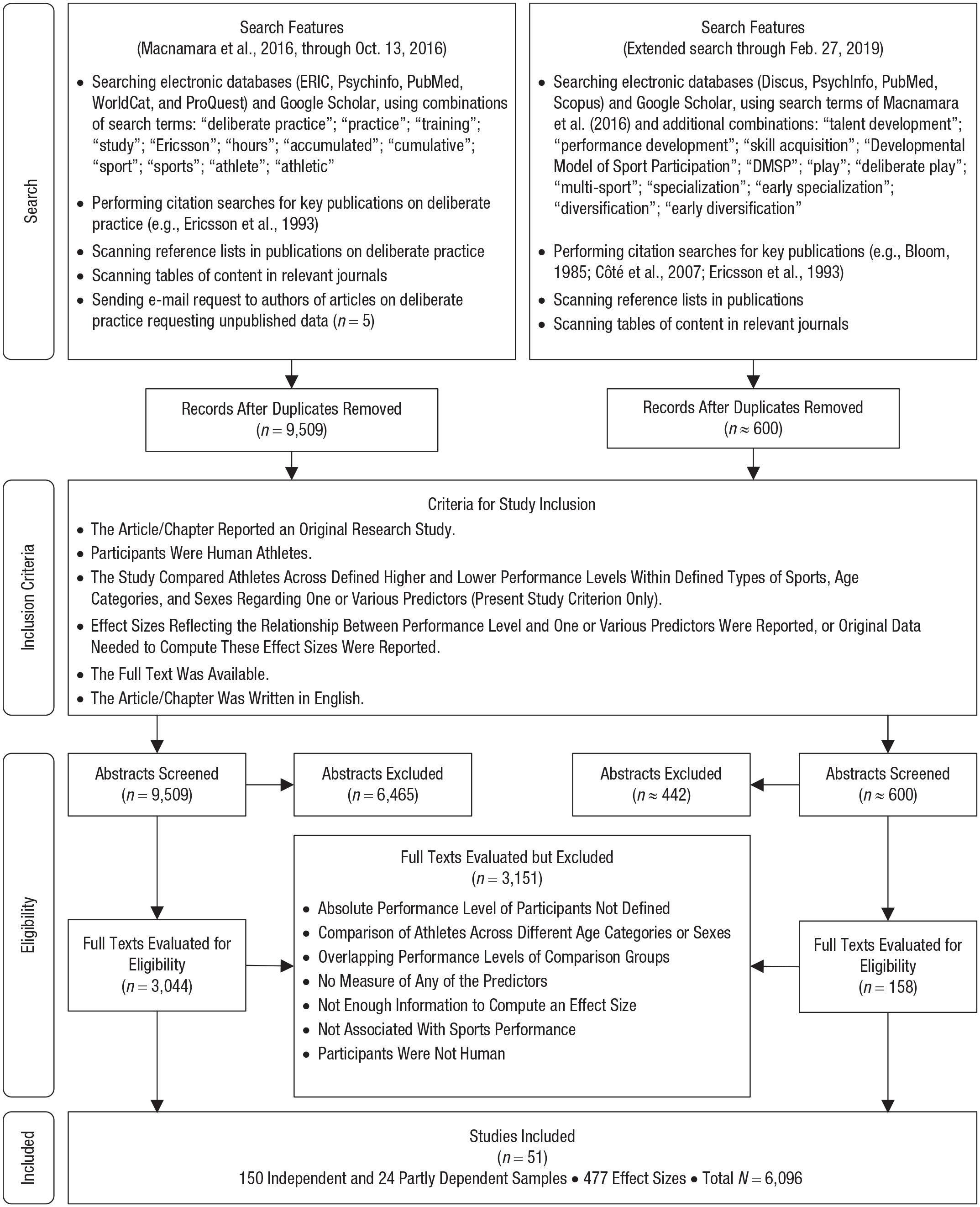
Preferred Reporting Items for Systematic Reviews and Meta-Analyses (PRISMA) flow diagram of the literature search and study coding.
Inclusion criteria and literature search
Studies were included in the meta-analysis if (a) the article/chapter reported an original research study; (b) participants were human athletes; (c) the study compared athletes across defined higher and lower performance levels within a defined type of sport, sex, and age category relative to starting age in the athlete’s respective main sport (henceforth starting age), age to reach performance-related developmental milestones in one’s main sport (henceforth age to reach milestones), amount of main-sport coach-led practice (henceforth main-sport practice), amount of main-sport youth-led play (henceforth main-sport play), and amount of other-sports coach-led practice and/or other-sports youth-led play (henceforth other-sports practice and other-sports play, respectively); (d) effect sizes reflecting the relationship between performance level and one or more of the abovementioned predictors were reported, or the original data needed to compute these effect sizes were reported; (e) the full text was available; and (f) the article/chapter was written in English.
We included the search results from Macnamara et al. (2016), but the scope of our meta-analysis is broader. Macnamara et al. (2016) focused on deliberate practice in one’s main sport; here, we searched for all studies that investigated the effects of any of the variables defining the specialization-diversification continuum: starting age, age to reach performance milestones, and practice and/or play in the athlete’s main sport and/or in other sports. We used a number of additional search terms and citation-chain analyses (see Fig. 2). Furthermore, the search was extended until February 27, 2019.
An examination of these articles and rejection of irrelevant ones resulted in an increase of the original sample by 24 relevant study reports and 438 effect sizes. However, six articles included in the original meta-analysis (Macnamara et al., 2016) were omitted from the current analyses because they did not meet all of our inclusion criteria (for details, see Supplemental Material Part 1 available online), and for one study (Johnson et al., 2006), we excluded the three junior swimmers included in the otherwise senior swimmer sample and recalculated the effect size from the original data in keeping with our inclusion criteria. Thirty-nine of the effect sizes included in the current sample were included in Macnamara et al. (2016), whereas 438 effect sizes are subject to a meta-analysis for the first time.
We also contacted the authors of 17 study reports by e-mail or phone to request effect sizes, original data, clarification of details of their research methods, and/or the competition level of the athletes; all responded.
Sample
The search procedure resulted in a total of 51 relevant study reports from 1998 to 2018. The study reports included 150 independent and 24 partly dependent samples; there were 477 effect sizes and a total sample size of 6,096 athletes. Of the 477 effect sizes, 389 were from published articles and 88 were from unpublished study reports (doctoral dissertations, manuscripts).
Athletes were from 15 countries; 68% were male and 32% were female. A wide range of sports were represented, including all sports of the Olympic Games. Forty-three percent participated in individual sports (e.g., artistic gymnastics, swimming, tennis, track and field, or wrestling), and 57% participated in team sports (e.g., baseball, basketball, cricket, soccer, or volleyball).
Age categories
We distinguished between “junior” (youth) athletes and “senior” athletes: The former refers to junior-age athletes competing in junior-level competitions, whereas the latter refers to athletes who compete in open-age competitions and are typically in their 20s or 30s (see Fig. 3). We determined athletes’ age status on the basis of the official definition of the age limit of the junior category defined by the international sport federations for each sport and sex (e.g., female artistic gymnastics: 16 years; male artistic gymnastics, baseball, and swimming: 18 years; basketball and track and field: 19 years; fencing and wrestling: 20 years). In our sample, 59% were junior athletes, and 41% were senior athletes.
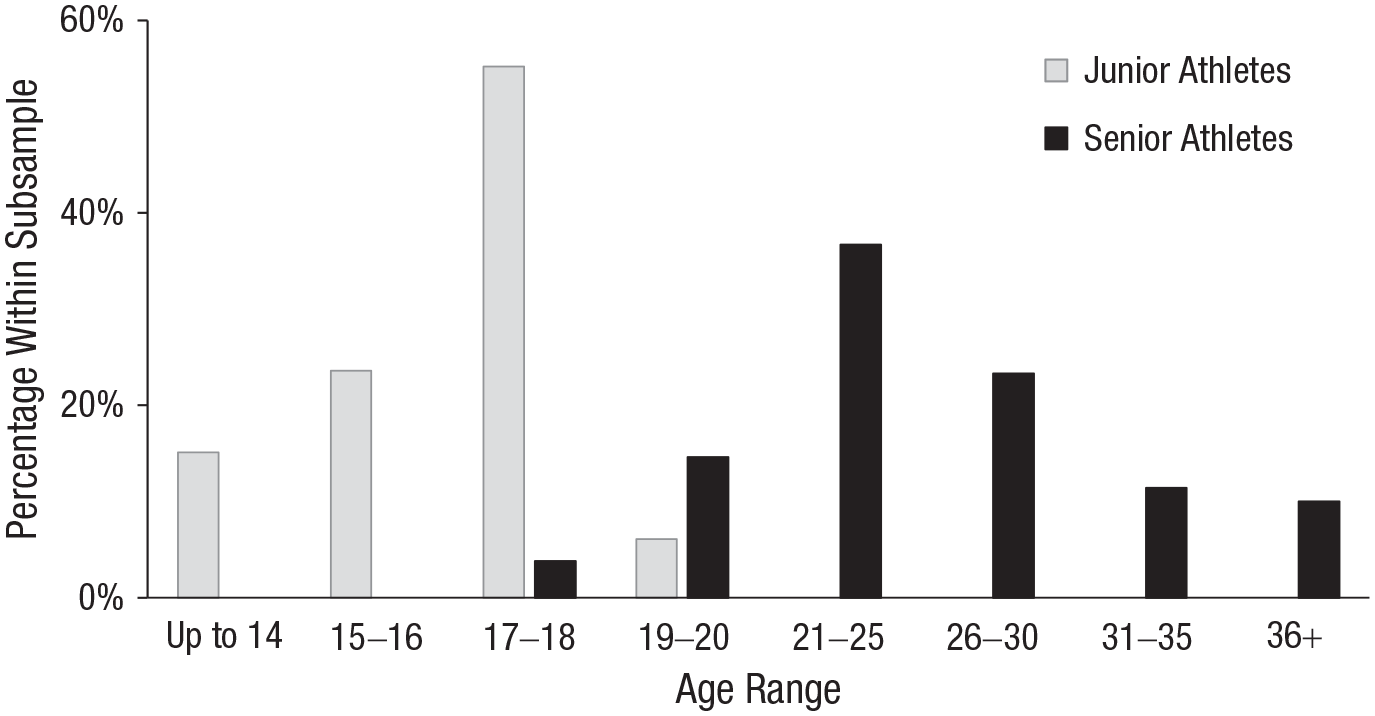
Age distribution of the subsamples of junior and senior athletes.
The distinction between predictors of junior and senior performance is important because the populations of successful junior athletes and successful senior athletes are not identical but are partly distinct populations: Most successful juniors do not become successful senior performers; likewise, most successful senior athletes did not achieve an equivalent success level at (former) junior competitions (for reviews, see Fransen & Güllich, 2018; Güllich & Cobley, 2017). Figure 3 shows the age distribution of the junior and senior athletes. Of the senior athletes, 90% were between 19 and 38 years old; of the junior athletes, 97% were ≤ 19 years old.
Performance levels
To consider the absolute performance level of each sample in the analyzed studies, we defined four performance levels corresponding to different competition levels: world class, national class, regional class, and below (Table 1). We determined the absolute performance levels included in a comparison and the size of the range of the compared performance levels within each study (the “bandwidth”). See Figure 4.
Definition of the Performance Level of the Participants

Note: Five studies reported the performance level of the participants by race times or scores, not competition level. For these cases, we examined the results of regional, national, and international championships in the respective sport to determine the athletes’ competition levels.
These junior athletes placed in the top 10 at international junior-age championships.
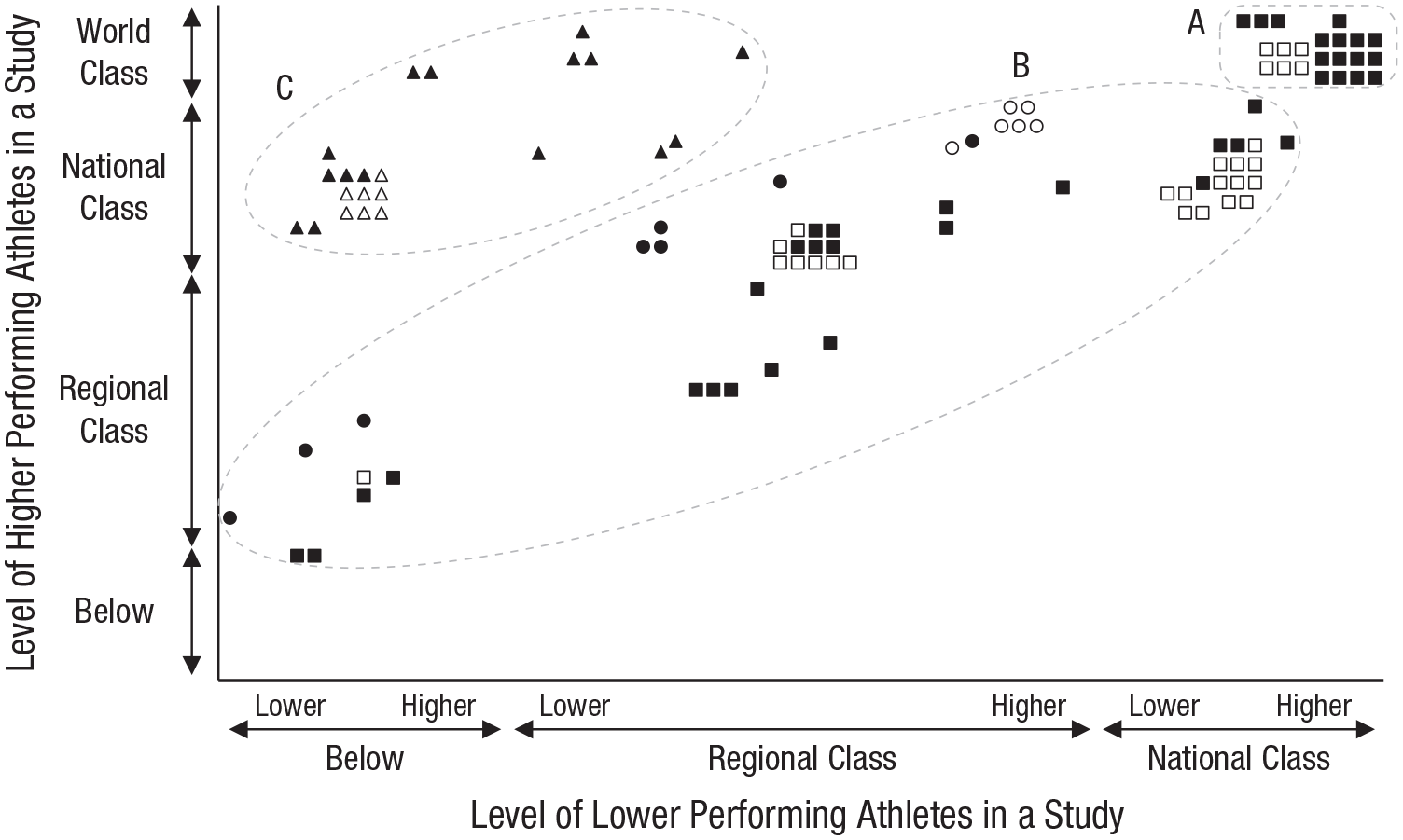
Absolute performance levels compared within each study. Each symbol represents a study, and the performance levels of the lower group and higher group are represented along the x-axis and y-axis, respectively. Relatively small performance differences (narrow bandwidth, indicated by squares) are located near the diagonal from lower left to upper right. The further away from the diagonal the symbol is, the larger the performance difference between compared groups (medium bandwidth, indicated by circles; extreme contrast, indicated by triangles). The “A” area consists of comparisons of world-class versus national-class athletes; the “B” area consists of comparisons among lower performance levels (national, regional, and below regional class); and area “C” consists of comparisons of extreme-contrast performance levels. Filled symbols indicate senior athletes, and open symbols indicate junior athletes.
Comparisons of higher performing and lower performing athletes within a competition level (e.g., within 1st league or within state-championship level), among neighboring competition levels (e.g., world-class vs. national squad players; state- vs. provincial-level championships), or among full professionals in highly professionalized sports, such as baseball and basketball in the United States or soccer in Europe, were defined as narrow bandwidths. Comparisons across nonneighboring competition levels within two levels were defined as medium bandwidths (e.g., world-class vs. state-level athletes). Wider performance differences were defined as extreme-contrast comparisons (e.g., world-level medalists vs. provincial-level or lower).
The question of what distinguishes the most outstanding performers from those just below—that is, world class from national class (Fig. 4, area “A”)—is critically important from both theoretical and practical perspectives. It raises the question of whether predictors among the highest levels differ from those among similar performance bandwidths across lower levels (national class and below; Fig. 4, area “B”). By contrast, we were less interested in extreme-contrast performance differences (Fig. 4, area “C”), which are less relevant from both theoretical and practical perspectives. Furthermore, these differences represent the weakest hypothesis testing and increase the likelihood of Type I error.
Predictors
We investigated the predictive effects of age-related variables and the amount of different sport activities on performance. The empirical indicators of the predictor variables used in the study reports are summarized in Table 2.
Empirical Indicators of the Predictor Variables
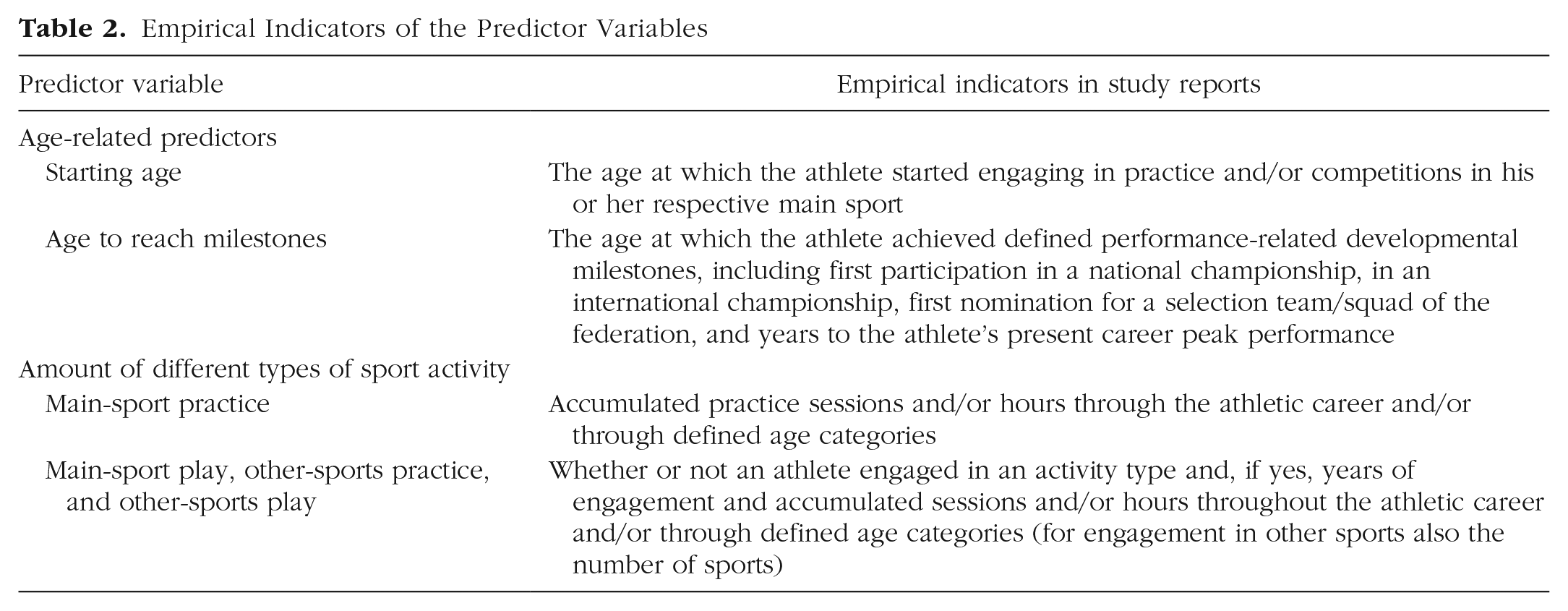
The age-related predictors include main-sport starting age and age to reach milestones (e.g., age of first national championship). Drawing on the concepts of Ericsson et al. (1993) and Côté et al. (2007), we defined different sport activities on the basis of the criteria of sport specificity (activity in the athlete’s respective main sport vs. in other sports) and supervision (coach-led practice in organized settings vs. informal youth-led play in nonorganized settings). The amount of sport activity was thus subdivided into four different types of activity: main-sport practice, main-sport play, other-sports practice, and other-sports play. Some studies did not distinguish between coach-led practice and youth-led play in other sports but reported the pooled amount of any activity in other sports. We therefore considered an additional predictor variable of any activity in other sports (practice and/or play; see Supplemental Material Part 2).
We analyzed predictor effects for the amount of each type of sport activity accumulated through the entire career. Because the early-specialization/deliberate-practice view and the early-diversification/DMSP view especially differ in their predictions associated with childhood/adolescent participation, we also examined predictor effects of athletes’ early sport activities up to the age of 15.
To illustrate the scale and development of the athletes’ sport activities, Figure 5 shows mean amount (in hours) of main-sport practice, main-sport play, and any activity in other sports for the entire sample (weighted means, maxima, and minima). The mean starting age of the samples ranged from 4.9 to 11.8 years. Unsurprisingly, main-sport practice increased continuously from childhood through adulthood (Fig. 5, left). However, the total practice amounts varied considerably across and within samples (Pearson’s coefficient of variability [V ] = 0.14–0.73; Fig. 5, right).
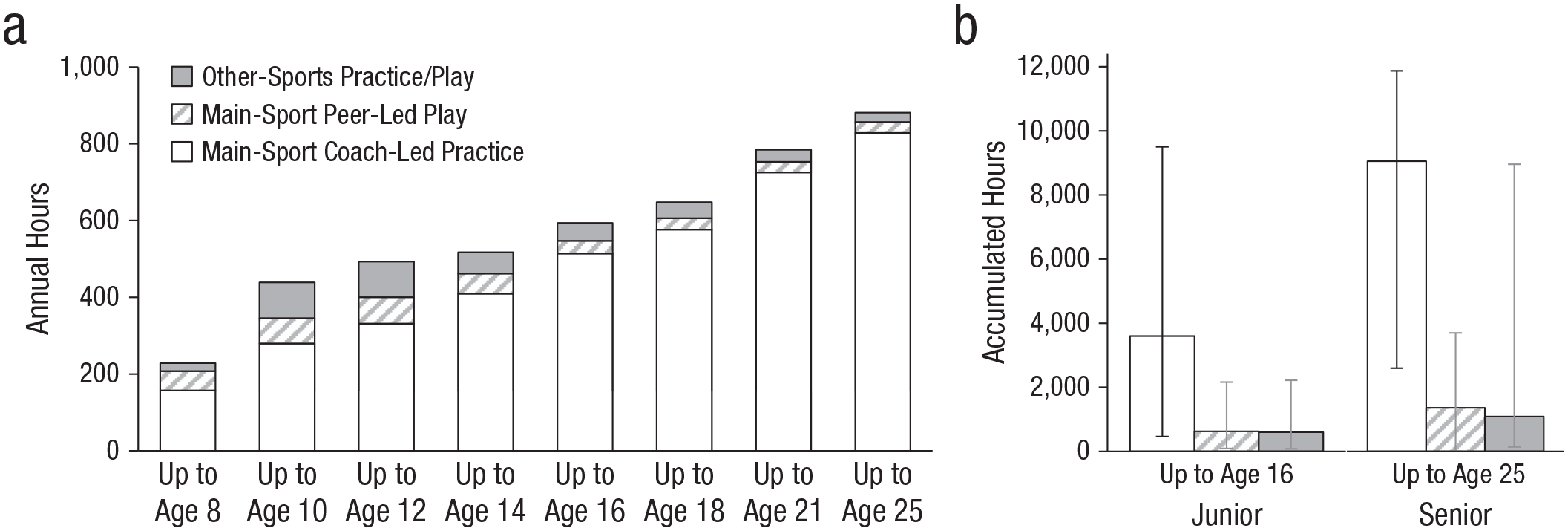
Amount of different sport activities by age category. The graphs show (a) annual time spent participating in different sport activities for all athletes and (b) time accumulated throughout the entire career of junior and senior athletes. Means are weighted by sample sizes; error bars in the right graph represent the range of sample means.
Reported percentages of athletes participating in other sports ranged from 48% to 100% within samples. Engagement in other sports typically started and increased during childhood as well and then was subsequently reduced or ended in adolescence/early adulthood (see Fig. 5, left). Reports on the mean duration of involvement in other sports ranged from 1 to 11 years (sample means) and samples engaged in means of one to seven other sports. Most of the athletes practicing other sports also competed in those sports (69%–88%) for 1 to 8 years (sample means). Absolute amount of participation in other sports varied massively between samples (see Fig. 5, right) and within samples (V = 0.73–3.67).
Research methods of the analyzed studies
The study reports used one of three approaches to determine the different performance levels of the participants: competition level (n = 4,010 athletes; e.g., international, national, and regional championships); coach rating within a defined competition level (n = 2,008 athletes; e.g., coaches evaluated the athlete’s performance or specific representative skills; coach rating also included nomination for a selection team or squad); or measurement of defined representative perceptual-motor skills in the laboratory (n = 78 athletes).
To cover the entire athletic career, which often spans 10 or more years, the methods of choice to record experiential factors are retrospective sport-biography interviews or questionnaires. The data were collected by interview for 701 athletes and by questionnaire for 5,256 athletes. Two study reports (139 athletes) did not define whether data collection used interviews or questionnaires. Of the 477 total effect sizes, 461 were based on group comparisons (5,646 athletes), and 16 were based on correlation analyses (450 athletes).
Effect sizes and coding
For each meta-analysis, we used as the effect size the standardized mean difference (i.e., Cohen’s d) between athletes achieving higher versus lower performance levels within the same type of sport, age category, and gender. The 16 effect sizes based on correlation analyses were converted to Cohen’s d values. Effects were weighted by sample size. When an article or chapter reported various indicators of one predictor variable, we pooled the effect sizes for that study and variable (e.g., starting age for practice and for competitions, practice amounts through 10 years old, 11–12 years old, and so forth through 21–22 years old). Dependent samples were adjusted using Cheung and Chan’s method (2004, 2008).
The number of effect sizes and the sample sizes for each meta-analytic model are shown in Table 3. We coded each study and the measures collected in it for reference information, sample information, measurement information, and results (the data file is available at https://osf.io/63e45).
Effect Sizes (k) and Sample Sizes (N) of Each Model Examining Comparisons of Age-Related Predictors or Amounts of Defined Sport Activities Between Groups
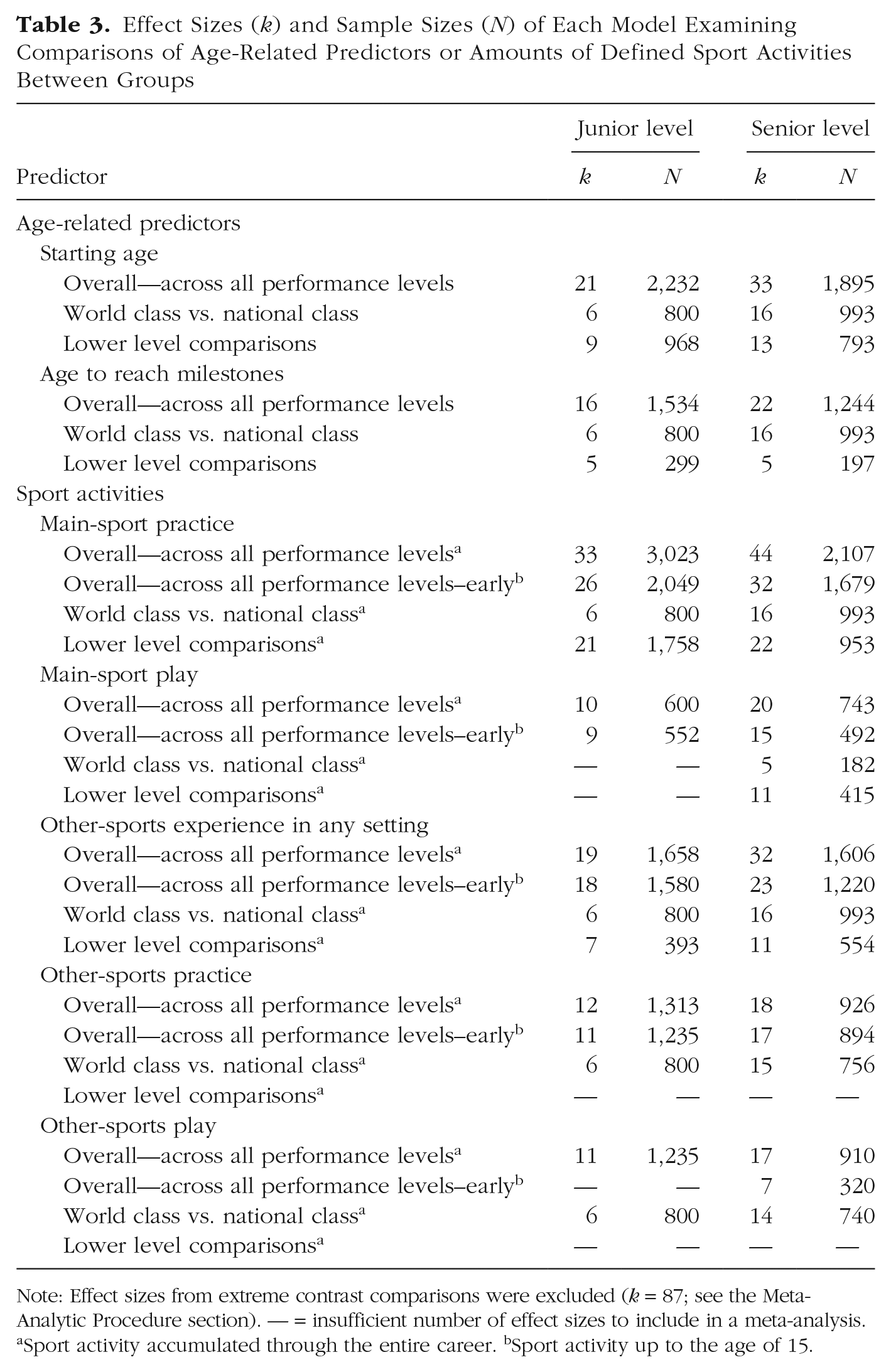
Note: Effect sizes from extreme contrast comparisons were excluded (k = 87; see the Meta-Analytic Procedure section). — = insufficient number of effect sizes to include in a meta-analysis.
Sport activity accumulated through the entire career. bSport activity up to the age of 15.
Meta-analytic procedure
The first step was to obtain the standardized mean difference between athletes achieving higher versus lower performance levels within a type of sport and age category in a sample on one of our predictors and the corresponding sample sizes.
The second step was to test whether including extreme contrasts (e.g., comparing an Olympian to a local-level athlete) produced relatively extreme effect sizes, which would obfuscate meaningful comparisons. We did this by comparing the effect sizes among narrow, medium, and extreme bandwidths for main-sport practice (the model with the most effect sizes). As predicted, extreme contrasts produced extreme effect sizes, the average being more than 5 times the size of the average for narrow-bandwidth comparisons, narrow:
The third step was to search for outliers in each model, which we defined as Cohen’s ds for which the residuals had z-scores of 3 or greater within the athlete age category (junior or senior age).
The fourth step was to conduct random-effects meta-analyses to estimate the overall effect and heterogeneity among the effect sizes and then to conduct mixed-effects meta-analyses to test whether some of the heterogeneity was predictable from moderator variables. For all moderator analyses, we used the rule of thumb that at least five studies are needed per subgroup (Williams, 2012).
The final step was to perform publication-bias analyses. We used Comprehensive Meta-Analysis (Version 2; Biostat, Englewood, NJ) to conduct analyses. All statistical testing was two-sided.
Results
This section is structured as follows. First, we report whether age-related factors (main-sport starting age, age to reach milestones) predict success and then whether the amount of different sport activities (main-sport practice, main-sport play, other-sports practice, other-sports play) predicts success. For each predictor, we first examine whether there are differences between relatively higher and lower performing athletes in the entire sample (junior and senior athletes, all performance levels; i.e., pooling of areas “A” and “B” in Fig. 4) and whether athletes’ age category—junior level versus senior level—moderates effects. For the amount of different sport activities, we then examined whether early experience is critical by including activities only up to the age of 15. Second, we report predictor effects among the highest performance levels—world class versus national class (Fig. 4, area “A”)—and whether they differ from effects on performance differences among the lower performance levels (comparisons among national class and lower; Fig. 4, area “B”). We report these results separately for junior and senior athletes. Finally, we explore whether patterns of effects differ across types of sports.
Forest plots and I2 statistics for all meta-analytic models are provided in Figures S1–S7 in the Supplemental Material Part 2, together with the results for other-sports experience in any setting (practice and/or play pooled). Publication-bias analyses are reported in Supplemental Material Part 4.
Starting age
Overall, athletes achieving relatively higher performance levels and those achieving lower performance levels began playing their main sport at a similar age,
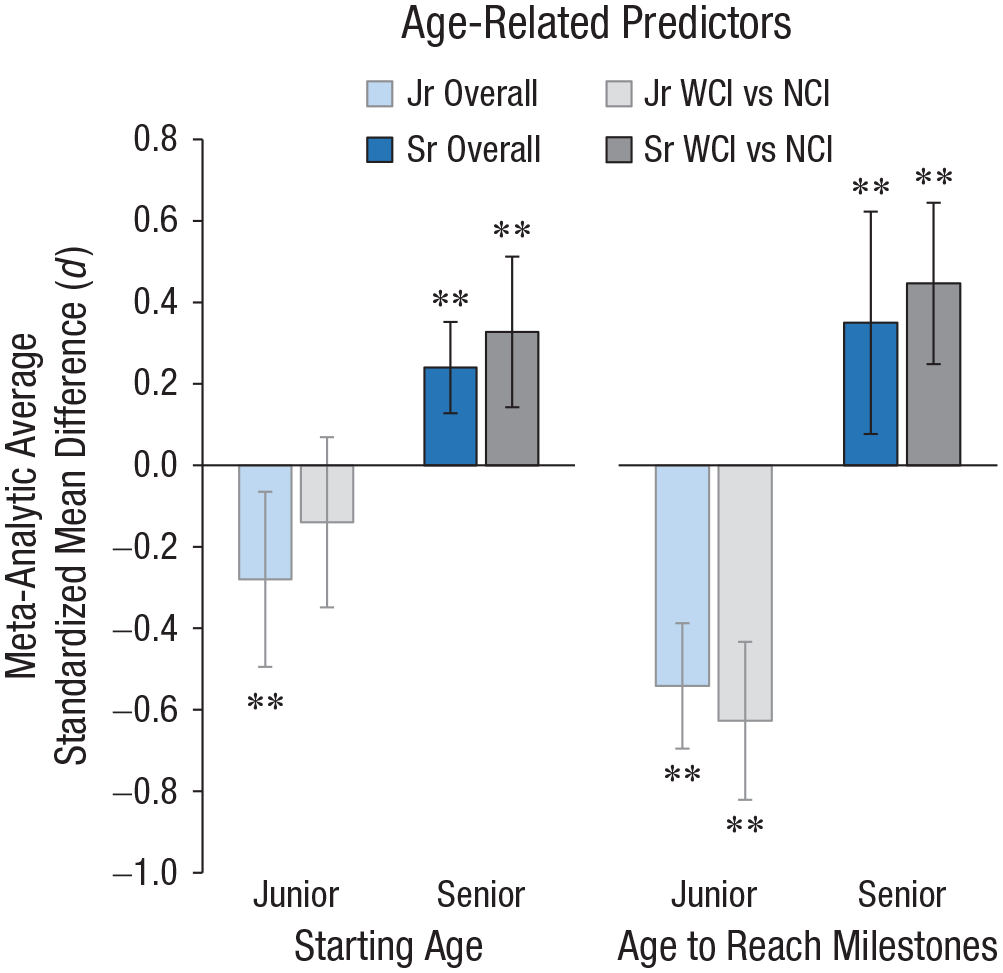
Effects (Cohen’s d) of main-sport starting age (left) and age to reach milestones (right), separately for junior (Jr) performance (lighter shading) and senior (Sr) performance (darker shading). The colored bars show differences between relatively higher performing and lower performing athletes across all performance levels (overall). The gray bars show differences between world-class (WCl) and national-class (NCl) athletes. A negative effect indicates that younger ages were associated with higher performance, whereas a positive effect indicates that older ages were associated with higher performance. Error bars represent 95% confidence intervals. Asterisks indicate significant difference between higher and lower performing athletes (**p < .01).
Given the opposing pattern of results observed between junior and senior athletes, we compared world-class and national-class athletes separately within junior athletes and within senior athletes. Junior world-class and national-class athletes did not significantly differ in their starting ages,
In contrast, senior world-class athletes started their main sport significantly later than did their national-class counterparts,
Age to reach performance-related developmental milestones
We next examined whether the age the athlete reached defined milestones in their main sport (e.g., first national championships, first nomination for a selection team) differed between athletes achieving relatively higher versus lower performance levels. They did not:
Given the opposing pattern of results observed between junior and senior athletes, we compared world-class and national-class athletes separately within junior athletes and within senior athletes. Junior world-class athletes reached milestones earlier than did their junior national-class counterparts,
By contrast, senior world-class athletes reached milestones significantly later than did their national-class counterparts,
Main-sport coach-led practice
Overall, athletes achieving relatively higher performance levels accumulated more main-sport practice than did athletes achieving lower performance levels,
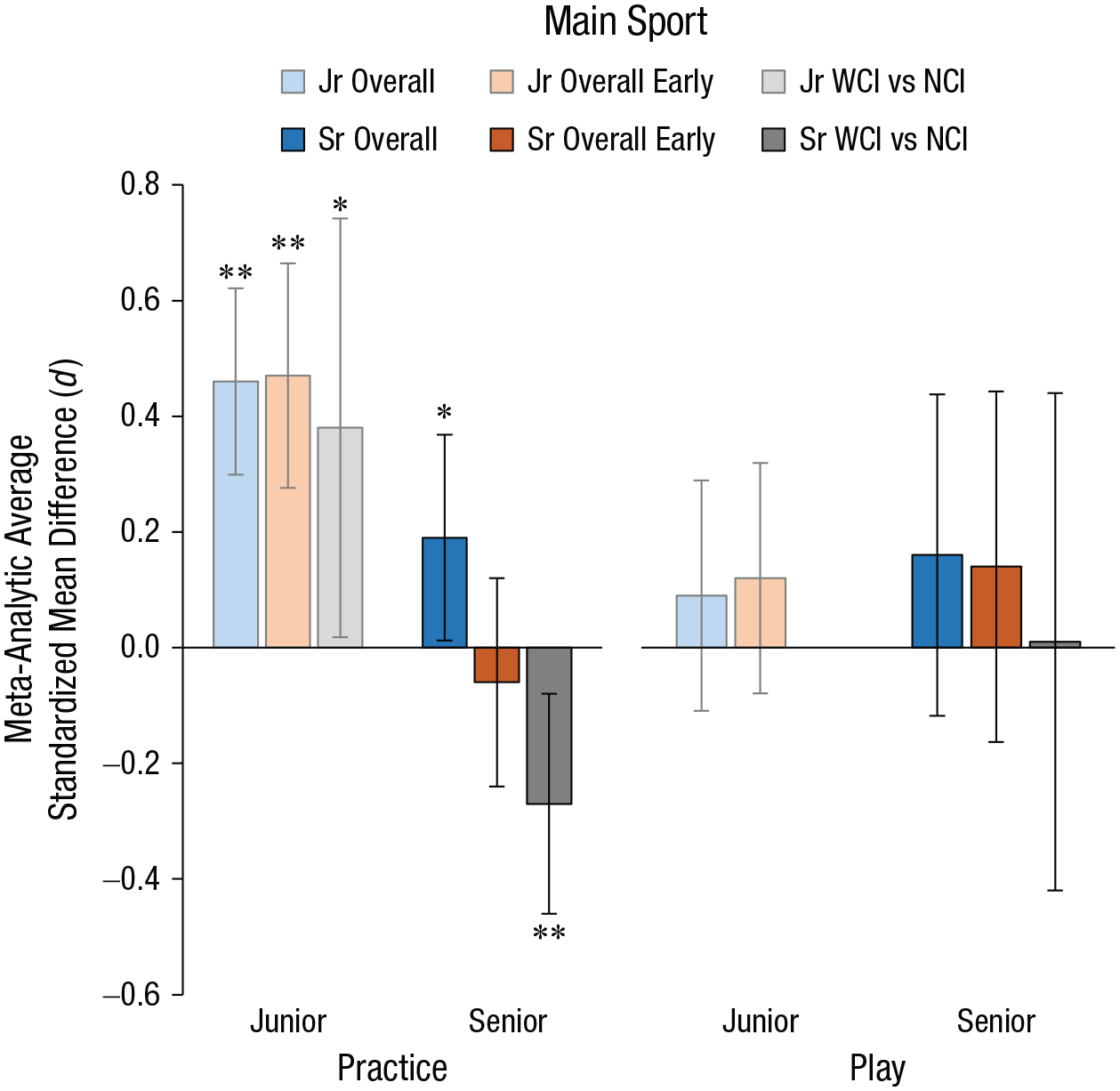
Effects (Cohen’s d) of main-sport practice (left) and main-sport play (right) on junior (Jr) performance (lighter shading) and senior (Sr) performance (darker shading). The colored bars show differences between relatively higher performing and lower performing athletes across all performance levels for amounts of practice or play accumulated throughout the entire career (overall; blues) or amounts of practice or play accumulated up to the age of 15 (overall early; oranges). The gray bars show differences between world-class (WCl) and national-class (NCl) athletes for amounts of practice or play accumulated throughout the entire career (WCl vs. NCl; grays). Error bars represent 95% confidence intervals. Asterisks indicate significant difference between higher and lower performing athletes (*p < .05, **p < .01).
Early amount
Relatively higher performing athletes accumulated more early main-sport practice up to the age of 15 than did relatively lower performing athletes overall,
World class versus national class
Junior and senior athletes were examined separately because of the significant moderation of the age category. Junior world-class athletes accumulated greater amounts of main-sport practice throughout their careers compared with their national-class counterparts,
In contrast, senior world-class athletes accumulated significantly less main-sport practice throughout their entire career than did their national-class counterparts,
Main-sport youth-led play
There was no significant difference in the amount of accumulated main-sport play between athletes attaining relatively higher versus lower performance levels overall,
Early amount
The amount of early main-sport play did not significantly differentiate higher from lower performing athletes overall,
World class vs. national class
For junior athletes, only one study was available that compared world-class and national-class athletes. We therefore conducted this analysis among only the senior athletes. There was no difference in the amount of accumulated main-sport play between senior world-class and national-class athletes,
Other-sports coach-led practice
Overall, athletes achieving relatively higher performance levels accumulated more other-sports coach-led practice than did athletes achieving relatively lower performance levels,
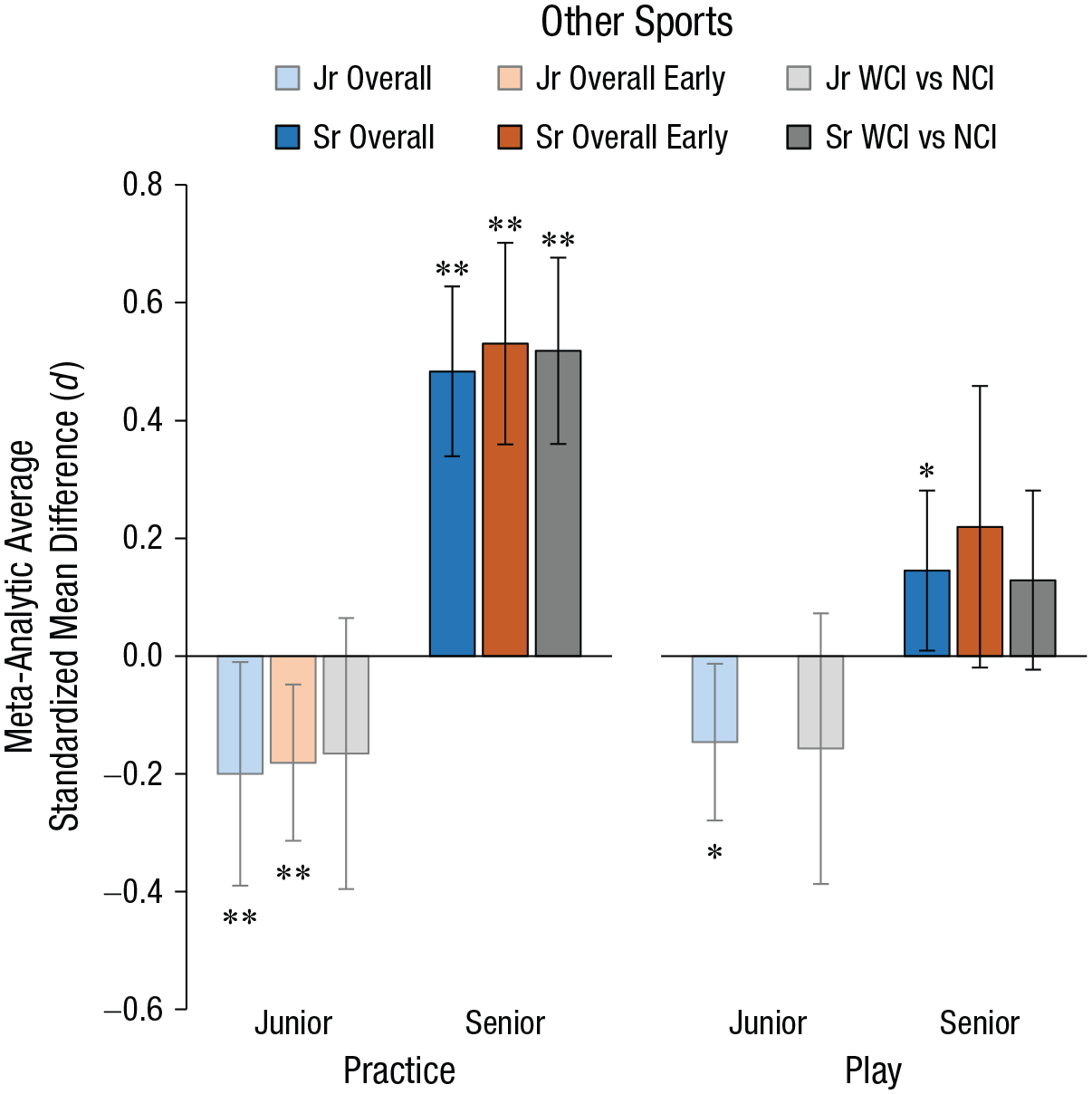
Effects (Cohen’s d) of other-sports practice (left) and other-sports play (right) on junior (Jr) performance (lighter shading) and senior (Sr) performance (darker shading). The colored bars show differences between relatively higher performing and lower performing athletes across all performance levels for amounts of practice or play accumulated throughout the entire career (overall; blues) or amounts of practice or play accumulated up to the age of 15 (overall early; oranges). The gray bars show differences between world-class (WCl) and national-class (NCl) athletes for amounts of practice or play accumulated throughout the entire career (WCl vs. NCl; grays). Error bars represent 95% confidence intervals. Asterisks indicate significant difference between higher and lower performing athletes (*p < .05, **p < .01).
Early amount
Relatively higher performing athletes accumulated more early other-sports practice up to the age of 15 years than did relatively lower performing athletes overall,
World class versus national class
We examined junior and senior athletes separately. Junior world-class athletes and their national-class counterparts accumulated similar amounts of other-sports practice throughout their careers,
Senior world-class athletes accumulated significantly greater amounts of other-sports coach-led practice than did their national-class counterparts,
Other-sports youth-led play
Overall, there was no difference in the amount of other-sports youth-led play between athletes attaining relatively higher versus lower performance,
Early amount
Only one effect size was available for early other-sports play among junior athletes. We therefore conducted a model for the senior sample only. There was no significant difference between relatively higher and lower performing senior athletes:
World class vs. national class
Junior and senior athletes were examined separately. There was no significant difference between junior world-class athletes and national-class athletes in other-sports play accumulated throughout the career,
We also found no significant difference between senior world-class and national-class athletes in other-sports play accumulated throughout the career,
Effects in different types of sports
Each effect size that we included in our meta-analysis was based on a comparison within sports and age category (e.g., higher vs. lower performing senior swimmers, higher vs. lower performing junior soccer players). Figure 9 shows patterns of effects across different types of sports. The effect sizes are reported for the most relevant predictor variables from the previous general analyses (i.e.,
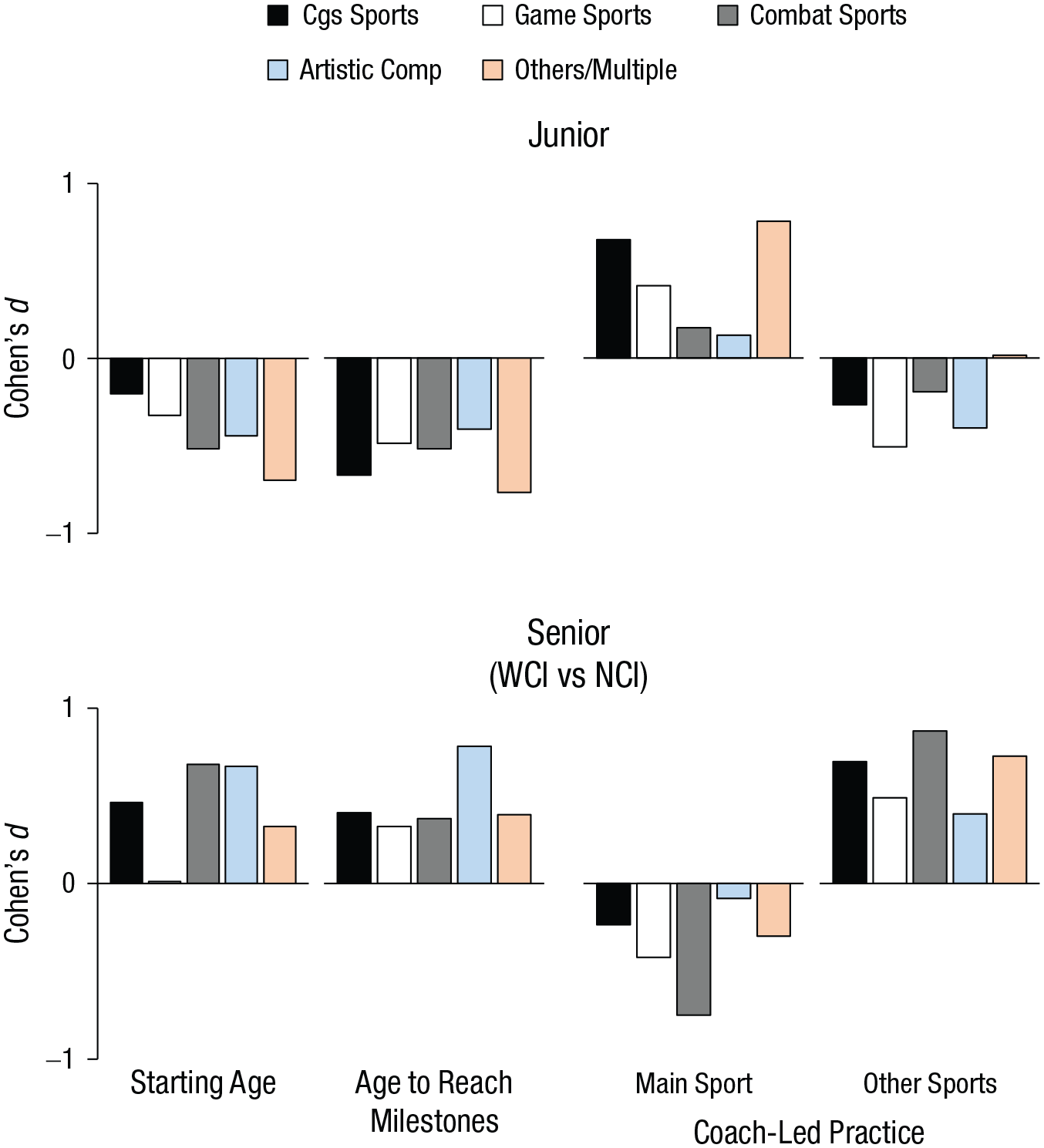
Effects of age-related and practice-related predictors on performance in different types of sports. The graphs show meta-analytic Cohen’s
There were not enough effect sizes in all sports types for each predictor to conduct moderator analyses across the types of sports. Nonetheless, at a descriptive level, the patterns of effects were generally consistent across these very different types of sports, and the pattern within each type of sport was similar to the general findings reported above. Most notably, the directions of effects of each predictor variable were consistent across the types of sports in both junior and senior athletes (Fig. 9). In none of the types of sports was a contrary pattern of effects relative to the other types of sports apparent. Moreover, our overall finding that the predictors of relatively higher junior performance were not only different from, but opposite to, the predictors of the highest senior performance level was confirmed across the different types of sports. Taken together, these observations suggest that the current findings are robust and generalizable.
Discussion
The current meta-analysis investigated the effects of main-sport and other-sports practice and play activities, along with rates of early progress, on sports performance in a sample of 6,096 athletes. This is the first meta-analysis to examine the full range of predictor variables defining the multidimensional specialization-diversification continuum in a sample spanning all performance levels, from youth novices to Olympic champions. Major findings are summarized in Table 4.
Overview of Predictor Effects on Relatively Higher Sports Performance: Overall Effects (Across All Performance Levels) and Effects Among the Highest Performance Levels (World Class vs. National Class)
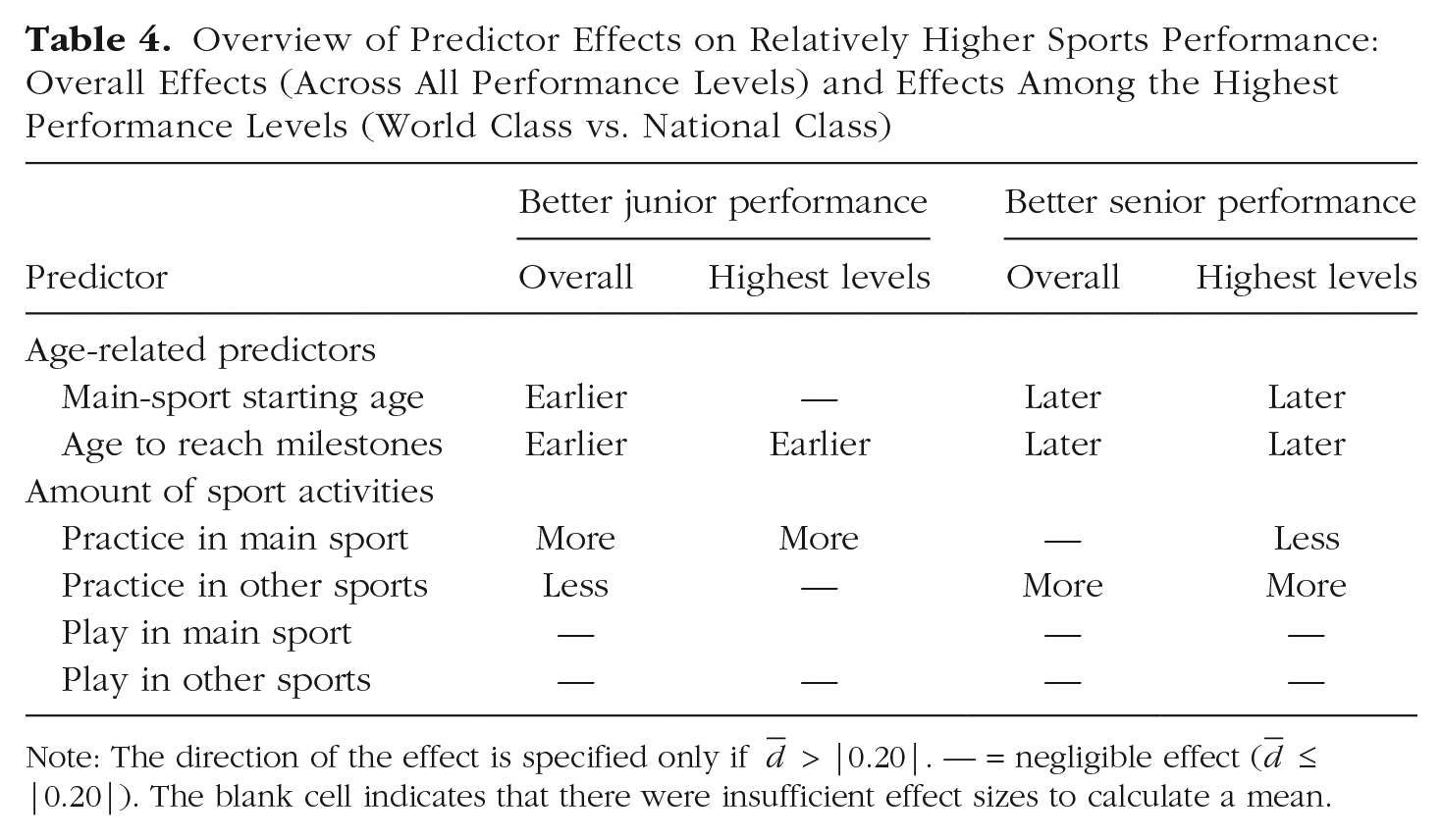
Note: The direction of the effect is specified only if
Three central findings emerged from the meta-analysis. First, the amount of multisport practice was a critical factor in discriminating between adult world-class athletes and their national-class counterparts. Senior world-class performers engaged in more coach-led practice in sports other than their main sport during childhood/adolescence and, relatedly, began playing their main sport later, accumulated less main-sport practice, and reached performance milestones at a slower rate than national-class performers. That is, senior world-class athletes who began their main sport early and specialized are the exception, not the rule.
Second, in most cases, predictors of junior-level performance were not only different from, but opposite to, those of senior-level performance. Specifically, better junior-age performers started main-sport practice earlier, accumulated more childhood/adolescent main-sport practice but less other-sports practice, and reached performance milestones at a faster rate than did their lower performing counterparts.
Third, youth-led play in one’s main sport and in other sports had negligible effects on both junior and senior performance. These three main findings are consistent with results from studies that controlled for potential confounds through matched-pairs analyses, including multiyear longitudinal quasiexperiments (Güllich, 2017, 2018b; Güllich & Emrich, 2014; Güllich et al., 2017; Hardy et al., 2013).
The findings have far-reaching practical implications for local sports clubs and high school sports as well as talent-development programs (TDPs) such as youth sport academies, elite sport schools, and federations’ squad programs at regional and national levels. These sports organizations make a choice, which may or may not be conscious and well informed: to reinforce rapid junior success at the expense of long-term senior success or to facilitate the long-term development of senior performance at the expense of early junior performance.
Institutional TDPs typically select young athletes around the age of puberty (Güllich, 2014b; Güllich & Emrich, 2006). They select the young athletes who show the most advanced performance at this age. Before the time of selection, these athletes have typically invested great amounts of time in sport-specific practice but have done little or no other-sports practice (Güllich & Cobley, 2017; in addition to having accelerated biological maturation and being relatively old within their birth year; Cobley et al., 2009; Malina et al., 2015). Once selected, the TDPs aim to further expand the young athletes’ sport-specific practice (Güllich & Cobley, 2017). The strategy likely increases the probability of early junior success but compromises the sustainability of long-term development of international senior success. Furthermore, the selection strategy will likely have a “radiating” effect (Güllich, 2014b), encouraging reinforced specialized practice among all the young athletes who aspire to be admitted to TDPs or to receive a sports scholarship. The pattern of recruitment and training is likely further reinforced by coaches’ employment structure: Many youth coaches have relatively short contracts, and the evaluation of their work and renewal of their contract is based on the current performance of their athletes. Therefore, it is in each coach’s best interest to select the most accelerated young athletes and seek to further accelerate their current progress.
On the other hand, senior world-class athletes in our meta-analysis were selected for TDPs at a later age than were their national-class counterparts. That is, early TDP involvement correlated negatively with senior world-class performance, indicating that early selection and involvement in TDPs is neither necessary nor beneficial to long-term senior success. The detrimental effects of early TDPs may be mitigated by postponing selection to later age ranges. Furthermore, in addition to being open to new athletes through late adolescence and early adulthood, TDPs may proactively search for promising athletes from other sports (Vaeyens et al., 2009).
This research focused on sports, but analogous findings have been reported for at least one nonathletic domain: science. Graf (2015) examined the biographies of the 48 German Nobel laureates in physics, chemistry, economy, and medicine/physiology since 1945. Forty-two had multidisciplinary study and/or working experiences. Compared with winners of the Leibnitz prize—Germany’s highest national science award—Nobel laureates were less likely to have won a scholarship as a student and took significantly longer to earn full professorships and to achieve their award. Taken together, the observations suggest that early multidisciplinary practice is associated with gradual initial discipline-specific progress but greater sustainability of long-term development of excellence.
Theoretical implications
The current findings on the development of excellence in sports do not call into question the importance of extensive sport-specific practice. At high levels of senior competition, all athletes had accumulated substantial amounts of main-sport practice. However, a critical discriminator among the highest levels of senior performance was the amount of other-sports practice.
How can the observed pattern of results be explained? Neither of the aforementioned theoretical views—the deliberate-practice view (Ericsson et al., 1993) or the DMSP (Côté et al., 2007)—adequately explain the full pattern of results. The deliberate-practice view partly corresponds to participation patterns of successful junior-level athletes. However, the deliberate-practice view is inconsistent with the empirical evidence on the participation patterns that differentiate senior-level world-class from national-class athletes. Thus, the framework used by Ericsson et al. cannot adequately explain individual differences among the highest levels of athletic performance. Ericsson and colleagues (1993) and Ericsson (2013) focused only on task-specific practice. Their recommendation to maximize task-specific practice implies that investing time and effort in practice in other sports is detrimental to one’s main-sport performance. This recommendation is not only inconsistent with but also contrary to the empirical evidence.
Côté and colleagues’ (2007) DMSP is also inconsistent with the empirical evidence and consequently cannot provide explanatory approaches. In particular, there was no evidence that the accumulated amount of youth-led play predicted subsequent performance. Côté and colleagues’ first argument was that childhood deliberate play promotes later intrinsic motivation and prolonged engagement. However, there is little empirical evidence to support this hypothesis and some evidence to contradict it (Hendry et al., 2014; Hendry & Hodges, 2019; Thomas & Güllich, 2019). Côté et al.’s second argument was that there is direct transfer of perceptual-motor skills and physical conditioning across related sports (sports that share common motor, perceptual, conceptual, or physical-conditioning elements). Indeed, such transfer has been reported (Abernethy et al., 2005; Causer & Ford, 2014; Schmidt & Wrisberg, 2000). However, this direct transfer cannot explain why practice in other sports is more beneficial than using the time for extended main-sport practice or why coach-led practice but not youth-led play in other sports correlated with later main-sport performance. In addition, research indicates that the benefit of other-sports practice is not moderated by the degree of relatedness of the other sports with one’s main sport (Güllich, 2014a, 2017, 2018a, 2018b; Güllich & Emrich, 2014; Hardy et al., 2013; Johnson et al., 2006).
Further, traditional views of giftedness, or what is commonly referred to as “innate talent,” have conceptualized a fast rate of early progress in a domain as an indicator of giftedness and as a determinant of ultimate performance (e.g., Gagné, 2015; Heller et al., 2005; Simonton, 2007; Von Károlyi & Winner, 2005). The notion corresponds to our findings among junior-level athletes. However, it is inconsistent with the empirical evidence on the development of the highest senior performers. Specifically, it is inconsistent with the observation that world-class senior performers initially progressed more slowly than did less accomplished senior performers. This type of giftedness theory, which assumes that giftedness manifests in rapid initial progress, thus does not have explanatory power for the highest senior performance levels either.
In sum, these established theoretical views of expertise fail to explain the full pattern of results revealed by the current meta-analysis. One of the reasons for some of the misdirection in existing theories of expert performance is presumably that former theorists commonly based their hypotheses on observations of very young (subelite) performers and/or extreme group comparisons (Côté et al., 2007; Ericsson et al., 1993; see also, e.g., Baker et al., 2003a, 2003b; Duffy et al., 2004; Ford et al., 2016; Ward et al., 2007). Our findings demonstrate that predictors of the highest senior performance level cannot be concluded by extrapolating findings from junior athletes, moderate performance ranges, or extreme contrast comparisons. In fairness, studies comparing senior world-class athletes and national-class athletes have only very recently become available to an appreciable extent. Thus, former theorists may have been incapable of understanding predictors among the highest performance ranges.
A critical question is why and how childhood/adolescent variable multisport practice benefits specific main-sport performance in adulthood. Although numerous studies have reported the phenomenon, there has still been relatively little research aimed at investigating its causal factors. Nevertheless, we can offer tentative speculations that seem justified on the basis of the extant evidence and hypotheses that seem important to investigate in future research.
We propose three interrelated hypotheses. The first is the sustainability hypothesis: Childhood/adolescent participation in multiple sports is associated with a lower risk of later overuse injury and burnout (for reviews, see Bell et al., 2018; Waldron et al., 2020). World-class senior athletes may have reached that level in part because they were less encumbered by injury or burnout (Rugg et al., 2018; Wilhelm et al., 2017).
The second is the multiple-sampling-and-functional-matching hypothesis: The focus on one main sport emerges from an athlete’s experiences in multiple sports, which increases the odds that an athlete will select a sport at which he or she is particularly talented (Güllich, 2017; Güllich & Emrich, 2014). Athletes who engage in multiple sports during early athletic development are more likely to find the sport that best matches their talents and preferences. Athletes who discover their optimal sports match are more likely to be world-class athletes than if they select and focus on a less-than-optimal sports match. A minority of athletes became senior world-class athletes despite specializing early. According to this hypothesis, those few successful early-specializing athletes likely either selected their optimal sport without sampling by luck or were talented in multiple sports, one of which was their selected sport.
The third is the transfer-as-preparation-for-future-learning (PFL) hypothesis: More varied earlier learning experiences facilitate later long-term domain-specific skill learning and refinement (Bransford & Schwartz, 1999; Güllich, 2017). The PFL hypothesis corresponds to central tenets of general learning theory (Bransford & Schwartz, 1999) and of self-organization of complex systems according to ecological-dynamics theory (Araújo et al., 2010; Davids et al., 2012). The PFL hypothesis rests on two premises. One is that amplified variation in learning tasks and situations may facilitate athletes’ ability to adapt their intentions and perceptual and motor actions in learning (e.g., Araújo et al., 2010; Davids et al., 2012). For example, practicing broader ranges of skills and experiencing varied practice drills, conditioned game formats, or varying coach-athlete interaction may provide the learner enhanced opportunities to adapt to different coaching styles, adapt their attentional focus or the intention for specific actions (e.g., to dribble, pass, or shoot in game situations). The other premise is that experience of greater variation in learning methodologies may provide an athlete with enhanced opportunities to understand the principles that lead to individually more or less effective learning, which facilitates the development of the elite athlete’s competencies for self-regulation in learning (for review, see Jordet, 2015). At the same time, experience of more varied learning methodologies may also increase the probability of encountering particularly functional individual learning solutions (i.e., an intraindividual-selection effect).
Our second and third hypotheses are supported by the fact that multisport coach-led practice but not youth-led play in various sports facilitated long-term senior performance. In addition, all three hypotheses are supported by two specific findings from several previous studies (Güllich, 2014a, 2018b; Güllich & Emrich, 2014; Güllich et al., 2017, 2019; Hardy et al., 2013; Hornig et al., 2016; Moesch et al., 2011). First, multiple studies suggest a delayed, moderator effect, such that childhood/adolescent other-sports practice facilitates later efficiency of practice in one’s main sport during adulthood—performance improvement per invested practice time. Second, this developmental advantage is not the result of better physical/physiological development but rather improved perceptual-motor learning.
The hypotheses may also explain the converse predictor effects on junior performance. The highest junior-age performers mostly exhibited a highly specialized childhood/adolescent participation pattern that likely compromised the sustainability of their subsequent development into adulthood. They were more likely hampered by later overuse injury or burnout, the choice of their focus sport was more likely suboptimal, and the narrowed range of learning experiences likely limited their opportunities to expand their potential for future learning. This background helps explain why the populations of successful juniors and of successful seniors are not identical but are partly distinct populations: Most successful juniors do not become successful seniors, whereas most of the successful seniors were not as successful in former junior competitions (see Method section). Taken together, an early-specialization pattern may reinforce rapid success through junior age but displays reduced sustainability in that it limits an athlete’s potential for subsequent long-term improvement.
Limitations and future directions
The major limitation of this study is that it is correlational and we cannot draw causal conclusions. Nevertheless, the major findings are entirely consistent with results of recent studies that controlled for potential confounds through matched-pairs analyses, including multiyear quasiexperiments (Güllich, 2017, 2018b; Güllich & Emrich, 2014; Güllich et al., 2017; Hardy et al., 2013). Another limitation is that developmental participation was investigated by relatively broad categories of sport activities; variation within each type of activity (e.g., types of individual exercises or modalities of how an athlete executes an exercise within coach-led practice activities) was not considered. Finally, this study does not investigate potential interactions of other factors with participation patterns, such as athletes’ psychological characteristics, familial socialization and support, genotype, or gene-environment interaction.
The goal for future work—in sports and other domains—is to further investigate developmental participation patterns leading to the highest senior performance levels rather than only junior-level performance. Of particular interest is the relationship between earlier participation patterns and later performance development. This suggests designing at least two multiyear observation periods: an earlier observation of athletes’ participation and a later observation of the development of performance and potential moderators (see below). Among elite athletes, multiyear experimental manipulation of the athlete’s participation variables is difficult to realize, if not impossible. Therefore, multiyear longitudinal quasiexperiments may be a promising approach. Within such approaches, cohort studies will allow for analyses over a wide age range (e.g., 4-year longitudinal studies with cohorts of ages 8, 12, 16, and 20 years at baseline). As in past research, matched-pairs designs may control for confounding variables such as baseline performance level, age, sex, and sports type. Further potential confounders may be recorded and controlled (e.g., sport opportunities, familial support, athlete’s psychological characteristics). Such research may extend to multivariate, perhaps nonlinear, interactive effects of the different predictors and potential moderators.
With respect to our three hypotheses, outcome indicators during the second multiyear period may include (a) the incidence of overuse injuries or burnout (first hypothesis), which can be determined by athlete interviews or surveys together with clinical assessment; (b) the “fit” between athletes and their target sports and other sports in which they may have engaged (second hypothesis)—fit indicators may include the athlete’s physique, physiological adaptations, learning progress, and athlete and coach assessment of the fit, including enjoyment, interaction with teammates and coach, perceived “ease” of learning, and the athlete’s perception that he or she is “cut out” for the demands of the sport; and (c) previously acquired skills and the type and variability of learning experiences in other sports in which the athlete may have engaged (third hypothesis). After the athlete has started his or her main sport, short-term (weeks) and longer-term (months, years) learning processes in the acquisition and refinement of skills in the main sport are observed. The acquired skills are compared with tasks included in the other sports the athlete practiced. In addition, coaches may evaluate how adaptive the athlete is in his or her learning. These observations will provide insight about whether and how these indicators moderate long-term performance development.
Conclusion
Current theories of expert performance are insufficient to adequately explain the full range of phenomena associated with expert performance in sports, most notably the acquisition of the highest performance level. Early variable, multidisciplinary practice is associated with gradual initial sport-specific progress but greater sustainability of long-term development of excellence. Conversely, early single-sport specialization with reinforced specialized practice is associated with rapid initial progress but compromises the sustainability of long-term development. The converging evidence from this research facilitates scientific understanding of the acquisition of outstanding performance, maps out promising avenues for future research, and informs practical application in high-performance settings.
Supplemental Material
sj-pdf-1-pps-10.1177_1745691620974772 – Supplemental material for What Makes a Champion? Early Multidisciplinary Practice, Not Early Specialization, Predicts World- Class Performance
Supplemental material, sj-pdf-1-pps-10.1177_1745691620974772 for What Makes a Champion? Early Multidisciplinary Practice, Not Early Specialization, Predicts World-Class Performance by Arne Güllich, Brooke N. Macnamara and David Z. Hambrick in Perspectives on Psychological Science
Footnotes
Acknowledgements

Transparency
Action Editor: Laura A. King
Editor: Laura A. King
Author Contributions
All of the authors conceptualized the study and methodology and administered the project. A. Güllich and B. N. Macnamara collected, organized, coded, and analyzed the data. All of the authors wrote and approved the final manuscript for submission.
References
Supplementary Material
Please find the following supplemental material available below.
For Open Access articles published under a Creative Commons License, all supplemental material carries the same license as the article it is associated with.
For non-Open Access articles published, all supplemental material carries a non-exclusive license, and permission requests for re-use of supplemental material or any part of supplemental material shall be sent directly to the copyright owner as specified in the copyright notice associated with the article.
